PRODUCTION GROUP
“Every theatre production has to create a unique world, system in which the spectator can recognize the 
events important for him through a series of partial truths; he can put the pieces together like in a puzzle. A 
good theatre is like the rabbit’s hole for us, where space and time changes every minute, where the actor 
turns into something different, he is a machine, a plant, an animal and human, statue and animation. Where 
the memories of our subconscious are connected to the main storyline with a thousand threads, where the 
numerous manifestations of the world around us can be animated within moments. Where in a concentrated 
moment I can feel the pouring rain, last year’s love, the fantasy comics or my latest family meal. Where the 
scenes don’t follow each other in a linear way, but every small unit can stand on its own as an individual 
vision, social message or even just an impression, but if I want, I can add to the plot by simply creating a 
story and going on writing my own story. 
The question ‘what is this scene or sentence doing here?’ cannot come up in theatre. It has to create a system 
in which these specks of dust roll by themselves and I can either identify myself with them or they disturb 
me. If the theatre doesn’t carry this kind of freedom, this kind of interpretation network, then it becomes 
predictable and transparent. Just another tally in the file where they tried to force a message on me instead 
of letting me arrive to an interpretation in my own rhythm.” 
Márk Radnai (director)
“In the theatre system – reading of a play, 
rehearsal, taking the scenes, etc. - there 
are no such things. We can do like for 
example what we did yesterday, before 
moving to Zsámbék, that we put a 20- 
page scene and put it in a car. We try how 
it works there. This style of work is much 
freer and allows this play.” 
Ádám Kovács – actor 
“After a performance like this, posterity can 
somewhat understand why the cabaret of 
Pest was so popular.” 
Bálint Kovács – Magyar Narancs 
“This drama brutally switches our emotions 
from one extreme to the other; from laughter 
to shock, from amazement to confusion. 
This is why it is only on your way home 
from the theatre, after coming to terms 
with the exposure to a fast-paced string 
of stimuli, that the reaL thoughts start to 
choke you.” 
Csaba Méhes – kulton.hu 
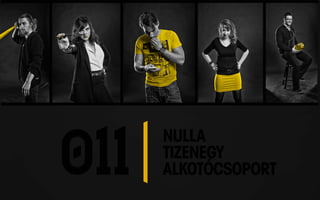
011 PRODUCTION GROUP 
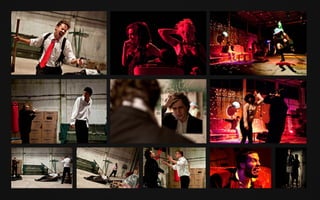
The 011 Alkotócsoport (011 Production Group) was formed in 2011 with the aim of 
assembling young theatre and film artists to create their own productions beside their 
other main activities. They presented the theatre adaptation of Quentin Tarantino’s 
“Reservoir Dogs” in 2011, which was co-written with the actors. After the successful 
performance at the Summer Festival of Zsámbék, they received an invitation to the 
Bárka Theatre of Budapest, where the production was staged. 
The creators financed their productions from their own resources due to lack funds. 
The set was built from discarded furniture picked up from the streets. In the two years 
spanning the foundation, experienced artists joined the team (Ildikó Ságodi, Péter Tóth, 
Zsolt Anger) who helped the production with their own knowledge even without a salary, 
because although the team didn’t have any funds, the realization and the preparations 
required professional work. 
In the summer of 2012, the Summer Festival of Balatonföldvár and the Summer Festival 
of Szentendre invited the group to create a production from the classical cabaret scenes 
of Károly Nóti. The team wrote and put their production entitled “Lepsénynél még 
megvolt!” on stage within three weeks. In November 2012, they started the rehearsals 
for the Oz-adaptation about drug addicted youths, entitled “Meanwhile in Kansas,” the 
genre of which is described by the group as progressive – fiction – documentary – trash 
pathography. The rehearsal process was preceded by six months of research, during 
which time the creators studied several research articles, biographies, films, novels and 
other literary sources. They invited Zsolt Bordos to enhance the visual experience and 
they were experimented with a revolutionary architectural projection and thus together 
they produced the first prosaic play of Hungary with 3D projection mapping.
MEANWHILE IN KANSAS 
“Leaving the theatre after the performance, I was surprised by the sight of the snow. During 
the time spent inside, I forgot that it’s winter and snow outside. This is not light evening 
entertainment; on the contrary, it is a particularly thought-provoking performance, witty, 
spectacular and bitter at the same time. It’s a must see.”
HISTORY 
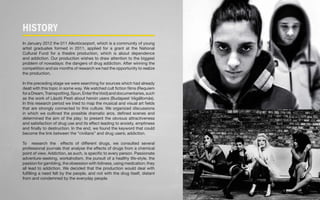
In January 2012 the 011 Alkotócsoport, which is a community of young 
artist graduates formed in 2011, applied for a grant at the National 
Cultural Fund for a theatre production, which is about dependence 
and addiction. Our production wishes to draw attention to the biggest 
problem of nowadays: the dangers of drug addiction. After winning the 
competition and six months of research we had the opportunity to realize 
the production. 
In the preceding stage we were searching for sources which had already 
dealt with this topic in some way. We watched cult fiction films (Requiem 
for a Dream, Trainspotting, Spun, Enter the Void) and documentaries, such 
as the work of László Pesti about heroin users (Budapest Végállomás). 
In this research period we tried to map the musical and visual art fields 
that are strongly connected to this culture. We organized discussions 
in which we outlined the possible dramatic arcs, defined scenes and 
determined the aim of the play: to present the obvious attractiveness 
and satisfaction of drug use and its effect leading to anxiety, emptiness 
and finally to destruction. In the end, we found the keyword that could 
become the link between the “civilians” and drug users; addiction. 
To research the effects of different drugs, we consulted several 
professional journals that analyse the effects of drugs from a chemical 
point of view. Addiction, as such, is specific to every person. Passionate 
adventure-seeking, workaholism, the pursuit of a healthy life-style, the 
passion for gambling, the obsession with tidiness, using medication; they 
all lead to addiction. We decided that the production would deal with 
fulfilling a need felt by the people, and not with the drug itself, distant 
from and condemned by the everyday people.
OBJECTIVES WORKING METHOD 
General beliefs are wide-spread about drugs. It is something is everyone 
is afraid of. All parents are afraid for their children. Drugs mean ending 
up on the streets, disease, distortion. Drug is death. This is not true. In 
our current society, one in five young people have already tried some 
kind of drug. Like alcohol, medication, sex, smoking, coffee, gambling. 
Passions don’t have destructive effects on their own, but as the result of 
dependence. Because it is good. And we want to repeat the experience 
again and again. Today’s young generation is maybe more aggressive, 
more impatient than the previous one. They’re searching for their place. 
Many of those youngsters unable to properly handle the upset order 
in society and in their family and to utilise their energy well find that 
something that lifts them out of the perceived upset world in drugs. What 
is this need that they want to fulfil like this? Does the act of fulfilment really 
happen? And what is this force that also makes one forget the long-term 
consequences? For us, this question is important not only in relation with 
our own surroundings. We cannot forget those articles in the daily news 
that report the down-fall of university and high school students. 
In the production we try to move the audience to a non-existent world. 
To the world of fantasy, dream, hallucination from which the protagonists 
come back every now and then to the reality undesirable for them. The 
goal of the play is to demonstrate the phenomenon. Not with the use 
of the classic drug- prevention methods, but with strong visual theatre 
devices. The topic requires the predominance of the figurative, associative, 
cinematic mechanisms of action instead of the linear-dramaturgy. 
For the processing of the topic, several books, fictional films and 
documentaries, educational films, music, audio materials, interviews, 
newspaper articles, blogs and biographical accounts served as a basis 
because it would be irresponsible to deal with such a serious topic without 
studying all these materials. We analysed a lot of films and books with the 
stage designer and the dramaturg separately, but the real work started 
when we moved in together for three days. In order to be able to find 
our way in this vision-world, we had to find the common denominator. 
While the stage designer created the pictures and graphics, we edited 
the text and searched inspirational films and photos. We tried to clear 
the stereotypes from all of our minds and start to write, edit and organize 
the dramatic material.
SET DESIGN AND SPACE 
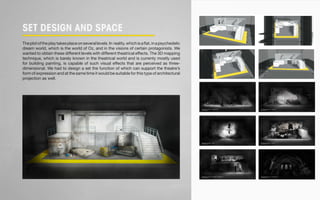
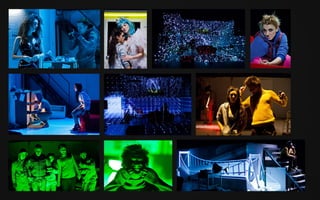
The plot of the play takes place on several levels. In reality, which is a flat, in a psychedelic 
dream world, which is the world of Oz, and in the visions of certain protagonists. We 
wanted to obtain these different levels with different theatrical effects. The 3D mapping 
technique, which is barely known in the theatrical world and is currenty mostly used 
for building painting, is capable of such visual effects that are perceived as three-dimensional. 
We had to design a set the function of which can support the theatre’s 
form of expression and at the same time it would be suitable for this type of architectural 
projection as well.
3D MAPPING 
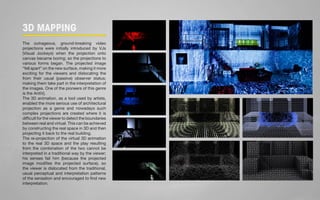
The outrageous, ground-breaking video 
projections were initially introduced by VJs 
(Visual Jockeys) when the projection onto 
canvas became boring; so the projections to 
various forms began. The projected image 
“fell apart” on the new surface, making it more 
exciting for the viewers and dislocating the 
from their usual (passive) observer status; 
making them take part in the interpretation of 
the images. One of the pioneers of this genre 
is the AntiVj. 
The 3D animation, as a tool used by artists, 
enabled the more serious use of architectural 
projection as a genre and nowadays such 
complex projections are created where it is 
difficult for the viewer to detect the boundaries 
between real and virtual. This can be achieved 
by constructing the real space in 3D and then 
projecting it back to the real building. 
The re-projection of the virtual 3D animation 
to the real 3D space and the play resulting 
from the combination of the two cannot be 
interpreted in a traditional way by the viewer; 
his senses fail him (because the projected 
image modifies the projected surface), so 
the viewer is dislocated from the traditional, 
usual perceptual and interpretation patterns 
of the sensation and encouraged to find new 
interpretation.
PLOT 
We used two important materials for the development of the dramaturgy and the 
context of the production. One of them is L. Frank Baum’s novel, The Wonderful 
Wizard of Oz, the other is Viktor Kubiszyn’s Drognapló (‘Drug Diary’), the author’s 
personal narrative about 16 years of drug use. The story of the tale seemed to be 
suitable to represent how the girl who wishes to get away from the black and white 
world gets to the emerald city and how she tries to find her way back. That is, what 
was really happening in reality while Dorothy imagined she was staying in the realm 
of Oz. Several symbols and characters of the tale were perfectly suitable for narrating 
this topic. The protagonists joining the girl in her journey are all characters waiting 
for some kind of solution who suffer from their own needs. 
Everybody knows the story of The Wonderful Wizard of Oz. A tornado separates 
Dorothy from her home and family and she find herself in an unknown world. She 
has to get to Oz in order to go back home. During her journey, she finds friends who 
too are waiting for help from Oz to fix their lives. Oz is willing to help only if they kill 
the Wicked Witch of the West. Once they finally manage to accomplish the task, 
Oz’s secret is out. He doesn’t have any power, he cannot really help them. There 
is no way out for Dorothy. At least, it seems so, until it turns out that the solution 
was there on her feet all along, in her shoes which – if she had known their secret – 
would’ve flown her home to Kansas at the beginning already. 
It is difficult to get out of the world accessible with drugs. Moreover, the black 
and white reality of Kansas or Budapest cannot be compared to the miracles of 
the other world. The plot runs parallel between these two worlds, both separately 
and simultaneously. We see a Budapest apartment the whole time, while countless 
scenes, dangers, timelines, decisions and drug-effects mix in front of our eyes. 
CAST AND CREW 
Dorothy - Alexa Bakonyi 
Good Witch of the North - Alexandra Borbély 
Wicked Witch of the West - Hanna Pálos 
Scarecrow - Bence Tasnádi 
Toto - Ádám Kovács 
Tin Woodman - Viktor Klem 
Oz - Vince Zrinyi Gál 
Cowardly Lion - Dániel Király 
Guardian of the Gates - Balázs Kulcsár 
3D mapping: Zsolt Bordos 
Set design: Renátó Cseh 
Costume design: Juli Szlávik 
Dresser: Vivien Cseh 
Lighting: Miklós Mervel 
Music and sound: Zoltán Belényesi 
Dramaturg: Ambrus Ivanyos 
Assistant: Nóra Zágoni 
Production Assistant: Júlia Kruzslicz 
Contributor: Zsolt Anger 
Director: Márk Radnai
THE PILLOWMAN 
“Director Márk Radnai has staged something that is rarely seen in Hungarian theatres. Martin 
McDonagh’s Pillowman namely mixes the genres of a thriller, a horror or a revenge play, a 
whodunit, a black comedy and a political play.”
Martin Mcdonagh - The Pillowman 
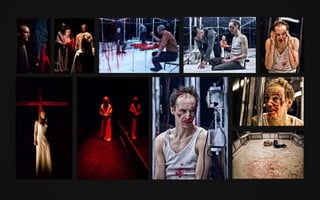
Three kids went missing, two of them were found dead. The murders show some strange 
connections with different short stories by a local writer, Katurian. Two investigators try to 
get a confession from the suspect, but Katurian cannot tell them anything. He knows that 
he’s innocent even when all the evidence indicates otherwise. His brother on the other 
hand, who’s mentally ill, is becoming more and more suspicious even for him. 
The play is based on three scenes, two interrogations and a long discussion between the 
two brothers in a prison cell. The audience also hears different short stories from the writer 
Katurian, which help understand the brutal life and the particular relations between the 
two brothers. 
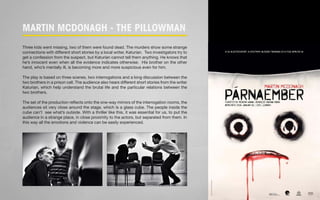
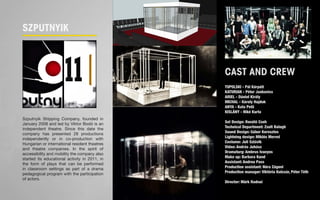
The set of the production reflects onto the one-way mirrors of the interrogation rooms, the 
audiences sit very close around the stage, which is a glass cube. The people inside the 
cube can’t see what’s outside. With a thriller like this, it was essential for us, to put the 
audience in a strange place, in close proximity to the actors, but separated from them. In 
this way all the emotions and violence can be easily experienced.
szputnyik 
Szputnyik Shipping Company, founded in 
January 2008 and led by Viktor Bodó is an 
independent theatre. Since this date the 
company has presented 28 productions 
independently or in co-production with 
Hungarian or international resident theatres 
and theatre companies. In the spirit of 
accessibility and mobility the company also 
started its educational activity in 2011, in 
the form of plays that can be performed 
in classroom settings as part of a drama 
pedagogical program with the participation 
of actors. 
CAST AND CREW 
TUPOLSKI - Pál Kárpáti 
KATURIAN - Péter Jankovics 
ARIEL - Dániel Király 
MICHAL - Károly Hajduk 
ANYA - Kata Pető 
KISLÁNY - Niké Kurta 
Set Design: Renátó Cseh 
Technical Department: Zsolt Balogh 
Sound Design: Gábor Keresztes 
Lightning design: Miklós Mervel 
Costume: Juli Szlávik 
Video: András Juhász 
Dramaturg: Ambrus Ivanyos 
Make up: Barbara Kund 
Assistant: Andrea Pass 
Production assistant: Nóra Zágoni 
Production manager: Viktória Kulcsár, Péter Tóth 
Director: Márk Radnai
RESERVOIR DOGS 
“When representing physical violence on stage, one can operate with only a smaller number 
of visual props or the end result will become overdone and thus ridiculous, if one finds the 
right theatrical language, because of the actors’ personal presence on stage, the impact can 
be greater than in a film where spectators and the act of violence are cut off by the screen.”
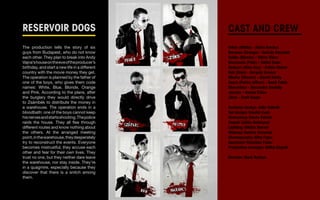
RESERVOIR DOGS 
The production tells the story of six 
guys from Budapest, who do not know 
each other. They plan to break into Andy 
Vajna’s house on the eve of the producer’s 
birthday, and start a new life in a different 
country with the movie money they get. 
The operation is planned by the father of 
one of the boys, who gives them code 
names: White, Blue, Blonde, Orange 
and Pink. According to the plans, after 
the burglary they would directly drive 
to Zsámbék to distribute the money in 
a warehouse. The operation ends in a 
bloodbath: one of the boys cannot keep 
his nerves and starts shooting. The police 
raids the house. They all flee through 
different routes and know nothing about 
the others. At the arranged meeting 
point, in the warehouse, they desperately 
try to reconstruct the events. Everyone 
becomes mistrustful, they accuse each 
other and fear for their own lives. They 
trust no one, but they neither dare leave 
the warehouse, nor stay inside. They’re 
in a quagmire, especially because they 
discover that there is a snitch among 
them. 
CAST AND CREW 
Fehér (White) - Ádám Kovács 
Narancs (Orange) - András Rusznák 
Szőke (Blonde) - Viktor Klem 
Rózsaszín (Pink) - Bálint Rada 
Széparc (Nice Guy) - Zoltán Simon 
Kék (Blue) - Gergely Kovács 
Mester (Master) - Dániel Király 
Zsaru (Police officer) - Benő Fehér 
Mercédesz - Alexandra Borbély 
Jessica - Hanna Pálos 
Józsi - Zsolt Anger 
Costume design: Júlia Szlávik 
Set design: Renátó Cseh 
Dramaturg: Tamás Fekete 
Sound: Zoltán Belényesi 
Lighting: Miklós Mervel 
Makeup: Beatrix Krasznai 
Choreography: Kitty Fejes 
Assistant: Krisztina Fodor 
Production manager: Ildikó Ságodi 
Director: Márk Radnai
DROSZT 
“Droszt, shows the adventure-packed nightlife of Budapest taxi-drivers in a way that the spectators 
sitting in Atrium Theatre (which was once a cinema) cannot decide if what they are watching is a 
theatre performance or a movie. Nonetheless, they are laughing all the way through it.”
DROSZT 
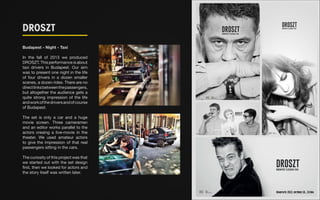
Budapest - Night - Taxi 
In the fall of 2013 we produced 
DROSZT. This performance is about 
taxi drivers in Budapest. Our aim 
was to present one night in the life 
of four drivers in a dozen smaller 
scenes, a dozen rides. There are no 
direct links between the passengers, 
but altogether the audience gets a 
quite strong impression of the life 
and work of the drivers and of course 
of Budapest. 
The set is only a car and a huge 
movie screen. Three cameramen 
and an editor works parallel to the 
actors creaing a live-movie in the 
theater. We used amateur actors 
to give the impression of that real 
passengers sitting in the cars. 
The curiosity of this project was that 
we started out with the set design 
first, then we looked for actors and 
the story itself was written later. 
Bemutató: 2013. október 10., 19 óra 
DROSZT_210x100.indd 1 10/3/13 4:15 PM
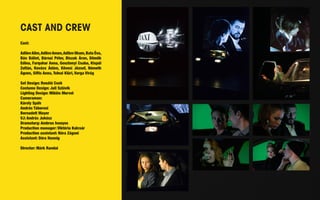
CAST AND CREW 
Cast: 
Adilov Alim, Adilov Amon, Adilov Ilham, Bata Éva, 
Bán Bálint, Bárnai Péter, Biszak Áron, Dömök 
Edina, Farquhar Anna, Gosztonyi Csaba, Kispál 
Zoltán, Kovács Ádám, Kövesi József, Németh 
Ágnes, Siflis Anna, Tolnai Klári, Varga Virág 
Set Design: Renátó Cseh 
Costume Design: Juli Szlávik 
Lighting Design: Miklós Mervel 
Cameraman: 
Károly Spáh 
András Táborosi 
Bernadett Mayer 
VJ: András Juhász 
Dramaturg: Ambrus Ivanyos 
Production manager: Viktória Kulcsár 
Production assistant: Nóra Zágoni 
Assistant: Dóra Hannig 
Director: Márk Randai
Flatletpanic 
“The play Flatletpanic could be a candid camera prank, but we would be fooling ourselves if 
we still laughed at the end. Instead the production is a memorable mixture of a tragicomedy, 
– with a wry sense of humor but also hilariously funny – a psychological drama that equals 
a couples therapy session and a mystical, engaging science fiction.”
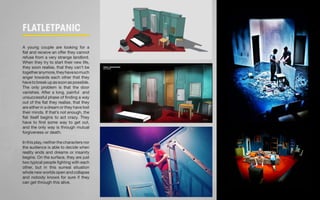
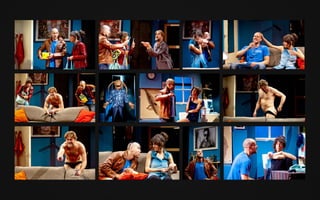
FLatletpanic 
A young couple are looking for a 
flat and receive an offer they cannot 
refuse from a very strange landlord. 
When they try to start their new life, 
they soon realise, that they can’t be 
together anymore, they have so much 
anger towards each other that they 
have to break up as soon as possible. 
The only problem is that the door 
vanishes. After a long, painful and 
unsuccessful phase of finding a way 
out of the flat they realise, that they 
are either in a dream or they have lost 
their minds. If that’s not enough, the 
flat itself begins to act crazy. They 
have to find some way to get out, 
and the only way is through mutual 
forgiveness or death. 
In this play, neither the characters nor 
the audience is able to decide when 
reality ends and dreams or insanity 
begins. On the surface, they are just 
two typical people fighting with each 
other, but in this surreal situation 
whole new worlds open and collapse 
and nobody knows for sure if they 
can get through this alive.
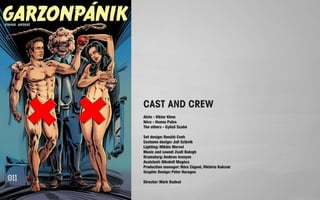
CAST AND CREW 
Alvin - Viktor Klem 
Nóra - Hanna Palos 
The others - Győző Szabó 
Set design: Renátó Cseh 
Costume design: Juli Szlávik 
Lighting: Miklós Mervel 
Music and sound: Zsolt Balogh 
Dramaturg: Ambrus Ivanyos 
Assistant: Nikolett Magócs 
Production manager: Nóra Zágoni, Viktória Kulcsár 
Graphic Design: Péter Haragos 
Director: Márk Radnai
reality room 
“I’d never have thought, that a neverending corridor will really thrill me once in a performance “
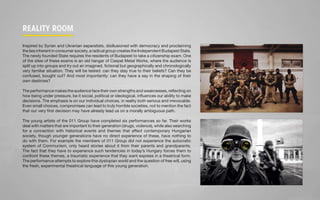
REALITY ROOM 
Inspired by Syrian and Ukranian separatists, disillusioned with democracy and proclaiming 
the lies inherent in consumer society, a radical group creates the Independent Budapest State. 
The newly founded State requires the residents of Budapest to take a citizenship exam. One 
of the sites of these exams is an old hangar of Csepel Metal Works, where the audience is 
split up into groups and try out an imagined, fictional but geographically and chronologically 
very familiar situation. They will be tested: can they stay true to their beliefs? Can they be 
confused, bought out? And most importantly: can they have a say in the shaping of their 
own destinies? 
The performance makes the audience face their own strengths and weaknesses, reflecting on 
how being under pressure, be it social, political or ideological, influences our ability to make 
decisions. The emphasis is on our individual choices, in reality both serious and irrevocable. 
Even small choices, compromises can lead to truly horrible societies, not to mention the fact 
that our very first decision may have already lead us on a morally ambiguous path. 
The young artists of the 011 Group have completed six performances so far. Their works 
deal with matters that are important to their generation (drugs, violence), while also searching 
for a connection with historical events and themes that affect contemporary Hungarian 
society, though younger generations have no direct experience of these, have nothing to 
do with them. For example the members of 011 Group did not experience the autocratic 
system of Communism, only heard stories about it from their parents and grandparents. 
The fact that they have to experience such tendencies in today’s Hungary forces them to 
confront these themes, a traumatic experience that they want express in a theatrical form. 
The performance attempts to explore this dystopian world and the question of free will, using 
the fresh, experimental theatrical language of this young generation.
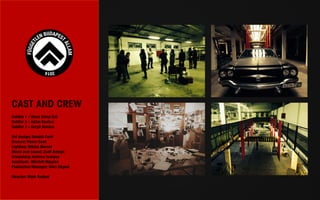
CAST AND CREW 
Soldier 1 - Vince Zrinyi Gál 
Soldier 2 - Ádám Kovács 
Soldier 3 - Gergő Kovács 
Set design: Renátó Cseh 
Dresser: Vivien Cseh 
Lighting: Miklós Mervel 
Music and sound: Zsolt Balogh 
Dramaturg: Ambrus Ivanyos 
Assistant: Nikolett Magócs 
Production Manager: Nóra Zágoni 
Director: Márk Radnai
REVIEWS 
“Tremendously spectacular projection with 
exceptionally strong atmosphere, roaring techno and 
thorough lighting glazing accompanies the loosely 
entwined scenes: the twisted Oz-story about the 
heroin-user Dorothy and her addict friends joining 
her along the way, who seek a solution from the 
wizard for quitting drugs; and the monologues about 
the amazing now and terrible tomorrow of drugs, 
based on the Drognapló of Viktor Kubiszyn; and the 
other surreal, vision-like fractions – always with great 
humour and speaking very honestly about drugs.” 
http://egyfelvonas.postr.hu/azert-van-annyi-drogos- 
mert-hazudtok - Kovács Bálint 
“This drama brutally switches our emotions from one 
extreme to the other; from laughter to shock, from 
amazement to confusion. This is why it is only on your 
way home from the theatre, after coming to terms 
with the exposure to a fast-paced string of stimuli, 
that the reaL thoughts start to choke you.” 
http://kulton.hu/szinhaz/011-alkotocsoport-meanwhile- 
in-kansas-kritika 
“The way the daredevils of the 011 Alkotócsoport 
(011 Creative Group) reinterpreted the story of Oz, 
brings a sea of change into the reigning Hungarian 
theatrical life and furthermore it may help to bridge the 
generation gaps in the representation of the theatre’s 
form of expression.” 
My thoughts are that it was high time to put this whole 
Kansas/Oz-story in a new dimension. And it needed 
to be done with such a bold and passionate zeal 
as the members of the 011 Alkotócsoport do at the 
Bárka theatre, in the surreal trash-vision of Meanwhile 
in Kansas. 
I would like if this so called “mapping theatre” combined 
with the giant projector could become a (sub)genre 
of its own because mixing photography, film and 
stage in such a way creates an amazing perspective 
experience by making an intense impression on 
multiple senses at the same time. I wish more theatres 
hosted the 011, or even better, I wish they had their 
own theatre building with their own repertoire and 
more and more premieres.” 
http://www.journality.hu/Meanwhile-in-Kansas-avagy- 
pszichedelikus- melyrepules-Dorka-tudatalattijaba/ 
130/14266/0 
“Progressive, because they use a 3D-effect theatre 
technique which has a powerful impact itself on the 
adrenalin level of the audience. Fiction, because the 
story is based on the children’s novel by L. Frank 
Baum and as such, the best Hungarian Oz-adaptation 
so far. Documentary and pathography, because it 
deals with drug addiction by using Drognapló (‘Drug 
Diary’) by Viktor Kubiszyn in which the author wrote 
about his own experiences of the beautiful and hellish 
empire of the wizard. All this was put on stage with 
intense dramaturgy; alternating narration built on 
internal monologues; captivating acting of precisely 
directed actors by Márk Radnai, who being attracted 
to cinematic solutions created an inner movie.” 
Magyar Narancs 2012/01/17 – Sisso
REVIEWS 
“This 1.5 hour performance does not pass judgement 
on drug users, but seeks to answer the whys instead 
and encourages the audience to not just superficially 
but thoroughly reflect upon what they saw because 
drugs do not choose; they take their toll from every 
social stratum – rich or poor.” 
http://petovariagnesszinikritika.wordpress. 
com/2013/01/17/meanwhile-in- kansas/ 
“Meanwhile in Kansas can be criticized from many 
points of view, but certainly not from one: it is about the 
most invisible phenomenon of the Hungarian reality, 
about today’s (and especially tomorrow’s) drugs and 
users.” 
http://7ora7.hu/programok/meanwhile-in-kansas/ 
nezopont 
“Each and every phase of the story is subordinated to 
the dependence; there is not one gesture, not a single 
moment which suggests that there is a way out. There 
is nobody, no love, no friendship, only comradery 
solidarity and relationships built on interests which 
are formed because of using.” 
http://revizoronline.com/hu/cikk/4360/meanwhile-in- 
kansas-011-es- alkotocsoportbarka-szinhaz/ 
“The world of wizard of Oz was never exactly close 
to me. Márk Radnai and the production directed by 
him and, of course, the techniques used, however, 
offered an interpretation of the story through which 
an understanding still unknown was added to the 
stumbling along of Dorothy and her friends.” 
http://www.szinhazkolonia.hu/kritika/Ozhoz-vezeto-utak 
“This time Adam and Eve are called Alvin and Nora, 
they are not the first, but the last couple on earth, 
who were not expelled from Paradise but locked up 
in a bedsit. Their sin is that they cannot love each 
other honestly. There is no god in this story, only 
an extraterrestrial, who plays god, but appears in 
a human form. He has certain conditions, of which 
Nora an Alvin are unaware, so they have to find out 
the rules of the game themselves. Their story can be 
read as a Biblical paraphrase, since they can eat as 
many tomatoes as they want – a vegetable which in 
Hungarian has the same name as Paradise. They, 
however, never touch the forbidden fruit, although the 
door of their fridge is laden with apples. The owner 
of the skimpy flat persuades them to take the lease, 
saying that would not need space to build an arc 
anyway. The verdict is strict and unequivocal: if we 
take the extraterrestrial for god, he is one who does 
not worry about our fate, if there is an arc being built, 
we do not build it ourselves, since we are only one of 
the species waiting to be saved.” 
“It is not the first time that director Márk Radnai and 
his ensemble of young artists, the 011 Alkotócsoport, 
makes their audience wonder. Their earlier production, 
Meanhile in Kansas, is a remake of Oz, the Great 
and Powerful that depicts the story as a drug-infused 
vision dreamt by Dorothy. Márk Radnai’s 
other direction, Droszt, shows the adventure-packed 
nightlife of Budapest taxi-drivers in a way that the 
spectators sitting in Atrium Theatre (which was once 
a cinema) cannot decide if what they are watching is 
a theatre performance or a movie. Nonetheless, they 
are laughing all the way through it.”
MOVIE SPOT FOR THEATRE WORKS: 
PILLOWMAN 1: 
https://www.youtube.com/watch?v=zfg53aCjc9Y&list=UUMQQEuCK2keikUpfGmWWzEA&index=7 
PILLOWMAN 2: 
https://www.youtube.com/watch?v=0vrpAYmi-LE&list=UUMQQEuCK2keikUpfGmWWzEA&index=6 
MEANWHILE IN KANSAS: 
https://www.youtube.com/watch?v=4iHwIjyj3BU&index=37&list=UUMQQEuCK2keikUpfGmWWzEA 
DROSZT: 
https://www.youtube.com/watch?v=8MVdckqHpe4&list=UUMQQEuCK2keikUpfGmWWzEA&index=15 
011 FESTIVAL: 
http://vimeo.com/93091571 
THEATER WORKS TRAILER: 
MEANWHILE IN KANSAS: 
https://www.youtube.com/watch?v=JsD0k8yE0Ws&list=UUMQQEuCK2keikUpfGmWWzEA&index=33 
MEANWHILE IN KANSAS 2: 
https://www.youtube.com/watch?v=Q5vu2fDlNP4 
FIRST 3D MAPPING TEST IN THEATRE PRODUCTION (HUNGARY) 
https://www.youtube.com/watch?v=o8D4ANYpGfI&list=UUMQQEuCK2keikUpfGmWWzEA&index=35 
RESERVOIR DOGS: 
https://www.youtube.com/watch?v=1Q1VYq-v8ro 
MIZANTROPE: 
https://www.youtube.com/watch?v=HaRDVndT7hA&index=31&list=UUMQQEuCK2keikUpfGmWWzEA
CONTACT 
011csoport@gmail.com 
Viktoria Kulcsar ( production manager ) 
viktoria.kulcsar@gmail.com 
+36203361134 
Csaba Gosztonyi ( communication manager ) 
csaba.gosztonyi@carbongroup.hu 
+36209380673

011 Production Group - BOOKLET - 2014

  • 1.
  • 2.
    “Every theatre productionhas to create a unique world, system in which the spectator can recognize the events important for him through a series of partial truths; he can put the pieces together like in a puzzle. A good theatre is like the rabbit’s hole for us, where space and time changes every minute, where the actor turns into something different, he is a machine, a plant, an animal and human, statue and animation. Where the memories of our subconscious are connected to the main storyline with a thousand threads, where the numerous manifestations of the world around us can be animated within moments. Where in a concentrated moment I can feel the pouring rain, last year’s love, the fantasy comics or my latest family meal. Where the scenes don’t follow each other in a linear way, but every small unit can stand on its own as an individual vision, social message or even just an impression, but if I want, I can add to the plot by simply creating a story and going on writing my own story. The question ‘what is this scene or sentence doing here?’ cannot come up in theatre. It has to create a system in which these specks of dust roll by themselves and I can either identify myself with them or they disturb me. If the theatre doesn’t carry this kind of freedom, this kind of interpretation network, then it becomes predictable and transparent. Just another tally in the file where they tried to force a message on me instead of letting me arrive to an interpretation in my own rhythm.” Márk Radnai (director)
  • 4.
    “In the theatresystem – reading of a play, rehearsal, taking the scenes, etc. - there are no such things. We can do like for example what we did yesterday, before moving to Zsámbék, that we put a 20- page scene and put it in a car. We try how it works there. This style of work is much freer and allows this play.” Ádám Kovács – actor “After a performance like this, posterity can somewhat understand why the cabaret of Pest was so popular.” Bálint Kovács – Magyar Narancs “This drama brutally switches our emotions from one extreme to the other; from laughter to shock, from amazement to confusion. This is why it is only on your way home from the theatre, after coming to terms with the exposure to a fast-paced string of stimuli, that the reaL thoughts start to choke you.” Csaba Méhes – kulton.hu 011 PRODUCTION GROUP The 011 Alkotócsoport (011 Production Group) was formed in 2011 with the aim of assembling young theatre and film artists to create their own productions beside their other main activities. They presented the theatre adaptation of Quentin Tarantino’s “Reservoir Dogs” in 2011, which was co-written with the actors. After the successful performance at the Summer Festival of Zsámbék, they received an invitation to the Bárka Theatre of Budapest, where the production was staged. The creators financed their productions from their own resources due to lack funds. The set was built from discarded furniture picked up from the streets. In the two years spanning the foundation, experienced artists joined the team (Ildikó Ságodi, Péter Tóth, Zsolt Anger) who helped the production with their own knowledge even without a salary, because although the team didn’t have any funds, the realization and the preparations required professional work. In the summer of 2012, the Summer Festival of Balatonföldvár and the Summer Festival of Szentendre invited the group to create a production from the classical cabaret scenes of Károly Nóti. The team wrote and put their production entitled “Lepsénynél még megvolt!” on stage within three weeks. In November 2012, they started the rehearsals for the Oz-adaptation about drug addicted youths, entitled “Meanwhile in Kansas,” the genre of which is described by the group as progressive – fiction – documentary – trash pathography. The rehearsal process was preceded by six months of research, during which time the creators studied several research articles, biographies, films, novels and other literary sources. They invited Zsolt Bordos to enhance the visual experience and they were experimented with a revolutionary architectural projection and thus together they produced the first prosaic play of Hungary with 3D projection mapping.
  • 5.
    MEANWHILE IN KANSAS “Leaving the theatre after the performance, I was surprised by the sight of the snow. During the time spent inside, I forgot that it’s winter and snow outside. This is not light evening entertainment; on the contrary, it is a particularly thought-provoking performance, witty, spectacular and bitter at the same time. It’s a must see.”
  • 6.
    HISTORY In January2012 the 011 Alkotócsoport, which is a community of young artist graduates formed in 2011, applied for a grant at the National Cultural Fund for a theatre production, which is about dependence and addiction. Our production wishes to draw attention to the biggest problem of nowadays: the dangers of drug addiction. After winning the competition and six months of research we had the opportunity to realize the production. In the preceding stage we were searching for sources which had already dealt with this topic in some way. We watched cult fiction films (Requiem for a Dream, Trainspotting, Spun, Enter the Void) and documentaries, such as the work of László Pesti about heroin users (Budapest Végállomás). In this research period we tried to map the musical and visual art fields that are strongly connected to this culture. We organized discussions in which we outlined the possible dramatic arcs, defined scenes and determined the aim of the play: to present the obvious attractiveness and satisfaction of drug use and its effect leading to anxiety, emptiness and finally to destruction. In the end, we found the keyword that could become the link between the “civilians” and drug users; addiction. To research the effects of different drugs, we consulted several professional journals that analyse the effects of drugs from a chemical point of view. Addiction, as such, is specific to every person. Passionate adventure-seeking, workaholism, the pursuit of a healthy life-style, the passion for gambling, the obsession with tidiness, using medication; they all lead to addiction. We decided that the production would deal with fulfilling a need felt by the people, and not with the drug itself, distant from and condemned by the everyday people.
  • 7.
    OBJECTIVES WORKING METHOD General beliefs are wide-spread about drugs. It is something is everyone is afraid of. All parents are afraid for their children. Drugs mean ending up on the streets, disease, distortion. Drug is death. This is not true. In our current society, one in five young people have already tried some kind of drug. Like alcohol, medication, sex, smoking, coffee, gambling. Passions don’t have destructive effects on their own, but as the result of dependence. Because it is good. And we want to repeat the experience again and again. Today’s young generation is maybe more aggressive, more impatient than the previous one. They’re searching for their place. Many of those youngsters unable to properly handle the upset order in society and in their family and to utilise their energy well find that something that lifts them out of the perceived upset world in drugs. What is this need that they want to fulfil like this? Does the act of fulfilment really happen? And what is this force that also makes one forget the long-term consequences? For us, this question is important not only in relation with our own surroundings. We cannot forget those articles in the daily news that report the down-fall of university and high school students. In the production we try to move the audience to a non-existent world. To the world of fantasy, dream, hallucination from which the protagonists come back every now and then to the reality undesirable for them. The goal of the play is to demonstrate the phenomenon. Not with the use of the classic drug- prevention methods, but with strong visual theatre devices. The topic requires the predominance of the figurative, associative, cinematic mechanisms of action instead of the linear-dramaturgy. For the processing of the topic, several books, fictional films and documentaries, educational films, music, audio materials, interviews, newspaper articles, blogs and biographical accounts served as a basis because it would be irresponsible to deal with such a serious topic without studying all these materials. We analysed a lot of films and books with the stage designer and the dramaturg separately, but the real work started when we moved in together for three days. In order to be able to find our way in this vision-world, we had to find the common denominator. While the stage designer created the pictures and graphics, we edited the text and searched inspirational films and photos. We tried to clear the stereotypes from all of our minds and start to write, edit and organize the dramatic material.
  • 8.
    SET DESIGN ANDSPACE The plot of the play takes place on several levels. In reality, which is a flat, in a psychedelic dream world, which is the world of Oz, and in the visions of certain protagonists. We wanted to obtain these different levels with different theatrical effects. The 3D mapping technique, which is barely known in the theatrical world and is currenty mostly used for building painting, is capable of such visual effects that are perceived as three-dimensional. We had to design a set the function of which can support the theatre’s form of expression and at the same time it would be suitable for this type of architectural projection as well.
  • 9.
    3D MAPPING Theoutrageous, ground-breaking video projections were initially introduced by VJs (Visual Jockeys) when the projection onto canvas became boring; so the projections to various forms began. The projected image “fell apart” on the new surface, making it more exciting for the viewers and dislocating the from their usual (passive) observer status; making them take part in the interpretation of the images. One of the pioneers of this genre is the AntiVj. The 3D animation, as a tool used by artists, enabled the more serious use of architectural projection as a genre and nowadays such complex projections are created where it is difficult for the viewer to detect the boundaries between real and virtual. This can be achieved by constructing the real space in 3D and then projecting it back to the real building. The re-projection of the virtual 3D animation to the real 3D space and the play resulting from the combination of the two cannot be interpreted in a traditional way by the viewer; his senses fail him (because the projected image modifies the projected surface), so the viewer is dislocated from the traditional, usual perceptual and interpretation patterns of the sensation and encouraged to find new interpretation.
  • 10.
    PLOT We usedtwo important materials for the development of the dramaturgy and the context of the production. One of them is L. Frank Baum’s novel, The Wonderful Wizard of Oz, the other is Viktor Kubiszyn’s Drognapló (‘Drug Diary’), the author’s personal narrative about 16 years of drug use. The story of the tale seemed to be suitable to represent how the girl who wishes to get away from the black and white world gets to the emerald city and how she tries to find her way back. That is, what was really happening in reality while Dorothy imagined she was staying in the realm of Oz. Several symbols and characters of the tale were perfectly suitable for narrating this topic. The protagonists joining the girl in her journey are all characters waiting for some kind of solution who suffer from their own needs. Everybody knows the story of The Wonderful Wizard of Oz. A tornado separates Dorothy from her home and family and she find herself in an unknown world. She has to get to Oz in order to go back home. During her journey, she finds friends who too are waiting for help from Oz to fix their lives. Oz is willing to help only if they kill the Wicked Witch of the West. Once they finally manage to accomplish the task, Oz’s secret is out. He doesn’t have any power, he cannot really help them. There is no way out for Dorothy. At least, it seems so, until it turns out that the solution was there on her feet all along, in her shoes which – if she had known their secret – would’ve flown her home to Kansas at the beginning already. It is difficult to get out of the world accessible with drugs. Moreover, the black and white reality of Kansas or Budapest cannot be compared to the miracles of the other world. The plot runs parallel between these two worlds, both separately and simultaneously. We see a Budapest apartment the whole time, while countless scenes, dangers, timelines, decisions and drug-effects mix in front of our eyes. CAST AND CREW Dorothy - Alexa Bakonyi Good Witch of the North - Alexandra Borbély Wicked Witch of the West - Hanna Pálos Scarecrow - Bence Tasnádi Toto - Ádám Kovács Tin Woodman - Viktor Klem Oz - Vince Zrinyi Gál Cowardly Lion - Dániel Király Guardian of the Gates - Balázs Kulcsár 3D mapping: Zsolt Bordos Set design: Renátó Cseh Costume design: Juli Szlávik Dresser: Vivien Cseh Lighting: Miklós Mervel Music and sound: Zoltán Belényesi Dramaturg: Ambrus Ivanyos Assistant: Nóra Zágoni Production Assistant: Júlia Kruzslicz Contributor: Zsolt Anger Director: Márk Radnai
  • 12.
    THE PILLOWMAN “DirectorMárk Radnai has staged something that is rarely seen in Hungarian theatres. Martin McDonagh’s Pillowman namely mixes the genres of a thriller, a horror or a revenge play, a whodunit, a black comedy and a political play.”
  • 13.
    Martin Mcdonagh -The Pillowman Three kids went missing, two of them were found dead. The murders show some strange connections with different short stories by a local writer, Katurian. Two investigators try to get a confession from the suspect, but Katurian cannot tell them anything. He knows that he’s innocent even when all the evidence indicates otherwise. His brother on the other hand, who’s mentally ill, is becoming more and more suspicious even for him. The play is based on three scenes, two interrogations and a long discussion between the two brothers in a prison cell. The audience also hears different short stories from the writer Katurian, which help understand the brutal life and the particular relations between the two brothers. The set of the production reflects onto the one-way mirrors of the interrogation rooms, the audiences sit very close around the stage, which is a glass cube. The people inside the cube can’t see what’s outside. With a thriller like this, it was essential for us, to put the audience in a strange place, in close proximity to the actors, but separated from them. In this way all the emotions and violence can be easily experienced.
  • 14.
    szputnyik Szputnyik ShippingCompany, founded in January 2008 and led by Viktor Bodó is an independent theatre. Since this date the company has presented 28 productions independently or in co-production with Hungarian or international resident theatres and theatre companies. In the spirit of accessibility and mobility the company also started its educational activity in 2011, in the form of plays that can be performed in classroom settings as part of a drama pedagogical program with the participation of actors. CAST AND CREW TUPOLSKI - Pál Kárpáti KATURIAN - Péter Jankovics ARIEL - Dániel Király MICHAL - Károly Hajduk ANYA - Kata Pető KISLÁNY - Niké Kurta Set Design: Renátó Cseh Technical Department: Zsolt Balogh Sound Design: Gábor Keresztes Lightning design: Miklós Mervel Costume: Juli Szlávik Video: András Juhász Dramaturg: Ambrus Ivanyos Make up: Barbara Kund Assistant: Andrea Pass Production assistant: Nóra Zágoni Production manager: Viktória Kulcsár, Péter Tóth Director: Márk Radnai
  • 16.
    RESERVOIR DOGS “Whenrepresenting physical violence on stage, one can operate with only a smaller number of visual props or the end result will become overdone and thus ridiculous, if one finds the right theatrical language, because of the actors’ personal presence on stage, the impact can be greater than in a film where spectators and the act of violence are cut off by the screen.”
  • 17.
    RESERVOIR DOGS Theproduction tells the story of six guys from Budapest, who do not know each other. They plan to break into Andy Vajna’s house on the eve of the producer’s birthday, and start a new life in a different country with the movie money they get. The operation is planned by the father of one of the boys, who gives them code names: White, Blue, Blonde, Orange and Pink. According to the plans, after the burglary they would directly drive to Zsámbék to distribute the money in a warehouse. The operation ends in a bloodbath: one of the boys cannot keep his nerves and starts shooting. The police raids the house. They all flee through different routes and know nothing about the others. At the arranged meeting point, in the warehouse, they desperately try to reconstruct the events. Everyone becomes mistrustful, they accuse each other and fear for their own lives. They trust no one, but they neither dare leave the warehouse, nor stay inside. They’re in a quagmire, especially because they discover that there is a snitch among them. CAST AND CREW Fehér (White) - Ádám Kovács Narancs (Orange) - András Rusznák Szőke (Blonde) - Viktor Klem Rózsaszín (Pink) - Bálint Rada Széparc (Nice Guy) - Zoltán Simon Kék (Blue) - Gergely Kovács Mester (Master) - Dániel Király Zsaru (Police officer) - Benő Fehér Mercédesz - Alexandra Borbély Jessica - Hanna Pálos Józsi - Zsolt Anger Costume design: Júlia Szlávik Set design: Renátó Cseh Dramaturg: Tamás Fekete Sound: Zoltán Belényesi Lighting: Miklós Mervel Makeup: Beatrix Krasznai Choreography: Kitty Fejes Assistant: Krisztina Fodor Production manager: Ildikó Ságodi Director: Márk Radnai
  • 19.
    DROSZT “Droszt, showsthe adventure-packed nightlife of Budapest taxi-drivers in a way that the spectators sitting in Atrium Theatre (which was once a cinema) cannot decide if what they are watching is a theatre performance or a movie. Nonetheless, they are laughing all the way through it.”
  • 20.
    DROSZT Budapest -Night - Taxi In the fall of 2013 we produced DROSZT. This performance is about taxi drivers in Budapest. Our aim was to present one night in the life of four drivers in a dozen smaller scenes, a dozen rides. There are no direct links between the passengers, but altogether the audience gets a quite strong impression of the life and work of the drivers and of course of Budapest. The set is only a car and a huge movie screen. Three cameramen and an editor works parallel to the actors creaing a live-movie in the theater. We used amateur actors to give the impression of that real passengers sitting in the cars. The curiosity of this project was that we started out with the set design first, then we looked for actors and the story itself was written later. Bemutató: 2013. október 10., 19 óra DROSZT_210x100.indd 1 10/3/13 4:15 PM
  • 21.
    CAST AND CREW Cast: Adilov Alim, Adilov Amon, Adilov Ilham, Bata Éva, Bán Bálint, Bárnai Péter, Biszak Áron, Dömök Edina, Farquhar Anna, Gosztonyi Csaba, Kispál Zoltán, Kovács Ádám, Kövesi József, Németh Ágnes, Siflis Anna, Tolnai Klári, Varga Virág Set Design: Renátó Cseh Costume Design: Juli Szlávik Lighting Design: Miklós Mervel Cameraman: Károly Spáh András Táborosi Bernadett Mayer VJ: András Juhász Dramaturg: Ambrus Ivanyos Production manager: Viktória Kulcsár Production assistant: Nóra Zágoni Assistant: Dóra Hannig Director: Márk Randai
  • 22.
    Flatletpanic “The playFlatletpanic could be a candid camera prank, but we would be fooling ourselves if we still laughed at the end. Instead the production is a memorable mixture of a tragicomedy, – with a wry sense of humor but also hilariously funny – a psychological drama that equals a couples therapy session and a mystical, engaging science fiction.”
  • 23.
    FLatletpanic A youngcouple are looking for a flat and receive an offer they cannot refuse from a very strange landlord. When they try to start their new life, they soon realise, that they can’t be together anymore, they have so much anger towards each other that they have to break up as soon as possible. The only problem is that the door vanishes. After a long, painful and unsuccessful phase of finding a way out of the flat they realise, that they are either in a dream or they have lost their minds. If that’s not enough, the flat itself begins to act crazy. They have to find some way to get out, and the only way is through mutual forgiveness or death. In this play, neither the characters nor the audience is able to decide when reality ends and dreams or insanity begins. On the surface, they are just two typical people fighting with each other, but in this surreal situation whole new worlds open and collapse and nobody knows for sure if they can get through this alive.
  • 24.
    CAST AND CREW Alvin - Viktor Klem Nóra - Hanna Palos The others - Győző Szabó Set design: Renátó Cseh Costume design: Juli Szlávik Lighting: Miklós Mervel Music and sound: Zsolt Balogh Dramaturg: Ambrus Ivanyos Assistant: Nikolett Magócs Production manager: Nóra Zágoni, Viktória Kulcsár Graphic Design: Péter Haragos Director: Márk Radnai
  • 26.
    reality room “I’dnever have thought, that a neverending corridor will really thrill me once in a performance “
  • 27.
    REALITY ROOM Inspiredby Syrian and Ukranian separatists, disillusioned with democracy and proclaiming the lies inherent in consumer society, a radical group creates the Independent Budapest State. The newly founded State requires the residents of Budapest to take a citizenship exam. One of the sites of these exams is an old hangar of Csepel Metal Works, where the audience is split up into groups and try out an imagined, fictional but geographically and chronologically very familiar situation. They will be tested: can they stay true to their beliefs? Can they be confused, bought out? And most importantly: can they have a say in the shaping of their own destinies? The performance makes the audience face their own strengths and weaknesses, reflecting on how being under pressure, be it social, political or ideological, influences our ability to make decisions. The emphasis is on our individual choices, in reality both serious and irrevocable. Even small choices, compromises can lead to truly horrible societies, not to mention the fact that our very first decision may have already lead us on a morally ambiguous path. The young artists of the 011 Group have completed six performances so far. Their works deal with matters that are important to their generation (drugs, violence), while also searching for a connection with historical events and themes that affect contemporary Hungarian society, though younger generations have no direct experience of these, have nothing to do with them. For example the members of 011 Group did not experience the autocratic system of Communism, only heard stories about it from their parents and grandparents. The fact that they have to experience such tendencies in today’s Hungary forces them to confront these themes, a traumatic experience that they want express in a theatrical form. The performance attempts to explore this dystopian world and the question of free will, using the fresh, experimental theatrical language of this young generation.
  • 28.
    CAST AND CREW Soldier 1 - Vince Zrinyi Gál Soldier 2 - Ádám Kovács Soldier 3 - Gergő Kovács Set design: Renátó Cseh Dresser: Vivien Cseh Lighting: Miklós Mervel Music and sound: Zsolt Balogh Dramaturg: Ambrus Ivanyos Assistant: Nikolett Magócs Production Manager: Nóra Zágoni Director: Márk Radnai
  • 29.
    REVIEWS “Tremendously spectacularprojection with exceptionally strong atmosphere, roaring techno and thorough lighting glazing accompanies the loosely entwined scenes: the twisted Oz-story about the heroin-user Dorothy and her addict friends joining her along the way, who seek a solution from the wizard for quitting drugs; and the monologues about the amazing now and terrible tomorrow of drugs, based on the Drognapló of Viktor Kubiszyn; and the other surreal, vision-like fractions – always with great humour and speaking very honestly about drugs.” http://egyfelvonas.postr.hu/azert-van-annyi-drogos- mert-hazudtok - Kovács Bálint “This drama brutally switches our emotions from one extreme to the other; from laughter to shock, from amazement to confusion. This is why it is only on your way home from the theatre, after coming to terms with the exposure to a fast-paced string of stimuli, that the reaL thoughts start to choke you.” http://kulton.hu/szinhaz/011-alkotocsoport-meanwhile- in-kansas-kritika “The way the daredevils of the 011 Alkotócsoport (011 Creative Group) reinterpreted the story of Oz, brings a sea of change into the reigning Hungarian theatrical life and furthermore it may help to bridge the generation gaps in the representation of the theatre’s form of expression.” My thoughts are that it was high time to put this whole Kansas/Oz-story in a new dimension. And it needed to be done with such a bold and passionate zeal as the members of the 011 Alkotócsoport do at the Bárka theatre, in the surreal trash-vision of Meanwhile in Kansas. I would like if this so called “mapping theatre” combined with the giant projector could become a (sub)genre of its own because mixing photography, film and stage in such a way creates an amazing perspective experience by making an intense impression on multiple senses at the same time. I wish more theatres hosted the 011, or even better, I wish they had their own theatre building with their own repertoire and more and more premieres.” http://www.journality.hu/Meanwhile-in-Kansas-avagy- pszichedelikus- melyrepules-Dorka-tudatalattijaba/ 130/14266/0 “Progressive, because they use a 3D-effect theatre technique which has a powerful impact itself on the adrenalin level of the audience. Fiction, because the story is based on the children’s novel by L. Frank Baum and as such, the best Hungarian Oz-adaptation so far. Documentary and pathography, because it deals with drug addiction by using Drognapló (‘Drug Diary’) by Viktor Kubiszyn in which the author wrote about his own experiences of the beautiful and hellish empire of the wizard. All this was put on stage with intense dramaturgy; alternating narration built on internal monologues; captivating acting of precisely directed actors by Márk Radnai, who being attracted to cinematic solutions created an inner movie.” Magyar Narancs 2012/01/17 – Sisso
  • 30.
    REVIEWS “This 1.5hour performance does not pass judgement on drug users, but seeks to answer the whys instead and encourages the audience to not just superficially but thoroughly reflect upon what they saw because drugs do not choose; they take their toll from every social stratum – rich or poor.” http://petovariagnesszinikritika.wordpress. com/2013/01/17/meanwhile-in- kansas/ “Meanwhile in Kansas can be criticized from many points of view, but certainly not from one: it is about the most invisible phenomenon of the Hungarian reality, about today’s (and especially tomorrow’s) drugs and users.” http://7ora7.hu/programok/meanwhile-in-kansas/ nezopont “Each and every phase of the story is subordinated to the dependence; there is not one gesture, not a single moment which suggests that there is a way out. There is nobody, no love, no friendship, only comradery solidarity and relationships built on interests which are formed because of using.” http://revizoronline.com/hu/cikk/4360/meanwhile-in- kansas-011-es- alkotocsoportbarka-szinhaz/ “The world of wizard of Oz was never exactly close to me. Márk Radnai and the production directed by him and, of course, the techniques used, however, offered an interpretation of the story through which an understanding still unknown was added to the stumbling along of Dorothy and her friends.” http://www.szinhazkolonia.hu/kritika/Ozhoz-vezeto-utak “This time Adam and Eve are called Alvin and Nora, they are not the first, but the last couple on earth, who were not expelled from Paradise but locked up in a bedsit. Their sin is that they cannot love each other honestly. There is no god in this story, only an extraterrestrial, who plays god, but appears in a human form. He has certain conditions, of which Nora an Alvin are unaware, so they have to find out the rules of the game themselves. Their story can be read as a Biblical paraphrase, since they can eat as many tomatoes as they want – a vegetable which in Hungarian has the same name as Paradise. They, however, never touch the forbidden fruit, although the door of their fridge is laden with apples. The owner of the skimpy flat persuades them to take the lease, saying that would not need space to build an arc anyway. The verdict is strict and unequivocal: if we take the extraterrestrial for god, he is one who does not worry about our fate, if there is an arc being built, we do not build it ourselves, since we are only one of the species waiting to be saved.” “It is not the first time that director Márk Radnai and his ensemble of young artists, the 011 Alkotócsoport, makes their audience wonder. Their earlier production, Meanhile in Kansas, is a remake of Oz, the Great and Powerful that depicts the story as a drug-infused vision dreamt by Dorothy. Márk Radnai’s other direction, Droszt, shows the adventure-packed nightlife of Budapest taxi-drivers in a way that the spectators sitting in Atrium Theatre (which was once a cinema) cannot decide if what they are watching is a theatre performance or a movie. Nonetheless, they are laughing all the way through it.”
  • 31.
    MOVIE SPOT FORTHEATRE WORKS: PILLOWMAN 1: https://www.youtube.com/watch?v=zfg53aCjc9Y&list=UUMQQEuCK2keikUpfGmWWzEA&index=7 PILLOWMAN 2: https://www.youtube.com/watch?v=0vrpAYmi-LE&list=UUMQQEuCK2keikUpfGmWWzEA&index=6 MEANWHILE IN KANSAS: https://www.youtube.com/watch?v=4iHwIjyj3BU&index=37&list=UUMQQEuCK2keikUpfGmWWzEA DROSZT: https://www.youtube.com/watch?v=8MVdckqHpe4&list=UUMQQEuCK2keikUpfGmWWzEA&index=15 011 FESTIVAL: http://vimeo.com/93091571 THEATER WORKS TRAILER: MEANWHILE IN KANSAS: https://www.youtube.com/watch?v=JsD0k8yE0Ws&list=UUMQQEuCK2keikUpfGmWWzEA&index=33 MEANWHILE IN KANSAS 2: https://www.youtube.com/watch?v=Q5vu2fDlNP4 FIRST 3D MAPPING TEST IN THEATRE PRODUCTION (HUNGARY) https://www.youtube.com/watch?v=o8D4ANYpGfI&list=UUMQQEuCK2keikUpfGmWWzEA&index=35 RESERVOIR DOGS: https://www.youtube.com/watch?v=1Q1VYq-v8ro MIZANTROPE: https://www.youtube.com/watch?v=HaRDVndT7hA&index=31&list=UUMQQEuCK2keikUpfGmWWzEA
  • 32.
    CONTACT 011csoport@gmail.com ViktoriaKulcsar ( production manager ) viktoria.kulcsar@gmail.com +36203361134 Csaba Gosztonyi ( communication manager ) csaba.gosztonyi@carbongroup.hu +36209380673