IoT Development History and Overview
Huawei Confidential
1
Foreword
 Internet of Things (IoT) is an important part of the new generation of
information technologies and an important development phase in the
information era.
 IoT is widely used in network convergence using communications and
sensing technologies, such as intelligent sensing, identification, and
pervasive computing. Therefore, IoT is called the third wave of global
information industry development after computers and the Internet.
Huawei Confidential
2
Objectives
 On completion of this course, you will have an understanding of:
 IoT development history
 Basic IoT concepts
 Layers of the IoT architecture
Huawei Confidential
3
Contents
1. IoT Development History
2. IoT Overview and Architecture
3. Huawei IoT Solution
Huawei Confidential
4
Origin of the IoT
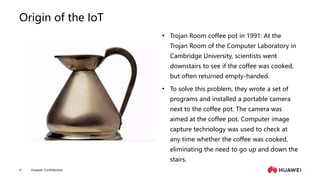
 Trojan Room coffee pot in 1991: At the
Trojan Room of the Computer Laboratory in
Cambridge University, scientists went
downstairs to see if the coffee was cooked,
but often returned empty-handed.
 To solve this problem, they wrote a set of
programs and installed a portable camera
next to the coffee pot. The camera was
aimed at the coffee pot. Computer image
capture technology was used to check at
any time whether the coffee was cooked,
eliminating the need to go up and down the
stairs.
Huawei Confidential
5
Development of the IoT
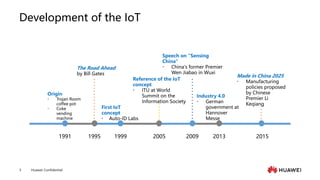
1991 1995 1999 2005
Origin
• Trojan Room
coffee pot
• Coke
vending
machine
The Road Ahead
by Bill Gates
First IoT
concept
• Auto-ID Labs
Reference of the IoT
concept
• ITU at World
Summit on the
Information Society
2009
Speech on "Sensing
China"
• China's former Premier
Wen Jiabao in Wuxi
2013
Industry 4.0
• German
government at
Hannover
Messe
2015
Made in China 2025
• Manufacturing
policies proposed
by Chinese
Premier Li
Keqiang
Huawei Confidential
6
IoT Key Events: Evolution of NB-IoT Standards
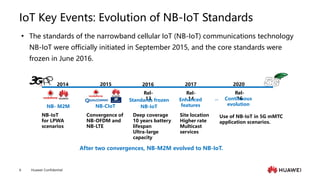
 The standards of the narrowband cellular IoT (NB-IoT) communications technology
NB-IoT were officially initiated in September 2015, and the core standards were
frozen in June 2016.
After two convergences, NB-M2M evolved to NB-IoT.
Use of NB-IoT in 5G mMTC
application scenarios.
...
Rel-
14
Rel-
16
2020
2014 2017
Site location
Higher rate
Multicast
services
Enhanced
features
Continuous
evolution
NB- M2M NB-CIoT
Rel-
13
2016
Deep coverage
10 years battery
lifespan
Ultra-large
capacity
Standards frozen
2015
NB-IoT
for LPWA
scenarios
Convergence of
NB-OFDM and
NB-LTE
NB-IoT
Huawei Confidential
7
IoT Key Events: Commercial Use of 5G
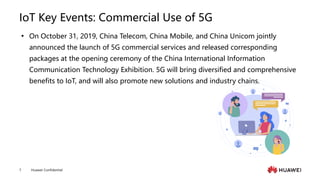
 On October 31, 2019, China Telecom, China Mobile, and China Unicom jointly
announced the launch of 5G commercial services and released corresponding
packages at the opening ceremony of the China International Information
Communication Technology Exhibition. 5G will bring diversified and comprehensive
benefits to IoT, and will also promote new solutions and industry chains.
Huawei Confidential
8
IoT Key Events: SoftBank's Acquisition of Arm
 On July 18, 2016, Japan’s SoftBank and the UK’s Arm announced that they had
reached an agreement. SoftBank acquired Arm at GBP 24.3 billion (CNY 202.8
billion, JPY 3.3 trillion).
Huawei Confidential
9
Development Status of the IoT Industry:
Consumption-Driven
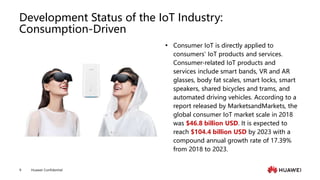
 Consumer IoT is directly applied to
consumers' IoT products and services.
Consumer-related IoT products and
services include smart bands, VR and AR
glasses, body fat scales, smart locks, smart
speakers, shared bicycles and trams, and
automated driving vehicles. According to a
report released by MarketsandMarkets, the
global consumer IoT market scale in 2018
was $46.8 billion USD. It is expected to
reach $104.4 billion USD by 2023 with a
compound annual growth rate of 17.39%
from 2018 to 2023.
Huawei Confidential
10
Development Status of the IoT Industry: Policy-Driven
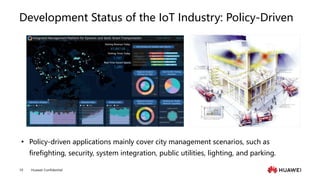
 Policy-driven applications mainly cover city management scenarios, such as
firefighting, security, system integration, public utilities, lighting, and parking.
Huawei Confidential
11
Development Status of the IoT Industry: Industry-
Driven
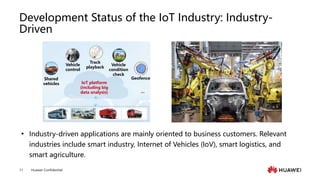
 Industry-driven applications are mainly oriented to business customers. Relevant
industries include smart industry, Internet of Vehicles (IoV), smart logistics, and
smart agriculture.
Vehicle
control
Shared
vehicles
Track
playback
Vehicle
condition
check
Geofence
IoT platform
(including big
data analysis) …
Huawei Confidential
12
Penetration and Development of IoT in Industries
Huawei Confidential
13
Contents
1. IoT Development History
2. IoT Overview and Architecture
3. Huawei IoT Solution
Huawei Confidential
14
IoT Overview
 The concept of IoT was first proposed by MIT in 1999. The early IoT was a network based on
RFID technology and devices. It combined objects with the Internet using the agreed
communication protocols to implement intelligent identification and management of objects
and realize interconnection and information sharing.
 IoT serves as a network that enables information sensing devices, such as QR code scanners,
RFID, infrared sensors, global positioning systems, and laser scanners, to connect any item
with the Internet for information exchange and communications based on agreed protocols.
As such, IoT can facilitate intelligent identification, location, tracking, monitoring, and
management (ITU).
 IoT is an Internet where all things are interconnected. This sentence has two meanings.
First, the core and foundation of the IoT is still the Internet. IoT is an extended network based
on the Internet. Second, the IoT connects any thing at the user end for information exchange
and communication (Baidu Baike).
Huawei Confidential
15
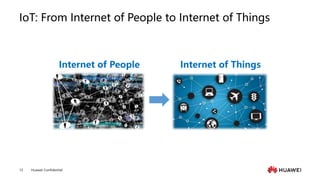
IoT: From Internet of People to Internet of Things
Internet of People Internet of Things
Huawei Confidential
16
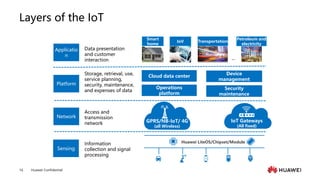
Layers of the IoT
Cloud data center
Device
management
Operations
platform
GPRS/NB-IoT/ 4G
(all Wireless)
Huawei LiteOS/Chipset/Module
Smart
home
IoV Transportation
Petroleum and
electricity
IoT Gateways
(All fixed)
...
Applicatio
n
Platform
Network
Sensing
Data presentation
and customer
interaction
Storage, retrieval, use,
service planning,
security, maintenance,
and expenses of data
Access and
transmission
network
Information
collection and signal
processing
Security
maintenance
Huawei Confidential
17
Contents
1. IoT Development History
2. IoT Overview and Architecture
3. Huawei IoT Solution
Huawei Confidential
18
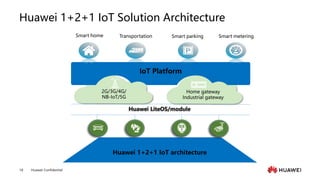
Huawei 1+2+1 IoT Solution Architecture
IoT Platform
2G/3G/4G/
NB-IoT/5G
Home gateway
Industrial gateway
Huawei LiteOS/module
Smart home Transportation Smart parking Smart metering
Huawei 1+2+1 IoT architecture
Huawei Confidential
19
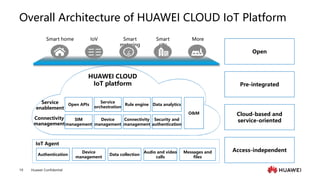
Overall Architecture of HUAWEI CLOUD IoT Platform
HUAWEI CLOUD
IoT platform
Service
enablement
Connectivity
management
Open APIs
Service
orchestration
SIM
management
Connectivity
management
Security and
authentication
Rule engine Data analytics
O&M
Device
management
IoT Agent
Authentication
Device
management
Data collection
Audio and video
calls
Messages and
files
Smart home
Open
Pre-integrated
Cloud-based and
service-oriented
Access-independent
IoV Smart
metering
Smart
city
More
Huawei Confidential
20
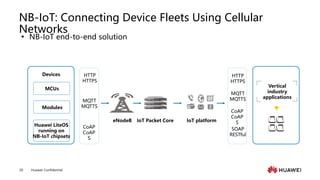
NB-IoT: Connecting Device Fleets Using Cellular
Networks
 NB-IoT end-to-end solution
Huawei LiteOS
running on
NB-IoT chipsets
MCUs
Modules
HTTP
HTTPS
MQTT
MQTTS
CoAP
CoAP
S
Vertical
industry
applications
HTTP
HTTPS
MQTT
MQTTS
CoAP
CoAP
S
SOAP
RESTful
IoT Packet Core IoT platform
eNodeB
Devices
Huawei Confidential
21
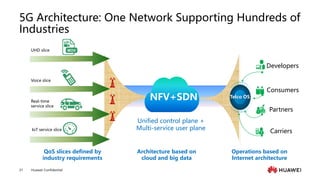
5G Architecture: One Network Supporting Hundreds of
Industries
QoS slices defined by
industry requirements
Architecture based on
cloud and big data
Operations based on
Internet architecture
UHD slice
Carriers
Partners
Consumers
Developers
Telco OS
Voice slice
Real-time
service slice
IoT service slice
Unified control plane +
Multi-service user plane
NFV+SDN
Huawei Confidential
22
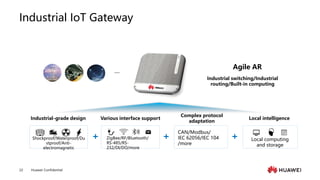
Industrial IoT Gateway
Industrial-grade design Various interface support
Complex protocol
adaptation
Industrial switching/Industrial
routing/Built-in computing
Agile AR
Local computing
and storage
CAN/Modbus/
IEC 62056/IEC 104
/more
ZigBee/RF/Bluetooth/
RS-485/RS-
232/DI/DO/more
+
....
+ +
Local intelligence
Shockproof/Waterproof/Du
stproof/Anti-
electromagnetic
Huawei Confidential
23
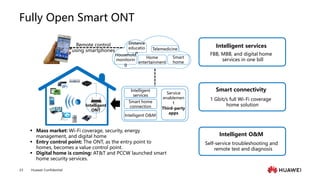
Fully Open Smart ONT
Service
enablemen
t
Smart home
connection
Intelligent
services
Household
monitorin
g
Home
entertainment
Smart
home
Distance
educatio
n
Telemedicine
Intelligent services
FBB, MBB, and digital home
services in one bill
Smart connectivity
1 Gbit/s full Wi-Fi coverage
home solution
Intelligent O&M
Self-service troubleshooting and
remote test and diagnosis
 Mass market: Wi-Fi coverage, security, energy
management, and digital home
 Entry control point: The ONT, as the entry point to
homes, becomes a value control point.
 Digital home is coming: AT&T and PCCW launched smart
home security services.
Intelligent O&M
Third-party
apps
Intelligent
ONT
Remote control
using smartphones
Huawei Confidential
24
Lightweight, Intelligent Huawei LiteOS
 Chip-level application
virtual machine
 Delay reduction
 Accuracy
improvement
 Support for short-distance
and long-distance
protocols
 Automatic networking
[KB-level kernel]
[Milliwatt-level
power
consumption]
[Microsecond-level
response]
[Intelligent sensing]
[Intelligent connection]
[Intelligent application]
Shorter time-to-market for devices
 Support for connection and device management by
industrial protocol stacks
 Support for Huawei and third-party platforms
 Supports HiSilicon and third-party chipsets
Security
framework
Open APIs
Connectivity
Sensor
framework
Runtime
engine
Kernel
Intelligence
Lightweight
Huawei
LiteOS
Huawei Confidential
25
Quiz
1. (T or F) IoT is an Internet where all things are interconnected. This sentence
has three meanings.
2. (Multiple-choice) Which of the following belong to the hierarchical
architecture of IoT?
A. Sensing Layer
B. Network Layer
C. Platform Layer
D. Application Layer
Huawei Confidential
26
Summary
 In this course, you learned about the origin and history of IoT
development and the four-layer architecture of IoT.
 You also learned about Huawei's solutions in the IoT industry based on
the four-layer architecture.
Copyright©2020 Huawei Technologies Co., Ltd.
All Rights Reserved.
The information in this document may contain predictive
statements including, without limitation, statements regarding
the future financial and operating results, future product
portfolio, new technology, etc. There are a number of factors
that
could cause actual results and developments to differ materially
from those expressed or implied in the predictive statements.
Therefore, such information is provided for reference purpose
only and constitutes neither an offer nor an acceptance. Huawei
may change the information at any time without notice.
把数字世界带入每个人、每个家庭、
每个组织,构建万物互联的智能世界。
Bring digital to every person, home, and
organization for a fully connected,
intelligent world.
Thank you.

01 IoT Development History and Overview.pptx

  • 1.
  • 2.
    Huawei Confidential 1 Foreword  Internetof Things (IoT) is an important part of the new generation of information technologies and an important development phase in the information era.  IoT is widely used in network convergence using communications and sensing technologies, such as intelligent sensing, identification, and pervasive computing. Therefore, IoT is called the third wave of global information industry development after computers and the Internet.
  • 3.
    Huawei Confidential 2 Objectives  Oncompletion of this course, you will have an understanding of:  IoT development history  Basic IoT concepts  Layers of the IoT architecture
  • 4.
    Huawei Confidential 3 Contents 1. IoTDevelopment History 2. IoT Overview and Architecture 3. Huawei IoT Solution
  • 5.
    Huawei Confidential 4 Origin ofthe IoT  Trojan Room coffee pot in 1991: At the Trojan Room of the Computer Laboratory in Cambridge University, scientists went downstairs to see if the coffee was cooked, but often returned empty-handed.  To solve this problem, they wrote a set of programs and installed a portable camera next to the coffee pot. The camera was aimed at the coffee pot. Computer image capture technology was used to check at any time whether the coffee was cooked, eliminating the need to go up and down the stairs.
  • 6.
    Huawei Confidential 5 Development ofthe IoT 1991 1995 1999 2005 Origin • Trojan Room coffee pot • Coke vending machine The Road Ahead by Bill Gates First IoT concept • Auto-ID Labs Reference of the IoT concept • ITU at World Summit on the Information Society 2009 Speech on "Sensing China" • China's former Premier Wen Jiabao in Wuxi 2013 Industry 4.0 • German government at Hannover Messe 2015 Made in China 2025 • Manufacturing policies proposed by Chinese Premier Li Keqiang
  • 7.
    Huawei Confidential 6 IoT KeyEvents: Evolution of NB-IoT Standards  The standards of the narrowband cellular IoT (NB-IoT) communications technology NB-IoT were officially initiated in September 2015, and the core standards were frozen in June 2016. After two convergences, NB-M2M evolved to NB-IoT. Use of NB-IoT in 5G mMTC application scenarios. ... Rel- 14 Rel- 16 2020 2014 2017 Site location Higher rate Multicast services Enhanced features Continuous evolution NB- M2M NB-CIoT Rel- 13 2016 Deep coverage 10 years battery lifespan Ultra-large capacity Standards frozen 2015 NB-IoT for LPWA scenarios Convergence of NB-OFDM and NB-LTE NB-IoT
  • 8.
    Huawei Confidential 7 IoT KeyEvents: Commercial Use of 5G  On October 31, 2019, China Telecom, China Mobile, and China Unicom jointly announced the launch of 5G commercial services and released corresponding packages at the opening ceremony of the China International Information Communication Technology Exhibition. 5G will bring diversified and comprehensive benefits to IoT, and will also promote new solutions and industry chains.
  • 9.
    Huawei Confidential 8 IoT KeyEvents: SoftBank's Acquisition of Arm  On July 18, 2016, Japan’s SoftBank and the UK’s Arm announced that they had reached an agreement. SoftBank acquired Arm at GBP 24.3 billion (CNY 202.8 billion, JPY 3.3 trillion).
  • 10.
    Huawei Confidential 9 Development Statusof the IoT Industry: Consumption-Driven  Consumer IoT is directly applied to consumers' IoT products and services. Consumer-related IoT products and services include smart bands, VR and AR glasses, body fat scales, smart locks, smart speakers, shared bicycles and trams, and automated driving vehicles. According to a report released by MarketsandMarkets, the global consumer IoT market scale in 2018 was $46.8 billion USD. It is expected to reach $104.4 billion USD by 2023 with a compound annual growth rate of 17.39% from 2018 to 2023.
  • 11.
    Huawei Confidential 10 Development Statusof the IoT Industry: Policy-Driven  Policy-driven applications mainly cover city management scenarios, such as firefighting, security, system integration, public utilities, lighting, and parking.
  • 12.
    Huawei Confidential 11 Development Statusof the IoT Industry: Industry- Driven  Industry-driven applications are mainly oriented to business customers. Relevant industries include smart industry, Internet of Vehicles (IoV), smart logistics, and smart agriculture. Vehicle control Shared vehicles Track playback Vehicle condition check Geofence IoT platform (including big data analysis) …
  • 13.
    Huawei Confidential 12 Penetration andDevelopment of IoT in Industries
  • 14.
    Huawei Confidential 13 Contents 1. IoTDevelopment History 2. IoT Overview and Architecture 3. Huawei IoT Solution
  • 15.
    Huawei Confidential 14 IoT Overview The concept of IoT was first proposed by MIT in 1999. The early IoT was a network based on RFID technology and devices. It combined objects with the Internet using the agreed communication protocols to implement intelligent identification and management of objects and realize interconnection and information sharing.  IoT serves as a network that enables information sensing devices, such as QR code scanners, RFID, infrared sensors, global positioning systems, and laser scanners, to connect any item with the Internet for information exchange and communications based on agreed protocols. As such, IoT can facilitate intelligent identification, location, tracking, monitoring, and management (ITU).  IoT is an Internet where all things are interconnected. This sentence has two meanings. First, the core and foundation of the IoT is still the Internet. IoT is an extended network based on the Internet. Second, the IoT connects any thing at the user end for information exchange and communication (Baidu Baike).
  • 16.
    Huawei Confidential 15 IoT: FromInternet of People to Internet of Things Internet of People Internet of Things
  • 17.
    Huawei Confidential 16 Layers ofthe IoT Cloud data center Device management Operations platform GPRS/NB-IoT/ 4G (all Wireless) Huawei LiteOS/Chipset/Module Smart home IoV Transportation Petroleum and electricity IoT Gateways (All fixed) ... Applicatio n Platform Network Sensing Data presentation and customer interaction Storage, retrieval, use, service planning, security, maintenance, and expenses of data Access and transmission network Information collection and signal processing Security maintenance
  • 18.
    Huawei Confidential 17 Contents 1. IoTDevelopment History 2. IoT Overview and Architecture 3. Huawei IoT Solution
  • 19.
    Huawei Confidential 18 Huawei 1+2+1IoT Solution Architecture IoT Platform 2G/3G/4G/ NB-IoT/5G Home gateway Industrial gateway Huawei LiteOS/module Smart home Transportation Smart parking Smart metering Huawei 1+2+1 IoT architecture
  • 20.
    Huawei Confidential 19 Overall Architectureof HUAWEI CLOUD IoT Platform HUAWEI CLOUD IoT platform Service enablement Connectivity management Open APIs Service orchestration SIM management Connectivity management Security and authentication Rule engine Data analytics O&M Device management IoT Agent Authentication Device management Data collection Audio and video calls Messages and files Smart home Open Pre-integrated Cloud-based and service-oriented Access-independent IoV Smart metering Smart city More
  • 21.
    Huawei Confidential 20 NB-IoT: ConnectingDevice Fleets Using Cellular Networks  NB-IoT end-to-end solution Huawei LiteOS running on NB-IoT chipsets MCUs Modules HTTP HTTPS MQTT MQTTS CoAP CoAP S Vertical industry applications HTTP HTTPS MQTT MQTTS CoAP CoAP S SOAP RESTful IoT Packet Core IoT platform eNodeB Devices
  • 22.
    Huawei Confidential 21 5G Architecture:One Network Supporting Hundreds of Industries QoS slices defined by industry requirements Architecture based on cloud and big data Operations based on Internet architecture UHD slice Carriers Partners Consumers Developers Telco OS Voice slice Real-time service slice IoT service slice Unified control plane + Multi-service user plane NFV+SDN
  • 23.
    Huawei Confidential 22 Industrial IoTGateway Industrial-grade design Various interface support Complex protocol adaptation Industrial switching/Industrial routing/Built-in computing Agile AR Local computing and storage CAN/Modbus/ IEC 62056/IEC 104 /more ZigBee/RF/Bluetooth/ RS-485/RS- 232/DI/DO/more + .... + + Local intelligence Shockproof/Waterproof/Du stproof/Anti- electromagnetic
  • 24.
    Huawei Confidential 23 Fully OpenSmart ONT Service enablemen t Smart home connection Intelligent services Household monitorin g Home entertainment Smart home Distance educatio n Telemedicine Intelligent services FBB, MBB, and digital home services in one bill Smart connectivity 1 Gbit/s full Wi-Fi coverage home solution Intelligent O&M Self-service troubleshooting and remote test and diagnosis  Mass market: Wi-Fi coverage, security, energy management, and digital home  Entry control point: The ONT, as the entry point to homes, becomes a value control point.  Digital home is coming: AT&T and PCCW launched smart home security services. Intelligent O&M Third-party apps Intelligent ONT Remote control using smartphones
  • 25.
    Huawei Confidential 24 Lightweight, IntelligentHuawei LiteOS  Chip-level application virtual machine  Delay reduction  Accuracy improvement  Support for short-distance and long-distance protocols  Automatic networking [KB-level kernel] [Milliwatt-level power consumption] [Microsecond-level response] [Intelligent sensing] [Intelligent connection] [Intelligent application] Shorter time-to-market for devices  Support for connection and device management by industrial protocol stacks  Support for Huawei and third-party platforms  Supports HiSilicon and third-party chipsets Security framework Open APIs Connectivity Sensor framework Runtime engine Kernel Intelligence Lightweight Huawei LiteOS
  • 26.
    Huawei Confidential 25 Quiz 1. (Tor F) IoT is an Internet where all things are interconnected. This sentence has three meanings. 2. (Multiple-choice) Which of the following belong to the hierarchical architecture of IoT? A. Sensing Layer B. Network Layer C. Platform Layer D. Application Layer
  • 27.
    Huawei Confidential 26 Summary  Inthis course, you learned about the origin and history of IoT development and the four-layer architecture of IoT.  You also learned about Huawei's solutions in the IoT industry based on the four-layer architecture.
  • 28.
    Copyright©2020 Huawei TechnologiesCo., Ltd. All Rights Reserved. The information in this document may contain predictive statements including, without limitation, statements regarding the future financial and operating results, future product portfolio, new technology, etc. There are a number of factors that could cause actual results and developments to differ materially from those expressed or implied in the predictive statements. Therefore, such information is provided for reference purpose only and constitutes neither an offer nor an acceptance. Huawei may change the information at any time without notice. 把数字世界带入每个人、每个家庭、 每个组织,构建万物互联的智能世界。 Bring digital to every person, home, and organization for a fully connected, intelligent world. Thank you.

Editor's Notes

  • #6 There is another story about the origin of the IoT. In 1990, a group of programmers at Carnegie Mellon University used to buy cans of soda from the Coke vending machine downstairs after coding, but oftentimes they were disappointed to find that there were no drinks. So they connected the vending machine to the network, wrote a segment of code to monitor the machine, checked if there were drinks available, and checked if they were cold.
  • #7 The concept of the IoT dates back to Bill Gates's 1995 book, The Road Ahead, in which Gates mentioned the idea of connection of things. However, due to the limited development of wireless networks, hardware, and sensors, his idea did not attract much attention. In 1998, MIT first proposed the IoT vision, which was then called the EPC system. In 1999, based on item coding, RFID technology, and the Internet, the Auto-ID Center in America first proposed the concept of IoT. On November 17, 2005, the ITU released the ITU Internet Reports 2005: The Internet of Things at the WSIS. The report stated that the ubiquitous IoT era was coming. All objects in the world, from tires to toothbrushes, from houses to tissues, would be able to exchange information through the Internet. On August 7, 2009, then Chinese Premier Wen Jiabao delivered an important speech during an inspection in Wuxi city, proposing the "Sensing China" strategy and saying that China should seize the opportunity to vigorously develop IoT technologies. Later on November 3 in the same year, he delivered a speech to the science and technology circle of Beijing, again emphasizing the importance of strategic emerging industries. He stated that China should focus on making breakthroughs in key technologies, such as sensor networks and the IoT. Smart Logistics, proposed for Industry 4.0, integrates logistics resources through the Internet, IoT, and logistics networks, to maximize the efficiency of existing logistics resource suppliers. This will allow demanders to quickly obtain service matching and logistics support. The first step of Made in China 2025 is to make China a world-leading manufacturing power in 10 years. In 2020, China's industrialization will be basically achieved, the status of the manufacturing industry will be further consolidated, and the informatization level of the manufacturing industry will be greatly improved. Key technologies in some key domains will be mastered, competitiveness in advantageous domains will be further enhanced, and product quality will be greatly improved. Significant progress will be made in the digitalization, networking, and intelligence of the manufacturing industry. The energy consumption, material consumption, and pollutant emissions of key industry units will decrease significantly.
  • #8 NB-OFDM: Narrowband Orthogonal Frequency Division Multiplexing NB-LTE: Narrowband LTE. Multiple new features of R14 are continuously evolving. NB-IoT is recognized as a part of 5G technologies.
  • #18 Sensing layer The sensing layer collects information and processes signals. The sensing and identification technologies enable objects to "speak and publish information", which is the part of the IoT that most distinguishes itself from other networks. The information generation devices of the sensing layer not only include devices such as RFID electronic labels, sensors, and positioning systems that can automatically generate information, but also includes various intelligent devices such as smartphones, PDAs, multimedia players, and laptops that can manually generate information. The sensing layer is at the bottom of the IoT four-layer model and is the basis of all upper-layer structures. Network layer The network layer directly accesses and transmits information from the sensing layer using the existing network infrastructure, such as the Internet, mobile communications network, and satellite communications network. The network layer connects to the sensing layer and the platform layer, and has a strong link function. Platform layer In a high-performance network computer environment, the platform layer can use computers to integrate massive quantities of information resources in the network into a large intelligent network that can be interconnected. This layer can solve the data problems of storage (database and mass storage technologies), retrieval (search engine), use (data mining and machine learning), and protection against abuse (data security and privacy protection). The platform layer is above the sensing and network layers and below the application layer. It is the source of intelligence for the IoT. On the basis of this layer, IoT applications are usually called "smart" and "intelligent", such as smart grid, intelligent transportation, and smart logistics. Application layer The application layer is a user interface of the IoT system that provides abundant specific services for users by analyzing processed sensor data. Specifically, the application layer receives information from the network layer, processes the information and makes a decision, and then sends the information using the network layer, to control devices at the sensing layer. IoT applications are centered on the "objects" or physical world and cover various fields such as object tracking, environment sensing, smart logistics, intelligent transportation, and intelligent customs.
  • #20 One IoT platform, two access methods, and one IoT operating system
  • #21 IoT service development requires a secure, reliable platform that supports decoupling from devices and from applications. The IoT platform provides device access, security verification, service orchestration, data management, and multi-protocol communications, implements connectivity management and capability openness, and connects to carriers' pipes and platforms.
  • #22 NB-IoT: Narrowband Internet of Things NB-IoT is a new narrowband cellular communications LPWAN technology. LPWAN stands for low-power wide-area network. NB-IoT has the advantages of strong connection, wide coverage, low cost, and low power consumption. CoAP: Constrained Application Protocol MQTT: Message Queuing Telemetry Transport SOAP: Simple Object Access Protocol HTTP: Hypertext Transfer Protocol
  • #23 Network function virtualization (NFV): Uses universal hardware (such as x86) and virtualization technologies to process software with many functions, to reduce network device costs. Using software and hardware decoupling and function abstraction, it enables network device functions to be independent of dedicated hardware. Resources can be flexibly shared, new services can be quickly developed and deployed, and automatic deployment, auto scaling, fault isolation, and self-healing can be performed based on actual service requirements. Software-defined networking (SDN): An innovative network architecture proposed by the Clean Slate Program research team from Stanford University. It is an approach to implementing network virtualization. Its core technology, OpenFlow, separates the control plane from the data plane of a network device. Therefore, network traffic can be flexibly controlled. This makes the network pipe more intelligent and provides a good platform for innovation of the core network and applications. Network slicing is to build multiple virtual end-to-end networks on a universal hardware using network slicing technology. Each network has different functions that meet different service requirements. Network slicing slices physical resources, which are for access, connection, computing, and storage. Network slices have three key features: customization, end to end, and isolation. A network slice is an end-to-end network, covering the RAN, transport network, and core network. It requires a cross-domain slice management system. Network slices require isolation of resources, security, and OAM. Different domains can use different technologies to achieve such isolation. For example, the core network uses virtualization technology. Network slices can be customized to provide specific network functions and features. 5G services have different requirements for network functions. Based on this, 5G standards cover three typical scenarios: eMBB, mMTC, and URLLC. The corresponding 5G network slice types are eMBB slice, mMTC slice, and URLLC slice.
  • #24 The industrial IoT gateway supports multiple network standards and provides interfaces that comply with various industry specifications, such as RS-485, PLC, and ZigBee. The gateway can directly communicate with devices on the sensor network, converge various heterogeneous sensor networks that adopt different technologies, and remotely transmit data generated by sensor networks using communications networks. It has the basic functions of common Internet routers. It provides multiple flexible access modes, wired or wireless, to connect to 3G mobile networks and the Internet. It connects to remote operating platforms, provides users with manageable and reliable services, and facilitates user management of production and other activities. It provides various Quality of Service (QoS) functions to ensure that each area or application corresponds to an independent queue, so applications can be scheduled in real time. It also provides protection measures for priority services, such as dedicated bandwidth and preferential forwarding, to ensure the quality of mission-critical control services. It provides security mechanisms to ensure authenticity and accuracy of big data on the IoT. Network security is important because the IoT communications network and the Internet are integrated. In addition, the gateway devices must be industrialized, support a wide temperature range, and be dustproof, waterproof, and strong electromagnetic-proof to adapt to different scenarios.
  • #25 Carriers are in urgent need of a product that can function as an entry to home networks to realize their vision of smart homes. This is where smart ONT comes in. Smart ONT has one core, two open advanced architectures, and a variety of innovative business models. Smart ONT is the core to bridge pipes and users. It provides smart full Wi-Fi coverage and IoT connection extended by USB dongles to achieve ubiquitous connections. For pipe capability openness, it extends flexible pipes from carriers' equipment rooms to users' homes. For home capability openness, it serves as the core of smart homes to integrate applications and build a platform. Using smart ONTs, various services such as security, home control, energy management, distance education, and telemedicine can be provided to help carriers expand the home market. The advantages of smart ONTs in smart connectivity, intelligent services, and intelligent O&M are unrivaled for Internet enterprises. These advantages together can help carriers increase revenue and reduce expenditure.
  • #26 Huawei LiteOS is a unified IoT operating system with middleware capabilities. It features lightweight (basic kernel size less than 10 KB), low power consumption, interconnection, and security. Currently, Huawei LiteOS is used on smart hardware in IoT fields including smart homes, wearable devices, IoV, smart metering, and industrial Internet. It can also connect to hardware in LiteOS ecosystems to improve user experience. LiteOS features low power consumption, small size, and quick response. In addition, LiteOS has established an open source community to support chipsets such as the HiSilicon PLC chipset HCT3911, media chipset 3798M and 3798C, IP camera chipset Hi3516A, and LTE-M chipset.
  • #27 F ABCD