
Physical & Environmental Security
Presented by
Mohammad Ashfaqur Rahman
Compliance Professional
www.linkedin.com/in/ashfaqsaphal
ashfaq.saphal@gmail.com
Objective
●
Crime Prevention
●
Physical Access Controll
●
Video Survillance System
●
Fire Survilance System
●
Air conditioning
●
Electrial Solution
●
Mechanical Practices
Physical Security
●
discuss about the threats, vulnerabilities, and
countermeasures that can be utilized to
– physical protect an enterprise’s resources
– and sensitive information.
●
covers designe to deny access to unauthorized personnel
(including attackers) from
– physically accessing a building, facility,
resources, or stored information;
●
and guidance on how to design structures to resist
potentially hostile acts.
Threats to Physical Environment
●
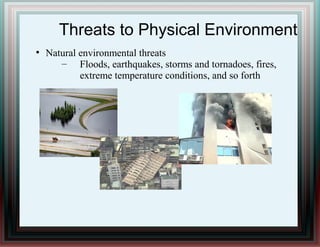
Natural environmental threats
– Floods, earthquakes, storms and tornadoes, fires,
extreme temperature conditions, and so forth
Threats to Physical Environment
●
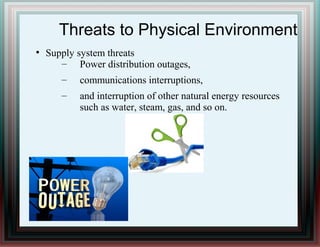
Supply system threats
– Power distribution outages,
– communications interruptions,
– and interruption of other natural energy resources
such as water, steam, gas, and so on.
Threats to Physical Environment
●
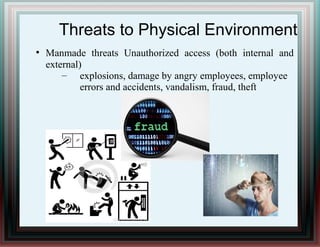
Manmade threats Unauthorized access (both internal and
external)
– explosions, damage by angry employees, employee
errors and accidents, vandalism, fraud, theft
Threats to Physical Environment
●
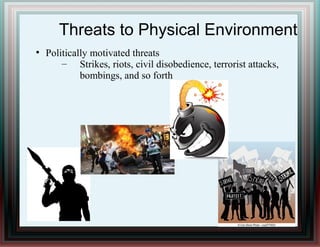
Politically motivated threats
– Strikes, riots, civil disobedience, terrorist attacks,
bombings, and so forth
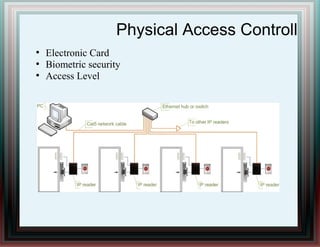
Physical Access Controll
●
Electronic Card
●
Biometric security
●
Access Level
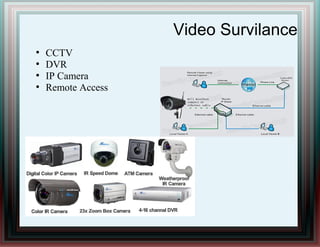
Video Survilance
●
CCTV
●
DVR
●
IP Camera
●
Remote Access
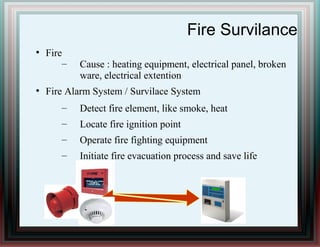
Fire Survilance
●
Fire
– Cause : heating equipment, electrical panel, broken
ware, electrical extention
●
Fire Alarm System / Survilace System
– Detect fire element, like smoke, heat
– Locate fire ignition point
– Operate fire fighting equipment
– Initiate fire evacuation process and save life
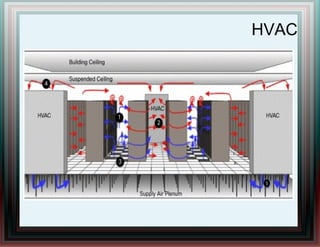
HVAC
●
Heating, Ventilating and Air Conditioning
– Upflow , downflow and inrow
– Air volume cubic feet per
– minute (CFM) per ton.
– Humidity control (RH 45% - 60%).
– Temperature control (72°F ± 2°F).
– Air Filters.
– Positive air pressure.
– Protected intake vents.
– Alarms: Leak detection, loss of power,
– temperature, humidity, fire, smoke detector.
HVAC
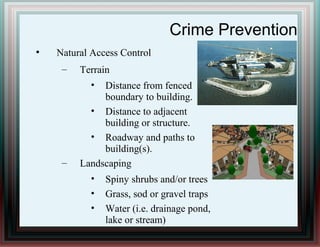
Crime Prevention
●
Natural Access Control
– Terrain
• Distance from fenced
boundary to building.
• Distance to adjacent
building or structure.
• Roadway and paths to
building(s).
– Landscaping
• Spiny shrubs and/or trees
• Grass, sod or gravel traps
• Water (i.e. drainage pond,
lake or stream)
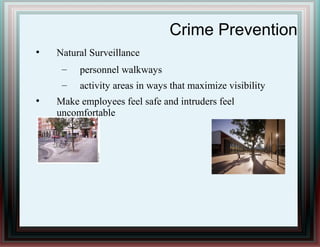
Crime Prevention
●
Natural Surveillance
– personnel walkways
– activity areas in ways that maximize visibility
●
Make employees feel safe and intruders feel
uncomfortable
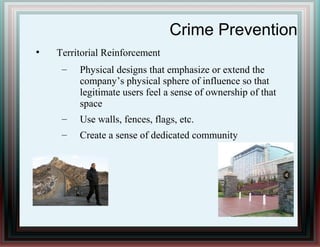
Crime Prevention
●
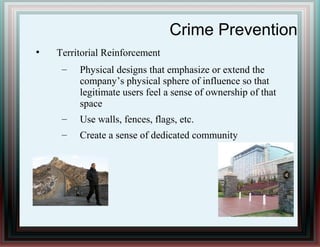
Territorial Reinforcement
– Physical designs that emphasize or extend the
company’s physical sphere of influence so that
legitimate users feel a sense of ownership of that
space
– Use walls, fences, flags, etc.
– Create a sense of dedicated community
Crime Prevention
●
Territorial Reinforcement
– Physical designs that emphasize or extend the
company’s physical sphere of influence so that
legitimate users feel a sense of ownership of that
space
– Use walls, fences, flags, etc.
– Create a sense of dedicated community
Data Center tier
●
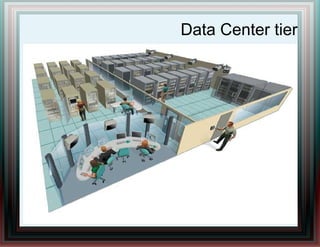
Tier 1 = Non-redundant capacity components (single
uplink and servers).
●
Tier 2 = Tier 1 + Redundant capacity components.
●
Tier 3 = Tier 1 + Tier 2 + Dual-powered equipments and
multiple uplinks.
●
Tier 4 = Tier 1 + Tier 2 + Tier 3 + all components are
fully fault-tolerant including uplinks, storage, chillers,
HVAC systems, servers etc. Everything is dual-powered.
Ref : www.adc.com/Library/Literature/102264AE.pdf
Data Center tier
Where are we ?

007.itsecurity bcp v1

  • 1.
    Physical & EnvironmentalSecurity Presented by Mohammad Ashfaqur Rahman Compliance Professional www.linkedin.com/in/ashfaqsaphal ashfaq.saphal@gmail.com
  • 2.
    Objective ● Crime Prevention ● Physical AccessControll ● Video Survillance System ● Fire Survilance System ● Air conditioning ● Electrial Solution ● Mechanical Practices
  • 3.
    Physical Security ● discuss aboutthe threats, vulnerabilities, and countermeasures that can be utilized to – physical protect an enterprise’s resources – and sensitive information. ● covers designe to deny access to unauthorized personnel (including attackers) from – physically accessing a building, facility, resources, or stored information; ● and guidance on how to design structures to resist potentially hostile acts.
  • 4.
    Threats to PhysicalEnvironment ● Natural environmental threats – Floods, earthquakes, storms and tornadoes, fires, extreme temperature conditions, and so forth
  • 5.
    Threats to PhysicalEnvironment ● Supply system threats – Power distribution outages, – communications interruptions, – and interruption of other natural energy resources such as water, steam, gas, and so on.
  • 6.
    Threats to PhysicalEnvironment ● Manmade threats Unauthorized access (both internal and external) – explosions, damage by angry employees, employee errors and accidents, vandalism, fraud, theft
  • 7.
    Threats to PhysicalEnvironment ● Politically motivated threats – Strikes, riots, civil disobedience, terrorist attacks, bombings, and so forth
  • 8.
    Physical Access Controll ● ElectronicCard ● Biometric security ● Access Level
  • 9.
  • 10.
    Fire Survilance ● Fire – Cause: heating equipment, electrical panel, broken ware, electrical extention ● Fire Alarm System / Survilace System – Detect fire element, like smoke, heat – Locate fire ignition point – Operate fire fighting equipment – Initiate fire evacuation process and save life
  • 11.
    HVAC ● Heating, Ventilating andAir Conditioning – Upflow , downflow and inrow – Air volume cubic feet per – minute (CFM) per ton. – Humidity control (RH 45% - 60%). – Temperature control (72°F ± 2°F). – Air Filters. – Positive air pressure. – Protected intake vents. – Alarms: Leak detection, loss of power, – temperature, humidity, fire, smoke detector.
  • 12.
  • 13.
    Crime Prevention ● Natural AccessControl – Terrain • Distance from fenced boundary to building. • Distance to adjacent building or structure. • Roadway and paths to building(s). – Landscaping • Spiny shrubs and/or trees • Grass, sod or gravel traps • Water (i.e. drainage pond, lake or stream)
  • 14.
    Crime Prevention ● Natural Surveillance –personnel walkways – activity areas in ways that maximize visibility ● Make employees feel safe and intruders feel uncomfortable
  • 15.
    Crime Prevention ● Territorial Reinforcement –Physical designs that emphasize or extend the company’s physical sphere of influence so that legitimate users feel a sense of ownership of that space – Use walls, fences, flags, etc. – Create a sense of dedicated community
  • 16.
    Crime Prevention ● Territorial Reinforcement –Physical designs that emphasize or extend the company’s physical sphere of influence so that legitimate users feel a sense of ownership of that space – Use walls, fences, flags, etc. – Create a sense of dedicated community
  • 17.
    Data Center tier ● Tier1 = Non-redundant capacity components (single uplink and servers). ● Tier 2 = Tier 1 + Redundant capacity components. ● Tier 3 = Tier 1 + Tier 2 + Dual-powered equipments and multiple uplinks. ● Tier 4 = Tier 1 + Tier 2 + Tier 3 + all components are fully fault-tolerant including uplinks, storage, chillers, HVAC systems, servers etc. Everything is dual-powered. Ref : www.adc.com/Library/Literature/102264AE.pdf
  • 18.
  • 19.