www.investmentweek.co.uk
6
FundManagerFocus:TomNaughton,PrusikInvestmentManagement
BY HANNAH SMITH
Asian equities boutique Prusik
Investment Management has had a
stellar year,with its newest fund topping
the performance charts despite a tricky
environment for investors in the Asia
Pacific region.
Tom Naughton’s Prusik Asian Equity
Income fund won the Asia category at
Investment Week’s Fund Manager of the
Year Awards earlier this month, and
the fund has gone from a hidden gem
to a favourite among multi-managers
looking for a high conviction, high
alpha fund offering small-cap exposure.
In fact, the fund has proved so
popular with investors that the group
introduced a front end charge of 3%
at the end of last year in order to stem
flows. However, Prusik anticipates
removing this within the next 12
months, paving the way for new
investors to tap in to the growing
prospects for Asian dividends.
Naughton’s Dublin-domiciled fund
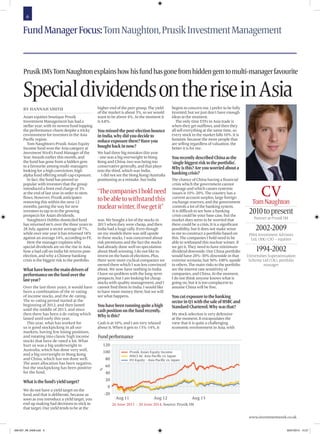
has returned 66% over the three years to
28 July, against a sector average of 7%,
while over one year it has returned 18%
against an average 14%, according to FE.
Here the manager explains why
special dividends are on the rise in Asia,
how a bad call on India hit returns post-
election, and why a Chinese banking
crisis is the biggest risk to the portfolio.
Whathavebeenthemaindriversof
performanceonthefundoverthe
lastyear?
Over the last three years, it would have
been a combination of the re-rating
of income stocks, and the de-rating.
The re-rating period started at the
beginning of 2012, and then lasted
until the middle of 2013, and since
then there has been a de-rating which
lasted until early this year.
This year, what has worked for
us is good stockpicking in all our
markets, having few losing positions,
and rotating into classic high income
stocks that have de-rated a lot. What
hurt us was a big underweight to
Australia, which has done very well,
and a big overweight to Hong Kong
and China, which has not done well.
The asset allocation has been negative,
but the stockpicking has been positive
for the fund.
Whatisthefund’syieldtarget?
We do not have a yield target on the
fund, and that is deliberate, because as
soon as you introduce a yield target, you
end up making bad decisions to stick to
that target. Our yield tends to be at the
higher end of the peer group. The yield
of the market is about 3%, so we would
want to be above 4%. At the moment it
is 4.8%.
Youmissedthepost-electionbounce
inIndia,whydidyoudecideto
reduceexposurethere?Haveyou
boughtbackinnow?
We had three big mistakes this year
- one was a big overweight to Hong
Kong and China, two was being too
conservative generally, and that plays
into the third, which was India.
I did not see the Hong Kong/Australia
positioning as a mistake, but India
was. We bought a lot of the stocks in
2013 when they were cheap, and then
India had a huge rally. Even though
on my models there was still upside
in these stocks, I was concerned about
risk premiums and the fact the stocks
had already done well on speculation
about Modi winning. I do not like to
invest on the basis of elections. Plus,
there were more cyclical companies we
owned there which I was less convinced
about. We now have nothing in India.
I have no problem with the long-term
prospects, but I am looking for cheap
stocks with quality management, and I
cannot find them in India. I would like
to have more money there, but we will
see what happens.
Youhavebeenrunningquiteahigh
cashpositiononthefundrecently.
Whyisthis?
Cash is at 10%, and I am very relaxed
about it. When it gets to 13%-14%, it
begins to concern me. I prefer to be fully
invested, but we just don’t have enough
ideas at the moment.
The only time ETFs in Asia trade is
when they get outflows, and then they
all sell everything at the same time, so
every stock in the market falls 10%. It is
fantastic because the more people that
are selling regardless of valuation, the
better it is for me.
YourecentlydescribedChinaasthe
‘singlebiggestrisktotheportfolio’.
Whyisthis?Areyouworriedabouta
bankingcrisis?
The chance of China having a financial
crisis which the government cannot
manage and which causes systemic
issues is 10%-20%. The country has a
current account surplus, large foreign
exchange reserves, and the government
controls a lot of the banking system.
It is difficult to see how a banking
crisis could be your base case, but the
market does seem to be worried that
there could be a crisis. It is a significant
possibility, but it does not make sense
to me to construct a portfolio based on
this. The companies I hold need to be
able to withstand this nuclear winter, if
we get it. They need to have minimum
dividend downside. Our China portfolio
would have 20%-30% downside in that
extreme scenario, but 50%-100% upside
in others. The main risks to the portfolio
are the interest rate sensitivity of
companies, and China. At the moment,
I do not think anyone knows what is
going on, but it is too complacent to
assume China will be fine.
Youcutexposuretothebanking
sectorinQ1withthesaleofHSBCand
StandardChartered.Whywasthat?
My stock selection is very defensive
at the moment. It encapsulates the
view that it is quite a challenging
economic environment in Asia, with
SpecialdividendsontheriseinAsia
PrusikIM’sTomNaughtonexplainshowhisfundhasgonefromhiddengemtomulti-managerfavourite
CV
TomNaughton
2010topresent
Partner at Prusik IM
2002-2009
PMA Investment Advisors
Ltd, (HK) CIO – equities
1994-2002
Universities Superannuation
Scheme Ltd (UK), portfolio
manager
26 June 2011 – 20 June 2014. Source: Prusik IM
%
Aug 13Aug 12Aug 11
-20
0
20
40
60
80
100
120
FO Equity - Asia Pacific ex Japan
MSCI AC Asia Pacific ex Japan
Prusik Asian Equity Income
Fundperformance
“ThecompaniesIholdneed
tobeabletowithstandthis
nuclearwinter,ifwegetit”
006-007_IW_0408.indd 6 30/07/2014 15:27
www.investmentweek.co.uk
7
RenAsset Management (formerly known as Renaissance Asset Managers) is a specialist
Emerging and Frontier markets institution with leading franchises in Eastern Europe, Turkey,
Africa and Global Frontier markets.
With investment offices in London, Moscow, Istanbul and Johannesburg, we combine the
investment rigour of the largest names in asset management with the bottom-up stock
picking expertise of a local manager.
The Renasset Ottoman Fund (RAOTTCE:ID) is our award winning strategy run since 2006
by Aziz Unan. The fund invests in an entirely unconstrained manner across Emerging Europe.
At RenAsset Management we believe that unconstrained investing brings significant
benefits to institutional portfolios.
The value of your investment can fall as well as rise and you may get back less than you
invested. Issued by Renaissance Asset Managers (Guernsey) Limited.
WE BELIEVE PASSIONATELY THAT THIS CENTURY BELONGS TO EMERGING AND FRONTIER MARKETS.
FUND MANAGER
RENASSET OTTOMAN FUND
To find out more, please contact investor@renasset.com | +44 1481 727278
ISIN: IE00B8G12179
BBG: RAOTTCE:ID
AZIZ UNAN
RENASSET OTTOMAN FUND
PIPELINE TO THE BEST UNCONSTRAINED IDEAS
IN EMERGING EUROPE AND BEYOND
IW_July 2014.indd 1 15/07/2014 10:11:19
FundManagerFocus
headwinds such as the end of tapering,
and slower growth. I want to focus
more on valuation rather than the fact
Asian earnings might grow faster than
expected. I had similar reasons for
selling both Standard Chartered and
HSBC – the environment in Hong Kong
is very weak for banking, with property
price declines, lower loan growth, and
a weaker China pressuring growth. You
really do not want to own banks going
in to a slower growth environment.
I looked at their return on equity
forecasts, and this suggests they are not
massively overvalued, but the returns
are not enough to consider including in
the portfolio. With Standard Chartered,
I am concerned about credit quality in
Asia as it is an EM bank, while HSBC
has different problems related to its US
business. It will struggle to generate
double-digit ROE. Banks have a
unique risk profile which is somewhat
unattractive.
Howdoestheenvironmentfor
specialdividendsinAsiacompareto
theUK?
It is happening in Asia for the same
reasons it is happening in the UK –
good levels of corporate profitability,
undergeared balance sheets, a lack
of growth capex opportunities, and
pressure from shareholders. Two of our
biggest positions, which were about
12% of the fund, paid special dividends
for the first time in their 40-year
history, for exactly those reasons.
Those two companies combined
generated 100 basis points of yield for
the fund. The businesses we own are
stable companies with huge excess
cash on their balance sheets, so we
expect to see more share buybacks
and dividends.
Whydidyoumakethedecisionto
trytolimitnewinvestmentintothe
fund?
The fund was at $930m in size at the
end of the year, and we put a front end
charge of 3% on it on 3 December. We
had about 15% of our shares redeemed,
but positive market performance has
meant the AUM is only 6%-7% lower.
In terms of when we would reopen the
fund, we would want to see our cash
level close to zero, and to see some new
ideas to buy. We would not reopen until
the fund gets to less than $700m, but we
could be there within 12 months. We
have 50% in mid and small caps, so we
want to be able to maintain liquidity.
Whatthemesdoyouexpecttodrive
returnsonthefundinfuture?
We have 50% in core infrastructure,
which has not been re-rated like
the consumer sector, and has been
a less popular sector in Asia than
elsewhere in the world. The structure
of companies does not allow as much
leverage, so you tend to have very
cheap valuations in high quality
companies.
Other than that, the opportunity set is
as attractive as it was a few years ago.
We want to focus on mid to high
double-digit returns without taking
on too much risk. I am conscious that
we are still only three years old - we
will know in five to ten years ‘does this
work?’. We still have a long way to go.
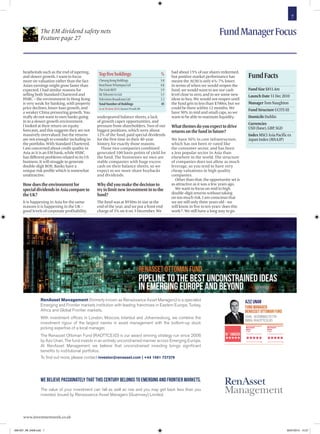
FundFacts
Fund Size$851.4m
Launch Date31Dec2010
ManagerTomNaughton
Fund StructureUCITSIII
DomicileDublin
Currencies
USD(base),GBP,SGD
IndexMSCIAsiaPacificex
JapanIndex(MXAJP)
Topfiveholdings %
CheungKongHoldings 5.8
HutchisonWhampoaLtd 4.8
TheLinkREIT 3.9
SKTelecomCoLtd 3.5
TelevisionBroadcastsLtd 3.3
TotalNumberofHoldings 45
Asat30June2014.Source:PrusikIM
The EM dividend safety nets
Feature page 27
006-007_IW_0408.indd 7 30/07/2014 15:27

006-007_IW_0408

  • 1.
    www.investmentweek.co.uk 6 FundManagerFocus:TomNaughton,PrusikInvestmentManagement BY HANNAH SMITH Asianequities boutique Prusik Investment Management has had a stellar year,with its newest fund topping the performance charts despite a tricky environment for investors in the Asia Pacific region. Tom Naughton’s Prusik Asian Equity Income fund won the Asia category at Investment Week’s Fund Manager of the Year Awards earlier this month, and the fund has gone from a hidden gem to a favourite among multi-managers looking for a high conviction, high alpha fund offering small-cap exposure. In fact, the fund has proved so popular with investors that the group introduced a front end charge of 3% at the end of last year in order to stem flows. However, Prusik anticipates removing this within the next 12 months, paving the way for new investors to tap in to the growing prospects for Asian dividends. Naughton’s Dublin-domiciled fund has returned 66% over the three years to 28 July, against a sector average of 7%, while over one year it has returned 18% against an average 14%, according to FE. Here the manager explains why special dividends are on the rise in Asia, how a bad call on India hit returns post- election, and why a Chinese banking crisis is the biggest risk to the portfolio. Whathavebeenthemaindriversof performanceonthefundoverthe lastyear? Over the last three years, it would have been a combination of the re-rating of income stocks, and the de-rating. The re-rating period started at the beginning of 2012, and then lasted until the middle of 2013, and since then there has been a de-rating which lasted until early this year. This year, what has worked for us is good stockpicking in all our markets, having few losing positions, and rotating into classic high income stocks that have de-rated a lot. What hurt us was a big underweight to Australia, which has done very well, and a big overweight to Hong Kong and China, which has not done well. The asset allocation has been negative, but the stockpicking has been positive for the fund. Whatisthefund’syieldtarget? We do not have a yield target on the fund, and that is deliberate, because as soon as you introduce a yield target, you end up making bad decisions to stick to that target. Our yield tends to be at the higher end of the peer group. The yield of the market is about 3%, so we would want to be above 4%. At the moment it is 4.8%. Youmissedthepost-electionbounce inIndia,whydidyoudecideto reduceexposurethere?Haveyou boughtbackinnow? We had three big mistakes this year - one was a big overweight to Hong Kong and China, two was being too conservative generally, and that plays into the third, which was India. I did not see the Hong Kong/Australia positioning as a mistake, but India was. We bought a lot of the stocks in 2013 when they were cheap, and then India had a huge rally. Even though on my models there was still upside in these stocks, I was concerned about risk premiums and the fact the stocks had already done well on speculation about Modi winning. I do not like to invest on the basis of elections. Plus, there were more cyclical companies we owned there which I was less convinced about. We now have nothing in India. I have no problem with the long-term prospects, but I am looking for cheap stocks with quality management, and I cannot find them in India. I would like to have more money there, but we will see what happens. Youhavebeenrunningquiteahigh cashpositiononthefundrecently. Whyisthis? Cash is at 10%, and I am very relaxed about it. When it gets to 13%-14%, it begins to concern me. I prefer to be fully invested, but we just don’t have enough ideas at the moment. The only time ETFs in Asia trade is when they get outflows, and then they all sell everything at the same time, so every stock in the market falls 10%. It is fantastic because the more people that are selling regardless of valuation, the better it is for me. YourecentlydescribedChinaasthe ‘singlebiggestrisktotheportfolio’. Whyisthis?Areyouworriedabouta bankingcrisis? The chance of China having a financial crisis which the government cannot manage and which causes systemic issues is 10%-20%. The country has a current account surplus, large foreign exchange reserves, and the government controls a lot of the banking system. It is difficult to see how a banking crisis could be your base case, but the market does seem to be worried that there could be a crisis. It is a significant possibility, but it does not make sense to me to construct a portfolio based on this. The companies I hold need to be able to withstand this nuclear winter, if we get it. They need to have minimum dividend downside. Our China portfolio would have 20%-30% downside in that extreme scenario, but 50%-100% upside in others. The main risks to the portfolio are the interest rate sensitivity of companies, and China. At the moment, I do not think anyone knows what is going on, but it is too complacent to assume China will be fine. Youcutexposuretothebanking sectorinQ1withthesaleofHSBCand StandardChartered.Whywasthat? My stock selection is very defensive at the moment. It encapsulates the view that it is quite a challenging economic environment in Asia, with SpecialdividendsontheriseinAsia PrusikIM’sTomNaughtonexplainshowhisfundhasgonefromhiddengemtomulti-managerfavourite CV TomNaughton 2010topresent Partner at Prusik IM 2002-2009 PMA Investment Advisors Ltd, (HK) CIO – equities 1994-2002 Universities Superannuation Scheme Ltd (UK), portfolio manager 26 June 2011 – 20 June 2014. Source: Prusik IM % Aug 13Aug 12Aug 11 -20 0 20 40 60 80 100 120 FO Equity - Asia Pacific ex Japan MSCI AC Asia Pacific ex Japan Prusik Asian Equity Income Fundperformance “ThecompaniesIholdneed tobeabletowithstandthis nuclearwinter,ifwegetit” 006-007_IW_0408.indd 6 30/07/2014 15:27
  • 2.
    www.investmentweek.co.uk 7 RenAsset Management (formerlyknown as Renaissance Asset Managers) is a specialist Emerging and Frontier markets institution with leading franchises in Eastern Europe, Turkey, Africa and Global Frontier markets. With investment offices in London, Moscow, Istanbul and Johannesburg, we combine the investment rigour of the largest names in asset management with the bottom-up stock picking expertise of a local manager. The Renasset Ottoman Fund (RAOTTCE:ID) is our award winning strategy run since 2006 by Aziz Unan. The fund invests in an entirely unconstrained manner across Emerging Europe. At RenAsset Management we believe that unconstrained investing brings significant benefits to institutional portfolios. The value of your investment can fall as well as rise and you may get back less than you invested. Issued by Renaissance Asset Managers (Guernsey) Limited. WE BELIEVE PASSIONATELY THAT THIS CENTURY BELONGS TO EMERGING AND FRONTIER MARKETS. FUND MANAGER RENASSET OTTOMAN FUND To find out more, please contact investor@renasset.com | +44 1481 727278 ISIN: IE00B8G12179 BBG: RAOTTCE:ID AZIZ UNAN RENASSET OTTOMAN FUND PIPELINE TO THE BEST UNCONSTRAINED IDEAS IN EMERGING EUROPE AND BEYOND IW_July 2014.indd 1 15/07/2014 10:11:19 FundManagerFocus headwinds such as the end of tapering, and slower growth. I want to focus more on valuation rather than the fact Asian earnings might grow faster than expected. I had similar reasons for selling both Standard Chartered and HSBC – the environment in Hong Kong is very weak for banking, with property price declines, lower loan growth, and a weaker China pressuring growth. You really do not want to own banks going in to a slower growth environment. I looked at their return on equity forecasts, and this suggests they are not massively overvalued, but the returns are not enough to consider including in the portfolio. With Standard Chartered, I am concerned about credit quality in Asia as it is an EM bank, while HSBC has different problems related to its US business. It will struggle to generate double-digit ROE. Banks have a unique risk profile which is somewhat unattractive. Howdoestheenvironmentfor specialdividendsinAsiacompareto theUK? It is happening in Asia for the same reasons it is happening in the UK – good levels of corporate profitability, undergeared balance sheets, a lack of growth capex opportunities, and pressure from shareholders. Two of our biggest positions, which were about 12% of the fund, paid special dividends for the first time in their 40-year history, for exactly those reasons. Those two companies combined generated 100 basis points of yield for the fund. The businesses we own are stable companies with huge excess cash on their balance sheets, so we expect to see more share buybacks and dividends. Whydidyoumakethedecisionto trytolimitnewinvestmentintothe fund? The fund was at $930m in size at the end of the year, and we put a front end charge of 3% on it on 3 December. We had about 15% of our shares redeemed, but positive market performance has meant the AUM is only 6%-7% lower. In terms of when we would reopen the fund, we would want to see our cash level close to zero, and to see some new ideas to buy. We would not reopen until the fund gets to less than $700m, but we could be there within 12 months. We have 50% in mid and small caps, so we want to be able to maintain liquidity. Whatthemesdoyouexpecttodrive returnsonthefundinfuture? We have 50% in core infrastructure, which has not been re-rated like the consumer sector, and has been a less popular sector in Asia than elsewhere in the world. The structure of companies does not allow as much leverage, so you tend to have very cheap valuations in high quality companies. Other than that, the opportunity set is as attractive as it was a few years ago. We want to focus on mid to high double-digit returns without taking on too much risk. I am conscious that we are still only three years old - we will know in five to ten years ‘does this work?’. We still have a long way to go. FundFacts Fund Size$851.4m Launch Date31Dec2010 ManagerTomNaughton Fund StructureUCITSIII DomicileDublin Currencies USD(base),GBP,SGD IndexMSCIAsiaPacificex JapanIndex(MXAJP) Topfiveholdings % CheungKongHoldings 5.8 HutchisonWhampoaLtd 4.8 TheLinkREIT 3.9 SKTelecomCoLtd 3.5 TelevisionBroadcastsLtd 3.3 TotalNumberofHoldings 45 Asat30June2014.Source:PrusikIM The EM dividend safety nets Feature page 27 006-007_IW_0408.indd 7 30/07/2014 15:27