Level 1
Foundations of Cloud Security
Lesson 3 - Paying your Cloud Bills
Objective 3:
● Tour cost explorer
● Understand budgets and budget alarms
● Use budgeting as an early warning system
Billing Sounds Boring
● Your bill is an indicator of compromise you get for “free”
● Often overlooked by security teams
● Goes to a contact no longer with the organization
● Sometimes goes to an Amazon Shopping email
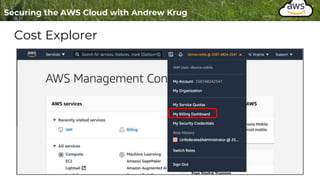
Cost Explorer
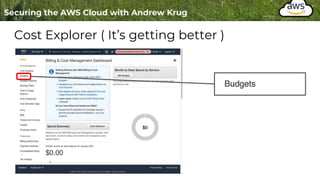
Cost Explorer ( It’s getting better )
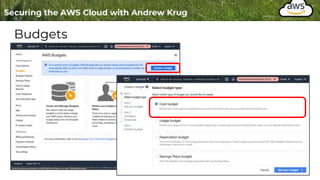
Budgets
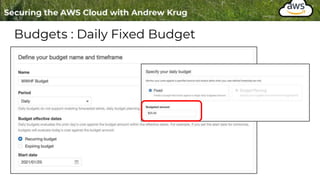
Budgets : Daily Fixed Budget
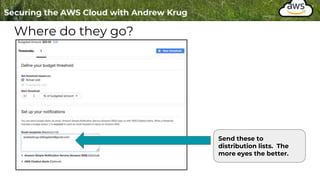
Where do they go?
Send these to
distribution lists. The
more eyes the better.
Don’t skip this in your lab
● You are responsible for the costs you
incur during the class.
● If you don’t monitor it you’ll probably
have a bad time.
What did we do?
● Looked at budgets
● Daily spend budget
based on actual cost
● Set an alert email
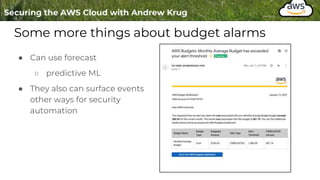
Some more things about budget alarms
● Can use forecast
○ predictive ML
● They also can surface events
other ways for security
automation
Let’s add a sprinkle of DevOps
Q: Can I form these
alarms with software?
A: Absolutely!
Cloudformation,
Terraform, SDK, CDK
all work.
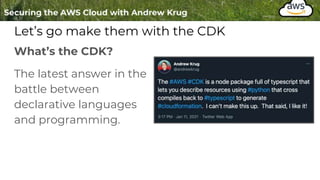
Let’s go make them with the CDK
What’s the CDK?
The latest answer in the
battle between
declarative languages
and programming.
CDK Provided in the course VM
npm install -g aws-cdk
At your own risk.
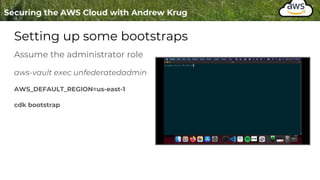
Setting up some bootstraps
Assume the administrator role
aws-vault exec unfederatedadmin
AWS_DEFAULT_REGION=us-east-1
cdk bootstrap
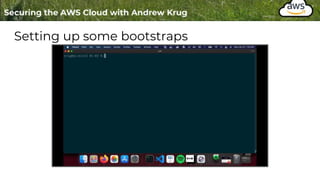
Setting up some bootstraps
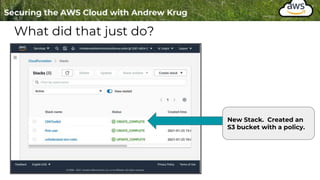
What did that just do?
New Stack. Created an
S3 bucket with a policy.
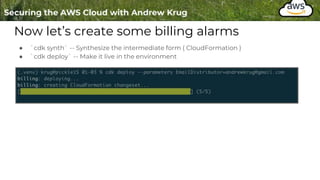
Now let’s create some billing alarms
● `cdk synth` -- Synthesize the intermediate form ( CloudFormation )
● `cdk deploy` -- Make it live in the environment
This is cool because ...
cdk deploy is idempotent
Idempotent - we can run it as many times as we
want and get the same result.
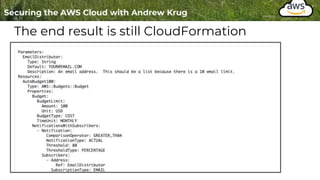
The end result is still CloudFormation
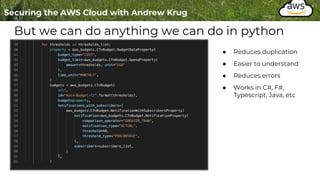
But we can do anything we can do in python
● Reduces duplication
● Easier to understand
● Reduces errors
● Works in C#, F#,
Typescript, Java, etc
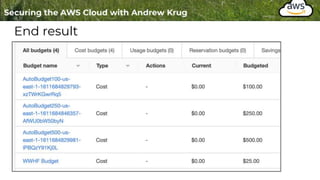
End result
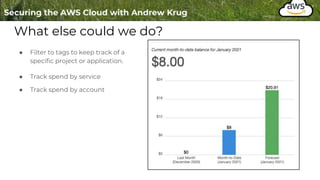
What else could we do?
● Filter to tags to keep track of a
specific project or application.
● Track spend by service
● Track spend by account
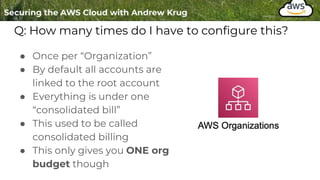
Q: How many times do I have to configure this?
● Once per “Organization”
● By default all accounts are
linked to the root account
● Everything is under one
“consolidated bill”
● This used to be called
consolidated billing
● This only gives you ONE org
budget though
What this doesn’t do?
● Detect granular low cost abuse
● Detect increase x% in spend
○ Maybe you can write a security automation!
● Alert quickly
Questions
Get the AWS CDK setup and practice inspecting it’s output
Instructions are available in labs/03 in the course supplement.
Coming Up
Get the AWS CDK setup and practice inspecting it’s output
Instructions are available in labs/01-03 in the course supplement.

003 - Billing -- hide01.ir.pptx

  • 1.
    Level 1 Foundations ofCloud Security
  • 2.
    Lesson 3 -Paying your Cloud Bills Objective 3: ● Tour cost explorer ● Understand budgets and budget alarms ● Use budgeting as an early warning system
  • 3.
    Billing Sounds Boring ●Your bill is an indicator of compromise you get for “free” ● Often overlooked by security teams ● Goes to a contact no longer with the organization ● Sometimes goes to an Amazon Shopping email
  • 4.
  • 5.
    Cost Explorer (It’s getting better )
  • 6.
  • 7.
    Budgets : DailyFixed Budget
  • 8.
    Where do theygo? Send these to distribution lists. The more eyes the better.
  • 9.
    Don’t skip thisin your lab ● You are responsible for the costs you incur during the class. ● If you don’t monitor it you’ll probably have a bad time.
  • 10.
    What did wedo? ● Looked at budgets ● Daily spend budget based on actual cost ● Set an alert email
  • 11.
    Some more thingsabout budget alarms ● Can use forecast ○ predictive ML ● They also can surface events other ways for security automation
  • 12.
    Let’s add asprinkle of DevOps Q: Can I form these alarms with software? A: Absolutely! Cloudformation, Terraform, SDK, CDK all work.
  • 13.
    Let’s go makethem with the CDK What’s the CDK? The latest answer in the battle between declarative languages and programming.
  • 14.
    CDK Provided inthe course VM npm install -g aws-cdk At your own risk.
  • 15.
    Setting up somebootstraps Assume the administrator role aws-vault exec unfederatedadmin AWS_DEFAULT_REGION=us-east-1 cdk bootstrap
  • 16.
    Setting up somebootstraps
  • 17.
    What did thatjust do? New Stack. Created an S3 bucket with a policy.
  • 18.
    Now let’s createsome billing alarms ● `cdk synth` -- Synthesize the intermediate form ( CloudFormation ) ● `cdk deploy` -- Make it live in the environment
  • 19.
    This is coolbecause ... cdk deploy is idempotent Idempotent - we can run it as many times as we want and get the same result.
  • 20.
    The end resultis still CloudFormation
  • 21.
    But we cando anything we can do in python ● Reduces duplication ● Easier to understand ● Reduces errors ● Works in C#, F#, Typescript, Java, etc
  • 22.
  • 23.
    What else couldwe do? ● Filter to tags to keep track of a specific project or application. ● Track spend by service ● Track spend by account
  • 24.
    Q: How manytimes do I have to configure this? ● Once per “Organization” ● By default all accounts are linked to the root account ● Everything is under one “consolidated bill” ● This used to be called consolidated billing ● This only gives you ONE org budget though
  • 25.
    What this doesn’tdo? ● Detect granular low cost abuse ● Detect increase x% in spend ○ Maybe you can write a security automation! ● Alert quickly
  • 26.
    Questions Get the AWSCDK setup and practice inspecting it’s output Instructions are available in labs/03 in the course supplement.
  • 27.
    Coming Up Get theAWS CDK setup and practice inspecting it’s output Instructions are available in labs/01-03 in the course supplement.