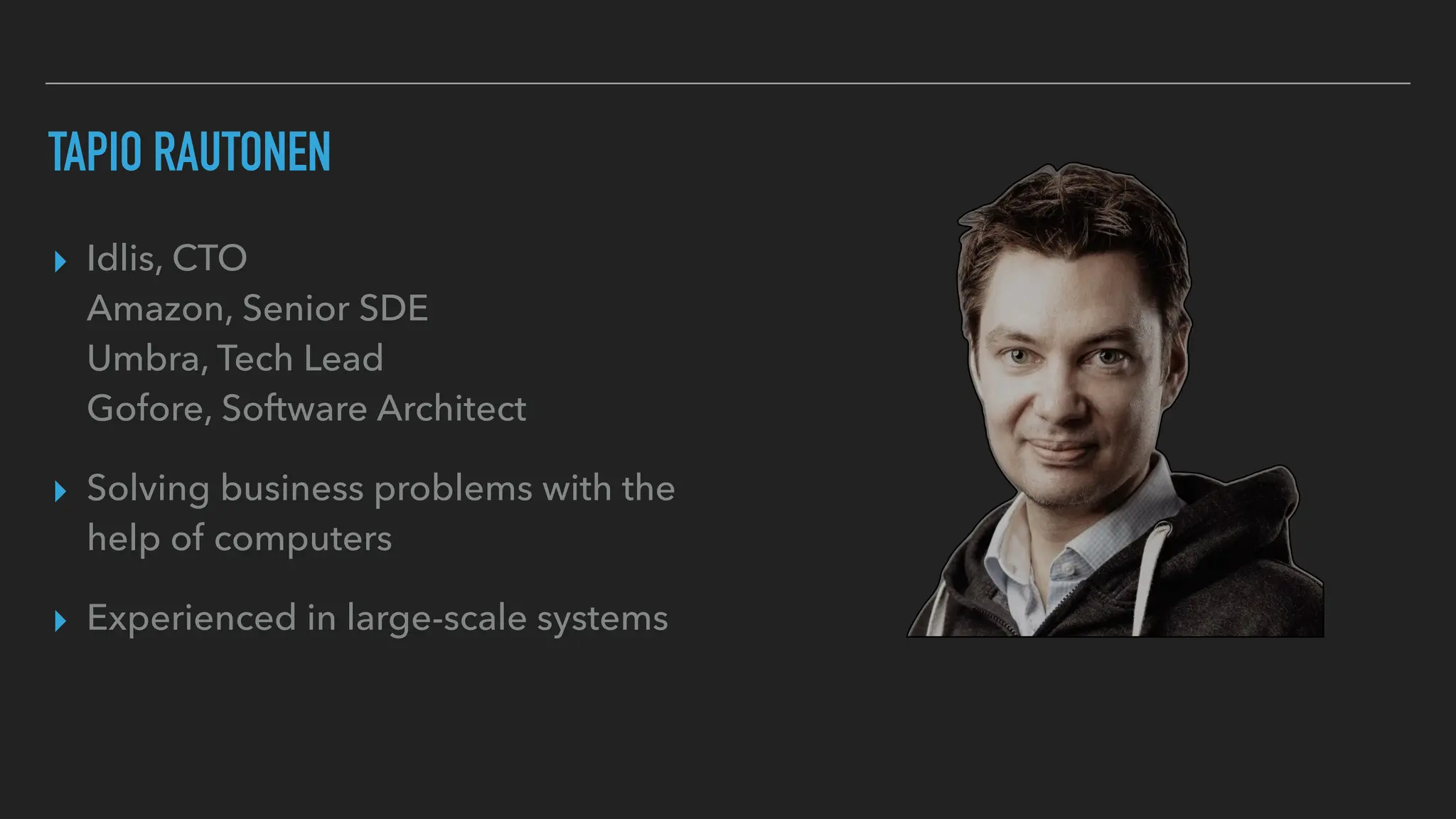
TAPIO RAUTONEN
▸ Idlis, CTO
Amazon, Senior SDE
Umbra, Tech Lead
Gofore, Software Architect
▸ Solving business problems with the
help of computers
▸ Experienced in large-scale systems
CUSTOM RESOURCES
DEEP DIVE INTO CDK
THE GOOD, THE BAD AND THE UGLY
▸ CDK vs CloudFormation
▸ What custom resources are
▸ Why you (or CDK constructs) need them
▸ Things you should and should not know
▸ Best practices to follow
CDK VS CLOUDFORMATION
CLOUDFORMATION
▸ Declarative approach to de
fi
ning infrastructure (YAML / JSON)
▸ Enables consistency and version control through reusable templates
▸ Limited logic control (conditions, mappings, outputs)
▸ Dif
fi
cult to manage large-scale infrastructure
▸ Awful to read and write
TEXT
CLOUD DEVELOPMENT KIT (CDK)
▸ High-level constructs and abstractions to simplify resource de
fi
nitions
▸ Supports complex logic and control structures
▸ Leverages familiar programming languages (TypeScript, Python, Go, etc.)
▸ Developer friendly and better productivity
▸ Essentially a YAML generator
CUSTOM RESOURCES
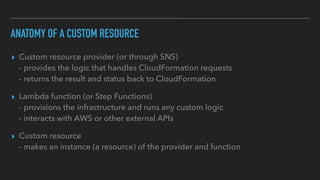
ANATOMY OF A CUSTOM RESOURCE
▸ Custom resource provider (or through SNS)
- provides the logic that handles CloudFormation requests
- returns the result and status back to CloudFormation
▸ Lambda function (or Step Functions)
- provisions the infrastructure and runs any custom logic
- interacts with AWS or other external APIs
▸ Custom resource
- makes an instance (a resource) of the provider and function
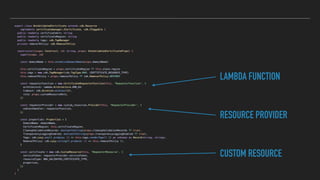
LAMBDA FUNCTION
RESOURCE PROVIDER
CUSTOM RESOURCE
CUSTOM RESOURCE LIFECYCLE
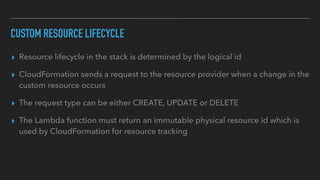
▸ Resource lifecycle in the stack is determined by the logical id
▸ CloudFormation sends a request to the resource provider when a change in the
custom resource occurs
▸ The request type can be either CREATE, UPDATE or DELETE
▸ The Lambda function must return an immutable physical resource id which is
used by CloudFormation for resource tracking
CREATE EVENT
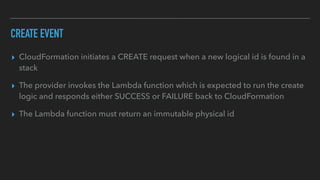
▸ CloudFormation initiates a CREATE request when a new logical id is found in a
stack
▸ The provider invokes the Lambda function which is expected to run the create
logic and responds either SUCCESS or FAILURE back to CloudFormation
▸ The Lambda function must return an immutable physical id
UPDATE EVENT
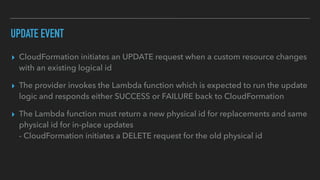
▸ CloudFormation initiates an UPDATE request when a custom resource changes
with an existing logical id
▸ The provider invokes the Lambda function which is expected to run the update
logic and responds either SUCCESS or FAILURE back to CloudFormation
▸ The Lambda function must return a new physical id for replacements and same
physical id for in-place updates
- CloudFormation initiates a DELETE request for the old physical id
DELETE EVENT
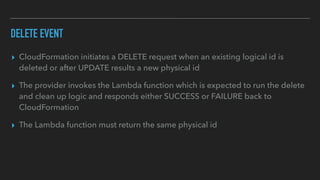
▸ CloudFormation initiates a DELETE request when an existing logical id is
deleted or after UPDATE results a new physical id
▸ The provider invokes the Lambda function which is expected to run the delete
and clean up logic and responds either SUCCESS or FAILURE back to
CloudFormation
▸ The Lambda function must return the same physical id
WHY YOU NEED THEM
CDK USES CUSTOM RESOURCES INTERNALLY
▸ CloudFormation does not support all use cases that are considered very useful
to infrastructure maintainers
▸ Handful of internal constructs use custom resources to extend CloudFormation
functionality
- S3 auto delete objects
- Route53 cross account zone delegation
- DynamoDB multi-region replication
- CDK cross region export reader
...
CROSS ACCOUNT / REGION OPERATIONS
▸ CloudFormation does not play nicely when provisioning needs to be done on
different account or region of where the stack resides
▸ Generally AWS and CDK teams discourage these kinds of operations, but due
to how AWS is built sometimes you need to cross the boundaries
▸ E.g. The infamous us-east-1 certi
fi
cates for CloudFront
TEXT
EXTEND CDK OR CLOUDFORMATION
▸ CloudFormation does not support all AWS services that might still have APIs
▸ CDK does not support all services that CloudFormation supports
▸ CDK implementation might be missing a critical feature
▸ E.g. CloudFront Origin Access Control or Bedrock
AUTOMATE RESOURCES BEYOND AWS
▸ Interact with 3rd party services or APIs
▸ Provision non-AWS infrastructure
▸ E.g. issue licenses, certi
fi
cate validation for 3rd party DNS provider or provision
external CDN like Cloud
fl
are
POST-DEPLOYMENT TASKS
▸ When a resource is deployed it might need some con
fi
guration or initialization
after the fact
▸ Execute external work
fl
ows after a successful or failed deployment
▸ E.g. database migration, asset deployment or trigger monitoring system
THINGS YOU SHOULD AND
SHOULD NOT KNOW
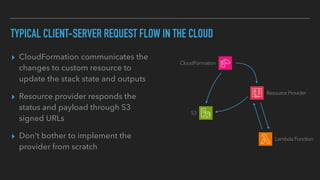
TYPICAL CLIENT-SERVER REQUEST FLOW IN THE CLOUD
▸ CloudFormation communicates the
changes to custom resource to
update the stack state and outputs
CloudFormation
LambdaFunction
S3
ResourceProvider
▸ Resource provider responds the
status and payload through S3
signed URLs
▸ Don't bother to implement the
provider from scratch
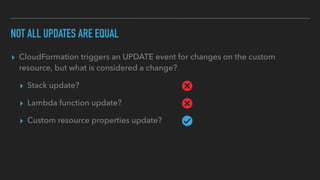
NOT ALL UPDATES ARE EQUAL
▸ CloudFormation triggers an UPDATE event for changes on the custom
resource, but what is considered a change?
▸ Stack update?
▸ Lambda function update?
▸ Custom resource properties update?
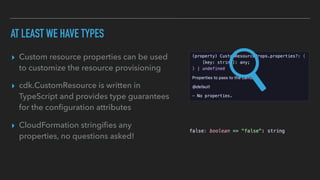
AT LEAST WE HAVE TYPES
▸ Custom resource properties can be used
to customize the resource provisioning
▸ cdk.CustomResource is written in
TypeScript and provides type guarantees
for the con
fi
guration attributes
▸ CloudFormation stringi
fi
es any
properties, no questions asked!
BEST PRACTICES TO FOLLOW
IDENTIFY YOUR RESOURCES
▸ Custom resources can be given custom resource type to differentiate the types
of custom resources in a stack
- use a speci
fi
c type like Custom::DnsValidatedCerti
fi
cate
▸ Resources provisioned by the custom resource cannot be identi
fi
ed easily
- can be easily mixed with manually created resources
- use tags wisely and create a convention to identify the resources
TAKE SECURITY SERIOUSLY
▸ Principle of least privilege access
- ensure the lambda role has minimum permissions to perform its tasks
▸ Can expose a security loophole by lambda invokes
- limit users who have permission to lambda invoke
▸ Secure secret management
- don't hardcode secrets, use Secrets Manager or Parameter Store
▸ Validate all input properties
MAKE YOUR CUSTOM RESOURCES IDEMPOTENT
▸ React correctly to CloudFormation events
- use same physical id for in-place updates and return new for replaces
- clean up resources on delete
▸ If an error occurs, the lambda function might be retried
- don't create duplicate resources on retried creates
- don't try to delete already deleted resources
▸ The physical id given for delete depends on CloudFormation update status
- old resource id on success, new resource on failure
SET CORRECT TIMEOUT EXPECTATIONS
▸ Misbehaving custom resource can stall the stack update for a long time
▸ Set the lambda function timeout according to expected provisioning time (max
15 minutes)
▸ Set the custom resource service timeout based on the lambda function timeout
and expected provisioning time (max 1 hour)
▸ Implement long running provisioning tasks using Step Functions
WHAT WAS ACTUALLY GENERATED AND WAS IT NECESSARY?
▸ As said earlier: CDK is essentially a YAML generator
▸ Read and review the synthesized output
▸ Learn from the CDK internal custom resources
▸ Think twice or rather 10 times before using a custom resource

Deep dive into AWS CDK custom resources by Tapio Rautonen

  • 1.
    TAPIO RAUTONEN ▸ Idlis,CTO Amazon, Senior SDE Umbra, Tech Lead Gofore, Software Architect ▸ Solving business problems with the help of computers ▸ Experienced in large-scale systems
  • 2.
  • 3.
    THE GOOD, THEBAD AND THE UGLY ▸ CDK vs CloudFormation ▸ What custom resources are ▸ Why you (or CDK constructs) need them ▸ Things you should and should not know ▸ Best practices to follow
  • 4.
  • 5.
    CLOUDFORMATION ▸ Declarative approachto de fi ning infrastructure (YAML / JSON) ▸ Enables consistency and version control through reusable templates ▸ Limited logic control (conditions, mappings, outputs) ▸ Dif fi cult to manage large-scale infrastructure ▸ Awful to read and write
  • 6.
    TEXT CLOUD DEVELOPMENT KIT(CDK) ▸ High-level constructs and abstractions to simplify resource de fi nitions ▸ Supports complex logic and control structures ▸ Leverages familiar programming languages (TypeScript, Python, Go, etc.) ▸ Developer friendly and better productivity ▸ Essentially a YAML generator
  • 7.
  • 8.
    ANATOMY OF ACUSTOM RESOURCE ▸ Custom resource provider (or through SNS) - provides the logic that handles CloudFormation requests - returns the result and status back to CloudFormation ▸ Lambda function (or Step Functions) - provisions the infrastructure and runs any custom logic - interacts with AWS or other external APIs ▸ Custom resource - makes an instance (a resource) of the provider and function
  • 9.
  • 10.
    CUSTOM RESOURCE LIFECYCLE ▸Resource lifecycle in the stack is determined by the logical id ▸ CloudFormation sends a request to the resource provider when a change in the custom resource occurs ▸ The request type can be either CREATE, UPDATE or DELETE ▸ The Lambda function must return an immutable physical resource id which is used by CloudFormation for resource tracking
  • 11.
    CREATE EVENT ▸ CloudFormationinitiates a CREATE request when a new logical id is found in a stack ▸ The provider invokes the Lambda function which is expected to run the create logic and responds either SUCCESS or FAILURE back to CloudFormation ▸ The Lambda function must return an immutable physical id
  • 12.
    UPDATE EVENT ▸ CloudFormationinitiates an UPDATE request when a custom resource changes with an existing logical id ▸ The provider invokes the Lambda function which is expected to run the update logic and responds either SUCCESS or FAILURE back to CloudFormation ▸ The Lambda function must return a new physical id for replacements and same physical id for in-place updates - CloudFormation initiates a DELETE request for the old physical id
  • 13.
    DELETE EVENT ▸ CloudFormationinitiates a DELETE request when an existing logical id is deleted or after UPDATE results a new physical id ▸ The provider invokes the Lambda function which is expected to run the delete and clean up logic and responds either SUCCESS or FAILURE back to CloudFormation ▸ The Lambda function must return the same physical id
  • 14.
  • 15.
    CDK USES CUSTOMRESOURCES INTERNALLY ▸ CloudFormation does not support all use cases that are considered very useful to infrastructure maintainers ▸ Handful of internal constructs use custom resources to extend CloudFormation functionality - S3 auto delete objects - Route53 cross account zone delegation - DynamoDB multi-region replication - CDK cross region export reader ...
  • 16.
    CROSS ACCOUNT /REGION OPERATIONS ▸ CloudFormation does not play nicely when provisioning needs to be done on different account or region of where the stack resides ▸ Generally AWS and CDK teams discourage these kinds of operations, but due to how AWS is built sometimes you need to cross the boundaries ▸ E.g. The infamous us-east-1 certi fi cates for CloudFront
  • 17.
    TEXT EXTEND CDK ORCLOUDFORMATION ▸ CloudFormation does not support all AWS services that might still have APIs ▸ CDK does not support all services that CloudFormation supports ▸ CDK implementation might be missing a critical feature ▸ E.g. CloudFront Origin Access Control or Bedrock
  • 18.
    AUTOMATE RESOURCES BEYONDAWS ▸ Interact with 3rd party services or APIs ▸ Provision non-AWS infrastructure ▸ E.g. issue licenses, certi fi cate validation for 3rd party DNS provider or provision external CDN like Cloud fl are
  • 19.
    POST-DEPLOYMENT TASKS ▸ Whena resource is deployed it might need some con fi guration or initialization after the fact ▸ Execute external work fl ows after a successful or failed deployment ▸ E.g. database migration, asset deployment or trigger monitoring system
  • 20.
    THINGS YOU SHOULDAND SHOULD NOT KNOW
  • 21.
    TYPICAL CLIENT-SERVER REQUESTFLOW IN THE CLOUD ▸ CloudFormation communicates the changes to custom resource to update the stack state and outputs CloudFormation LambdaFunction S3 ResourceProvider ▸ Resource provider responds the status and payload through S3 signed URLs ▸ Don't bother to implement the provider from scratch
  • 22.
    NOT ALL UPDATESARE EQUAL ▸ CloudFormation triggers an UPDATE event for changes on the custom resource, but what is considered a change? ▸ Stack update? ▸ Lambda function update? ▸ Custom resource properties update?
  • 23.
    AT LEAST WEHAVE TYPES ▸ Custom resource properties can be used to customize the resource provisioning ▸ cdk.CustomResource is written in TypeScript and provides type guarantees for the con fi guration attributes ▸ CloudFormation stringi fi es any properties, no questions asked!
  • 24.
  • 25.
    IDENTIFY YOUR RESOURCES ▸Custom resources can be given custom resource type to differentiate the types of custom resources in a stack - use a speci fi c type like Custom::DnsValidatedCerti fi cate ▸ Resources provisioned by the custom resource cannot be identi fi ed easily - can be easily mixed with manually created resources - use tags wisely and create a convention to identify the resources
  • 26.
    TAKE SECURITY SERIOUSLY ▸Principle of least privilege access - ensure the lambda role has minimum permissions to perform its tasks ▸ Can expose a security loophole by lambda invokes - limit users who have permission to lambda invoke ▸ Secure secret management - don't hardcode secrets, use Secrets Manager or Parameter Store ▸ Validate all input properties
  • 27.
    MAKE YOUR CUSTOMRESOURCES IDEMPOTENT ▸ React correctly to CloudFormation events - use same physical id for in-place updates and return new for replaces - clean up resources on delete ▸ If an error occurs, the lambda function might be retried - don't create duplicate resources on retried creates - don't try to delete already deleted resources ▸ The physical id given for delete depends on CloudFormation update status - old resource id on success, new resource on failure
  • 28.
    SET CORRECT TIMEOUTEXPECTATIONS ▸ Misbehaving custom resource can stall the stack update for a long time ▸ Set the lambda function timeout according to expected provisioning time (max 15 minutes) ▸ Set the custom resource service timeout based on the lambda function timeout and expected provisioning time (max 1 hour) ▸ Implement long running provisioning tasks using Step Functions
  • 29.
    WHAT WAS ACTUALLYGENERATED AND WAS IT NECESSARY? ▸ As said earlier: CDK is essentially a YAML generator ▸ Read and review the synthesized output ▸ Learn from the CDK internal custom resources ▸ Think twice or rather 10 times before using a custom resource