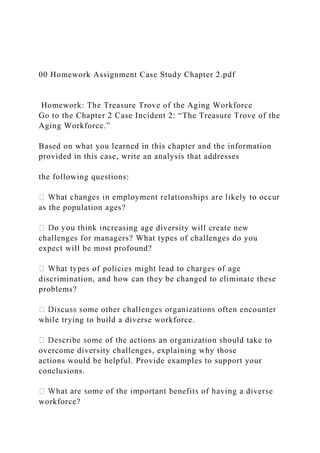
00 Homework Assignment Case Study Chapter 2.pdf
Homework: The Treasure Trove of the Aging Workforce
Go to the Chapter 2 Case Incident 2: “The Treasure Trove of the
Aging Workforce.”
Based on what you learned in this chapter and the information
provided in this case, write an analysis that addresses
the following questions:
as the population ages?
asing age diversity will create new
challenges for managers? What types of challenges do you
expect will be most profound?
discrimination, and how can they be changed to eliminate these
problems?
while trying to build a diverse workforce.
overcome diversity challenges, explaining why those
actions would be helpful. Provide examples to support your
conclusions.
workforce?
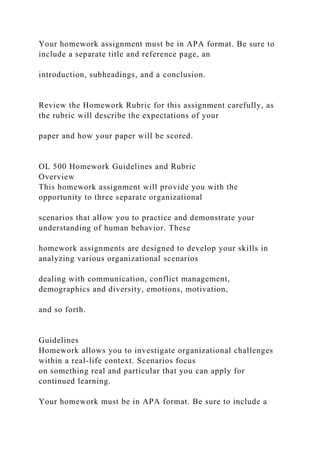
Your homework assignment must be in APA format. Be sure to
include a separate title and reference page, an
introduction, subheadings, and a conclusion.
Review the Homework Rubric for this assignment carefully, as
the rubric will describe the expectations of your
paper and how your paper will be scored.
OL 500 Homework Guidelines and Rubric
Overview
This homework assignment will provide you with the
opportunity to three separate organizational
scenarios that allow you to practice and demonstrate your
understanding of human behavior. These
homework assignments are designed to develop your skills in
analyzing various organizational scenarios
dealing with communication, conflict management,
demographics and diversity, emotions, motivation,
and so forth.
Guidelines
Homework allows you to investigate organizational challenges
within a real-life context. Scenarios focus
on something real and particular that you can apply for
continued learning.
Your homework must be in APA format. Be sure to include a
separate title and reference page, an
introduction, subheadings, and a conclusion. The requirements
for this assignment are 2 to 4 pages in
length (not including title and reference pages), double spaced,
12-point Times New Roman font, 1-
inch margins, and discipline-appropriate citations.
Instructor feedback:
Critical Elements Exemplary Proficient
Summary of Scenario Accurately summarizes main
elements with sufficient details
in a concise fashion and is able
to connect with own analysis
(23-25)
Accurately summarizes main
elements with sufficient details
and is able to connect with own
analysis
(20-22)
http://www.mymanagementlab.com/
Analysis of the
Organizational Issue
Explores multiple issues
through extensive collection
and in-depth analysis of
evidence to make informed
conclusions
(23-25)
Explores some issues through
collection and in-depth analysis
of evidence to make informed
conclusions
(20-22)
Application Applies all of the course
concepts correctly within the
analysis
(18-20)
Applies most of the course
concepts correctly within the
analysis
(16-17)
Critical Thinking Demonstrates comprehensive
exploration of issues and ideas
before accepting or forming an
opinion or conclusion
(18-20)
Demonstrates moderate
exploration of issues and ideas
before accepting or forming an
opinion or conclusion
(16-17)
Articulation of
Response
Submission is free of errors
related to citations, grammar,
syntax, and organization and is
presented in a professional and
easy-to-read format
(9-10)
Submission has no major errors
related to citations, grammar,
syntax, or organization
(8)
100%
01 OL_500_Homework_Rubric.pdf
OL 500 Homework Guidelines and Rubric
Overview
These homework assignments will provide you with the
opportunity to three separate organizational scenarios that allow
you to practice and demonstrate your
understanding of human behavior. These homework assignments
are designed to develop your skills in analyzing various
organizational scenarios dealing with
communication, conflict management, demographics and
diversity, emotions, motivation, and so forth.
Guidelines
Homework allows you to investigate organizational challenges
within a real-life context. Scenarios focus on something real
and particular that you can apply for
continued learning.
Your homework must be in APA format. Be sure to include a
separate title and reference page, an introduction, subheadings,
and a conclusion. The
requirements for this assignment are 2 to 4 pages in length (not
including title and reference pages), double spaced, 12-point
Times New Roman font, 1-inch
margins, and discipline-appropriate citations.
Instructor feedback: Students can find their feedback in
Turnitin.
Critical Elements Exemplary Proficient Needs Improvement
Not Evident Value
Summary of Scenario Accurately summarizes main
elements with sufficient details
in a concise fashion and is able
to connect with own analysis
(23-25)
Accurately summarizes main
elements with sufficient details
and is able to connect with own
analysis
(20-22)
Summarizes main elements
with sufficient details but with
insufficient detail to connect
with own analysis
(18-19)
Does not summarize the main
elements and does not connect
with one’s own analysis
(0-17)
25
Analysis of the
Organizational Issue
Explores multiple issues
through extensive collection
and in-depth analysis of
evidence to make informed
conclusions
(23-25)
Explores some issues through
collection and in-depth analysis
of evidence to make informed
conclusions
(20-22)
Explores minimal issues
through collection and analysis
of evidence to make informed
conclusions
(18-19)
Does not explore issues
through collection and analysis
of evidence and does not make
informed conclusions
(0-17)
25
Application Applies all of the course
concepts correctly within the
analysis
(18-20)
Applies most of the course
concepts correctly within the
analysis
(16-17)
Applies some of the course
concepts correctly within the
analysis
(14-15)
Does not correctly apply any of
the course concepts within the
analysis
(0-13)
20
Critical Thinking Demonstrates comprehensive
exploration of issues and ideas
before accepting or forming an
opinion or conclusion
(18-20)
Demonstrates moderate
exploration of issues and ideas
before accepting or forming an
opinion or conclusion
(16-17)
Demonstrates minimal
exploration of issues and ideas
before accepting or forming an
opinion or conclusion
(14-15)
Does not demonstrate
exploration of issues and ideas
before accepting or forming an
opinion or conclusion
(0-13)
20
Articulation of
Response
Submission is free of errors
related to citations, grammar,
syntax, and organization and is
presented in a professional and
easy-to-read format
(9-10)
Submission has no major errors
related to citations, grammar,
syntax, or organization
(8)
Submission has major errors
related to citations, grammar,
syntax, and organization that
negatively impact readability
and articulation of main ideas
(7)
Submission has critical errors
related to citations, grammar,
syntax, or organization that
prevent understanding of ideas
(0-6)
10
Earned Total
Comments:
100%
02 APA Formatting Cheat Sheet for Page Layout.pdf
APA “Cheat Sheet” for Formatting
Professor Erin Perry
APA is pretty strict about how your paper needs to be set up.
The margins, the font and font size,
the placement of your information on the title page, even the
line spacing and how you indent
your paragraphs: all of these need to be set up to APA
standards. When they are, you will have a
professional-looking paper. Get to know these tools from the
start, and get in the good habit of
setting up your paper to fit the criteria.
You may need to do a quick Google search to find the
formatting tools that fit your program.
Font and Font Size
1. Your must use a serif font, such as Times New Roman.
2. You must use 12-point font.
Line Spacing/Paragraphs
1. Before you start typing ANYTHING, set your line spacing
and paragraph spacing.
2. Line spacing must be set to Double.
3. There can be no spaces between paragraphs. In Word, you
can turn this feature off by
going to Page Layout and selecting the pop-out box under
“Paragraph.” Check the box
that says “Don’t Add Space Between Paragraphs.”
4. You will indent the first line of each paragraph by one “tab”
key stroke.
Page Breaks
1. Between key elements of your paper, you will insert a page
break. This ensures that
thenext section of the paper is always aligned at the top of the
following page. You will
need to insert a page break at the end of the text on the:
a. Title page (before the Abstract page)
b. Abstract (before the body text page)
c. Body text (before the References page)
Page Titles
1. Your paper’s title will be centered at the top of the first body
text page, and will be in the
same font/size as your text. It will not be in bold. You will not
use any extra line spaces
after this title.
2. References and Abstract will be centered at the top of their
pages, no bold or underline.
There will be no additional line spaces before or after these
titles.
Title Page
1. Your title page information must be centered, half-way down
the page. Your information
will be as follows, and will of course be double-spaced:
Your Title
Your Name
Granite State College
Abstract
1. Your abstract is optional. It is a short piece that introduces
the reader to the purpose of
your paper. It should be no longer than 3-5 sentences, and it
may include the methods
your paper will employ to make your point.
References Page
1. Your references page will have the heading References
centered at the top, with no
additional line spaces following. All text will be in the same
font and size as the rest of
your paper.
2. Your references will be listed alphabetically by first word.
3. You will use a hanging indent for your reference list.
Headers
1. Headers are required, and must be formatted from within the
header bar, NOT in the
body of the text. Use the “Header” feature to enter your
information, and be sure to select
“Different First Page” to set up your title page header.
2. Headers must be the same font and font size as the body text.
3. Your title page header must say (including capital letters):
Running Head: YOUR PAPER TITLE
[of course, you’ll insert your actual title there. This may be
abbreviated to the most
crucial elements of the title if you have a long title.].
4. All headers from page two through the final (References)
page of the paper will say only:
YOUR PAPER TITLE
[of course, the title will be yours, and will match the running
head title if you
abbreviated].
5. This title in the header will be aligned to the LEFT.
6. A page number (just the number, no p.) will be aligned to the
RIGHT.
At no time is it allowable to use decorative templates for your
paper.
Avoid using the auto-formatting features included with word
processors. They average 3 errors
per paper, and they disallow your full learning and
understanding of the purpose of APA, so that
when you are required to fix your error, you will not understand
how to do so. Instead, find a
current style manual (APA 6th edition) or use the Owl at Purdue
as a guide. Once you
understand how APA works, it will be a fairly simple matter to
write strong, professional papers
using this citation style.
Pearson eText 1.pdf
Pearson eText 10.pdf
Pearson eText 11.pdf
Pearson eText 12.pdf
Pearson eText 13 (Case Study).pdf
Pearson eText 2.pdf
Pearson eText 3.pdf
Pearson eText 4.pdf
Pearson eText 5.pdf
Pearson eText 6.pdf
Pearson eText 7.pdf
Pearson eText 8.pdf
Pearson eText 9.pdf

00 Homework Assignment Case Study Chapter 2.pdf Homework .docx

  • 1.
    00 Homework AssignmentCase Study Chapter 2.pdf Homework: The Treasure Trove of the Aging Workforce Go to the Chapter 2 Case Incident 2: “The Treasure Trove of the Aging Workforce.” Based on what you learned in this chapter and the information provided in this case, write an analysis that addresses the following questions: as the population ages? asing age diversity will create new challenges for managers? What types of challenges do you expect will be most profound? discrimination, and how can they be changed to eliminate these problems? while trying to build a diverse workforce. overcome diversity challenges, explaining why those actions would be helpful. Provide examples to support your conclusions. workforce?
  • 2.
    Your homework assignmentmust be in APA format. Be sure to include a separate title and reference page, an introduction, subheadings, and a conclusion. Review the Homework Rubric for this assignment carefully, as the rubric will describe the expectations of your paper and how your paper will be scored. OL 500 Homework Guidelines and Rubric Overview This homework assignment will provide you with the opportunity to three separate organizational scenarios that allow you to practice and demonstrate your understanding of human behavior. These homework assignments are designed to develop your skills in analyzing various organizational scenarios dealing with communication, conflict management, demographics and diversity, emotions, motivation, and so forth. Guidelines Homework allows you to investigate organizational challenges within a real-life context. Scenarios focus on something real and particular that you can apply for continued learning. Your homework must be in APA format. Be sure to include a
  • 3.
    separate title andreference page, an introduction, subheadings, and a conclusion. The requirements for this assignment are 2 to 4 pages in length (not including title and reference pages), double spaced, 12-point Times New Roman font, 1- inch margins, and discipline-appropriate citations. Instructor feedback: Critical Elements Exemplary Proficient Summary of Scenario Accurately summarizes main elements with sufficient details in a concise fashion and is able to connect with own analysis (23-25) Accurately summarizes main elements with sufficient details and is able to connect with own analysis (20-22)
  • 4.
    http://www.mymanagementlab.com/ Analysis of the OrganizationalIssue Explores multiple issues through extensive collection and in-depth analysis of evidence to make informed conclusions (23-25) Explores some issues through collection and in-depth analysis of evidence to make informed conclusions (20-22) Application Applies all of the course concepts correctly within the analysis
  • 5.
    (18-20) Applies most ofthe course concepts correctly within the analysis (16-17) Critical Thinking Demonstrates comprehensive exploration of issues and ideas before accepting or forming an opinion or conclusion (18-20) Demonstrates moderate exploration of issues and ideas before accepting or forming an opinion or conclusion (16-17) Articulation of Response Submission is free of errors
  • 6.
    related to citations,grammar, syntax, and organization and is presented in a professional and easy-to-read format (9-10) Submission has no major errors related to citations, grammar, syntax, or organization (8) 100% 01 OL_500_Homework_Rubric.pdf OL 500 Homework Guidelines and Rubric Overview These homework assignments will provide you with the opportunity to three separate organizational scenarios that allow you to practice and demonstrate your
  • 7.
    understanding of humanbehavior. These homework assignments are designed to develop your skills in analyzing various organizational scenarios dealing with communication, conflict management, demographics and diversity, emotions, motivation, and so forth. Guidelines Homework allows you to investigate organizational challenges within a real-life context. Scenarios focus on something real and particular that you can apply for continued learning. Your homework must be in APA format. Be sure to include a separate title and reference page, an introduction, subheadings, and a conclusion. The requirements for this assignment are 2 to 4 pages in length (not including title and reference pages), double spaced, 12-point Times New Roman font, 1-inch margins, and discipline-appropriate citations. Instructor feedback: Students can find their feedback in Turnitin. Critical Elements Exemplary Proficient Needs Improvement Not Evident Value Summary of Scenario Accurately summarizes main elements with sufficient details in a concise fashion and is able to connect with own analysis (23-25) Accurately summarizes main elements with sufficient details
  • 8.
    and is ableto connect with own analysis (20-22) Summarizes main elements with sufficient details but with insufficient detail to connect with own analysis (18-19) Does not summarize the main elements and does not connect with one’s own analysis (0-17) 25 Analysis of the Organizational Issue Explores multiple issues through extensive collection and in-depth analysis of evidence to make informed conclusions (23-25) Explores some issues through collection and in-depth analysis of evidence to make informed conclusions (20-22)
  • 9.
    Explores minimal issues throughcollection and analysis of evidence to make informed conclusions (18-19) Does not explore issues through collection and analysis of evidence and does not make informed conclusions (0-17) 25 Application Applies all of the course concepts correctly within the analysis (18-20) Applies most of the course concepts correctly within the analysis (16-17) Applies some of the course concepts correctly within the analysis (14-15) Does not correctly apply any of the course concepts within the analysis (0-13)
  • 10.
    20 Critical Thinking Demonstratescomprehensive exploration of issues and ideas before accepting or forming an opinion or conclusion (18-20) Demonstrates moderate exploration of issues and ideas before accepting or forming an opinion or conclusion (16-17) Demonstrates minimal exploration of issues and ideas before accepting or forming an opinion or conclusion (14-15) Does not demonstrate exploration of issues and ideas before accepting or forming an opinion or conclusion (0-13) 20 Articulation of Response Submission is free of errors related to citations, grammar,
  • 11.
    syntax, and organizationand is presented in a professional and easy-to-read format (9-10) Submission has no major errors related to citations, grammar, syntax, or organization (8) Submission has major errors related to citations, grammar, syntax, and organization that negatively impact readability and articulation of main ideas (7) Submission has critical errors related to citations, grammar, syntax, or organization that prevent understanding of ideas (0-6) 10 Earned Total Comments: 100%
  • 12.
    02 APA FormattingCheat Sheet for Page Layout.pdf APA “Cheat Sheet” for Formatting Professor Erin Perry APA is pretty strict about how your paper needs to be set up. The margins, the font and font size, the placement of your information on the title page, even the line spacing and how you indent your paragraphs: all of these need to be set up to APA standards. When they are, you will have a professional-looking paper. Get to know these tools from the start, and get in the good habit of setting up your paper to fit the criteria. You may need to do a quick Google search to find the formatting tools that fit your program. Font and Font Size 1. Your must use a serif font, such as Times New Roman. 2. You must use 12-point font. Line Spacing/Paragraphs 1. Before you start typing ANYTHING, set your line spacing
  • 13.
    and paragraph spacing. 2.Line spacing must be set to Double. 3. There can be no spaces between paragraphs. In Word, you can turn this feature off by going to Page Layout and selecting the pop-out box under “Paragraph.” Check the box that says “Don’t Add Space Between Paragraphs.” 4. You will indent the first line of each paragraph by one “tab” key stroke. Page Breaks 1. Between key elements of your paper, you will insert a page break. This ensures that thenext section of the paper is always aligned at the top of the following page. You will need to insert a page break at the end of the text on the: a. Title page (before the Abstract page) b. Abstract (before the body text page) c. Body text (before the References page) Page Titles 1. Your paper’s title will be centered at the top of the first body text page, and will be in the same font/size as your text. It will not be in bold. You will not use any extra line spaces after this title.
  • 14.
    2. References andAbstract will be centered at the top of their pages, no bold or underline. There will be no additional line spaces before or after these titles. Title Page 1. Your title page information must be centered, half-way down the page. Your information will be as follows, and will of course be double-spaced: Your Title Your Name Granite State College Abstract 1. Your abstract is optional. It is a short piece that introduces the reader to the purpose of your paper. It should be no longer than 3-5 sentences, and it may include the methods your paper will employ to make your point. References Page
  • 15.
    1. Your referencespage will have the heading References centered at the top, with no additional line spaces following. All text will be in the same font and size as the rest of your paper. 2. Your references will be listed alphabetically by first word. 3. You will use a hanging indent for your reference list. Headers 1. Headers are required, and must be formatted from within the header bar, NOT in the body of the text. Use the “Header” feature to enter your information, and be sure to select “Different First Page” to set up your title page header. 2. Headers must be the same font and font size as the body text. 3. Your title page header must say (including capital letters): Running Head: YOUR PAPER TITLE [of course, you’ll insert your actual title there. This may be abbreviated to the most crucial elements of the title if you have a long title.]. 4. All headers from page two through the final (References) page of the paper will say only:
  • 16.
    YOUR PAPER TITLE [ofcourse, the title will be yours, and will match the running head title if you abbreviated]. 5. This title in the header will be aligned to the LEFT. 6. A page number (just the number, no p.) will be aligned to the RIGHT. At no time is it allowable to use decorative templates for your paper. Avoid using the auto-formatting features included with word processors. They average 3 errors per paper, and they disallow your full learning and understanding of the purpose of APA, so that when you are required to fix your error, you will not understand how to do so. Instead, find a current style manual (APA 6th edition) or use the Owl at Purdue as a guide. Once you understand how APA works, it will be a fairly simple matter to write strong, professional papers using this citation style.
  • 17.
    Pearson eText 1.pdf PearsoneText 10.pdf Pearson eText 11.pdf Pearson eText 12.pdf Pearson eText 13 (Case Study).pdf Pearson eText 2.pdf
  • 18.
    Pearson eText 3.pdf PearsoneText 4.pdf Pearson eText 5.pdf Pearson eText 6.pdf Pearson eText 7.pdf Pearson eText 8.pdf
  • 19.