1
NAME__________________
EXAM 1
Directions: Answer the following questions on the attached
sheets of paper. Please adhere
to the following guidelines to reduce any suspicions of
cheating:
1. KEEP YOUR EYES ON YOUR OWN EXAM AT ALL
TIMES.
2. KEEP YOUR ANSWERS COVERED AT ALL TIMES.
3. Do not communicate with any other student during the exam.
4. Do not use any unauthorized prepared material during the
exam.
5. Only acceptable calculators may be used on the exams.
6. Do not leave the room at any time before handing in your
exam.
7. SHOW ALL OF YOUR WORK (answers may not be accepted
without work
shown)
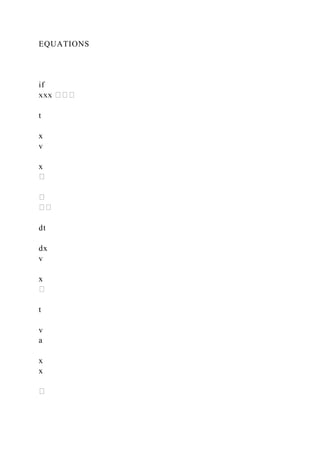
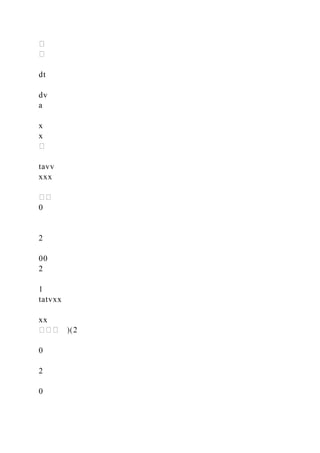
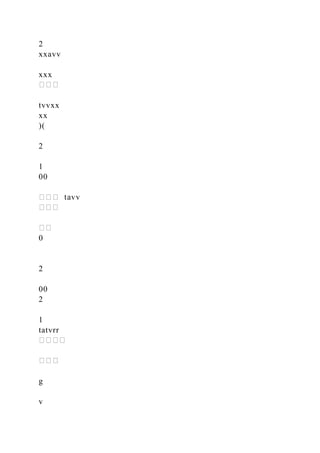
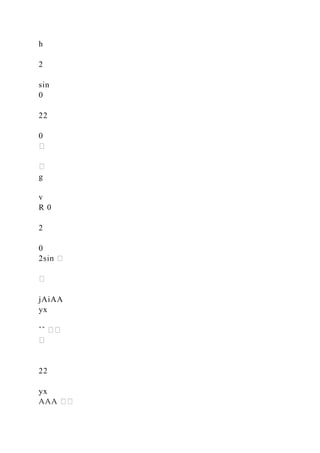
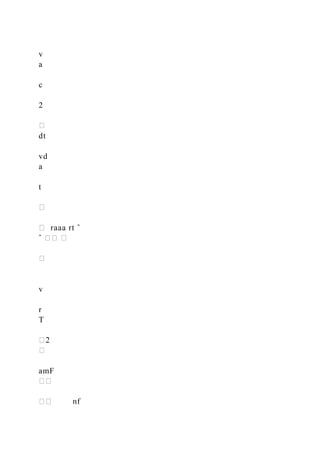
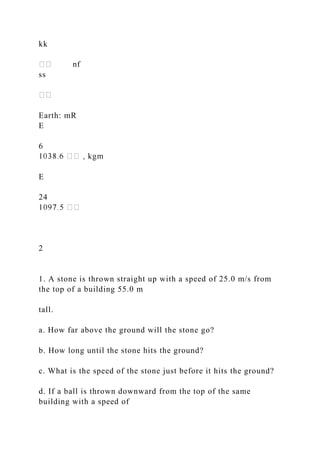
EQUATIONS
if
t
x
v
x
dt
dx
v
x
t
v
a
x
x
dt
dv
a
x
x
tavv
xxx
0
2
00
2
1
tatvxx
xx
0
2
0
2
xxavv
xxx
tvvxx
xx
)(
2
1
00
0
2
00
2
1
tatvrr
g
v
h
2
sin
0
22
0
g
v
R 0
2
0
jAiAA
yx
22
yx
x
y
A
A
1
r
v
a
c
2
dt
vd
a
t
v
r
T
amF
kk
ss
Earth: mR
E
6
E
24
2
1. A stone is thrown straight up with a speed of 25.0 m/s from
the top of a building 55.0 m
tall.
a. How far above the ground will the stone go?
b. How long until the stone hits the ground?
c. What is the speed of the stone just before it hits the ground?
d. If a ball is thrown downward from the top of the same
building with a speed of
25.0 m/s, will its speed just before hitting the ground be greater
than, less than, or
equal to the speed of the stone just before it hits the ground?
Explain. (Hint:
What is the speed of the stone when it returns to the height it
was thrown?)
3
2. A ball is thrown from the top of a building of height 40m at
an angle of 20˚ above the
horizontal and with an initial speed of 15m/s. Use the
assumptions of projectile motion
to answer the following questions.
a. How high above the ground will the ball travel?
b. What speed will the ball have at the maximum height?
c. What is the direction of the velocity of the ball at the
maximum height?
d. How far has the ball traveled horizontally when it hits the
ground?
e. What will be the speed of the ball when it hits the ground?
4
3. Consider the frictionless system below. The pulley is
massless and frictionless, and the
string is massless. The mass of each block is ma = 2.0 kg, mb =
1.0 kg, mc = 2.0 kg, and
md = 1.0 kg.
a. What is the acceleration of the system?
b. What is the tension in the string between block a and block
b?
c. What is the tension in the string between block b and block
c?
d. What is the tension in the string between block c and block
d?
e. If the system is initially at rest, how long will it take block d
to fall 3.0 m?
5
4. Two equal masses of 20kg are attached by a massless string
and are sliding down an
inclined plane of 35˚. The coefficients of kinetic friction
between the blocks and the
ramp are different. The top block has coefficient 700.0
1
k
coefficient 500.0
2
k
. The system accelerates down the plane and the string
remains
tight.
a. Draw a free body diagram for each block.
b. Calculate the tension in the string.
c. Find the magnitude of the acceleration of the blocks.
6
5. A train slows down as it rounds a sharp horizontal turn,
slowing from 25.0 m/s to 13.9
m/s in 15.0 s. The radius of the curve is 150 m.
a. Calculate the magnitude of the tangential component of the
acceleration (assumed
constant).
b. Calculate the magnitude of the radial component of the
acceleration (when the
train reaches 13.9 m/s).
c. Calculate the magnitude of the total acceleration (when the
train reaches 13.9
m/s).
d. Calculate the angle of the total acceleration vector relative to
the radial
component (when the train reaches 13.9 m/s).
Chapter 1
Legal Foundations
McGraw-Hill/Irwin
Copyright © 2011 by The McGraw-Hill Companies, Inc.
All rights reserved.
1-*
Chapter OverviewHow legal issues impact business planning
and strategy.
The foundations, definitions, and scope of various primary and
secondary sources of law.
Classifications of law.
1-*
“THEORY to PRACTICE”
The Melvin Text 2-Step SystemStep 1: developing insight by
understanding legal fundamentals
Step 2: learning to apply legal theories in practice
*
Instructor should consider giving several specific examples of
the application of legal theories in practice. My suggestion
would be to choose your own cases, perhaps from your previous
law practice experience, or the local newspaper to demonstrate
the practical application of theory. The Melvin text uses this
theme throughout the book, so it is worthwhile to spend extra
time on this.
1-*
Law – What is It? Law is a body of rules of action or conduct
prescribed by controlling authority, and having legal binding
force.
1-*
Purposes of LawSystem of order that defines crimes and levies
punishment for violations
System for resolving disputes by providing a basis for deciding
the legal interests and rights of the parties
1-*
Jurisprudence
The philosophy behind the law:
Legal realism (most widely used in U.S.)
Natural law
Positive law
1-*
“Legal Environment” of BusinessLaw serves as an important
catalyst for commerce by promoting good faith dealing among
merchants and consumers.
Law also provides some degree of reliability that can be
considered in business planning and commercial transactions.
1-*
Role of CounselManagers often work closely with a business
attorney.This often results in reduced costs, and limitation of
risk and liability.
1-*
Primary Sources of LawConstitutional law
Statutory law
Common law
Administrative law
1-*
Constitutional LawEstablishes important legal principles
Not designed to specifically resolve every legal issue or case
May require “interpretation” by courts
Exists at state and federal levels
1-*
Statutory LawCreated by a legislative body
Approved or disapproved by the
executive branch
(i.e., governor or president)
Also known as “codes”
1-*
Common LawMade by appellate courts
Based on the fundamentals of
previous cases that had similar facts
Also known as “case” law
1-*
Administrative LawSource of law that regulates the exercise of
authority by government agencies
Also known as “regulations”
1-*
Secondary Sources of LawSecondary sources have no
independent authority, nor are they legally binding.
Include the Restatements of the Law and sets of model statutes
Example: Uniform Commercial Code
1-*
Restatements of the LawCollections of uniform legal principles
in a specific area of law that are designed to reduce the
complexity of judicial decisions.
Common examples of widely used restatements include torts
and contracts.
1-*
Uniform Model StatutesDrafted by legal experts, in hopes that
they will be used or adopted by state legislatures to provide
uniformity in laws between the states.
Examples: UCC, RUPA, MBCA
*
Give examples, e.g.: UCC – Art 2 Sales
1-*
Categories of LawBroad categories based on classifications
related to a particular legal function or a right afforded by law
Helpful in understanding “big picture” of our legal system
1-*
Criminal Law versus Civil LawCivil laws are designed to
compensate parties for losses as a result of another’s conduct.
Criminal laws are a protection of society, and the violation of
criminal laws results in penalties to the violator such as fines or
imprisonment.
1-*
Substantive Law vs Procedural LawSubstantive laws provide
individuals with rights and create certain duties.
Procedural laws provide a structure and set out rules for
pursuing substantive rights.
1-*
Public Law vs Private LawPublic laws are those derived from
some government entity.
Private laws are recognized as binding between two parties even
though no specific statute or regulation provides for the rights
of the parties.
1-*
Law vs EquityWe use the terms law and equity when describing
the appropriate measure of judicial action intended to
compensate an injured party in a civil lawsuit.
These measures are known as legal or equitable remedies.
1-*
Types of RemediesRemedies at law generally take the form of
money damages.
Equitable remedies or relief generally includes an injunction or
restraining order (a judicial order requiring a party to cease a
certain activity, or perhaps to take a specific action).
1-*
Important Equitable MaximumsThese maxims have been
developed by early American courts.
Broad statements of rules that are based on notions of fairness
and justice in applying the law.
1-*
Equity Aids the VigilantThe law favors those who exercise
vigilance in pursuing their claims and disfavors those who rest
on their legal rights by failing to act to protect their rights in a
reasonable period of time.
1-*
Substance over FormWhen applying the law, courts look to the
intent of parties involved and adhere to a standard of good faith
and fair play instead of applying the letter of the law in a way
that would violate fundamental principles of fairness and
consistency.
1-*
Clean Hands DoctrineCourts are guided in their decisions not
only by the letter of the law, but also on the basis that one
seeking the aid of a court must come to the court with clean
hands that are unstained by bad faith, misrepresentations, or
deceit.
1-*
Kauffman-Harmon v. Kauffman
36 P. 3d 408 (Sup. Ct., Mont. 2001)“The doctrine of clean
hands provides that parties must not expect relief in equity,
unless they come into court with clean hands.”
1-*
Case PrecedentOnce an appellate court has decided a particular
case, the decision becomes a case precedent.
Precedent is usually only binding within the jurisdiction of the
court setting the precedent.
1-*
Stare DecisisThe doctrine of stare decisis, one of the most
important concepts in American law, is the principle that
similar cases with similar facts and issues should have the same
judicial outcome.
*
Consider spending additional time on this concept. One could
generate class discussion based on Supreme Court nominee
confirmation hearings, i.e. Bork, or others.
1-*
Advantages of Stare Decisis Allows individuals and business to
have some degree of confidence that the law will remain
reasonably consistent.
Requires all lower courts, such as a trial court, to follow the
case precedent so that any similar case would be decided
according to the precedent.
1-*
Flagiello v. Pennsylvania Hospital 208 A2d 193 (PA
1965)“Stare decisis channels the law. It erects lighthouses and
[flies] the signals of safety…but the principle of stare decisis
does not demand that we follow precedents which shipwreck
justice.”
1-*
learning outcome checklist1 - 1 Understand the broad definition
and origins of law.
1-2 List and explain the purposes of law.
1-3 Explain the importance and benefits of legal awareness for
business owners and managers in creating strategy and adding
value to a company.
1-*
learning outcome checklist1-4 Articulate the role of counsel in
legal decision making in a business context.
1-5 Recognize, explain, and give examples of sources of
American law.
1-6 Differentiate between the concepts of law and equity.
1-*
learning outcome checklist1-7 Understand the legal doctrine of
stare decisis.
1-8 Identify and apply important equitable maxims.
1-9 Classify the law into several broad categories.
Chapter 2
Business
and the Constitution
McGraw-Hill/Irwin
Copyright © 2011 by The McGraw-Hill Companies, Inc.
All rights reserved.
2-*
Chapter OverviewThe structure of the U.S. Constitution and
individual state constitutions, and their respective roles in the
American legal system.
The specific powers granted to the government
in the Constitution.
The protections afforded by the Constitution
in the Bill of Rights and the 14th Amendment.
2-*
Functions of the Constitution(1) establishing a structure for the
federal government and rules for amending the Constitution;
(2) granting specific powers for the different branches of
government;
(3) providing procedural protections for U.S. citizens from
wrongful government actions.
2-*
Structure of the ConstitutionPreambleSeven articles27
amendments
2-*
Overview of Articles I, IIArticle I Establishes the legislative
branch (A Congress composed of the House of Representatives
and the Senate); sets qualifications for members; grants
congressional powers (lawmaking).
Article II Establishes the executive branch (president); sets
qualifications for the presidency; grants executive powers
(enforcement of laws).
2-*
Overview of Articles III, IV, VArticle III Establishes the
judicial branch with a federal system of courts, including a
Supreme Court; grants certain judicial powers.
Article IV Establishes the relationship between the states and
the federal government; describes how to admit new states to
the Union.
Article V Describes the process for amending the Constitution.
2-*
Overview of Articles VI, VIIArticle VI Establishes the
Constitution and federal law as the supreme law of the United
States over any conflicting state law; authorizes the national
debt (Congress may borrow money); public officials must take
an oath to support the Constitution.
Article VII Lists the requirements for ratification of the
Constitution.
2-*
FEDERAL POWERS
The powers that generally impact business owners:
(1) the power to regulate commerce
(2) taxing the citizenry and commercial entities and spending
government funds (tax and spend provisions)
(3) bankruptcy, patents, and copyrights
(4) a more general implied authority to make all laws necessary
for carrying out its enumerated powers
2-*
Constitutional Checks and BalancesThis system of checks and
balances is called the separation of powers.
2-*
Judicial ReviewOne of the central concepts in federal
Constitutional law is the notion that federal courts have the
right to invalidate state or federal laws that are inconsistent
with the U.S. Constitution.
The U.S. Supreme Court is the ultimate judge
2-*
Standards of ReviewCourt classifies the action into one of three
categories of scrutiny:
(1) the rational basis category, or
(2) intermediate-level scrutiny, or
(3) strict scrutiny.
*
Explain that one appeals their case based on “law” rather than
jury’s decision on facts.
2-*
Supremacy Clause and Preemption
U.S. Constitution provides that valid federal laws (those made
pursuant to Congress’s constitutional authority and that are
constitutionally sound) are always supreme to any conflicting
state law
2-*
Cipollone v. Liggett Group, Inc., et al., 505 U.S. 504 (1992)
“Article VI of the Constitution provides that the laws of the
United States shall be the supreme Law of the Land. Thus, [. . .]
it has been settled that state law that conflicts with federal law
is ‘without effect.’
2-*
COMMERCE POWERSCongress’s broadest power is derived
from the Commerce Clause whereby Congress is given the
power to “regulate Commerce among the several states.”
2-*
Application of Commerce PowersCongress has the express
constitutional authority to regulate:(1) channels of interstate
commerce such as railways and highways,(2) the
instrumentalities of interstate commerce such as vehicles used
in shipping, (3) the articles moving in interstate commerce
2-*
Constitutional Restrictions on State Regulation of Commerce
The U.S. Supreme Court has ruled that the mere existence of
congressional commerce powers restricts the states from
discriminating against or unduly burdening interstate commerce.
2-*
Cavel International, Inc. v. Madigan, 500 F.3d 551 (7th Cir.,
2007)
“The state statute regulates even-handedly to effectuate a
legitimate local public interest, and its effects on interstate
commerce are only incidental, it should be upheld unless the
burden imposed on such commerce is clearly excessive in
relation to the putative local benefits.”
*
The next slide gives an example of a valid state law; instructor
might consider also giving an example of an invalid state law.
2-*
TAX AND SPEND POWER
Congress has a far-reaching power to tax the citizenry and to
spend the federal government’s money in any way that promotes
the common defense and general welfare.
2-*
Necessary and Proper ClauseCongress may also place
conditions on the use of federal money in order to achieve some
public policy objective.
Congress generally cites the Necessary and Proper Clause as
authorization to set conditions on the spending.
2-*
CONSTITUTIONAL PROTECTIONSThe Constitution provides
protection for the citizenry from unlawful or repressive acts by
the government.
The Bill of Rights (the first ten amendments) and other
amendments that guarantee the right of due process.
2-*
First Amendment“Congress shall make no law”:
That allows government encroachment in the areas of religion,
press, speech, assembly, and petition of grievances.
*
Explain free speech – the concept that it relates to government
interference and may not exist in private setting.
2-*
Speech by CorporationsCommercial Speech
Political Speech
Which can be regulated?
*
Talk about recent Supreme Court decisions related to this topic,
and how it is now more protected than previously.
2-*
Pagan v. Fruchey and Village of Glendale, 492 F.3d 766 (6th
Cir., 2007)
“Glendale’s attempt to justify its ordinance amounts to
nothing more than a conclusory articulation of governmental
interests.”
2-*
Political Spending and CorporationsTraditional distinctions
between free speech vs. spending limits on political advertising.
General rule prior to 2010 was that spending limits were legal.
See recent case on following slide.
2-*
Citizens United v. Federal Election Commission
In a 2010 case that attracted significant media attention, the
U.S. Supreme Court ruled that the government may not ban all
political spending by corporations in candidate elections.
2-*
Fourth Amendment
The U.S. Supreme Court has systematically applied a
reasonableness test to define the limits of when the government
may search without a warrant based on probable cause that
criminal activity is possible.
*
Use example such as OSHA or EPA.
2-*
Fifth AmendmentThis amendment does not apply to corporate
entities when the government is seeking certain business
records, individual corporate officers and employees are
entitled to Fifth Amendment protection when facing a criminal
investigation.
2-*
DUE PROCESS PROTECTIONS
Fifth and Fourteenth Amendments
These clauses protect individuals from being deprived of “life,
liberty, or property” without due process of law
2-*
Fourteenth Amendment
Perhaps the most important role of the Fourteenth Amendment
is that it makes the Bill of Rights applicable to the states.
2-*
Equal Protection under the 14th Amendment
Fundamentally, the clause guarantees that the government will
treat people who are similarly situated equally.
2-*
State Farm Mutual v. Campbell
538 U.S. 408 (2003)
“States possess discretion over the imposition of punitive
damages, but it is well established that there are constitutional
limitations-the Due Process Clause of the Fourteenth
Amendment prohibits the imposition of grossly excessive or
arbitrary punishments.”
2-*
PRIVACYAlthough not explicitly mentioned in the
Constitution, privacy rights play a central role in our legal
system.
Common law origins
Statutory law examples
2-*
Federal StatutesHealth Insurance Portability and Accountability
Act (HIPPA)
Uniting and Strengthening America by Providing Appropriate
Tools Required to Intercept and Obstruct Terrorism Act (called
the USA Patriot Act)
2-*
Workplace PrivacyMost privacy rights afforded by the U.S.
Constitution do not extend to the workplace.
Nonetheless, privacy rights have become increasingly important
to business owners and managers as Congress and state
legislatures seek to clarify workplace privacy rights by statute.
2-*
learning outcome checklist2 - 1 Explain the federal system in
the context of the U.S. Constitution.
2 - 2 Describe the purpose and structure of the Constitution.
2 - 3 List the major provisions of the first three articles of the
Constitution and explain the underlying assumptions of coequal
branches of government.
2 - 4 Identify the powers of Congress that impact individuals
and businesses.
2-*
learning outcome checklist2 - 5 Recognize the role of judicial
review in interpreting the Constitution.
2 - 6 Understand the various applications and limits of
congressional power under the Commerce Clause.
2 - 7 Apply Constitutional restrictions on state regulation of
commerce in the business environment.
2 - 8 Explain how the tax and spend powers impact business.
2-*
learning outcome checklist2 - 9 List the major protections in the
Constitution’s Bill of Rights and explain how they apply in the
business environment.
2-10 Understand limits imposed on government overreaching by
virtue of the Due Process Clause and Equal Protection Clause.
2 - 11 Explain the right of privacy that has been recognized by
the U.S. Supreme Court and Congress.
Chapter 3
The American Judicial
System, Jurisdiction,
and Venue
McGraw-Hill/Irwin
Copyright © 2011 by The McGraw-Hill Companies, Inc.
All rights reserved.
3-*
Chapter OverviewThe role and structure of the American
judicial system.
The function and authority of state and federal courts.
How the law develops through court decisions.
The circumstances when a court has the authority to hear a
certain case.
The appropriate location to resolve disputes.
3-*
ROLE OF THE JUDICIARY
The judiciary has two primary roles:
First, courts adjudicate disputes
Second, certain courts are charged with the responsibility of
judicial review
3-*
STRUCTURE OF THE JUDICIARYState CourtsFederal Courts
3-*
State CourtsThe majority of court cases filed in the United
States are filed in state courts.
All states have two types of courts: state trial courts and state
appellate courts
3-*
Federal CourtsThe principal trial courts are the U.S. district
courts.
Federal appellate courts are called the U.S. courts of appeal.
Finally, the U.S. Supreme Court is the ultimate arbiter of
federal law.
3-*
U.S. Supreme CourtThe ultimate arbiters of federal law are the
nine justices of the U.S. Supreme Court.
Although the Court has both original and appellate jurisdiction,
the primary role of the court is to finalize a legal decision on
any given case.
3-*
Writ of certiorariA discretionary order issued by the Supreme
Court (and federal appellate courts) granting a request to argue
an appeal.
A party filing for an appeal must file a petition for a writ of
certiorari.
3-*
JURISDICTIONJurisdiction is a court’s authority to decide a
particular case based on:
(1) who the parties are, and
(2) the subject matter of the dispute
3-*
VENUEVenue is a determination of the most appropriate court
location for litigating a dispute.
3-*
Jurisdiction and Business StrategyA cost-benefit analysis
involving jurisdictional restrictions may affect the managerial
decision-making process when a company contemplates filing a
lawsuit.
Litigating disputes in out-of-state courts will increase the costs
of litigation.
3-*
Overview of JurisdictionJurisdiction requires a two-part
analysis: a court must have both:
(1) subject matter jurisdiction
(2) personal jurisdiction
3-*
Subject Matter Jurisdiction
Authority over the Dispute Based on:
Federal question
Diversity of citizenship
3-*
Personal Jurisdiction
In-State vs. Out-of-State DefendantsState long-arm statute
3-*
Estate of Weingeroff v. Pilatus Aircraft, 566 F.3d 94 (3rd Cir.
2009)
“It is clear that the critical finding is that the defendant
purposefully availed itself of the privilege of conducting
activities within the forum requires contacts that amount to a
deliberate reaching into the forum state to target its citizens.”
3-*
Forum Selection cont’d.“In the event of any dispute that arises
from the performance, breach or any obligations under this
contract, the parties agree to litigate any such disputes in the
State Court of … as the exclusive venue and both parties hereby
voluntarily submit to their exclusive jurisdiction over the
matter.”
3-*
VenueVenue is the legal concept that defines the most
appropriate location for the trial within a jurisdiction.
Typically, state statutes provide that venue in a civil case is
where the defendant resides or is headquartered.
3-*
Jurisdiction Implications in CyberspaceMinimum Contacts over
the Internet
The Zippo Standardcomprehensive scheme for testing a
minimum contacts analysis of personal jurisdiction based on one
party’s use of the Internet in its business
3-*
Mink v. AAAA Development LLC, 190 F.3d 333 (5th Cir. 1999)
“We find that the reasoning of Zippo is persuasive and adopt it
in this Circuit.”
*
Explain the circuit concept, and what it means when a circuit
court makes a ruling.
3-*
E-MAIL AND MINIMUM CONTACTSA comprehensive scheme
for testing a minimum contacts analysis of personal jurisdiction
may be based on one party’s use of the Internet and/or email in
its business.
3-*
INTERNATIONAL JURISDICTION FOR INTERNET
TRANSACTIONSThe US, Canada, and the European Union
have generally agreed to apply the law of the country where the
defendant’s servers are located.
This so-called country of origin principle allows courts an easy
rule of thumb to determine choice of law.
3-*
ExceptionsSome countries have adopted a country of reception
approach.
This increases the risk to a business because, in theory, one
would need to have a fundamental knowledge of the laws of
each individual country.
3-*
Other Theories of Jurisdiction in Electronic Commerce
Australia’s highest court, in 2002, ruled that American–based
publisher Dow Jones could be sued in Australia for defamation
based on an article that appeared on its Web site, even though
Dow Jones has no presence in Australia and its Web site and
infrastructure are located in New Jersey.
3-*
learning outcome checklist3 - 1 Explain the role of the judiciary
in the context of the American legal system.
3-2 Distinguish between the role of federal courts and state
courts.
3-3 Identify the responsibilities of trial courts versus appellate
courts.
3-*
learning outcome checklist3-4 Articulate how the law develops
via adjudication of cases.
3-5 Differentiate between subject matter jurisdiction and
personal jurisdiction.
3-6 List the types of controversies over which federal courts
have subject matter jurisdiction.
3-*
learning outcome checklist3-7 Explain the role of long-arm
statutes in determining personal jurisdiction.
3-8 Apply the minimum contacts test in both a traditional and
cyber setting and describe the importance of the Zippo sliding
scale.
3-9 Articulate the special problems posed by different
international jurisdiction standards.
Chapter 4
Resolving Disputes:
Litigation and
Alternative Dispute
Resolution Options
McGraw-Hill/Irwin
Copyright © 2011 by The McGraw-Hill Companies, Inc.
All rights reserved.
4-*
CHAPTER OVERVIEWThe role of dispute resolution in
business planning.
The process of using civil litigation to resolve disputes.
Methods of alternative dispute resolution.
4-*
CIVIL LITIGATIONA dispute resolution process where the
parties and their counsel argue their view of a civil
(noncriminal) controversy in a court of law
4-*
LITIGATIONThe odds of a business organization becoming
involved in litigation have increased precipitously in recent
years.
From 1980 to 2005, the number of civil cases filed in federal
courts more than doubled.
4-*
Pre-lawsuit: Demand/Settlement Negotiations
If the issues are relatively simple, this can be a cost-effective
method to resolve a dispute fairly and quickly.
Also minimizes publicity.
4-*
StandingMeans that the party asserting the claim:
(1) must have suffered an injury in fact;(2) suffered harm that is
direct, concrete, and individualized;(3) articulates what legal
redress exists to compensate for the injury.
4-*
Parties to a LawsuitPlaintiff: The party who initiates a lawsuit
by filing a complaint with the clerk of the court against the
defendant.
Defendant: The party sued in a civil lawsuit, (a defendant may
be called a respondent).
4-*
Pleadings StageComplaint and Summons
Answer
Counterclaim
Cross-Claim
4-*
Discovery StageDepositions
Interrogatories
Requests for production
Request for Admissions
4-*
Motions Used During LitigationTo Dismiss
For Summary Judgment
To Compel Discovery
To Dismiss for Mistrial
For Judgment as a Matter of Law
4-*
Bridgestone Americas,Inc. v. Mayberry,
854 N.E.2d 355 (Indiana 2006)
Discovery controversy: whether to order information disclosed
or not ?
The court must weigh the potential harm of disclosure against
the need for the information in reaching a decision.
4-*
Pretrial ConferenceThe conference is generally held between
the attorneys for the parties and the judge.
The primary reason is to encourage settlement.
Second, the court will resolve any outstanding motions.
4-*
TrialIf the case cannot be settled, the parties will eventually go
to trial.
The trial generally takes place in front of a judge as the finder
of law and with a jury as a finder of fact.
4-*
Jury Selection and OpeningProcess of asking potential jurors
questions to reveal any prejudices.
The questioning process is known as voir dire.
After the jury is selected, the attorneys present their theory of
the case and what they hope to prove to the jury in opening
statements.
4-*
TestimonyAfter the opening statement, the plaintiff’s attorney
then asks questions, known as direct examination, of the
witnesses.
The defendant’s attorney may then conduct cross-examination
of the witnesses.
4-*
Submission of EvidenceEach side also uses its witnesses to
introduce relevant evidence, or to:
authenticate documents, verify physical evidence, or provide
expert testimony accompanied by charts or graphs shown to the
jury.
4-*
Closing ArgumentsOnce the testimony/evidence is presented to
the jury, the attorneys sum up the case and try to convince the
jury that their version of the case is more compelling.
This is known as a closing argument.
4-*
Charging the JuryThe judge then charges the jury, by giving
them instructions on how to work through the process of coming
to a factual decision.
The judge will also inform the jury that the standard of proof in
a civil case is a preponderance of the evidence.
4-*
DeliberationsAfter receiving the charge, jurors move to a
private room and engage in deliberations.
Although the jury is permitted to send questions to the judge,
the jurors are alone in their deliberations.
4-*
VerdictThe jury returns a decision: the verdict.
If, however, the jury cannot agree on a verdict, this is known as
a hung jury and the litigants must start the process all over.
Rules for civil litigation frequently do not require a unanimous
verdict, so hung juries are rare in a commercial dispute.
4-*
Post-trial Motions and Appeals
Appellate courts engage in judicial review to decide whether
any errors were committed during the trial and also have the
power to reverse or modify the decisions of trial courts.
*
Students tend to think that one can appeal their case simply
because they lost, and need help understanding that appeals are
based on legal issues, not factual ones.
4-*
Collecting the Judgment
Collecting judgments may sometimes be difficult, especially if
the defendant’s assets are tied up in nonliquid forms such as
real estate, or are exempt from claims of creditors through a
bankruptcy filing.
4-*
ALTERNATIVE DISPUTE RESOLUTION
Increasingly popular due to the following:
Cost
Time
Privacy
4-*
Arbitration
Voluntary or Contractual
vs
Legally mandated
*
Consider explaining the Federal Arbitration Act
4-*
MediationMediation is becoming increasingly common as a
cost-efficient form primarily because mediation is relatively
informal and does not require as much time or preparation as
arbitration.
4-*
Green Tree Financial Corporation v. Randolph, 531 U.S. 70
(2000)
“[W]e have recognized that federal statutory claims can be
appropriately resolved through arbitration, and we have
enforced agreements to arbitrate that involve such claims.”
4-*
Expert EvaluationFor parties involved in a business dispute
where the issues are somewhat complex and related to the
intricacies of a certain industry or profession, expert evaluation
by an independent expert who recommends a settlement is a
popular alternative.
4-*
Hybrid Form of ADRSometimes known as med-arb, both parties
first submit to mediation for a set period of time (perhaps two
days).
If the mediation fails, the process then moves to binding
arbitration.
4-*
learning outcomes checklist4 - 1 Identify the ways in which
dispute resolution can be used in business planning.
4- 2 Explain the meaning and purpose of civil litigation as a
method of resolving disputes.
4- 3 Articulate the concept of standing.
4-*
learning outcomes checklist4- 4 Name the stages of litigation
and identify the characteristics of each stage.
4- 5 List the methods of alternative dispute resolution (ADR)
and potential advantages of using ADR.
4- 6 Distinguish between arbitration and mediation and explain
both processes .
4-*
learning outcomes checklist4- 7 Apply the legal standards for
when an arbitration clause may be held invalid.
4- 8 Explain how online dispute resolution can be used to solve
small claim disputes.
4 - 9 Provide an example of a hybrid form of alternative dispute
resolution.
Chapter 1:
1. Identify 8 purposes of Law: peacekeeping, personal freedom,
planning and actualization of reasonable expectations-
contracts, promote/protect competition to promote economic
growth – antitrust, social justice, environmental protection,
system of order – consistency and fairness, promotes good faith
dealing among merchants and consumers
2. What is public policy? What is law? What is jurisprudence?
3. Identify 6 sources of American Law; How many articles are
in the constitution? Ans: 7; How many amendments are in the
constitution? Ans: 27
4. What is Stare Decisis? Precedent? why it is so important in
American law?
5. What 4 primary questions should be considered by the court
when deciding whether an earlier decision should be overruled?
(see t
ext for the list)
6. What is “Equity” in our legal system? What are 2 maxims of
equity? What are 2 equitable remedies?
1.) Explain the difference between courts of law and courts of
equity and determine which court applies to modern America.
A court of law is a court that bases it decisions strictly on
existing laws and rules, while a court of equity, applied the
rules of fairness when applications of technical rules resulted in
an injustice.
2.) Billy and Bob walk into a Best Buy store and are each
caught stealing an iPad. Billy’s parents are well known in the
community and as a result the judge gives him 5 hours of
community service. Bob on the other hand is known in the town
for being a troublemaker and is sentence to a week in prison.
Why is this considered unfair?
Under the doctrine of stare decisis, similar cases with similar
facts and issues should have the same judicial outcome. Because
Billy and Bob were both in the same place at the same time
stealing the same thing, the outcome of their trials should have
been the same.
7. Identify 4 key public policy objectives in American law that
seek to enhance economic activity, commerce and for-profit
corporations (promote economic growth, protect workers,
promote consumer welfare, promote public welfare, resolve
policy conflicts)
8. What is the difference between Civil vs. Criminal Law?
Explain the difference between criminal laws and civil laws and
give an example of each.
9. What is the difference between Substantive and Procedural
Law?
10. What is the difference between Public and Private Law?
11. What form of government do we have in the U.S.? What are
the three parts of government and what is the purpose of having
these three parts?
12. List 10 rights US citizens have guaranteed to them under the
US Constitution.
13. What is a Bill of Attainder? An Ex post facto clause?
14. Give 2 examples of the taxing and spending power of the
Federal government.
Chapter 2:
1. What is judicial review? (Marbury v. Madison) What 3
standards does the Court apply when reviewing a government
action for constitutional soundness? (rational basis category,
intermediate-level scrutiny, or strict scrutiny) What is the
difference in these levels of scrutiny?
2. What is Federalism? In McCulloch v. Maryland, the
Necessary and proper clause was discussed. What is the
importance of this clause in the U.S. Constitution? (hint: this is
the national bank case)
3. Explain the Supremacy Clause and Preemption within the
context of settling conflicts between the federal government and
the states. (City of Burbank - hint the airport case)
4.Commerce Clause: a complete essay answer will explain
where Congress gets its power to regulate commerce (the
commerce clause of the US constitution); will identify the 3
theories that explain how INTERstate commerce was expanded
to include INTRAstate commerce – using the 3 cases as
examples, Jones & Laughlin Steel, US v. Filburn (farmer) and
Heart of Atlanta Motel + Lopez + Morrison (see text – these are
the non economic impact cases) Then REMEMBER to
specifically answer what my question is on the exam given fact
scenario on the exam. HINT: your answer to Discussion Board
#2
Explain the expansion of the Commerce clause (interstate to
intrastate) (3 theories, 3 cases, + Lopez, + Morrison - Violence
Against Women Act.)
5. Explain First Amendment protections are given to
businesses? Or How are businesses in the U.S. impacted by the
rights to free speech and free press? Discuss whether or
not freedom of speech should be limited on the Internet.
6. What is Due Process? Procedural and substantive? How does
due process impact the business environment?
Chapter 3:
1. What is jurisdiction? In rem jurisdiction? Personal
jurisdiction? Federal question jurisdiction? Diversity
jurisdiction? Venue? What is the difference between venue and
jurisdiction? What is a writ of certiorari and how does a party
go about getting one?
2. Name the 9 US Supreme Court justices.
3. How is diversity jurisdiction established at the Federal level?
(federal question, diversity and concurrent).
4. What is standing? (3)
5. We discussed the International Shoe case…how does this
case explain personal jurisdiction, “long arm statutes” and
“minimum contacts”?
6. What is the Zippo Standard (passive, interactive and
integral)? Explain how jurisdiction is obtained when e-mail is
involved (minimum contacts – see Johnson v. King Media).
Explain the difference between the country of origin standard
and the country of reception standard?
What is an example where one party could not be protected by
the Zippo standard?
7. How does a State Appellate Court assess the lower court’s
decision?
1) Reviewing the lower court transcripts and rulings
2) Reading documents written by attorneys for each side
articulating legal reasons why their side should prevail.
3) Sometimes allowing the attorneys to engage in oral
arguments
What are the two parts in the two-part analysis that jurisdiction
needs?
1) Subject matter jurisdiction: court’s authority over the dispute
between parties
2) Personal jurisdiction: court’s authority over the parties in the
dispute
Chapter 4
1. List the steps in the litigation process for resolving disputes –
before, during and post – trial.
2. What is Discovery? Types of tools used in discovery?
3. What is Alternative Dispute Resolution? Explain thoroughly
4 different types of ADR (mediation, arbitration, combo or
hybrid med-arb, expert evaluation, summary jury trial,
executive panel) Explain how ADR can be used as part of
business planning.
4. What are the advantages and disadvantages of using ADR?
If people truly have a right to “their day in court,” how does
ADR affect that?
5. In arbitration, what do the parties need to submit and present
to arbitrators? And then how is the decision made?

1 NAME__________________ EXAM 1 Directi.docx

  • 1.
    1 NAME__________________ EXAM 1 Directions: Answerthe following questions on the attached sheets of paper. Please adhere to the following guidelines to reduce any suspicions of cheating: 1. KEEP YOUR EYES ON YOUR OWN EXAM AT ALL TIMES. 2. KEEP YOUR ANSWERS COVERED AT ALL TIMES. 3. Do not communicate with any other student during the exam. 4. Do not use any unauthorized prepared material during the exam. 5. Only acceptable calculators may be used on the exams. 6. Do not leave the room at any time before handing in your exam. 7. SHOW ALL OF YOUR WORK (answers may not be accepted without work shown)
  • 2.
  • 3.
  • 4.
  • 5.
  • 6.
  • 7.
  • 8.
    kk ss Earth: mR E 6 E 24 2 1. Astone is thrown straight up with a speed of 25.0 m/s from the top of a building 55.0 m tall. a. How far above the ground will the stone go? b. How long until the stone hits the ground? c. What is the speed of the stone just before it hits the ground? d. If a ball is thrown downward from the top of the same building with a speed of
  • 9.
    25.0 m/s, willits speed just before hitting the ground be greater than, less than, or equal to the speed of the stone just before it hits the ground? Explain. (Hint: What is the speed of the stone when it returns to the height it was thrown?) 3 2. A ball is thrown from the top of a building of height 40m at an angle of 20˚ above the horizontal and with an initial speed of 15m/s. Use the assumptions of projectile motion to answer the following questions. a. How high above the ground will the ball travel? b. What speed will the ball have at the maximum height? c. What is the direction of the velocity of the ball at the maximum height? d. How far has the ball traveled horizontally when it hits the ground? e. What will be the speed of the ball when it hits the ground? 4
  • 10.
    3. Consider thefrictionless system below. The pulley is massless and frictionless, and the string is massless. The mass of each block is ma = 2.0 kg, mb = 1.0 kg, mc = 2.0 kg, and md = 1.0 kg. a. What is the acceleration of the system? b. What is the tension in the string between block a and block b? c. What is the tension in the string between block b and block c? d. What is the tension in the string between block c and block d? e. If the system is initially at rest, how long will it take block d to fall 3.0 m? 5 4. Two equal masses of 20kg are attached by a massless string and are sliding down an inclined plane of 35˚. The coefficients of kinetic friction between the blocks and the ramp are different. The top block has coefficient 700.0 1 k
  • 11.
    coefficient 500.0 2 k . Thesystem accelerates down the plane and the string remains tight. a. Draw a free body diagram for each block. b. Calculate the tension in the string. c. Find the magnitude of the acceleration of the blocks. 6 5. A train slows down as it rounds a sharp horizontal turn, slowing from 25.0 m/s to 13.9 m/s in 15.0 s. The radius of the curve is 150 m. a. Calculate the magnitude of the tangential component of the acceleration (assumed constant). b. Calculate the magnitude of the radial component of the acceleration (when the train reaches 13.9 m/s).
  • 12.
    c. Calculate themagnitude of the total acceleration (when the train reaches 13.9 m/s). d. Calculate the angle of the total acceleration vector relative to the radial component (when the train reaches 13.9 m/s). Chapter 1 Legal Foundations McGraw-Hill/Irwin Copyright © 2011 by The McGraw-Hill Companies, Inc. All rights reserved. 1-* Chapter OverviewHow legal issues impact business planning and strategy. The foundations, definitions, and scope of various primary and secondary sources of law. Classifications of law. 1-* “THEORY to PRACTICE”
  • 13.
    The Melvin Text2-Step SystemStep 1: developing insight by understanding legal fundamentals Step 2: learning to apply legal theories in practice * Instructor should consider giving several specific examples of the application of legal theories in practice. My suggestion would be to choose your own cases, perhaps from your previous law practice experience, or the local newspaper to demonstrate the practical application of theory. The Melvin text uses this theme throughout the book, so it is worthwhile to spend extra time on this. 1-* Law – What is It? Law is a body of rules of action or conduct prescribed by controlling authority, and having legal binding force. 1-* Purposes of LawSystem of order that defines crimes and levies punishment for violations System for resolving disputes by providing a basis for deciding the legal interests and rights of the parties 1-* Jurisprudence
  • 14.
    The philosophy behindthe law: Legal realism (most widely used in U.S.) Natural law Positive law 1-* “Legal Environment” of BusinessLaw serves as an important catalyst for commerce by promoting good faith dealing among merchants and consumers. Law also provides some degree of reliability that can be considered in business planning and commercial transactions. 1-* Role of CounselManagers often work closely with a business attorney.This often results in reduced costs, and limitation of risk and liability. 1-* Primary Sources of LawConstitutional law Statutory law Common law Administrative law 1-* Constitutional LawEstablishes important legal principles Not designed to specifically resolve every legal issue or case
  • 15.
    May require “interpretation”by courts Exists at state and federal levels 1-* Statutory LawCreated by a legislative body Approved or disapproved by the executive branch (i.e., governor or president) Also known as “codes” 1-* Common LawMade by appellate courts Based on the fundamentals of previous cases that had similar facts Also known as “case” law 1-* Administrative LawSource of law that regulates the exercise of authority by government agencies Also known as “regulations” 1-* Secondary Sources of LawSecondary sources have no independent authority, nor are they legally binding. Include the Restatements of the Law and sets of model statutes Example: Uniform Commercial Code
  • 16.
    1-* Restatements of theLawCollections of uniform legal principles in a specific area of law that are designed to reduce the complexity of judicial decisions. Common examples of widely used restatements include torts and contracts. 1-* Uniform Model StatutesDrafted by legal experts, in hopes that they will be used or adopted by state legislatures to provide uniformity in laws between the states. Examples: UCC, RUPA, MBCA * Give examples, e.g.: UCC – Art 2 Sales 1-* Categories of LawBroad categories based on classifications related to a particular legal function or a right afforded by law Helpful in understanding “big picture” of our legal system 1-* Criminal Law versus Civil LawCivil laws are designed to compensate parties for losses as a result of another’s conduct. Criminal laws are a protection of society, and the violation of criminal laws results in penalties to the violator such as fines or imprisonment.
  • 17.
    1-* Substantive Law vsProcedural LawSubstantive laws provide individuals with rights and create certain duties. Procedural laws provide a structure and set out rules for pursuing substantive rights. 1-* Public Law vs Private LawPublic laws are those derived from some government entity. Private laws are recognized as binding between two parties even though no specific statute or regulation provides for the rights of the parties. 1-* Law vs EquityWe use the terms law and equity when describing the appropriate measure of judicial action intended to compensate an injured party in a civil lawsuit. These measures are known as legal or equitable remedies. 1-* Types of RemediesRemedies at law generally take the form of money damages. Equitable remedies or relief generally includes an injunction or restraining order (a judicial order requiring a party to cease a certain activity, or perhaps to take a specific action).
  • 18.
    1-* Important Equitable MaximumsThesemaxims have been developed by early American courts. Broad statements of rules that are based on notions of fairness and justice in applying the law. 1-* Equity Aids the VigilantThe law favors those who exercise vigilance in pursuing their claims and disfavors those who rest on their legal rights by failing to act to protect their rights in a reasonable period of time. 1-* Substance over FormWhen applying the law, courts look to the intent of parties involved and adhere to a standard of good faith and fair play instead of applying the letter of the law in a way that would violate fundamental principles of fairness and consistency. 1-* Clean Hands DoctrineCourts are guided in their decisions not only by the letter of the law, but also on the basis that one seeking the aid of a court must come to the court with clean hands that are unstained by bad faith, misrepresentations, or deceit. 1-* Kauffman-Harmon v. Kauffman
  • 19.
    36 P. 3d408 (Sup. Ct., Mont. 2001)“The doctrine of clean hands provides that parties must not expect relief in equity, unless they come into court with clean hands.” 1-* Case PrecedentOnce an appellate court has decided a particular case, the decision becomes a case precedent. Precedent is usually only binding within the jurisdiction of the court setting the precedent. 1-* Stare DecisisThe doctrine of stare decisis, one of the most important concepts in American law, is the principle that similar cases with similar facts and issues should have the same judicial outcome. * Consider spending additional time on this concept. One could generate class discussion based on Supreme Court nominee confirmation hearings, i.e. Bork, or others. 1-* Advantages of Stare Decisis Allows individuals and business to have some degree of confidence that the law will remain reasonably consistent. Requires all lower courts, such as a trial court, to follow the case precedent so that any similar case would be decided according to the precedent.
  • 20.
    1-* Flagiello v. PennsylvaniaHospital 208 A2d 193 (PA 1965)“Stare decisis channels the law. It erects lighthouses and [flies] the signals of safety…but the principle of stare decisis does not demand that we follow precedents which shipwreck justice.” 1-* learning outcome checklist1 - 1 Understand the broad definition and origins of law. 1-2 List and explain the purposes of law. 1-3 Explain the importance and benefits of legal awareness for business owners and managers in creating strategy and adding value to a company. 1-* learning outcome checklist1-4 Articulate the role of counsel in legal decision making in a business context. 1-5 Recognize, explain, and give examples of sources of American law. 1-6 Differentiate between the concepts of law and equity. 1-* learning outcome checklist1-7 Understand the legal doctrine of stare decisis. 1-8 Identify and apply important equitable maxims. 1-9 Classify the law into several broad categories.
  • 21.
    Chapter 2 Business and theConstitution McGraw-Hill/Irwin Copyright © 2011 by The McGraw-Hill Companies, Inc. All rights reserved. 2-* Chapter OverviewThe structure of the U.S. Constitution and individual state constitutions, and their respective roles in the American legal system. The specific powers granted to the government in the Constitution. The protections afforded by the Constitution in the Bill of Rights and the 14th Amendment. 2-* Functions of the Constitution(1) establishing a structure for the federal government and rules for amending the Constitution; (2) granting specific powers for the different branches of government; (3) providing procedural protections for U.S. citizens from wrongful government actions.
  • 22.
    2-* Structure of theConstitutionPreambleSeven articles27 amendments 2-* Overview of Articles I, IIArticle I Establishes the legislative branch (A Congress composed of the House of Representatives and the Senate); sets qualifications for members; grants congressional powers (lawmaking). Article II Establishes the executive branch (president); sets qualifications for the presidency; grants executive powers (enforcement of laws). 2-* Overview of Articles III, IV, VArticle III Establishes the judicial branch with a federal system of courts, including a Supreme Court; grants certain judicial powers. Article IV Establishes the relationship between the states and the federal government; describes how to admit new states to the Union. Article V Describes the process for amending the Constitution. 2-* Overview of Articles VI, VIIArticle VI Establishes the Constitution and federal law as the supreme law of the United States over any conflicting state law; authorizes the national debt (Congress may borrow money); public officials must take an oath to support the Constitution. Article VII Lists the requirements for ratification of the Constitution.
  • 23.
    2-* FEDERAL POWERS The powersthat generally impact business owners: (1) the power to regulate commerce (2) taxing the citizenry and commercial entities and spending government funds (tax and spend provisions) (3) bankruptcy, patents, and copyrights (4) a more general implied authority to make all laws necessary for carrying out its enumerated powers 2-* Constitutional Checks and BalancesThis system of checks and balances is called the separation of powers. 2-* Judicial ReviewOne of the central concepts in federal Constitutional law is the notion that federal courts have the right to invalidate state or federal laws that are inconsistent with the U.S. Constitution. The U.S. Supreme Court is the ultimate judge 2-* Standards of ReviewCourt classifies the action into one of three categories of scrutiny:
  • 24.
    (1) the rationalbasis category, or (2) intermediate-level scrutiny, or (3) strict scrutiny. * Explain that one appeals their case based on “law” rather than jury’s decision on facts. 2-* Supremacy Clause and Preemption U.S. Constitution provides that valid federal laws (those made pursuant to Congress’s constitutional authority and that are constitutionally sound) are always supreme to any conflicting state law 2-* Cipollone v. Liggett Group, Inc., et al., 505 U.S. 504 (1992) “Article VI of the Constitution provides that the laws of the United States shall be the supreme Law of the Land. Thus, [. . .] it has been settled that state law that conflicts with federal law is ‘without effect.’ 2-* COMMERCE POWERSCongress’s broadest power is derived from the Commerce Clause whereby Congress is given the power to “regulate Commerce among the several states.”
  • 25.
    2-* Application of CommercePowersCongress has the express constitutional authority to regulate:(1) channels of interstate commerce such as railways and highways,(2) the instrumentalities of interstate commerce such as vehicles used in shipping, (3) the articles moving in interstate commerce 2-* Constitutional Restrictions on State Regulation of Commerce The U.S. Supreme Court has ruled that the mere existence of congressional commerce powers restricts the states from discriminating against or unduly burdening interstate commerce. 2-* Cavel International, Inc. v. Madigan, 500 F.3d 551 (7th Cir., 2007) “The state statute regulates even-handedly to effectuate a legitimate local public interest, and its effects on interstate commerce are only incidental, it should be upheld unless the burden imposed on such commerce is clearly excessive in relation to the putative local benefits.” * The next slide gives an example of a valid state law; instructor might consider also giving an example of an invalid state law. 2-* TAX AND SPEND POWER Congress has a far-reaching power to tax the citizenry and to
  • 26.
    spend the federalgovernment’s money in any way that promotes the common defense and general welfare. 2-* Necessary and Proper ClauseCongress may also place conditions on the use of federal money in order to achieve some public policy objective. Congress generally cites the Necessary and Proper Clause as authorization to set conditions on the spending. 2-* CONSTITUTIONAL PROTECTIONSThe Constitution provides protection for the citizenry from unlawful or repressive acts by the government. The Bill of Rights (the first ten amendments) and other amendments that guarantee the right of due process. 2-* First Amendment“Congress shall make no law”: That allows government encroachment in the areas of religion, press, speech, assembly, and petition of grievances. * Explain free speech – the concept that it relates to government interference and may not exist in private setting.
  • 27.
    2-* Speech by CorporationsCommercialSpeech Political Speech Which can be regulated? * Talk about recent Supreme Court decisions related to this topic, and how it is now more protected than previously. 2-* Pagan v. Fruchey and Village of Glendale, 492 F.3d 766 (6th Cir., 2007) “Glendale’s attempt to justify its ordinance amounts to nothing more than a conclusory articulation of governmental interests.” 2-* Political Spending and CorporationsTraditional distinctions between free speech vs. spending limits on political advertising. General rule prior to 2010 was that spending limits were legal. See recent case on following slide. 2-* Citizens United v. Federal Election Commission In a 2010 case that attracted significant media attention, the U.S. Supreme Court ruled that the government may not ban all
  • 28.
    political spending bycorporations in candidate elections. 2-* Fourth Amendment The U.S. Supreme Court has systematically applied a reasonableness test to define the limits of when the government may search without a warrant based on probable cause that criminal activity is possible. * Use example such as OSHA or EPA. 2-* Fifth AmendmentThis amendment does not apply to corporate entities when the government is seeking certain business records, individual corporate officers and employees are entitled to Fifth Amendment protection when facing a criminal investigation. 2-* DUE PROCESS PROTECTIONS Fifth and Fourteenth Amendments These clauses protect individuals from being deprived of “life, liberty, or property” without due process of law 2-* Fourteenth Amendment
  • 29.
    Perhaps the mostimportant role of the Fourteenth Amendment is that it makes the Bill of Rights applicable to the states. 2-* Equal Protection under the 14th Amendment Fundamentally, the clause guarantees that the government will treat people who are similarly situated equally. 2-* State Farm Mutual v. Campbell 538 U.S. 408 (2003) “States possess discretion over the imposition of punitive damages, but it is well established that there are constitutional limitations-the Due Process Clause of the Fourteenth Amendment prohibits the imposition of grossly excessive or arbitrary punishments.” 2-* PRIVACYAlthough not explicitly mentioned in the Constitution, privacy rights play a central role in our legal system. Common law origins Statutory law examples 2-* Federal StatutesHealth Insurance Portability and Accountability Act (HIPPA)
  • 30.
    Uniting and StrengtheningAmerica by Providing Appropriate Tools Required to Intercept and Obstruct Terrorism Act (called the USA Patriot Act) 2-* Workplace PrivacyMost privacy rights afforded by the U.S. Constitution do not extend to the workplace. Nonetheless, privacy rights have become increasingly important to business owners and managers as Congress and state legislatures seek to clarify workplace privacy rights by statute. 2-* learning outcome checklist2 - 1 Explain the federal system in the context of the U.S. Constitution. 2 - 2 Describe the purpose and structure of the Constitution. 2 - 3 List the major provisions of the first three articles of the Constitution and explain the underlying assumptions of coequal branches of government. 2 - 4 Identify the powers of Congress that impact individuals and businesses. 2-* learning outcome checklist2 - 5 Recognize the role of judicial review in interpreting the Constitution. 2 - 6 Understand the various applications and limits of congressional power under the Commerce Clause. 2 - 7 Apply Constitutional restrictions on state regulation of commerce in the business environment. 2 - 8 Explain how the tax and spend powers impact business.
  • 31.
    2-* learning outcome checklist2- 9 List the major protections in the Constitution’s Bill of Rights and explain how they apply in the business environment. 2-10 Understand limits imposed on government overreaching by virtue of the Due Process Clause and Equal Protection Clause. 2 - 11 Explain the right of privacy that has been recognized by the U.S. Supreme Court and Congress. Chapter 3 The American Judicial System, Jurisdiction, and Venue McGraw-Hill/Irwin Copyright © 2011 by The McGraw-Hill Companies, Inc. All rights reserved. 3-* Chapter OverviewThe role and structure of the American judicial system. The function and authority of state and federal courts. How the law develops through court decisions. The circumstances when a court has the authority to hear a certain case. The appropriate location to resolve disputes.
  • 32.
    3-* ROLE OF THEJUDICIARY The judiciary has two primary roles: First, courts adjudicate disputes Second, certain courts are charged with the responsibility of judicial review 3-* STRUCTURE OF THE JUDICIARYState CourtsFederal Courts 3-* State CourtsThe majority of court cases filed in the United States are filed in state courts. All states have two types of courts: state trial courts and state appellate courts 3-* Federal CourtsThe principal trial courts are the U.S. district courts. Federal appellate courts are called the U.S. courts of appeal. Finally, the U.S. Supreme Court is the ultimate arbiter of federal law. 3-* U.S. Supreme CourtThe ultimate arbiters of federal law are the nine justices of the U.S. Supreme Court. Although the Court has both original and appellate jurisdiction,
  • 33.
    the primary roleof the court is to finalize a legal decision on any given case. 3-* Writ of certiorariA discretionary order issued by the Supreme Court (and federal appellate courts) granting a request to argue an appeal. A party filing for an appeal must file a petition for a writ of certiorari. 3-* JURISDICTIONJurisdiction is a court’s authority to decide a particular case based on: (1) who the parties are, and (2) the subject matter of the dispute 3-* VENUEVenue is a determination of the most appropriate court location for litigating a dispute. 3-* Jurisdiction and Business StrategyA cost-benefit analysis involving jurisdictional restrictions may affect the managerial decision-making process when a company contemplates filing a lawsuit. Litigating disputes in out-of-state courts will increase the costs of litigation.
  • 34.
    3-* Overview of JurisdictionJurisdictionrequires a two-part analysis: a court must have both: (1) subject matter jurisdiction (2) personal jurisdiction 3-* Subject Matter Jurisdiction Authority over the Dispute Based on: Federal question Diversity of citizenship 3-* Personal Jurisdiction In-State vs. Out-of-State DefendantsState long-arm statute 3-* Estate of Weingeroff v. Pilatus Aircraft, 566 F.3d 94 (3rd Cir. 2009) “It is clear that the critical finding is that the defendant purposefully availed itself of the privilege of conducting activities within the forum requires contacts that amount to a deliberate reaching into the forum state to target its citizens.”
  • 35.
    3-* Forum Selection cont’d.“Inthe event of any dispute that arises from the performance, breach or any obligations under this contract, the parties agree to litigate any such disputes in the State Court of … as the exclusive venue and both parties hereby voluntarily submit to their exclusive jurisdiction over the matter.” 3-* VenueVenue is the legal concept that defines the most appropriate location for the trial within a jurisdiction. Typically, state statutes provide that venue in a civil case is where the defendant resides or is headquartered. 3-* Jurisdiction Implications in CyberspaceMinimum Contacts over the Internet The Zippo Standardcomprehensive scheme for testing a minimum contacts analysis of personal jurisdiction based on one party’s use of the Internet in its business 3-* Mink v. AAAA Development LLC, 190 F.3d 333 (5th Cir. 1999) “We find that the reasoning of Zippo is persuasive and adopt it in this Circuit.” *
  • 36.
    Explain the circuitconcept, and what it means when a circuit court makes a ruling. 3-* E-MAIL AND MINIMUM CONTACTSA comprehensive scheme for testing a minimum contacts analysis of personal jurisdiction may be based on one party’s use of the Internet and/or email in its business. 3-* INTERNATIONAL JURISDICTION FOR INTERNET TRANSACTIONSThe US, Canada, and the European Union have generally agreed to apply the law of the country where the defendant’s servers are located. This so-called country of origin principle allows courts an easy rule of thumb to determine choice of law. 3-* ExceptionsSome countries have adopted a country of reception approach. This increases the risk to a business because, in theory, one would need to have a fundamental knowledge of the laws of each individual country. 3-* Other Theories of Jurisdiction in Electronic Commerce Australia’s highest court, in 2002, ruled that American–based publisher Dow Jones could be sued in Australia for defamation
  • 37.
    based on anarticle that appeared on its Web site, even though Dow Jones has no presence in Australia and its Web site and infrastructure are located in New Jersey. 3-* learning outcome checklist3 - 1 Explain the role of the judiciary in the context of the American legal system. 3-2 Distinguish between the role of federal courts and state courts. 3-3 Identify the responsibilities of trial courts versus appellate courts. 3-* learning outcome checklist3-4 Articulate how the law develops via adjudication of cases. 3-5 Differentiate between subject matter jurisdiction and personal jurisdiction. 3-6 List the types of controversies over which federal courts have subject matter jurisdiction. 3-* learning outcome checklist3-7 Explain the role of long-arm statutes in determining personal jurisdiction. 3-8 Apply the minimum contacts test in both a traditional and cyber setting and describe the importance of the Zippo sliding scale. 3-9 Articulate the special problems posed by different international jurisdiction standards.
  • 38.
    Chapter 4 Resolving Disputes: Litigationand Alternative Dispute Resolution Options McGraw-Hill/Irwin Copyright © 2011 by The McGraw-Hill Companies, Inc. All rights reserved. 4-* CHAPTER OVERVIEWThe role of dispute resolution in business planning. The process of using civil litigation to resolve disputes. Methods of alternative dispute resolution. 4-* CIVIL LITIGATIONA dispute resolution process where the parties and their counsel argue their view of a civil (noncriminal) controversy in a court of law 4-* LITIGATIONThe odds of a business organization becoming involved in litigation have increased precipitously in recent years. From 1980 to 2005, the number of civil cases filed in federal courts more than doubled.
  • 39.
    4-* Pre-lawsuit: Demand/Settlement Negotiations Ifthe issues are relatively simple, this can be a cost-effective method to resolve a dispute fairly and quickly. Also minimizes publicity. 4-* StandingMeans that the party asserting the claim: (1) must have suffered an injury in fact;(2) suffered harm that is direct, concrete, and individualized;(3) articulates what legal redress exists to compensate for the injury. 4-* Parties to a LawsuitPlaintiff: The party who initiates a lawsuit by filing a complaint with the clerk of the court against the defendant. Defendant: The party sued in a civil lawsuit, (a defendant may be called a respondent). 4-* Pleadings StageComplaint and Summons Answer Counterclaim Cross-Claim
  • 40.
    4-* Discovery StageDepositions Interrogatories Requests forproduction Request for Admissions 4-* Motions Used During LitigationTo Dismiss For Summary Judgment To Compel Discovery To Dismiss for Mistrial For Judgment as a Matter of Law 4-* Bridgestone Americas,Inc. v. Mayberry, 854 N.E.2d 355 (Indiana 2006) Discovery controversy: whether to order information disclosed or not ? The court must weigh the potential harm of disclosure against the need for the information in reaching a decision. 4-* Pretrial ConferenceThe conference is generally held between the attorneys for the parties and the judge. The primary reason is to encourage settlement. Second, the court will resolve any outstanding motions.
  • 41.
    4-* TrialIf the casecannot be settled, the parties will eventually go to trial. The trial generally takes place in front of a judge as the finder of law and with a jury as a finder of fact. 4-* Jury Selection and OpeningProcess of asking potential jurors questions to reveal any prejudices. The questioning process is known as voir dire. After the jury is selected, the attorneys present their theory of the case and what they hope to prove to the jury in opening statements. 4-* TestimonyAfter the opening statement, the plaintiff’s attorney then asks questions, known as direct examination, of the witnesses. The defendant’s attorney may then conduct cross-examination of the witnesses. 4-* Submission of EvidenceEach side also uses its witnesses to introduce relevant evidence, or to: authenticate documents, verify physical evidence, or provide expert testimony accompanied by charts or graphs shown to the jury.
  • 42.
    4-* Closing ArgumentsOnce thetestimony/evidence is presented to the jury, the attorneys sum up the case and try to convince the jury that their version of the case is more compelling. This is known as a closing argument. 4-* Charging the JuryThe judge then charges the jury, by giving them instructions on how to work through the process of coming to a factual decision. The judge will also inform the jury that the standard of proof in a civil case is a preponderance of the evidence. 4-* DeliberationsAfter receiving the charge, jurors move to a private room and engage in deliberations. Although the jury is permitted to send questions to the judge, the jurors are alone in their deliberations. 4-* VerdictThe jury returns a decision: the verdict. If, however, the jury cannot agree on a verdict, this is known as a hung jury and the litigants must start the process all over. Rules for civil litigation frequently do not require a unanimous verdict, so hung juries are rare in a commercial dispute. 4-* Post-trial Motions and Appeals
  • 43.
    Appellate courts engagein judicial review to decide whether any errors were committed during the trial and also have the power to reverse or modify the decisions of trial courts. * Students tend to think that one can appeal their case simply because they lost, and need help understanding that appeals are based on legal issues, not factual ones. 4-* Collecting the Judgment Collecting judgments may sometimes be difficult, especially if the defendant’s assets are tied up in nonliquid forms such as real estate, or are exempt from claims of creditors through a bankruptcy filing. 4-* ALTERNATIVE DISPUTE RESOLUTION Increasingly popular due to the following: Cost Time Privacy 4-* Arbitration Voluntary or Contractual vs Legally mandated
  • 44.
    * Consider explaining theFederal Arbitration Act 4-* MediationMediation is becoming increasingly common as a cost-efficient form primarily because mediation is relatively informal and does not require as much time or preparation as arbitration. 4-* Green Tree Financial Corporation v. Randolph, 531 U.S. 70 (2000) “[W]e have recognized that federal statutory claims can be appropriately resolved through arbitration, and we have enforced agreements to arbitrate that involve such claims.” 4-* Expert EvaluationFor parties involved in a business dispute where the issues are somewhat complex and related to the intricacies of a certain industry or profession, expert evaluation by an independent expert who recommends a settlement is a popular alternative. 4-* Hybrid Form of ADRSometimes known as med-arb, both parties first submit to mediation for a set period of time (perhaps two
  • 45.
    days). If the mediationfails, the process then moves to binding arbitration. 4-* learning outcomes checklist4 - 1 Identify the ways in which dispute resolution can be used in business planning. 4- 2 Explain the meaning and purpose of civil litigation as a method of resolving disputes. 4- 3 Articulate the concept of standing. 4-* learning outcomes checklist4- 4 Name the stages of litigation and identify the characteristics of each stage. 4- 5 List the methods of alternative dispute resolution (ADR) and potential advantages of using ADR. 4- 6 Distinguish between arbitration and mediation and explain both processes . 4-* learning outcomes checklist4- 7 Apply the legal standards for when an arbitration clause may be held invalid. 4- 8 Explain how online dispute resolution can be used to solve small claim disputes. 4 - 9 Provide an example of a hybrid form of alternative dispute resolution. Chapter 1: 1. Identify 8 purposes of Law: peacekeeping, personal freedom, planning and actualization of reasonable expectations-
  • 46.
    contracts, promote/protect competitionto promote economic growth – antitrust, social justice, environmental protection, system of order – consistency and fairness, promotes good faith dealing among merchants and consumers 2. What is public policy? What is law? What is jurisprudence? 3. Identify 6 sources of American Law; How many articles are in the constitution? Ans: 7; How many amendments are in the constitution? Ans: 27 4. What is Stare Decisis? Precedent? why it is so important in American law? 5. What 4 primary questions should be considered by the court when deciding whether an earlier decision should be overruled? (see t ext for the list) 6. What is “Equity” in our legal system? What are 2 maxims of equity? What are 2 equitable remedies? 1.) Explain the difference between courts of law and courts of equity and determine which court applies to modern America. A court of law is a court that bases it decisions strictly on existing laws and rules, while a court of equity, applied the rules of fairness when applications of technical rules resulted in an injustice. 2.) Billy and Bob walk into a Best Buy store and are each caught stealing an iPad. Billy’s parents are well known in the community and as a result the judge gives him 5 hours of community service. Bob on the other hand is known in the town for being a troublemaker and is sentence to a week in prison. Why is this considered unfair? Under the doctrine of stare decisis, similar cases with similar facts and issues should have the same judicial outcome. Because Billy and Bob were both in the same place at the same time stealing the same thing, the outcome of their trials should have been the same. 7. Identify 4 key public policy objectives in American law that
  • 47.
    seek to enhanceeconomic activity, commerce and for-profit corporations (promote economic growth, protect workers, promote consumer welfare, promote public welfare, resolve policy conflicts) 8. What is the difference between Civil vs. Criminal Law? Explain the difference between criminal laws and civil laws and give an example of each. 9. What is the difference between Substantive and Procedural Law? 10. What is the difference between Public and Private Law? 11. What form of government do we have in the U.S.? What are the three parts of government and what is the purpose of having these three parts? 12. List 10 rights US citizens have guaranteed to them under the US Constitution. 13. What is a Bill of Attainder? An Ex post facto clause? 14. Give 2 examples of the taxing and spending power of the Federal government. Chapter 2: 1. What is judicial review? (Marbury v. Madison) What 3 standards does the Court apply when reviewing a government action for constitutional soundness? (rational basis category, intermediate-level scrutiny, or strict scrutiny) What is the difference in these levels of scrutiny? 2. What is Federalism? In McCulloch v. Maryland, the Necessary and proper clause was discussed. What is the importance of this clause in the U.S. Constitution? (hint: this is the national bank case) 3. Explain the Supremacy Clause and Preemption within the context of settling conflicts between the federal government and the states. (City of Burbank - hint the airport case) 4.Commerce Clause: a complete essay answer will explain where Congress gets its power to regulate commerce (the commerce clause of the US constitution); will identify the 3 theories that explain how INTERstate commerce was expanded to include INTRAstate commerce – using the 3 cases as
  • 48.
    examples, Jones &Laughlin Steel, US v. Filburn (farmer) and Heart of Atlanta Motel + Lopez + Morrison (see text – these are the non economic impact cases) Then REMEMBER to specifically answer what my question is on the exam given fact scenario on the exam. HINT: your answer to Discussion Board #2 Explain the expansion of the Commerce clause (interstate to intrastate) (3 theories, 3 cases, + Lopez, + Morrison - Violence Against Women Act.) 5. Explain First Amendment protections are given to businesses? Or How are businesses in the U.S. impacted by the rights to free speech and free press? Discuss whether or not freedom of speech should be limited on the Internet. 6. What is Due Process? Procedural and substantive? How does due process impact the business environment? Chapter 3: 1. What is jurisdiction? In rem jurisdiction? Personal jurisdiction? Federal question jurisdiction? Diversity jurisdiction? Venue? What is the difference between venue and jurisdiction? What is a writ of certiorari and how does a party go about getting one? 2. Name the 9 US Supreme Court justices. 3. How is diversity jurisdiction established at the Federal level? (federal question, diversity and concurrent). 4. What is standing? (3) 5. We discussed the International Shoe case…how does this case explain personal jurisdiction, “long arm statutes” and “minimum contacts”? 6. What is the Zippo Standard (passive, interactive and integral)? Explain how jurisdiction is obtained when e-mail is involved (minimum contacts – see Johnson v. King Media). Explain the difference between the country of origin standard and the country of reception standard? What is an example where one party could not be protected by the Zippo standard? 7. How does a State Appellate Court assess the lower court’s
  • 49.
    decision? 1) Reviewing thelower court transcripts and rulings 2) Reading documents written by attorneys for each side articulating legal reasons why their side should prevail. 3) Sometimes allowing the attorneys to engage in oral arguments What are the two parts in the two-part analysis that jurisdiction needs? 1) Subject matter jurisdiction: court’s authority over the dispute between parties 2) Personal jurisdiction: court’s authority over the parties in the dispute Chapter 4 1. List the steps in the litigation process for resolving disputes – before, during and post – trial. 2. What is Discovery? Types of tools used in discovery? 3. What is Alternative Dispute Resolution? Explain thoroughly 4 different types of ADR (mediation, arbitration, combo or hybrid med-arb, expert evaluation, summary jury trial, executive panel) Explain how ADR can be used as part of business planning. 4. What are the advantages and disadvantages of using ADR? If people truly have a right to “their day in court,” how does ADR affect that? 5. In arbitration, what do the parties need to submit and present to arbitrators? And then how is the decision made?