Fetal Alcohol
Spectrum Disorder

 Prepared by: Shaina Horton
        ICC Student
 Prepared For: Duke Walker
       ICC Professor
What is Fetal Alcohol Spectral
Disorder or FASD?
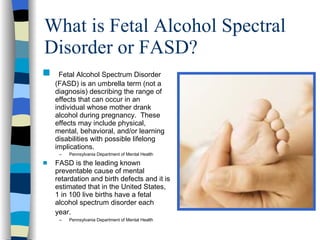
s    Fetal Alcohol Spectrum Disorder
    (FASD) is an umbrella term (not a
    diagnosis) describing the range of
    effects that can occur in an
    individual whose mother drank
    alcohol during pregnancy. These
    effects may include physical,
    mental, behavioral, and/or learning
    disabilities with possible lifelong
    implications.
     –   Pennsylvania Department of Mental Health
s   FASD is the leading known
    preventable cause of mental
    retardation and birth defects and it is
    estimated that in the United States,
    1 in 100 live births have a fetal
    alcohol spectrum disorder each
    year.
     –   Pennsylvania Department of Mental Health
What Causes FASD?
s   FASD is caused when women drink during
    pregnancy.
s   According to the Surgeon General, there is no
    safe amount of alcohol at any time during
    pregnancy.
s   Unfortunately, with 50 % of pregnancies in the
    U.S. being unplanned, many women consume
    alcohol early on before they even realize they are
    pregnant.
s   FASD is completely preventable all one has to do
    is not consume alcohol during pregnancy.
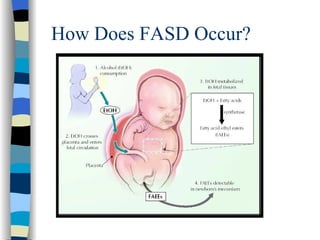
How Does FASD Occur?
Growth Deficiency
s   Growth deficiency is ranked as
    follows by the "4-Digit
    Diagnostic Code:"[1]
s      * Severe - Height and weight
    at or below the 3rd percentile.
s      * Moderate - Either height or
    weight at or below the 3rd
    percentile, but not both.
s      * Mild - Either height or
    weight or both between the 3rd
    and 10th percentiles.
s      * None - Height and weight
    both above the 10th percentile.
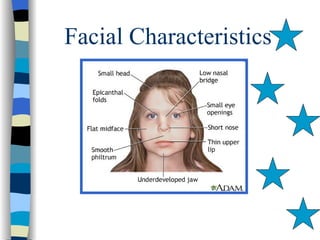
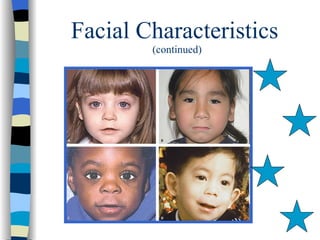
Facial Characteristics
        (continued)
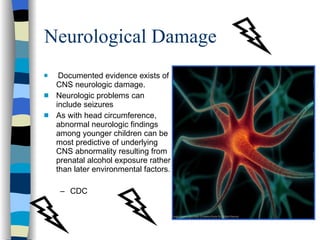
Neurological Damage
s    Documented evidence exists of
    CNS neurologic damage.
s   Neurologic problems can
    include seizures
s   As with head circumference,
    abnormal neurologic findings
    among younger children can be
    most predictive of underlying
    CNS abnormality resulting from
    prenatal alcohol exposure rather
    than later environmental factors.

     – CDC
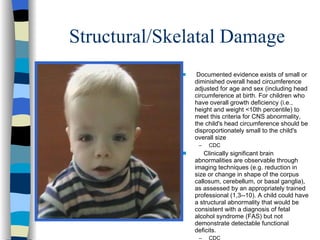
Structural/Skelatal Damage
             s    Documented evidence exists of small or
                 diminished overall head circumference
                 adjusted for age and sex (including head
                 circumference at birth. For children who
                 have overall growth deficiency (i.e.,
                 height and weight <10th percentile) to
                 meet this criteria for CNS abnormality,
                 the child's head circumference should be
                 disproportionately small to the child's
                 overall size
                  –   CDC
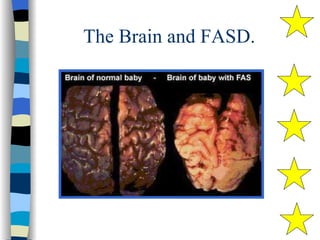
             s       Clinically significant brain
                 abnormalities are observable through
                 imaging techniques (e.g. reduction in
                 size or change in shape of the corpus
                 callosum, cerebellum, or basal ganglia),
                 as assessed by an appropriately trained
                 professional (1,3--10). A child could have
                 a structural abnormality that would be
                 consistent with a diagnosis of fetal
                 alcohol syndrome (FAS) but not
                 demonstrate detectable functional
                 deficits.
                  –   CDC
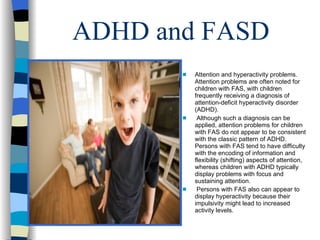
ADHD and FASD
       s   Attention and hyperactivity problems.
           Attention problems are often noted for
           children with FAS, with children
           frequently receiving a diagnosis of
           attention-deficit hyperactivity disorder
           (ADHD).
       s    Although such a diagnosis can be
           applied, attention problems for children
           with FAS do not appear to be consistent
           with the classic pattern of ADHD.
           Persons with FAS tend to have difficulty
           with the encoding of information and
           flexibility (shifting) aspects of attention,
           whereas children with ADHD typically
           display problems with focus and
           sustaining attention.
       s    Persons with FAS also can appear to
           display hyperactivity because their
           impulsivity might lead to increased
           activity levels.
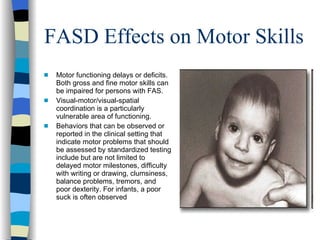
FASD Effects on Motor Skills
s   Motor functioning delays or deficits.
    Both gross and fine motor skills can
    be impaired for persons with FAS.
s   Visual-motor/visual-spatial
    coordination is a particularly
    vulnerable area of functioning.
s   Behaviors that can be observed or
    reported in the clinical setting that
    indicate motor problems that should
    be assessed by standardized testing
    include but are not limited to
    delayed motor milestones, difficulty
    with writing or drawing, clumsiness,
    balance problems, tremors, and
    poor dexterity. For infants, a poor
    suck is often observed
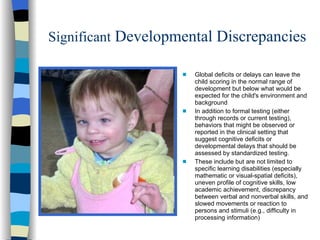
Significant Developmental Discrepancies

                    s   Global deficits or delays can leave the
                        child scoring in the normal range of
                        development but below what would be
                        expected for the child's environment and
                        background
                    s   In addition to formal testing (either
                        through records or current testing),
                        behaviors that might be observed or
                        reported in the clinical setting that
                        suggest cognitive deficits or
                        developmental delays that should be
                        assessed by standardized testing.
                    s   These include but are not limited to
                        specific learning disabilities (especially
                        mathematic or visual-spatial deficits),
                        uneven profile of cognitive skills, low
                        academic achievement, discrepancy
                        between verbal and nonverbal skills, and
                        slowed movements or reaction to
                        persons and stimuli (e.g., difficulty in
                        processing information)
The Brain and FASD.
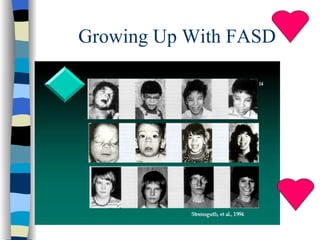
Growing Up With FASD
The Bottom Line is Do Not Drink
While you Pregnant. Your child’s
life is way too important to throw
away on something as meaningless
as getting buzzed. Show your baby
some love, take care of yourself
and that precious thing inside you!
References

s   Center for Disease Control
s   Pennsylvania Department of Mental
    Health
s   Surgeon General

Fetal Alcohol Spectrum Disorder

  • 1.
    Fetal Alcohol Spectrum Disorder Prepared by: Shaina Horton ICC Student Prepared For: Duke Walker ICC Professor
  • 2.
    What is FetalAlcohol Spectral Disorder or FASD? s Fetal Alcohol Spectrum Disorder (FASD) is an umbrella term (not a diagnosis) describing the range of effects that can occur in an individual whose mother drank alcohol during pregnancy. These effects may include physical, mental, behavioral, and/or learning disabilities with possible lifelong implications. – Pennsylvania Department of Mental Health s FASD is the leading known preventable cause of mental retardation and birth defects and it is estimated that in the United States, 1 in 100 live births have a fetal alcohol spectrum disorder each year. – Pennsylvania Department of Mental Health
  • 3.
    What Causes FASD? s FASD is caused when women drink during pregnancy. s According to the Surgeon General, there is no safe amount of alcohol at any time during pregnancy. s Unfortunately, with 50 % of pregnancies in the U.S. being unplanned, many women consume alcohol early on before they even realize they are pregnant. s FASD is completely preventable all one has to do is not consume alcohol during pregnancy.
  • 4.
  • 5.
    Growth Deficiency s Growth deficiency is ranked as follows by the "4-Digit Diagnostic Code:"[1] s * Severe - Height and weight at or below the 3rd percentile. s * Moderate - Either height or weight at or below the 3rd percentile, but not both. s * Mild - Either height or weight or both between the 3rd and 10th percentiles. s * None - Height and weight both above the 10th percentile.
  • 6.
  • 7.
  • 8.
    Neurological Damage s Documented evidence exists of CNS neurologic damage. s Neurologic problems can include seizures s As with head circumference, abnormal neurologic findings among younger children can be most predictive of underlying CNS abnormality resulting from prenatal alcohol exposure rather than later environmental factors. – CDC
  • 9.
    Structural/Skelatal Damage s Documented evidence exists of small or diminished overall head circumference adjusted for age and sex (including head circumference at birth. For children who have overall growth deficiency (i.e., height and weight <10th percentile) to meet this criteria for CNS abnormality, the child's head circumference should be disproportionately small to the child's overall size – CDC s Clinically significant brain abnormalities are observable through imaging techniques (e.g. reduction in size or change in shape of the corpus callosum, cerebellum, or basal ganglia), as assessed by an appropriately trained professional (1,3--10). A child could have a structural abnormality that would be consistent with a diagnosis of fetal alcohol syndrome (FAS) but not demonstrate detectable functional deficits. – CDC
  • 10.
    ADHD and FASD s Attention and hyperactivity problems. Attention problems are often noted for children with FAS, with children frequently receiving a diagnosis of attention-deficit hyperactivity disorder (ADHD). s Although such a diagnosis can be applied, attention problems for children with FAS do not appear to be consistent with the classic pattern of ADHD. Persons with FAS tend to have difficulty with the encoding of information and flexibility (shifting) aspects of attention, whereas children with ADHD typically display problems with focus and sustaining attention. s Persons with FAS also can appear to display hyperactivity because their impulsivity might lead to increased activity levels.
  • 11.
    FASD Effects onMotor Skills s Motor functioning delays or deficits. Both gross and fine motor skills can be impaired for persons with FAS. s Visual-motor/visual-spatial coordination is a particularly vulnerable area of functioning. s Behaviors that can be observed or reported in the clinical setting that indicate motor problems that should be assessed by standardized testing include but are not limited to delayed motor milestones, difficulty with writing or drawing, clumsiness, balance problems, tremors, and poor dexterity. For infants, a poor suck is often observed
  • 12.
    Significant Developmental Discrepancies s Global deficits or delays can leave the child scoring in the normal range of development but below what would be expected for the child's environment and background s In addition to formal testing (either through records or current testing), behaviors that might be observed or reported in the clinical setting that suggest cognitive deficits or developmental delays that should be assessed by standardized testing. s These include but are not limited to specific learning disabilities (especially mathematic or visual-spatial deficits), uneven profile of cognitive skills, low academic achievement, discrepancy between verbal and nonverbal skills, and slowed movements or reaction to persons and stimuli (e.g., difficulty in processing information)
  • 13.
  • 14.
  • 15.
    The Bottom Lineis Do Not Drink While you Pregnant. Your child’s life is way too important to throw away on something as meaningless as getting buzzed. Show your baby some love, take care of yourself and that precious thing inside you!
  • 16.
    References s Center for Disease Control s Pennsylvania Department of Mental Health s Surgeon General