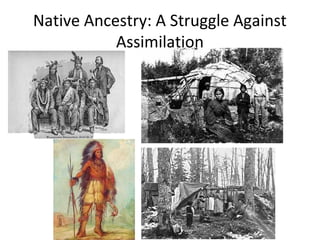
Native Ancestry: A Struggle Against
           Assimilation
The Ojibwe Experience Then and Now
About the Ojibwe
• Ojibwe or also known as; Ojibwa, Ojibway,
  Chippewa or Chippeway
• The Ojibwe peoples are a major group of the
  Anishinaabe-speaking peoples, a branch of the
  Algonquian language family which includes;
  the Algonquin, Nipissing, Oji-Cree, Odawa and
  Potawatomi
• The Ojibwe peoples number over 56,440 in
  the U.S.
Where the Ojibwe Live


                    Source: Wikipedia
About the Ojibwe
• The Ojibwe are known for the crafting of birch
  bark canoes and the cultivation of wild rice.
• The Ojibwe Nation was the first to sign more
  detailed treaties with European settlers
  before they were allowed too settle farther
  west
Anishinaabe
• Lake Superior Chippewa is one of the largest
  bands of the Ojibwe
• Reside in northern parts of present day
  Michigan, Minnesota and Wisconsin
• Defeated the Dakota(Sioux) pushing them
  west of the Mississippi in 1754
• More technologically adapt purchased guns
  from the French fur traders
Bands United
• Several treaties with the US government leading up to the
  final treaty of 1854 unite the independent bands of the Lake
  Superior Chippewa; Mississippi, Pillager, Bois Forte, Muskrat,
  Red Lake, Pembina and La Pointe become a collective
• These treaties of 1837 and 1842 were constantly in dispute-
  they allowed rights to timber and copper in region with the
  assurance that the Ojibwe would not be forced west of the
  Mississippi and would retain their hunting and fishing rights
  to the land
• The seat of power of the Ojibwe was located at LaPointe on
  Madeline Island in present day Wisconsin
Encroachment
• The Indian Removal Act of 1830 signed by President
  Andrew Jackson allowed the government to relocate
  Indians west of the Mississippi. This was
  instrumental in creating the states like Wisconsin
  and Minnesota
• The Ojibwe were not forced to move initially but
  watched as other kin tribes were forcibly relocated
  to less desirable land but in 1850 this changed
• White settlers ignored the treaties and encroached
  on Ojibwe land in increasing numbers during that
  period
1850
• In 1850 President Zachary Taylor signed an order
  to remove the Ojibwe west in order to “protect”
  them from the white settlers. The new state of
  Wisconsin ignored the presidential order and
  refused to act on the removal
• Minnesota territory Governor Alexander Ramsey
  and Indian Agent John Watrous created a plan
  that resulted in the death of over 200 hundred
  Ojibwe
Sandy Lake
• Watrous refused to continue disbursing the
  annual annuities in LaPointe requiring the
  Ojibwe to travel to Sandy Lake in the territory
  of Minnesota approximately 150 miles west
• Ojibwe people faced starvation, harsh
  conditions and rotten provisions when they
  arrived in Sandy Lake.
Chief Buffalo
(Kechewaishke)
In 1852 at 92 years of age,
serving as primary chief of
the Lake Superior
Chippewa for over fifty
years, Chief Buffalo made
a personal trek to
Washington DC after the
Sandy Lake tragedy. He
manages to meet with
President Fillmore who
agrees to stop the forced
move west of the Ojibwe
and agrees to open up
negotiations that next year
on a new treaty which
became the treaty of 1854
1854 The Treaty of LaPointe
This treaty ceded all of the Lake Superior
Ojibwe lands to the United States in the
area denoted in map as 332. In exchange
it created reservations for the Lake
Superior Ojibwe in Wisconsin, Michigan,
and Minnesota. Also, these tribes
retained hunting, fishing and gathering
right within this region. Exercising these
treaty rights would remain a struggle into
the 21st century. Indian reservations
established under this treaty were:
L'Anse with Lac Vieux Desert
Bad River
Lac du Flambeau and Lac Courte Oreilles
Fond du Lac
Grand Portage
Ontonagon and Red Cliff


                                             Source: Wikipedia
Anishinaabe Syndicated:

WHY THIS BOOK?
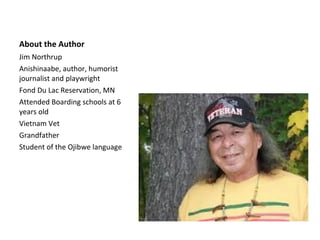
About the Author
Jim Northrup
Anishinaabe, author, humorist
journalist and playwright
Fond Du Lac Reservation, MN
Attended Boarding schools at 6
years old
Vietnam Vet
Grandfather
Student of the Ojibwe language
Anishinaabe Syndicated
Northrup’s book chronicles the years
between 1989 and 2001 when shifting treaty
rights, casino gambling, tribal sovereignty and
native language renewal were important
topics for his monthly syndicated newspaper
column the Fond du Lac Follies
Irreverence
Northrup is often irreverent in equal
measures regarding the treatment of
gaming/treaty rights by the federal
government, “necks of red” as he calls them
and the tribal government who he is often
baffled by their approach to the gaming
disputes.
“Christopher Columbus was just the point man”
Are you full blooded Indian?
• http://www.youtube.com/watch?
  feature=player_embedded&v=q3wBCavyD1E
Fond Du Lac: Lake Beer Can
Powwows
• Northrup writes fondly of visiting various
  powwows across the midwest. He describes in
  detail the sights and sounds and the feelings of
  togetherness that these stir in him
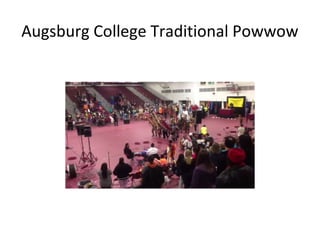
• As I reflect on the powwow I attended captured
  in the next video, I could see a little better how
  the event could really bring the culture alive for
  the participants. The excitement, food, crafts and
  dancing and celebration of elders
Augsburg College Traditional Powwow
Powwow
• What also struck me was the overall patriotic
  theme that was integrated through the
  ceremony. A significant amount of time was
  devoted to honoring the veterans of our
  nation and how the powwow ceremony itself
  elevated the importance of this act
Veteran and Activist
Jim Northrup is a veteran and his
writing for the FDL Follies captures his
activism for veterans rights.
 He has travelled the nation speaking
and advocating for fair treatment for
all veterans as well as
acknowledgement of the Anishinaabe
contribution to protecting our country.
 In the attached video he shares
(candidly) a deeply personal poem
about the loss and devastation that
followed many veterans home after
the war.

Below I read an excerpt from his book
about attending a war memorial in
Duluth                                     http://youtu.be/iKIPO3aXJBs
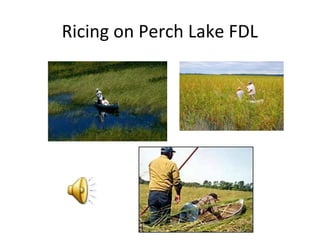
Ricing
• An important and critical skill and aspect of
  being an Anishinaabe
• Jim Northrup writes extensivelly about this
  practice in his book. It is clear that the practice
  of ricing is much more than economic. It is
  provides a connection to the history of the
  Anishinaabe and reconnects him as a man to
  his childhood
Ricing on Perch Lake FDL
Sugar Bush
• Northrup writes many times over the years
  about the practice of making maple syrup
• “We tapped into the cycle of seasons once
  again. It was a family affair to go to the sugar
  bush. Anishinaabeg(plural) have been making
  maple syrup for hundreds of generations”p.91
My grandson Aaron
Connecting it all together

 The Ojibwa prayer below set to the Gaelic
 music captures my emotional connection to
 Madeline Island and my own Irish heritage.
 My visits to Madeline always reminds me of
 my time in Ireland

http://youtu.be/vEBvo8Y4ZIY

Native american ojibwi presentation fliskv2

  • 1.
    Native Ancestry: AStruggle Against Assimilation
  • 2.
  • 3.
    About the Ojibwe •Ojibwe or also known as; Ojibwa, Ojibway, Chippewa or Chippeway • The Ojibwe peoples are a major group of the Anishinaabe-speaking peoples, a branch of the Algonquian language family which includes; the Algonquin, Nipissing, Oji-Cree, Odawa and Potawatomi • The Ojibwe peoples number over 56,440 in the U.S.
  • 4.
    Where the OjibweLive Source: Wikipedia
  • 5.
    About the Ojibwe •The Ojibwe are known for the crafting of birch bark canoes and the cultivation of wild rice. • The Ojibwe Nation was the first to sign more detailed treaties with European settlers before they were allowed too settle farther west
  • 6.
    Anishinaabe • Lake SuperiorChippewa is one of the largest bands of the Ojibwe • Reside in northern parts of present day Michigan, Minnesota and Wisconsin • Defeated the Dakota(Sioux) pushing them west of the Mississippi in 1754 • More technologically adapt purchased guns from the French fur traders
  • 7.
    Bands United • Severaltreaties with the US government leading up to the final treaty of 1854 unite the independent bands of the Lake Superior Chippewa; Mississippi, Pillager, Bois Forte, Muskrat, Red Lake, Pembina and La Pointe become a collective • These treaties of 1837 and 1842 were constantly in dispute- they allowed rights to timber and copper in region with the assurance that the Ojibwe would not be forced west of the Mississippi and would retain their hunting and fishing rights to the land • The seat of power of the Ojibwe was located at LaPointe on Madeline Island in present day Wisconsin
  • 8.
    Encroachment • The IndianRemoval Act of 1830 signed by President Andrew Jackson allowed the government to relocate Indians west of the Mississippi. This was instrumental in creating the states like Wisconsin and Minnesota • The Ojibwe were not forced to move initially but watched as other kin tribes were forcibly relocated to less desirable land but in 1850 this changed • White settlers ignored the treaties and encroached on Ojibwe land in increasing numbers during that period
  • 9.
    1850 • In 1850President Zachary Taylor signed an order to remove the Ojibwe west in order to “protect” them from the white settlers. The new state of Wisconsin ignored the presidential order and refused to act on the removal • Minnesota territory Governor Alexander Ramsey and Indian Agent John Watrous created a plan that resulted in the death of over 200 hundred Ojibwe
  • 10.
    Sandy Lake • Watrousrefused to continue disbursing the annual annuities in LaPointe requiring the Ojibwe to travel to Sandy Lake in the territory of Minnesota approximately 150 miles west • Ojibwe people faced starvation, harsh conditions and rotten provisions when they arrived in Sandy Lake.
  • 11.
    Chief Buffalo (Kechewaishke) In 1852at 92 years of age, serving as primary chief of the Lake Superior Chippewa for over fifty years, Chief Buffalo made a personal trek to Washington DC after the Sandy Lake tragedy. He manages to meet with President Fillmore who agrees to stop the forced move west of the Ojibwe and agrees to open up negotiations that next year on a new treaty which became the treaty of 1854
  • 12.
    1854 The Treatyof LaPointe This treaty ceded all of the Lake Superior Ojibwe lands to the United States in the area denoted in map as 332. In exchange it created reservations for the Lake Superior Ojibwe in Wisconsin, Michigan, and Minnesota. Also, these tribes retained hunting, fishing and gathering right within this region. Exercising these treaty rights would remain a struggle into the 21st century. Indian reservations established under this treaty were: L'Anse with Lac Vieux Desert Bad River Lac du Flambeau and Lac Courte Oreilles Fond du Lac Grand Portage Ontonagon and Red Cliff Source: Wikipedia
  • 13.
  • 14.
    About the Author JimNorthrup Anishinaabe, author, humorist journalist and playwright Fond Du Lac Reservation, MN Attended Boarding schools at 6 years old Vietnam Vet Grandfather Student of the Ojibwe language
  • 15.
    Anishinaabe Syndicated Northrup’s bookchronicles the years between 1989 and 2001 when shifting treaty rights, casino gambling, tribal sovereignty and native language renewal were important topics for his monthly syndicated newspaper column the Fond du Lac Follies
  • 16.
    Irreverence Northrup is oftenirreverent in equal measures regarding the treatment of gaming/treaty rights by the federal government, “necks of red” as he calls them and the tribal government who he is often baffled by their approach to the gaming disputes.
  • 17.
    “Christopher Columbus wasjust the point man”
  • 18.
    Are you fullblooded Indian? • http://www.youtube.com/watch? feature=player_embedded&v=q3wBCavyD1E
  • 19.
    Fond Du Lac:Lake Beer Can
  • 20.
    Powwows • Northrup writesfondly of visiting various powwows across the midwest. He describes in detail the sights and sounds and the feelings of togetherness that these stir in him • As I reflect on the powwow I attended captured in the next video, I could see a little better how the event could really bring the culture alive for the participants. The excitement, food, crafts and dancing and celebration of elders
  • 21.
  • 22.
    Powwow • What alsostruck me was the overall patriotic theme that was integrated through the ceremony. A significant amount of time was devoted to honoring the veterans of our nation and how the powwow ceremony itself elevated the importance of this act
  • 23.
    Veteran and Activist JimNorthrup is a veteran and his writing for the FDL Follies captures his activism for veterans rights. He has travelled the nation speaking and advocating for fair treatment for all veterans as well as acknowledgement of the Anishinaabe contribution to protecting our country. In the attached video he shares (candidly) a deeply personal poem about the loss and devastation that followed many veterans home after the war. Below I read an excerpt from his book about attending a war memorial in Duluth http://youtu.be/iKIPO3aXJBs
  • 24.
    Ricing • An importantand critical skill and aspect of being an Anishinaabe • Jim Northrup writes extensivelly about this practice in his book. It is clear that the practice of ricing is much more than economic. It is provides a connection to the history of the Anishinaabe and reconnects him as a man to his childhood
  • 25.
  • 26.
    Sugar Bush • Northrupwrites many times over the years about the practice of making maple syrup • “We tapped into the cycle of seasons once again. It was a family affair to go to the sugar bush. Anishinaabeg(plural) have been making maple syrup for hundreds of generations”p.91
  • 27.
  • 28.
    Connecting it alltogether The Ojibwa prayer below set to the Gaelic music captures my emotional connection to Madeline Island and my own Irish heritage. My visits to Madeline always reminds me of my time in Ireland http://youtu.be/vEBvo8Y4ZIY