Settlers in the
               Ohio Valley
                    
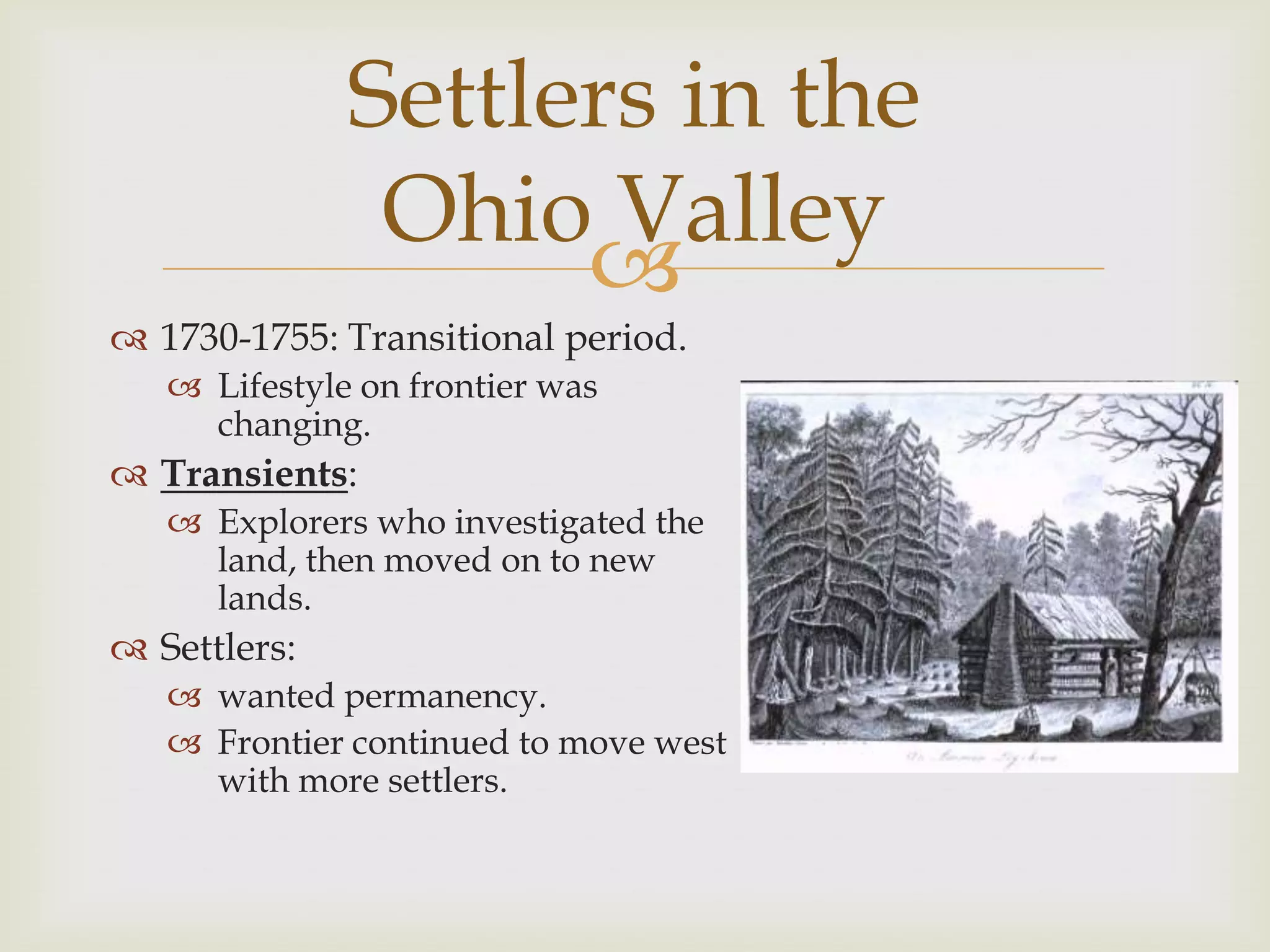
 1730-1755: Transitional period.
    Lifestyle on frontier was
     changing.
 Transients:
    Explorers who investigated the
     land, then moved on to new
     lands.
 Settlers:
    wanted permanency.
    Frontier continued to move west
     with more settlers.
Conflicting Land Claims
            
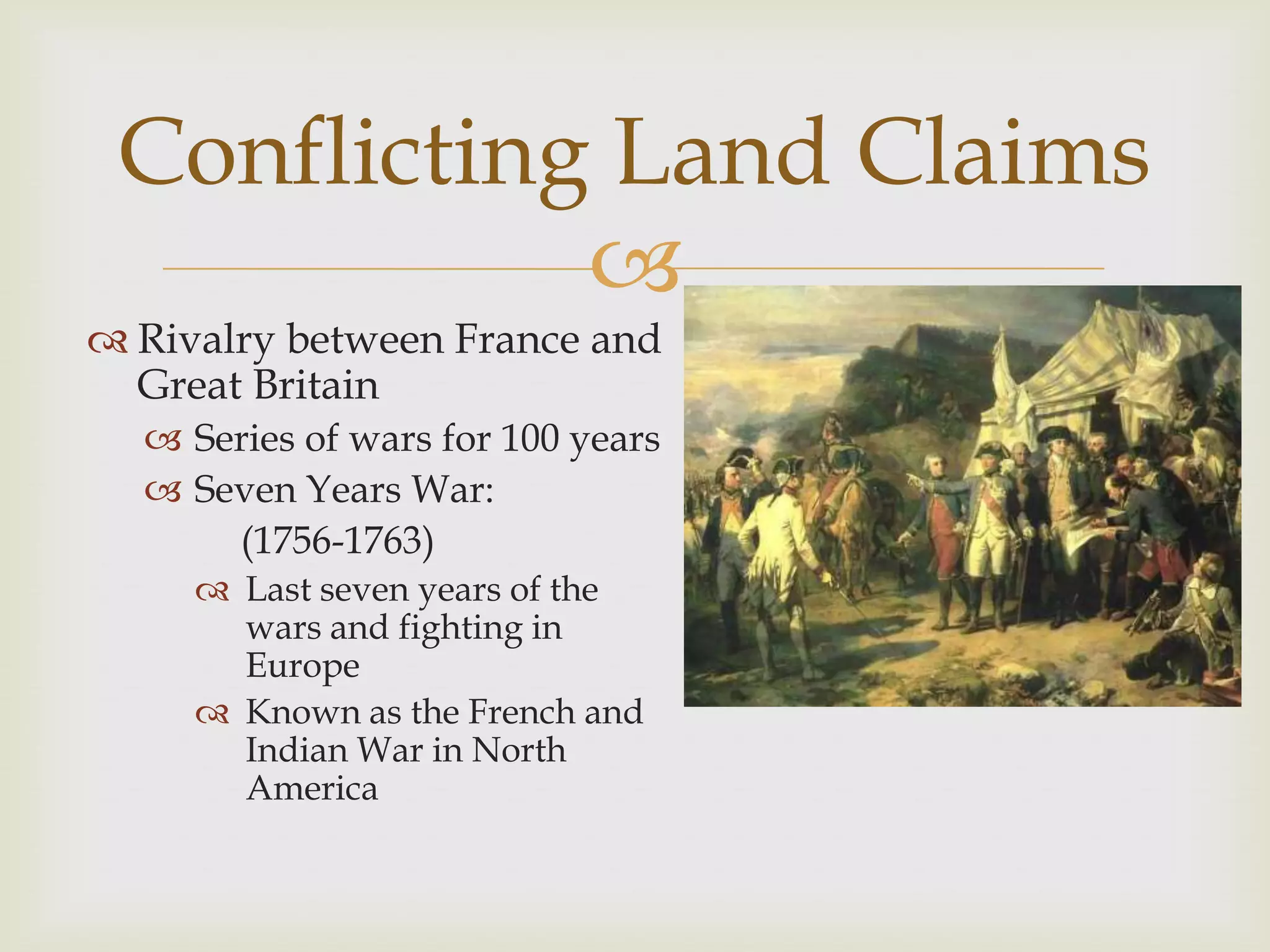
 Rivalry between France and
  Great Britain
   Series of wars for 100 years
   Seven Years War:
      (1756-1763)
      Last seven years of the
       wars and fighting in
       Europe
      Known as the French and
       Indian War in North
       America
Think ahead:
                 
1. Why is the war known as the French and Indian
War? Why not the British and French War?
2. What are allies?
3. Who become allies, when fighting occurs in North
America?
   French and Native Americans?
   British and Native Americans?
   No allies. Everyone fights against everyone?
Claims of the Ohio River
                      Valley
                           de
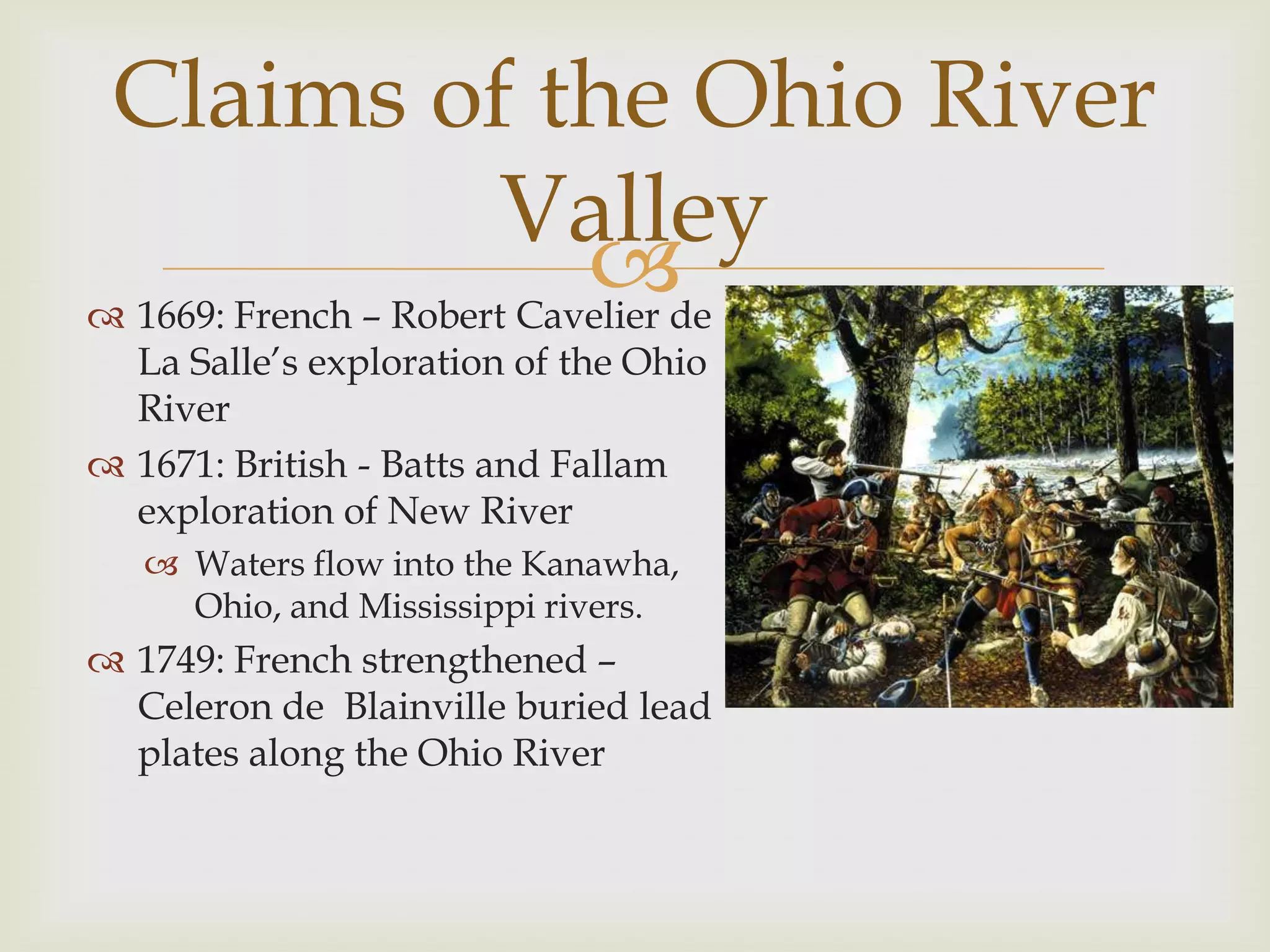
 1669: French – Robert Cavelier
  La Salle’s exploration of the Ohio
  River
 1671: British - Batts and Fallam
  exploration of New River
    Waters flow into the Kanawha,
     Ohio, and Mississippi rivers.
 1749: French strengthened –
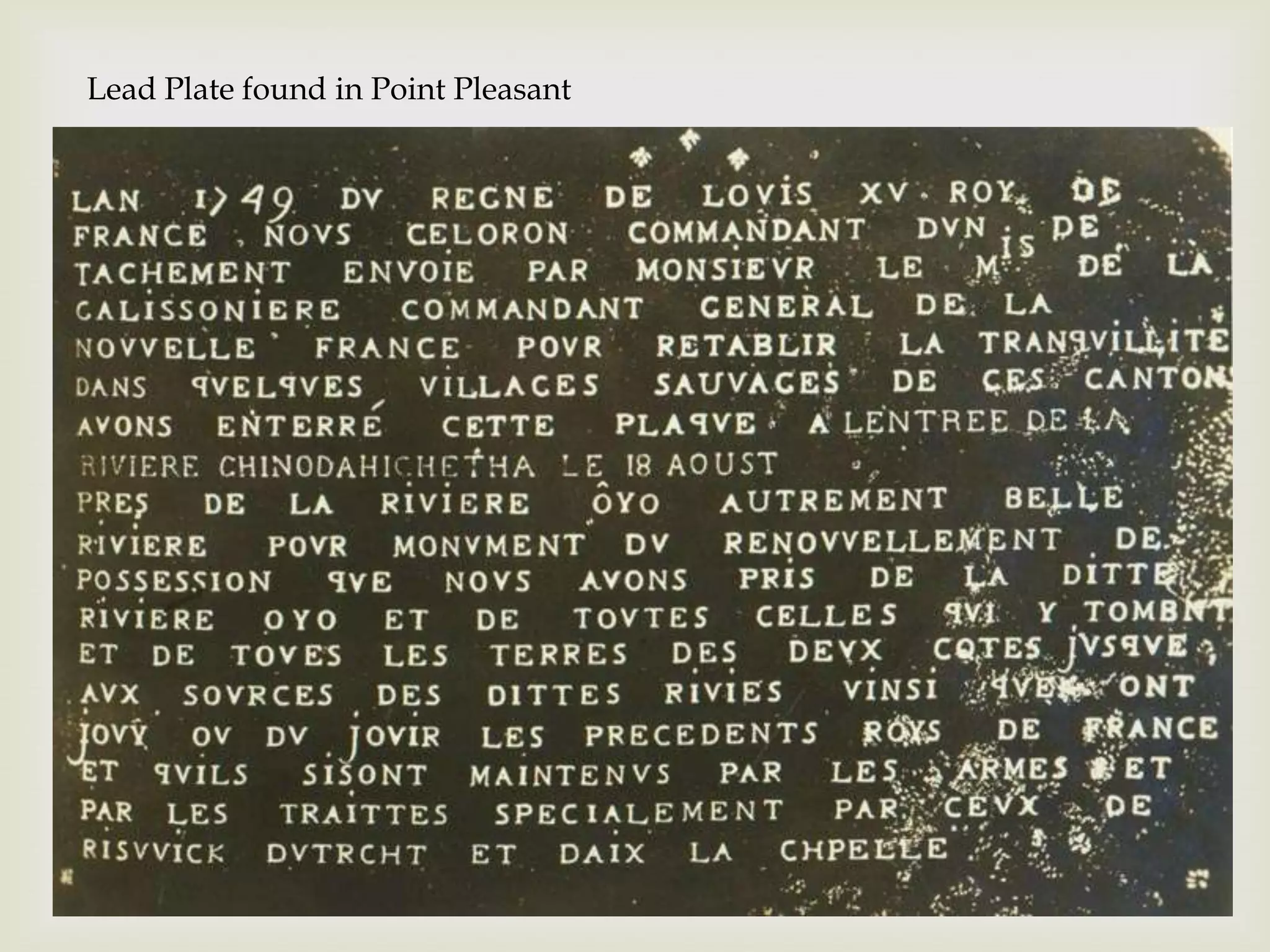
  Celeron de Blainville buried lead
  plates along the Ohio River
Lead Plate found in Point Pleasant


                                     
Lead Plate Translation
             
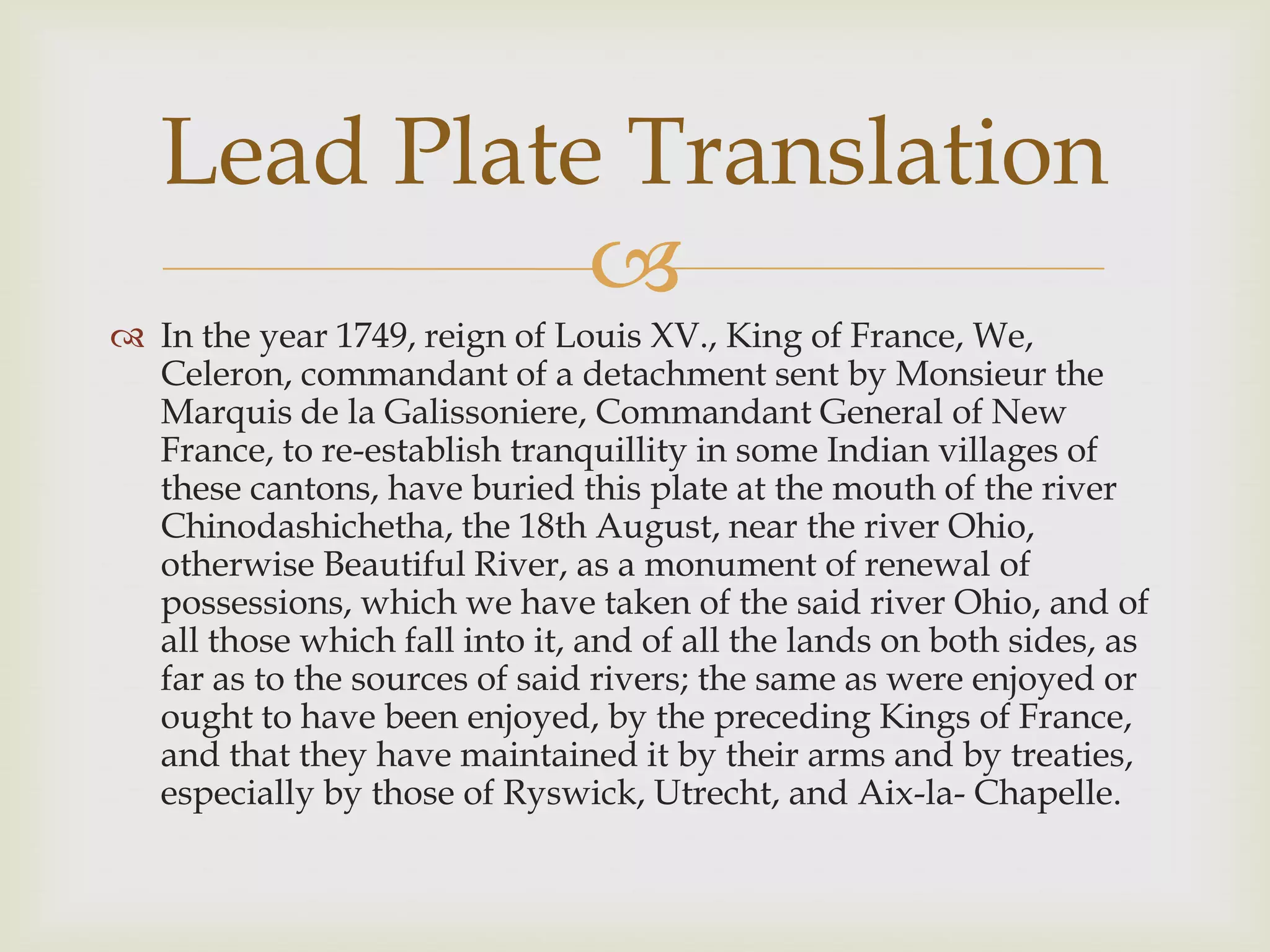
 In the year 1749, reign of Louis XV., King of France, We,
  Celeron, commandant of a detachment sent by Monsieur the
  Marquis de la Galissoniere, Commandant General of New
  France, to re-establish tranquillity in some Indian villages of
  these cantons, have buried this plate at the mouth of the river
  Chinodashichetha, the 18th August, near the river Ohio,
  otherwise Beautiful River, as a monument of renewal of
  possessions, which we have taken of the said river Ohio, and of
  all those which fall into it, and of all the lands on both sides, as
  far as to the sources of said rivers; the same as were enjoyed or
  ought to have been enjoyed, by the preceding Kings of France,
  and that they have maintained it by their arms and by treaties,
  especially by those of Ryswick, Utrecht, and Aix-la- Chapelle.
Views on Treaties and
        Land Ownership
                Indians:
                
 British:
    Avoided difficulties by           Treaties are seen as the
     negotiating treaties with          end of warfare or as
     Indians                            trade agreements
                                       Treaties had nothing to
    Used treaties to take              do with land ownership
     control of property
                                       Saw treaties as
    Saw treaties as binding            changeable.
              French:
                Permanent ownership of land was not
                 a major consideration.
                More interested in fur trade.
                Did not pose a threat to Indians.
Setting the Scene
                  
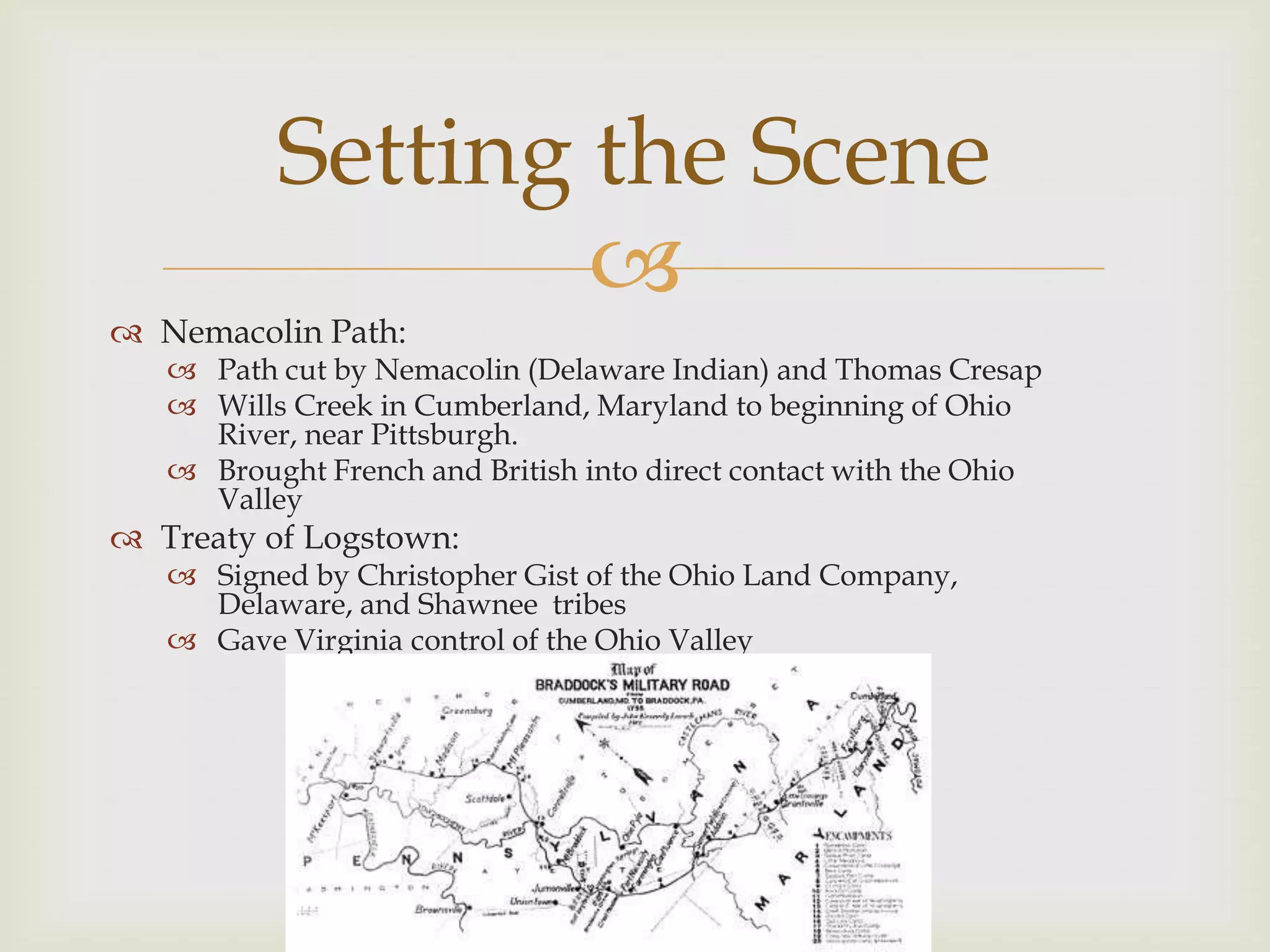
 Nemacolin Path:
    Path cut by Nemacolin (Delaware Indian) and Thomas Cresap
    Wills Creek in Cumberland, Maryland to beginning of Ohio
     River, near Pittsburgh.
    Brought French and British into direct contact with the Ohio
     Valley
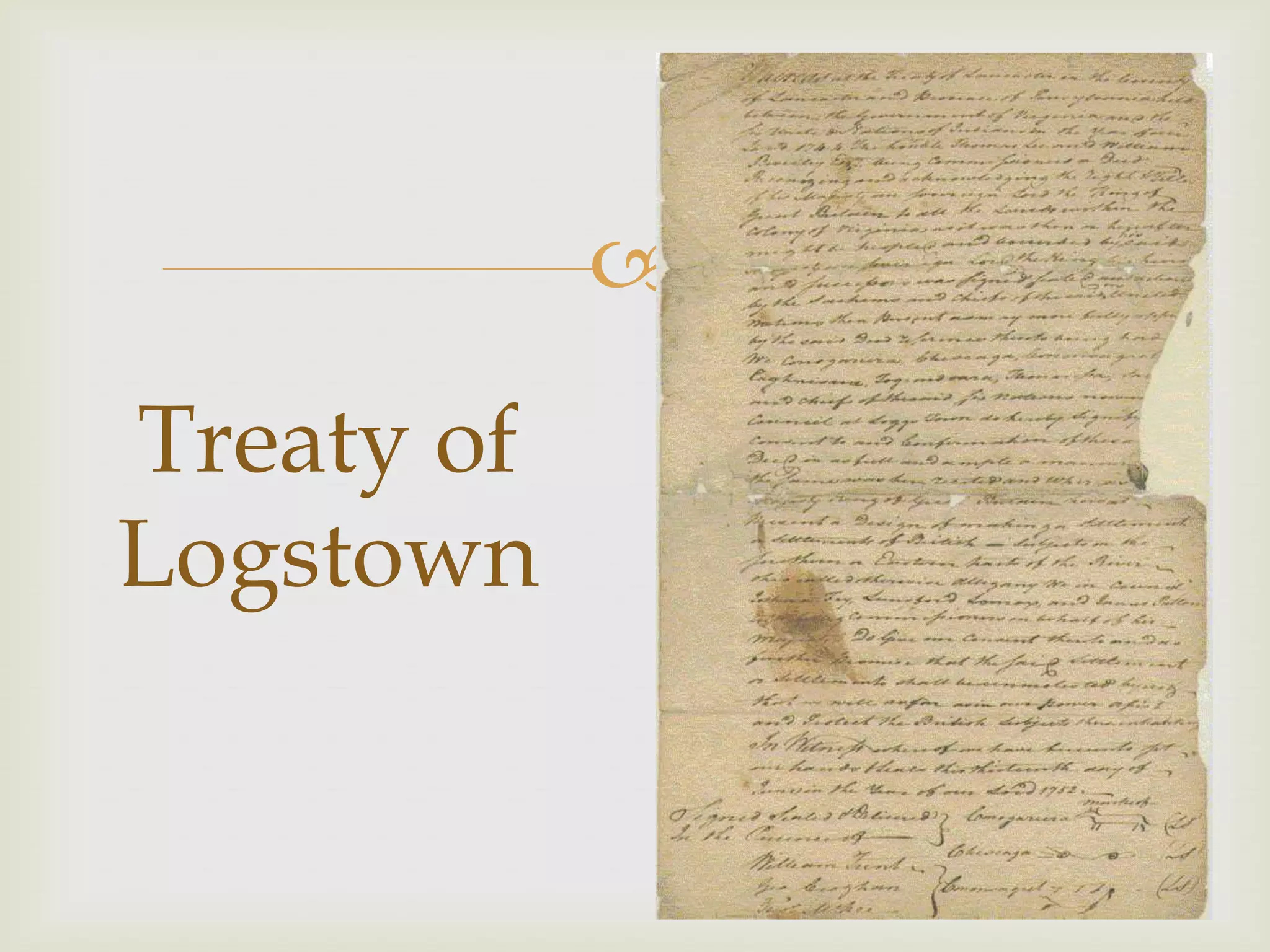
 Treaty of Logstown:
    Signed by Christopher Gist of the Ohio Land Company,
     Delaware, and Shawnee tribes
    Gave Virginia control of the Ohio Valley

Treaty of
Logstown
Governor Dinwiddie’s
            Proposal
                         
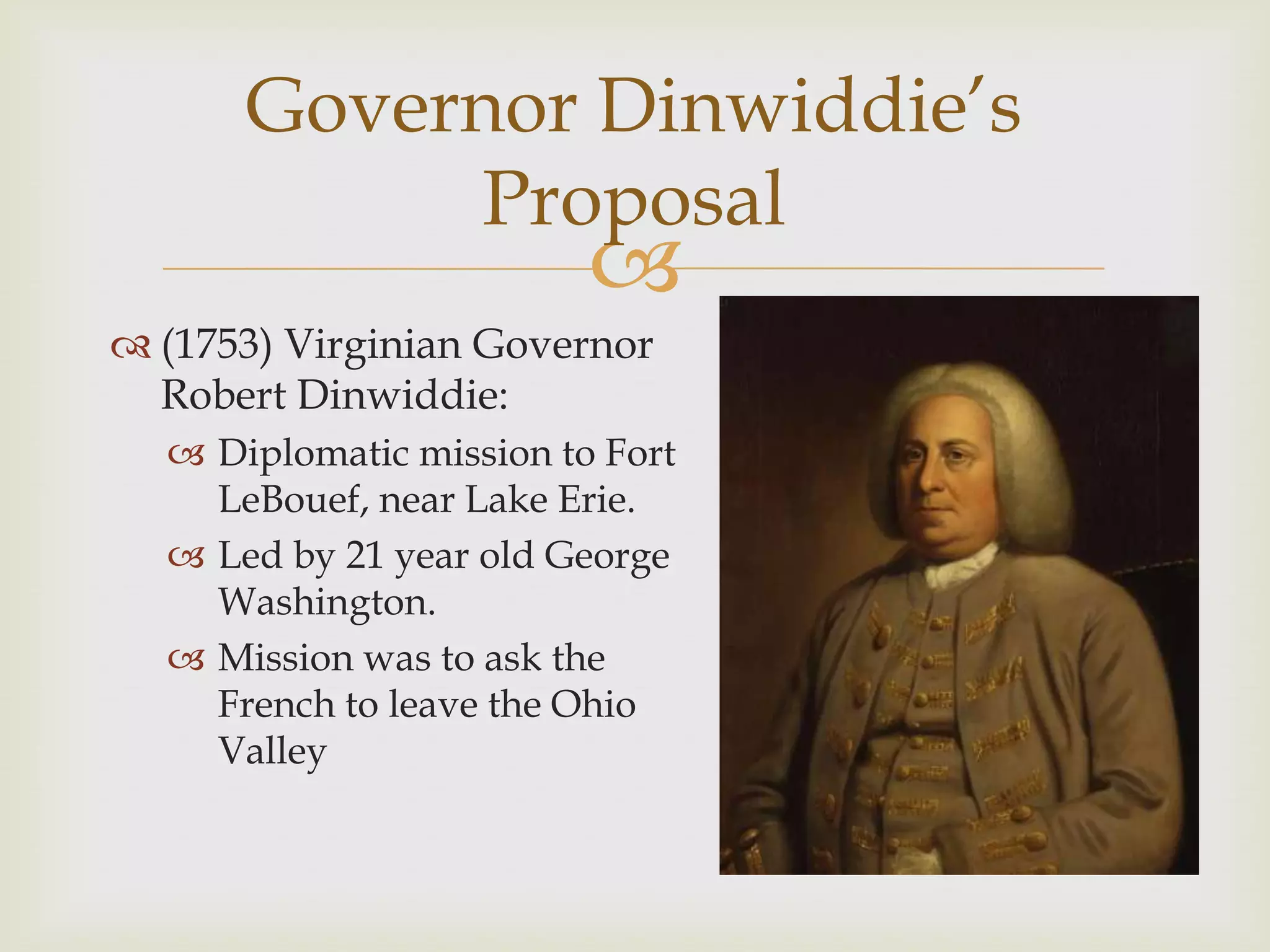
 (1753) Virginian Governor
  Robert Dinwiddie:
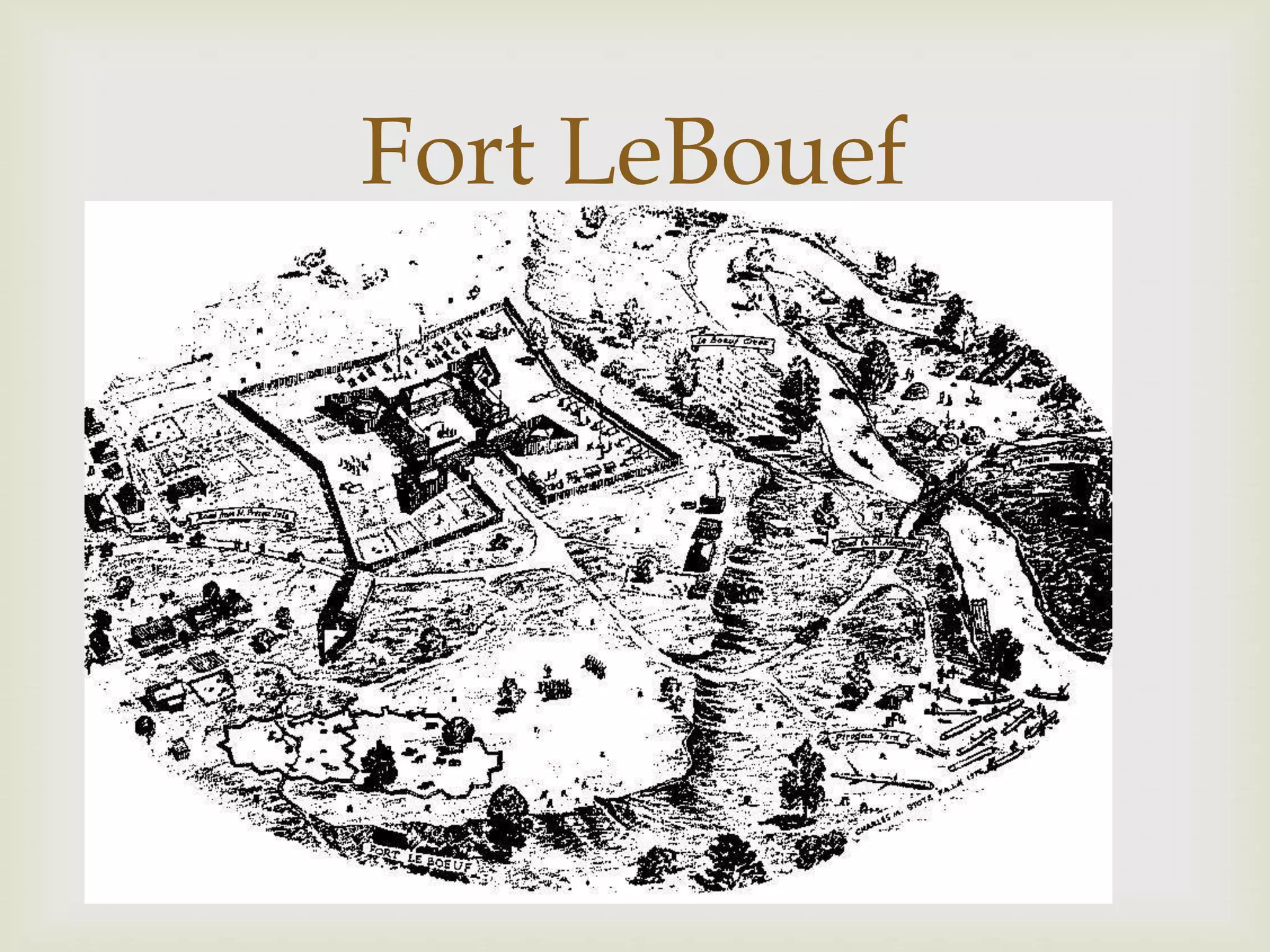
   Diplomatic mission to Fort
    LeBouef, near Lake Erie.
   Led by 21 year old George
    Washington.
   Mission was to ask the
    French to leave the Ohio
    Valley
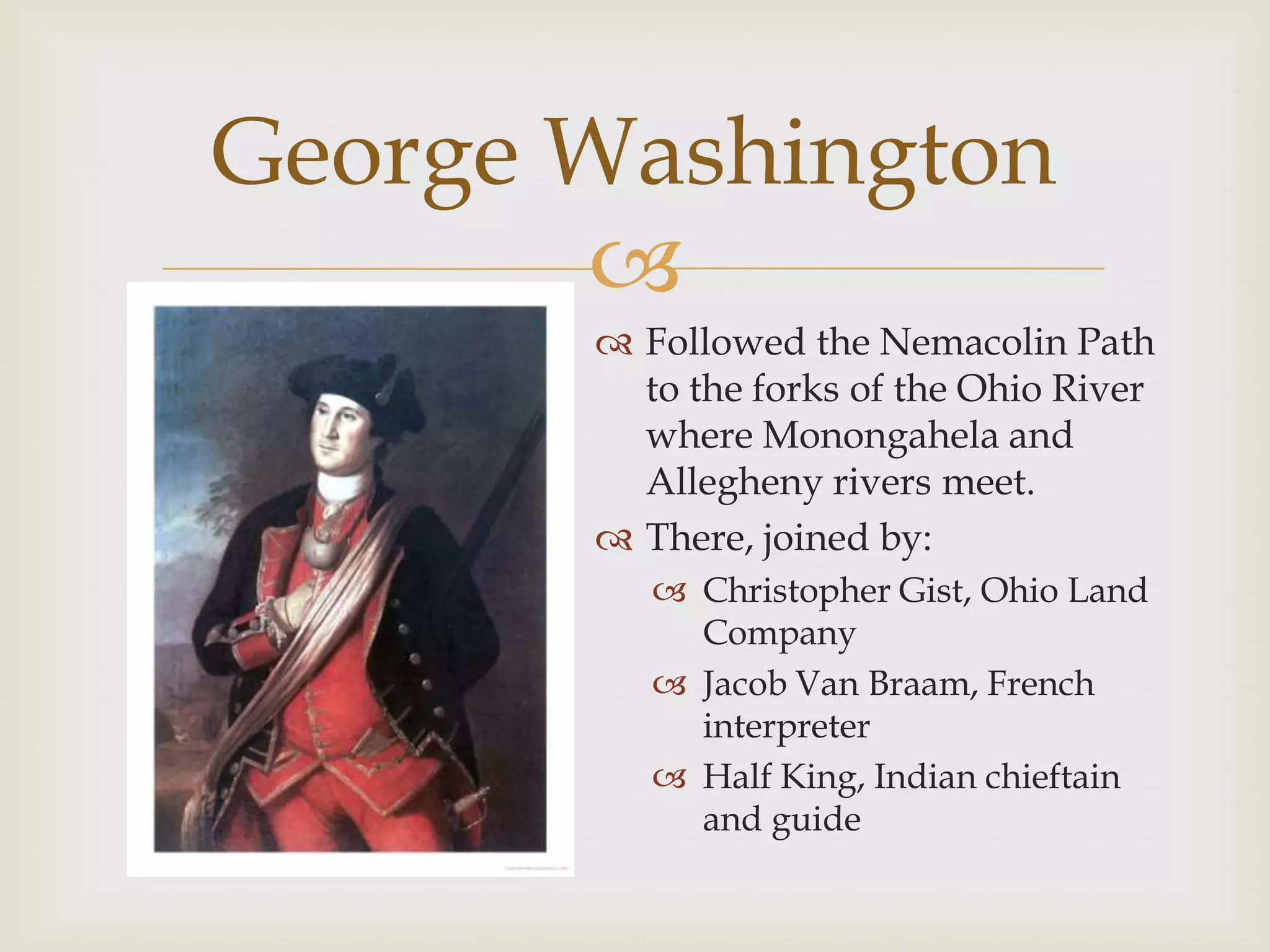
George Washington
       
        Followed the Nemacolin Path
         to the forks of the Ohio River
         where Monongahela and
         Allegheny rivers meet.
        There, joined by:
           Christopher Gist, Ohio Land
            Company
           Jacob Van Braam, French
            interpreter
           Half King, Indian chieftain
            and guide
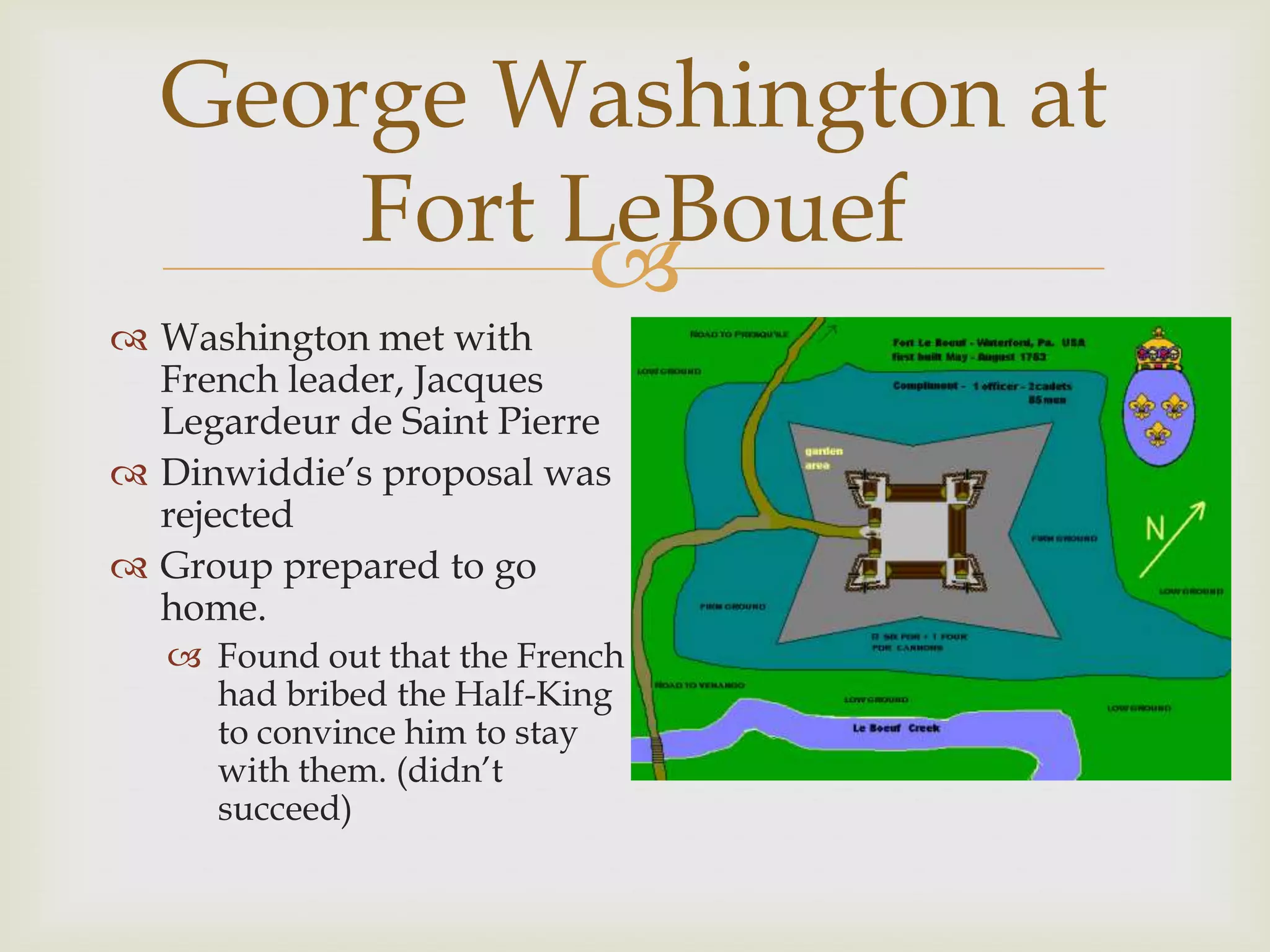
Fort LeBouef
      
George Washington at
      Fort LeBouef
            
 Washington met with
  French leader, Jacques
  Legardeur de Saint Pierre
 Dinwiddie’s proposal was
  rejected
 Group prepared to go
  home.
    Found out that the French
     had bribed the Half-King
     to convince him to stay
     with them. (didn’t
     succeed)
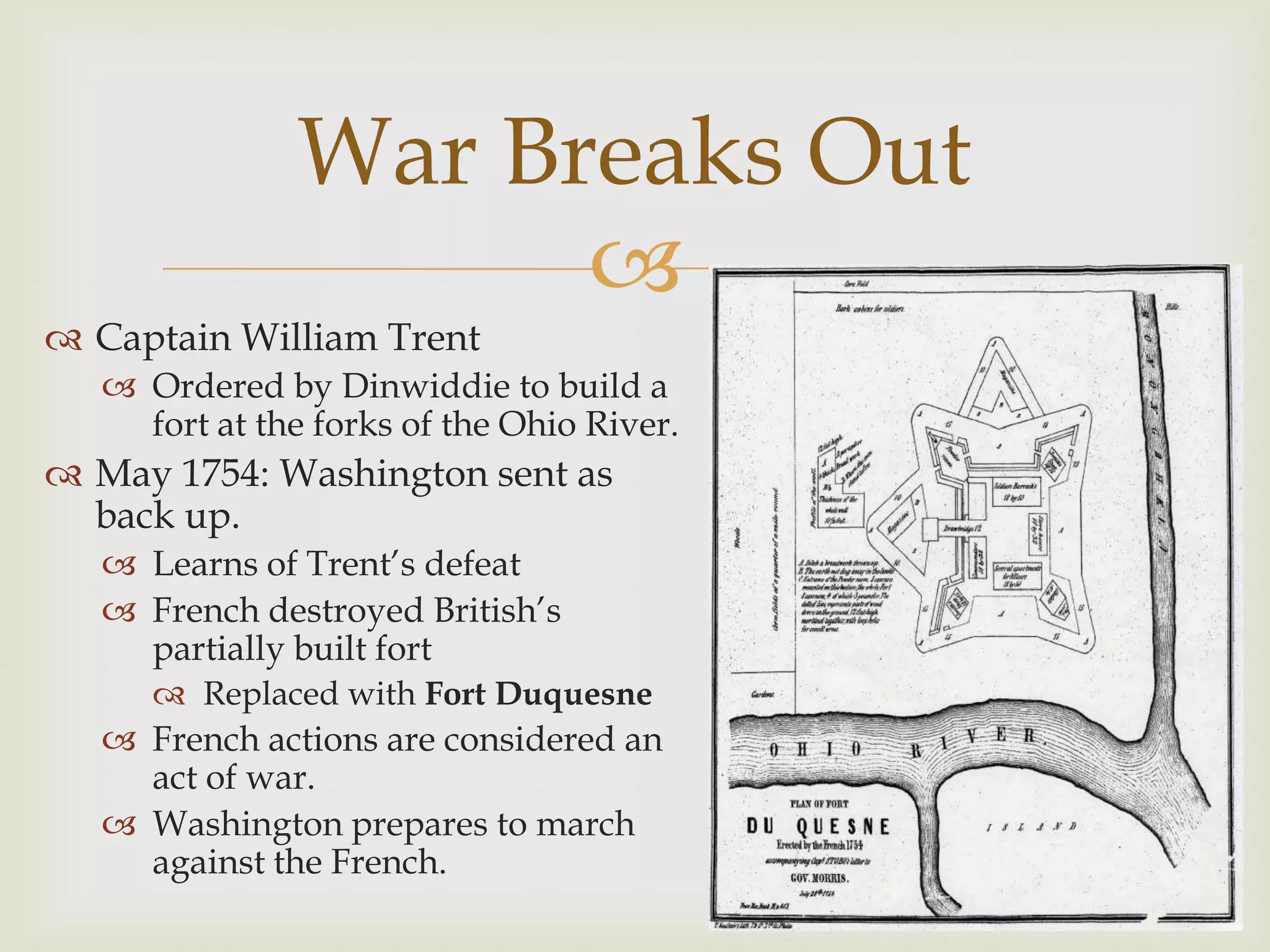
War Breaks Out
                     
 Captain William Trent
    Ordered by Dinwiddie to build a
     fort at the forks of the Ohio River.
 May 1754: Washington sent as
  back up.
    Learns of Trent’s defeat
    French destroyed British’s
     partially built fort
       Replaced with Fort Duquesne
    French actions are considered an
     act of war.
    Washington prepares to march
     against the French.
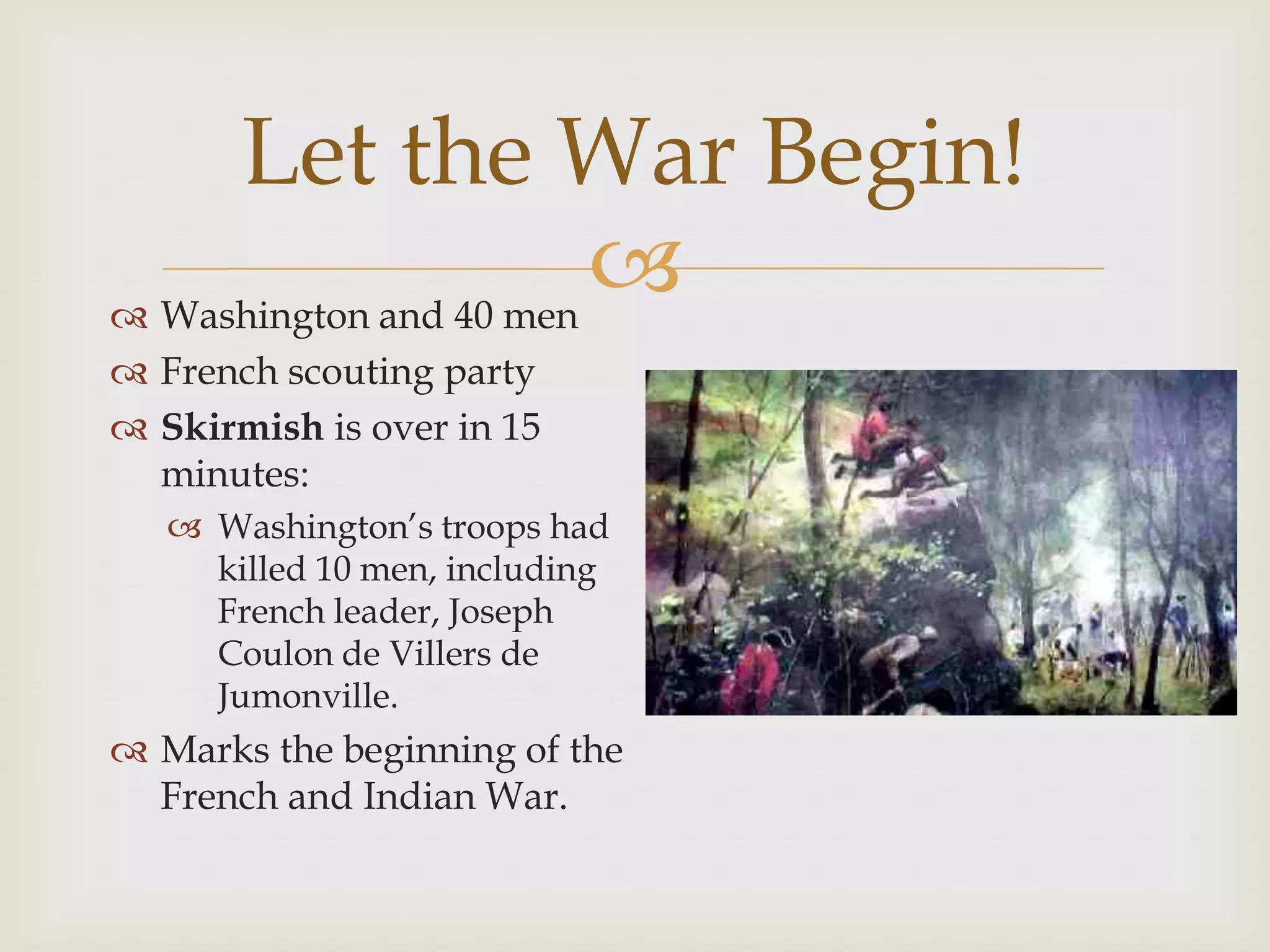
Let the War Begin!
 Washington and 40 men
                        
 French scouting party
 Skirmish is over in 15
  minutes:
    Washington’s troops had
     killed 10 men, including
     French leader, Joseph
     Coulon de Villers de
     Jumonville.
 Marks the beginning of the
  French and Indian War.
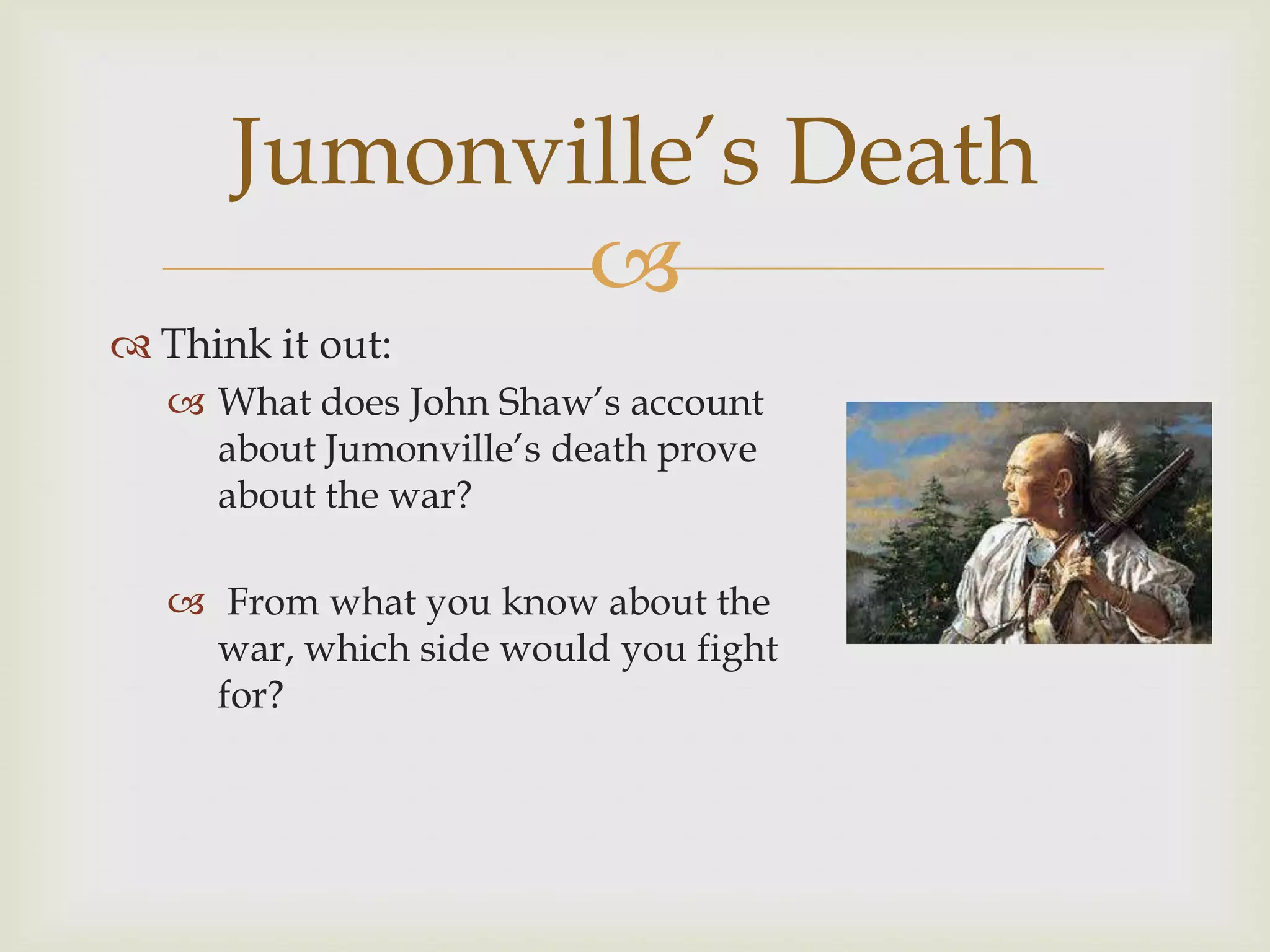
Jumonville’s Death
             
 Think it out:
    What does John Shaw’s account
     about Jumonville’s death prove
     about the war?

    From what you know about the
     war, which side would you fight
     for?
Advantages
                 
 French:                     British:
   Larger land claim            Larger population
   Already-existing             Powerful Iroquois
    system of forts in the        allies
    Ohio Valley                  Control of the oceans
   Majority of Indian           Population that was
    allies                        concentrated in a very
   Superior military             small area
    officers and army.           Desire to protect their
                                  own property
Disadvantages
                 
 French:                       British:
   Sparse Population              Military organization
   Soldiers with no               Poorly organized
    personal interest in the        frontier volunteers
    land                           Less qualified officers.
   Poor lines of supply
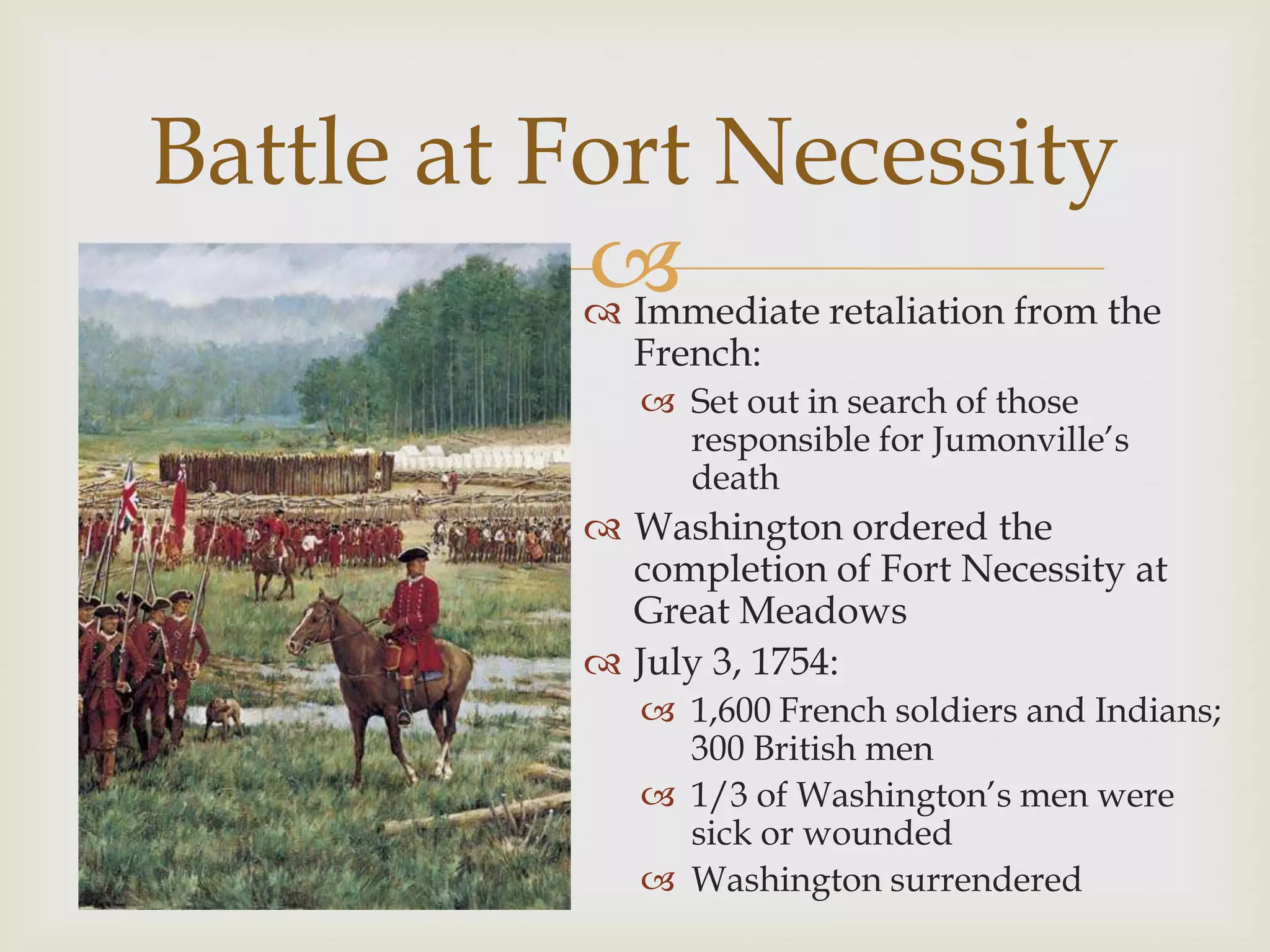
Battle at Fort Necessity
           
            Immediate retaliation from the
                    French:
                      Set out in search of those
                       responsible for Jumonville’s
                       death
                   Washington ordered the
                    completion of Fort Necessity at
                    Great Meadows
                   July 3, 1754:
                      1,600 French soldiers and Indians;
                       300 British men
                      1/3 of Washington’s men were
                       sick or wounded
                      Washington surrendered
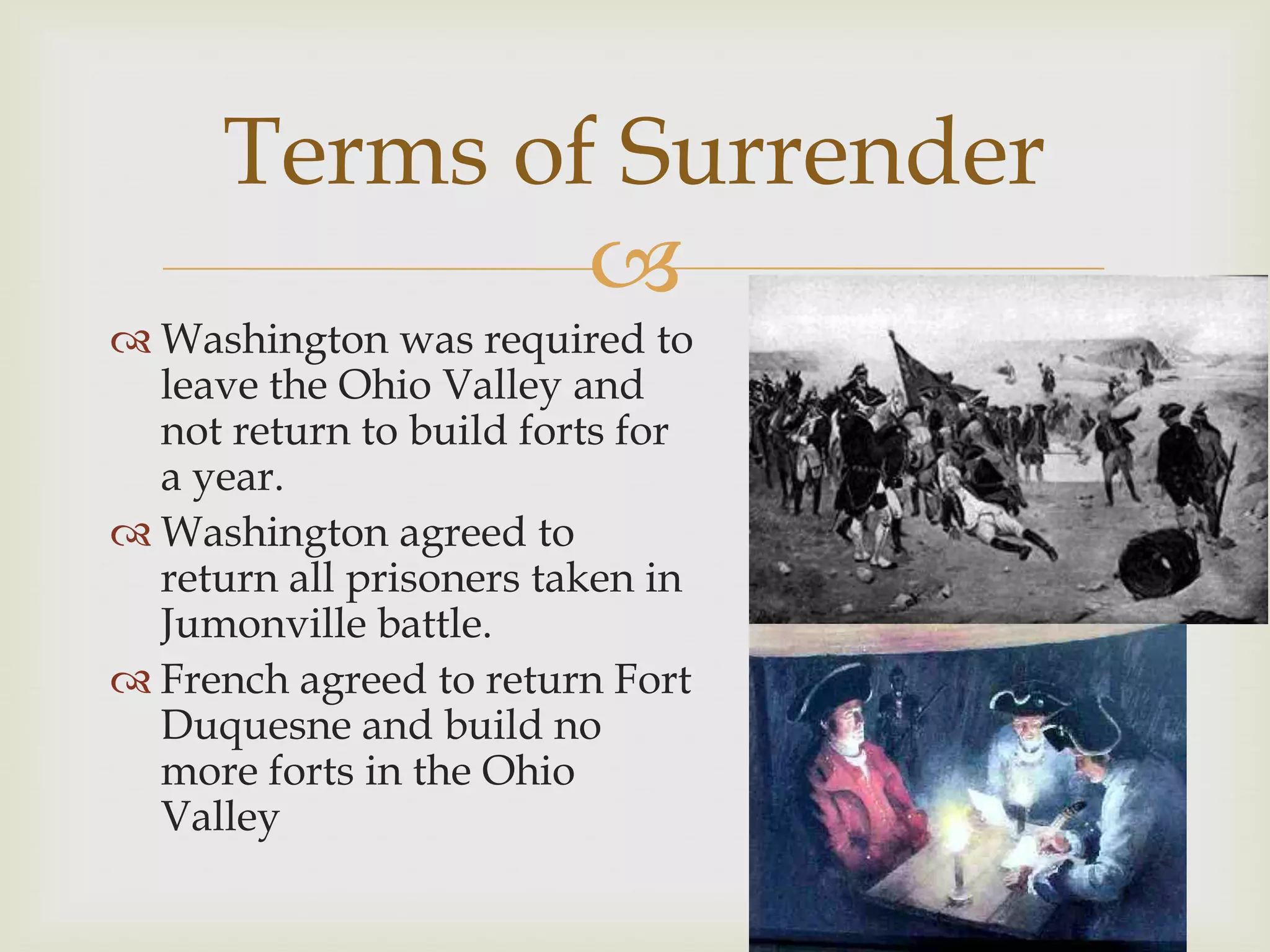
Terms of Surrender
              
 Washington was required to
  leave the Ohio Valley and
  not return to build forts for
  a year.
 Washington agreed to
  return all prisoners taken in
  Jumonville battle.
 French agreed to return Fort
  Duquesne and build no
  more forts in the Ohio
  Valley
Battle of the
                Monongahela
                     
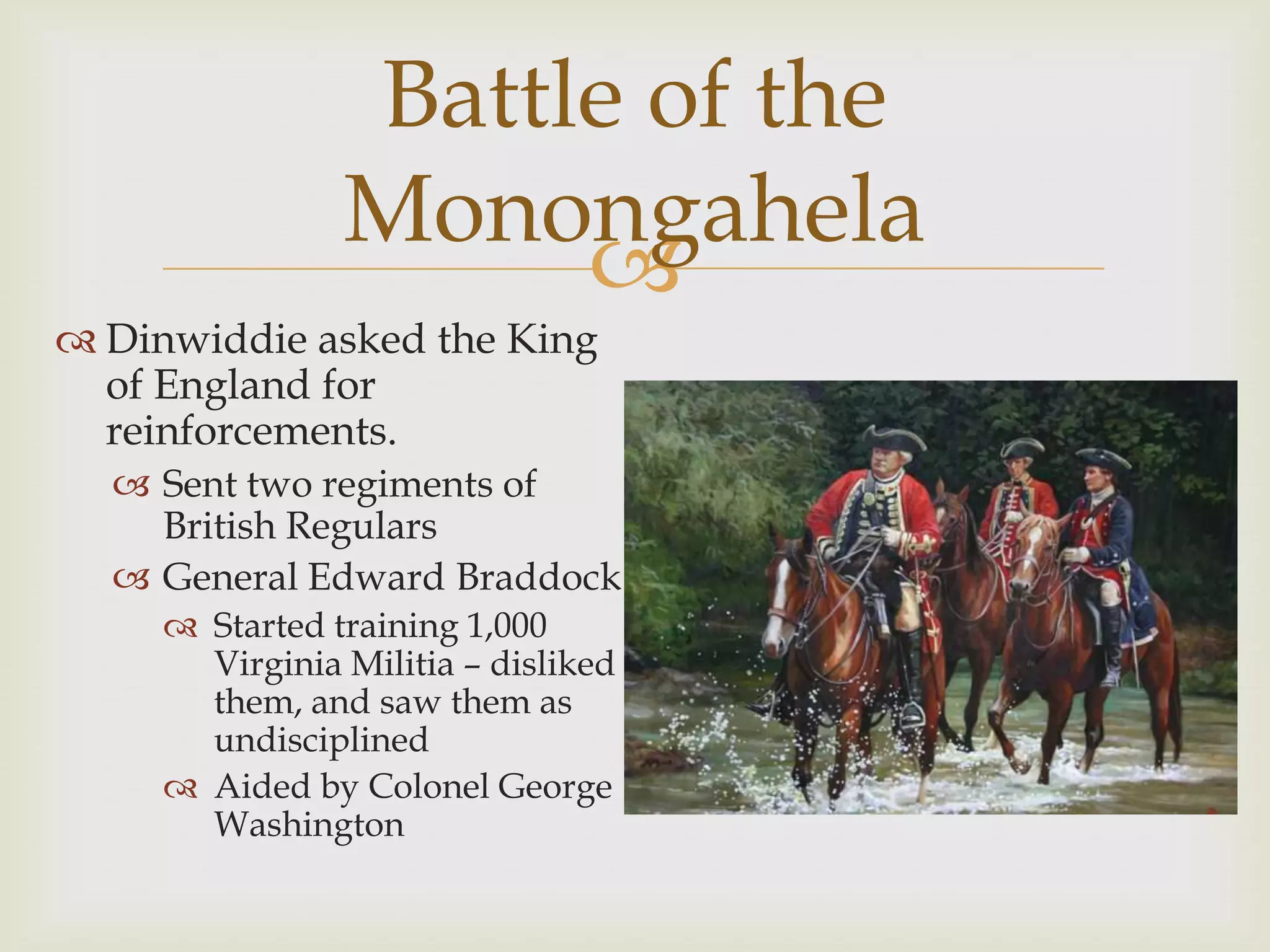
 Dinwiddie asked the King
  of England for
  reinforcements.
   Sent two regiments of
    British Regulars
   General Edward Braddock
      Started training 1,000
       Virginia Militia – disliked
       them, and saw them as
       undisciplined
      Aided by Colonel George
       Washington
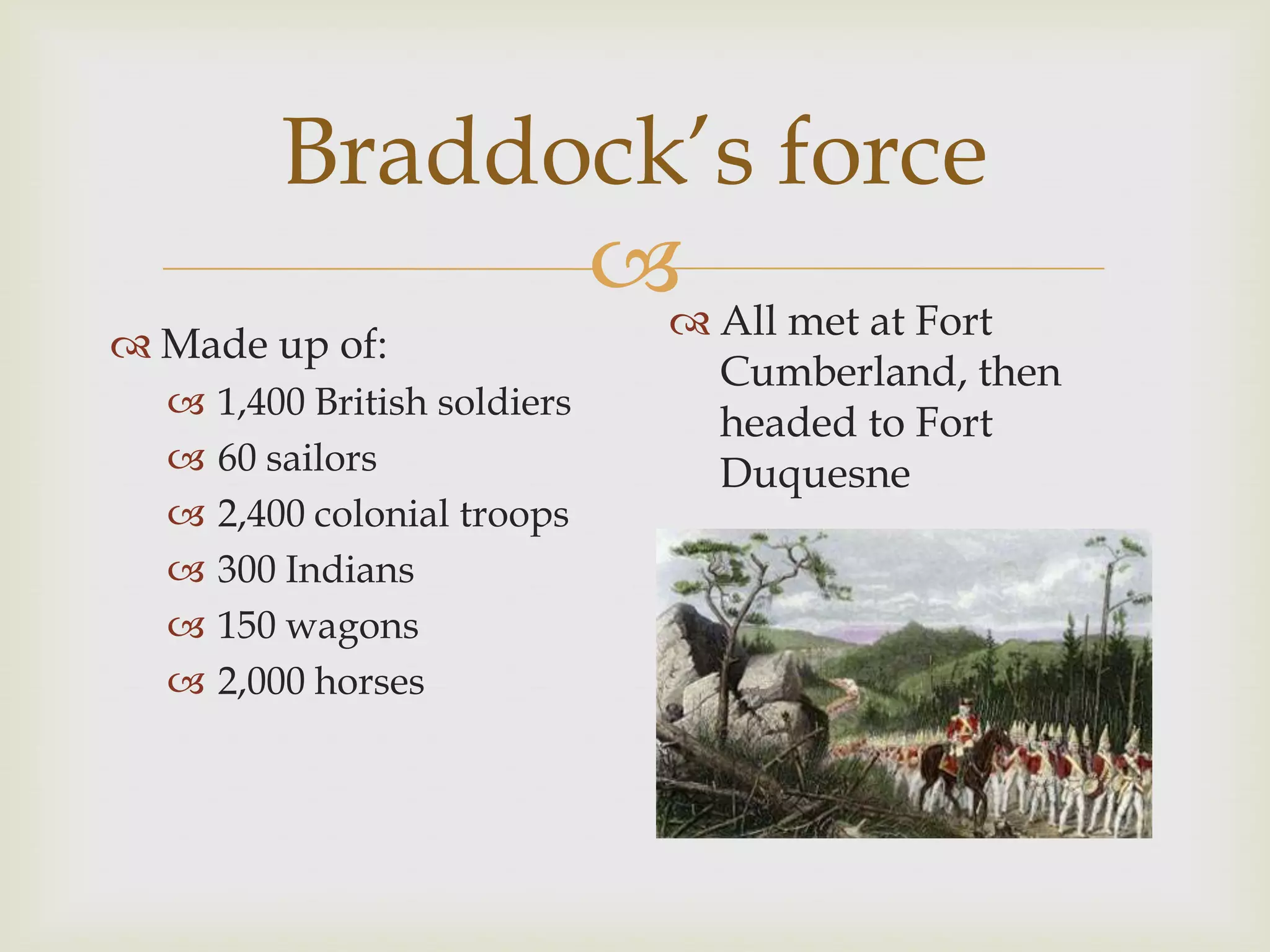
Braddock’s force
                All met at Fort
 Made up of:
                               Cumberland, then
     1,400 British soldiers
                               headed to Fort
     60 sailors               Duquesne
     2,400 colonial troops
     300 Indians
     150 wagons
     2,000 horses
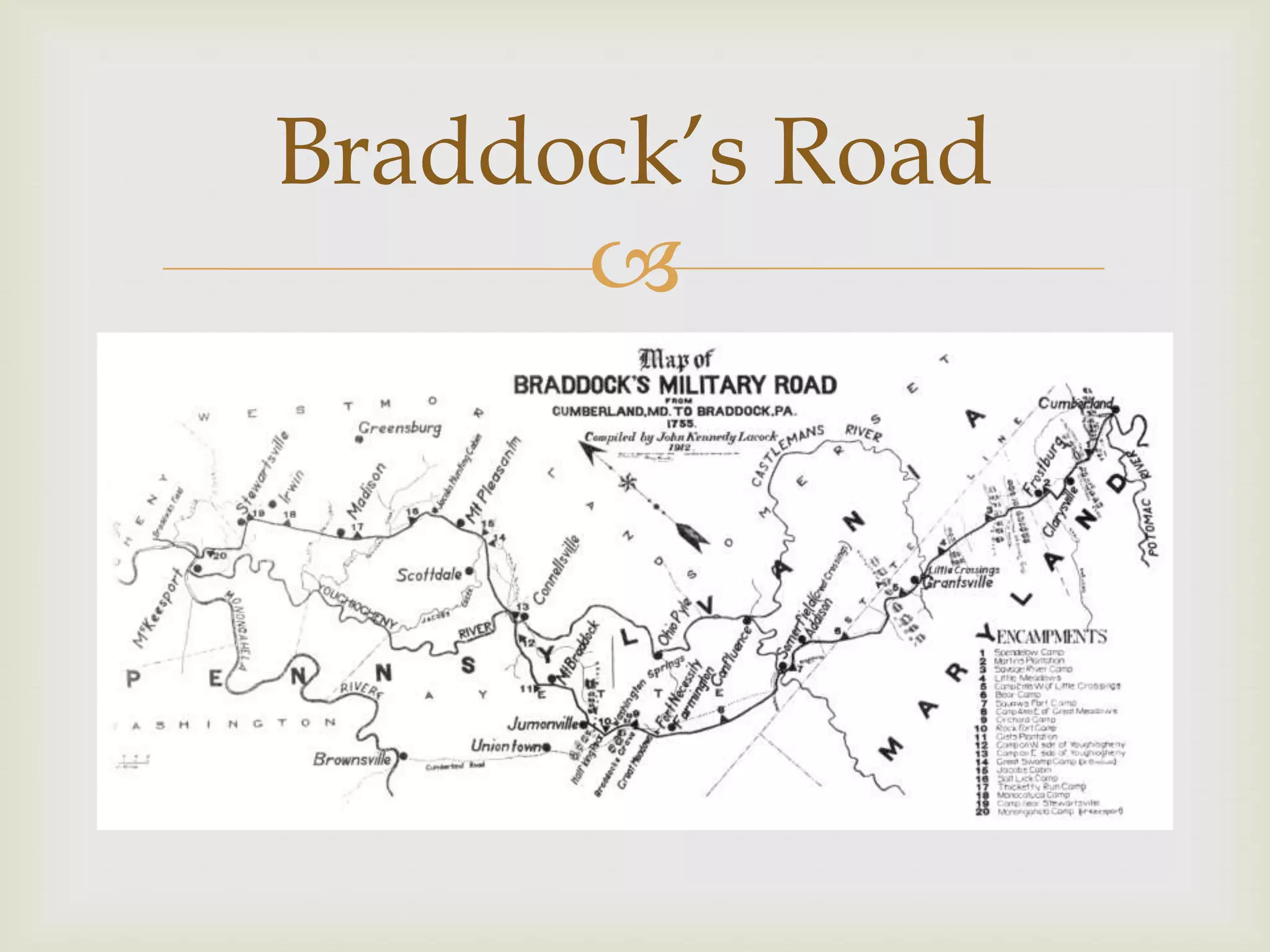
Braddock’s Road
      
Braddock’s Defeat
       
The Shawnee and
Mary Draper Ingles
         
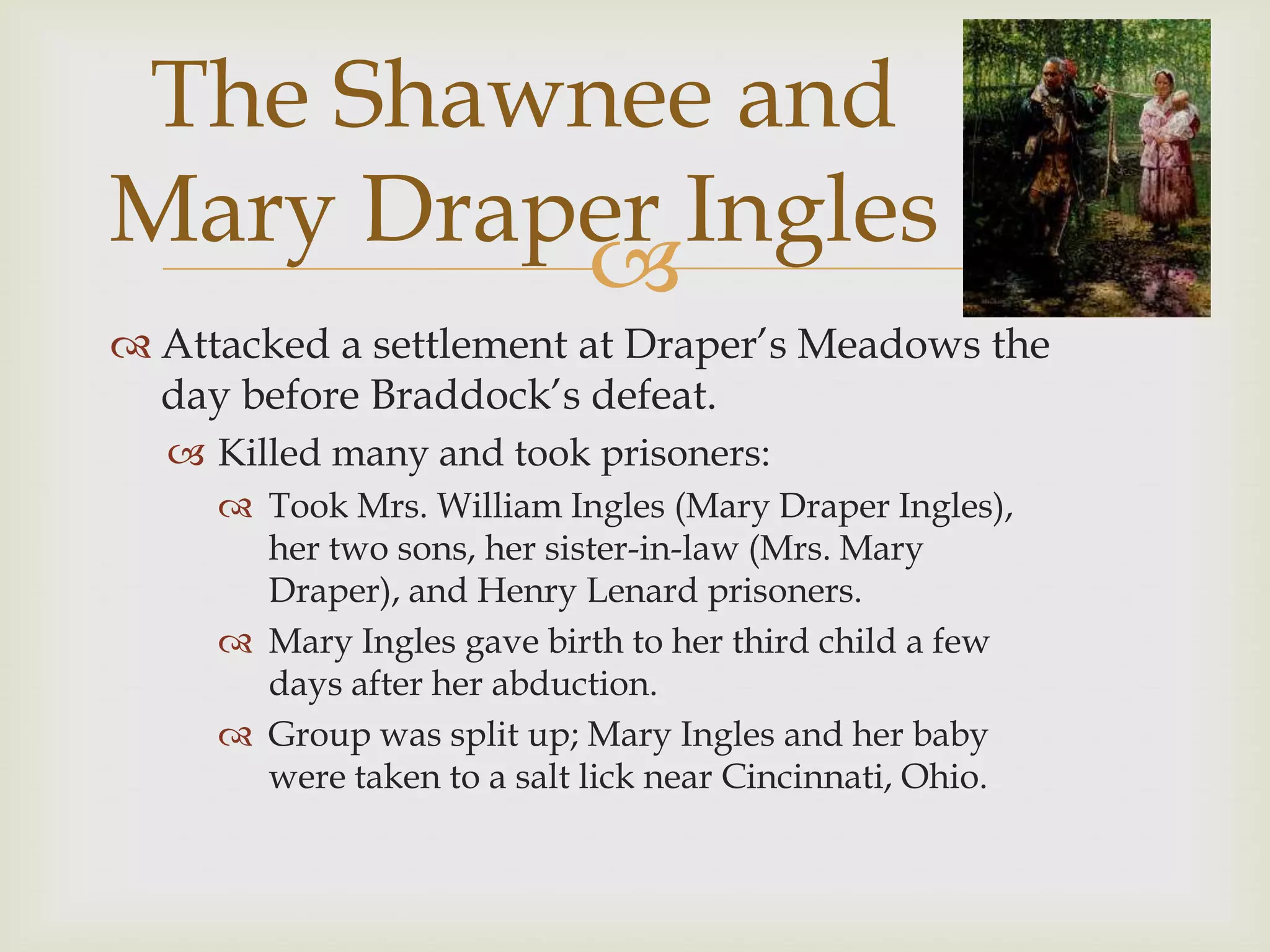
 Attacked a settlement at Draper’s Meadows the
  day before Braddock’s defeat.
   Killed many and took prisoners:
      Took Mrs. William Ingles (Mary Draper Ingles),
       her two sons, her sister-in-law (Mrs. Mary
       Draper), and Henry Lenard prisoners.
      Mary Ingles gave birth to her third child a few
       days after her abduction.
      Group was split up; Mary Ingles and her baby
       were taken to a salt lick near Cincinnati, Ohio.
Escape
                          
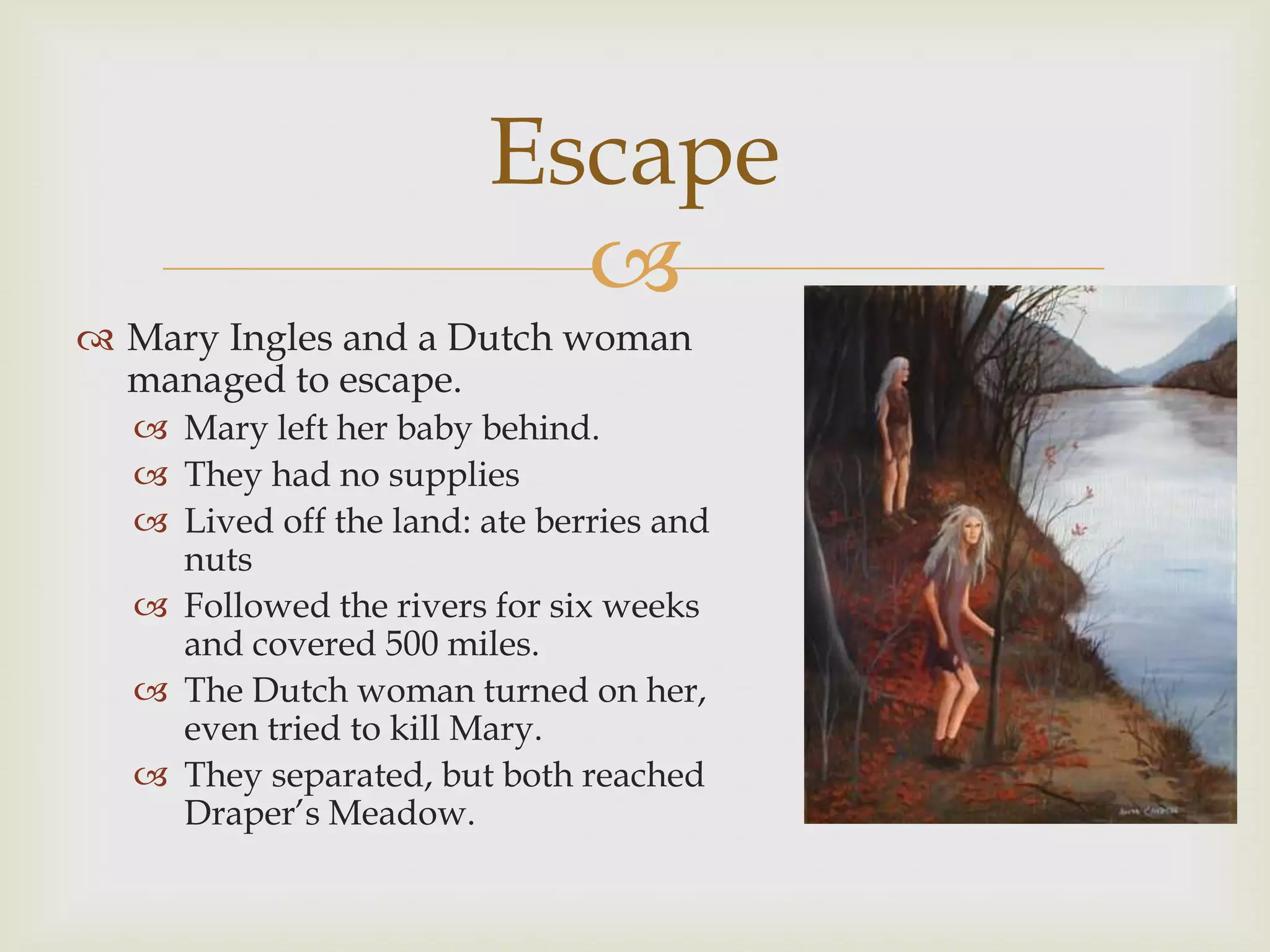
 Mary Ingles and a Dutch woman
  managed to escape.
   Mary left her baby behind.
   They had no supplies
   Lived off the land: ate berries and
    nuts
   Followed the rivers for six weeks
    and covered 500 miles.
   The Dutch woman turned on her,
    even tried to kill Mary.
   They separated, but both reached
    Draper’s Meadow.
Native
    Americans
    Fight Back             Major Andrew Lewis and a
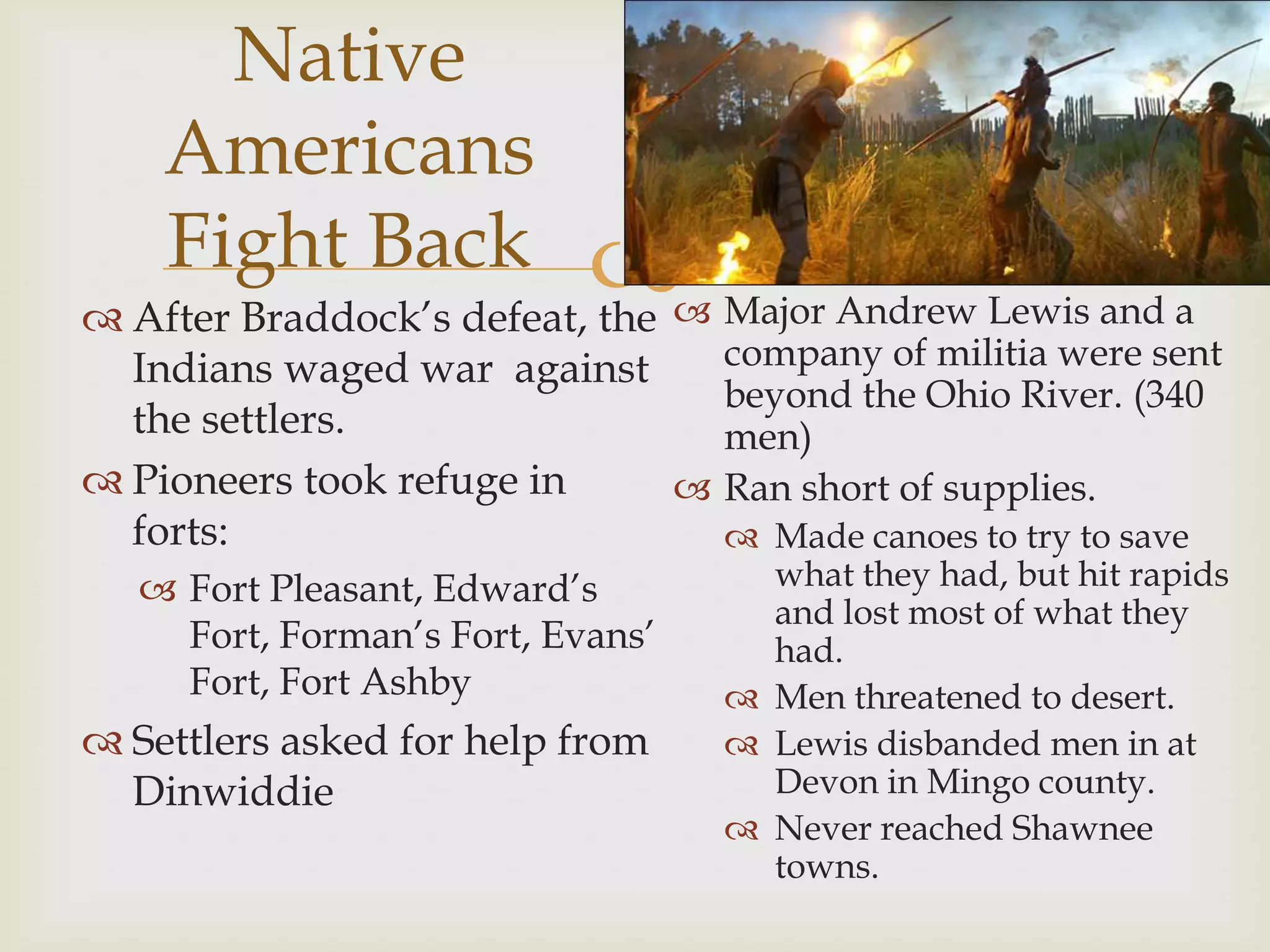
 After Braddock’s defeat, the
  Indians waged war against   company of militia were sent
                              beyond the Ohio River. (340
  the settlers.               men)
 Pioneers took refuge in    Ran short of supplies.
  forts:                       Made canoes to try to save
    Fort Pleasant, Edward’s         what they had, but hit rapids
                                     and lost most of what they
     Fort, Forman’s Fort, Evans’     had.
     Fort, Fort Ashby               Men threatened to desert.
 Settlers asked for help from      Lewis disbanded men in at
  Dinwiddie                          Devon in Mingo county.
                                    Never reached Shawnee
                                     towns.
Tides of War
                    
 April 1756
   Group of French and Indians attacked Edward’s Fort in
    Hampshire County.
      Totally wiped out British forces
   Four months later, Dinwiddie issued a formal declaration of
    war.
 May 1758
   Band of Shawnee attacked Fort Seybert in Pendleton
    County
      Indians promised that if the frontiersmen surrendered, their
       lives would be spared.
         It was a trick. All eleven who surrendered were put to death.
Success with William Pitt
           
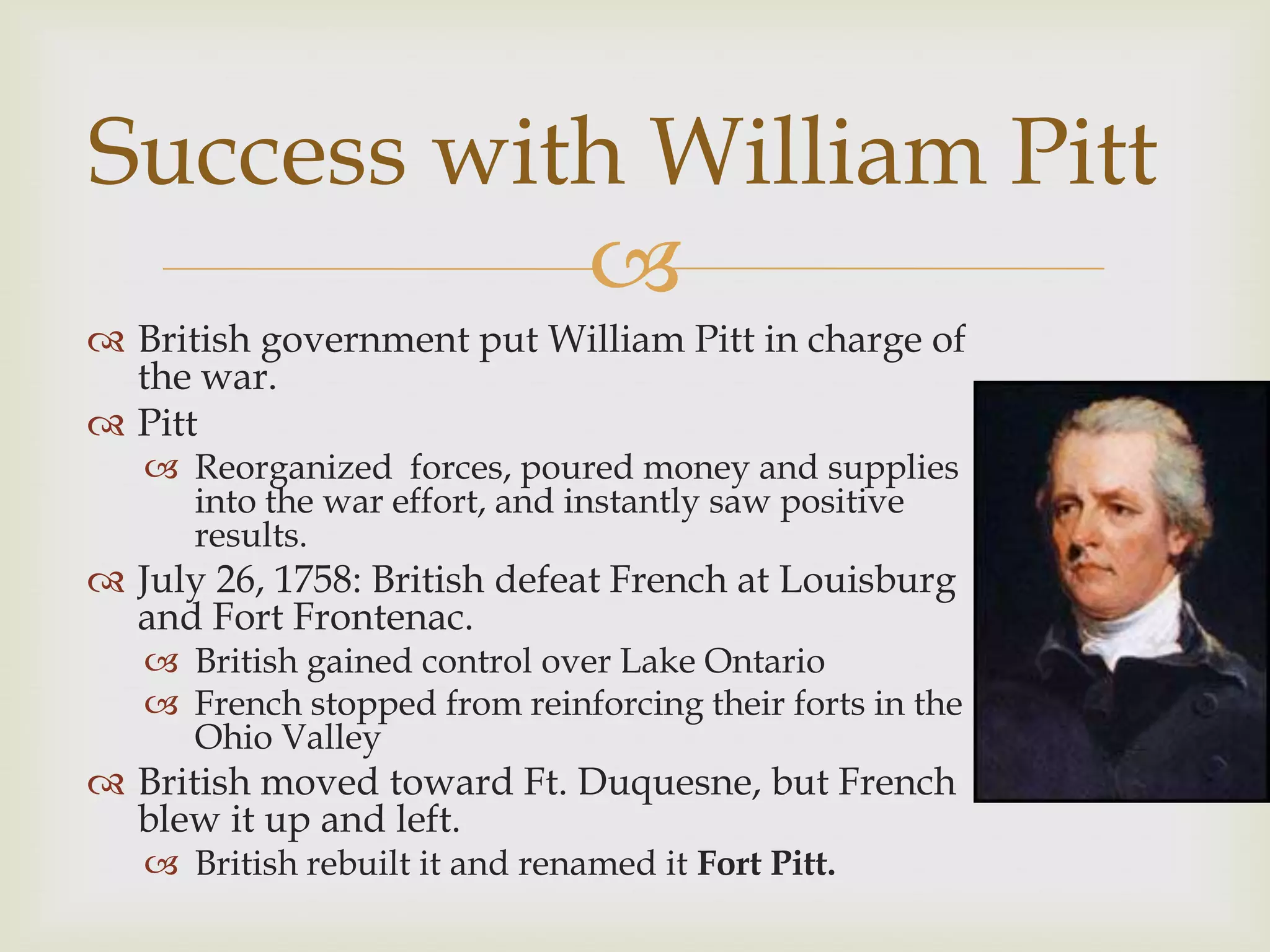
 British government put William Pitt in charge of
  the war.
 Pitt
    Reorganized forces, poured money and supplies
     into the war effort, and instantly saw positive
     results.
 July 26, 1758: British defeat French at Louisburg
  and Fort Frontenac.
    British gained control over Lake Ontario
    French stopped from reinforcing their forts in the
     Ohio Valley
 British moved toward Ft. Duquesne, but French
  blew it up and left.
    British rebuilt it and renamed it Fort Pitt.
Battle of Quebec
                   
 British victories at Ft. Niagara, Ft.
  Ticonderoga, and Crown Point preceded
  the Battle of Quebec.
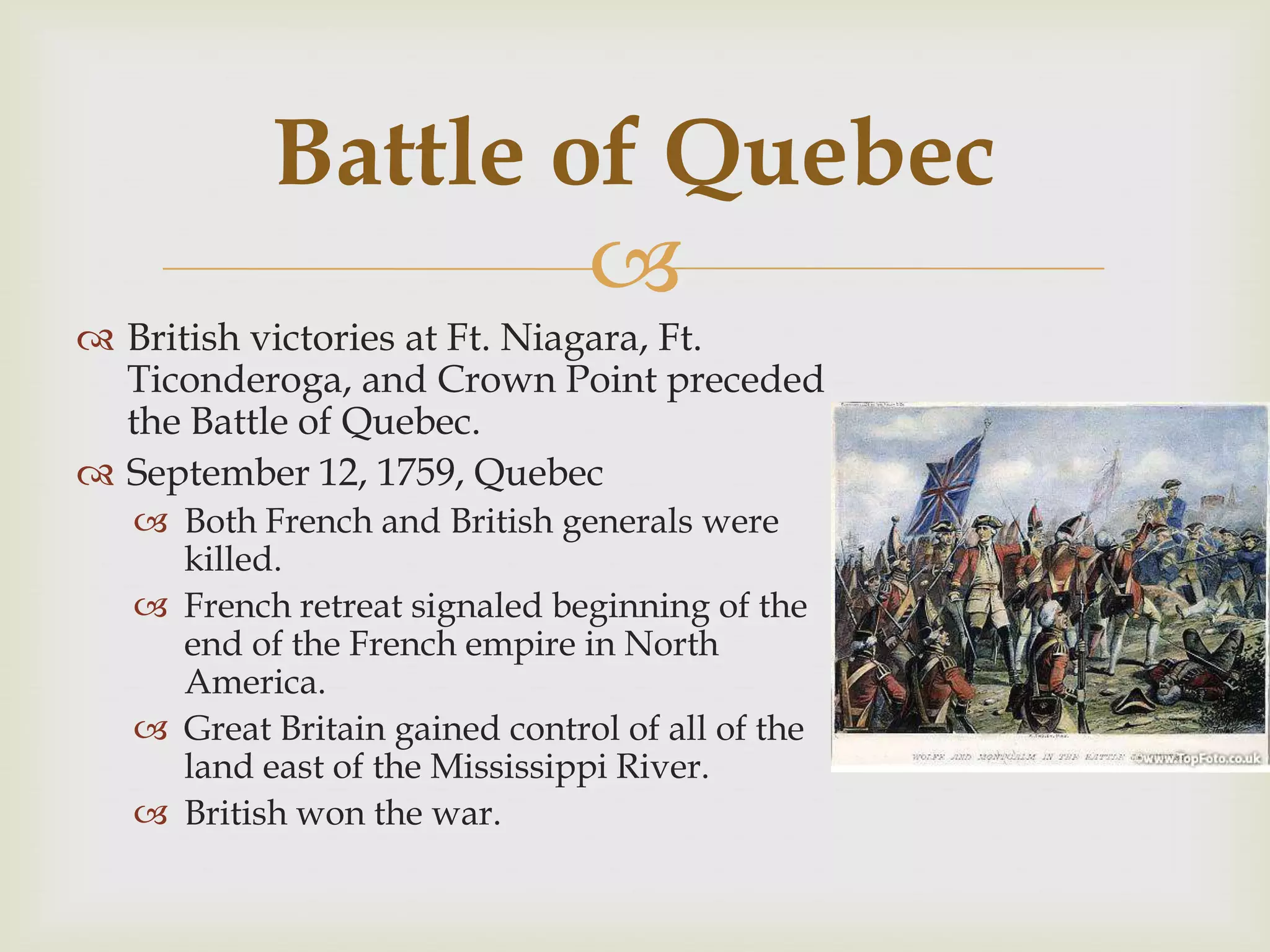
 September 12, 1759, Quebec
   Both French and British generals were
    killed.
   French retreat signaled beginning of the
    end of the French empire in North
    America.
   Great Britain gained control of all of the
    land east of the Mississippi River.
   British won the war.
Journal Entry
                 
 You are a soldier during the French and Indian War.
  Choose one battle and write a letter to someone in
  your family about your experiences throughout the
  battle. It must be historically accurate, use real
  names, and real events.
 Have fun with it! This is your chance to express your
  opinions about which side you would choose to fight
  with, brutality of the battles, and your own ideas
  about what may work better when fighting.
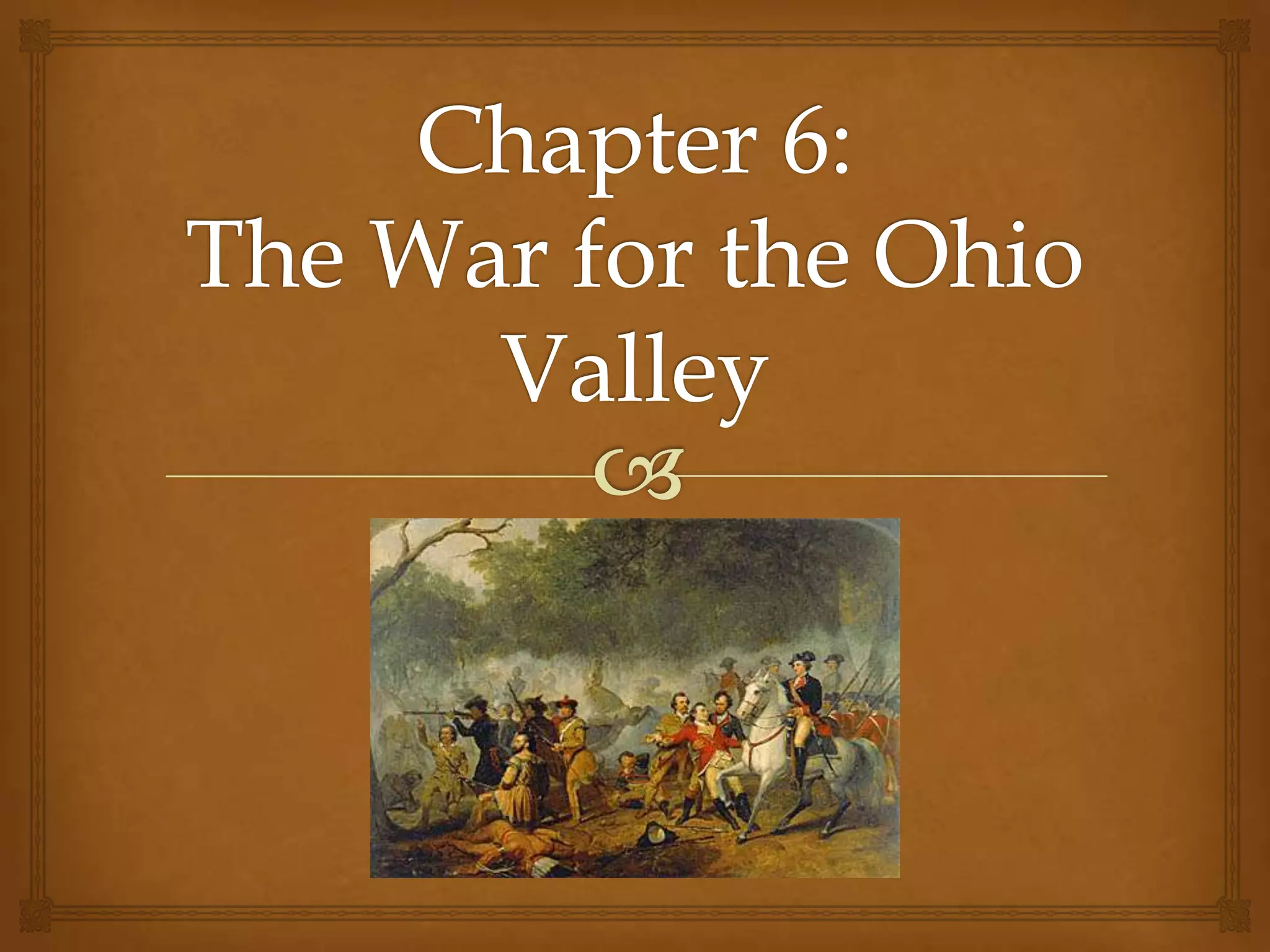
Chapter 6

  • 2.
    Settlers in the Ohio Valley   1730-1755: Transitional period.  Lifestyle on frontier was changing.  Transients:  Explorers who investigated the land, then moved on to new lands.  Settlers:  wanted permanency.  Frontier continued to move west with more settlers.
  • 3.
    Conflicting Land Claims   Rivalry between France and Great Britain  Series of wars for 100 years  Seven Years War: (1756-1763)  Last seven years of the wars and fighting in Europe  Known as the French and Indian War in North America
  • 4.
    Think ahead:  1. Why is the war known as the French and Indian War? Why not the British and French War? 2. What are allies? 3. Who become allies, when fighting occurs in North America?  French and Native Americans?  British and Native Americans?  No allies. Everyone fights against everyone?
  • 5.
    Claims of theOhio River Valley de  1669: French – Robert Cavelier La Salle’s exploration of the Ohio River  1671: British - Batts and Fallam exploration of New River  Waters flow into the Kanawha, Ohio, and Mississippi rivers.  1749: French strengthened – Celeron de Blainville buried lead plates along the Ohio River
  • 6.
    Lead Plate foundin Point Pleasant 
  • 7.
    Lead Plate Translation   In the year 1749, reign of Louis XV., King of France, We, Celeron, commandant of a detachment sent by Monsieur the Marquis de la Galissoniere, Commandant General of New France, to re-establish tranquillity in some Indian villages of these cantons, have buried this plate at the mouth of the river Chinodashichetha, the 18th August, near the river Ohio, otherwise Beautiful River, as a monument of renewal of possessions, which we have taken of the said river Ohio, and of all those which fall into it, and of all the lands on both sides, as far as to the sources of said rivers; the same as were enjoyed or ought to have been enjoyed, by the preceding Kings of France, and that they have maintained it by their arms and by treaties, especially by those of Ryswick, Utrecht, and Aix-la- Chapelle.
  • 8.
    Views on Treatiesand Land Ownership  Indians:   British:  Avoided difficulties by  Treaties are seen as the negotiating treaties with end of warfare or as Indians trade agreements  Treaties had nothing to  Used treaties to take do with land ownership control of property  Saw treaties as  Saw treaties as binding changeable.  French:  Permanent ownership of land was not a major consideration.  More interested in fur trade.  Did not pose a threat to Indians.
  • 9.
    Setting the Scene   Nemacolin Path:  Path cut by Nemacolin (Delaware Indian) and Thomas Cresap  Wills Creek in Cumberland, Maryland to beginning of Ohio River, near Pittsburgh.  Brought French and British into direct contact with the Ohio Valley  Treaty of Logstown:  Signed by Christopher Gist of the Ohio Land Company, Delaware, and Shawnee tribes  Gave Virginia control of the Ohio Valley
  • 10.
  • 11.
    Governor Dinwiddie’s Proposal   (1753) Virginian Governor Robert Dinwiddie:  Diplomatic mission to Fort LeBouef, near Lake Erie.  Led by 21 year old George Washington.  Mission was to ask the French to leave the Ohio Valley
  • 12.
    George Washington   Followed the Nemacolin Path to the forks of the Ohio River where Monongahela and Allegheny rivers meet.  There, joined by:  Christopher Gist, Ohio Land Company  Jacob Van Braam, French interpreter  Half King, Indian chieftain and guide
  • 13.
  • 14.
    George Washington at Fort LeBouef   Washington met with French leader, Jacques Legardeur de Saint Pierre  Dinwiddie’s proposal was rejected  Group prepared to go home.  Found out that the French had bribed the Half-King to convince him to stay with them. (didn’t succeed)
  • 15.
    War Breaks Out   Captain William Trent  Ordered by Dinwiddie to build a fort at the forks of the Ohio River.  May 1754: Washington sent as back up.  Learns of Trent’s defeat  French destroyed British’s partially built fort  Replaced with Fort Duquesne  French actions are considered an act of war.  Washington prepares to march against the French.
  • 16.
    Let the WarBegin!  Washington and 40 men   French scouting party  Skirmish is over in 15 minutes:  Washington’s troops had killed 10 men, including French leader, Joseph Coulon de Villers de Jumonville.  Marks the beginning of the French and Indian War.
  • 17.
    Jumonville’s Death   Think it out:  What does John Shaw’s account about Jumonville’s death prove about the war?  From what you know about the war, which side would you fight for?
  • 18.
    Advantages   French:  British:  Larger land claim  Larger population  Already-existing  Powerful Iroquois system of forts in the allies Ohio Valley  Control of the oceans  Majority of Indian  Population that was allies concentrated in a very  Superior military small area officers and army.  Desire to protect their own property
  • 19.
    Disadvantages   French:  British:  Sparse Population  Military organization  Soldiers with no  Poorly organized personal interest in the frontier volunteers land  Less qualified officers.  Poor lines of supply
  • 20.
    Battle at FortNecessity   Immediate retaliation from the French:  Set out in search of those responsible for Jumonville’s death  Washington ordered the completion of Fort Necessity at Great Meadows  July 3, 1754:  1,600 French soldiers and Indians; 300 British men  1/3 of Washington’s men were sick or wounded  Washington surrendered
  • 21.
    Terms of Surrender   Washington was required to leave the Ohio Valley and not return to build forts for a year.  Washington agreed to return all prisoners taken in Jumonville battle.  French agreed to return Fort Duquesne and build no more forts in the Ohio Valley
  • 22.
    Battle of the Monongahela   Dinwiddie asked the King of England for reinforcements.  Sent two regiments of British Regulars  General Edward Braddock  Started training 1,000 Virginia Militia – disliked them, and saw them as undisciplined  Aided by Colonel George Washington
  • 23.
    Braddock’s force  All met at Fort  Made up of: Cumberland, then  1,400 British soldiers headed to Fort  60 sailors Duquesne  2,400 colonial troops  300 Indians  150 wagons  2,000 horses
  • 24.
  • 25.
  • 26.
    The Shawnee and MaryDraper Ingles   Attacked a settlement at Draper’s Meadows the day before Braddock’s defeat.  Killed many and took prisoners:  Took Mrs. William Ingles (Mary Draper Ingles), her two sons, her sister-in-law (Mrs. Mary Draper), and Henry Lenard prisoners.  Mary Ingles gave birth to her third child a few days after her abduction.  Group was split up; Mary Ingles and her baby were taken to a salt lick near Cincinnati, Ohio.
  • 27.
    Escape   Mary Ingles and a Dutch woman managed to escape.  Mary left her baby behind.  They had no supplies  Lived off the land: ate berries and nuts  Followed the rivers for six weeks and covered 500 miles.  The Dutch woman turned on her, even tried to kill Mary.  They separated, but both reached Draper’s Meadow.
  • 28.
    Native Americans Fight Back  Major Andrew Lewis and a  After Braddock’s defeat, the Indians waged war against company of militia were sent beyond the Ohio River. (340 the settlers. men)  Pioneers took refuge in  Ran short of supplies. forts:  Made canoes to try to save  Fort Pleasant, Edward’s what they had, but hit rapids and lost most of what they Fort, Forman’s Fort, Evans’ had. Fort, Fort Ashby  Men threatened to desert.  Settlers asked for help from  Lewis disbanded men in at Dinwiddie Devon in Mingo county.  Never reached Shawnee towns.
  • 29.
    Tides of War   April 1756  Group of French and Indians attacked Edward’s Fort in Hampshire County.  Totally wiped out British forces  Four months later, Dinwiddie issued a formal declaration of war.  May 1758  Band of Shawnee attacked Fort Seybert in Pendleton County  Indians promised that if the frontiersmen surrendered, their lives would be spared.  It was a trick. All eleven who surrendered were put to death.
  • 30.
    Success with WilliamPitt   British government put William Pitt in charge of the war.  Pitt  Reorganized forces, poured money and supplies into the war effort, and instantly saw positive results.  July 26, 1758: British defeat French at Louisburg and Fort Frontenac.  British gained control over Lake Ontario  French stopped from reinforcing their forts in the Ohio Valley  British moved toward Ft. Duquesne, but French blew it up and left.  British rebuilt it and renamed it Fort Pitt.
  • 31.
    Battle of Quebec   British victories at Ft. Niagara, Ft. Ticonderoga, and Crown Point preceded the Battle of Quebec.  September 12, 1759, Quebec  Both French and British generals were killed.  French retreat signaled beginning of the end of the French empire in North America.  Great Britain gained control of all of the land east of the Mississippi River.  British won the war.
  • 32.
    Journal Entry   You are a soldier during the French and Indian War. Choose one battle and write a letter to someone in your family about your experiences throughout the battle. It must be historically accurate, use real names, and real events.  Have fun with it! This is your chance to express your opinions about which side you would choose to fight with, brutality of the battles, and your own ideas about what may work better when fighting.