WWW.EROSA.AGINFRA.EU
e-ROSA has received funding from the European
Union’s Horizon 2020 research and innovation
programme under grant agreement No 730988
OSFair2017 | Athens, 6 September 2017
Madeleine Huber
French National Institute for Agricultural Research (INRA)
The Roadmap to better food: Using ICT and Open Data to overcome barriers
in the agriculture value chain
Towards an e-infrastructure for open
science in agri-food
WWW.EROSA.AGINFRA.EU
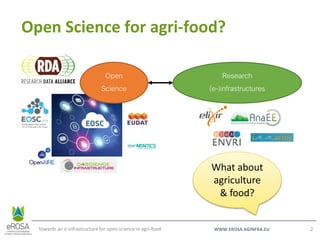
Open Science for agri-food?
Towards an e-infrastructure for open science in agri-food 2
Open
Science
Research
(e-)infrastructures
What about
agriculture
& food?
WWW.EROSA.AGINFRA.EU
The data opportunity in agri-food
Towards an e-infrastructure for open science in agri-food 3
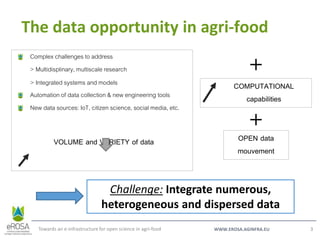
Complex challenges to address
> Multidisplinary, multiscale research
> Integrated systems and models
Automation of data collection & new engineering tools
New data sources: IoT, citizen science, social media, etc.
VOLUME and VARIETY of data
+
COMPUTATIONAL
capabilities
+
OPEN data
mouvement
Challenge: Integrate numerous,
heterogeneous and dispersed data
WWW.EROSA.AGINFRA.EU
Why an e-infrastructure?
Towards an e-infrastructure for open science in agri-food 4
We need a common e-infrastructure to:
connect data and connect infrastructures
integrate existing initiatives into a common framework at a global level, facilitate
collaboration
share efforts and resources: provide shared services to integrate, explore and
analyse data
support a collective change of practices through the adoption of shared standards:
support the elaboration and use of FAIR data
provide a pre-competitive space for sharing data and speeding up innovation
processes
WWW.EROSA.AGINFRA.EU
e-ROSA in brief
Towards an e-infrastructure for open science in agri-food 5
Coordination and support action (infrasupp 3 2016)
18 months (01/2017 – 06/2018)
Consortium: INRA (FR), WUR Alterra (NL), Agroknow (GR)
Objective: elaborate a roadmap for an e-infrastructure for open science in agri-food
WWW.EROSA.AGINFRA.EU
e-ROSA approach
Towards an e-infrastructure for open science in agri-food 6
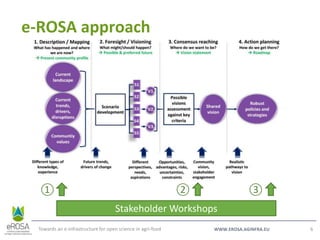
Stakeholder Workshops
① ② ③
WWW.EROSA.AGINFRA.EU
What we have done so far
Towards an e-infrastructure for open science in agri-food 7
Bibliometric analysis
> Initial scoping of the e-ROSA community
Online map
> Cataloguing key stakeholders, initiatives and
> Open call to come
First Stakeholder Workshop: 6-7 July 2017 in
Montpellier, France
> Initiate community-building and improve knowledge
http://www.erosa.aginfra.eu/sites/erosa_deliverables/D1.1.pdf
http://www.aginfra.eu/discover
http://www.erosa.aginfra.eu/node/47
WWW.EROSA.AGINFRA.EU
Current landscape: Our “Commons”
Towards an e-infrastructure for open science in agri-food 8
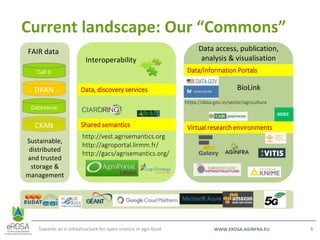
Iron and Wires
Interoperability
http://vest.agrisemantics.org
http://agroportal.lirmm.fr/
http://gacs/agrisemantics.org/
Shared semantics
Data, discovery servicesDKAN
Sustainable,
distributed
and trusted
storage &
management
CKAN
DataVerse
Call it
FAIR data
,
Virtual research environments
Data/Information Portals
Data access, publication,
analysis & visualisation
https://data.gov.in/sector/agriculture
BioLink
WWW.EROSA.AGINFRA.EU
Current landscape: Challenges
Towards an e-infrastructure for open science in agri-food 9
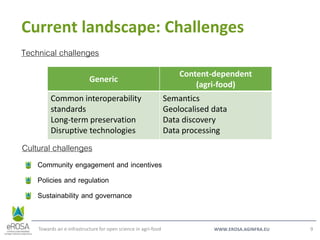
Technical challenges
Generic
Content-dependent
(agri-food)
Common interoperability
standards
Long-term preservation
Disruptive technologies
Semantics
Geolocalised data
Data discovery
Data processing
Cultural challenges
Community engagement and incentives
Policies and regulation
Sustainability and governance
WWW.EROSA.AGINFRA.EU
Towards the e-infrastructure
Towards an e-infrastructure for open science in agri-food 10
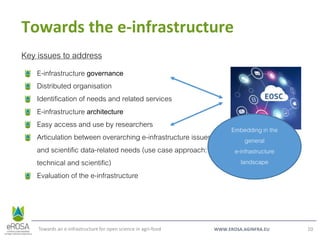
Key issues to address
E-infrastructure governance
Distributed organisation
Identification of needs and related services
E-infrastructure architecture
Easy access and use by researchers
Articulation between overarching e-infrastructure issues
and scientific data-related needs (use case approach:
technical and scientific)
Evaluation of the e-infrastructure
Embedding in the
general
e-infrastructure
landscape
WWW.EROSA.AGINFRA.EU
Towards the e-infrastructure
Towards an e-infrastructure for open science in agri-food 11
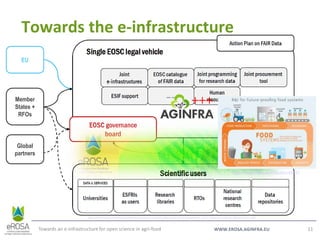
EU
Member
States +
RFOs
Global
partners
+++
https://www.open-science-conference.eu/wp-content/uploads/2016/02/Burgelman_2017-Science-2-Berlin-March-2017.pdf
http://www.erosa.aginfra.eu/node/47
WWW.EROSA.AGINFRA.EU
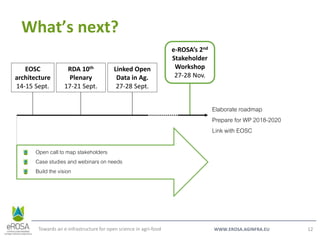
What’s next?
Towards an e-infrastructure for open science in agri-food 12
Elaborate roadmap
Prepare for WP 2018-2020
Link with EOSC
Open call to map stakeholders
Case studies and webinars on needs
Build the vision
EOSC
architecture
14-15 Sept.
RDA 10th
Plenary
17-21 Sept.
Linked Open
Data in Ag.
27-28 Sept.
e-ROSA’s 2nd
Stakeholder
Workshop
27-28 Nov.
WWW.EROSA.AGINFRA.EU
Discussion
Towards an e-infrastructure for open science in agri-food 13
Interaction between generic and domain-specific e-infrastructures
What services should be generic? How to ensure affordable and sustainable
access to data analytics and computation to researchers, regardless of their
disciplines or where they are located?
What are the specific service requirements for the Agri-food sciences?
WWW.EROSA.AGINFRA.EU
CONSORTIUM
WWW.EROSA.AGINFRA.EU
14
Thank you for your attention!

OSFair2017 Workshop | Towards an e-infrastructure for open science in agri-food

  • 1.
    WWW.EROSA.AGINFRA.EU e-ROSA has receivedfunding from the European Union’s Horizon 2020 research and innovation programme under grant agreement No 730988 OSFair2017 | Athens, 6 September 2017 Madeleine Huber French National Institute for Agricultural Research (INRA) The Roadmap to better food: Using ICT and Open Data to overcome barriers in the agriculture value chain Towards an e-infrastructure for open science in agri-food
  • 2.
    WWW.EROSA.AGINFRA.EU Open Science foragri-food? Towards an e-infrastructure for open science in agri-food 2 Open Science Research (e-)infrastructures What about agriculture & food?
  • 3.
    WWW.EROSA.AGINFRA.EU The data opportunityin agri-food Towards an e-infrastructure for open science in agri-food 3 Complex challenges to address > Multidisplinary, multiscale research > Integrated systems and models Automation of data collection & new engineering tools New data sources: IoT, citizen science, social media, etc. VOLUME and VARIETY of data + COMPUTATIONAL capabilities + OPEN data mouvement Challenge: Integrate numerous, heterogeneous and dispersed data
  • 4.
    WWW.EROSA.AGINFRA.EU Why an e-infrastructure? Towardsan e-infrastructure for open science in agri-food 4 We need a common e-infrastructure to: connect data and connect infrastructures integrate existing initiatives into a common framework at a global level, facilitate collaboration share efforts and resources: provide shared services to integrate, explore and analyse data support a collective change of practices through the adoption of shared standards: support the elaboration and use of FAIR data provide a pre-competitive space for sharing data and speeding up innovation processes
  • 5.
    WWW.EROSA.AGINFRA.EU e-ROSA in brief Towardsan e-infrastructure for open science in agri-food 5 Coordination and support action (infrasupp 3 2016) 18 months (01/2017 – 06/2018) Consortium: INRA (FR), WUR Alterra (NL), Agroknow (GR) Objective: elaborate a roadmap for an e-infrastructure for open science in agri-food
  • 6.
    WWW.EROSA.AGINFRA.EU e-ROSA approach Towards ane-infrastructure for open science in agri-food 6 Stakeholder Workshops ① ② ③
  • 7.
    WWW.EROSA.AGINFRA.EU What we havedone so far Towards an e-infrastructure for open science in agri-food 7 Bibliometric analysis > Initial scoping of the e-ROSA community Online map > Cataloguing key stakeholders, initiatives and > Open call to come First Stakeholder Workshop: 6-7 July 2017 in Montpellier, France > Initiate community-building and improve knowledge http://www.erosa.aginfra.eu/sites/erosa_deliverables/D1.1.pdf http://www.aginfra.eu/discover http://www.erosa.aginfra.eu/node/47
  • 8.
    WWW.EROSA.AGINFRA.EU Current landscape: Our“Commons” Towards an e-infrastructure for open science in agri-food 8 Iron and Wires Interoperability http://vest.agrisemantics.org http://agroportal.lirmm.fr/ http://gacs/agrisemantics.org/ Shared semantics Data, discovery servicesDKAN Sustainable, distributed and trusted storage & management CKAN DataVerse Call it FAIR data , Virtual research environments Data/Information Portals Data access, publication, analysis & visualisation https://data.gov.in/sector/agriculture BioLink
  • 9.
    WWW.EROSA.AGINFRA.EU Current landscape: Challenges Towardsan e-infrastructure for open science in agri-food 9 Technical challenges Generic Content-dependent (agri-food) Common interoperability standards Long-term preservation Disruptive technologies Semantics Geolocalised data Data discovery Data processing Cultural challenges Community engagement and incentives Policies and regulation Sustainability and governance
  • 10.
    WWW.EROSA.AGINFRA.EU Towards the e-infrastructure Towardsan e-infrastructure for open science in agri-food 10 Key issues to address E-infrastructure governance Distributed organisation Identification of needs and related services E-infrastructure architecture Easy access and use by researchers Articulation between overarching e-infrastructure issues and scientific data-related needs (use case approach: technical and scientific) Evaluation of the e-infrastructure Embedding in the general e-infrastructure landscape
  • 11.
    WWW.EROSA.AGINFRA.EU Towards the e-infrastructure Towardsan e-infrastructure for open science in agri-food 11 EU Member States + RFOs Global partners +++ https://www.open-science-conference.eu/wp-content/uploads/2016/02/Burgelman_2017-Science-2-Berlin-March-2017.pdf http://www.erosa.aginfra.eu/node/47
  • 12.
    WWW.EROSA.AGINFRA.EU What’s next? Towards ane-infrastructure for open science in agri-food 12 Elaborate roadmap Prepare for WP 2018-2020 Link with EOSC Open call to map stakeholders Case studies and webinars on needs Build the vision EOSC architecture 14-15 Sept. RDA 10th Plenary 17-21 Sept. Linked Open Data in Ag. 27-28 Sept. e-ROSA’s 2nd Stakeholder Workshop 27-28 Nov.
  • 13.
    WWW.EROSA.AGINFRA.EU Discussion Towards an e-infrastructurefor open science in agri-food 13 Interaction between generic and domain-specific e-infrastructures What services should be generic? How to ensure affordable and sustainable access to data analytics and computation to researchers, regardless of their disciplines or where they are located? What are the specific service requirements for the Agri-food sciences?
  • 14.

Editor's Notes

  • #2 Hello everyone, I’m Madeleine Huber, I work at INRA, the French National Institute for Agricultural Research, and today I would like to talk to you about the project I work for which is called e-ROSA and which stands for “…”, and I would like to talk to you about why we need an e-infrastructure for agri-food research. And I’m going to start with that.
  • #3 Well aware of the open data/open science movement: global and European Convinced of the benefits We already have research infrastructures for implementing open science in some research fields But we don’t have one for agri-food, although we urgently need one
  • #4 And why is that? “real” data from farms to validate models
  • #6 So now we need to start to think about the development of this e-infra, and that’s exactly what e-ROSA is trying to do Foresight project
  • #7 Stakeholder WSs for: Effective community-building Collaborative envisioning of the e-infrastructure Identification of future partners to be involved in the design and implementation of the e-infrastructure
  • #8 Bibliometric analysis: Most publishing institutions Collaborations amongst organisations Linking of organisations to data-related topics (e.g. big data, sensors, semantics, etc.) 1st WS: most significant 1st step, I’m going to go into more details about the WS
  • #9 Three-layer conceptual model: 1st layer on the left: data sources, dispersed using different technologies and softwares to open and manage their data Sustainability Trusted (FAIR principles) To what extend should local repositories FAIRify their data (time- and resource-consuming) 3rd layer on the right: user layer with services Portals relying on data integration, integration of related data and info in publications, not just tabular data Data processing (not only public services, but also private with appropriate business models) Middle layer: interoperability layer Data catalogues: issue of metadata and federated dataset catalogues
  • #10 More content-dependent technical issues, strongly linked to the type of data (agri-food) Semantics: Highly fragmented resources and lack of shared standards Also lack of smart annotation tools and fully usable hub of ontologies with related APIs Need to catalogue and align semantic assets Need to embed semantic support services within research infrastructures Location-based data: crucial issue as agri-food research is location-dependent Lacking Linked Open Data tools and formats that are adapted to the integration of such data (e.g. RDF not completely suitable) Data discovery services: We need high quality metadata, so we need to engage data producers to provide this metadata as they are the ones that know the data best We need to build federated data catalogues and develop related APIs to support discovery services Data processing services: Design of Virtual Research Environments for specific communities Elaboration and sharing of workflows, need to improve their interoperability Intelligent data processing Data visualisation and exploration Cultural challenges: Community engagement, incentivise researchers to share their data through dedicated mechanisms: By valuing data sharing and publication at the institutional level By providing technical support to publish data papers (citable asset) By providing technical support to elaborate FAIR data (metadata, standards, licenses) By monitoring openness and FAIRness of data as a strategic objective at the institutional level Policies and regulations: play a crucial role in: Preventing from monopoly of data and supporting Keeping enough of the web of data in the public domain to support generation of knowledge of public interest Fostering data sharing by harmonising data publication expectations amongst funders Sustainability and governance: We need to take several dimensions into account: Global EOSC Rely on what is already supported by individual organisations and initiatives Specific governance mechanism for semantic resources Business models need to: Support clear benefits for individual data owners (variety: research, public, farmers, industry, consumer) Support long-term maintenance of data repositories, catalogues, standards and tools for FAIR data
  • #11 Good overview of where we are at regarding the current landscape and the challenges ahead of us, the topics to explore deeper And now we have to go further into the envisioning and design of the e-infrastructure: Governance: To have a sustainable governance model, we need to keep the interest of people, so we need to develop impactful examples of what is already possible thanks to open data and what could be possible if we further support it (make the case for the e-infrastructure) Distributed organization: several issues: Agree on data access and interoperability policies; Secure sustainable funding for long-term common resources; Agree on an efficient division of labour to maximise total impact; Synchronise technical updates (e.g. at a local level, when implementing improvements of a common data model) Use cases: approach that was discussed in depth during the workshop Both scientific and technical demonstrators are required to address specific needs of scientific communities and provide scalable, more generic services that can serve agri-food research as a whole Scientific: identifying weeds, predicting toxicology, track food products from farm to fork, design of a use case on the performance of wheat varieties Technical: I already talked about those issues that could provide the basis for technical demonstrators: semantics, federated dataset catalogue, linking of location-based data, data visualisation, etc. Challenge to integrate this future thematic e-infrastructure in the landscape of existing generic e-infrastructures and technological services
  • #12 Make the link between the centralised/transversal platform EOSC and thematic e-infrastructures Take into account specific needs of the agri-food community, requires an appropriate governance model But for now generic services: not clear for researchers, not easily accessible or understandable We need to understand how we can collaborate with generic e-infrastructures Example: semantics: have a generic e-infrastructure that maintains semantic technologies while we collaborate to provide the content on agri-food
  • #14 E-infrastructure: federated platform that offers working environments for researchers, that integrate various services that are labelled as trusted Integrate technological services to our domain-specific applications and VREs How can we collaborate with more technological infrastructures as service providers? Can they clarify their offer of services for specific/thematic research communities?
  • #15 And that’s all for me!