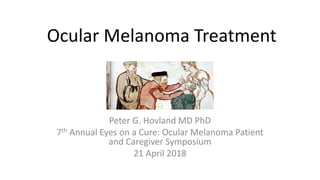
Ocular Melanoma Treatment
Peter G. Hovland MD PhD
7th Annual Eyes on a Cure: Ocular Melanoma Patient
and Caregiver Symposium
21 April 2018
Welcome!
• Patient advocacy can make a difference
• Your fundraising helps
– Improve understanding
– Promotes better communication
– Fosters focused research
Introduction
• Dr. Peter Hovland
• Ocular Oncologist and Retina Specialist
• Clinical practice with Colorado Retina Associates
for 12 years
Disclosure
• Castle Biosciences – Advisory Board
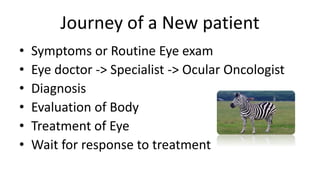
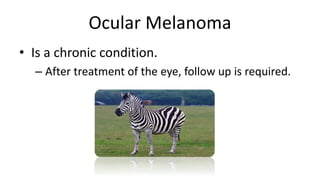
When you hear hoof steps…
• You think of horses not zebras!
• Common things are seen more commonly.
• This talk is about zebras however.
Common Rare
Ocular Melanoma
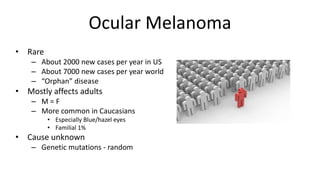
• Rare
– About 2000 new cases per year in US
– About 7000 new cases per year world
– “Orphan” disease
• Mostly affects adults
– M = F
– More common in Caucasians
• Especially Blue/hazel eyes
• Familial 1%
• Cause unknown
– Genetic mutations - random
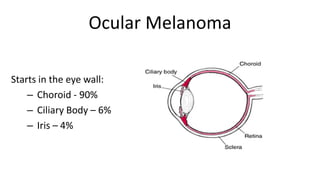
Ocular Melanoma
Starts in the eye wall:
– Choroid - 90%
– Ciliary Body – 6%
– Iris – 4%
OM originates in the eye
– Some OM can spread to the body
Tangent: Other cancers can spread to the eye
• Adenocarcinomas
– Breast, Lung, Prostate, GI, GU
• Lymphoma
• Sarcoma
• Melanoma
• Carcinoid
Journey of a New patient
• Symptoms or Routine Eye exam
• Eye doctor -> Specialist -> Ocular Oncologist
• Diagnosis
• Evaluation of Body
• Treatment of Eye
• Wait for response to treatment
How do we know it’s melanoma?
• Diagnosis based on exam and testing
• Diagnosis may be made
– At initial presentation
– After a period of observation
• Tumor may grow
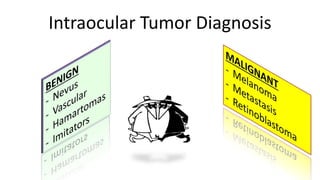
Intraocular Tumor Diagnosis
Diagnostic Testing
• Initial evaluation
• Periodic observation
• Monitor response to treatment
• Multimodal
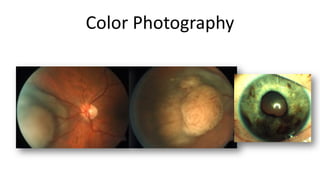
Color Photography
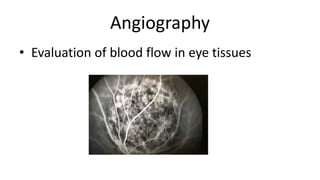
Angiography
• Evaluation of blood flow in eye tissues
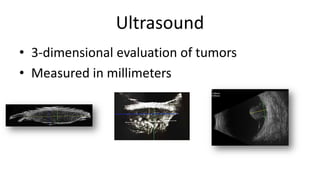
Ultrasound
• 3-dimensional evaluation of tumors
• Measured in millimeters
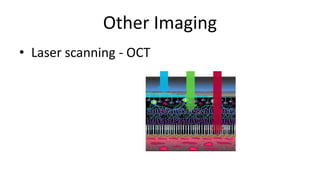
Other Imaging
• Laser scanning - OCT
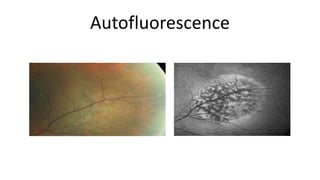
Autofluorescence
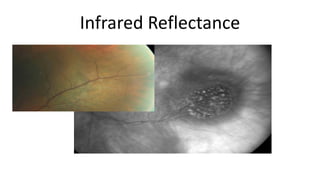
Infrared Reflectance
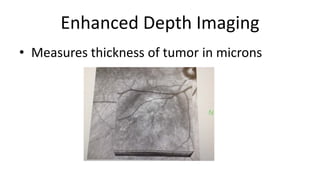
Enhanced Depth Imaging
• Measures thickness of tumor in microns
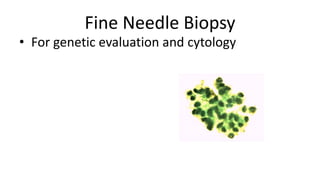
Fine Needle Biopsy
• For genetic evaluation and cytology
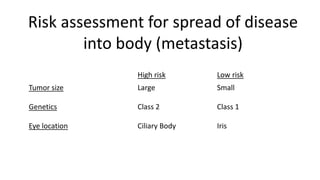
Risk assessment for spread of disease
into body (metastasis)
High risk Low risk
Tumor size Large Small
Genetics Class 2 Class 1
Eye location Ciliary Body Iris
Phases of patient experience
• Phase 1 – Diagnosis
– “Shock and Awe”
– Unexpected and Unwelcome
– Anxiety
– Why me?
– Loss of Control
– Confusion
– Fear of Unknown
– Work up
• Systemic screen for metastatic disease
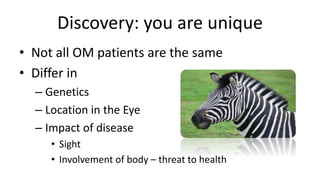
Discovery: you are unique
• Not all OM patients are the same
• Differ in
– Genetics
– Location in the Eye
– Impact of disease
• Sight
• Involvement of body – threat to health
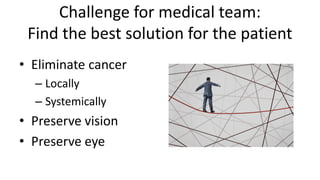
Challenge for medical team:
Find the best solution for the patient
• Eliminate cancer
– Locally
– Systemically
• Preserve vision
• Preserve eye
• You choose, providers inform, guide
• Three principles
– Life
• highest priority
– Vision
• can be damaged by treatment
• Can be improved or stabilized with other treatment
– Quality of life
• Pain
• Anxiety
• Appearance
Decisions – what to do?
Treatments for OM
• Toolbox
– Enucleation
– Radiation
– Laser
– Cryotherapy
– Excision
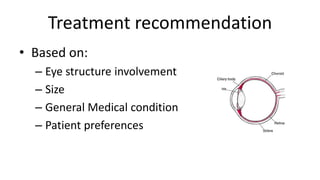
Treatment recommendation
• Based on:
– Eye structure involvement
– Size
– General Medical condition
– Patient preferences
Phases of patient experience
• Phase 2 – Treatment of eye
– Accept diagnosis
– Determination to get
through it
– Endure discomfort
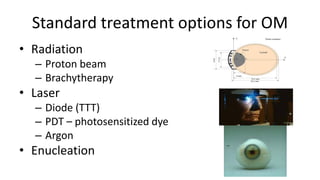
Standard treatment options for OM
• Radiation
– Proton beam
– Brachytherapy
• Laser
– Diode (TTT)
– PDT – photosensitized dye
– Argon
• Enucleation
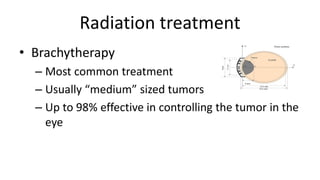
Radiation treatment
• Brachytherapy
– Most common treatment
– Usually “medium” sized tumors
– Up to 98% effective in controlling the tumor in the
eye
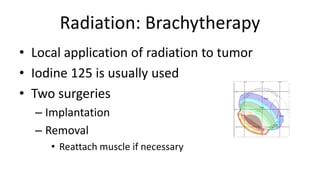
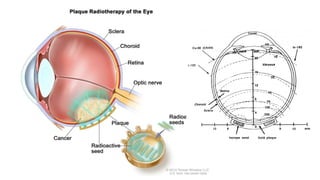
Radiation: Brachytherapy
• Local application of radiation to tumor
• Iodine 125 is usually used
• Two surgeries
– Implantation
– Removal
• Reattach muscle if necessary
Plaque Brachytherapy Pre-op
– Anxiety due to recent
diagnosis
• Need for treatment
• Loss of vision
– Pain usually not an
issue
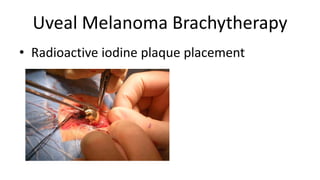
Uveal Melanoma Brachytherapy
• Radioactive iodine plaque placement
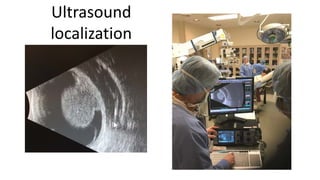
Ultrasound
localization
Radiation safety
• Requires coordination with radiation
department
– Radiation oncologist
– Radiation oncology physicist
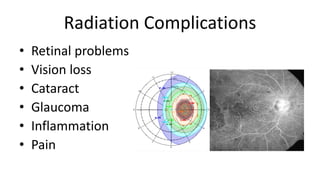
Radiation Complications
• Retinal problems
• Vision loss
• Cataract
• Glaucoma
• Inflammation
• Pain
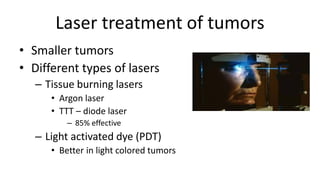
Laser treatment of tumors
• Smaller tumors
• Different types of lasers
– Tissue burning lasers
• Argon laser
• TTT – diode laser
– 85% effective
– Light activated dye (PDT)
• Better in light colored tumors
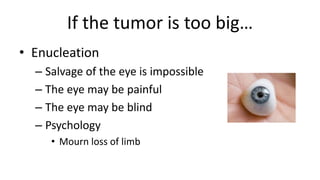
If the tumor is too big…
• Enucleation
– Salvage of the eye is impossible
– The eye may be painful
– The eye may be blind
– Psychology
• Mourn loss of limb
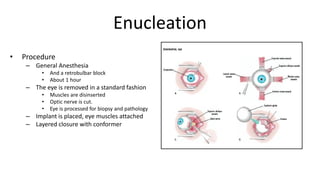
Enucleation
• Procedure
– General Anesthesia
• And a retrobulbar block
• About 1 hour
– The eye is removed in a standard fashion
• Muscles are disinserted
• Optic nerve is cut.
• Eye is processed for biopsy and pathology
– Implant is placed, eye muscles attached
– Layered closure with conformer
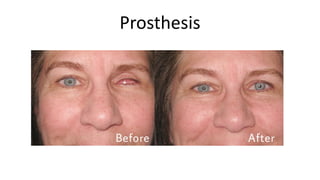
Prosthesis
Phases of patient experience
• Phase 3 - Recovery
• Healing from surgery
– Vision issues
• Adjusting to the “new” you
• May need additional treatments to eye
– Prosthesis
– Intraocular shots
– Laser
– Additional surgery
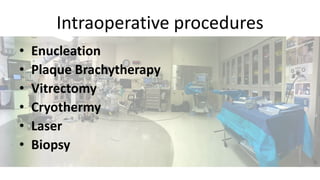
Intraoperative procedures
• Enucleation
• Plaque Brachytherapy
• Vitrectomy
• Cryothermy
• Laser
• Biopsy
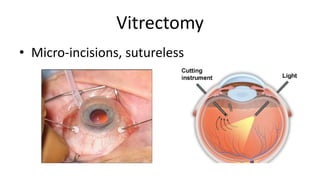
Vitrectomy
• Micro-incisions, sutureless
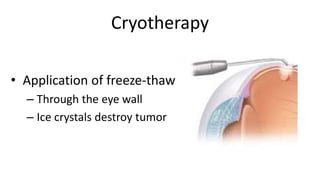
Cryotherapy
• Application of freeze-thaw
– Through the eye wall
– Ice crystals destroy tumor
Are there a better ways to treat OM?
Research designed to improve
treatment of eye tumors
• Goal to replace radiation and it’s side effects
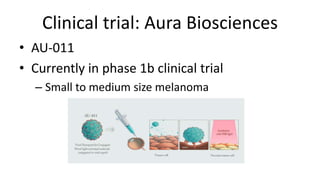
Clinical trial: Aura Biosciences
• AU-011
• Currently in phase 1b clinical trial
– Small to medium size melanoma
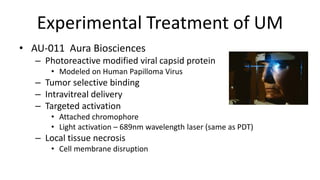
Experimental Treatment of UM
• AU-011 Aura Biosciences
– Photoreactive modified viral capsid protein
• Modeled on Human Papilloma Virus
– Tumor selective binding
– Intravitreal delivery
– Targeted activation
• Attached chromophore
• Light activation – 689nm wavelength laser (same as PDT)
– Local tissue necrosis
• Cell membrane disruption
Experimental Treatment of UM
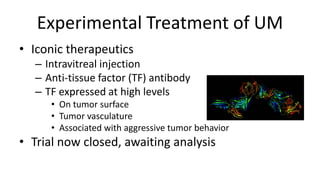
• Iconic therapeutics
– Intravitreal injection
– Anti-tissue factor (TF) antibody
– TF expressed at high levels
• On tumor surface
• Tumor vasculature
• Associated with aggressive tumor behavior
• Trial now closed, awaiting analysis
Phases of patient experience
• Phase 4 – Long term issues
– Surveillance after treatment
• Body Imaging
– What kinds?
– How often?
– Genetic information from Biopsy
• Low risk
– Are you cured?
• High risk
– Adjuvant trials
» Is it right for you?
– What if you have metastatic disease?
Ocular Melanoma
• Is a chronic condition.
– After treatment of the eye, follow up is required.
Teamwork needed!
• Patient
– Unique
• Support team
– Family
– Social
• Providers
– Advise
– Treat
Enjoy the meeting!

Ocular Melanoma Treatment

  • 1.
    Ocular Melanoma Treatment PeterG. Hovland MD PhD 7th Annual Eyes on a Cure: Ocular Melanoma Patient and Caregiver Symposium 21 April 2018
  • 2.
    Welcome! • Patient advocacycan make a difference • Your fundraising helps – Improve understanding – Promotes better communication – Fosters focused research
  • 3.
    Introduction • Dr. PeterHovland • Ocular Oncologist and Retina Specialist • Clinical practice with Colorado Retina Associates for 12 years
  • 4.
  • 5.
    When you hearhoof steps… • You think of horses not zebras! • Common things are seen more commonly. • This talk is about zebras however. Common Rare
  • 6.
    Ocular Melanoma • Rare –About 2000 new cases per year in US – About 7000 new cases per year world – “Orphan” disease • Mostly affects adults – M = F – More common in Caucasians • Especially Blue/hazel eyes • Familial 1% • Cause unknown – Genetic mutations - random
  • 7.
    Ocular Melanoma Starts inthe eye wall: – Choroid - 90% – Ciliary Body – 6% – Iris – 4%
  • 8.
    OM originates inthe eye – Some OM can spread to the body
  • 9.
    Tangent: Other cancerscan spread to the eye • Adenocarcinomas – Breast, Lung, Prostate, GI, GU • Lymphoma • Sarcoma • Melanoma • Carcinoid
  • 10.
    Journey of aNew patient • Symptoms or Routine Eye exam • Eye doctor -> Specialist -> Ocular Oncologist • Diagnosis • Evaluation of Body • Treatment of Eye • Wait for response to treatment
  • 11.
    How do weknow it’s melanoma? • Diagnosis based on exam and testing • Diagnosis may be made – At initial presentation – After a period of observation • Tumor may grow
  • 12.
  • 13.
    Diagnostic Testing • Initialevaluation • Periodic observation • Monitor response to treatment • Multimodal
  • 14.
  • 15.
    Angiography • Evaluation ofblood flow in eye tissues
  • 16.
    Ultrasound • 3-dimensional evaluationof tumors • Measured in millimeters
  • 17.
  • 18.
  • 19.
  • 20.
    Enhanced Depth Imaging •Measures thickness of tumor in microns
  • 21.
    Fine Needle Biopsy •For genetic evaluation and cytology
  • 22.
    Risk assessment forspread of disease into body (metastasis) High risk Low risk Tumor size Large Small Genetics Class 2 Class 1 Eye location Ciliary Body Iris
  • 23.
    Phases of patientexperience • Phase 1 – Diagnosis – “Shock and Awe” – Unexpected and Unwelcome – Anxiety – Why me? – Loss of Control – Confusion – Fear of Unknown – Work up • Systemic screen for metastatic disease
  • 24.
    Discovery: you areunique • Not all OM patients are the same • Differ in – Genetics – Location in the Eye – Impact of disease • Sight • Involvement of body – threat to health
  • 25.
    Challenge for medicalteam: Find the best solution for the patient • Eliminate cancer – Locally – Systemically • Preserve vision • Preserve eye
  • 26.
    • You choose,providers inform, guide • Three principles – Life • highest priority – Vision • can be damaged by treatment • Can be improved or stabilized with other treatment – Quality of life • Pain • Anxiety • Appearance Decisions – what to do?
  • 27.
    Treatments for OM •Toolbox – Enucleation – Radiation – Laser – Cryotherapy – Excision
  • 28.
    Treatment recommendation • Basedon: – Eye structure involvement – Size – General Medical condition – Patient preferences
  • 29.
    Phases of patientexperience • Phase 2 – Treatment of eye – Accept diagnosis – Determination to get through it – Endure discomfort
  • 30.
    Standard treatment optionsfor OM • Radiation – Proton beam – Brachytherapy • Laser – Diode (TTT) – PDT – photosensitized dye – Argon • Enucleation
  • 31.
    Radiation treatment • Brachytherapy –Most common treatment – Usually “medium” sized tumors – Up to 98% effective in controlling the tumor in the eye
  • 32.
    Radiation: Brachytherapy • Localapplication of radiation to tumor • Iodine 125 is usually used • Two surgeries – Implantation – Removal • Reattach muscle if necessary
  • 33.
    Plaque Brachytherapy Pre-op –Anxiety due to recent diagnosis • Need for treatment • Loss of vision – Pain usually not an issue
  • 35.
    Uveal Melanoma Brachytherapy •Radioactive iodine plaque placement
  • 36.
  • 37.
    Radiation safety • Requirescoordination with radiation department – Radiation oncologist – Radiation oncology physicist
  • 38.
    Radiation Complications • Retinalproblems • Vision loss • Cataract • Glaucoma • Inflammation • Pain
  • 39.
    Laser treatment oftumors • Smaller tumors • Different types of lasers – Tissue burning lasers • Argon laser • TTT – diode laser – 85% effective – Light activated dye (PDT) • Better in light colored tumors
  • 40.
    If the tumoris too big… • Enucleation – Salvage of the eye is impossible – The eye may be painful – The eye may be blind – Psychology • Mourn loss of limb
  • 41.
    Enucleation • Procedure – GeneralAnesthesia • And a retrobulbar block • About 1 hour – The eye is removed in a standard fashion • Muscles are disinserted • Optic nerve is cut. • Eye is processed for biopsy and pathology – Implant is placed, eye muscles attached – Layered closure with conformer
  • 42.
  • 43.
    Phases of patientexperience • Phase 3 - Recovery • Healing from surgery – Vision issues • Adjusting to the “new” you • May need additional treatments to eye – Prosthesis – Intraocular shots – Laser – Additional surgery
  • 44.
    Intraoperative procedures • Enucleation •Plaque Brachytherapy • Vitrectomy • Cryothermy • Laser • Biopsy
  • 45.
  • 46.
    Cryotherapy • Application offreeze-thaw – Through the eye wall – Ice crystals destroy tumor
  • 47.
    Are there abetter ways to treat OM?
  • 48.
    Research designed toimprove treatment of eye tumors • Goal to replace radiation and it’s side effects
  • 49.
    Clinical trial: AuraBiosciences • AU-011 • Currently in phase 1b clinical trial – Small to medium size melanoma
  • 50.
    Experimental Treatment ofUM • AU-011 Aura Biosciences – Photoreactive modified viral capsid protein • Modeled on Human Papilloma Virus – Tumor selective binding – Intravitreal delivery – Targeted activation • Attached chromophore • Light activation – 689nm wavelength laser (same as PDT) – Local tissue necrosis • Cell membrane disruption
  • 51.
    Experimental Treatment ofUM • Iconic therapeutics – Intravitreal injection – Anti-tissue factor (TF) antibody – TF expressed at high levels • On tumor surface • Tumor vasculature • Associated with aggressive tumor behavior • Trial now closed, awaiting analysis
  • 52.
    Phases of patientexperience • Phase 4 – Long term issues – Surveillance after treatment • Body Imaging – What kinds? – How often? – Genetic information from Biopsy • Low risk – Are you cured? • High risk – Adjuvant trials » Is it right for you? – What if you have metastatic disease?
  • 53.
    Ocular Melanoma • Isa chronic condition. – After treatment of the eye, follow up is required.
  • 54.
    Teamwork needed! • Patient –Unique • Support team – Family – Social • Providers – Advise – Treat
  • 56.