1
Chapter 1.
INTRODUCTION
This report covers the School Design Project which was our project
for the Fourth semester Design Studio Class. Before the designing of our
individual Schools, we worked together in groups and studied our given site. We
researched and gathered information relevant to our project as the part of
literature review. We also studied numerous National Schools (Pre-
schools/Primary Schools) as well as International Schools to closely analyze
already built school buildings. Hence the comparison of the standard
requirements of a building with the case study buildings gave us further
knowledge abouthow we should considervarious factors to design an educational
building.
We then studied our given site for school designing, located at Vijaypur,
Dharan, with regard to the various factors that could impact or make a difference
in the designing of our school. Thus, this report also informs about the Design
Process with reference to the site constraints locality, environmental factors and
sustainability. It includes designing of a primary school to higher secondary
school.
Then, we did further study on what is Concept and how we can use a
concept to create an effective design in our school buildings.
After gathering all this information we began our individual design process
starting from the concept generation phase. Thus, this report was made to keep
records of all our researches that were done within this design project.
2
The contents of the various research conducted for designing the school
have been divided into four parts for the easy and proper collection and
recording of data, they are as follows:-
Literature Review
Site Analysis
Case Studies :
National Case studies
International Case Studies
CHAPTER 2.
LITERATURE REVIEW
INTRODUCTION TO LITERATURE REVIEW
A literature review, also called as literature study discusses in particular
the published information of a subject area within a certain time period. It can
either be just a simple summary of the sources or it might give a new
interpretation of old materials combined with the old interpretation. It can be
considered as a text written by someone to consider the critical points of current
knowledge including substantive findings.
School
A Schoolis a building oran institution designed for the teaching of students
under the direction of teachers. Similarly, a primary schoolis a schoolin which
3
the children receive primary/elementary education within the age group of 5-11
years and pre-primary education within the age group 1-5.
A School is also an organized space purposed for teaching and learning,
meaning to say that school does not only refer to the building consisting of
classrooms where students study but it is as a whole the summation of various
component parts that make a functional.
These parts can be listed out as follows:-
TEACHING / LEARNING AREAS OTHER AREAS
Classrooms Staff & Administration
Laboratory Cafeteria
Libraries Storage
Multi-purpose Hall Circulation
Extra Curricular Activity rooms Ancillary Space
Computer Lab SchoolYard
Auditorium Athletic field
Audio/ Visual Room Teachers Staff Room
Music Room Assembly Hall
Components of School
On the basis of the qualitative and quantitative considerations made in a
design, the various components of a school can also be categorized in the
following manner:-
COMPONENTS OF SCHOOL
QUALITATIVE CONSIDERATIONS QUANTITATIVE CONSIDERATIONS
Built Form,
Child Psychology,
Classroom,
Library,
4
Safety, Security,
Health,
Landscaping,
Air Circulation,
Lighting,
Ventilation
Staff room,
Canteen,
Play Area,
Admin Block,
Multi–purpose halls,
Parking Area
Thevarious types of built form of school can be listed out as follows
Single Corridor
Double Corridor
Courtyard
Cluster
1) ANTHROPOMETRY
(HUMAN PROPORTION)
Anthropometry simply means "measurement of a human body". The
word ‘anthropometry’ is derived from the Greek words: - ‘anthros’ means man,
and 'metron' meaning measure. It refers to the measurement of the human
individual which measures all physical aspects of your body. Simple
measurements include height and width. Thus, it is the systematic collection and
correlation ofmeasurements of the human body. Given below are some examples
of human dimensions.
5
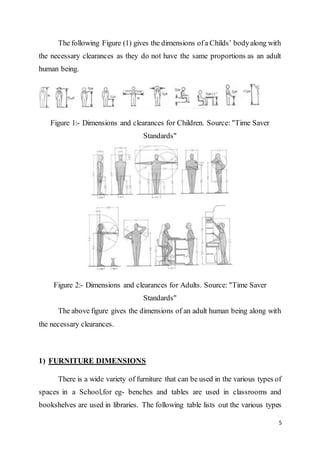
The following Figure (1) gives the dimensions ofa Childs’ bodyalong with
the necessary clearances as they do not have the same proportions as an adult
human being.
Figure 1:- Dimensions and clearances for Children. Source: "Time Saver
Standards"
Figure 2:- Dimensions and clearances for Adults. Source: "Time Saver
Standards"
The above figure gives the dimensions of an adult human being along with
the necessary clearances.
1) FURNITURE DIMENSIONS
There is a wide variety of furniture that can be used in the various types of
spaces in a School,for eg- benches and tables are used in classrooms and
bookshelves are used in libraries. The following table lists out the various types
6
of furnitures used according to the type of room along with their dimensions and
few examples.
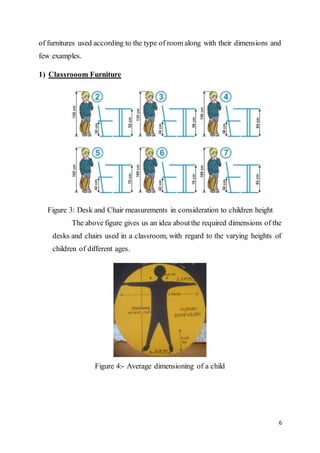
1) Classrooom Furniture
Figure 3: Desk and Chair measurements in consideration to children height
The above figure gives us an idea aboutthe required dimensions of the
desks and chairs used in a classroom, with regard to the varying heights of
children of different ages.
Figure 4:- Average dimensioning of a child
7
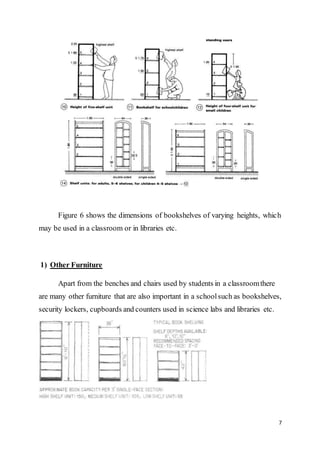
Figure 6 shows the dimensions of bookshelves of varying heights, which
may be used in a classroom or in libraries etc.
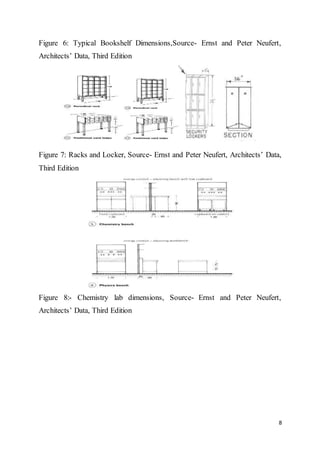
1) Other Furniture
Apart from the benches and chairs used by students in a classroomthere
are many other furniture that are also important in a schoolsuch as bookshelves,
security lockers, cupboards and counters used in science labs and libraries etc.
8
Figure 6: Typical Bookshelf Dimensions,Source- Ernst and Peter Neufert,
Architects’ Data, Third Edition
Figure 7: Racks and Locker, Source- Ernst and Peter Neufert, Architects’ Data,
Third Edition
Figure 8:- Chemistry lab dimensions, Source- Ernst and Peter Neufert,
Architects’ Data, Third Edition
9
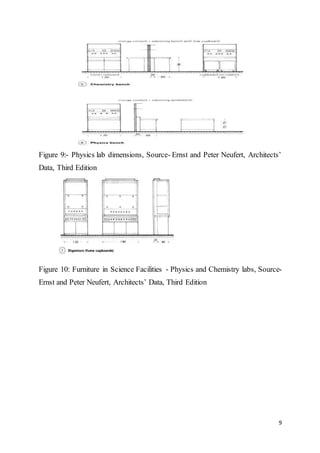
Figure 9:- Physics lab dimensions, Source- Ernst and Peter Neufert, Architects’
Data, Third Edition
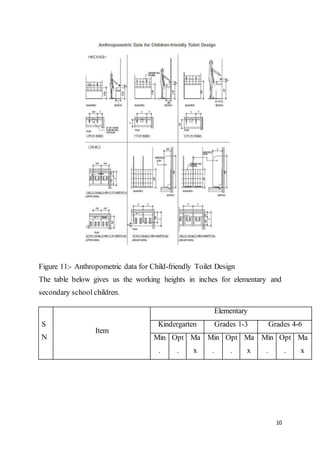
Figure 10: Furniture in Science Facilities - Physics and Chemistry labs, Source-
Ernst and Peter Neufert, Architects’ Data, Third Edition
10
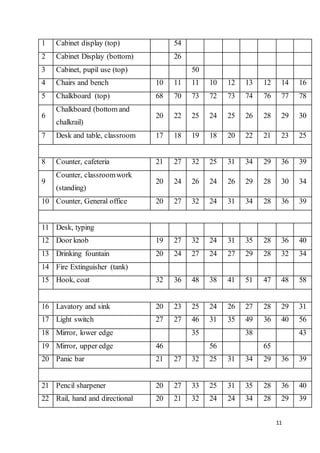
Figure 11:- Anthropometric data for Child-friendly Toilet Design
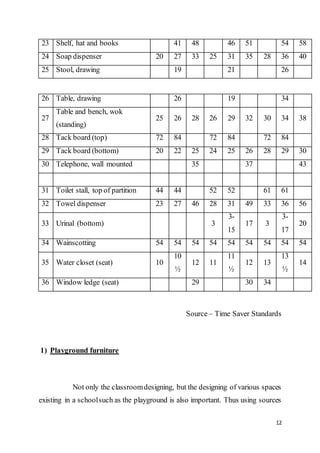
The table below gives us the working heights in inches for elementary and
secondary school children.
S
N
Item
Elementary
Kindergarten Grades 1-3 Grades 4-6
Min
.
Opt
.
Ma
x
Min
.
Opt
.
Ma
x
Min
.
Opt
.
Ma
x
11
1 Cabinet display (top) 54
2 Cabinet Display (bottom) 26
3 Cabinet, pupil use (top) 50
4 Chairs and bench 10 11 11 10 12 13 12 14 16
5 Chalkboard (top) 68 70 73 72 73 74 76 77 78
6
Chalkboard (bottom and
chalkrail)
20 22 25 24 25 26 28 29 30
7 Desk and table, classroom 17 18 19 18 20 22 21 23 25
8 Counter, cafeteria 21 27 32 25 31 34 29 36 39
9
Counter, classroomwork
(standing)
20 24 26 24 26 29 28 30 34
10 Counter, General office 20 27 32 24 31 34 28 36 39
11 Desk, typing
12 Door knob 19 27 32 24 31 35 28 36 40
13 Drinking fountain 20 24 27 24 27 29 28 32 34
14 Fire Extinguisher (tank)
15 Hook, coat 32 36 48 38 41 51 47 48 58
16 Lavatory and sink 20 23 25 24 26 27 28 29 31
17 Light switch 27 27 46 31 35 49 36 40 56
18 Mirror, lower edge 35 38 43
19 Mirror, upper edge 46 56 65
20 Panic bar 21 27 32 25 31 34 29 36 39
21 Pencil sharpener 20 27 33 25 31 35 28 36 40
22 Rail, hand and directional 20 21 32 24 24 34 28 29 39
12
23 Shelf, hat and books 41 48 46 51 54 58
24 Soap dispenser 20 27 33 25 31 35 28 36 40
25 Stool, drawing 19 21 26
26 Table, drawing 26 19 34
27
Table and bench, wok
(standing)
25 26 28 26 29 32 30 34 38
28 Tack board (top) 72 84 72 84 72 84
29 Tack board (bottom) 20 22 25 24 25 26 28 29 30
30 Telephone, wall mounted 35 37 43
31 Toilet stall, top of partition 44 44 52 52 61 61
32 Towel dispenser 23 27 46 28 31 49 33 36 56
33 Urinal (bottom) 3
3-
15
17 3
3-
17
20
34 Wainscotting 54 54 54 54 54 54 54 54 54
35 Water closet (seat) 10
10
½
12 11
11
½
12 13
13
½
14
36 Window ledge (seat) 29 30 34
Source – Time Saver Standards
1) Playground furniture
Not only the classroomdesigning, but the designing of various spaces
existing in a schoolsuch as the playground is also important. Thus using sources
13
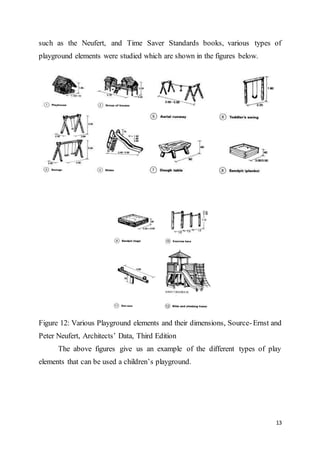
such as the Neufert, and Time Saver Standards books, various types of
playground elements were studied which are shown in the figures below.
Figure 12: Various Playground elements and their dimensions, Source-Ernst and
Peter Neufert, Architects’ Data, Third Edition
The above figures give us an example of the different types of play
elements that can be used a children’s playground.
14
1) SPACE PLANNING:-
Space Planning can be referred to the proper division and zoning of the
various spaces existing inside the school premises. There are certain
considerations to be made and pre-requisites to be followed in order to properly
design a school. They are as given below.
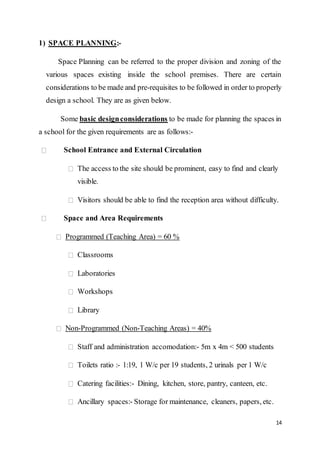
Some basic designconsiderations to be made for planning the spaces in
a school for the given requirements are as follows:-
School Entrance and External Circulation
The access to the site should be prominent, easy to find and clearly
visible.
Visitors should be able to find the reception area without difficulty.
Space and Area Requirements
Programmed (Teaching Area) = 60 %
Classrooms
Laboratories
Workshops
Library
Non-Programmed (Non-Teaching Areas) = 40%
Staff and administration accomodation:- 5m x 4m < 500 students
Toilets ratio :- 1:19, 1 W/c per 19 students, 2 urinals per 1 W/c
Catering facilities:- Dining, kitchen, store, pantry, canteen, etc.
Ancillary spaces:- Storage for maintenance, cleaners, papers, etc.
15
Circulations and partitions:- corridors, stairs, foyers, etc.
Teacher Student Ratio
20 children of 3-5 years = 1 Teacher + 1Part time
50 children of 5-8 years = 2 Teachers
40 children = 1 Teacher + 1 Floating Teacher
1 teacher = 34 children
2 teachers = 68 children
3 teachers = 102 children
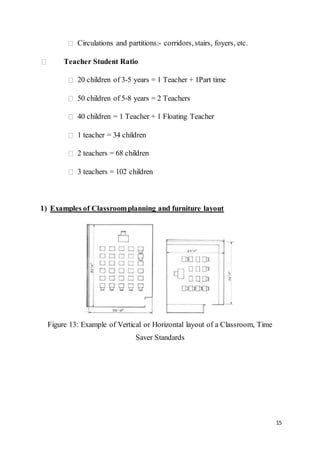
1) Examples of Classroomplanning and furniture layout
Figure 13: Example of Vertical or Horizontal layout of a Classroom, Time
Saver Standards
16
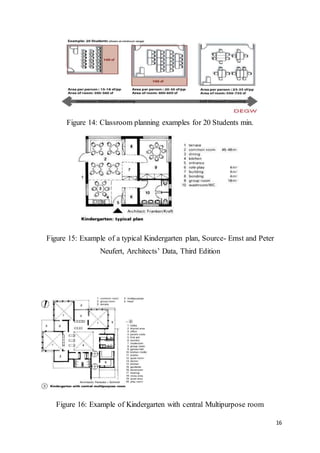
Figure 14: Classroom planning examples for 20 Students min.
Figure 15: Example of a typical Kindergarten plan, Source- Ernst and Peter
Neufert, Architects’ Data, Third Edition
Figure 16: Example of Kindergarten with central Multipurpose room
17
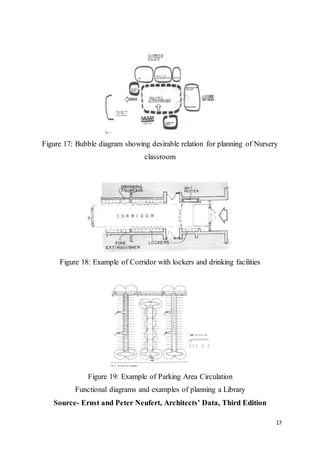
Figure 17: Bubble diagram showing desirable relation for planning of Nursery
classroom
Figure 18: Example of Corridor with lockers and drinking facilities
Figure 19: Example of Parking Area Circulation
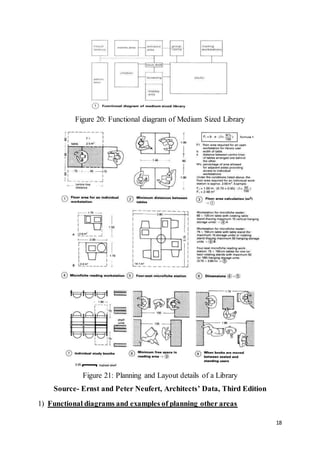
Functional diagrams and examples of planning a Library
Source- Ernst and Peter Neufert, Architects’ Data, Third Edition
18
Figure 20: Functional diagram of Medium Sized Library
Figure 21: Planning and Layout details of a Library
Source- Ernst and Peter Neufert, Architects’ Data, Third Edition
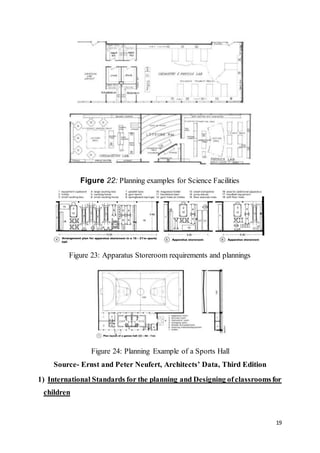
1) Functional diagrams and examples of planning other areas
19
Figure 22: Planning examples for Science Facilities
Figure 23: Apparatus Storeroom requirements and plannings
Figure 24: Planning Example of a Sports Hall
Source- Ernst and Peter Neufert, Architects’ Data, Third Edition
1) International Standards for the planning and Designing ofclassroomsfor
children
20
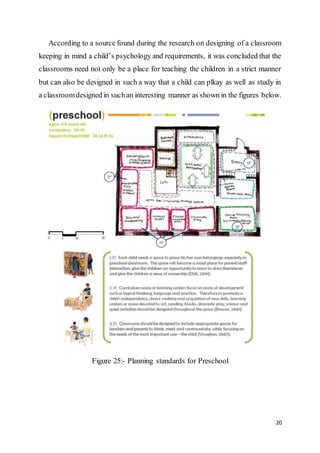
According to a source found during the research on designing of a classroom
keeping in mind a child’s psychology and requirements, it was concluded that the
classrooms need not only be a place for teaching the children in a strict manner
but can also be designed in such a way that a child can plkay as well as study in
a classroomdesigned in suchan interesting manner as shown in the figures below.
Figure 25:- Planning standards for Preschool
21
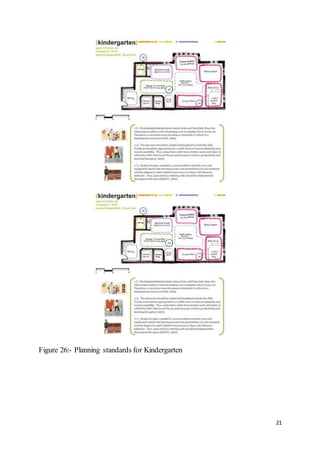
Figure 26:- Planning standards for Kindergarten
22
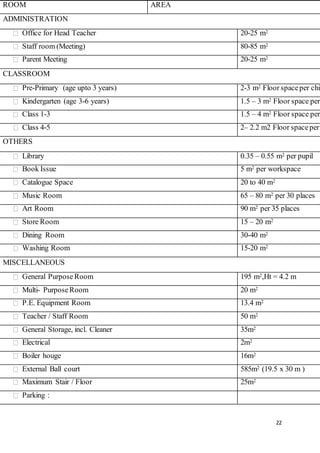
ROOM AREA
ADMINISTRATION
Office for Head Teacher 20-25 m2
Staff room (Meeting) 80-85 m2
Parent Meeting 20-25 m2
CLASSROOM
Pre-Primary (age upto 3 years) 2-3 m2 Floor spaceper chil
Kindergarten (age 3-6 years) 1.5 – 3 m2 Floor space per
Class 1-3 1.5 – 4 m2 Floor space per
Class 4-5 2– 2.2 m2 Floor spaceper
OTHERS
Library 0.35 – 0.55 m2 per pupil
Book Issue 5 m2 per workspace
Catalogue Space 20 to 40 m2
Music Room 65 – 80 m2 per 30 places
Art Room 90 m2 per 35 places
Store Room 15 – 20 m2
Dining Room 30-40 m2
Washing Room 15-20 m2
MISCELLANEOUS
General PurposeRoom 195 m2,Ht = 4.2 m
Multi- PurposeRoom 20 m2
P.E. Equipment Room 13.4 m2
Teacher / Staff Room 50 m2
General Storage, incl. Cleaner 35m2
Electrical 2m2
Boiler houge 16m2
External Ball court 585m2 (19.5 x 30 m )
Maximum Stair / Floor 25m2
Parking :
23
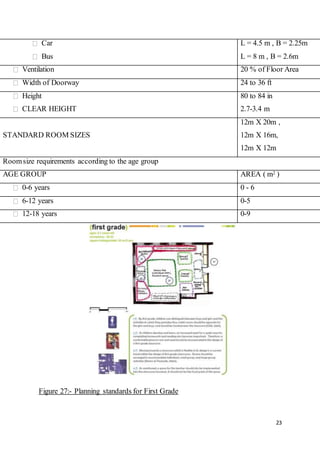
Figure 27:- Planning standards for First Grade
Car
Bus
L = 4.5 m , B = 2.25m
L = 8 m , B = 2.6m
Ventilation 20 % of Floor Area
Width of Doorway 24 to 36 ft
Height
CLEAR HEIGHT
80 to 84 in
2.7-3.4 m
STANDARD ROOM SIZES
12m X 20m ,
12m X 16m,
12m X 12m
Roomsize requirements according to the age group
AGE GROUP AREA ( m2 )
0-6 years 0 - 6
6-12 years 0-5
12-18 years 0-9
24
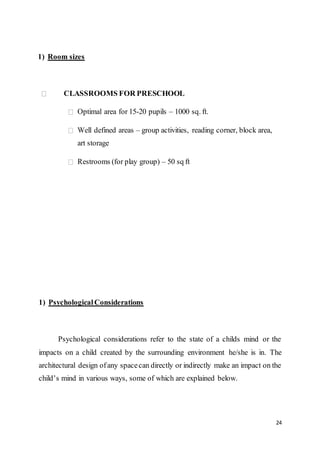
1) Room sizes
CLASSROOMS FOR PRESCHOOL
Optimal area for 15-20 pupils – 1000 sq. ft.
Well defined areas – group activities, reading corner, block area,
art storage
Restrooms (for play group) – 50 sq ft
1) PsychologicalConsiderations
Psychological considerations refer to the state of a childs mind or the
impacts on a child created by the surrounding environment he/she is in. The
architectural design ofany spacecan directly or indirectly make an impact on the
child’s mind in various ways, some of which are explained below.
25
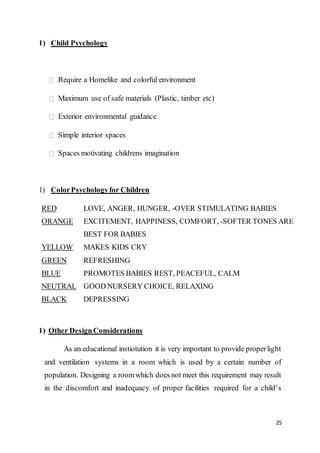
1) Child Psychology
Require a Homelike and colorful environment
Maximum use of safe materials (Plastic, timber etc)
Exterior environmental guidance
Simple interior spaces
Spaces motivating childrens imagination
1) ColorPsychologyfor Children
RED LOVE, ANGER, HUNGER, -OVER STIMULATING BABIES
ORANGE EXCITEMENT, HAPPINESS, COMFORT, -SOFTER TONES ARE
BEST FOR BABIES
YELLOW MAKES KIDS CRY
GREEN REFRESHING
BLUE PROMOTES BABIES REST, PEACEFUL, CALM
NEUTRAL GOOD NURSERY CHOICE, RELAXING
BLACK DEPRESSING
1) Other DesignConsiderations
As an educational instiotution it is very important to provide properlight
and ventilation systems in a room which is used by a certain number of
population. Designing a roomwhich does not meet this requirement may result
in the discomfort and inadequacy of proper facilities required for a child’s
26
proper develeopment which is also the purpose of a school design. The light
and ventilation inside the room is directly proportional to the area of window.
1) LIGHTING
Light reflectance value
For floor= 20 – 30 %
For wall = 40 - 60 %
For furniture = 40 – 50 %
Primary teaching wall = 45 – 50 %
300 lux on per working area
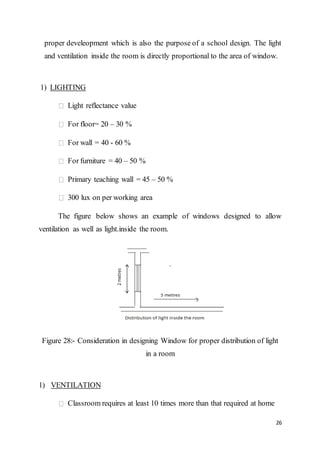
The figure below shows an example of windows designed to allow
ventilation as well as light.inside the room.
Figure 28:- Consideration in designing Window for proper distribution of light
in a room
1) VENTILATION
Classroom requires at least 10 times more than that required at home
27
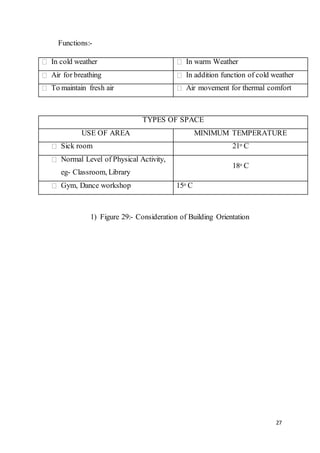
Functions:-
In cold weather In warm Weather
Air for breathing In addition function of cold weather
To maintain fresh air Air movement for thermal comfort
TYPES OF SPACE
USE OF AREA MINIMUM TEMPERATURE
Sick room 21o C
Normal Level of Physical Activity,
eg- Classroom, Library
18o C
Gym, Dance workshop 15o C
1) Figure 29:- Consideration of Building Orientation
28
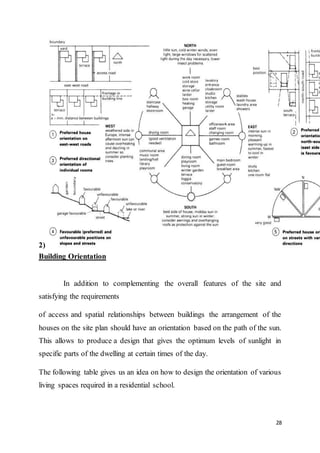
2)
Building Orientation
Figure
In addition to complementing the overall features of the site and
satisfying the requirements
of access and spatial relationships between buildings the arrangement of the
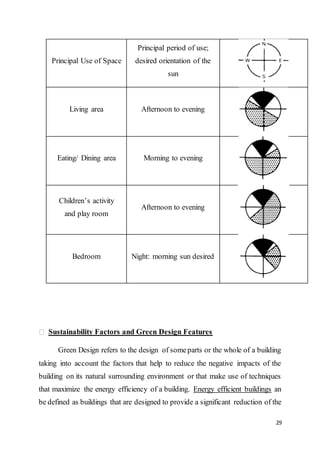
houses on the site plan should have an orientation based on the path of the sun.
This allows to produce a design that gives the optimum levels of sunlight in
specific parts of the dwelling at certain times of the day.
The following table gives us an idea on how to design the orientation of various
living spaces required in a residential school.
29
Principal Use of Space
Principal period of use;
desired orientation of the
sun
Living area Afternoon to evening
Eating/ Dining area Morning to evening
Children’s activity
and play room
Afternoon to evening
Bedroom Night: morning sun desired
Sustainability Factors and Green Design Features
Green Design refers to the design of someparts or the whole of a building
taking into account the factors that help to reduce the negative impacts of the
building on its natural surrounding environment or that make use of techniques
that maximize the energy efficiency of a building. Energy efficient buildings an
be defined as buildings that are designed to provide a significant reduction of the
30
energy need for heating and cooling, independently of the energy and of the
equipments that will be chosen to heat or cool the building.
This can be achieved through the following elements:
bioclimatic architecture: shape and orientation of the building, solar
protections, passive solar systems
high performing building envelope: thorough insulation, high
performing glazing and windows, air-sealed construction, avoidance of
thermal bridges
high performance controlled ventilation: mechanical insulation, heat
recovery
Only when the building has been designed to minimise the energy loss, it
makes sense to start looking at the energy source (including renewable energy)
and at the heating and cooling equipments.
Green design features of a building can be listed out as following the idea of
Green roof,
Solid waste management,
Ground water recharge,
Rainwater harvesting etc.
Green roof
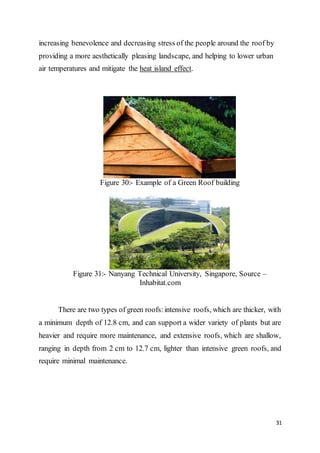
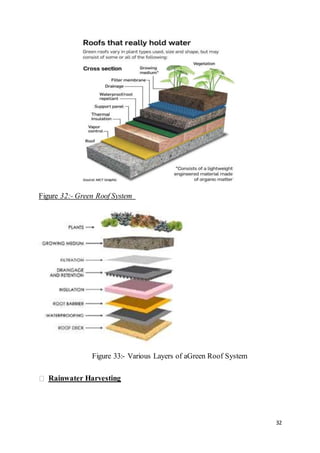
A greenroof or living roof is a roof of a building that is partially or
completely covered with vegetation and a growing medium, planted over
a waterproofing membrane. It may also include additional layers such as a root
barrier and drainage and irrigation systems. Rooftop ponds are another form of
green roofs which are used to treat greywater.
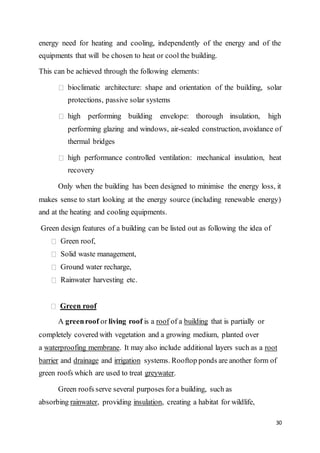
Green roofs serve several purposes fora building, such as
absorbing rainwater, providing insulation, creating a habitat for wildlife,
31
increasing benevolence and decreasing stress of the people around the roof by
providing a more aesthetically pleasing landscape, and helping to lower urban
air temperatures and mitigate the heat island effect.
Figure 30:- Example of a Green Roof building
Figure 31:- Nanyang Technical University, Singapore, Source –
Inhabitat.com
There are two types of green roofs:intensive roofs, which are thicker, with
a minimum depth of 12.8 cm, and can support a wider variety of plants but are
heavier and require more maintenance, and extensive roofs, which are shallow,
ranging in depth from 2 cm to 12.7 cm, lighter than intensive green roofs, and
require minimal maintenance.
32
Figure 32:- Green Roof System
Figure 33:- Various Layers of aGreen Roof System
Rainwater Harvesting
33
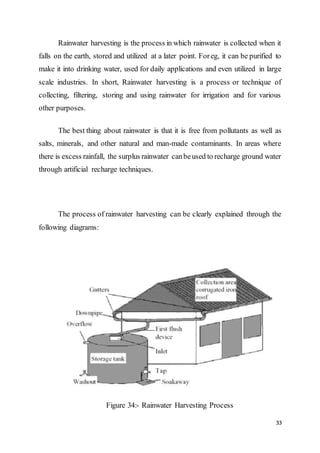
Rainwater harvesting is the process in which rainwater is collected when it
falls on the earth, stored and utilized at a later point. Foreg, it can be purified to
make it into drinking water, used for daily applications and even utilized in large
scale industries. In short, Rainwater harvesting is a process or technique of
collecting, filtering, storing and using rainwater for irrigation and for various
other purposes.
The best thing about rainwater is that it is free from pollutants as well as
salts, minerals, and other natural and man-made contaminants. In areas where
there is excess rainfall, the surplus rainwater canbeused to recharge ground water
through artificial recharge techniques.
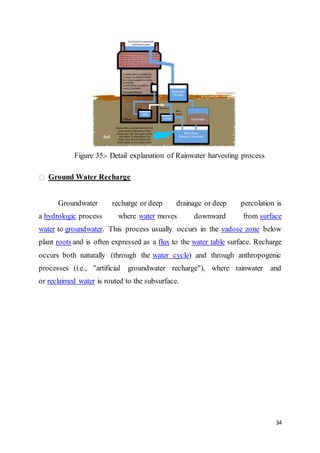
The process of rainwater harvesting can be clearly explained through the
following diagrams:
Figure 34:- Rainwater Harvesting Process
34
Figure 35:- Detail explanation of Rainwater harvesting process
Ground Water Recharge
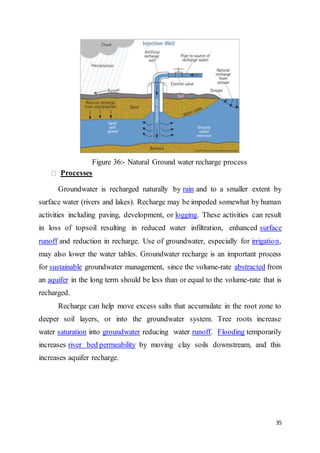
Groundwater recharge or deep drainage or deep percolation is
a hydrologic process where water moves downward from surface
water to groundwater. This process usually occurs in the vadose zone below
plant roots and is often expressed as a flux to the water table surface. Recharge
occurs both naturally (through the water cycle) and through anthropogenic
processes (i.e., "artificial groundwater recharge"), where rainwater and
or reclaimed water is routed to the subsurface.
35
Figure 36:- Natural Ground water recharge process
Processes
Groundwater is recharged naturally by rain and to a smaller extent by
surface water (rivers and lakes). Recharge may be impeded somewhat by human
activities including paving, development, or logging. These activities can result
in loss of topsoil resulting in reduced water infiltration, enhanced surface
runoff and reduction in recharge. Use of groundwater, especially for irrigation,
may also lower the water tables. Groundwater recharge is an important process
for sustainable groundwater management, since the volume-rate abstracted from
an aquifer in the long term should be less than or equal to the volume-rate that is
recharged.
Recharge can help move excess salts that accumulate in the root zone to
deeper soil layers, or into the groundwater system. Tree roots increase
water saturation into groundwater reducing water runoff. Flooding temporarily
increases river bed permeability by moving clay soils downstream, and this
increases aquifer recharge.
36
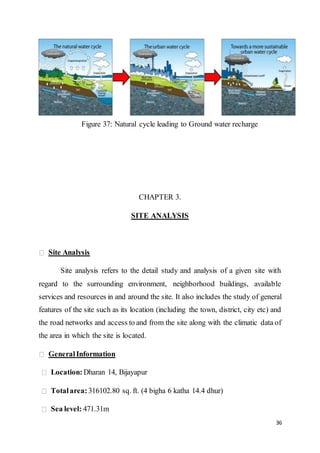
Figure 37: Natural cycle leading to Ground water recharge
CHAPTER 3.
SITE ANALYSIS
Site Analysis
Site analysis refers to the detail study and analysis of a given site with
regard to the surrounding environment, neighborhood buildings, available
services and resources in and around the site. It also includes the study of general
features of the site such as its location (including the town, district, city etc) and
the road networks and access to and from the site along with the climatic data of
the area in which the site is located.
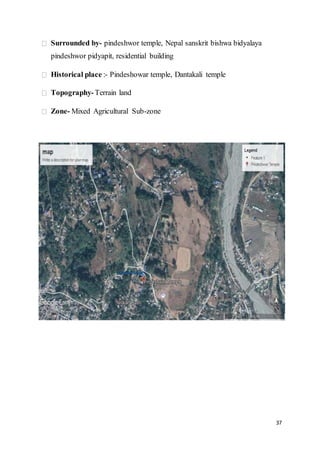
GeneralInformation
Location: Dharan 14, Bijayapur
Totalarea: 316102.80 sq. ft. (4 bigha 6 katha 14.4 dhur)
Sea level: 471.31m
37
Surrounded by- pindeshwor temple, Nepal sanskrit bishwa bidyalaya
pindeshwor pidyapit, residential building
Historical place :- Pindeshowar temple, Dantakali temple
Topography-Terrain land
Zone- Mixed Agricultural Sub-zone
38
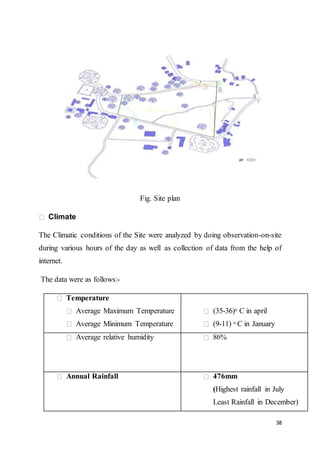
Fig. Site plan
Climate
The Climatic conditions of the Site were analyzed by doing observation-on-site
during various hours of the day as well as collection of data from the help of
internet.
The data were as follows:-
Temperature
Average Maximum Temperature
Average Minimum Temperature
(35-36)o C in april
(9-11) o C in January
Average relative humidity 86%
Annual Rainfall 476mm
(Highest rainfall in July
Least Rainfall in December)
39
Wind Direction
Morning
Evening
North-East to South-West
Building By-Laws
Various bye-Laws need to be followed in order to design a building with
proper requirements set by the government to ensure the safety and smooth life
of a building
Maximum Ground Coverage 60 %
Maximum Floor Area Ratio (FAR) 2.5
Minimum Parking Area 15%
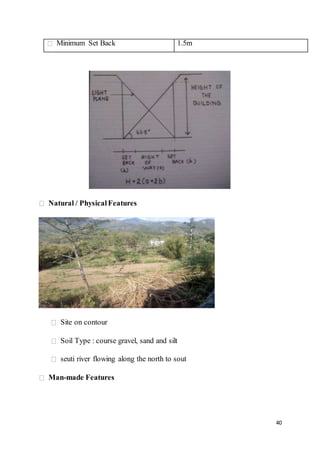
Minimum Set Back 1.5m
Distance measurements
Bus park Dharan to our site – 1.4km
Purwanchal campus to site – 3.2km
Building By-Laws
Various bye-Laws need to be followed in order to design a building with
proper requirements set by the government to ensure the safety and smooth life
of a building
Maximum Ground Coverage 60 %
Maximum Floor Area Ratio (FAR) 2.5
Minimum Parking Area 15%
40
Minimum Set Back 1.5m
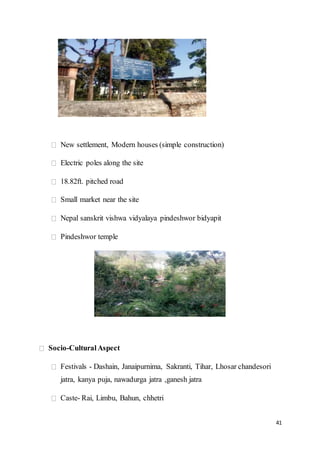
Natural / PhysicalFeatures
Site on contour
Soil Type : course gravel, sand and silt
seuti river flowing along the north to sout
Man-made Features
41
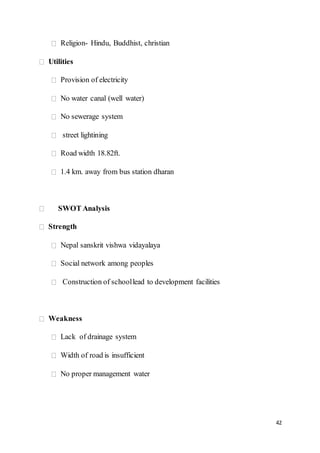
New settlement, Modern houses (simple construction)
Electric poles along the site
18.82ft. pitched road
Small market near the site
Nepal sanskrit vishwa vidyalaya pindeshwor bidyapit
Pindeshwor temple
Socio-CulturalAspect
Festivals - Dashain, Janaipurnima, Sakranti, Tihar, Lhosar chandesori
jatra, kanya puja, nawadurga jatra ,ganesh jatra
Caste- Rai, Limbu, Bahun, chhetri
42
Religion- Hindu, Buddhist, christian
Utilities
Provision of electricity
No water canal (well water)
No sewerage system
street lightining
Road width 18.82ft.
1.4 km. away from bus station dharan
SWOT Analysis
Strength
Nepal sanskrit vishwa vidayalaya
Social network among peoples
Construction of schoollead to development facilities
Weakness
Lack of drainage system
Width of road is insufficient
No proper management water
43
Threats
Local people want to stay in developed area
Middle class peoples
Low chiid population around site
Sustainilibility factor
Opportunities
Social network among people
Construction of schoolleads to development of facilities
DESIGN CONSIDERATIONS
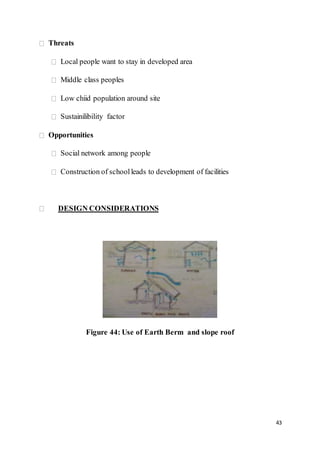
Figure 44: Use of Earth Berm and slope roof
44
CASE STUDY
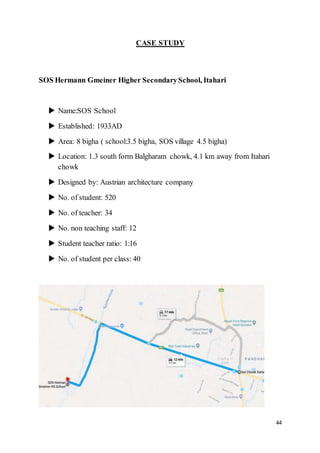
SOS Hermann Gmeiner Higher SecondarySchool, Itahari
 Name:SOS School
 Established: 1933AD
 Area: 8 bigha ( school:3.5 bigha, SOS village 4.5 bigha)
 Location: 1.3 south form Balgharam chowk, 4.1 km away from Itahari
chowk
 Designed by: Austrian architecture company
 No. of student: 520
 No. of teacher: 34
 No. non teaching staff: 12
 Student teacher ratio: 1:16
 No. of student per class: 40
45
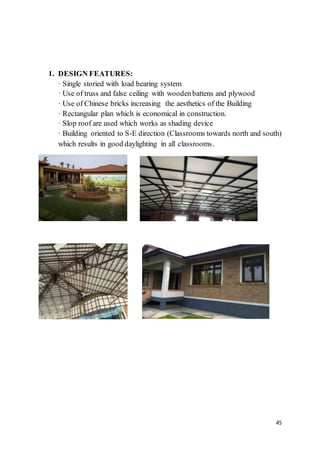
1. DESIGN FEATURES:
· Single storied with load bearing system
· Use of truss and false ceiling with woodenbattens and plywood
· Use of Chinese bricks increasing the aesthetics of the Building
· Rectangular plan which is economical in construction.
· Slop roof are used which works as shading device
· Building oriented to S-E direction (Classrooms towards north and south)
which results in good daylighting in all classrooms.
46
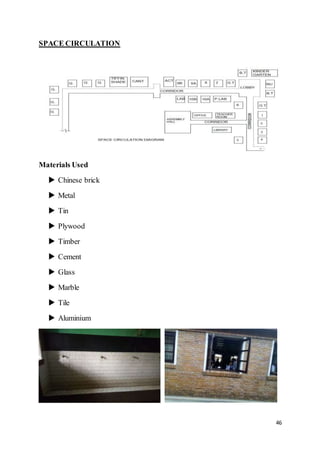
SPACE CIRCULATION
Materials Used
 Chinese brick
 Metal
 Tin
 Plywood
 Timber
 Cement
 Glass
 Marble
 Tile
 Aluminium
47
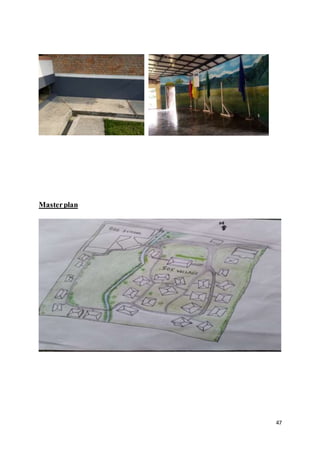
Masterplan
48
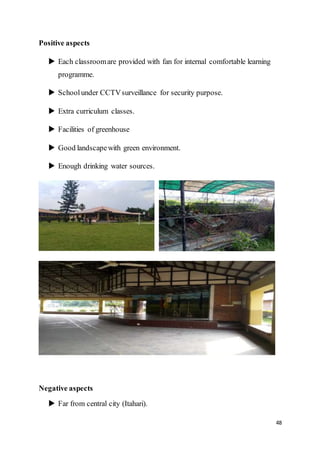
Positive aspects
 Each classroomare provided with fan for internal comfortable learning
programme.
 Schoolunder CCTVsurveillance for security purpose.
 Extra curriculum classes.
 Facilities of greenhouse
 Good landscapewith green environment.
 Enough drinking water sources.
Negative aspects
 Far from central city (Itahari).
49
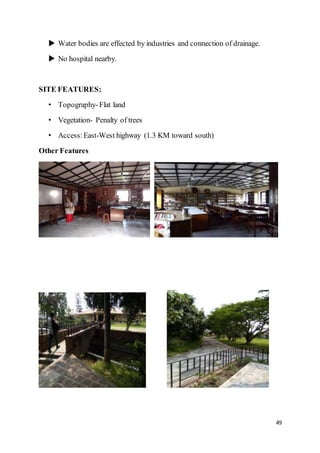
 Water bodies are effected by industries and connection of drainage.
 No hospital nearby.
SITE FEATURES:
• Topography-Flat land
• Vegetation- Penalty of trees
• Access:East-West highway (1.3 KM toward south)
Other Features
50
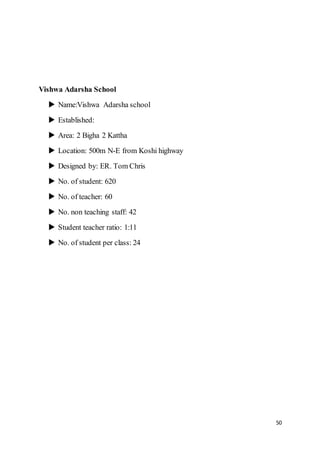
Vishwa Adarsha School
 Name:Vishwa Adarsha school
 Established:
 Area: 2 Bigha 2 Kattha
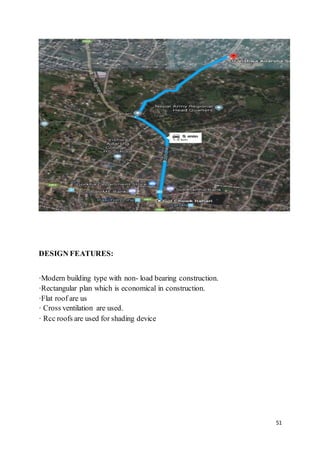
 Location: 500m N-E from Koshi highway
 Designed by: ER. Tom Chris
 No. of student: 620
 No. of teacher: 60
 No. non teaching staff: 42
 Student teacher ratio: 1:11
 No. of student per class: 24
51
DESIGN FEATURES:
·Modern building type with non- load bearing construction.
·Rectangular plan which is economical in construction.
·Flat roof are us
· Cross ventilation are used.
· Rcc roofs are used for shading device
52
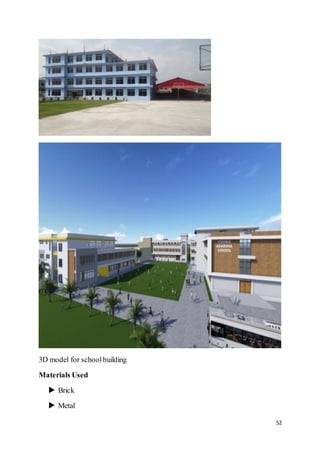
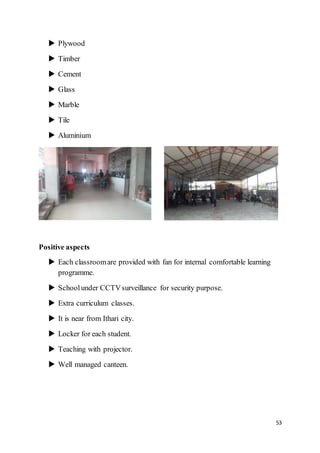
3D model for schoolbuilding
Materials Used
 Brick
 Metal
53
 Plywood
 Timber
 Cement
 Glass
 Marble
 Tile
 Aluminium
Positive aspects
 Each classroomare provided with fan for internal comfortable learning
programme.
 Schoolunder CCTVsurveillance for security purpose.
 Extra curriculum classes.
 It is near from Ithari city.
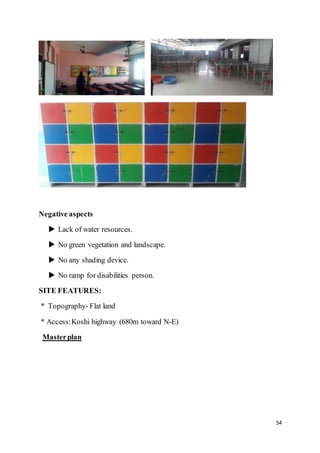
 Locker for each student.
 Teaching with projector.
 Well managed canteen.
54
Negative aspects
 Lack of water resources.
 No green vegetation and landscape.
 No any shading device.
 No ramp for disabilities person.
SITE FEATURES:
* Topography- Flat land
* Access:Koshi highway (680m toward N-E)
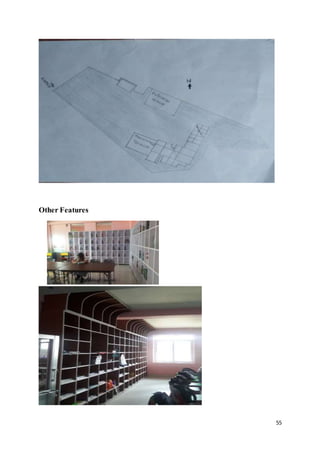
Masterplan
55
Other Features
56
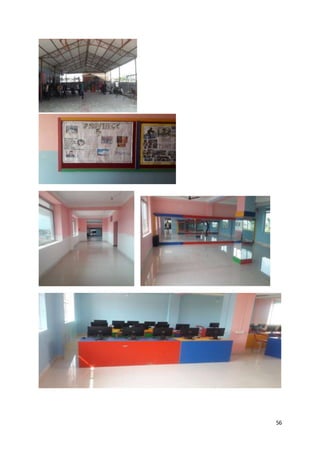
57
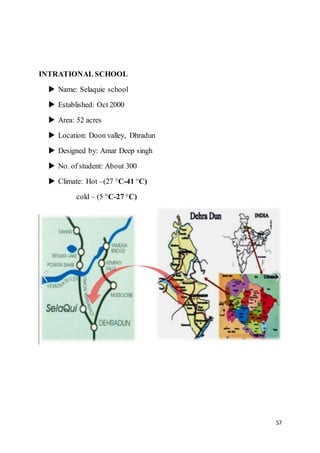
INTRATIONAL SCHOOL
 Name: Selaquie school
 Established: Oct 2000
 Area: 52 acres
 Location: Doon valley, Dhradun
 Designed by: Amar Deep singh
 No. of student: About 300
 Climate: Hot –(27 °C-41 °C)
cold – (5 °C-27 °C)
58
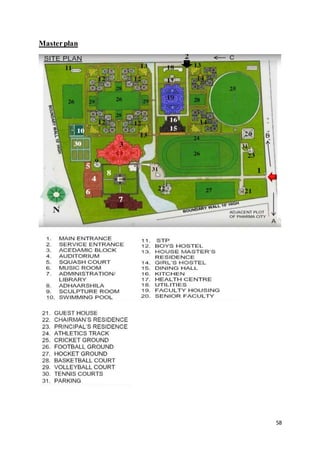
Masterplan
59
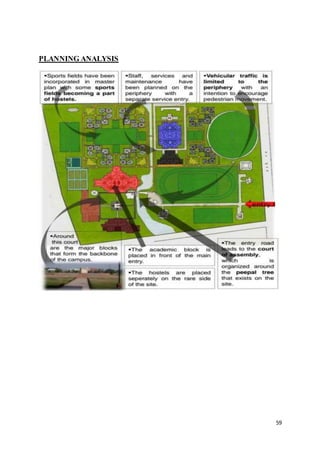
PLANNING ANALYSIS
60
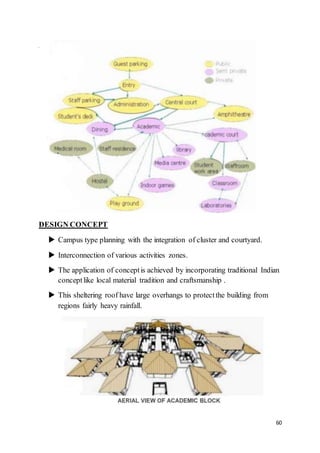
DESIGN CONCEPT
 Campus type planning with the integration of cluster and courtyard.
 Interconnection of various activities zones.
 The application of conceptis achieved by incorporating traditional Indian
conceptlike local material tradition and craftsmanship .
 This sheltering roof have large overhangs to protectthe building from
regions fairly heavy rainfall.
61
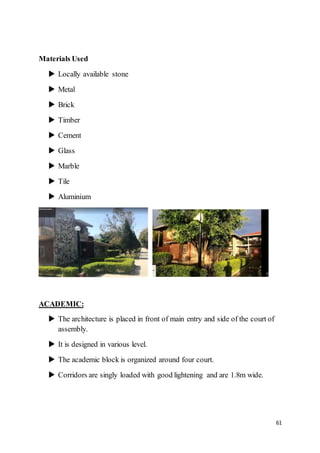
Materials Used
 Locally available stone
 Metal
 Brick
 Timber
 Cement
 Glass
 Marble
 Tile
 Aluminium
ACADEMIC:
 The architecture is placed in front of main entry and side of the court of
assembly.
 It is designed in various level.
 The academic block is organized around four court.
 Corridors are singly loaded with good lightening and are 1.8m wide.
62
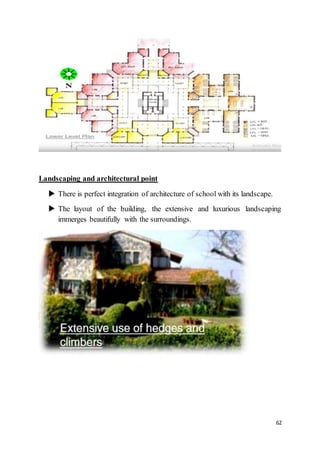
Landscaping and architectural point
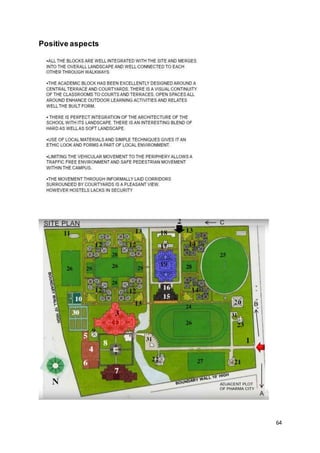
 There is perfect integration of architecture of school with its landscape.
 The layout of the building, the extensive and luxurious landscaping
immerges beautifully with the surroundings.
63
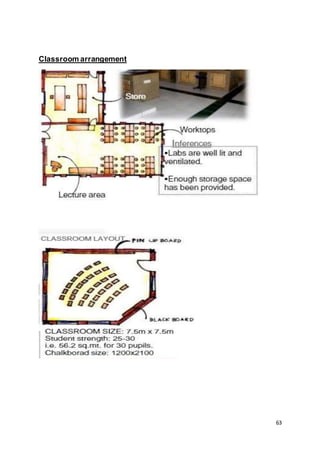
Classroom arrangement
64
Positive aspects
65

Project report on school

  • 1.
    1 Chapter 1. INTRODUCTION This reportcovers the School Design Project which was our project for the Fourth semester Design Studio Class. Before the designing of our individual Schools, we worked together in groups and studied our given site. We researched and gathered information relevant to our project as the part of literature review. We also studied numerous National Schools (Pre- schools/Primary Schools) as well as International Schools to closely analyze already built school buildings. Hence the comparison of the standard requirements of a building with the case study buildings gave us further knowledge abouthow we should considervarious factors to design an educational building. We then studied our given site for school designing, located at Vijaypur, Dharan, with regard to the various factors that could impact or make a difference in the designing of our school. Thus, this report also informs about the Design Process with reference to the site constraints locality, environmental factors and sustainability. It includes designing of a primary school to higher secondary school. Then, we did further study on what is Concept and how we can use a concept to create an effective design in our school buildings. After gathering all this information we began our individual design process starting from the concept generation phase. Thus, this report was made to keep records of all our researches that were done within this design project.
  • 2.
    2 The contents ofthe various research conducted for designing the school have been divided into four parts for the easy and proper collection and recording of data, they are as follows:- Literature Review Site Analysis Case Studies : National Case studies International Case Studies CHAPTER 2. LITERATURE REVIEW INTRODUCTION TO LITERATURE REVIEW A literature review, also called as literature study discusses in particular the published information of a subject area within a certain time period. It can either be just a simple summary of the sources or it might give a new interpretation of old materials combined with the old interpretation. It can be considered as a text written by someone to consider the critical points of current knowledge including substantive findings. School A Schoolis a building oran institution designed for the teaching of students under the direction of teachers. Similarly, a primary schoolis a schoolin which
  • 3.
    3 the children receiveprimary/elementary education within the age group of 5-11 years and pre-primary education within the age group 1-5. A School is also an organized space purposed for teaching and learning, meaning to say that school does not only refer to the building consisting of classrooms where students study but it is as a whole the summation of various component parts that make a functional. These parts can be listed out as follows:- TEACHING / LEARNING AREAS OTHER AREAS Classrooms Staff & Administration Laboratory Cafeteria Libraries Storage Multi-purpose Hall Circulation Extra Curricular Activity rooms Ancillary Space Computer Lab SchoolYard Auditorium Athletic field Audio/ Visual Room Teachers Staff Room Music Room Assembly Hall Components of School On the basis of the qualitative and quantitative considerations made in a design, the various components of a school can also be categorized in the following manner:- COMPONENTS OF SCHOOL QUALITATIVE CONSIDERATIONS QUANTITATIVE CONSIDERATIONS Built Form, Child Psychology, Classroom, Library,
  • 4.
    4 Safety, Security, Health, Landscaping, Air Circulation, Lighting, Ventilation Staffroom, Canteen, Play Area, Admin Block, Multi–purpose halls, Parking Area Thevarious types of built form of school can be listed out as follows Single Corridor Double Corridor Courtyard Cluster 1) ANTHROPOMETRY (HUMAN PROPORTION) Anthropometry simply means "measurement of a human body". The word ‘anthropometry’ is derived from the Greek words: - ‘anthros’ means man, and 'metron' meaning measure. It refers to the measurement of the human individual which measures all physical aspects of your body. Simple measurements include height and width. Thus, it is the systematic collection and correlation ofmeasurements of the human body. Given below are some examples of human dimensions.
  • 5.
    5 The following Figure(1) gives the dimensions ofa Childs’ bodyalong with the necessary clearances as they do not have the same proportions as an adult human being. Figure 1:- Dimensions and clearances for Children. Source: "Time Saver Standards" Figure 2:- Dimensions and clearances for Adults. Source: "Time Saver Standards" The above figure gives the dimensions of an adult human being along with the necessary clearances. 1) FURNITURE DIMENSIONS There is a wide variety of furniture that can be used in the various types of spaces in a School,for eg- benches and tables are used in classrooms and bookshelves are used in libraries. The following table lists out the various types
  • 6.
    6 of furnitures usedaccording to the type of room along with their dimensions and few examples. 1) Classrooom Furniture Figure 3: Desk and Chair measurements in consideration to children height The above figure gives us an idea aboutthe required dimensions of the desks and chairs used in a classroom, with regard to the varying heights of children of different ages. Figure 4:- Average dimensioning of a child
  • 7.
    7 Figure 6 showsthe dimensions of bookshelves of varying heights, which may be used in a classroom or in libraries etc. 1) Other Furniture Apart from the benches and chairs used by students in a classroomthere are many other furniture that are also important in a schoolsuch as bookshelves, security lockers, cupboards and counters used in science labs and libraries etc.
  • 8.
    8 Figure 6: TypicalBookshelf Dimensions,Source- Ernst and Peter Neufert, Architects’ Data, Third Edition Figure 7: Racks and Locker, Source- Ernst and Peter Neufert, Architects’ Data, Third Edition Figure 8:- Chemistry lab dimensions, Source- Ernst and Peter Neufert, Architects’ Data, Third Edition
  • 9.
    9 Figure 9:- Physicslab dimensions, Source- Ernst and Peter Neufert, Architects’ Data, Third Edition Figure 10: Furniture in Science Facilities - Physics and Chemistry labs, Source- Ernst and Peter Neufert, Architects’ Data, Third Edition
  • 10.
    10 Figure 11:- Anthropometricdata for Child-friendly Toilet Design The table below gives us the working heights in inches for elementary and secondary school children. S N Item Elementary Kindergarten Grades 1-3 Grades 4-6 Min . Opt . Ma x Min . Opt . Ma x Min . Opt . Ma x
  • 11.
    11 1 Cabinet display(top) 54 2 Cabinet Display (bottom) 26 3 Cabinet, pupil use (top) 50 4 Chairs and bench 10 11 11 10 12 13 12 14 16 5 Chalkboard (top) 68 70 73 72 73 74 76 77 78 6 Chalkboard (bottom and chalkrail) 20 22 25 24 25 26 28 29 30 7 Desk and table, classroom 17 18 19 18 20 22 21 23 25 8 Counter, cafeteria 21 27 32 25 31 34 29 36 39 9 Counter, classroomwork (standing) 20 24 26 24 26 29 28 30 34 10 Counter, General office 20 27 32 24 31 34 28 36 39 11 Desk, typing 12 Door knob 19 27 32 24 31 35 28 36 40 13 Drinking fountain 20 24 27 24 27 29 28 32 34 14 Fire Extinguisher (tank) 15 Hook, coat 32 36 48 38 41 51 47 48 58 16 Lavatory and sink 20 23 25 24 26 27 28 29 31 17 Light switch 27 27 46 31 35 49 36 40 56 18 Mirror, lower edge 35 38 43 19 Mirror, upper edge 46 56 65 20 Panic bar 21 27 32 25 31 34 29 36 39 21 Pencil sharpener 20 27 33 25 31 35 28 36 40 22 Rail, hand and directional 20 21 32 24 24 34 28 29 39
  • 12.
    12 23 Shelf, hatand books 41 48 46 51 54 58 24 Soap dispenser 20 27 33 25 31 35 28 36 40 25 Stool, drawing 19 21 26 26 Table, drawing 26 19 34 27 Table and bench, wok (standing) 25 26 28 26 29 32 30 34 38 28 Tack board (top) 72 84 72 84 72 84 29 Tack board (bottom) 20 22 25 24 25 26 28 29 30 30 Telephone, wall mounted 35 37 43 31 Toilet stall, top of partition 44 44 52 52 61 61 32 Towel dispenser 23 27 46 28 31 49 33 36 56 33 Urinal (bottom) 3 3- 15 17 3 3- 17 20 34 Wainscotting 54 54 54 54 54 54 54 54 54 35 Water closet (seat) 10 10 ½ 12 11 11 ½ 12 13 13 ½ 14 36 Window ledge (seat) 29 30 34 Source – Time Saver Standards 1) Playground furniture Not only the classroomdesigning, but the designing of various spaces existing in a schoolsuch as the playground is also important. Thus using sources
  • 13.
    13 such as theNeufert, and Time Saver Standards books, various types of playground elements were studied which are shown in the figures below. Figure 12: Various Playground elements and their dimensions, Source-Ernst and Peter Neufert, Architects’ Data, Third Edition The above figures give us an example of the different types of play elements that can be used a children’s playground.
  • 14.
    14 1) SPACE PLANNING:- SpacePlanning can be referred to the proper division and zoning of the various spaces existing inside the school premises. There are certain considerations to be made and pre-requisites to be followed in order to properly design a school. They are as given below. Some basic designconsiderations to be made for planning the spaces in a school for the given requirements are as follows:- School Entrance and External Circulation The access to the site should be prominent, easy to find and clearly visible. Visitors should be able to find the reception area without difficulty. Space and Area Requirements Programmed (Teaching Area) = 60 % Classrooms Laboratories Workshops Library Non-Programmed (Non-Teaching Areas) = 40% Staff and administration accomodation:- 5m x 4m < 500 students Toilets ratio :- 1:19, 1 W/c per 19 students, 2 urinals per 1 W/c Catering facilities:- Dining, kitchen, store, pantry, canteen, etc. Ancillary spaces:- Storage for maintenance, cleaners, papers, etc.
  • 15.
    15 Circulations and partitions:-corridors, stairs, foyers, etc. Teacher Student Ratio 20 children of 3-5 years = 1 Teacher + 1Part time 50 children of 5-8 years = 2 Teachers 40 children = 1 Teacher + 1 Floating Teacher 1 teacher = 34 children 2 teachers = 68 children 3 teachers = 102 children 1) Examples of Classroomplanning and furniture layout Figure 13: Example of Vertical or Horizontal layout of a Classroom, Time Saver Standards
  • 16.
    16 Figure 14: Classroomplanning examples for 20 Students min. Figure 15: Example of a typical Kindergarten plan, Source- Ernst and Peter Neufert, Architects’ Data, Third Edition Figure 16: Example of Kindergarten with central Multipurpose room
  • 17.
    17 Figure 17: Bubblediagram showing desirable relation for planning of Nursery classroom Figure 18: Example of Corridor with lockers and drinking facilities Figure 19: Example of Parking Area Circulation Functional diagrams and examples of planning a Library Source- Ernst and Peter Neufert, Architects’ Data, Third Edition
  • 18.
    18 Figure 20: Functionaldiagram of Medium Sized Library Figure 21: Planning and Layout details of a Library Source- Ernst and Peter Neufert, Architects’ Data, Third Edition 1) Functional diagrams and examples of planning other areas
  • 19.
    19 Figure 22: Planningexamples for Science Facilities Figure 23: Apparatus Storeroom requirements and plannings Figure 24: Planning Example of a Sports Hall Source- Ernst and Peter Neufert, Architects’ Data, Third Edition 1) International Standards for the planning and Designing ofclassroomsfor children
  • 20.
    20 According to asource found during the research on designing of a classroom keeping in mind a child’s psychology and requirements, it was concluded that the classrooms need not only be a place for teaching the children in a strict manner but can also be designed in such a way that a child can plkay as well as study in a classroomdesigned in suchan interesting manner as shown in the figures below. Figure 25:- Planning standards for Preschool
  • 21.
    21 Figure 26:- Planningstandards for Kindergarten
  • 22.
    22 ROOM AREA ADMINISTRATION Office forHead Teacher 20-25 m2 Staff room (Meeting) 80-85 m2 Parent Meeting 20-25 m2 CLASSROOM Pre-Primary (age upto 3 years) 2-3 m2 Floor spaceper chil Kindergarten (age 3-6 years) 1.5 – 3 m2 Floor space per Class 1-3 1.5 – 4 m2 Floor space per Class 4-5 2– 2.2 m2 Floor spaceper OTHERS Library 0.35 – 0.55 m2 per pupil Book Issue 5 m2 per workspace Catalogue Space 20 to 40 m2 Music Room 65 – 80 m2 per 30 places Art Room 90 m2 per 35 places Store Room 15 – 20 m2 Dining Room 30-40 m2 Washing Room 15-20 m2 MISCELLANEOUS General PurposeRoom 195 m2,Ht = 4.2 m Multi- PurposeRoom 20 m2 P.E. Equipment Room 13.4 m2 Teacher / Staff Room 50 m2 General Storage, incl. Cleaner 35m2 Electrical 2m2 Boiler houge 16m2 External Ball court 585m2 (19.5 x 30 m ) Maximum Stair / Floor 25m2 Parking :
  • 23.
    23 Figure 27:- Planningstandards for First Grade Car Bus L = 4.5 m , B = 2.25m L = 8 m , B = 2.6m Ventilation 20 % of Floor Area Width of Doorway 24 to 36 ft Height CLEAR HEIGHT 80 to 84 in 2.7-3.4 m STANDARD ROOM SIZES 12m X 20m , 12m X 16m, 12m X 12m Roomsize requirements according to the age group AGE GROUP AREA ( m2 ) 0-6 years 0 - 6 6-12 years 0-5 12-18 years 0-9
  • 24.
    24 1) Room sizes CLASSROOMSFOR PRESCHOOL Optimal area for 15-20 pupils – 1000 sq. ft. Well defined areas – group activities, reading corner, block area, art storage Restrooms (for play group) – 50 sq ft 1) PsychologicalConsiderations Psychological considerations refer to the state of a childs mind or the impacts on a child created by the surrounding environment he/she is in. The architectural design ofany spacecan directly or indirectly make an impact on the child’s mind in various ways, some of which are explained below.
  • 25.
    25 1) Child Psychology Requirea Homelike and colorful environment Maximum use of safe materials (Plastic, timber etc) Exterior environmental guidance Simple interior spaces Spaces motivating childrens imagination 1) ColorPsychologyfor Children RED LOVE, ANGER, HUNGER, -OVER STIMULATING BABIES ORANGE EXCITEMENT, HAPPINESS, COMFORT, -SOFTER TONES ARE BEST FOR BABIES YELLOW MAKES KIDS CRY GREEN REFRESHING BLUE PROMOTES BABIES REST, PEACEFUL, CALM NEUTRAL GOOD NURSERY CHOICE, RELAXING BLACK DEPRESSING 1) Other DesignConsiderations As an educational instiotution it is very important to provide properlight and ventilation systems in a room which is used by a certain number of population. Designing a roomwhich does not meet this requirement may result in the discomfort and inadequacy of proper facilities required for a child’s
  • 26.
    26 proper develeopment whichis also the purpose of a school design. The light and ventilation inside the room is directly proportional to the area of window. 1) LIGHTING Light reflectance value For floor= 20 – 30 % For wall = 40 - 60 % For furniture = 40 – 50 % Primary teaching wall = 45 – 50 % 300 lux on per working area The figure below shows an example of windows designed to allow ventilation as well as light.inside the room. Figure 28:- Consideration in designing Window for proper distribution of light in a room 1) VENTILATION Classroom requires at least 10 times more than that required at home
  • 27.
    27 Functions:- In cold weatherIn warm Weather Air for breathing In addition function of cold weather To maintain fresh air Air movement for thermal comfort TYPES OF SPACE USE OF AREA MINIMUM TEMPERATURE Sick room 21o C Normal Level of Physical Activity, eg- Classroom, Library 18o C Gym, Dance workshop 15o C 1) Figure 29:- Consideration of Building Orientation
  • 28.
    28 2) Building Orientation Figure In additionto complementing the overall features of the site and satisfying the requirements of access and spatial relationships between buildings the arrangement of the houses on the site plan should have an orientation based on the path of the sun. This allows to produce a design that gives the optimum levels of sunlight in specific parts of the dwelling at certain times of the day. The following table gives us an idea on how to design the orientation of various living spaces required in a residential school.
  • 29.
    29 Principal Use ofSpace Principal period of use; desired orientation of the sun Living area Afternoon to evening Eating/ Dining area Morning to evening Children’s activity and play room Afternoon to evening Bedroom Night: morning sun desired Sustainability Factors and Green Design Features Green Design refers to the design of someparts or the whole of a building taking into account the factors that help to reduce the negative impacts of the building on its natural surrounding environment or that make use of techniques that maximize the energy efficiency of a building. Energy efficient buildings an be defined as buildings that are designed to provide a significant reduction of the
  • 30.
    30 energy need forheating and cooling, independently of the energy and of the equipments that will be chosen to heat or cool the building. This can be achieved through the following elements: bioclimatic architecture: shape and orientation of the building, solar protections, passive solar systems high performing building envelope: thorough insulation, high performing glazing and windows, air-sealed construction, avoidance of thermal bridges high performance controlled ventilation: mechanical insulation, heat recovery Only when the building has been designed to minimise the energy loss, it makes sense to start looking at the energy source (including renewable energy) and at the heating and cooling equipments. Green design features of a building can be listed out as following the idea of Green roof, Solid waste management, Ground water recharge, Rainwater harvesting etc. Green roof A greenroof or living roof is a roof of a building that is partially or completely covered with vegetation and a growing medium, planted over a waterproofing membrane. It may also include additional layers such as a root barrier and drainage and irrigation systems. Rooftop ponds are another form of green roofs which are used to treat greywater. Green roofs serve several purposes fora building, such as absorbing rainwater, providing insulation, creating a habitat for wildlife,
  • 31.
    31 increasing benevolence anddecreasing stress of the people around the roof by providing a more aesthetically pleasing landscape, and helping to lower urban air temperatures and mitigate the heat island effect. Figure 30:- Example of a Green Roof building Figure 31:- Nanyang Technical University, Singapore, Source – Inhabitat.com There are two types of green roofs:intensive roofs, which are thicker, with a minimum depth of 12.8 cm, and can support a wider variety of plants but are heavier and require more maintenance, and extensive roofs, which are shallow, ranging in depth from 2 cm to 12.7 cm, lighter than intensive green roofs, and require minimal maintenance.
  • 32.
    32 Figure 32:- GreenRoof System Figure 33:- Various Layers of aGreen Roof System Rainwater Harvesting
  • 33.
    33 Rainwater harvesting isthe process in which rainwater is collected when it falls on the earth, stored and utilized at a later point. Foreg, it can be purified to make it into drinking water, used for daily applications and even utilized in large scale industries. In short, Rainwater harvesting is a process or technique of collecting, filtering, storing and using rainwater for irrigation and for various other purposes. The best thing about rainwater is that it is free from pollutants as well as salts, minerals, and other natural and man-made contaminants. In areas where there is excess rainfall, the surplus rainwater canbeused to recharge ground water through artificial recharge techniques. The process of rainwater harvesting can be clearly explained through the following diagrams: Figure 34:- Rainwater Harvesting Process
  • 34.
    34 Figure 35:- Detailexplanation of Rainwater harvesting process Ground Water Recharge Groundwater recharge or deep drainage or deep percolation is a hydrologic process where water moves downward from surface water to groundwater. This process usually occurs in the vadose zone below plant roots and is often expressed as a flux to the water table surface. Recharge occurs both naturally (through the water cycle) and through anthropogenic processes (i.e., "artificial groundwater recharge"), where rainwater and or reclaimed water is routed to the subsurface.
  • 35.
    35 Figure 36:- NaturalGround water recharge process Processes Groundwater is recharged naturally by rain and to a smaller extent by surface water (rivers and lakes). Recharge may be impeded somewhat by human activities including paving, development, or logging. These activities can result in loss of topsoil resulting in reduced water infiltration, enhanced surface runoff and reduction in recharge. Use of groundwater, especially for irrigation, may also lower the water tables. Groundwater recharge is an important process for sustainable groundwater management, since the volume-rate abstracted from an aquifer in the long term should be less than or equal to the volume-rate that is recharged. Recharge can help move excess salts that accumulate in the root zone to deeper soil layers, or into the groundwater system. Tree roots increase water saturation into groundwater reducing water runoff. Flooding temporarily increases river bed permeability by moving clay soils downstream, and this increases aquifer recharge.
  • 36.
    36 Figure 37: Naturalcycle leading to Ground water recharge CHAPTER 3. SITE ANALYSIS Site Analysis Site analysis refers to the detail study and analysis of a given site with regard to the surrounding environment, neighborhood buildings, available services and resources in and around the site. It also includes the study of general features of the site such as its location (including the town, district, city etc) and the road networks and access to and from the site along with the climatic data of the area in which the site is located. GeneralInformation Location: Dharan 14, Bijayapur Totalarea: 316102.80 sq. ft. (4 bigha 6 katha 14.4 dhur) Sea level: 471.31m
  • 37.
    37 Surrounded by- pindeshwortemple, Nepal sanskrit bishwa bidyalaya pindeshwor pidyapit, residential building Historical place :- Pindeshowar temple, Dantakali temple Topography-Terrain land Zone- Mixed Agricultural Sub-zone
  • 38.
    38 Fig. Site plan Climate TheClimatic conditions of the Site were analyzed by doing observation-on-site during various hours of the day as well as collection of data from the help of internet. The data were as follows:- Temperature Average Maximum Temperature Average Minimum Temperature (35-36)o C in april (9-11) o C in January Average relative humidity 86% Annual Rainfall 476mm (Highest rainfall in July Least Rainfall in December)
  • 39.
    39 Wind Direction Morning Evening North-East toSouth-West North-East to South-West Building By-Laws Various bye-Laws need to be followed in order to design a building with proper requirements set by the government to ensure the safety and smooth life of a building Maximum Ground Coverage 60 % Maximum Floor Area Ratio (FAR) 2.5 Minimum Parking Area 15% Minimum Set Back 1.5m Distance measurements Bus park Dharan to our site – 1.4km Purwanchal campus to site – 3.2km Building By-Laws Various bye-Laws need to be followed in order to design a building with proper requirements set by the government to ensure the safety and smooth life of a building Maximum Ground Coverage 60 % Maximum Floor Area Ratio (FAR) 2.5 Minimum Parking Area 15%
  • 40.
    40 Minimum Set Back1.5m Natural / PhysicalFeatures Site on contour Soil Type : course gravel, sand and silt seuti river flowing along the north to sout Man-made Features
  • 41.
    41 New settlement, Modernhouses (simple construction) Electric poles along the site 18.82ft. pitched road Small market near the site Nepal sanskrit vishwa vidyalaya pindeshwor bidyapit Pindeshwor temple Socio-CulturalAspect Festivals - Dashain, Janaipurnima, Sakranti, Tihar, Lhosar chandesori jatra, kanya puja, nawadurga jatra ,ganesh jatra Caste- Rai, Limbu, Bahun, chhetri
  • 42.
    42 Religion- Hindu, Buddhist,christian Utilities Provision of electricity No water canal (well water) No sewerage system street lightining Road width 18.82ft. 1.4 km. away from bus station dharan SWOT Analysis Strength Nepal sanskrit vishwa vidayalaya Social network among peoples Construction of schoollead to development facilities Weakness Lack of drainage system Width of road is insufficient No proper management water
  • 43.
    43 Threats Local people wantto stay in developed area Middle class peoples Low chiid population around site Sustainilibility factor Opportunities Social network among people Construction of schoolleads to development of facilities DESIGN CONSIDERATIONS Figure 44: Use of Earth Berm and slope roof
  • 44.
    44 CASE STUDY SOS HermannGmeiner Higher SecondarySchool, Itahari  Name:SOS School  Established: 1933AD  Area: 8 bigha ( school:3.5 bigha, SOS village 4.5 bigha)  Location: 1.3 south form Balgharam chowk, 4.1 km away from Itahari chowk  Designed by: Austrian architecture company  No. of student: 520  No. of teacher: 34  No. non teaching staff: 12  Student teacher ratio: 1:16  No. of student per class: 40
  • 45.
    45 1. DESIGN FEATURES: ·Single storied with load bearing system · Use of truss and false ceiling with woodenbattens and plywood · Use of Chinese bricks increasing the aesthetics of the Building · Rectangular plan which is economical in construction. · Slop roof are used which works as shading device · Building oriented to S-E direction (Classrooms towards north and south) which results in good daylighting in all classrooms.
  • 46.
    46 SPACE CIRCULATION Materials Used Chinese brick  Metal  Tin  Plywood  Timber  Cement  Glass  Marble  Tile  Aluminium
  • 47.
  • 48.
    48 Positive aspects  Eachclassroomare provided with fan for internal comfortable learning programme.  Schoolunder CCTVsurveillance for security purpose.  Extra curriculum classes.  Facilities of greenhouse  Good landscapewith green environment.  Enough drinking water sources. Negative aspects  Far from central city (Itahari).
  • 49.
    49  Water bodiesare effected by industries and connection of drainage.  No hospital nearby. SITE FEATURES: • Topography-Flat land • Vegetation- Penalty of trees • Access:East-West highway (1.3 KM toward south) Other Features
  • 50.
    50 Vishwa Adarsha School Name:Vishwa Adarsha school  Established:  Area: 2 Bigha 2 Kattha  Location: 500m N-E from Koshi highway  Designed by: ER. Tom Chris  No. of student: 620  No. of teacher: 60  No. non teaching staff: 42  Student teacher ratio: 1:11  No. of student per class: 24
  • 51.
    51 DESIGN FEATURES: ·Modern buildingtype with non- load bearing construction. ·Rectangular plan which is economical in construction. ·Flat roof are us · Cross ventilation are used. · Rcc roofs are used for shading device
  • 52.
    52 3D model forschoolbuilding Materials Used  Brick  Metal
  • 53.
    53  Plywood  Timber Cement  Glass  Marble  Tile  Aluminium Positive aspects  Each classroomare provided with fan for internal comfortable learning programme.  Schoolunder CCTVsurveillance for security purpose.  Extra curriculum classes.  It is near from Ithari city.  Locker for each student.  Teaching with projector.  Well managed canteen.
  • 54.
    54 Negative aspects  Lackof water resources.  No green vegetation and landscape.  No any shading device.  No ramp for disabilities person. SITE FEATURES: * Topography- Flat land * Access:Koshi highway (680m toward N-E) Masterplan
  • 55.
  • 56.
  • 57.
    57 INTRATIONAL SCHOOL  Name:Selaquie school  Established: Oct 2000  Area: 52 acres  Location: Doon valley, Dhradun  Designed by: Amar Deep singh  No. of student: About 300  Climate: Hot –(27 °C-41 °C) cold – (5 °C-27 °C)
  • 58.
  • 59.
  • 60.
    60 DESIGN CONCEPT  Campustype planning with the integration of cluster and courtyard.  Interconnection of various activities zones.  The application of conceptis achieved by incorporating traditional Indian conceptlike local material tradition and craftsmanship .  This sheltering roof have large overhangs to protectthe building from regions fairly heavy rainfall.
  • 61.
    61 Materials Used  Locallyavailable stone  Metal  Brick  Timber  Cement  Glass  Marble  Tile  Aluminium ACADEMIC:  The architecture is placed in front of main entry and side of the court of assembly.  It is designed in various level.  The academic block is organized around four court.  Corridors are singly loaded with good lightening and are 1.8m wide.
  • 62.
    62 Landscaping and architecturalpoint  There is perfect integration of architecture of school with its landscape.  The layout of the building, the extensive and luxurious landscaping immerges beautifully with the surroundings.
  • 63.
  • 64.
  • 65.