PRESENT SIMPLE vs PRESENT
PROGRESSIVE
FUTURE
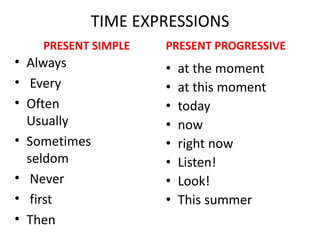
TIME EXPRESSIONS
PRESENT SIMPLE
• Always
• Every
• Often
Usually
• Sometimes
seldom
• Never
• first
• Then
PRESENT PROGRESSIVE
• at the moment
• at this moment
• today
• now
• right now
• Listen!
• Look!
• This summer
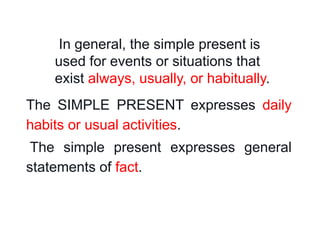
The SIMPLE PRESENT expresses daily
habits or usual activities.
The simple present expresses general
statements of fact.
In general, the simple present is
used for events or situations that
exist always, usually, or habitually.
EXAMPLES
• Every Monday, Sally …………….. (drive) her kids to
football practice.
2. Usually, I ……………….(work) as a secretary at
SFQ. , but this summer I …………….. (study) French
at a language school in Paris. That is why I am in
Paris.
3. Shhhhh! Be quiet! John …………………(sleep) .
4. Don't forget to take your umbrella. It ………………
(rain) .
EXAMPLES
6. I'm sorry I can't hear what you …………………
(say) because everybody ………………….. (talk) so
loudly.
7. Justin ……………………..(write
) a book about his adventures in Tibet. I hope he can find
a good publisher when he is finished.
8. Jim: Do you want to come over for dinner tonight?
Denise: Oh, I'm sorry, I can‘ I ………………(go) to a movie
tonight with some friends
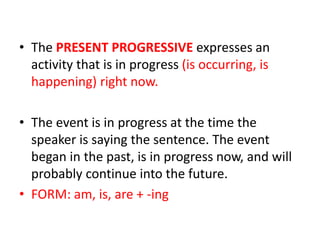
• The PRESENT PROGRESSIVE expresses an
activity that is in progress (is occurring, is
happening) right now.
• The event is in progress at the time the
speaker is saying the sentence. The event
began in the past, is in progress now, and will
probably continue into the future.
• FORM: am, is, are + -ing
Ann can't come to the phone right now
because she is taking a shower.
I am reading my grammar book right
now.
Jimmy and Susie are babies. They are
crying. I can hear them right now.
Maybe they are hungry.

Present simple vs present progressive

  • 1.
    PRESENT SIMPLE vsPRESENT PROGRESSIVE FUTURE
  • 2.
    TIME EXPRESSIONS PRESENT SIMPLE •Always • Every • Often Usually • Sometimes seldom • Never • first • Then PRESENT PROGRESSIVE • at the moment • at this moment • today • now • right now • Listen! • Look! • This summer
  • 3.
    The SIMPLE PRESENTexpresses daily habits or usual activities. The simple present expresses general statements of fact. In general, the simple present is used for events or situations that exist always, usually, or habitually.
  • 4.
    EXAMPLES • Every Monday,Sally …………….. (drive) her kids to football practice. 2. Usually, I ……………….(work) as a secretary at SFQ. , but this summer I …………….. (study) French at a language school in Paris. That is why I am in Paris. 3. Shhhhh! Be quiet! John …………………(sleep) . 4. Don't forget to take your umbrella. It ……………… (rain) .
  • 5.
    EXAMPLES 6. I'm sorryI can't hear what you ………………… (say) because everybody ………………….. (talk) so loudly. 7. Justin ……………………..(write ) a book about his adventures in Tibet. I hope he can find a good publisher when he is finished. 8. Jim: Do you want to come over for dinner tonight? Denise: Oh, I'm sorry, I can‘ I ………………(go) to a movie tonight with some friends
  • 6.
    • The PRESENTPROGRESSIVE expresses an activity that is in progress (is occurring, is happening) right now. • The event is in progress at the time the speaker is saying the sentence. The event began in the past, is in progress now, and will probably continue into the future. • FORM: am, is, are + -ing
  • 7.
    Ann can't cometo the phone right now because she is taking a shower. I am reading my grammar book right now. Jimmy and Susie are babies. They are crying. I can hear them right now. Maybe they are hungry.