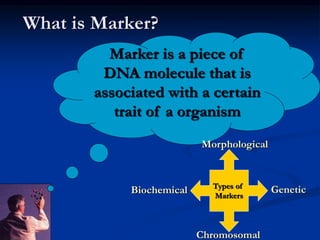
What is Marker?
Marker is a piece of
DNA molecule that is
associated with a certain
trait of a organism
Morphological
Biochemical
Chromosomal
Genetic
Types of
Markers
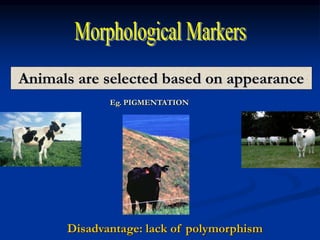
Animals are selected based on appearance
Eg. PIGMENTATION
Disadvantage: lack of polymorphism
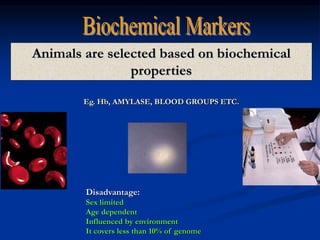
Animals are selected based on biochemical
properties
Eg. Hb, AMYLASE, BLOOD GROUPS ETC.
Disadvantage:
Sex limited
Age dependent
Influenced by environment
It covers less than 10% of genome
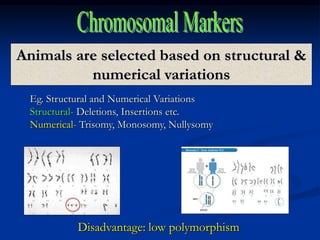
Animals are selected based on structural &
numerical variations
Eg. Structural and Numerical Variations
Structural- Deletions, Insertions etc.
Numerical- Trisomy, Monosomy, Nullysomy
Disadvantage: low polymorphism
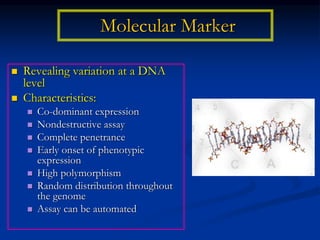
Molecular Marker
 Revealing variation at a DNA
level
 Characteristics:
 Co-dominant expression
 Nondestructive assay
 Complete penetrance
 Early onset of phenotypic
expression
 High polymorphism
 Random distribution throughout
the genome
 Assay can be automated
DNA isolated from any tissue eg. Blood, hair etc.
DNA isolated at any stage even during foetal life
DNA has longer shelf-life readily exchangeable b/w labs
Analysis of DNA carried out at early age/ even at the
embryonic
Stage irrespective of sex.
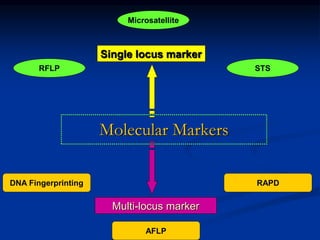
Molecular Markers
Single locus marker
Multi-locus marker
RFLP
Microsatellite
STS
DNA Fingerprinting
AFLP
RAPD
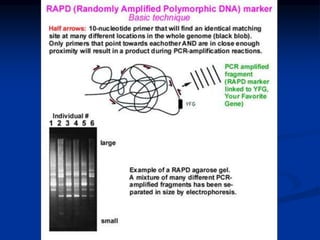
Randomly Amplified Polymorphic DNA
(RAPD)
 PCR based marker with 10-12 base pairs
 Random amplification of several fragments
 Amplified fragments run in agarose gel detected
by EtBr
 Unstable amplification leads to poor repeatability
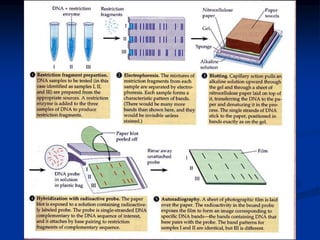
Restriction Fragment Length
Polymorphism (RFLP)
 Genomic DNA digested with Restriction
Enzymes
 DNA fragments separated via electrophoresis
and transfer to nylon membrane
 Membranes exposed to probes labelled with P32
via southern hybridization
 Film exposed to X-Ray
Amplified Fragment Length
Polymorphism (AFLP)
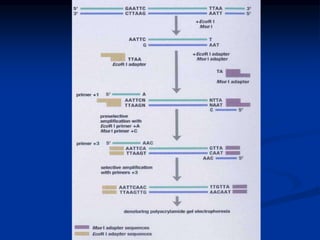
 Restriction endonuclease digestion of DNA
 Ligation of adaptors
 Amplification of ligated fragments
 Separation of the amplified fragments via
electrophoresis and visualization
 AFLPs have stable amplification and good
repeatability
SSR: Simple Sequence Repeat or
Microsatellite
 PCR based markers with 18-25 base pair primers
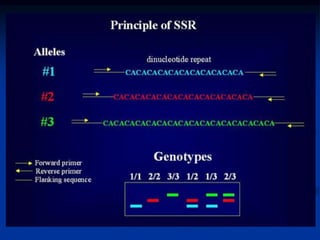
 SSR polymorphisms are based on no. of repeat
units and are hypervariable
 SSRs have stable amplification and good
repeatability
 SSR are easy to run and automate
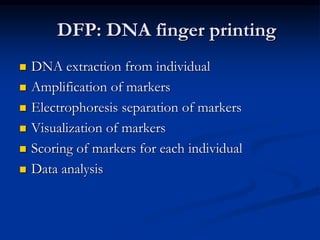
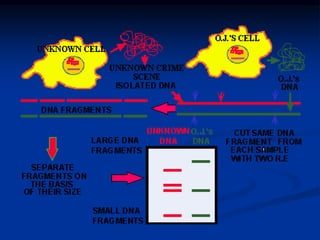
DFP: DNA finger printing
 DNA extraction from individual
 Amplification of markers
 Electrophoresis separation of markers
 Visualization of markers
 Scoring of markers for each individual
 Data analysis
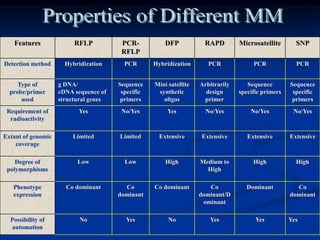
Features RFLP PCR-
RFLP
DFP RAPD Microsatellite SNP
Detection method Hybridization PCR Hybridization PCR PCR PCR
Type of
probe/primer
used
g DNA/
cDNA sequence of
structural genes
Sequence
specific
primers
Mini satellite
synthetic
oligos
Arbitrarily
design
primer
Sequence
specific primers
Sequence
specific
primers
Requirement of
radioactivity
Yes No/Yes Yes No/Yes No/Yes No/Yes
Extant of genomic
coverage
Limited Limited Extensive Extensive Extensive Extensive
Degree of
polymorphisms
Low Low High Medium to
High
High High
Phenotype
expression
Co dominant Co
dominant
Co dominant Co
dominant/D
ominant
Dominant Co
dominant
Possibility of
automation
No Yes No Yes Yes Yes
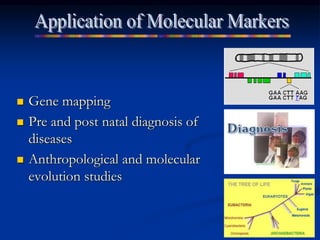
 Gene mapping
 Pre and post natal diagnosis of
diseases
 Anthropological and molecular
evolution studies
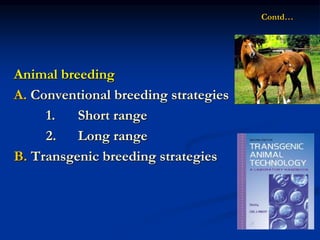
Contd…
Animal breeding
A. Conventional breeding strategies
1. Short range
2. Long range
B. Transgenic breeding strategies
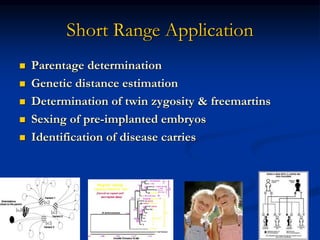
Short Range Application
 Parentage determination
 Genetic distance estimation
 Determination of twin zygosity & freemartins
 Sexing of pre-implanted embryos
 Identification of disease carries
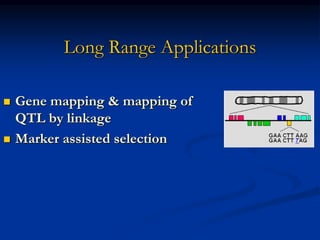
Long Range Applications
 Gene mapping & mapping of
QTL by linkage
 Marker assisted selection
TRANSGENIC BREEDING
STRATEGIES
 IDENTIFICATION OF ANIMALS
CARRYING THE TRANSGENES
CONCLUSIONS
The genetic improvement of animals is a continuous and
complex process. Ever since the domestication of animals
by man, he has always remained busy in improving his
animals. In this pursuit many methods have been developed
and tested. In recent years, the demonstration of genetic
polymorphism at the DNA sequence level has provided a
large number of marker techniques with variety of
applications. This has, in turn, prompted further
consideration for the potential utility of these markers in
animal breeding. However, utilization of marker-based
information for genetic improvement depends on the choice
of an appropriate marker system for a given application.

Molecular markers.ppt

  • 2.
    What is Marker? Markeris a piece of DNA molecule that is associated with a certain trait of a organism Morphological Biochemical Chromosomal Genetic Types of Markers
  • 3.
    Animals are selectedbased on appearance Eg. PIGMENTATION Disadvantage: lack of polymorphism
  • 4.
    Animals are selectedbased on biochemical properties Eg. Hb, AMYLASE, BLOOD GROUPS ETC. Disadvantage: Sex limited Age dependent Influenced by environment It covers less than 10% of genome
  • 5.
    Animals are selectedbased on structural & numerical variations Eg. Structural and Numerical Variations Structural- Deletions, Insertions etc. Numerical- Trisomy, Monosomy, Nullysomy Disadvantage: low polymorphism
  • 6.
    Molecular Marker  Revealingvariation at a DNA level  Characteristics:  Co-dominant expression  Nondestructive assay  Complete penetrance  Early onset of phenotypic expression  High polymorphism  Random distribution throughout the genome  Assay can be automated
  • 7.
    DNA isolated fromany tissue eg. Blood, hair etc. DNA isolated at any stage even during foetal life DNA has longer shelf-life readily exchangeable b/w labs Analysis of DNA carried out at early age/ even at the embryonic Stage irrespective of sex.
  • 8.
    Molecular Markers Single locusmarker Multi-locus marker RFLP Microsatellite STS DNA Fingerprinting AFLP RAPD
  • 9.
    Randomly Amplified PolymorphicDNA (RAPD)  PCR based marker with 10-12 base pairs  Random amplification of several fragments  Amplified fragments run in agarose gel detected by EtBr  Unstable amplification leads to poor repeatability
  • 11.
    Restriction Fragment Length Polymorphism(RFLP)  Genomic DNA digested with Restriction Enzymes  DNA fragments separated via electrophoresis and transfer to nylon membrane  Membranes exposed to probes labelled with P32 via southern hybridization  Film exposed to X-Ray
  • 13.
    Amplified Fragment Length Polymorphism(AFLP)  Restriction endonuclease digestion of DNA  Ligation of adaptors  Amplification of ligated fragments  Separation of the amplified fragments via electrophoresis and visualization  AFLPs have stable amplification and good repeatability
  • 15.
    SSR: Simple SequenceRepeat or Microsatellite  PCR based markers with 18-25 base pair primers  SSR polymorphisms are based on no. of repeat units and are hypervariable  SSRs have stable amplification and good repeatability  SSR are easy to run and automate
  • 17.
    DFP: DNA fingerprinting  DNA extraction from individual  Amplification of markers  Electrophoresis separation of markers  Visualization of markers  Scoring of markers for each individual  Data analysis
  • 19.
    Features RFLP PCR- RFLP DFPRAPD Microsatellite SNP Detection method Hybridization PCR Hybridization PCR PCR PCR Type of probe/primer used g DNA/ cDNA sequence of structural genes Sequence specific primers Mini satellite synthetic oligos Arbitrarily design primer Sequence specific primers Sequence specific primers Requirement of radioactivity Yes No/Yes Yes No/Yes No/Yes No/Yes Extant of genomic coverage Limited Limited Extensive Extensive Extensive Extensive Degree of polymorphisms Low Low High Medium to High High High Phenotype expression Co dominant Co dominant Co dominant Co dominant/D ominant Dominant Co dominant Possibility of automation No Yes No Yes Yes Yes
  • 20.
     Gene mapping Pre and post natal diagnosis of diseases  Anthropological and molecular evolution studies
  • 21.
    Contd… Animal breeding A. Conventionalbreeding strategies 1. Short range 2. Long range B. Transgenic breeding strategies
  • 22.
    Short Range Application Parentage determination  Genetic distance estimation  Determination of twin zygosity & freemartins  Sexing of pre-implanted embryos  Identification of disease carries
  • 23.
    Long Range Applications Gene mapping & mapping of QTL by linkage  Marker assisted selection
  • 24.
    TRANSGENIC BREEDING STRATEGIES  IDENTIFICATIONOF ANIMALS CARRYING THE TRANSGENES
  • 25.
    CONCLUSIONS The genetic improvementof animals is a continuous and complex process. Ever since the domestication of animals by man, he has always remained busy in improving his animals. In this pursuit many methods have been developed and tested. In recent years, the demonstration of genetic polymorphism at the DNA sequence level has provided a large number of marker techniques with variety of applications. This has, in turn, prompted further consideration for the potential utility of these markers in animal breeding. However, utilization of marker-based information for genetic improvement depends on the choice of an appropriate marker system for a given application.