Bullet Journal MethodRuder Carroll
Learning outcome
• Adapt the Bullet journal method for planning and reflection
Rapid logging
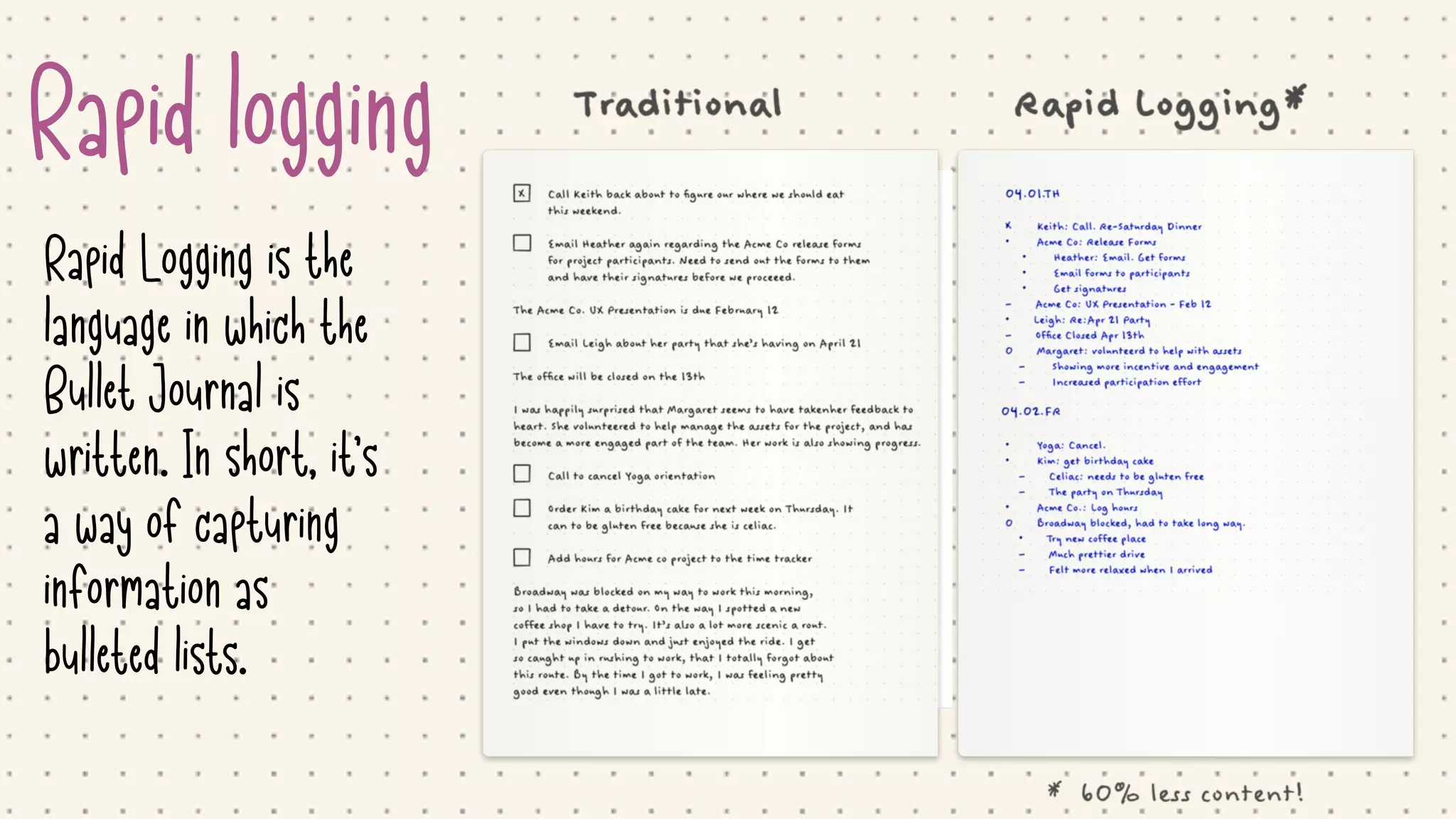
Rapid Logging is the
language in which the
Bullet Journal is
written. In short, it’s
a way of capturing
information as
bulleted lists.
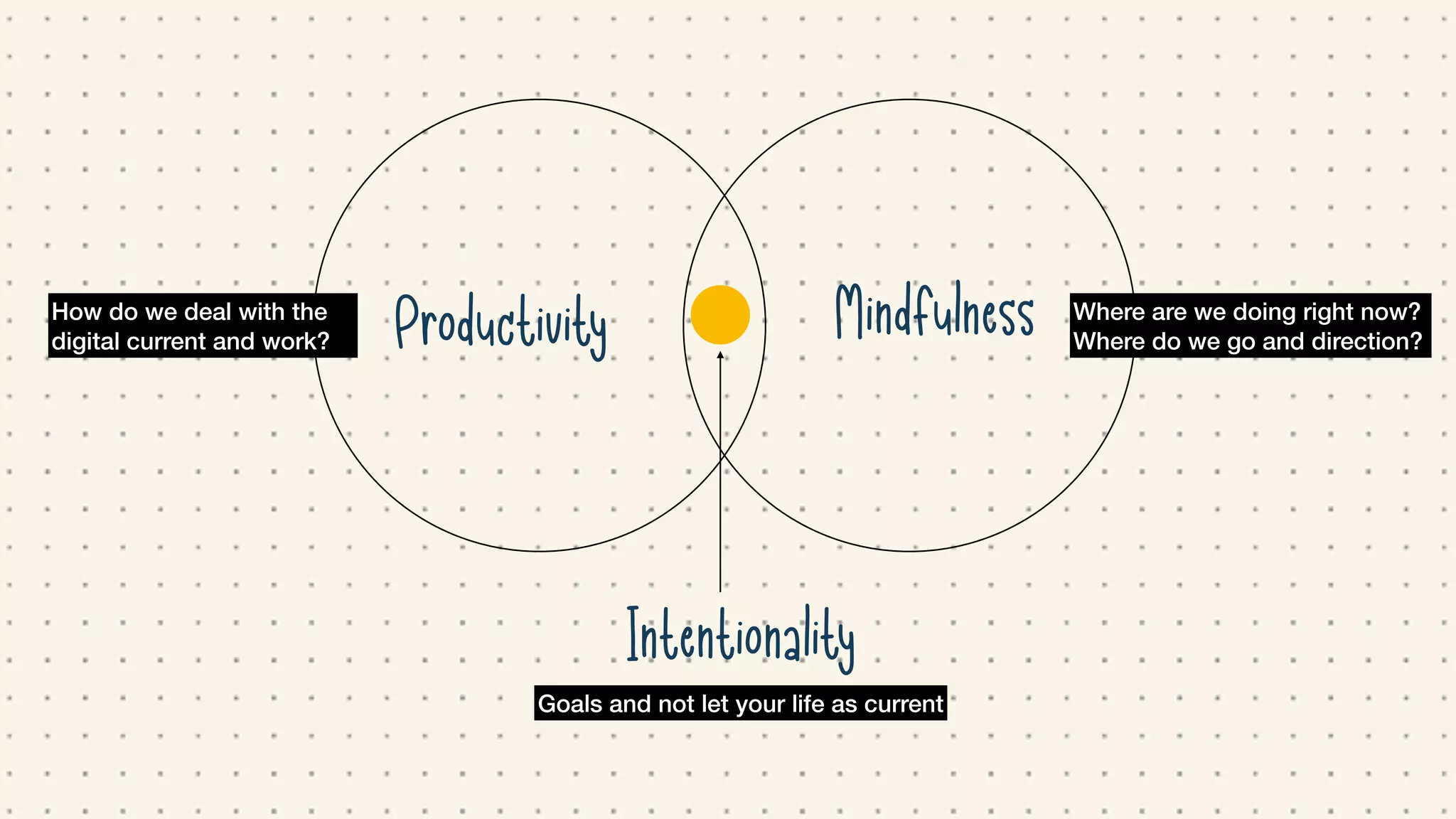
Productivity Mindfulness
Intentionality
Goals and not let your life as current
Where are we doing right now?
Where do we go and direction?
How do we deal with the
digital current and work?
Bullet
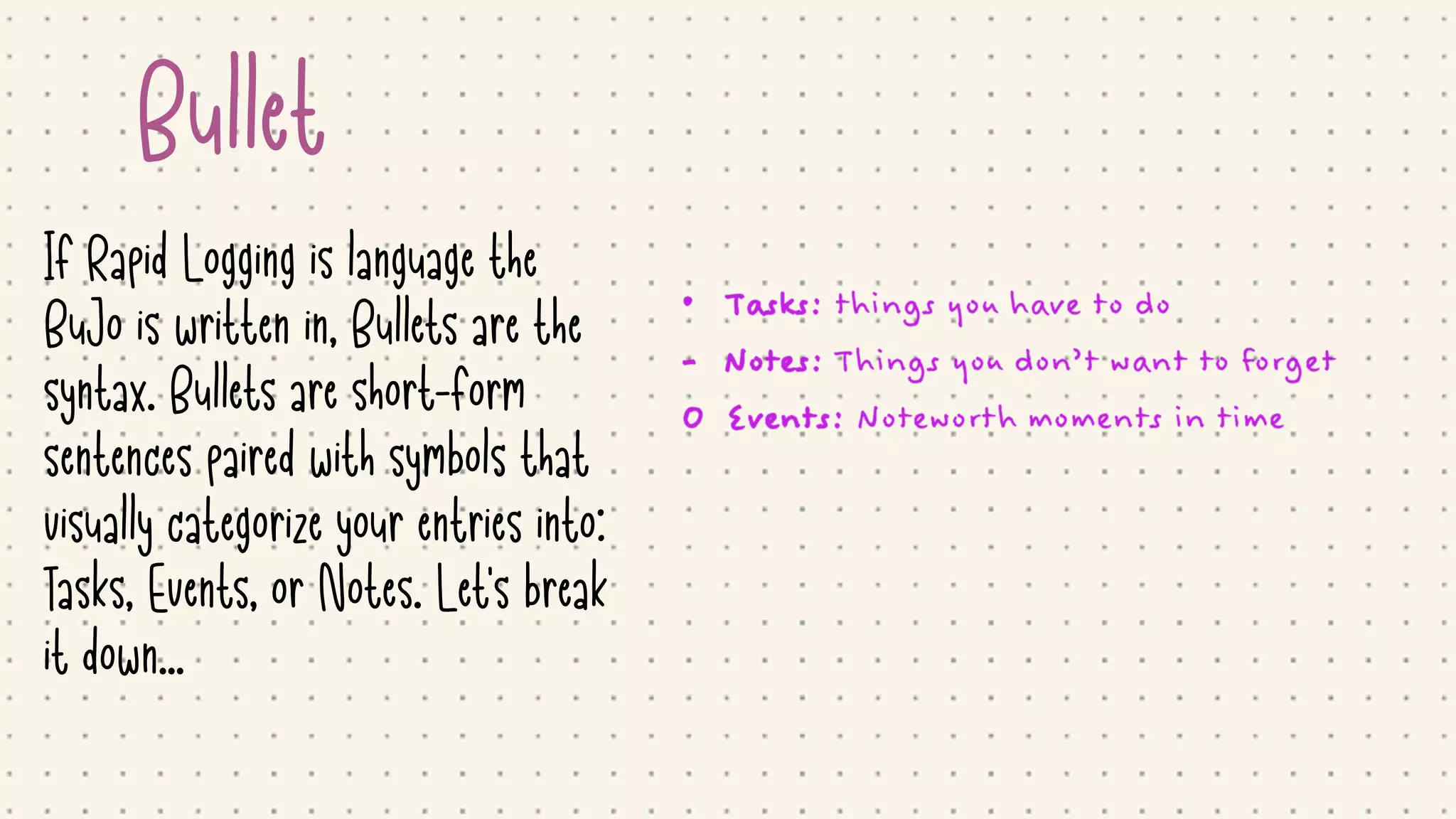
If Rapid Logging is language the
BuJo is written in, Bullets are the
syntax. Bullets are short-form
sentences paired with symbols that
visually categorize your entries into:
Tasks, Events, or Notes. Let's break
it down...
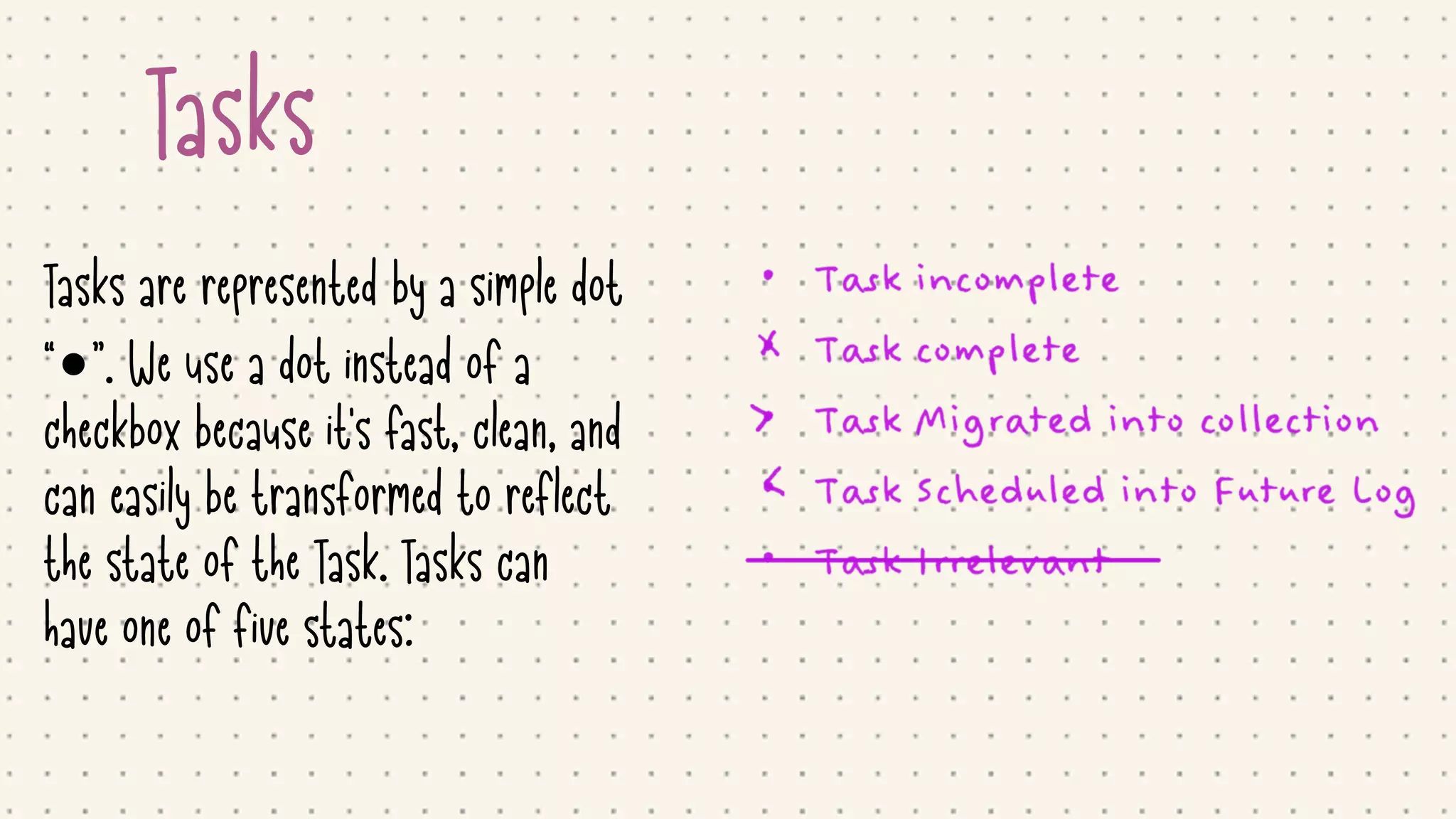
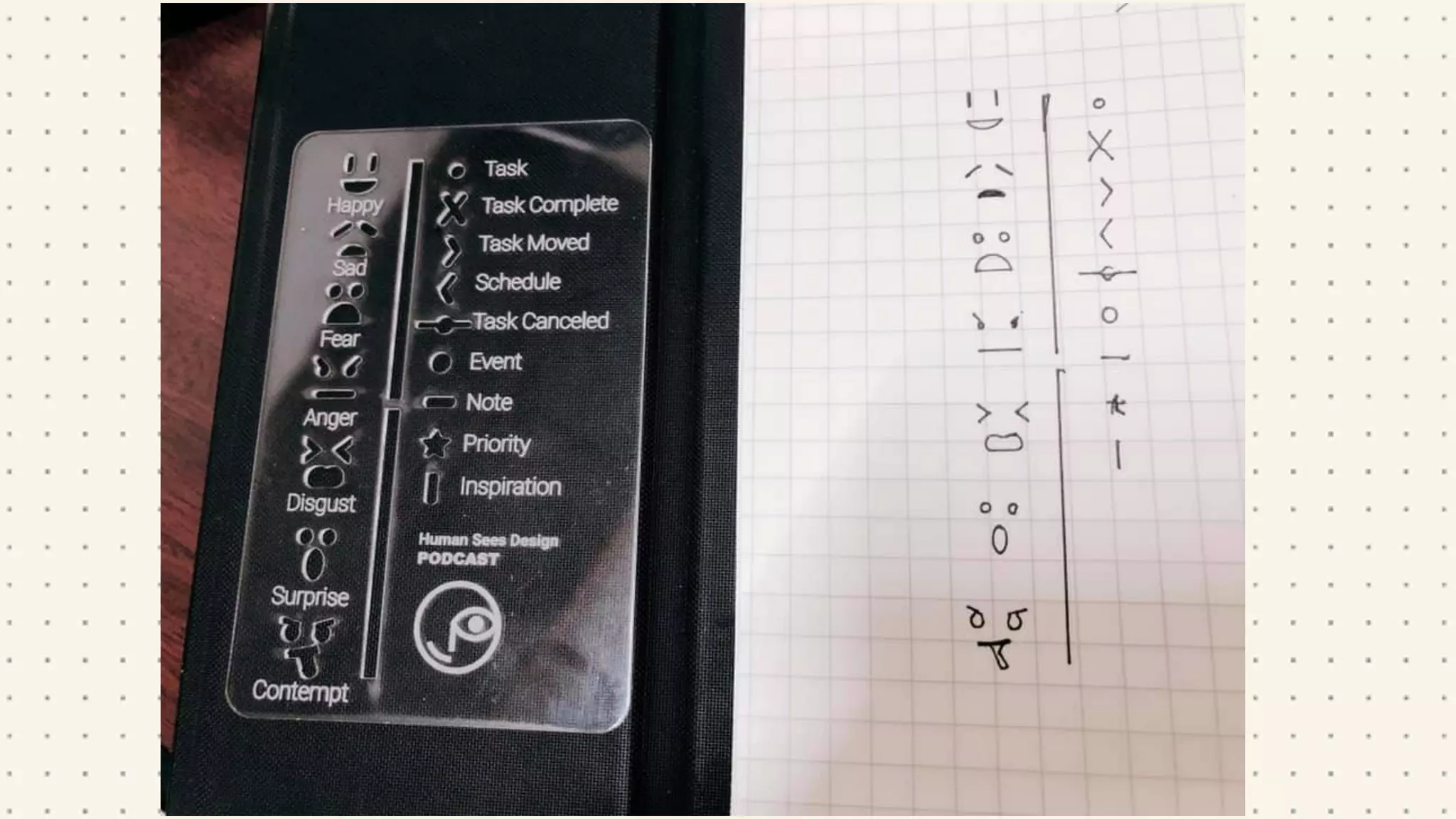
Tasks
Tasks are represented by a simple dot
“•”. We use a dot instead of a
checkbox because it's fast, clean, and
can easily be transformed to reflect
the state of the Task. Tasks can
have one of five states:
Event
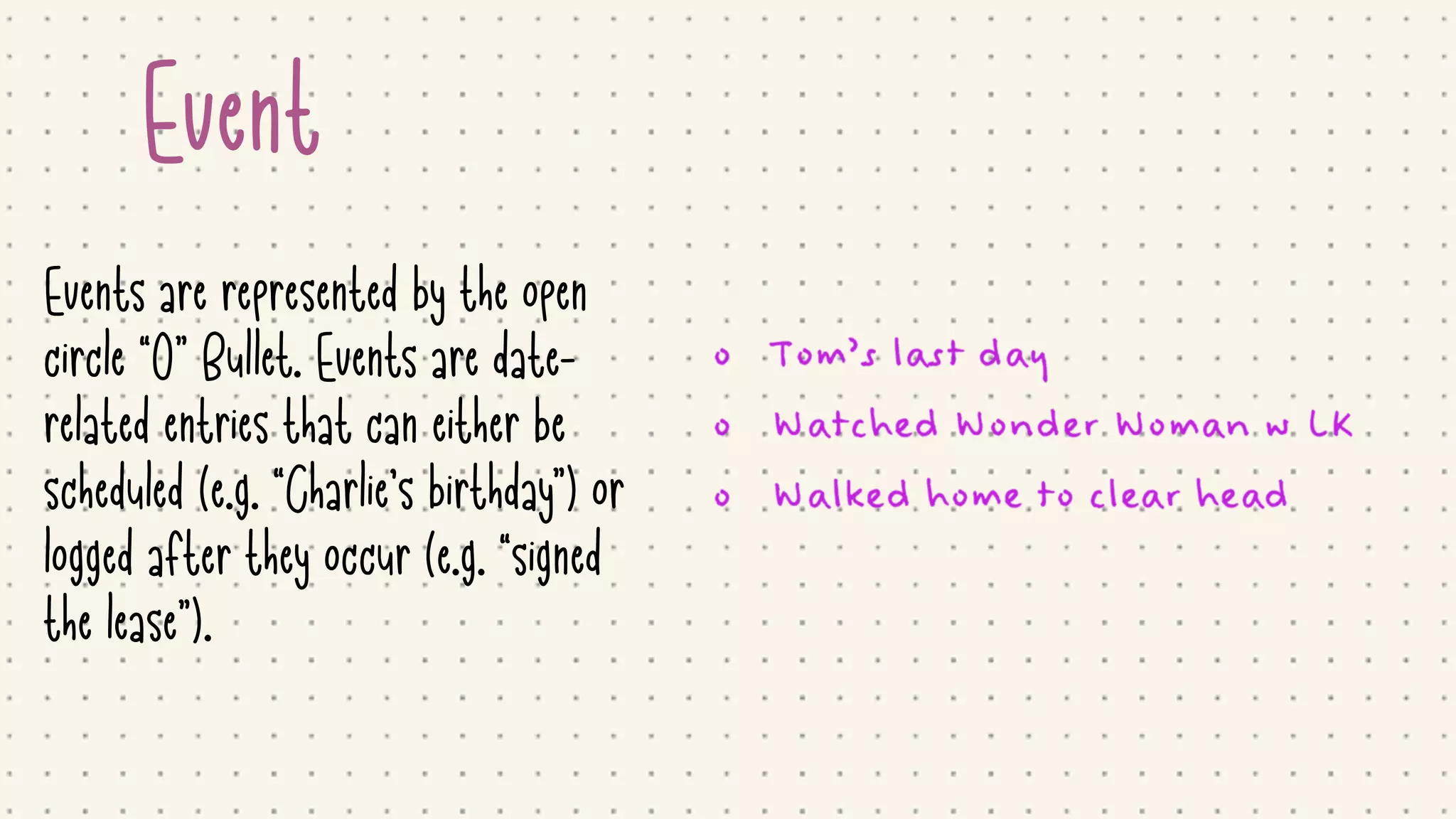
Events are represented by the open
circle “O” Bullet. Events are date-
related entries that can either be
scheduled (e.g. “Charlie’s birthday”) or
logged after they occur (e.g. “signed
the lease”).
Notes
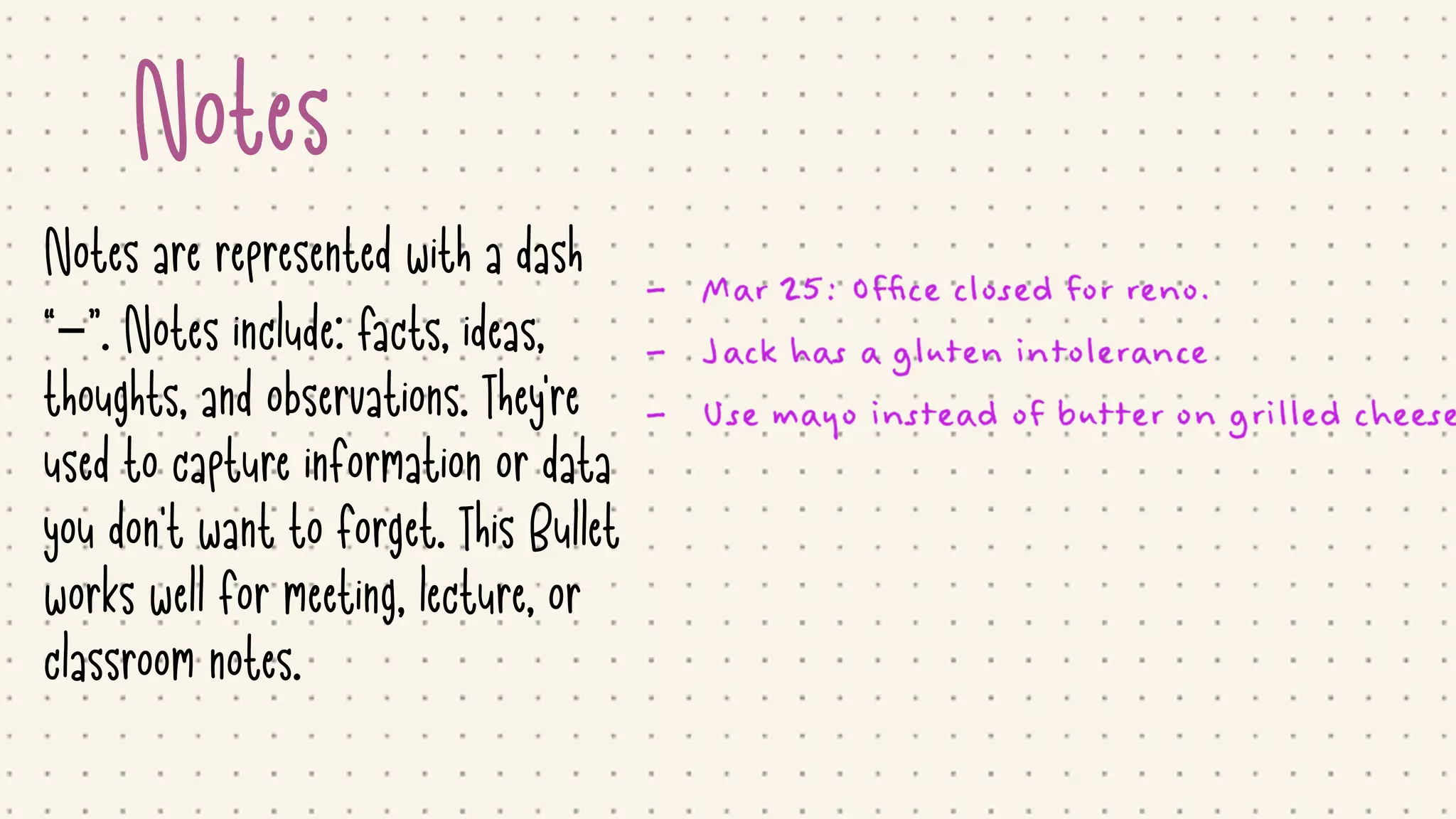
Notes are represented with a dash
“–”. Notes include: facts, ideas,
thoughts, and observations. They're
used to capture information or data
you don't want to forget. This Bullet
works well for meeting, lecture, or
classroom notes.
Mix & Match
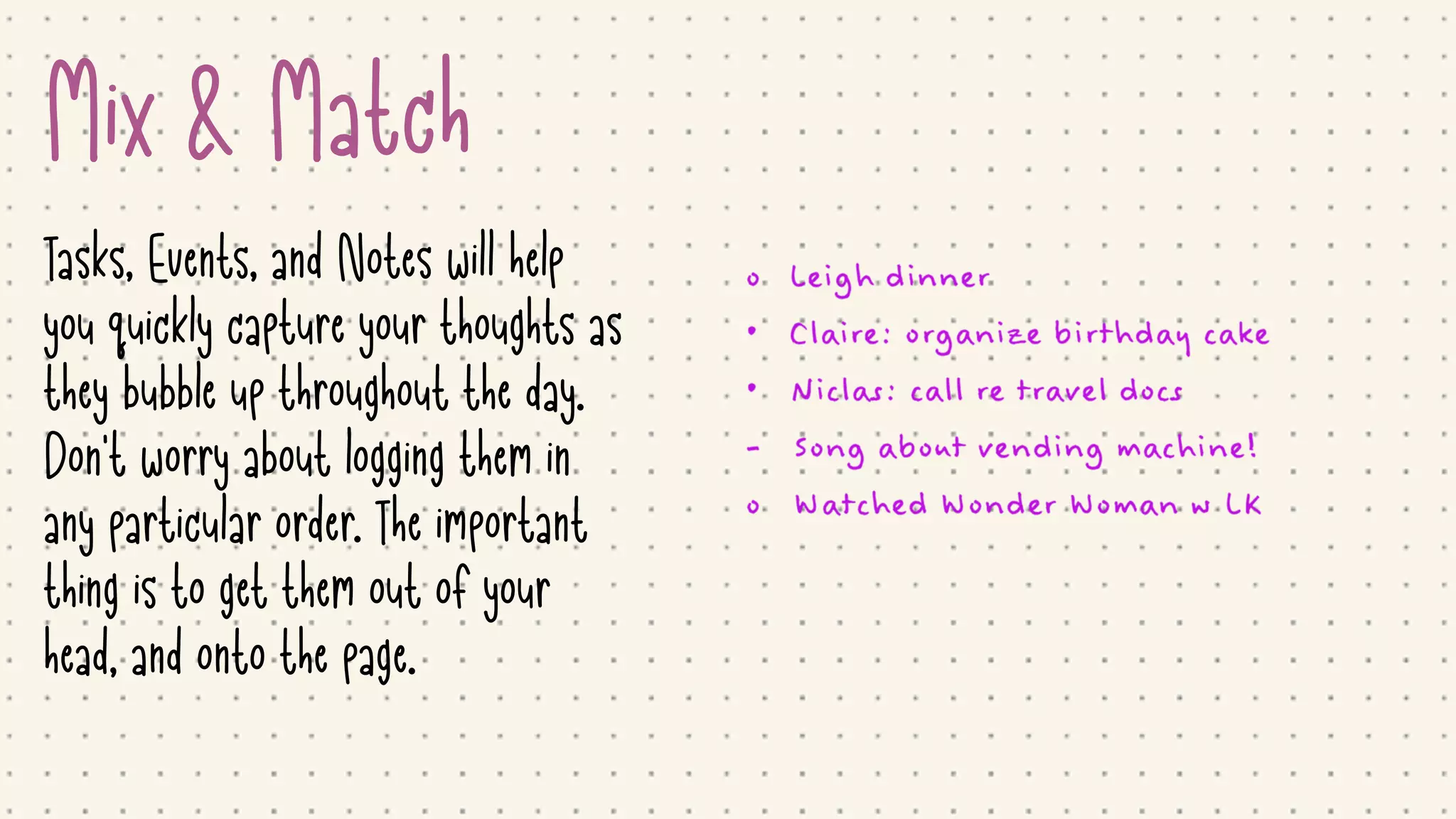
Tasks, Events, and Notes will help
you quickly capture your thoughts as
they bubble up throughout the day.
Don't worry about logging them in
any particular order. The important
thing is to get them out of your
head, and onto the page.
Signifiers
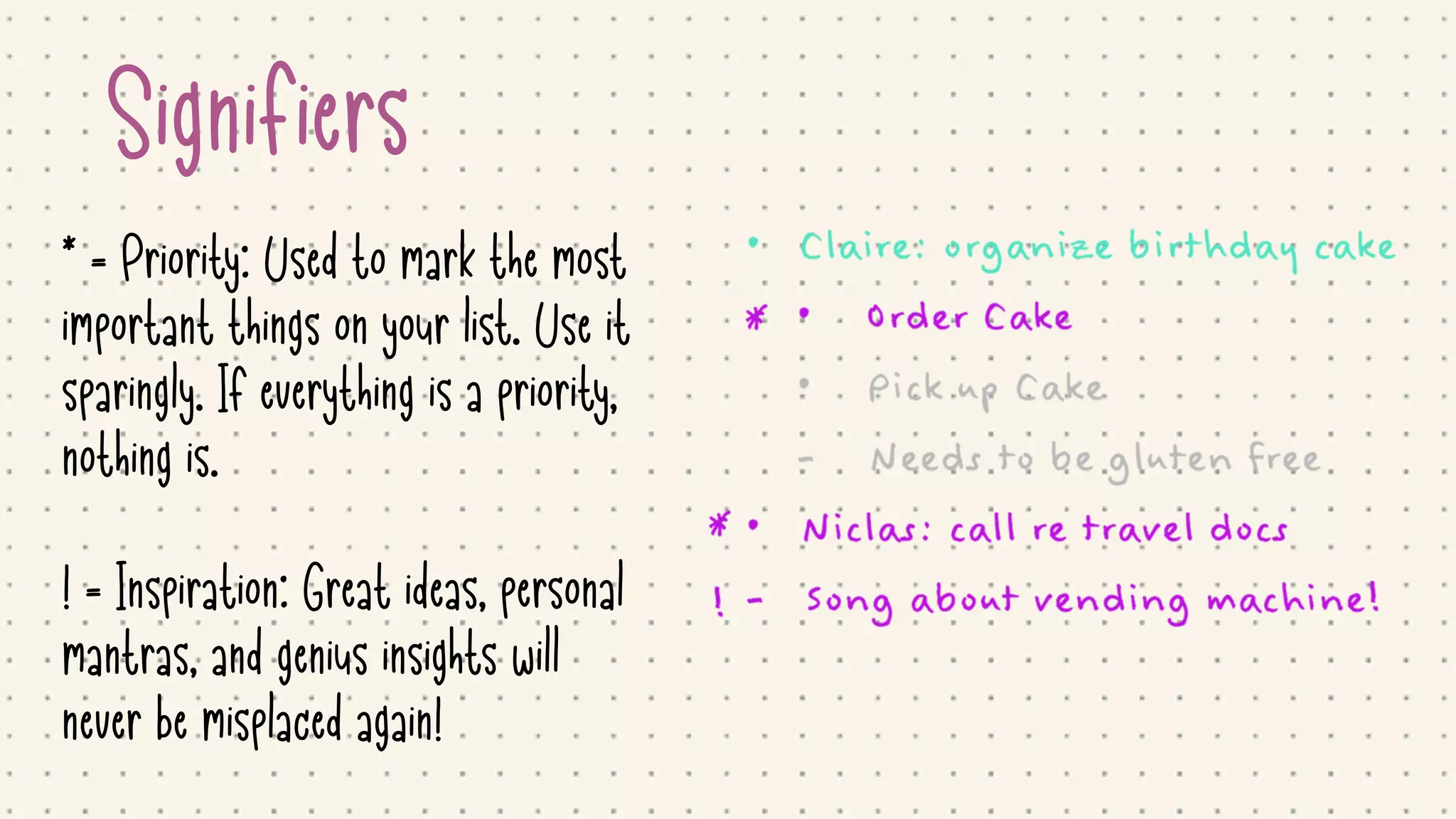
* = Priority: Used to mark the most
important things on your list. Use it
sparingly. If everything is a priority,
nothing is.

! = Inspiration: Great ideas, personal
mantras, and genius insights will
never be misplaced again!
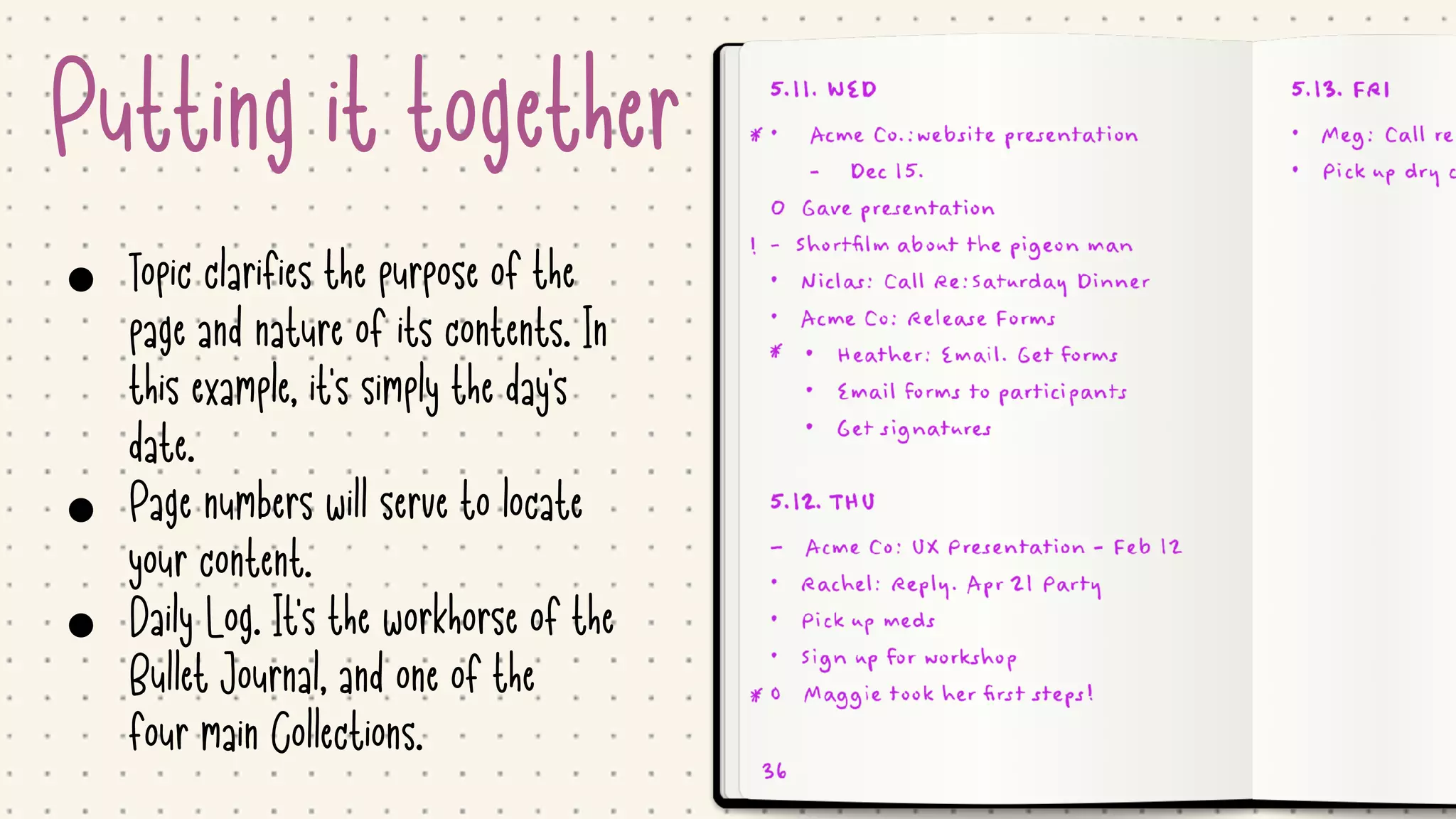
Putting it together
• Topic clarifies the purpose of the
page and nature of its contents. In
this example, it's simply the day's
date.

• Page numbers will serve to locate
your content. 

• Daily Log. It's the workhorse of the
Bullet Journal, and one of the
four main Collections.
Key components
• Index

• Future log

• Monthly log

• Daily log

• Collections
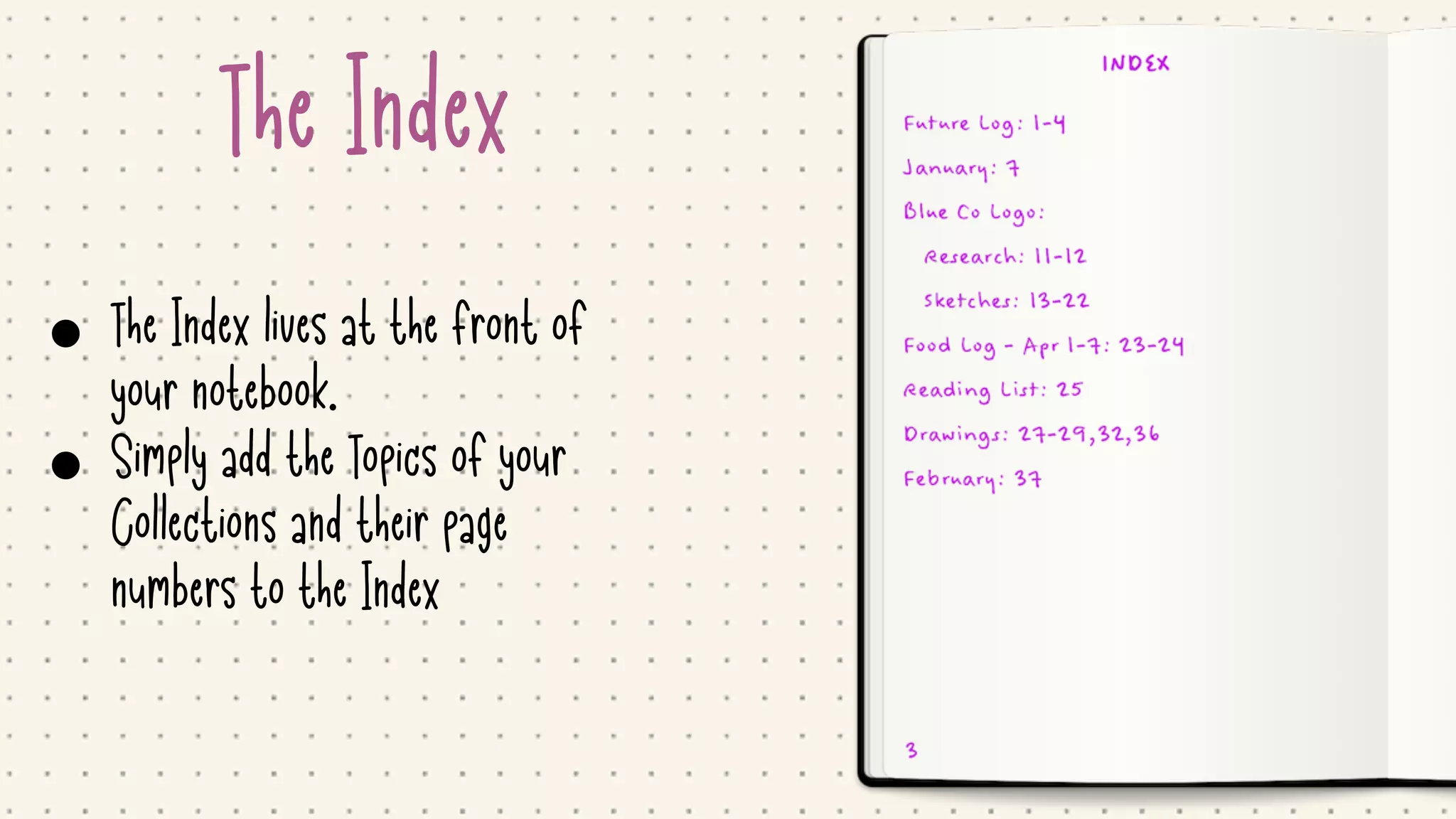
The Index
• The Index lives at the front of
your notebook.

• Simply add the Topics of your
Collections and their page
numbers to the Index
The Future Log
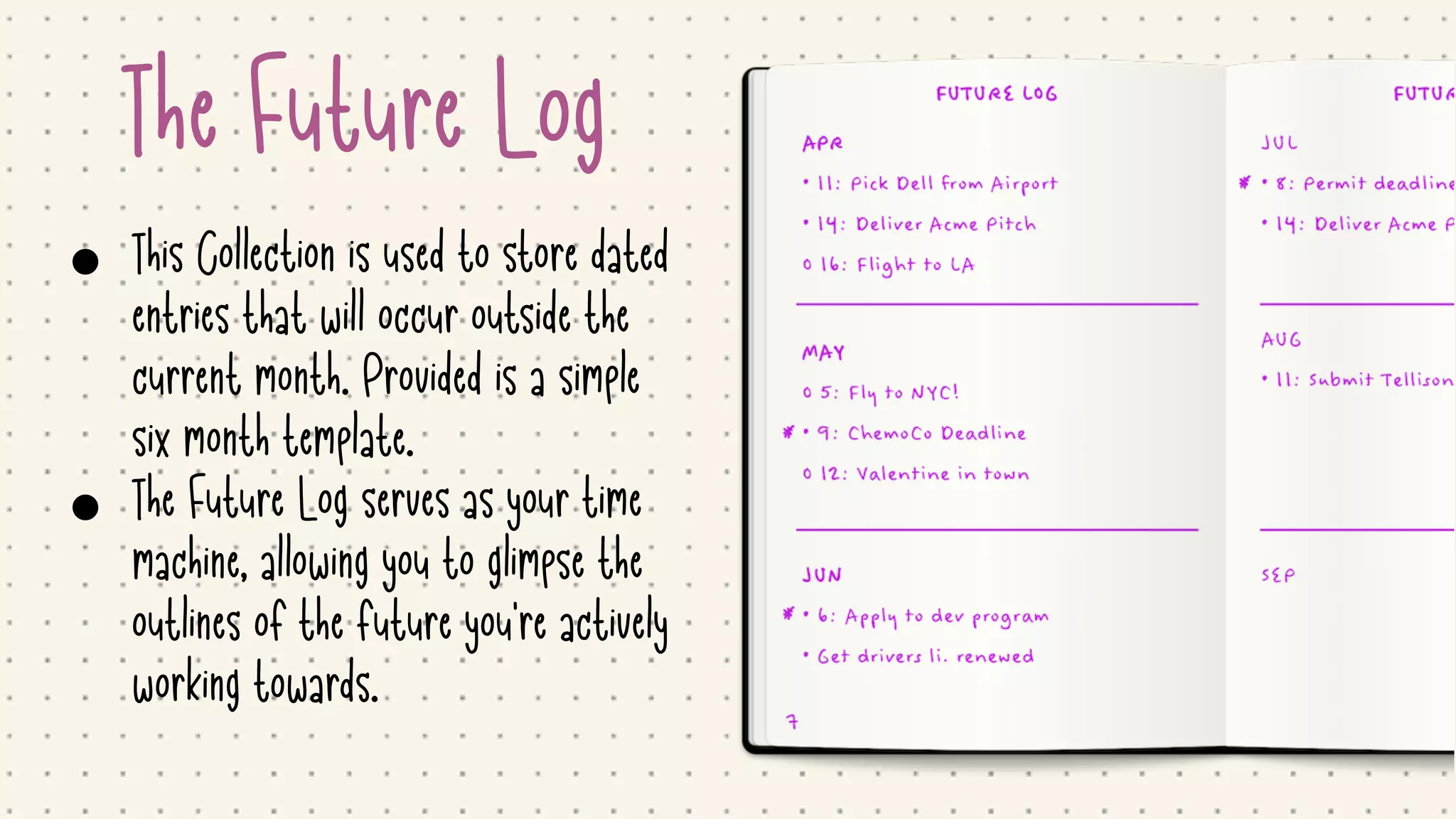
• This Collection is used to store dated
entries that will occur outside the
current month. Provided is a simple
six month template.

• The Future Log serves as your time
machine, allowing you to glimpse the
outlines of the future you're actively
working towards.
Monthly Log
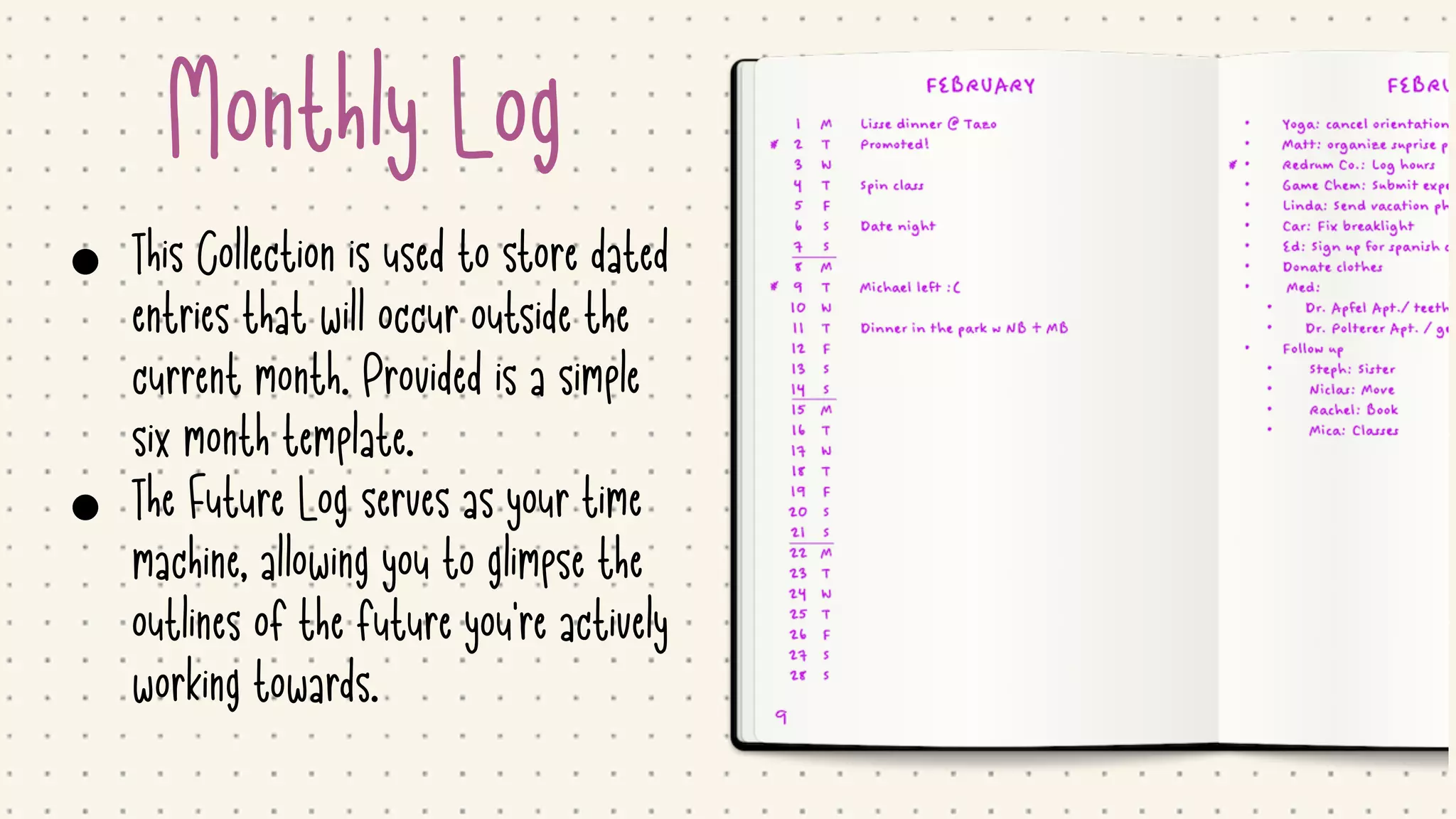
• This Collection is used to store dated
entries that will occur outside the
current month. Provided is a simple
six month template.

• The Future Log serves as your time
machine, allowing you to glimpse the
outlines of the future you're actively
working towards.
Daily Log
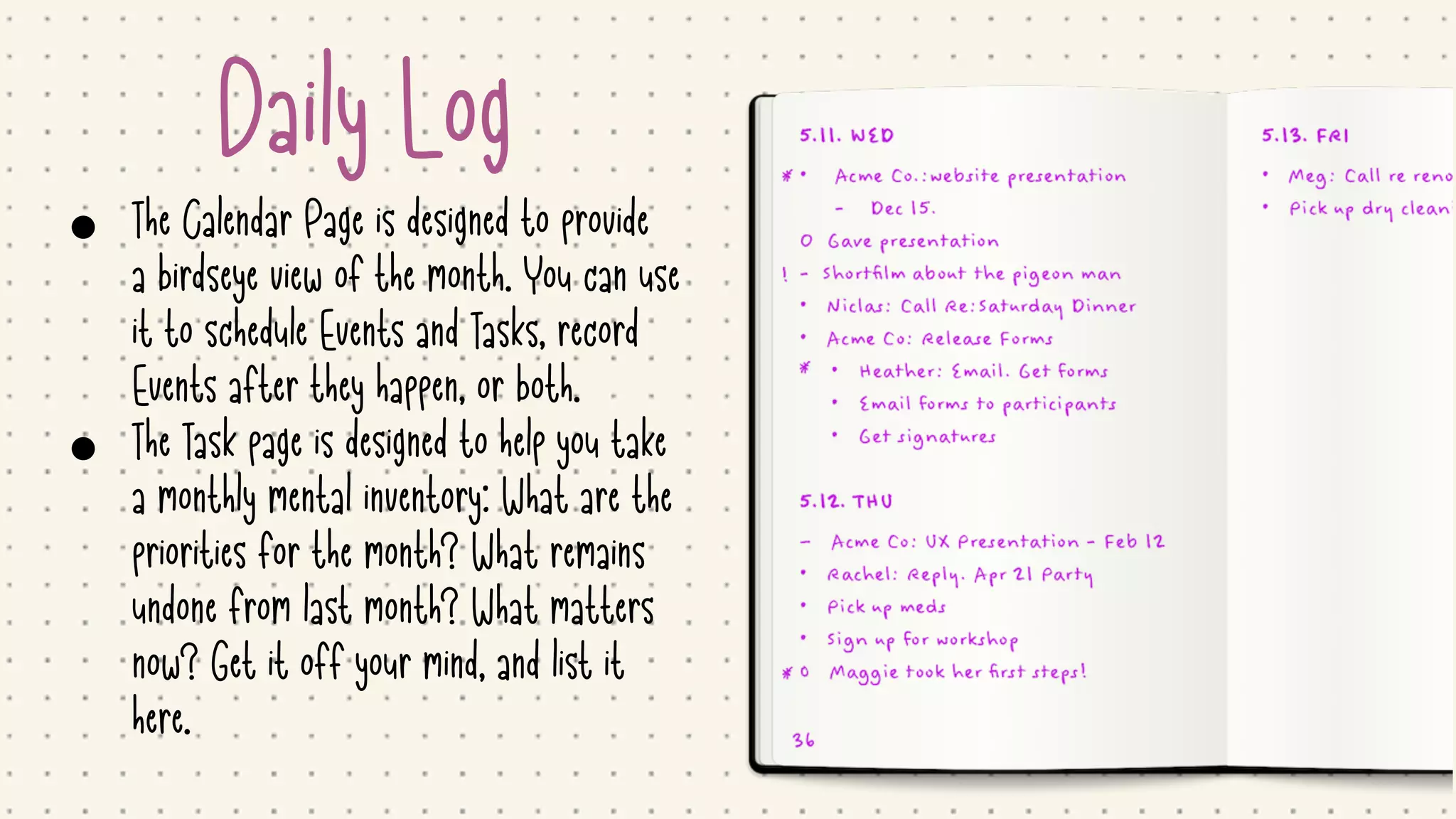
• The Calendar Page is designed to provide
a birdseye view of the month. You can use
it to schedule Events and Tasks, record
Events after they happen, or both.

• The Task page is designed to help you take
a monthly mental inventory: What are the
priorities for the month? What remains
undone from last month? What matters
now? Get it off your mind, and list it
here.
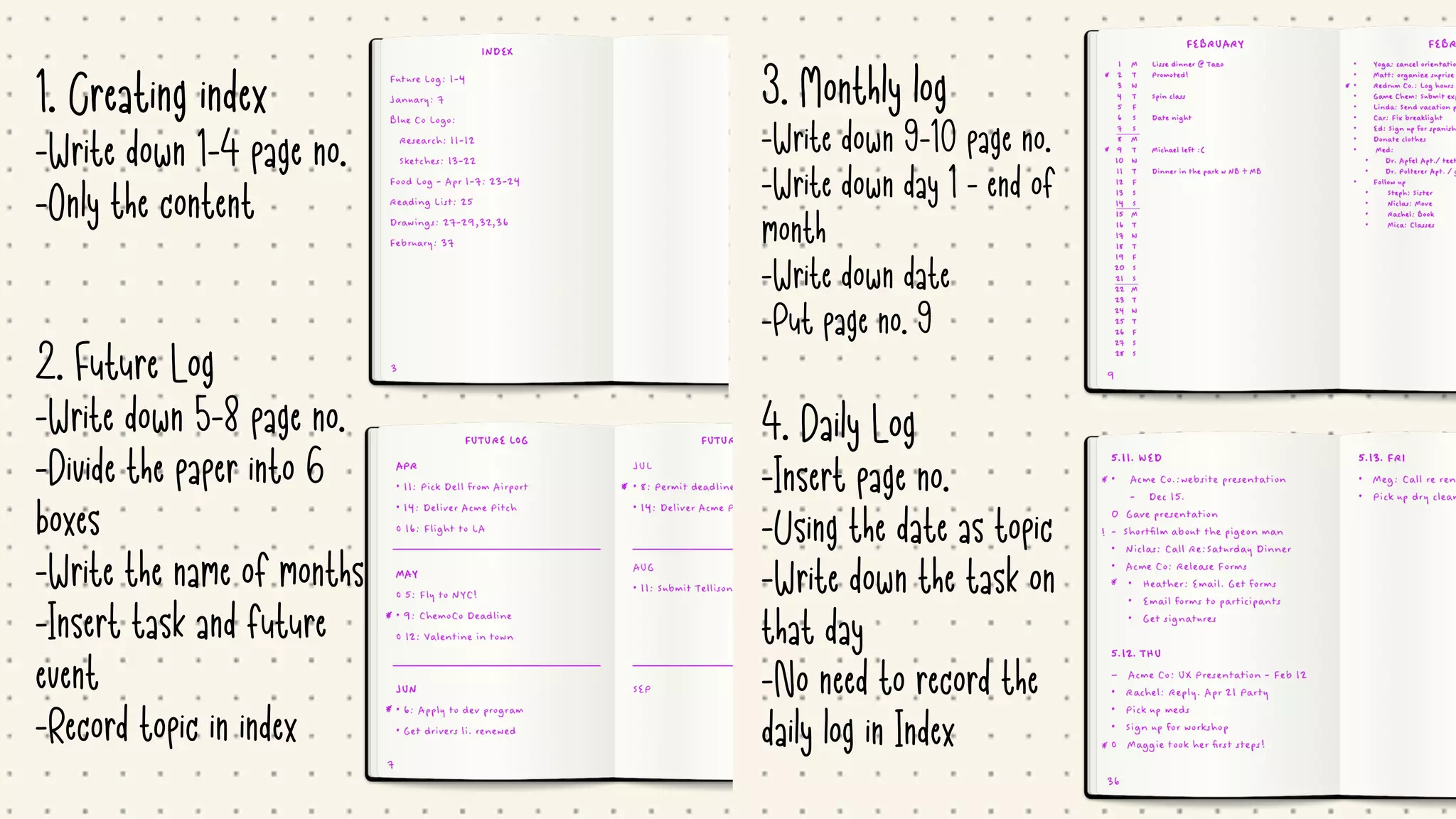
1. Creating index

-Write down 1-4 page no.

-Only the content

2. Future Log

-Write down 5-8 page no.

-Divide the paper into 6
boxes

-Write the name of months

-Insert task and future
event

-Record topic in index
3. Monthly log

-Write down 9-10 page no.

-Write down day 1 - end of
month

-Write down date 

-Put page no. 9

4. Daily Log

-Insert page no.

-Using the date as topic

-Write down the task on

that day

-No need to record the
daily log in Index
Exercise : Intentionality
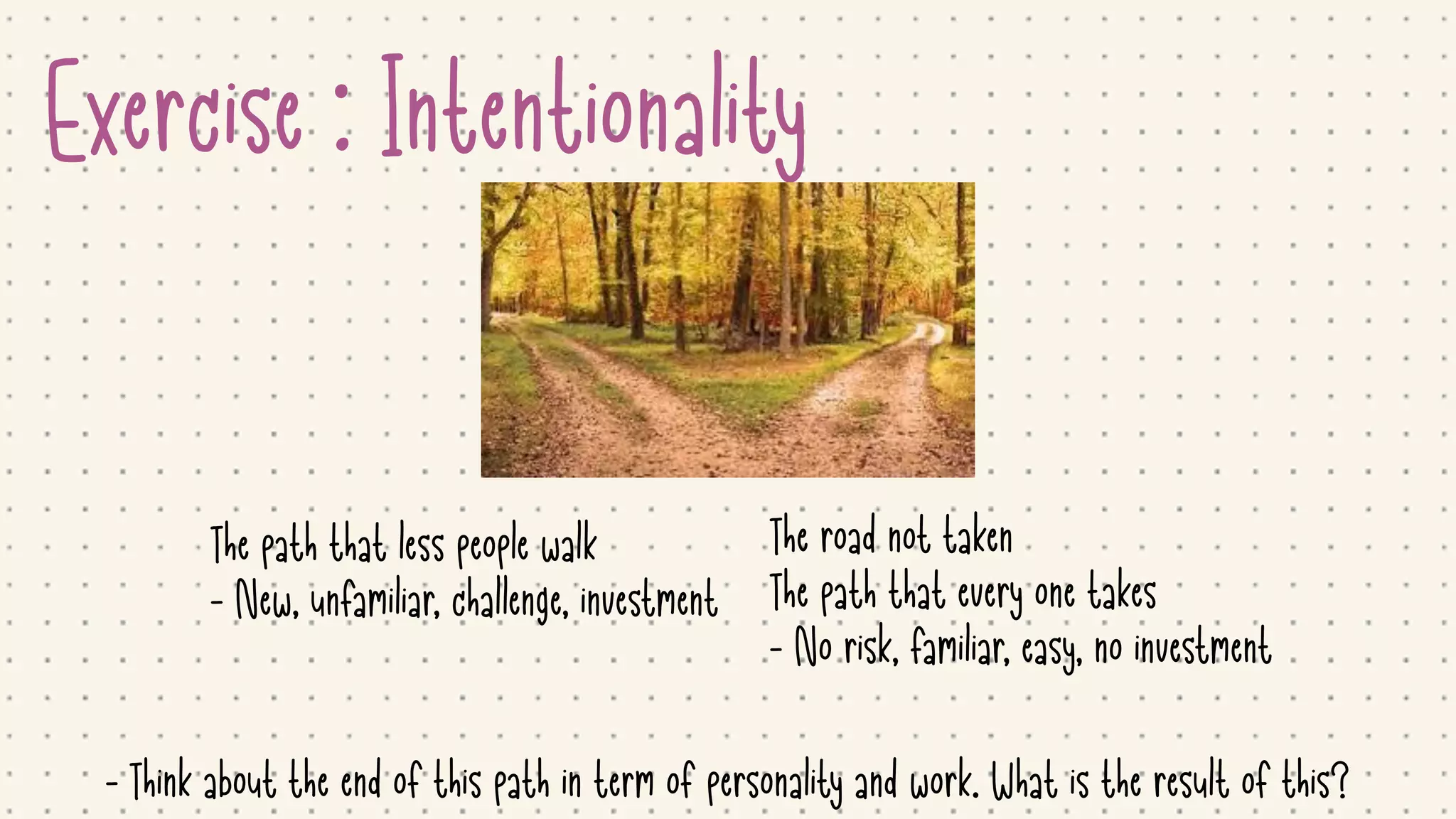
The road not taken

The path that every one takes

- No risk, familiar, easy, no investment
The path that less people walk

- New, unfamiliar, challenge, investment

- Think about the end of this path in term of personality and work. What is the result of this?
Exercise : Intentionality
Using 5 mins to write the mourning word for your death for each path.

Then build 2 types of collections and place on the Index page.

Please think carefully and be true for yourself.
Exercise : Intentionality
Read your mourning word and write a letter to yourself. Try to transfer

your emotion, feeling and question both good and bad during this practice.
Exercise 5 4 3 2 1
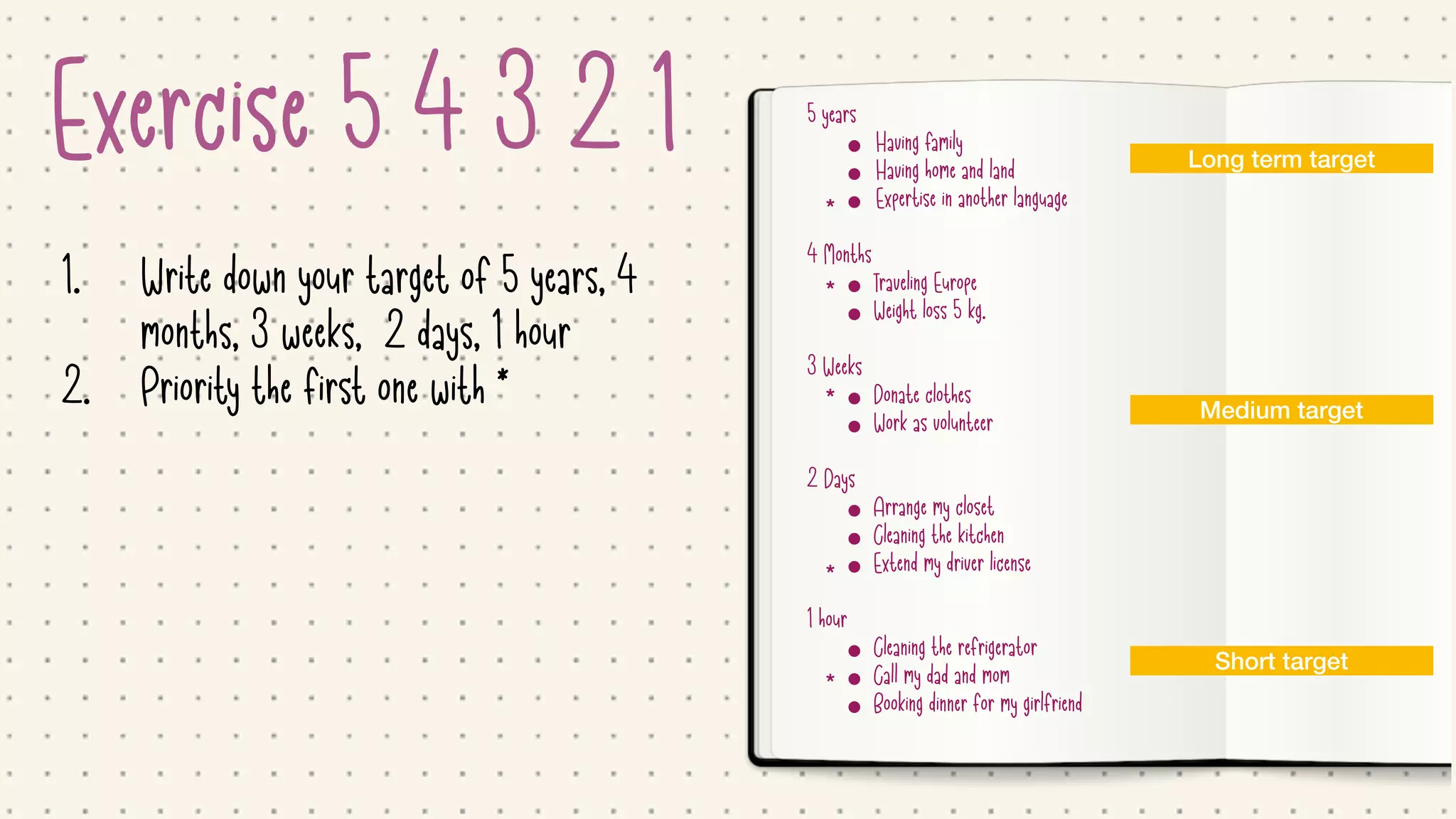
1. Write down your target of 5 years, 4
months, 3 weeks, 2 days, 1 hour

2. Priority the first one with *
5 years

• Having family

• Having home and land

• Expertise in another language

4 Months

• Traveling Europe

• Weight loss 5 kg.

3 Weeks

• Donate clothes

• Work as volunteer

2 Days

• Arrange my closet

• Cleaning the kitchen

• Extend my driver license

1 hour

• Cleaning the refrigerator

• Call my dad and mom

• Booking dinner for my girlfriend
*
*
*
*
*
Long term target
Medium target
Short target
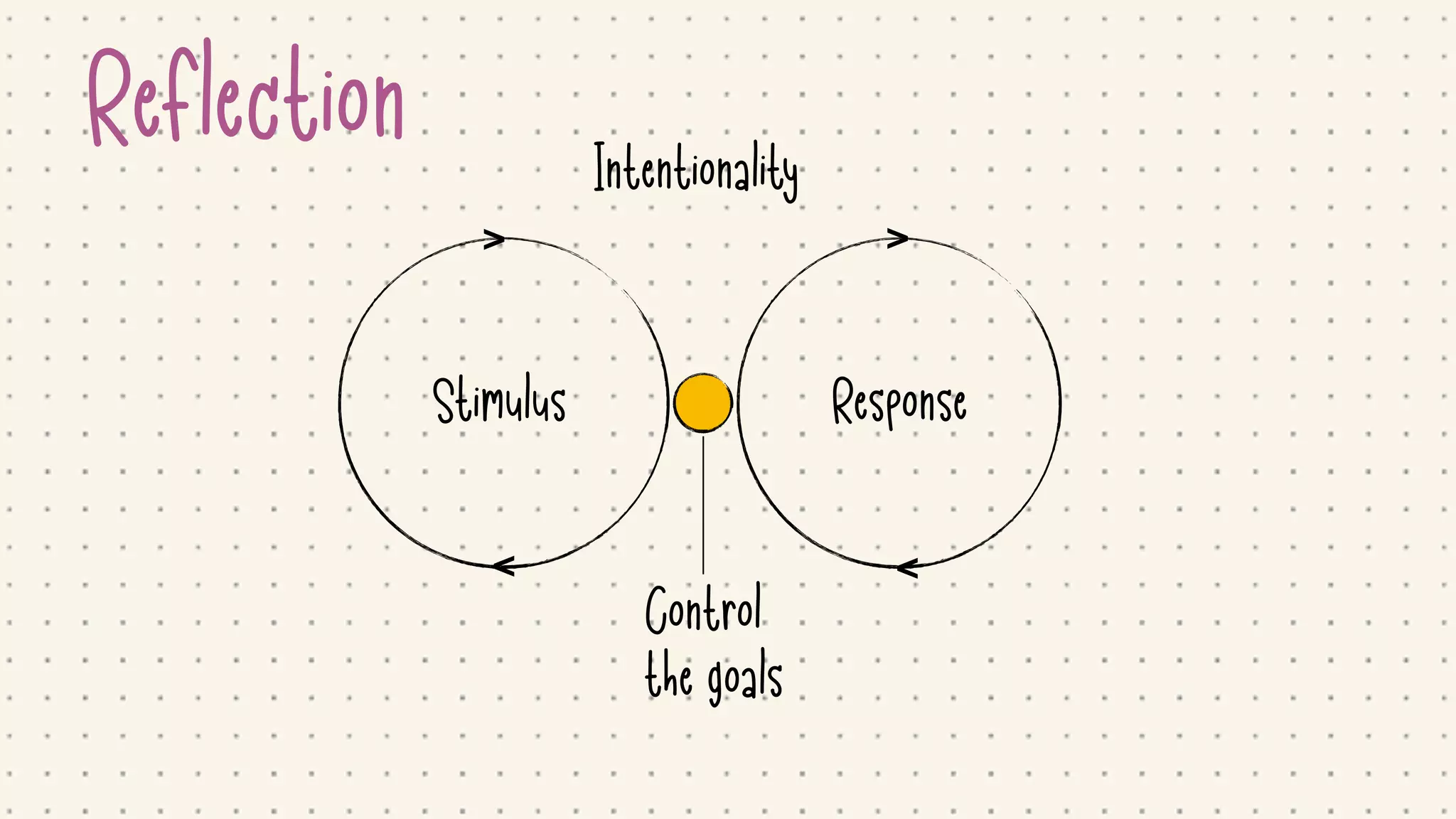
Reflection
Stimulus Response
Control
the goals
>
<
>
<
Intentionality
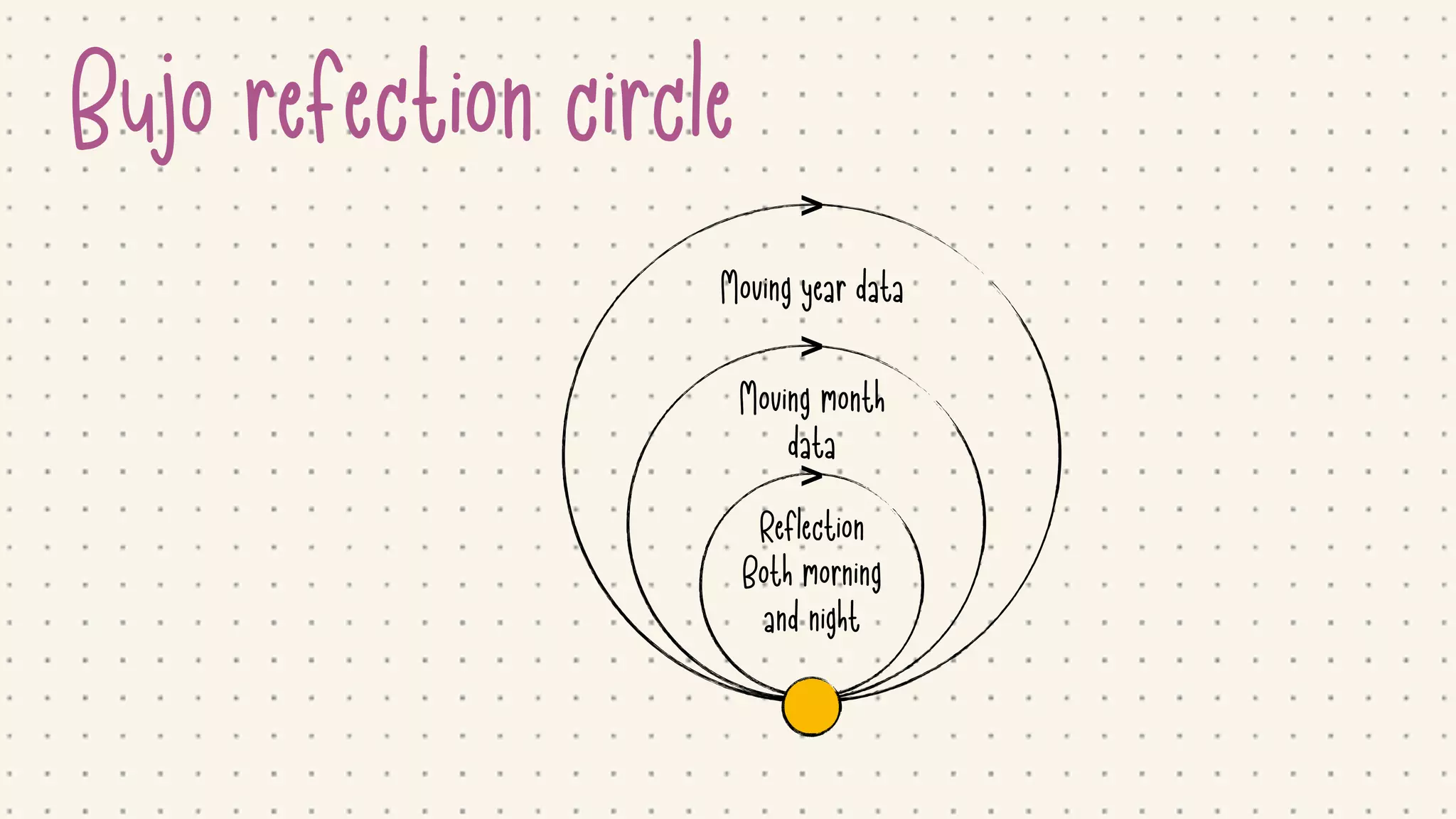
Bujo refection circle
Reflection

Both morning
and night
Moving month
data
Moving year data
>
>
>
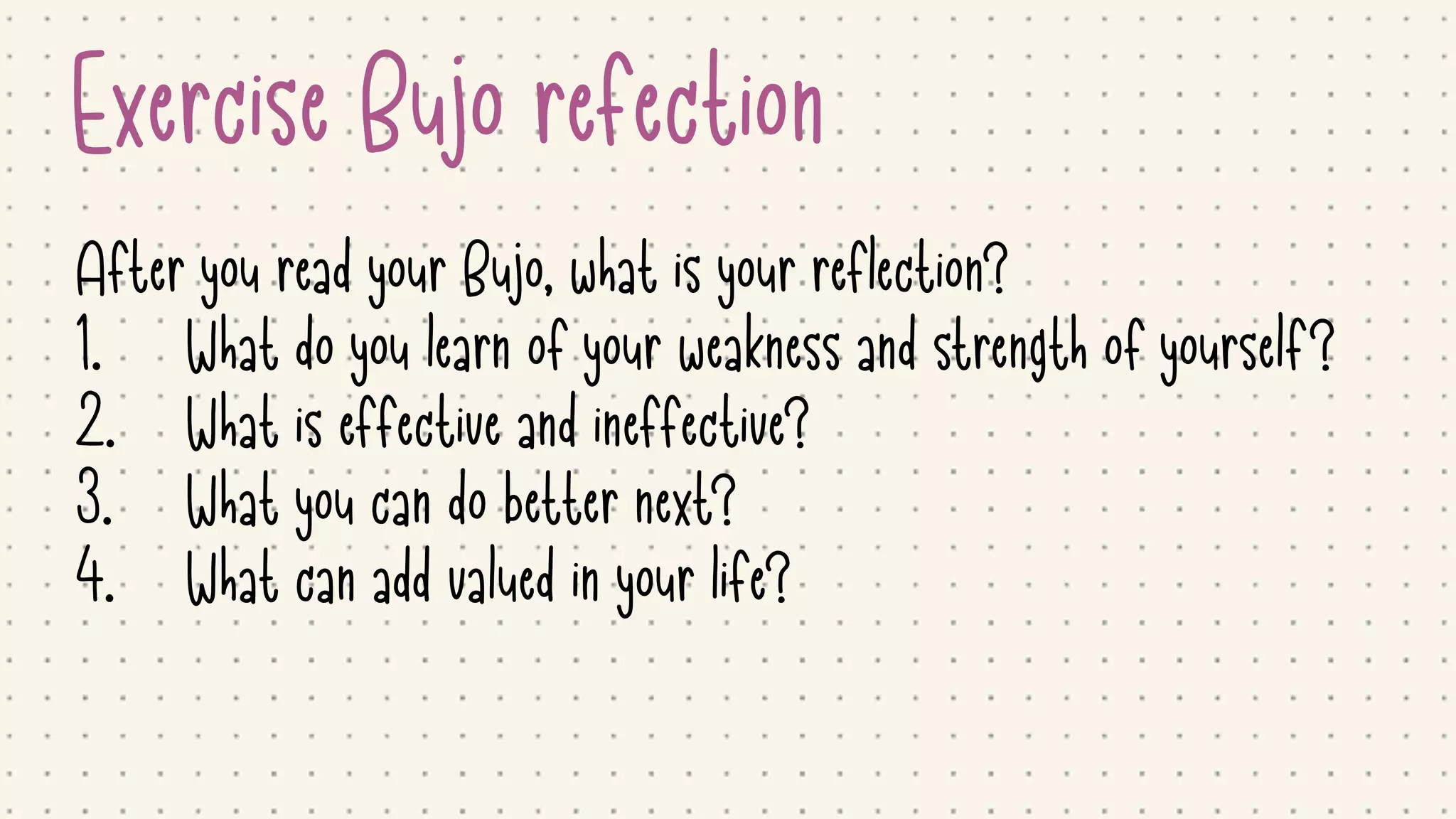
Exercise Bujo refection
After you read your Bujo, what is your reflection?

1. What do you learn of your weakness and strength of yourself?

2. What is effective and ineffective?

3. What you can do better next?

4. What can add valued in your life?
Bullet journal method

Bullet journal method

  • 1.
  • 2.
    Learning outcome • Adaptthe Bullet journal method for planning and reflection
  • 3.
    Rapid logging Rapid Loggingis the language in which the Bullet Journal is written. In short, it’s a way of capturing information as bulleted lists.
  • 4.
    Productivity Mindfulness Intentionality Goals andnot let your life as current Where are we doing right now? Where do we go and direction? How do we deal with the digital current and work?
  • 5.
    Bullet If Rapid Loggingis language the BuJo is written in, Bullets are the syntax. Bullets are short-form sentences paired with symbols that visually categorize your entries into: Tasks, Events, or Notes. Let's break it down...
  • 6.
    Tasks Tasks are representedby a simple dot “•”. We use a dot instead of a checkbox because it's fast, clean, and can easily be transformed to reflect the state of the Task. Tasks can have one of five states:
  • 7.
    Event Events are representedby the open circle “O” Bullet. Events are date- related entries that can either be scheduled (e.g. “Charlie’s birthday”) or logged after they occur (e.g. “signed the lease”).
  • 8.
    Notes Notes are representedwith a dash “–”. Notes include: facts, ideas, thoughts, and observations. They're used to capture information or data you don't want to forget. This Bullet works well for meeting, lecture, or classroom notes.
  • 9.
    Mix & Match Tasks, Events,and Notes will help you quickly capture your thoughts as they bubble up throughout the day. Don't worry about logging them in any particular order. The important thing is to get them out of your head, and onto the page.
  • 10.
    Signifiers * = Priority: Usedto mark the most important things on your list. Use it sparingly. If everything is a priority, nothing is. ! = Inspiration: Great ideas, personal mantras, and genius insights will never be misplaced again!
  • 12.
    Putting it together •Topic clarifies the purpose of the page and nature of its contents. In this example, it's simply the day's date. • Page numbers will serve to locate your content.  • Daily Log. It's the workhorse of the Bullet Journal, and one of the four main Collections.
  • 13.
    Key components • Index •Future log • Monthly log • Daily log • Collections
  • 14.
    The Index • TheIndex lives at the front of your notebook. • Simply add the Topics of your Collections and their page numbers to the Index
  • 15.
    The Future Log •This Collection is used to store dated entries that will occur outside the current month. Provided is a simple six month template. • The Future Log serves as your time machine, allowing you to glimpse the outlines of the future you're actively working towards.
  • 16.
    Monthly Log • ThisCollection is used to store dated entries that will occur outside the current month. Provided is a simple six month template. • The Future Log serves as your time machine, allowing you to glimpse the outlines of the future you're actively working towards.
  • 17.
    Daily Log • TheCalendar Page is designed to provide a birdseye view of the month. You can use it to schedule Events and Tasks, record Events after they happen, or both. • The Task page is designed to help you take a monthly mental inventory: What are the priorities for the month? What remains undone from last month? What matters now? Get it off your mind, and list it here.
  • 18.
    1. Creating index -Writedown 1-4 page no. -Only the content 2. Future Log -Write down 5-8 page no. -Divide the paper into 6 boxes -Write the name of months -Insert task and future event -Record topic in index 3. Monthly log -Write down 9-10 page no. -Write down day 1 - end of month -Write down date -Put page no. 9 4. Daily Log -Insert page no. -Using the date as topic -Write down the task on that day -No need to record the daily log in Index
  • 19.
    Exercise : Intentionality Theroad not taken The path that every one takes - No risk, familiar, easy, no investment The path that less people walk - New, unfamiliar, challenge, investment - Think about the end of this path in term of personality and work. What is the result of this?
  • 20.
    Exercise : Intentionality Using5 mins to write the mourning word for your death for each path. Then build 2 types of collections and place on the Index page. Please think carefully and be true for yourself.
  • 21.
    Exercise : Intentionality Readyour mourning word and write a letter to yourself. Try to transfer your emotion, feeling and question both good and bad during this practice.
  • 22.
    Exercise 5 43 2 1 1. Write down your target of 5 years, 4 months, 3 weeks, 2 days, 1 hour 2. Priority the first one with * 5 years • Having family • Having home and land • Expertise in another language 4 Months • Traveling Europe • Weight loss 5 kg. 3 Weeks • Donate clothes • Work as volunteer 2 Days • Arrange my closet • Cleaning the kitchen • Extend my driver license 1 hour • Cleaning the refrigerator • Call my dad and mom • Booking dinner for my girlfriend * * * * * Long term target Medium target Short target
  • 23.
  • 24.
    Bujo refection circle Reflection Bothmorning and night Moving month data Moving year data > > >
  • 25.
    Exercise Bujo refection Afteryou read your Bujo, what is your reflection? 1. What do you learn of your weakness and strength of yourself? 2. What is effective and ineffective? 3. What you can do better next? 4. What can add valued in your life?