KLEINFELDER CONFIDENTIAL
Monitoring and Reporting Landscape
Condition on Defence Lands
Jim Nikolareas, Richard Thackway &
Chelayne Evans
14 February 2018
Defence Industry Conference 2018, Canberra
KLEINFELDER CONFIDENTIAL
• Definitions and concepts
• A nationally consistent method for monitoring and
reporting landscape condition at an operational scale
• A case study: Kapooka Military Area
• Discussion
• Conclusions
Outline
KLEINFELDER CONFIDENTIAL
Definitions and Concepts
KLEINFELDER CONFIDENTIAL
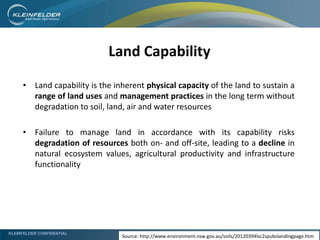
• Land capability is the inherent physical capacity of the land to sustain a
range of land uses and management practices in the long term without
degradation to soil, land, air and water resources
• Failure to manage land in accordance with its capability risks
degradation of resources both on- and off-site, leading to a decline in
natural ecosystem values, agricultural productivity and infrastructure
functionality
Land Capability
Source: http://www.environment.nsw.gov.au/soils/20120394lsc2spubslandingpage.htm
KLEINFELDER CONFIDENTIAL
Landscape Modification
• Landscape modification is an assessment of change in ecological
condition function caused by the effects of land management over time
• Change and trend can be assessed relative to a reference state
Source: VAST Framework http://www.mdpi.com/2073-445X/5/4/40
KLEINFELDER CONFIDENTIAL
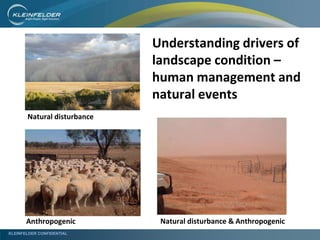
Natural disturbance
Anthropogenic Natural disturbance & Anthropogenic
Understanding drivers of
landscape condition –
human management and
natural events
KLEINFELDER CONFIDENTIAL
Land use and management practices influence
ecological function
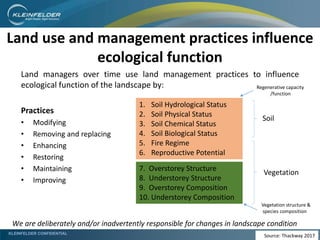
Land managers over time use land management practices to influence
ecological function of the landscape by:
Practices
• Modifying
• Removing and replacing
• Enhancing
• Restoring
• Maintaining
• Improving
We are deliberately and/or inadvertently responsible for changes in landscape condition
Source: Thackway 2017
1. Soil Hydrological Status
2. Soil Physical Status
3. Soil Chemical Status
4. Soil Biological Status
5. Fire Regime
6. Reproductive Potential
7. Overstorey Structure
8. Understorey Structure
9. Overstorey Composition
10. Understorey Composition
Soil
Vegetation
Regenerative capacity
/function
Vegetation structure &
species composition
KLEINFELDER CONFIDENTIAL
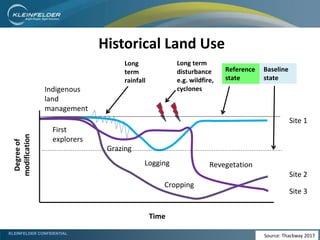
Historical Land Use
Indigenous
land
management
First
explorers
Degreeof
modification
Logging
Cropping
Site 1
Site 2
Site 3
Time
Reference
state
Long
term
rainfall
Long term
disturbance
e.g. wildfire,
cyclones
Revegetation
Baseline
state
Grazing
Source: Thackway 2017
KLEINFELDER CONFIDENTIAL
A nationally
consistent method for assessing
Landscape Condition
KLEINFELDER CONFIDENTIAL
Methodology
• Mapping Landscape Capability
• Mapping Landscape Modification
• Landscape Management Units
• Satellite-based Remote Sensing
• Response Criteria and Indicators
KLEINFELDER CONFIDENTIAL
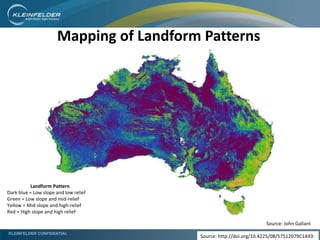
Mapping of Landform Patterns
Landform Pattern
Dark blue = Low slope and low relief
Green = Low slope and mid-relief
Yellow = Mid-slope and high-relief
Red = High slope and high relief
Source: http://doi.org/10.4225/08/57512079C1A93:
Source: John Gallant
KLEINFELDER CONFIDENTIAL
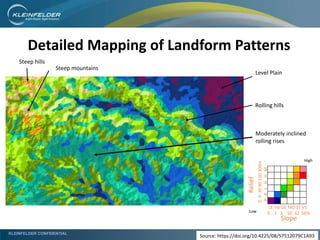
Detailed Mapping of Landform Patterns
Source: https://doi.org/10.4225/08/57512079C1A93
Relief
Slope
LE VG GE MO ST VS
0 1 3 10 32 56%
093090150300m
PRLHHM
Level Plain
Moderately inclined
rolling rises
Steep mountains
Steep hills
Rolling hills
Low
High
KLEINFELDER CONFIDENTIAL
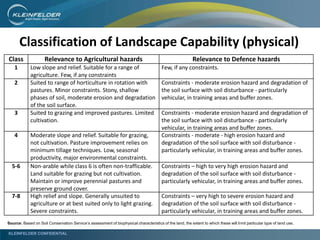
Class Relevance to Agricultural hazards Relevance to Defence hazards
1 Low slope and relief. Suitable for a range of
agriculture. Few, if any constraints
Few, if any constraints.
2 Suited to range of horticulture in rotation with
pastures. Minor constraints. Stony, shallow
phases of soil, moderate erosion and degradation
of the soil surface.
Constraints - moderate erosion hazard and degradation of
the soil surface with soil disturbance - particularly
vehicular, in training areas and buffer zones.
3 Suited to grazing and improved pastures. Limited
cultivation.
Constraints - moderate erosion hazard and degradation of
the soil surface with soil disturbance - particularly
vehicular, in training areas and buffer zones.
4 Moderate slope and relief. Suitable for grazing,
not cultivation. Pasture improvement relies on
minimum tillage techniques. Low, seasonal
productivity, major environmental constraints.
Constraints - moderate - high erosion hazard and
degradation of the soil surface with soil disturbance -
particularly vehicular, in training areas and buffer zones.
5-6 Non-arable while class 6 is often non-trafficable.
Land suitable for grazing but not cultivation.
Maintain or improve perennial pastures and
preserve ground cover.
Constraints – high to very high erosion hazard and
degradation of the soil surface with soil disturbance -
particularly vehicular, in training areas and buffer zones.
7-8 High relief and slope. Generally unsuited to
agriculture or at best suited only to light grazing.
Severe constraints.
Constraints – very high to severe erosion hazard and
degradation of the soil surface with soil disturbance -
particularly vehicular, in training areas and buffer zones.
Source: Based on Soil Conservation Service’s assessment of biophysical characteristics of the land, the extent to which these will limit particular type of land use.
Classification of Landscape Capability (physical)
KLEINFELDER CONFIDENTIAL
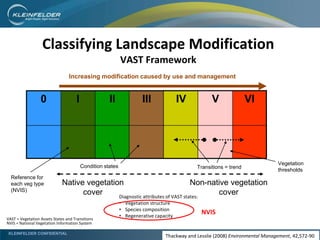
VAST = Vegetation Assets States and Transitions
NVIS = National Vegetation Information System
VIVIVIIIIII0
Native vegetation
cover
Non-native vegetation
cover
Increasing modification caused by use and management
Transitions = trend
Vegetation
thresholds
Reference for
each veg type
(NVIS)
Classifying Landscape Modification
VAST Framework
Condition states
Diagnostic attributes of VAST states:
• Vegetation structure
• Species composition
• Regenerative capacity
NVIS
Thackway and Lesslie (2008) Environmental Management, 42,572-90
KLEINFELDER CONFIDENTIAL
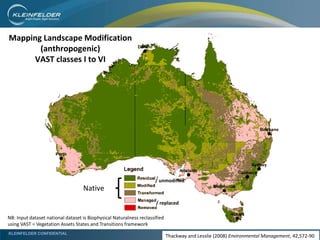
NB: Input dataset national dataset is Biophysical Naturalness reclassified
using VAST = Vegetation Assets States and Transitions framework
/ replaced
/ unmodified
Native
Mapping Landscape Modification
(anthropogenic)
VAST classes I to VI
Thackway and Lesslie (2008) Environmental Management, 42,572-90
KLEINFELDER CONFIDENTIAL
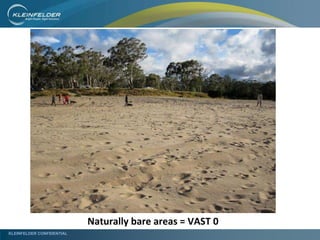
Naturally bare areas = VAST 0
KLEINFELDER CONFIDENTIAL
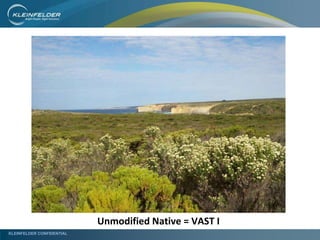
Unmodified Native = VAST I
KLEINFELDER CONFIDENTIAL
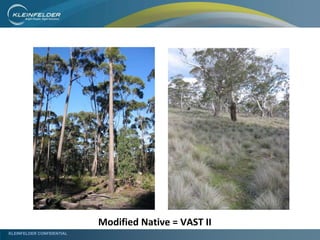
Modified Native = VAST II
KLEINFELDER CONFIDENTIAL
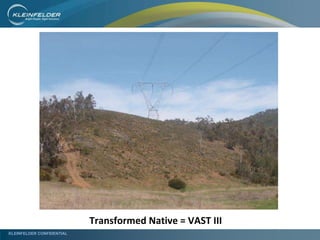
Transformed Native = VAST III
KLEINFELDER CONFIDENTIAL
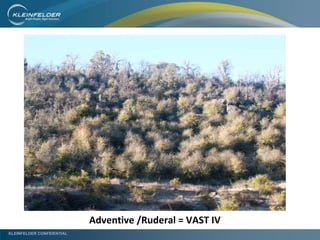
Adventive /Ruderal = VAST IV
KLEINFELDER CONFIDENTIAL
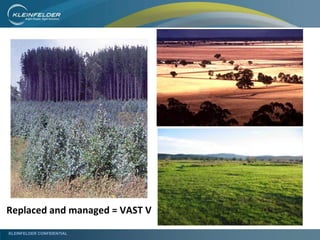
Replaced and managed = VAST V
KLEINFELDER CONFIDENTIAL
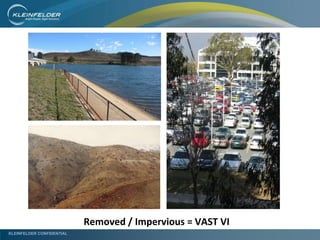
Removed / Impervious = VAST VI
KLEINFELDER CONFIDENTIAL
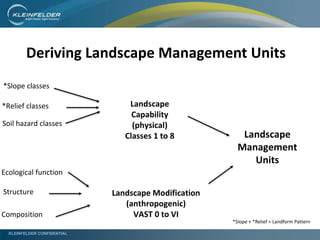
Landscape
Capability
(physical)
Classes 1 to 8
*Slope classes
*Relief classes
Soil hazard classes
Landscape Modification
(anthropogenic)
VAST 0 to VI
Ecological function
Structure
Composition
Landscape
Management
Units
Deriving Landscape Management Units
*Slope + *Relief = Landform Pattern
KLEINFELDER CONFIDENTIAL
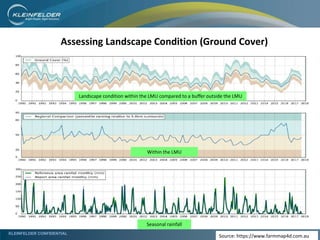
Assessing Landscape Condition (Ground Cover)
Within the LMU
Landscape condition within the LMU compared to a buffer outside the LMU
Seasonal rainfall
Source: https://www.farmmap4d.com.au/
KLEINFELDER CONFIDENTIAL
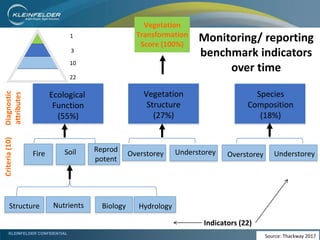
1
3
10
22
Diagnostic
attributes
Vegetation
Transformation
Score (100%)
Criteria(10)
Vegetation
Structure
(27%)
Overstorey Understorey
Species
Composition
(18%)
UnderstoreyOverstorey
Ecological
Function
(55%)
Fire
Reprod
potent
Soil
HydrologyBiologyNutrientsStructure
Indicators (22)
Monitoring/ reporting
benchmark indicators
over time
Source: Thackway 2017
KLEINFELDER CONFIDENTIAL
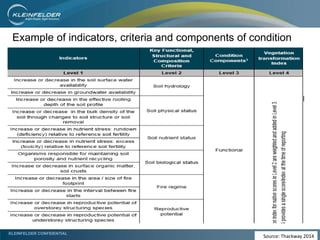
Example of indicators, criteria and components of condition
Source: Thackway 2014
KLEINFELDER CONFIDENTIAL
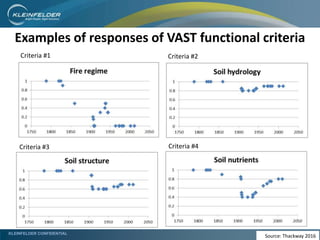
Examples of responses of VAST functional criteria
Criteria #1 Criteria #2
Criteria #3 Criteria #4
Source: Thackway 2016
KLEINFELDER CONFIDENTIAL
Case study: Kapooka Military Area
KLEINFELDER CONFIDENTIAL
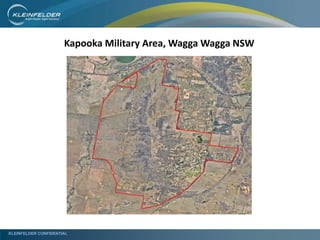
Kapooka Military Area, Wagga Wagga NSW
KLEINFELDER CONFIDENTIAL
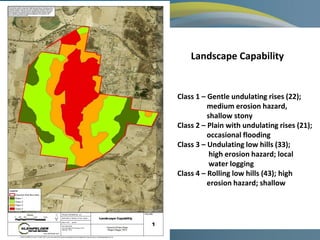
Class 1 – Gentle undulating rises (22);
medium erosion hazard,
shallow stony
Class 2 – Plain with undulating rises (21);
occasional flooding
Class 3 – Undulating low hills (33);
high erosion hazard; local
water logging
Class 4 – Rolling low hills (43); high
erosion hazard; shallow
Landscape Capability
KLEINFELDER CONFIDENTIAL
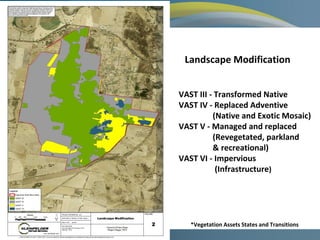
VAST III - Transformed Native
VAST IV - Replaced Adventive
(Native and Exotic Mosaic)
VAST V - Managed and replaced
(Revegetated, parkland
& recreational)
VAST VI - Impervious
(Infrastructure)
Landscape Modification
*Vegetation Assets States and Transitions
KLEINFELDER CONFIDENTIAL
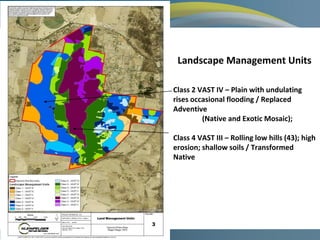
Landscape Management Units
Class 2 VAST IV – Plain with undulating
rises occasional flooding / Replaced
Adventive
(Native and Exotic Mosaic);
Class 4 VAST III – Rolling low hills (43); high
erosion; shallow soils / Transformed
Native
KLEINFELDER CONFIDENTIAL
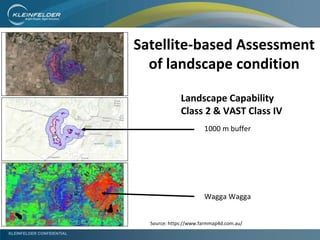
Landscape Capability
Class 2 & VAST Class IV
Wagga Wagga
Satellite-based Assessment
of landscape condition
1000 m buffer
Source: https://www.farmmap4d.com.au/
KLEINFELDER CONFIDENTIAL
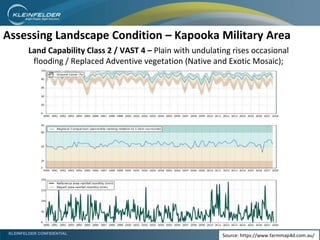
Assessing Landscape Condition – Kapooka Military Area
Land Capability Class 2 / VAST 4 – Plain with undulating rises occasional
flooding / Replaced Adventive vegetation (Native and Exotic Mosaic);
Source: https://www.farmmap4d.com.au/
KLEINFELDER CONFIDENTIAL
Discussion
KLEINFELDER CONFIDENTIAL
Transformationscore
Years
1800
2016
Reference
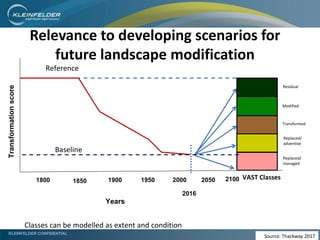
Relevance to developing scenarios for
future landscape modification
Modified
Transformed
Replaced/
managed
Residual
Replaced/
adventive
VAST Classes1850 19501900 2000 2050 2100
Classes can be modelled as extent and condition
Baseline
Source: Thackway 2017
KLEINFELDER CONFIDENTIAL
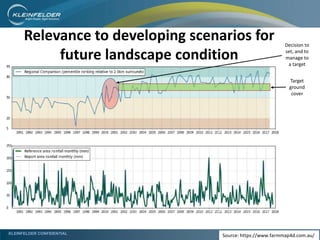
Relevance to developing scenarios for
future landscape condition
Decision to
set, and to
manage to
a target
Target
ground
cover
Source: https://www.farmmap4d.com.au/
KLEINFELDER CONFIDENTIAL
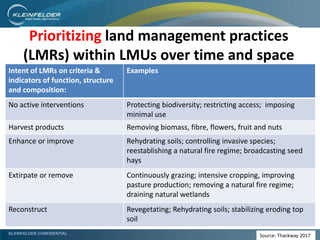
Intent of LMRs on criteria &
indicators of function, structure
and composition:
Examples
No active interventions Protecting biodiversity; restricting access; imposing
minimal use
Harvest products Removing biomass, fibre, flowers, fruit and nuts
Enhance or improve Rehydrating soils; controlling invasive species;
reestablishing a natural fire regime; broadcasting seed
hays
Extirpate or remove Continuously grazing; intensive cropping, improving
pasture production; removing a natural fire regime;
draining natural wetlands
Reconstruct Revegetating; Rehydrating soils; stabilizing eroding top
soil
Prioritizing land management practices
(LMRs) within LMUs over time and space
Source: Thackway 2017
KLEINFELDER CONFIDENTIAL
Conclusions
• Monitoring and reporting landscape condition methodology can be applied on any
Defence property at an operation level.
• This integrated reporting will enable and provide cutting-edge monitoring and
evaluation.
• Changes and trends in landscape condition can help decision makers understand drivers
of change - human management and natural events
• Continuous monitoring and reporting of landscape condition (ground cover) linked to
direct site-based measures can assist land managers prioritise and adjust on-ground
interventions.
• The application of landscape condition assessment provides a measureable threshold
for land managers to make more informed decisions surrounding their land
management practices, and to maintain Defence land that is fit for purpose.
• Landscape condition is not a replacement for detailed biodiversity-based monitoring
and reporting.
KLEINFELDER CONFIDENTIAL
More information
http://www.kleinfelder.com.au/
http://www.farmmap4d.com.au/
http://www.vasttransformations.com/
http://portal.tern.org.au/#/9f6d265e
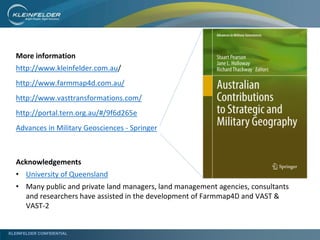
Advances in Military Geosciences - Springer
Acknowledgements
• University of Queensland
• Many public and private land managers, land management agencies, consultants
and researchers have assisted in the development of Farmmap4D and VAST &
VAST-2

Monitoring and Reporting Landscape Condition on Defence Lands

  • 1.
    KLEINFELDER CONFIDENTIAL Monitoring andReporting Landscape Condition on Defence Lands Jim Nikolareas, Richard Thackway & Chelayne Evans 14 February 2018 Defence Industry Conference 2018, Canberra
  • 2.
    KLEINFELDER CONFIDENTIAL • Definitionsand concepts • A nationally consistent method for monitoring and reporting landscape condition at an operational scale • A case study: Kapooka Military Area • Discussion • Conclusions Outline
  • 3.
  • 4.
    KLEINFELDER CONFIDENTIAL • Landcapability is the inherent physical capacity of the land to sustain a range of land uses and management practices in the long term without degradation to soil, land, air and water resources • Failure to manage land in accordance with its capability risks degradation of resources both on- and off-site, leading to a decline in natural ecosystem values, agricultural productivity and infrastructure functionality Land Capability Source: http://www.environment.nsw.gov.au/soils/20120394lsc2spubslandingpage.htm
  • 5.
    KLEINFELDER CONFIDENTIAL Landscape Modification •Landscape modification is an assessment of change in ecological condition function caused by the effects of land management over time • Change and trend can be assessed relative to a reference state Source: VAST Framework http://www.mdpi.com/2073-445X/5/4/40
  • 6.
    KLEINFELDER CONFIDENTIAL Natural disturbance AnthropogenicNatural disturbance & Anthropogenic Understanding drivers of landscape condition – human management and natural events
  • 7.
    KLEINFELDER CONFIDENTIAL Land useand management practices influence ecological function Land managers over time use land management practices to influence ecological function of the landscape by: Practices • Modifying • Removing and replacing • Enhancing • Restoring • Maintaining • Improving We are deliberately and/or inadvertently responsible for changes in landscape condition Source: Thackway 2017 1. Soil Hydrological Status 2. Soil Physical Status 3. Soil Chemical Status 4. Soil Biological Status 5. Fire Regime 6. Reproductive Potential 7. Overstorey Structure 8. Understorey Structure 9. Overstorey Composition 10. Understorey Composition Soil Vegetation Regenerative capacity /function Vegetation structure & species composition
  • 8.
    KLEINFELDER CONFIDENTIAL Historical LandUse Indigenous land management First explorers Degreeof modification Logging Cropping Site 1 Site 2 Site 3 Time Reference state Long term rainfall Long term disturbance e.g. wildfire, cyclones Revegetation Baseline state Grazing Source: Thackway 2017
  • 9.
    KLEINFELDER CONFIDENTIAL A nationally consistentmethod for assessing Landscape Condition
  • 10.
    KLEINFELDER CONFIDENTIAL Methodology • MappingLandscape Capability • Mapping Landscape Modification • Landscape Management Units • Satellite-based Remote Sensing • Response Criteria and Indicators
  • 11.
    KLEINFELDER CONFIDENTIAL Mapping ofLandform Patterns Landform Pattern Dark blue = Low slope and low relief Green = Low slope and mid-relief Yellow = Mid-slope and high-relief Red = High slope and high relief Source: http://doi.org/10.4225/08/57512079C1A93: Source: John Gallant
  • 12.
    KLEINFELDER CONFIDENTIAL Detailed Mappingof Landform Patterns Source: https://doi.org/10.4225/08/57512079C1A93 Relief Slope LE VG GE MO ST VS 0 1 3 10 32 56% 093090150300m PRLHHM Level Plain Moderately inclined rolling rises Steep mountains Steep hills Rolling hills Low High
  • 13.
    KLEINFELDER CONFIDENTIAL Class Relevanceto Agricultural hazards Relevance to Defence hazards 1 Low slope and relief. Suitable for a range of agriculture. Few, if any constraints Few, if any constraints. 2 Suited to range of horticulture in rotation with pastures. Minor constraints. Stony, shallow phases of soil, moderate erosion and degradation of the soil surface. Constraints - moderate erosion hazard and degradation of the soil surface with soil disturbance - particularly vehicular, in training areas and buffer zones. 3 Suited to grazing and improved pastures. Limited cultivation. Constraints - moderate erosion hazard and degradation of the soil surface with soil disturbance - particularly vehicular, in training areas and buffer zones. 4 Moderate slope and relief. Suitable for grazing, not cultivation. Pasture improvement relies on minimum tillage techniques. Low, seasonal productivity, major environmental constraints. Constraints - moderate - high erosion hazard and degradation of the soil surface with soil disturbance - particularly vehicular, in training areas and buffer zones. 5-6 Non-arable while class 6 is often non-trafficable. Land suitable for grazing but not cultivation. Maintain or improve perennial pastures and preserve ground cover. Constraints – high to very high erosion hazard and degradation of the soil surface with soil disturbance - particularly vehicular, in training areas and buffer zones. 7-8 High relief and slope. Generally unsuited to agriculture or at best suited only to light grazing. Severe constraints. Constraints – very high to severe erosion hazard and degradation of the soil surface with soil disturbance - particularly vehicular, in training areas and buffer zones. Source: Based on Soil Conservation Service’s assessment of biophysical characteristics of the land, the extent to which these will limit particular type of land use. Classification of Landscape Capability (physical)
  • 14.
    KLEINFELDER CONFIDENTIAL VAST =Vegetation Assets States and Transitions NVIS = National Vegetation Information System VIVIVIIIIII0 Native vegetation cover Non-native vegetation cover Increasing modification caused by use and management Transitions = trend Vegetation thresholds Reference for each veg type (NVIS) Classifying Landscape Modification VAST Framework Condition states Diagnostic attributes of VAST states: • Vegetation structure • Species composition • Regenerative capacity NVIS Thackway and Lesslie (2008) Environmental Management, 42,572-90
  • 15.
    KLEINFELDER CONFIDENTIAL NB: Inputdataset national dataset is Biophysical Naturalness reclassified using VAST = Vegetation Assets States and Transitions framework / replaced / unmodified Native Mapping Landscape Modification (anthropogenic) VAST classes I to VI Thackway and Lesslie (2008) Environmental Management, 42,572-90
  • 16.
  • 17.
  • 18.
  • 19.
  • 20.
  • 21.
  • 22.
  • 23.
    KLEINFELDER CONFIDENTIAL Landscape Capability (physical) Classes 1to 8 *Slope classes *Relief classes Soil hazard classes Landscape Modification (anthropogenic) VAST 0 to VI Ecological function Structure Composition Landscape Management Units Deriving Landscape Management Units *Slope + *Relief = Landform Pattern
  • 24.
    KLEINFELDER CONFIDENTIAL Assessing LandscapeCondition (Ground Cover) Within the LMU Landscape condition within the LMU compared to a buffer outside the LMU Seasonal rainfall Source: https://www.farmmap4d.com.au/
  • 25.
    KLEINFELDER CONFIDENTIAL 1 3 10 22 Diagnostic attributes Vegetation Transformation Score (100%) Criteria(10) Vegetation Structure (27%) OverstoreyUnderstorey Species Composition (18%) UnderstoreyOverstorey Ecological Function (55%) Fire Reprod potent Soil HydrologyBiologyNutrientsStructure Indicators (22) Monitoring/ reporting benchmark indicators over time Source: Thackway 2017
  • 26.
    KLEINFELDER CONFIDENTIAL Example ofindicators, criteria and components of condition Source: Thackway 2014
  • 27.
    KLEINFELDER CONFIDENTIAL Examples ofresponses of VAST functional criteria Criteria #1 Criteria #2 Criteria #3 Criteria #4 Source: Thackway 2016
  • 28.
  • 29.
  • 30.
    KLEINFELDER CONFIDENTIAL Class 1– Gentle undulating rises (22); medium erosion hazard, shallow stony Class 2 – Plain with undulating rises (21); occasional flooding Class 3 – Undulating low hills (33); high erosion hazard; local water logging Class 4 – Rolling low hills (43); high erosion hazard; shallow Landscape Capability
  • 31.
    KLEINFELDER CONFIDENTIAL VAST III- Transformed Native VAST IV - Replaced Adventive (Native and Exotic Mosaic) VAST V - Managed and replaced (Revegetated, parkland & recreational) VAST VI - Impervious (Infrastructure) Landscape Modification *Vegetation Assets States and Transitions
  • 32.
    KLEINFELDER CONFIDENTIAL Landscape ManagementUnits Class 2 VAST IV – Plain with undulating rises occasional flooding / Replaced Adventive (Native and Exotic Mosaic); Class 4 VAST III – Rolling low hills (43); high erosion; shallow soils / Transformed Native
  • 33.
    KLEINFELDER CONFIDENTIAL Landscape Capability Class2 & VAST Class IV Wagga Wagga Satellite-based Assessment of landscape condition 1000 m buffer Source: https://www.farmmap4d.com.au/
  • 34.
    KLEINFELDER CONFIDENTIAL Assessing LandscapeCondition – Kapooka Military Area Land Capability Class 2 / VAST 4 – Plain with undulating rises occasional flooding / Replaced Adventive vegetation (Native and Exotic Mosaic); Source: https://www.farmmap4d.com.au/
  • 35.
  • 36.
    KLEINFELDER CONFIDENTIAL Transformationscore Years 1800 2016 Reference Relevance todeveloping scenarios for future landscape modification Modified Transformed Replaced/ managed Residual Replaced/ adventive VAST Classes1850 19501900 2000 2050 2100 Classes can be modelled as extent and condition Baseline Source: Thackway 2017
  • 37.
    KLEINFELDER CONFIDENTIAL Relevance todeveloping scenarios for future landscape condition Decision to set, and to manage to a target Target ground cover Source: https://www.farmmap4d.com.au/
  • 38.
    KLEINFELDER CONFIDENTIAL Intent ofLMRs on criteria & indicators of function, structure and composition: Examples No active interventions Protecting biodiversity; restricting access; imposing minimal use Harvest products Removing biomass, fibre, flowers, fruit and nuts Enhance or improve Rehydrating soils; controlling invasive species; reestablishing a natural fire regime; broadcasting seed hays Extirpate or remove Continuously grazing; intensive cropping, improving pasture production; removing a natural fire regime; draining natural wetlands Reconstruct Revegetating; Rehydrating soils; stabilizing eroding top soil Prioritizing land management practices (LMRs) within LMUs over time and space Source: Thackway 2017
  • 39.
    KLEINFELDER CONFIDENTIAL Conclusions • Monitoringand reporting landscape condition methodology can be applied on any Defence property at an operation level. • This integrated reporting will enable and provide cutting-edge monitoring and evaluation. • Changes and trends in landscape condition can help decision makers understand drivers of change - human management and natural events • Continuous monitoring and reporting of landscape condition (ground cover) linked to direct site-based measures can assist land managers prioritise and adjust on-ground interventions. • The application of landscape condition assessment provides a measureable threshold for land managers to make more informed decisions surrounding their land management practices, and to maintain Defence land that is fit for purpose. • Landscape condition is not a replacement for detailed biodiversity-based monitoring and reporting.
  • 40.
    KLEINFELDER CONFIDENTIAL More information http://www.kleinfelder.com.au/ http://www.farmmap4d.com.au/ http://www.vasttransformations.com/ http://portal.tern.org.au/#/9f6d265e Advancesin Military Geosciences - Springer Acknowledgements • University of Queensland • Many public and private land managers, land management agencies, consultants and researchers have assisted in the development of Farmmap4D and VAST & VAST-2