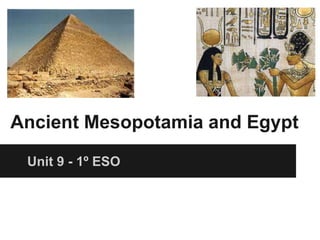
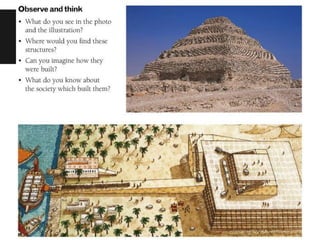
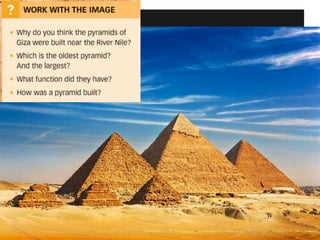



Ancient Mesopotamia and Egypt
Unit 9 - 1º ESO
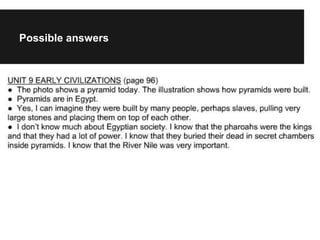
Possible answers
Activity time
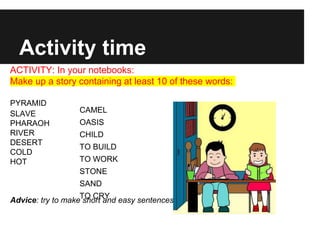
ACTIVITY: In your notebooks:
Make up a story containing at least 10 of these words:
PYRAMID
SLAVE
PHARAOH
RIVER
DESERT
COLD
HOT
Advice: try to make short and easy sentences but correct!
CAMEL
OASIS
CHILD
TO BUILD
TO WORK
STONE
SAND
TO CRY
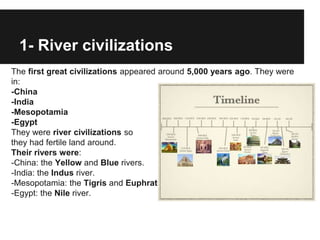
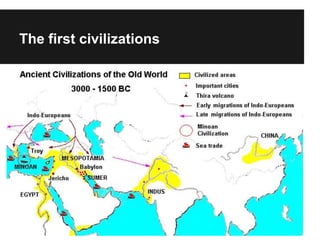
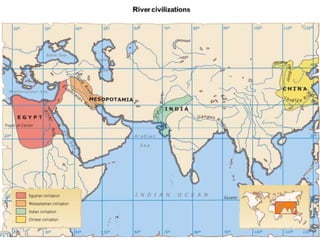
The first great civilizations appeared around 5,000 years ago. They were
in:
-China
-India
-Mesopotamia
-Egypt
They were river civilizations so
they had fertile land around.
Their rivers were:
-China: the Yellow and Blue rivers.
-India: the Indus river.
-Mesopotamia: the Tigris and Euphrates rivers.
-Egypt: the Nile river.
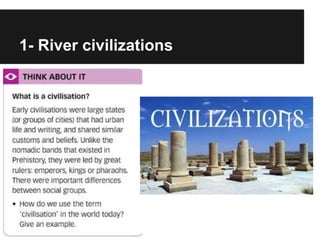
1- River civilizations
The first civilizations
1- River civilizations
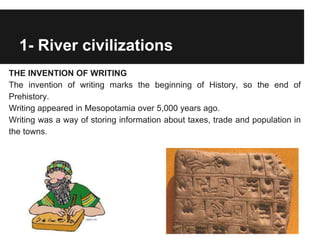
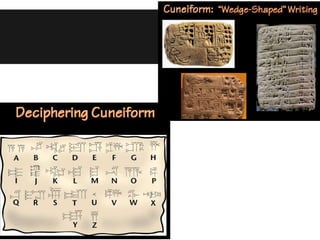
THE INVENTION OF WRITING
The invention of writing marks the beginning of History, so the end of
Prehistory.
Writing appeared in Mesopotamia over 5,000 years ago.
Writing was a way of storing information about taxes, trade and population in
the towns.
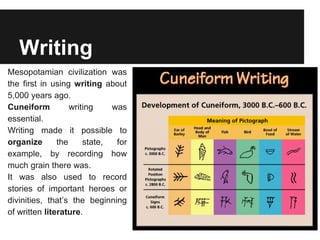
Writing
Mesopotamian civilization was
the first in using writing about
5,000 years ago.
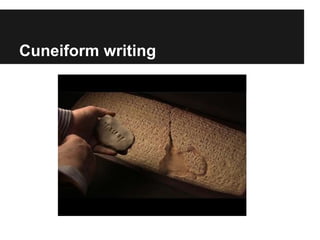
Cuneiform writing was
essential.
Writing made it possible to
organize the state, for
example, by recording how
much grain there was.
It was also used to record
stories of important heroes or
divinities, that’s the beginning
of written literature.
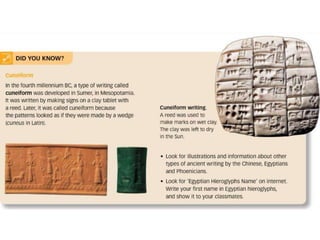
Cuneiform writing
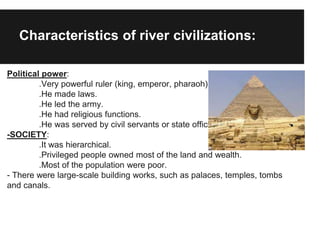
Characteristics of river civilizations:
Political power:
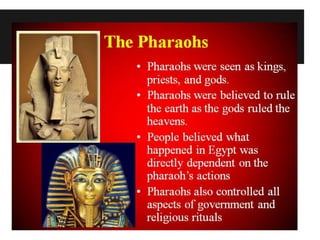
.Very powerful ruler (king, emperor, pharaoh).
.He made laws.
.He led the army.
.He had religious functions.
.He was served by civil servants or state officials.
-SOCIETY:
.It was hierarchical.
.Privileged people owned most of the land and wealth.
.Most of the population were poor.
- There were large-scale building works, such as palaces, temples, tombs
and canals.
Activities
Exercises 1, 2, 3, 5 and 6 on page 145.
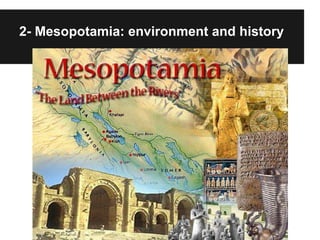
2- Mesopotamia: environment and history
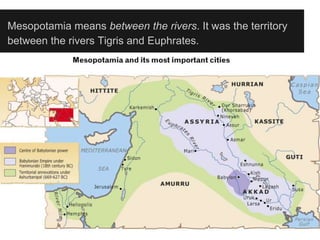
Mesopotamia means between the rivers. It was the territory
between the rivers Tigris and Euphrates.
Mesopotamian first cities
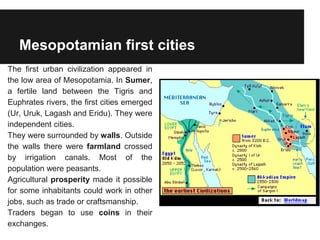
The first urban civilization appeared in
the low area of Mesopotamia. In Sumer,
a fertile land between the Tigris and
Euphrates rivers, the first cities emerged
(Ur, Uruk, Lagash and Eridu). They were
independent cities.
They were surrounded by walls. Outside
the walls there were farmland crossed
by irrigation canals. Most of the
population were peasants.
Agricultural prosperity made it possible
for some inhabitants could work in other
jobs, such as trade or craftsmanship.
Traders began to use coins in their
exchanges.
City-states and empires
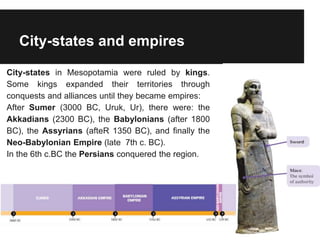
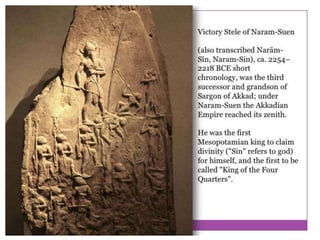
City-states in Mesopotamia were ruled by kings.
Some kings expanded their territories through
conquests and alliances until they became empires:
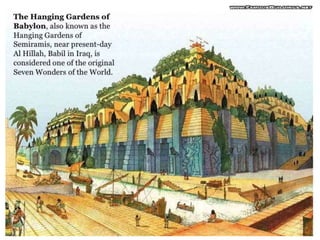
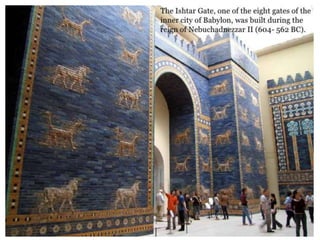
After Sumer (3000 BC, Uruk, Ur), there were: the
Akkadians (2300 BC), the Babylonians (after 1800
BC), the Assyrians (afteR 1350 BC), and finally the
Neo-Babylonian Empire (late 7th c. BC).
In the 6th c.BC the Persians conquered the region.
Activities Full
sentences!!!!
Exercises 1, 2, 5, 6, 7 on page 143.
3- Society and Art in Mesopotamia
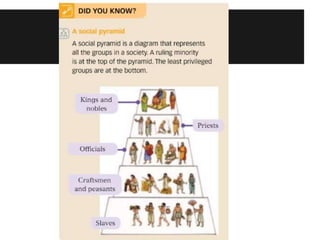
Ancient Mesopotamia had a complex society. It was hierarchical. There were
three social classes: nobility, free citizens, and slaves. The king was in the top.
The nobility or aristocracy included priests, and priest-kings. The priest-kings
were believed to be the representative of the city’s patron God or Goddess. They
lived in temples and were the city's tax collectors. All people of the nobility class
were in charge of maintenance, construction, and organization of the canals. It
included also the family of the king.
The free people class was a combination of a modern day middle and lower
classes: merchants, craftsmen, and anyone who was involved in trade. They lived
in the city. Farmers, fishermen, shepherds, and hunters made up the lower class.
These people lived on the outskirts of the city and were responsible for the food
supply.
The slave class was the lowest class, made up of prisoners of war, and these
slaves could be bought or sold. The slaves were allowed to marry and have a family
if they wished.
Women in Mesopotamia.
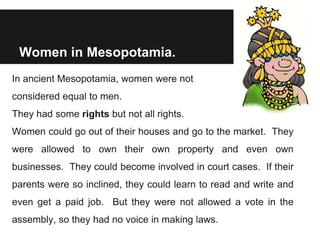
In ancient Mesopotamia, women were not
considered equal to men.
They had some rights but not all rights.
Women could go out of their houses and go to the market. They
were allowed to own their own property and even own
businesses. They could become involved in court cases. If their
parents were so inclined, they could learn to read and write and
even get a paid job. But they were not allowed a vote in the
assembly, so they had no voice in making laws.
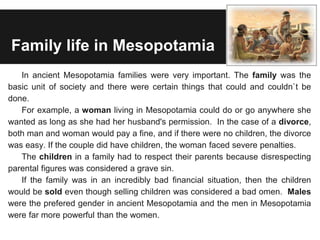
Family life in Mesopotamia
In ancient Mesopotamia families were very important. The family was the
basic unit of society and there were certain things that could and couldn`t be
done.
For example, a woman living in Mesopotamia could do or go anywhere she
wanted as long as she had her husband's permission. In the case of a divorce,
both man and woman would pay a fine, and if there were no children, the divorce
was easy. If the couple did have children, the woman faced severe penalties.
The children in a family had to respect their parents because disrespecting
parental figures was considered a grave sin.
If the family was in an incredibly bad financial situation, then the children
would be sold even though selling children was considered a bad omen. Males
were the prefered gender in ancient Mesopotamia and the men in Mesopotamia
were far more powerful than the women.
Activities
Exercises 1 to 3 on page 144.
What was Mesopotamian
culture like?
Religion and Food
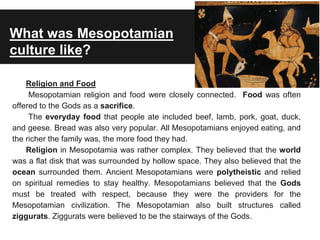
Mesopotamian religion and food were closely connected. Food was often
offered to the Gods as a sacrifice.
The everyday food that people ate included beef, lamb, pork, goat, duck,
and geese. Bread was also very popular. All Mesopotamians enjoyed eating, and
the richer the family was, the more food they had.
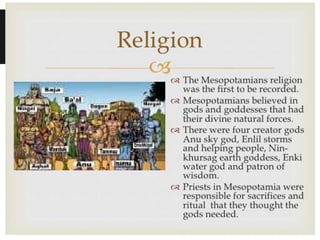
Religion in Mesopotamia was rather complex. They believed that the world
was a flat disk that was surrounded by hollow space. They also believed that the
ocean surrounded them. Ancient Mesopotamians were polytheistic and relied
on spiritual remedies to stay healthy. Mesopotamians believed that the Gods
must be treated with respect, because they were the providers for the
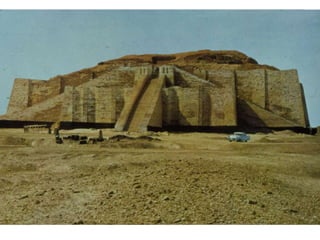
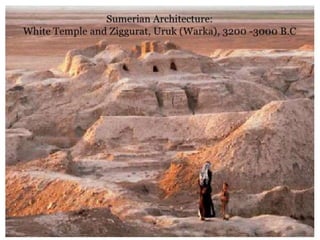
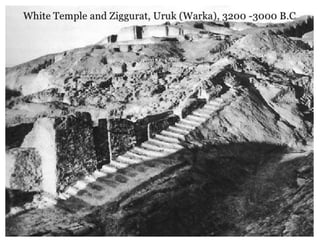
Mesopotamian civilization. The Mesopotamian also built structures called
ziggurats. Ziggurats were believed to be the stairways of the Gods.
Religion in Mesopotamia
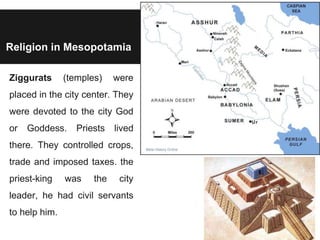
Ziggurats (temples) were
placed in the city center. They
were devoted to the city God
or Goddess. Priests lived
there. They controlled crops,
trade and imposed taxes. the
priest-king was the city
leader, he had civil servants
to help him.
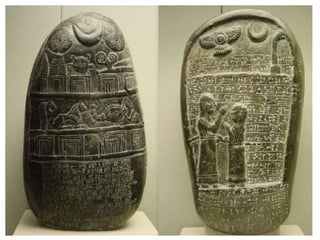
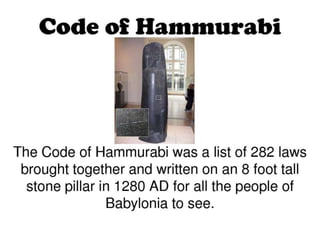
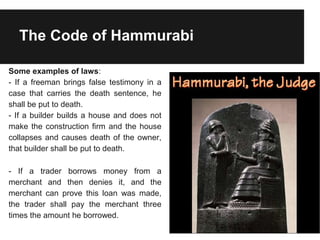
The Code of Hammurabi
Some examples of laws:
- If a freeman brings false testimony in a
case that carries the death sentence, he
shall be put to death.
- If a builder builds a house and does not
make the construction firm and the house
collapses and causes death of the owner,
that builder shall be put to death.
- If a trader borrows money from a
merchant and then denies it, and the
merchant can prove this loan was made,
the trader shall pay the merchant three
times the amount he borrowed.
Homework
Summary of the Mesopotamian civilization
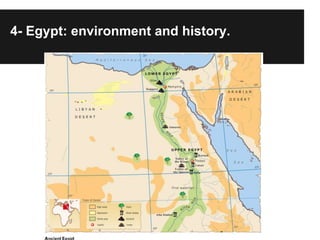
4- Egypt: environment and history.
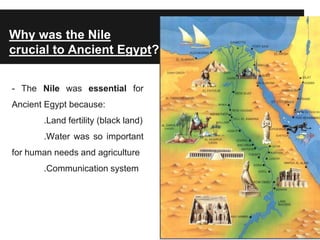
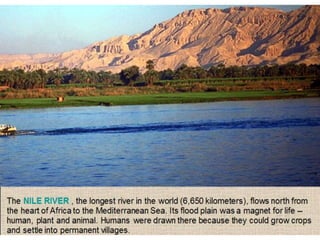
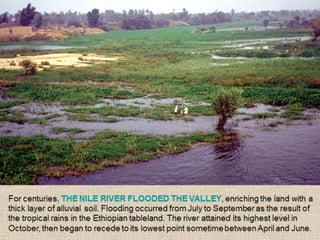
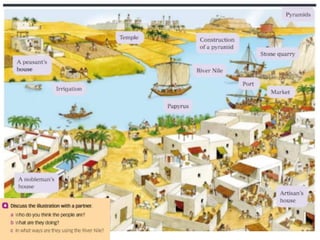
Why was the Nile
crucial to Ancient Egypt?
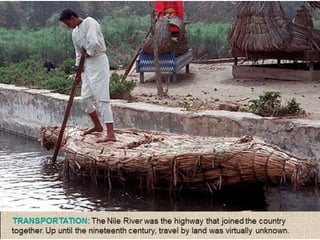
- The Nile was essential for
Ancient Egypt because:
.Land fertility (black land)
.Water was so important
for human needs and agriculture
.Communication system
Homework
Exercises 1 and 3 on page 146-7.
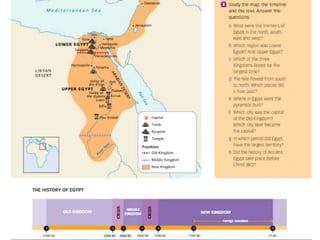
The history of Egypt
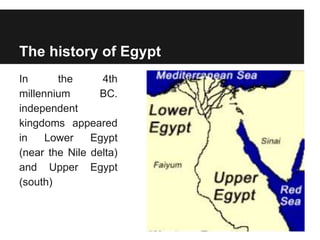
In the 4th
millennium BC.
independent
kingdoms appeared
in Lower Egypt
(near the Nile delta)
and Upper Egypt
(south)
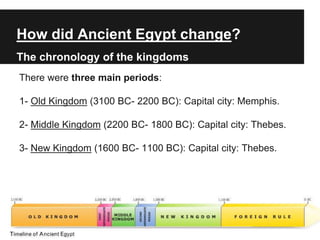
How did Ancient Egypt change?
The chronology of the kingdoms
There were three main periods:
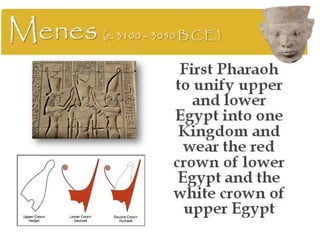
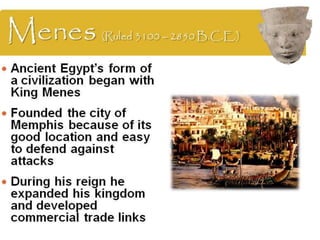
1- Old Kingdom (3100 BC- 2200 BC): Capital city: Memphis.
2- Middle Kingdom (2200 BC- 1800 BC): Capital city: Thebes.
3- New Kingdom (1600 BC- 1100 BC): Capital city: Thebes.
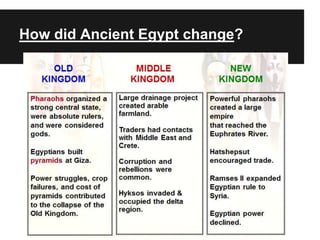
How did Ancient Egypt change?
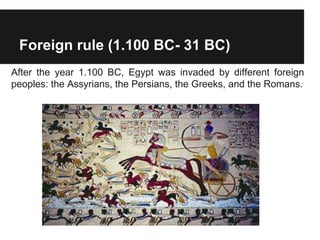
Foreign rule (1.100 BC- 31 BC)
After the year 1.100 BC, Egypt was invaded by different foreign
peoples: the Assyrians, the Persians, the Greeks, and the Romans.
Activities
Exercises 4, 5 and 6 on page 147.
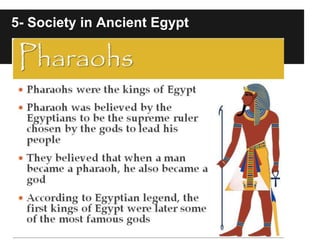
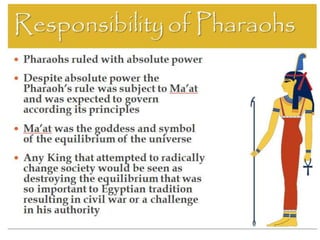
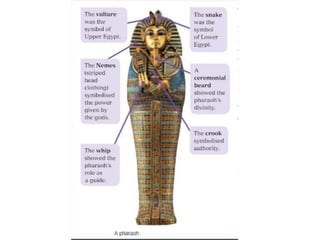
5- Society in Ancient Egypt
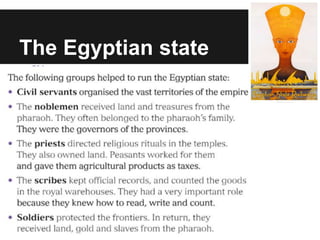
The Egyptian state
Activities
Exercises 1 and 2 page 148.
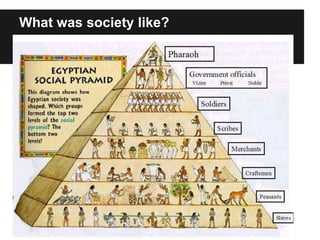
What was society like?
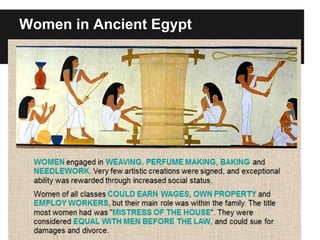
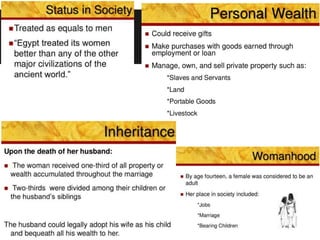
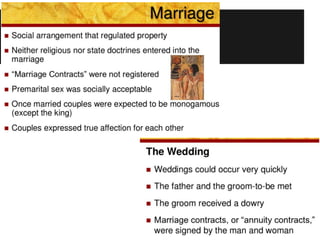
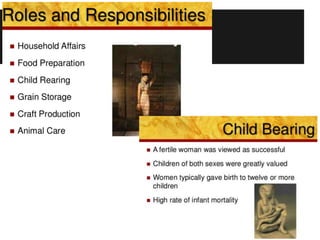
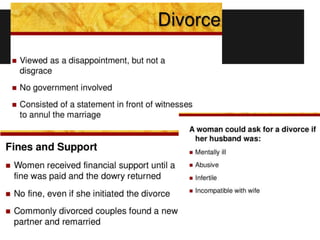
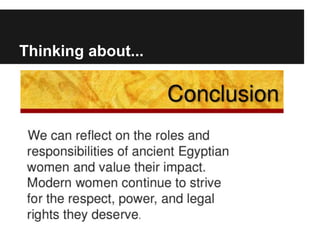
Women in Ancient Egypt
Thinking about...
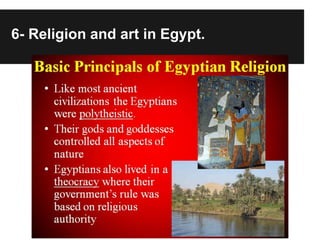
6- Religion and art in Egypt.
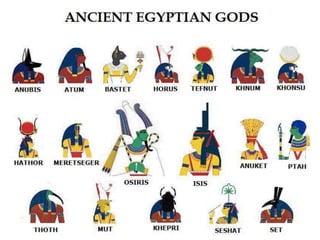
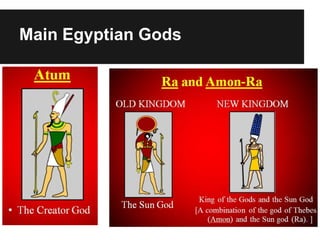
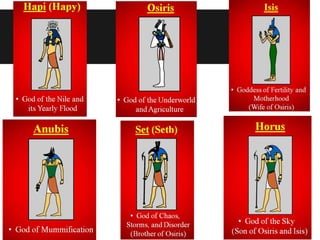
Main Egyptian Gods
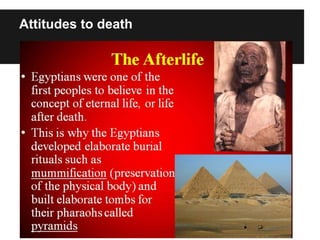
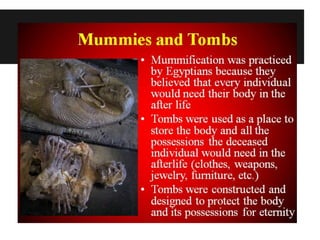
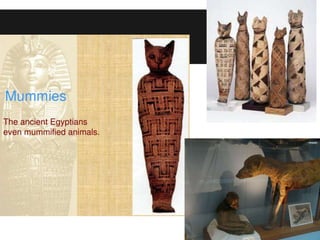
Attitudes to death
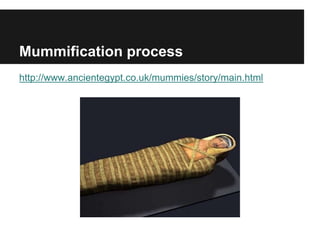
Mummification process
http://www.ancientegypt.co.uk/mummies/story/main.html
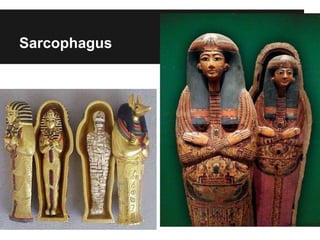
Sarcophagus
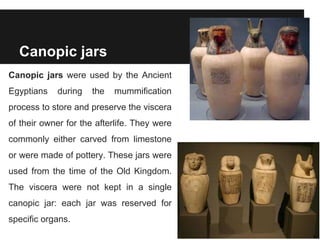
Canopic jars
Canopic jars were used by the Ancient
Egyptians during the mummification
process to store and preserve the viscera
of their owner for the afterlife. They were
commonly either carved from limestone
or were made of pottery. These jars were
used from the time of the Old Kingdom.
The viscera were not kept in a single
canopic jar: each jar was reserved for
specific organs.
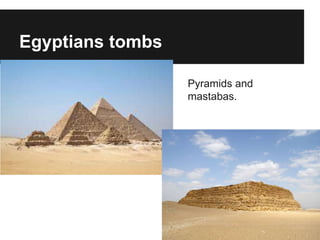
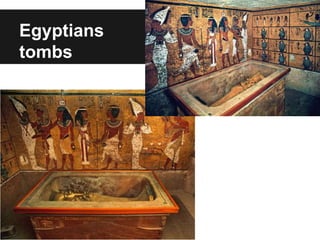
Egyptians tombs
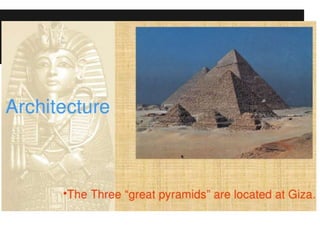
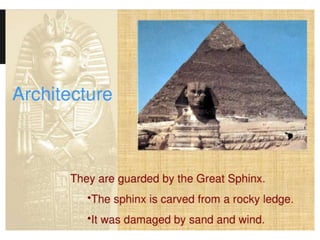
Pyramids and
mastabas.
Egyptians
tombs
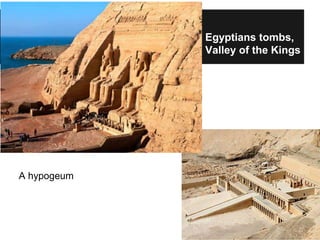
Egyptians tombs,
Valley of the Kings
A hypogeum
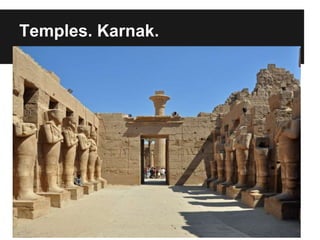
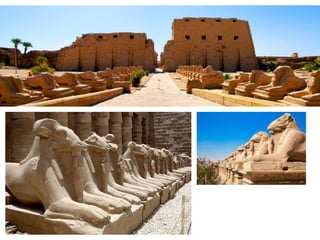
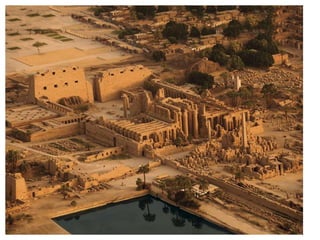
Temples. Karnak.
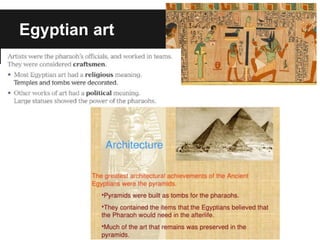
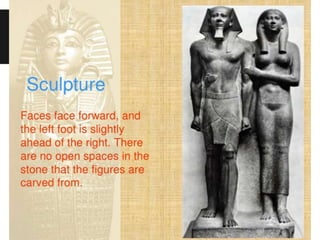
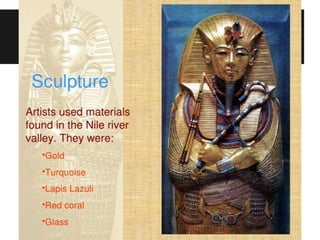
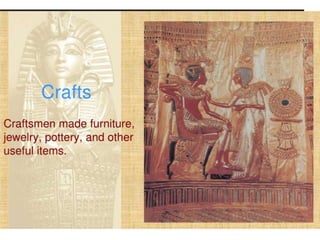
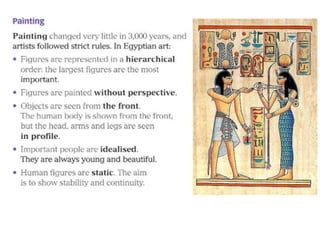
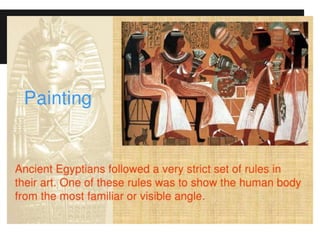
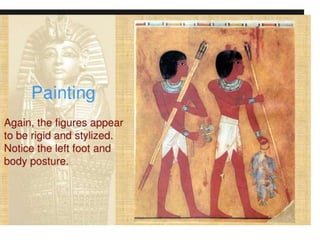
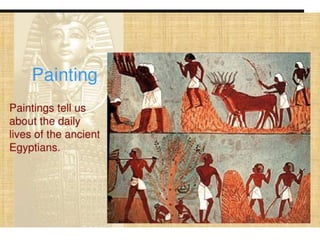
Egyptian art
Activities
Exercise 1 on page 151.
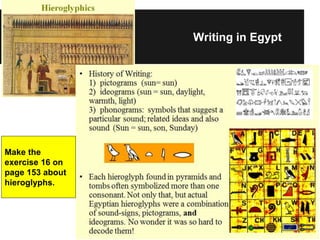
Writing in Egypt
Make the
exercise 16 on
page 153 about
hieroglyphs.
Activities
Exercises 1, 4, 5, 6, 10, 11 and 12
on page 152-3.
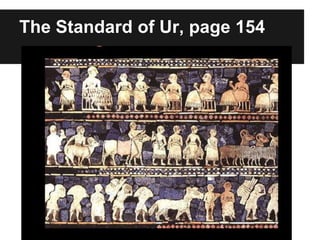
The Standard of Ur, page 154
Royal Standard of Ur
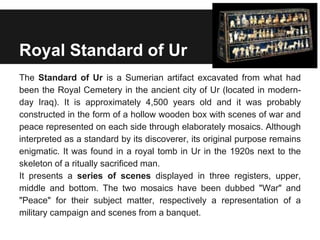
The Standard of Ur is a Sumerian artifact excavated from what had
been the Royal Cemetery in the ancient city of Ur (located in modern-
day Iraq). It is approximately 4,500 years old and it was probably
constructed in the form of a hollow wooden box with scenes of war and
peace represented on each side through elaborately mosaics. Although
interpreted as a standard by its discoverer, its original purpose remains
enigmatic. It was found in a royal tomb in Ur in the 1920s next to the
skeleton of a ritually sacrificed man.
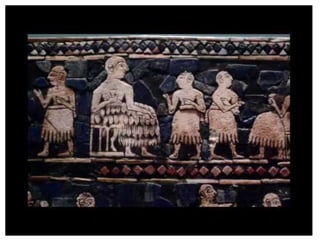
It presents a series of scenes displayed in three registers, upper,
middle and bottom. The two mosaics have been dubbed "War" and
"Peace" for their subject matter, respectively a representation of a
military campaign and scenes from a banquet.
Homework
In your notebook, answer the following questions about the previous video
(do not forget to use full sentences!):
1.What does the olive branch symbolized?
2.Which city-state does the standard come from?
3.What is the name of the archeologist who discovered the Standard?
4.What was the function of the Standard?
5.Can we know if there was a social organization in that time with the
information represented in the Standard?
6.Is there anyone more important than the rest? why do you know it?
7.Is there any musician? What is he playing?
8.What do the scenes on the back of the Standard represent?
9.Does the king appeared in the back? Where? Why do you know it?
10.Express your opinion: Tell us what do you think now about this piece of art.

Unit 9 - Mesopotamia and Egypt - new

  • 1.
    Ancient Mesopotamia andEgypt Unit 9 - 1º ESO
  • 3.
  • 6.
    Activity time ACTIVITY: Inyour notebooks: Make up a story containing at least 10 of these words: PYRAMID SLAVE PHARAOH RIVER DESERT COLD HOT Advice: try to make short and easy sentences but correct! CAMEL OASIS CHILD TO BUILD TO WORK STONE SAND TO CRY
  • 7.
    The first greatcivilizations appeared around 5,000 years ago. They were in: -China -India -Mesopotamia -Egypt They were river civilizations so they had fertile land around. Their rivers were: -China: the Yellow and Blue rivers. -India: the Indus river. -Mesopotamia: the Tigris and Euphrates rivers. -Egypt: the Nile river. 1- River civilizations
  • 8.
  • 9.
  • 14.
    1- River civilizations THEINVENTION OF WRITING The invention of writing marks the beginning of History, so the end of Prehistory. Writing appeared in Mesopotamia over 5,000 years ago. Writing was a way of storing information about taxes, trade and population in the towns.
  • 15.
    Writing Mesopotamian civilization was thefirst in using writing about 5,000 years ago. Cuneiform writing was essential. Writing made it possible to organize the state, for example, by recording how much grain there was. It was also used to record stories of important heroes or divinities, that’s the beginning of written literature.
  • 18.
  • 19.
    Characteristics of rivercivilizations: Political power: .Very powerful ruler (king, emperor, pharaoh). .He made laws. .He led the army. .He had religious functions. .He was served by civil servants or state officials. -SOCIETY: .It was hierarchical. .Privileged people owned most of the land and wealth. .Most of the population were poor. - There were large-scale building works, such as palaces, temples, tombs and canals.
  • 21.
    Activities Exercises 1, 2,3, 5 and 6 on page 145.
  • 22.
  • 23.
    Mesopotamia means betweenthe rivers. It was the territory between the rivers Tigris and Euphrates.
  • 24.
    Mesopotamian first cities Thefirst urban civilization appeared in the low area of Mesopotamia. In Sumer, a fertile land between the Tigris and Euphrates rivers, the first cities emerged (Ur, Uruk, Lagash and Eridu). They were independent cities. They were surrounded by walls. Outside the walls there were farmland crossed by irrigation canals. Most of the population were peasants. Agricultural prosperity made it possible for some inhabitants could work in other jobs, such as trade or craftsmanship. Traders began to use coins in their exchanges.
  • 25.
    City-states and empires City-statesin Mesopotamia were ruled by kings. Some kings expanded their territories through conquests and alliances until they became empires: After Sumer (3000 BC, Uruk, Ur), there were: the Akkadians (2300 BC), the Babylonians (after 1800 BC), the Assyrians (afteR 1350 BC), and finally the Neo-Babylonian Empire (late 7th c. BC). In the 6th c.BC the Persians conquered the region.
  • 26.
  • 27.
    3- Society andArt in Mesopotamia Ancient Mesopotamia had a complex society. It was hierarchical. There were three social classes: nobility, free citizens, and slaves. The king was in the top. The nobility or aristocracy included priests, and priest-kings. The priest-kings were believed to be the representative of the city’s patron God or Goddess. They lived in temples and were the city's tax collectors. All people of the nobility class were in charge of maintenance, construction, and organization of the canals. It included also the family of the king. The free people class was a combination of a modern day middle and lower classes: merchants, craftsmen, and anyone who was involved in trade. They lived in the city. Farmers, fishermen, shepherds, and hunters made up the lower class. These people lived on the outskirts of the city and were responsible for the food supply. The slave class was the lowest class, made up of prisoners of war, and these slaves could be bought or sold. The slaves were allowed to marry and have a family if they wished.
  • 29.
    Women in Mesopotamia. Inancient Mesopotamia, women were not considered equal to men. They had some rights but not all rights. Women could go out of their houses and go to the market. They were allowed to own their own property and even own businesses. They could become involved in court cases. If their parents were so inclined, they could learn to read and write and even get a paid job. But they were not allowed a vote in the assembly, so they had no voice in making laws.
  • 30.
    Family life inMesopotamia In ancient Mesopotamia families were very important. The family was the basic unit of society and there were certain things that could and couldn`t be done. For example, a woman living in Mesopotamia could do or go anywhere she wanted as long as she had her husband's permission. In the case of a divorce, both man and woman would pay a fine, and if there were no children, the divorce was easy. If the couple did have children, the woman faced severe penalties. The children in a family had to respect their parents because disrespecting parental figures was considered a grave sin. If the family was in an incredibly bad financial situation, then the children would be sold even though selling children was considered a bad omen. Males were the prefered gender in ancient Mesopotamia and the men in Mesopotamia were far more powerful than the women.
  • 31.
  • 33.
    What was Mesopotamian culturelike? Religion and Food Mesopotamian religion and food were closely connected. Food was often offered to the Gods as a sacrifice. The everyday food that people ate included beef, lamb, pork, goat, duck, and geese. Bread was also very popular. All Mesopotamians enjoyed eating, and the richer the family was, the more food they had. Religion in Mesopotamia was rather complex. They believed that the world was a flat disk that was surrounded by hollow space. They also believed that the ocean surrounded them. Ancient Mesopotamians were polytheistic and relied on spiritual remedies to stay healthy. Mesopotamians believed that the Gods must be treated with respect, because they were the providers for the Mesopotamian civilization. The Mesopotamian also built structures called ziggurats. Ziggurats were believed to be the stairways of the Gods.
  • 34.
    Religion in Mesopotamia Ziggurats(temples) were placed in the city center. They were devoted to the city God or Goddess. Priests lived there. They controlled crops, trade and imposed taxes. the priest-king was the city leader, he had civil servants to help him.
  • 50.
    The Code ofHammurabi Some examples of laws: - If a freeman brings false testimony in a case that carries the death sentence, he shall be put to death. - If a builder builds a house and does not make the construction firm and the house collapses and causes death of the owner, that builder shall be put to death. - If a trader borrows money from a merchant and then denies it, and the merchant can prove this loan was made, the trader shall pay the merchant three times the amount he borrowed.
  • 52.
  • 53.
    Summary of theMesopotamian civilization
  • 54.
  • 55.
    Why was theNile crucial to Ancient Egypt? - The Nile was essential for Ancient Egypt because: .Land fertility (black land) .Water was so important for human needs and agriculture .Communication system
  • 59.
    Homework Exercises 1 and3 on page 146-7.
  • 60.
    The history ofEgypt In the 4th millennium BC. independent kingdoms appeared in Lower Egypt (near the Nile delta) and Upper Egypt (south)
  • 63.
    How did AncientEgypt change? The chronology of the kingdoms There were three main periods: 1- Old Kingdom (3100 BC- 2200 BC): Capital city: Memphis. 2- Middle Kingdom (2200 BC- 1800 BC): Capital city: Thebes. 3- New Kingdom (1600 BC- 1100 BC): Capital city: Thebes.
  • 64.
    How did AncientEgypt change?
  • 65.
    Foreign rule (1.100BC- 31 BC) After the year 1.100 BC, Egypt was invaded by different foreign peoples: the Assyrians, the Persians, the Greeks, and the Romans.
  • 66.
    Activities Exercises 4, 5and 6 on page 147.
  • 68.
    5- Society inAncient Egypt
  • 72.
  • 73.
  • 74.
  • 75.
  • 80.
  • 82.
    6- Religion andart in Egypt.
  • 84.
  • 89.
  • 92.
  • 93.
  • 94.
    Canopic jars Canopic jarswere used by the Ancient Egyptians during the mummification process to store and preserve the viscera of their owner for the afterlife. They were commonly either carved from limestone or were made of pottery. These jars were used from the time of the Old Kingdom. The viscera were not kept in a single canopic jar: each jar was reserved for specific organs.
  • 95.
  • 96.
  • 97.
    Egyptians tombs, Valley ofthe Kings A hypogeum
  • 98.
  • 101.
  • 115.
  • 116.
    Writing in Egypt Makethe exercise 16 on page 153 about hieroglyphs.
  • 118.
    Activities Exercises 1, 4,5, 6, 10, 11 and 12 on page 152-3.
  • 119.
    The Standard ofUr, page 154
  • 120.
    Royal Standard ofUr The Standard of Ur is a Sumerian artifact excavated from what had been the Royal Cemetery in the ancient city of Ur (located in modern- day Iraq). It is approximately 4,500 years old and it was probably constructed in the form of a hollow wooden box with scenes of war and peace represented on each side through elaborately mosaics. Although interpreted as a standard by its discoverer, its original purpose remains enigmatic. It was found in a royal tomb in Ur in the 1920s next to the skeleton of a ritually sacrificed man. It presents a series of scenes displayed in three registers, upper, middle and bottom. The two mosaics have been dubbed "War" and "Peace" for their subject matter, respectively a representation of a military campaign and scenes from a banquet.
  • 122.
    Homework In your notebook,answer the following questions about the previous video (do not forget to use full sentences!): 1.What does the olive branch symbolized? 2.Which city-state does the standard come from? 3.What is the name of the archeologist who discovered the Standard? 4.What was the function of the Standard? 5.Can we know if there was a social organization in that time with the information represented in the Standard? 6.Is there anyone more important than the rest? why do you know it? 7.Is there any musician? What is he playing? 8.What do the scenes on the back of the Standard represent? 9.Does the king appeared in the back? Where? Why do you know it? 10.Express your opinion: Tell us what do you think now about this piece of art.

Editor's Notes