Breast Cancer
IntroductionMost common female cancerAccounts for 32% of all female cancer211,300 new cases yearly and rising40,000 deaths yearly
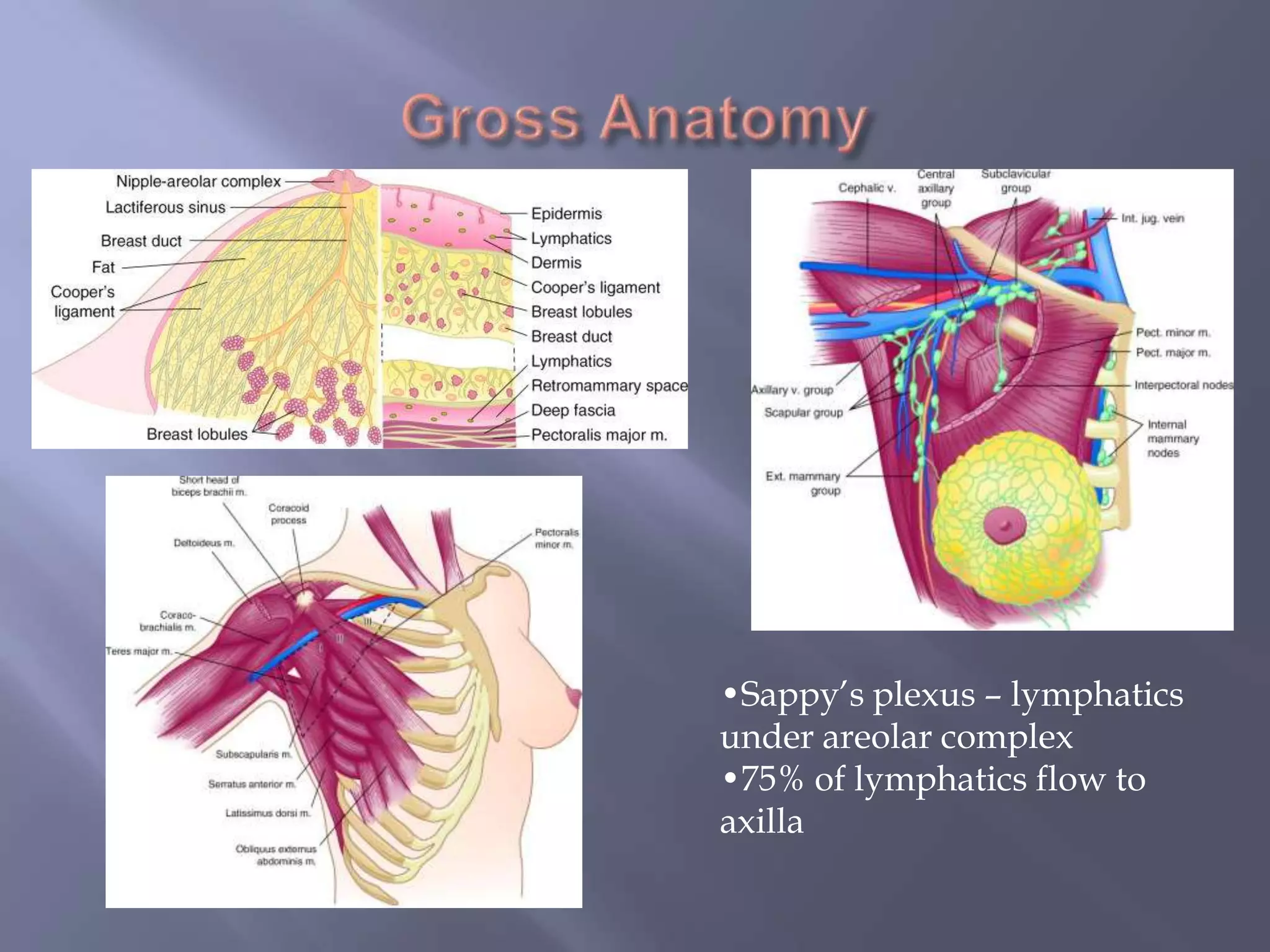
Gross AnatomySappy’s plexus – lymphatics  under areolar complex
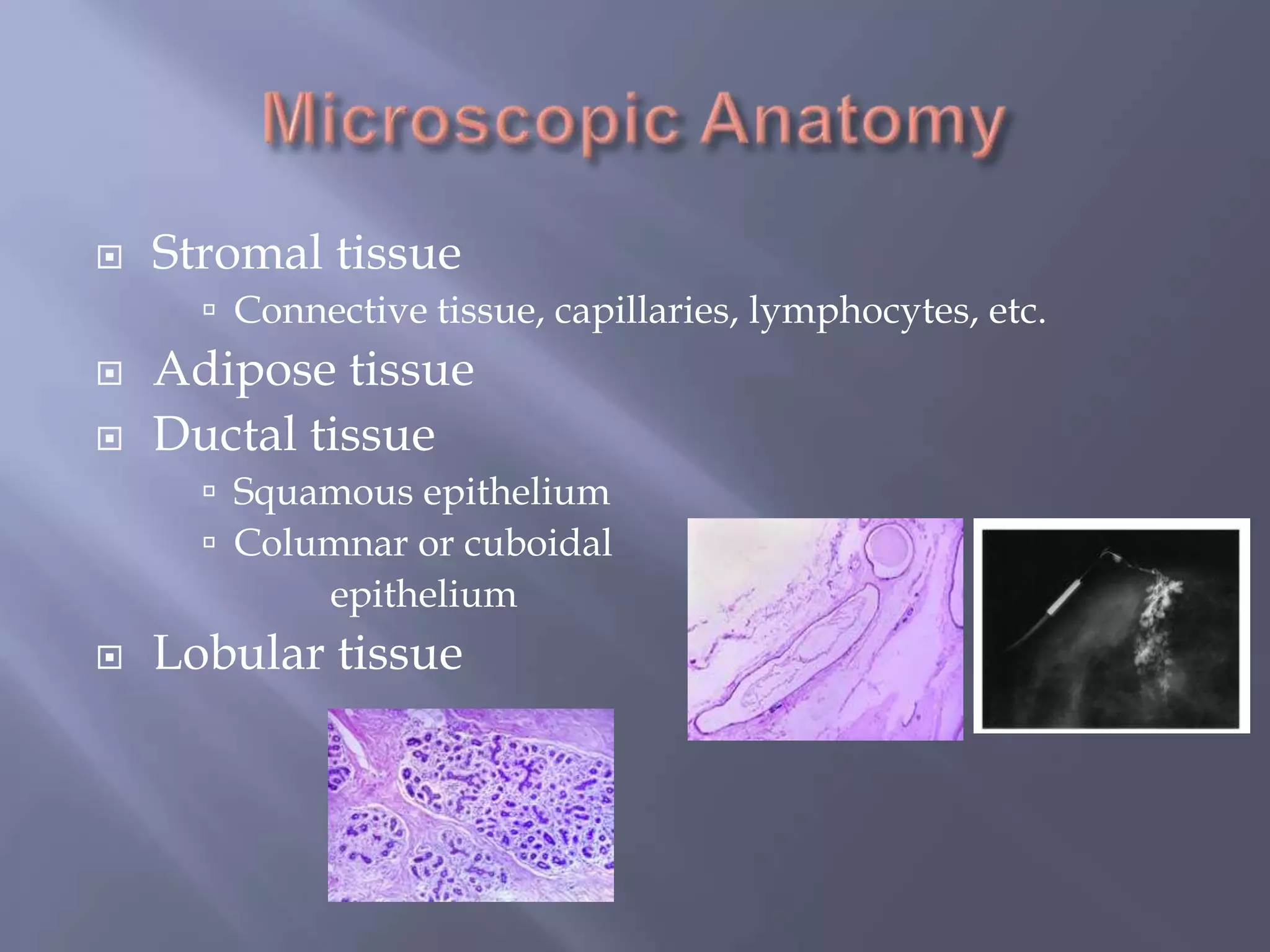
75% of lymphatics flow to axillaMicroscopic AnatomyStromal tissueConnective tissue, capillaries, lymphocytes, etc.Adipose tissueDuctal tissueSquamous epitheliumColumnar or cuboidal 		epitheliumLobular tissue
PresentationBreast lumpAbnormal mammogramAxillarylympadenopathyMetastatic disease
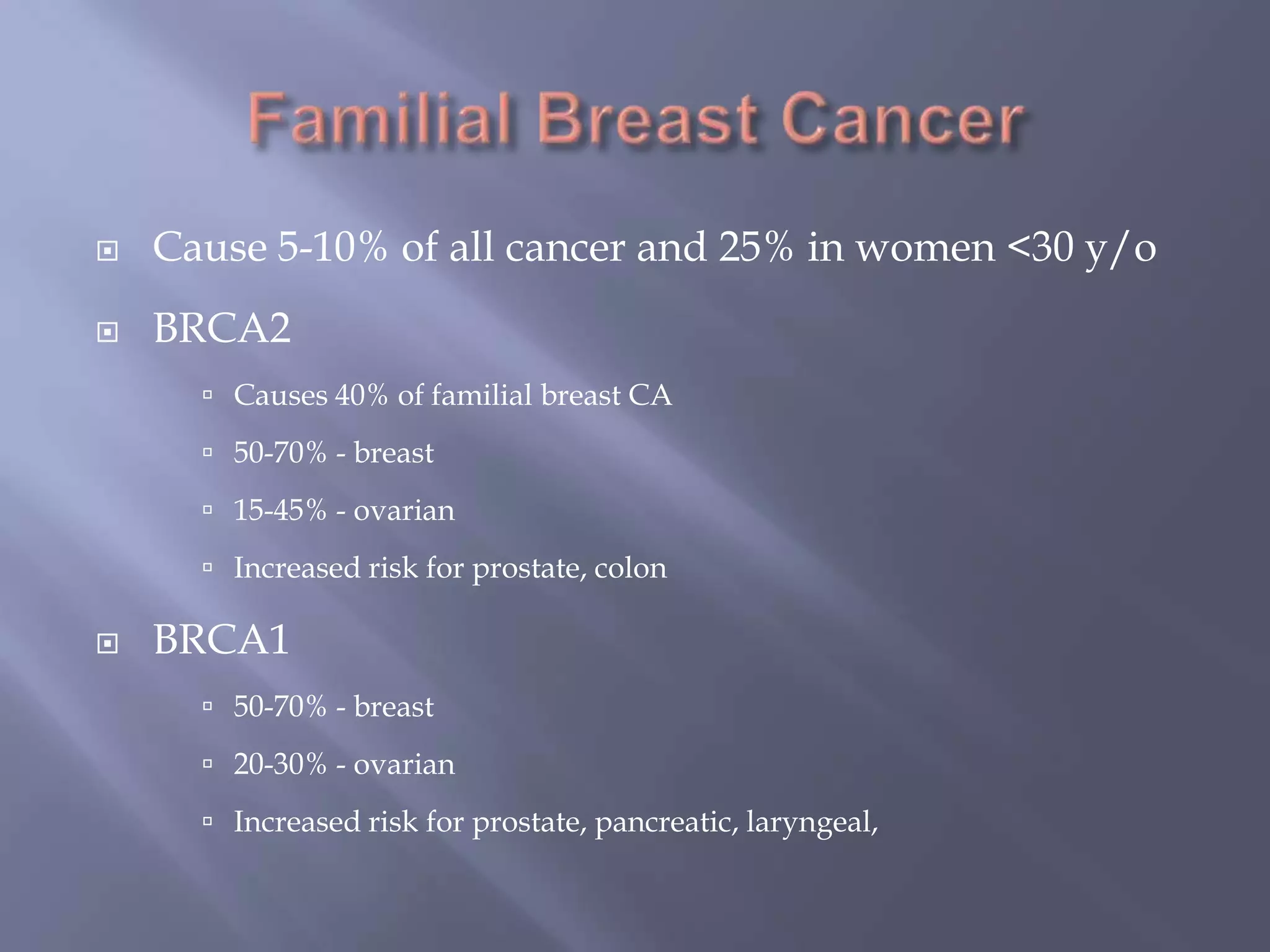
Familial Breast CancerCause 5-10% of all cancer and 25% in women <30 y/oBRCA2Causes 40% of familial breast CA50-70% - breast15-45% - ovarianIncreased risk for prostate, colonBRCA150-70% - breast20-30% - ovarianIncreased risk for prostate, pancreatic, laryngeal,
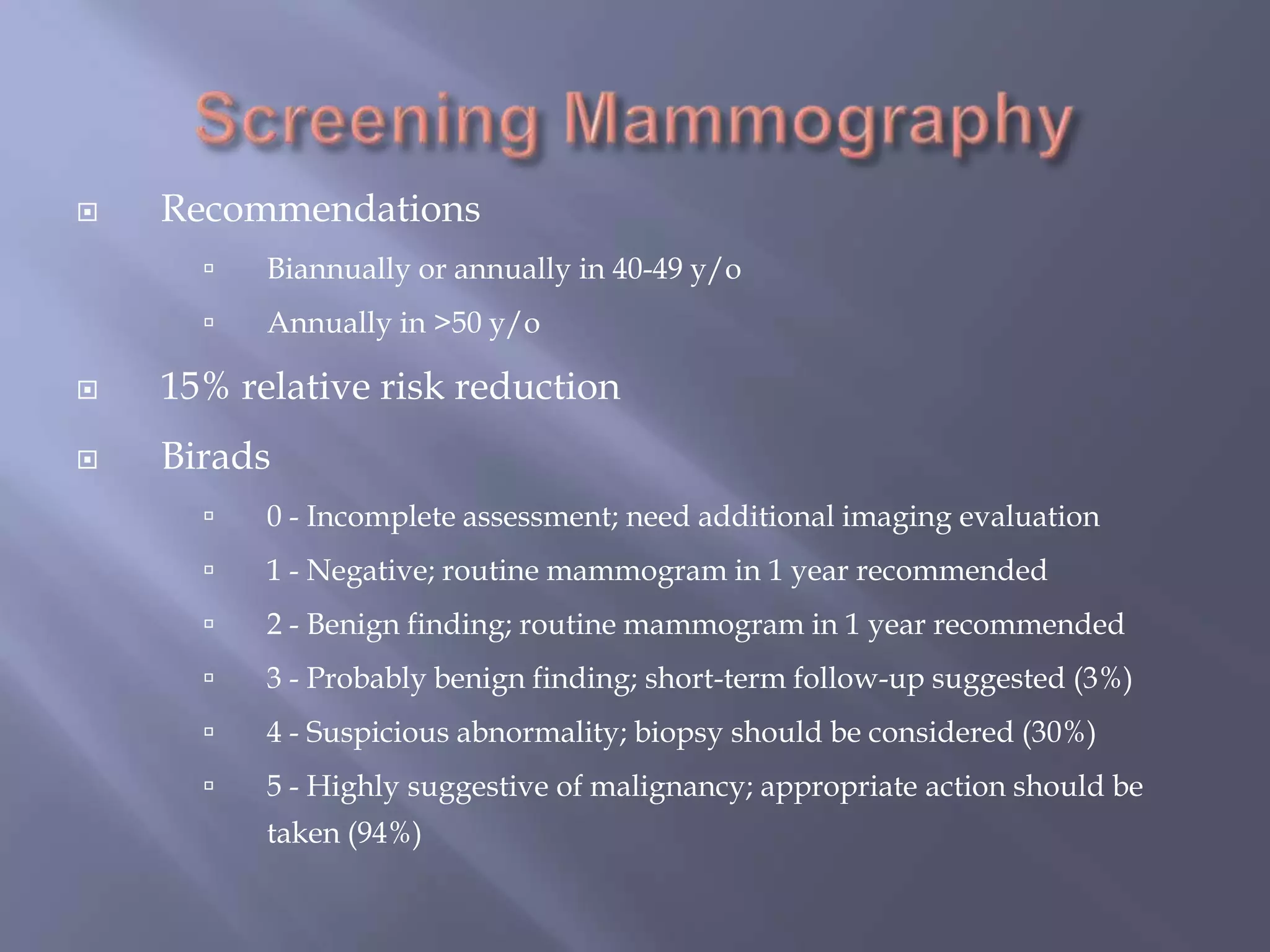
Screening MammographyRecommendationsBiannually or annually in 40-49 y/oAnnually in >50 y/o15% relative risk reductionBirads0 - Incomplete assessment; need additional imaging evaluation 1 - Negative; routine mammogram in 1 year recommended 2 - Benign finding; routine mammogram in 1 year recommended 3 - Probably benign finding; short-term follow-up suggested (3%)4 - Suspicious abnormality; biopsy should be considered (30%)5 - Highly suggestive of malignancy; appropriate action should be taken (94%)
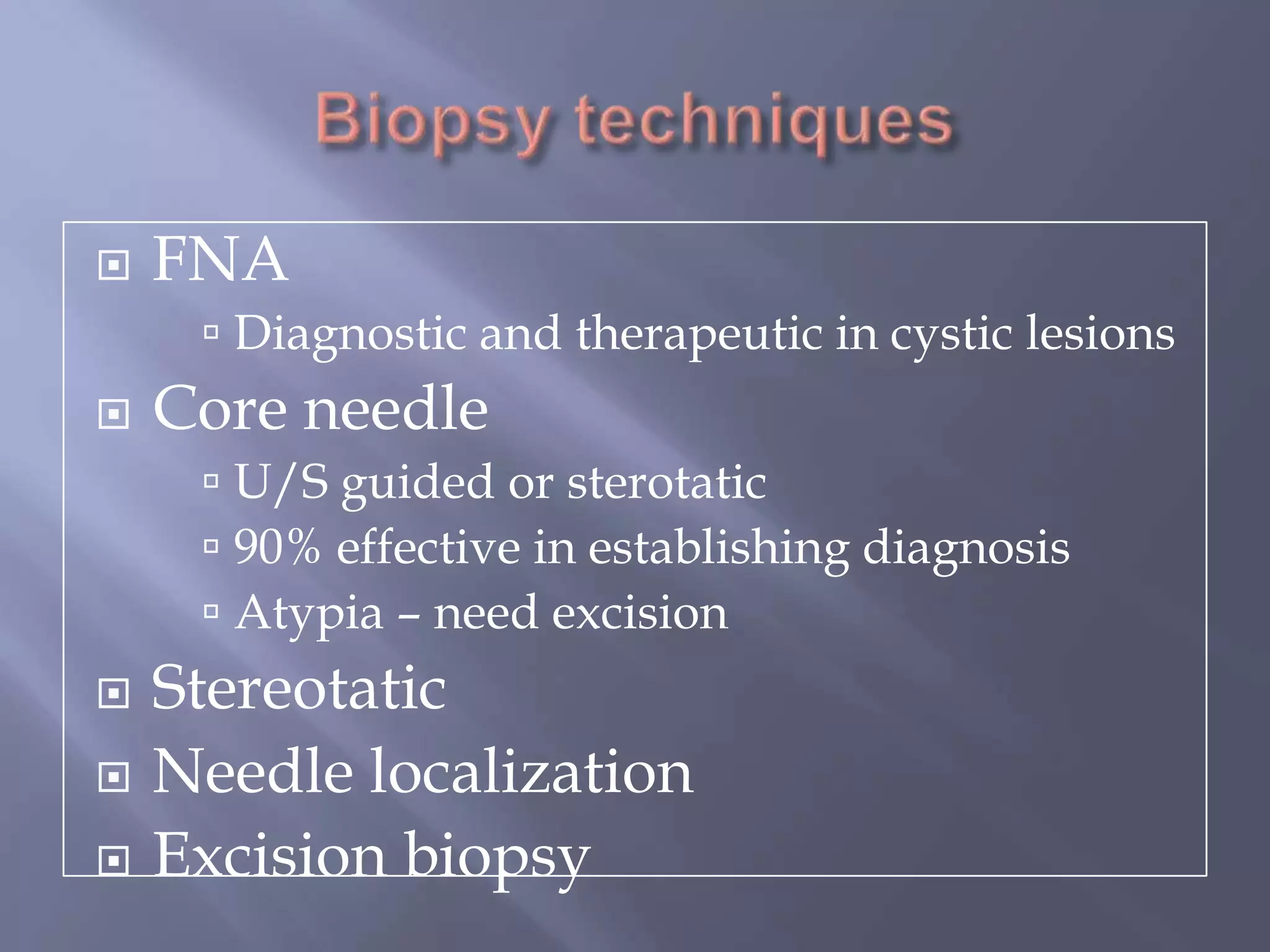
Biopsy techniquesFNADiagnostic and therapeutic in cystic lesionsCore needleU/S guided or sterotatic90% effective in establishing diagnosisAtypia – need excisionStereotaticNeedle localizationExcision biopsy
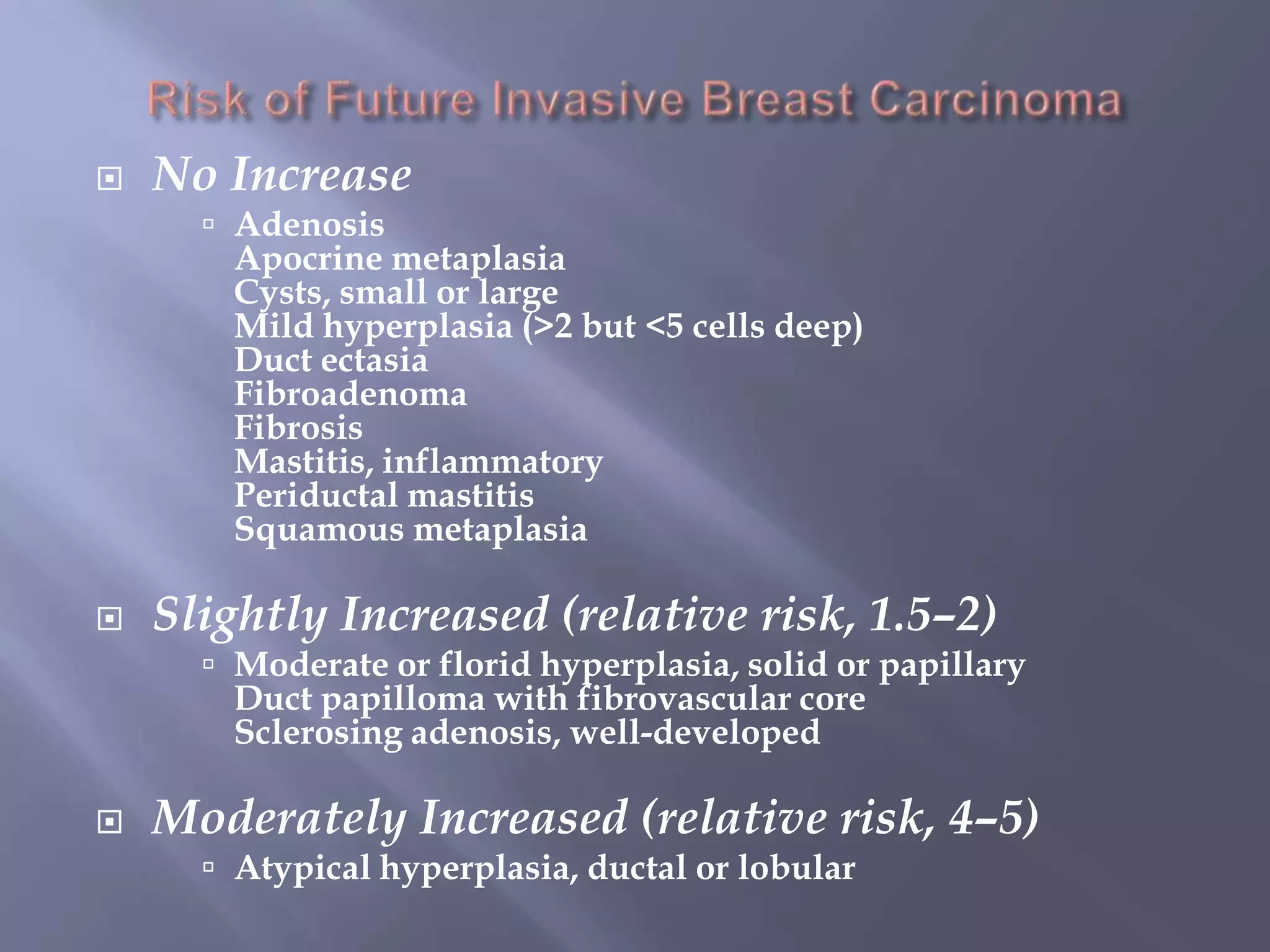
Risk of Future Invasive Breast CarcinomaNo Increase AdenosisApocrinemetaplasiaCysts, small or largeMild hyperplasia (>2 but <5 cells deep)Duct ectasiaFibroadenomaFibrosisMastitis, inflammatoryPeriductal mastitisSquamousmetaplasiaSlightly Increased (relative risk, 1.5–2) Moderate or florid hyperplasia, solid or papillaryDuct papilloma with fibrovascular coreSclerosingadenosis, well-developedModerately Increased (relative risk, 4–5) Atypical hyperplasia, ductal or lobular
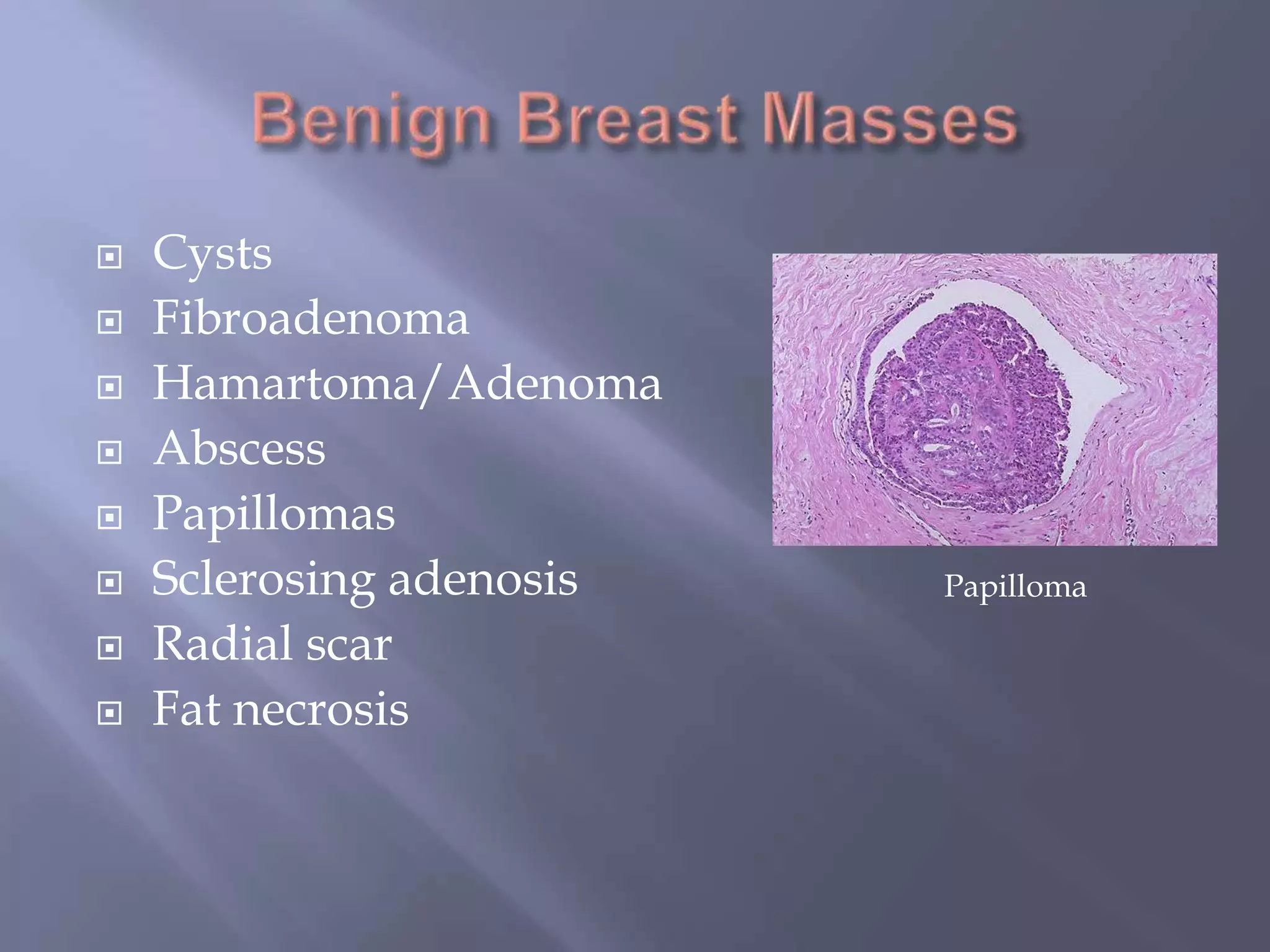
Benign Breast MassesCystsFibroadenomaHamartoma/AdenomaAbscessPapillomasSclerosing adenosisRadial scarFat necrosisPapilloma
Maligant Breast MassesDuctal carcinomaDCISInvasiveLobular carcinomaLCISInvasiveInflammatory carcinomaPaget’s diseasePhyllodes tumorAngiosarcoma
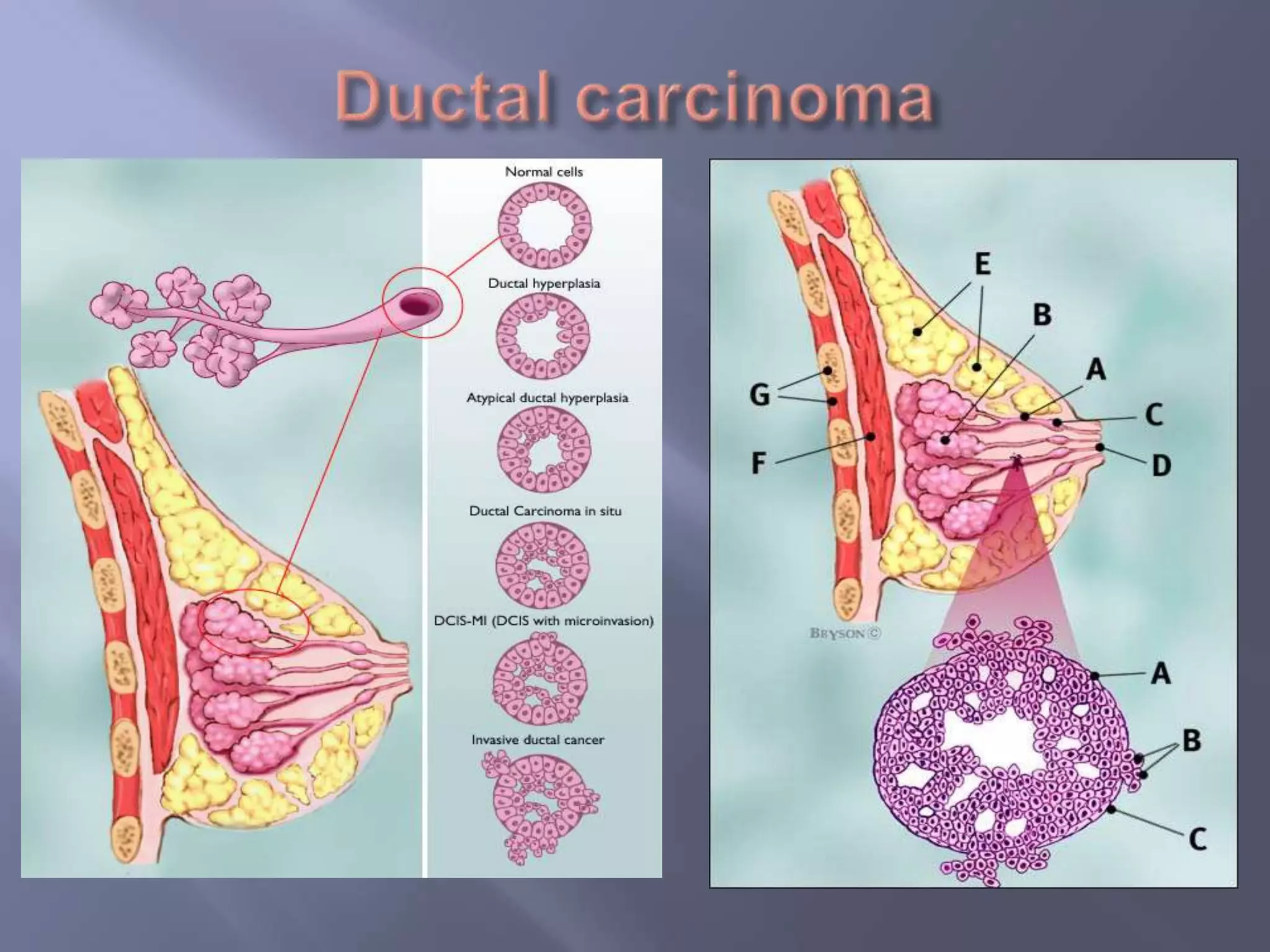
Ductal carcinoma
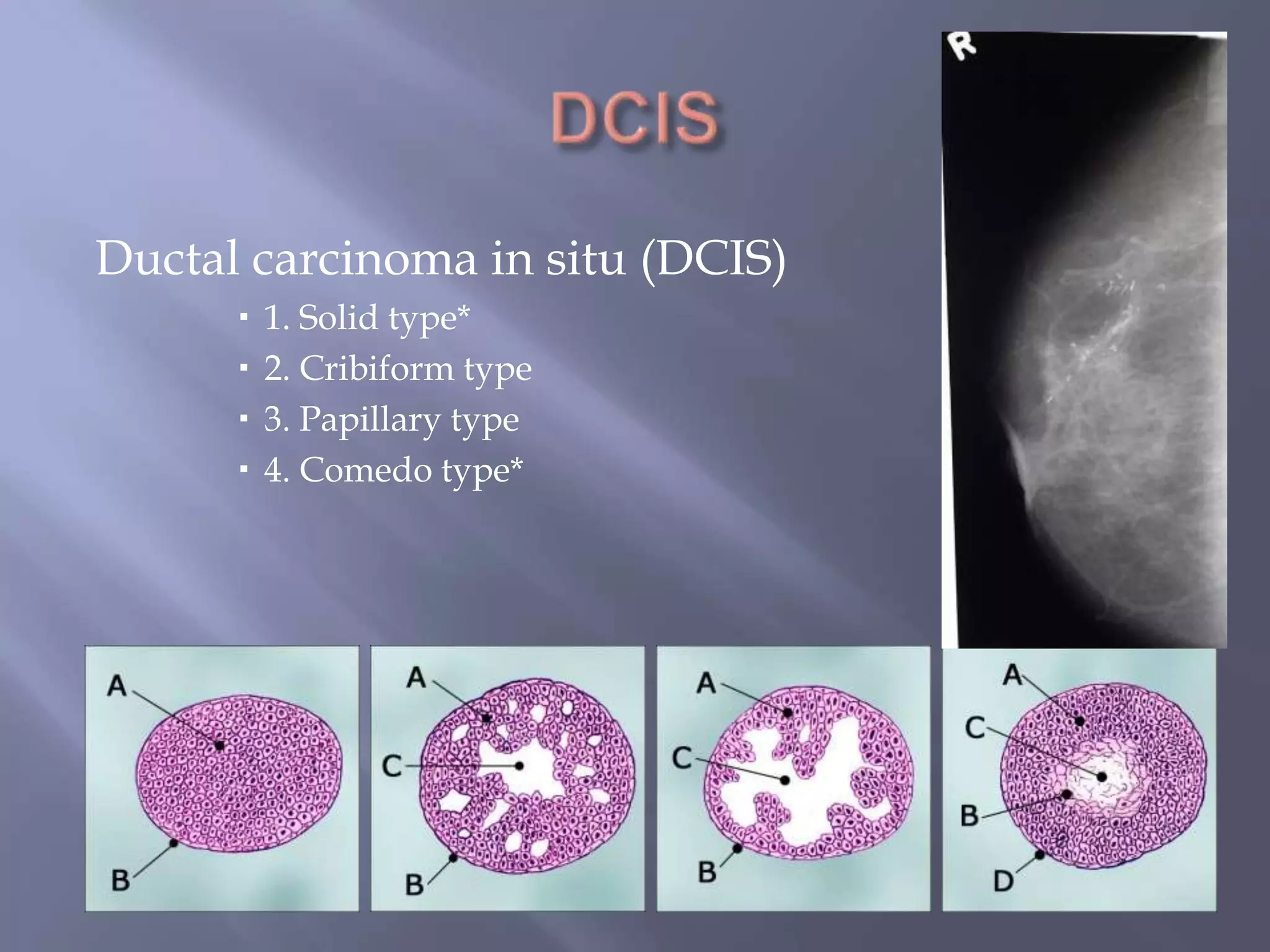
DCISDuctal carcinoma in situ (DCIS)1. Solid type*2. Cribiform type3. Papillary type4. Comedo type*
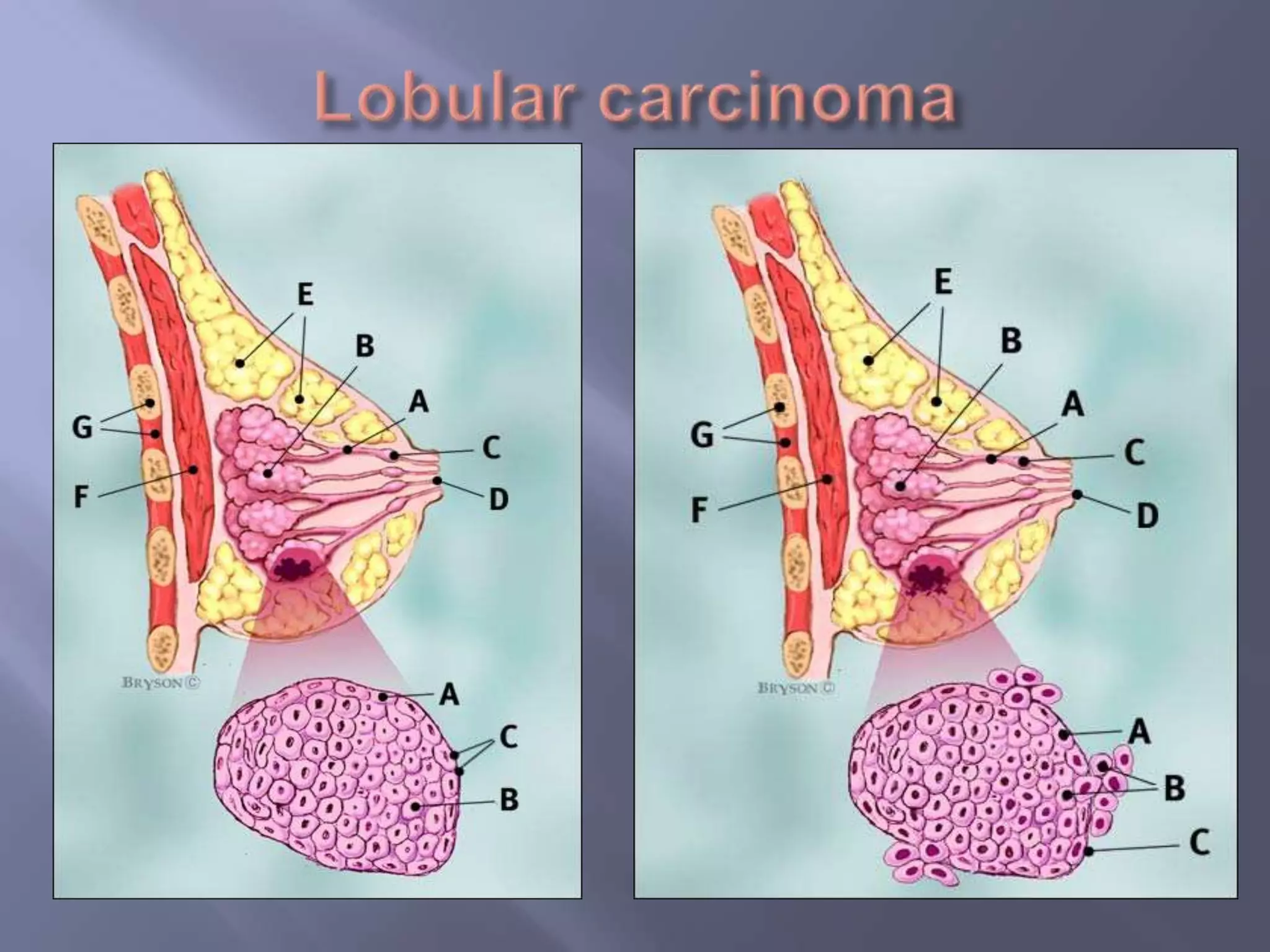
Lobular carcinoma
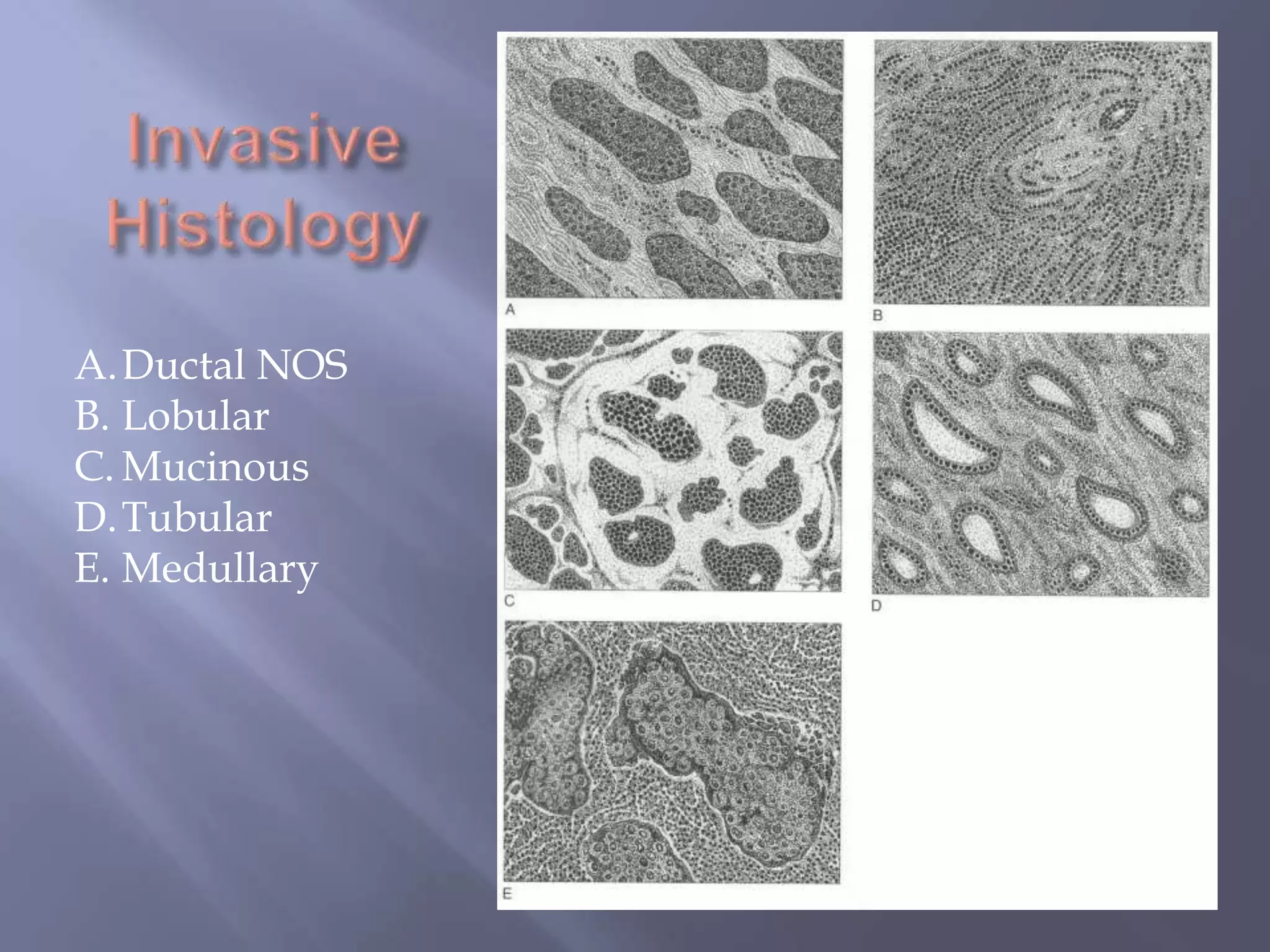
Invasive HistologyDuctal NOSLobularMucinousTubularMedullary
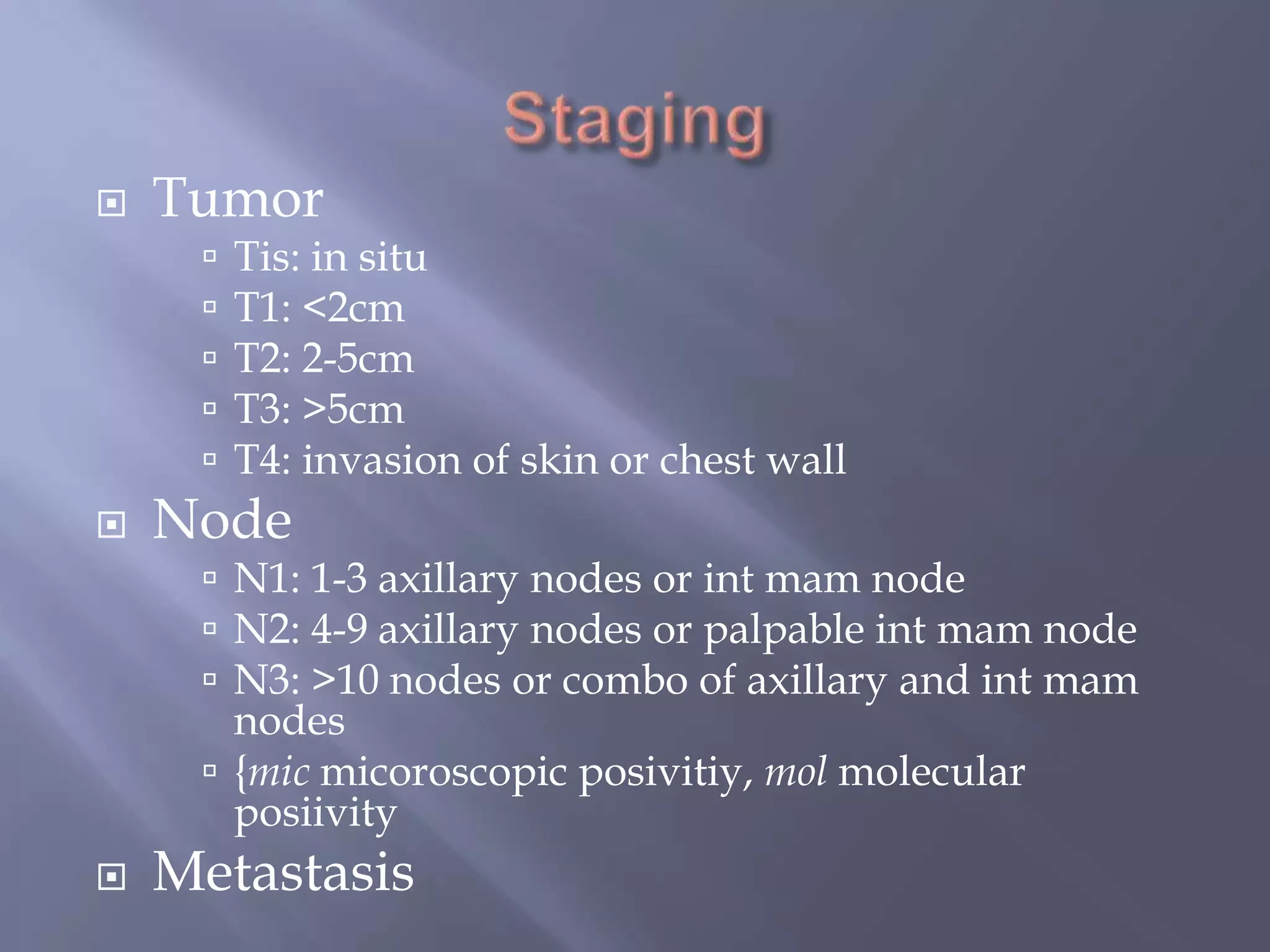
StagingTumorTis: in situT1: <2cmT2: 2-5cmT3: >5cmT4: invasion of skin or chest wallNodeN1: 1-3 axillary nodes or intmam nodeN2: 4-9 axillary nodes or palpable intmam nodeN3: >10 nodes or combo of axillary and intmam nodes{micmicoroscopicposivitiy, mol molecular posiivityMetastasis
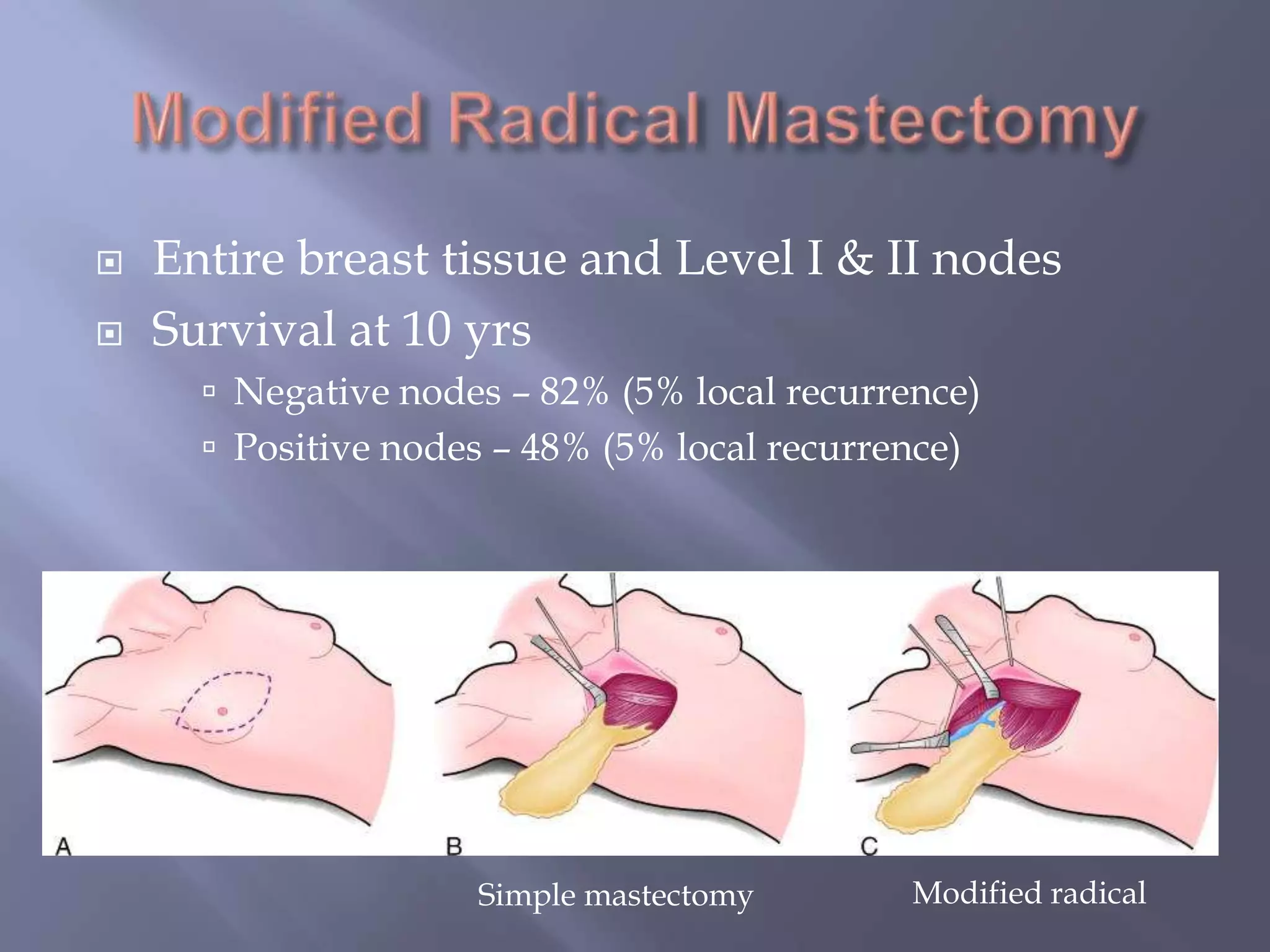
Modified Radical MastectomyEntire breast tissue and Level I & II nodesSurvival at 10 yrsNegative nodes – 82% (5% local recurrence)Positive nodes – 48% (5% local recurrence)Modified radicalSimple mastectomy
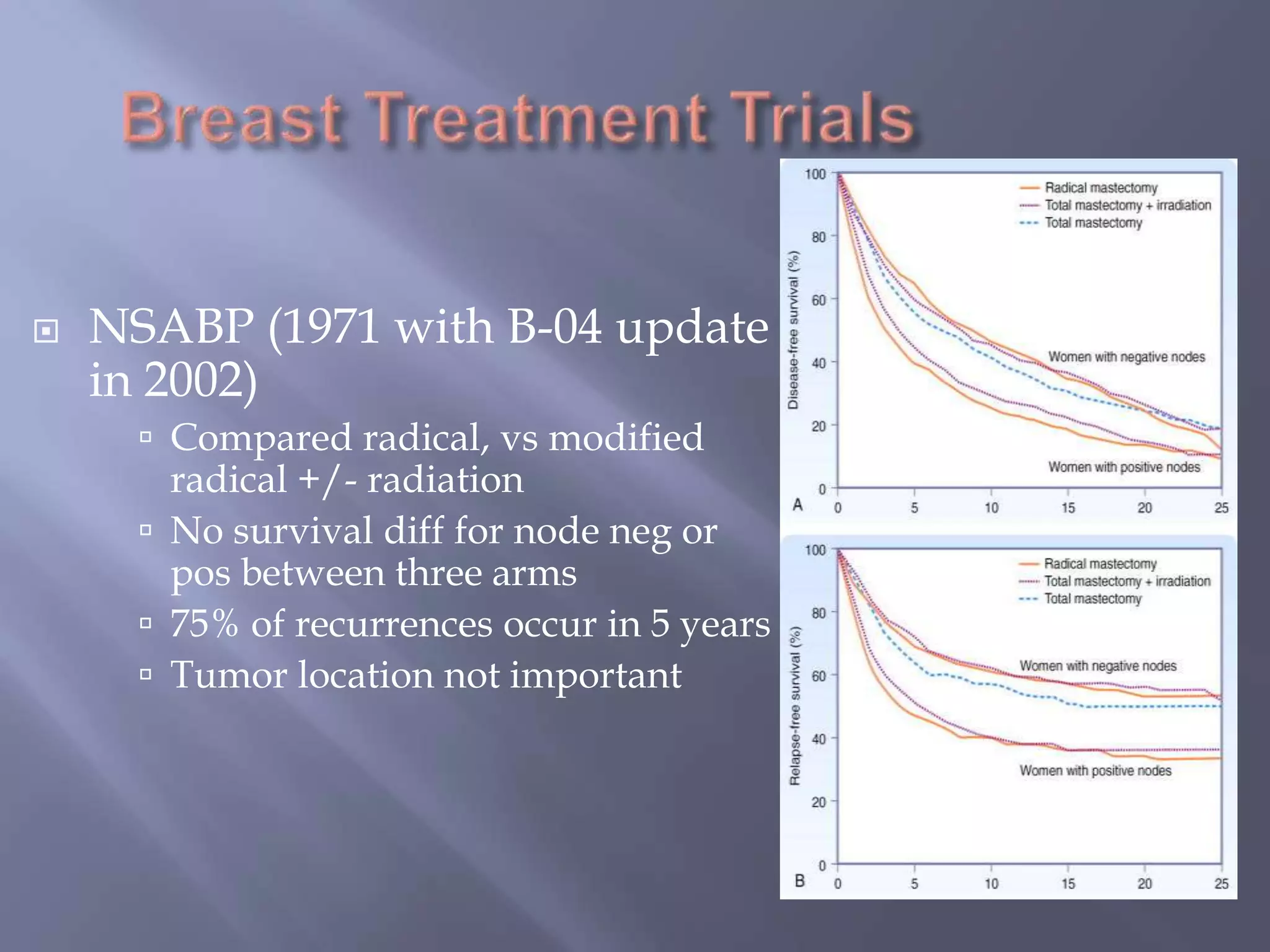
Breast Treatment TrialsNSABP (1971 with B-04 update in 2002)Compared radical, vs modified radical +/- radiationNo survival diff for node neg or pos between three arms75% of recurrences occur in 5 yearsTumor location not important
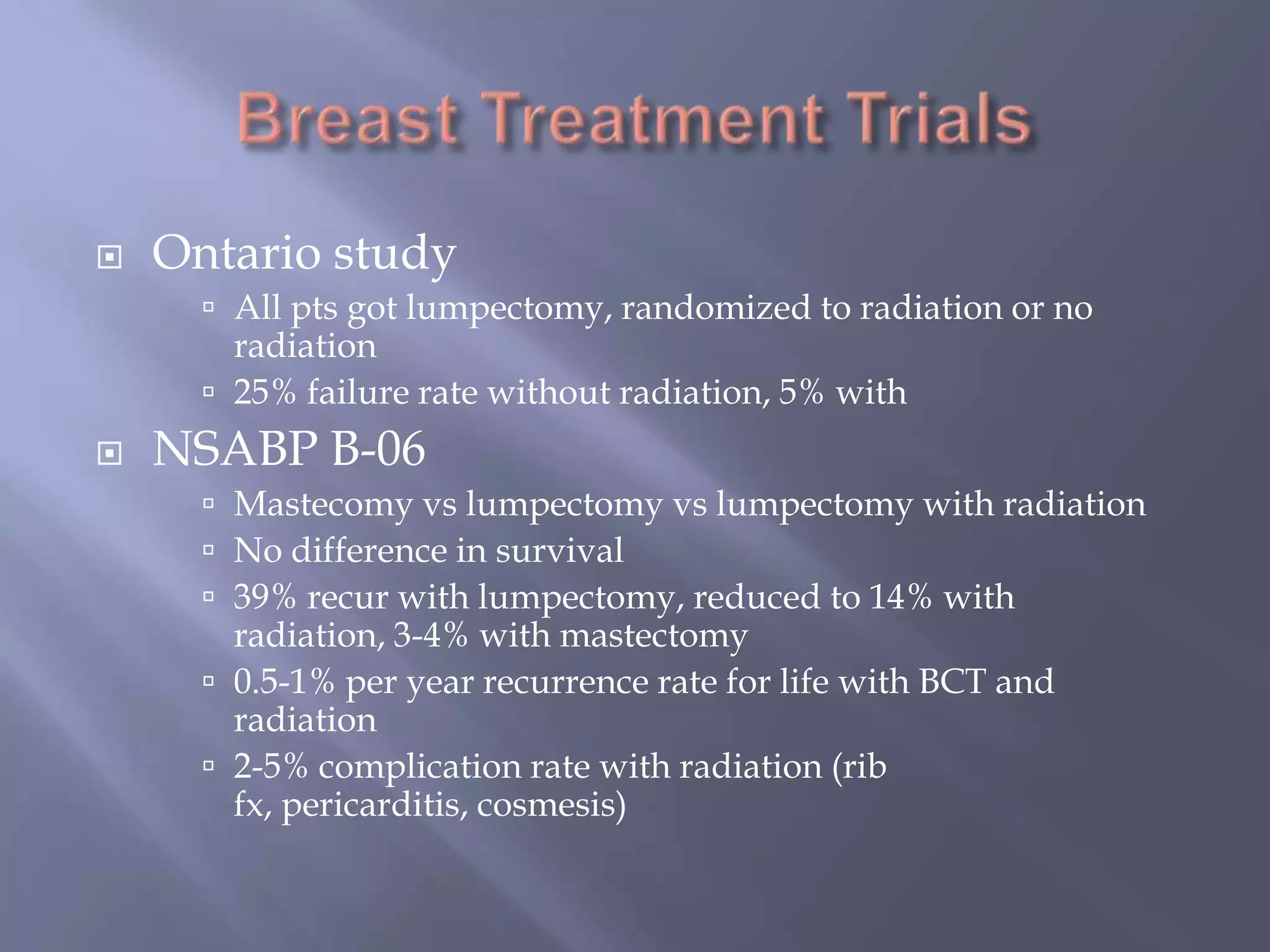
Breast Treatment TrialsOntario studyAll pts got lumpectomy, randomized to radiation or no radiation25% failure rate without radiation, 5% withNSABP B-06Mastecomyvs lumpectomy vs lumpectomy with radiationNo difference in survival39% recur with lumpectomy, reduced to 14% with radiation, 3-4% with mastectomy0.5-1% per year recurrence rate for life with BCT and radiation2-5% complication rate with radiation (rib fx, pericarditis, cosmesis)
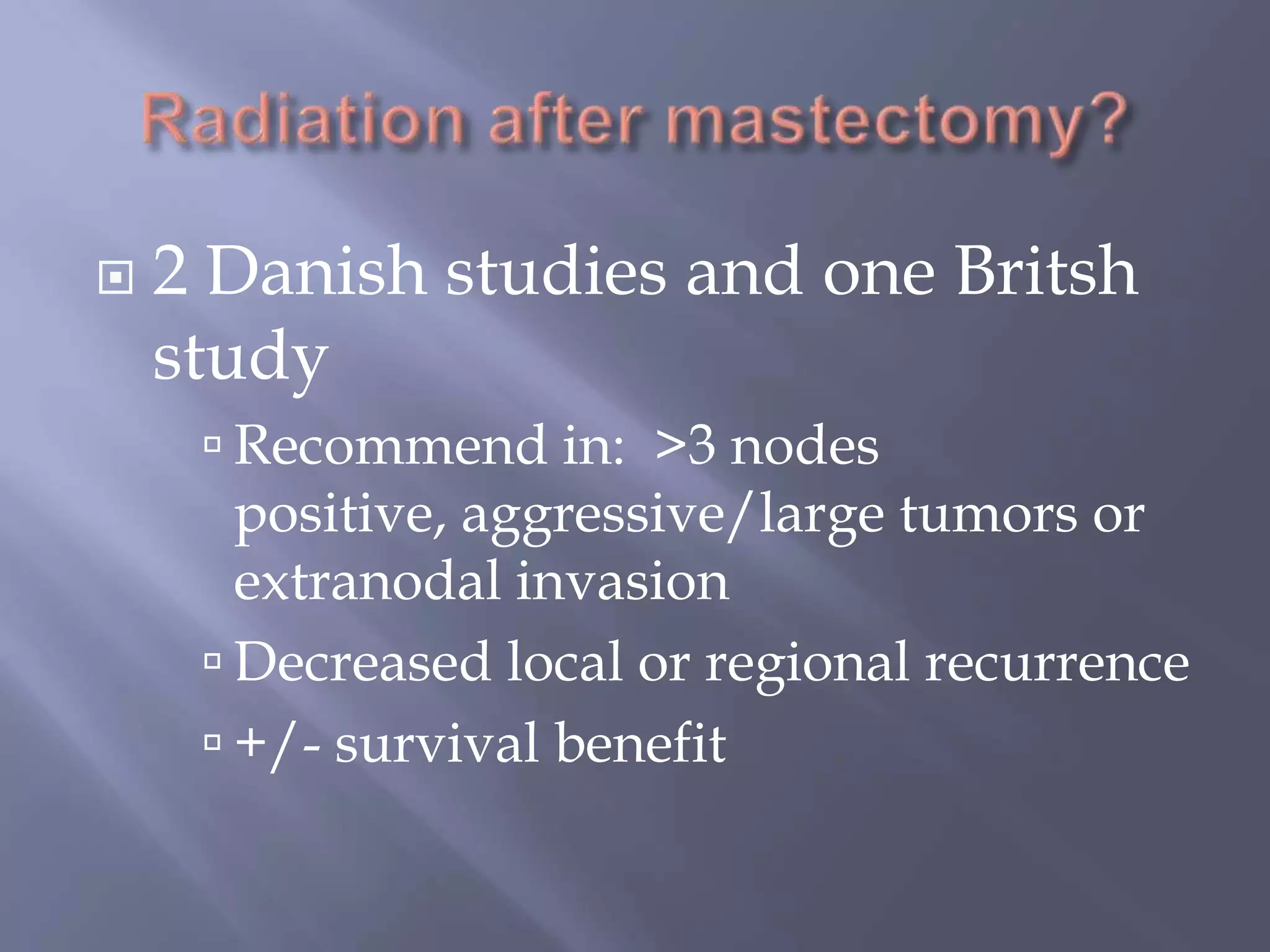
Radiation after mastectomy?2 Danish studies and one Britsh studyRecommend in:  >3 nodes positive, aggressive/large tumors or extranodal invasionDecreased local or regional recurrence+/- survival benefit
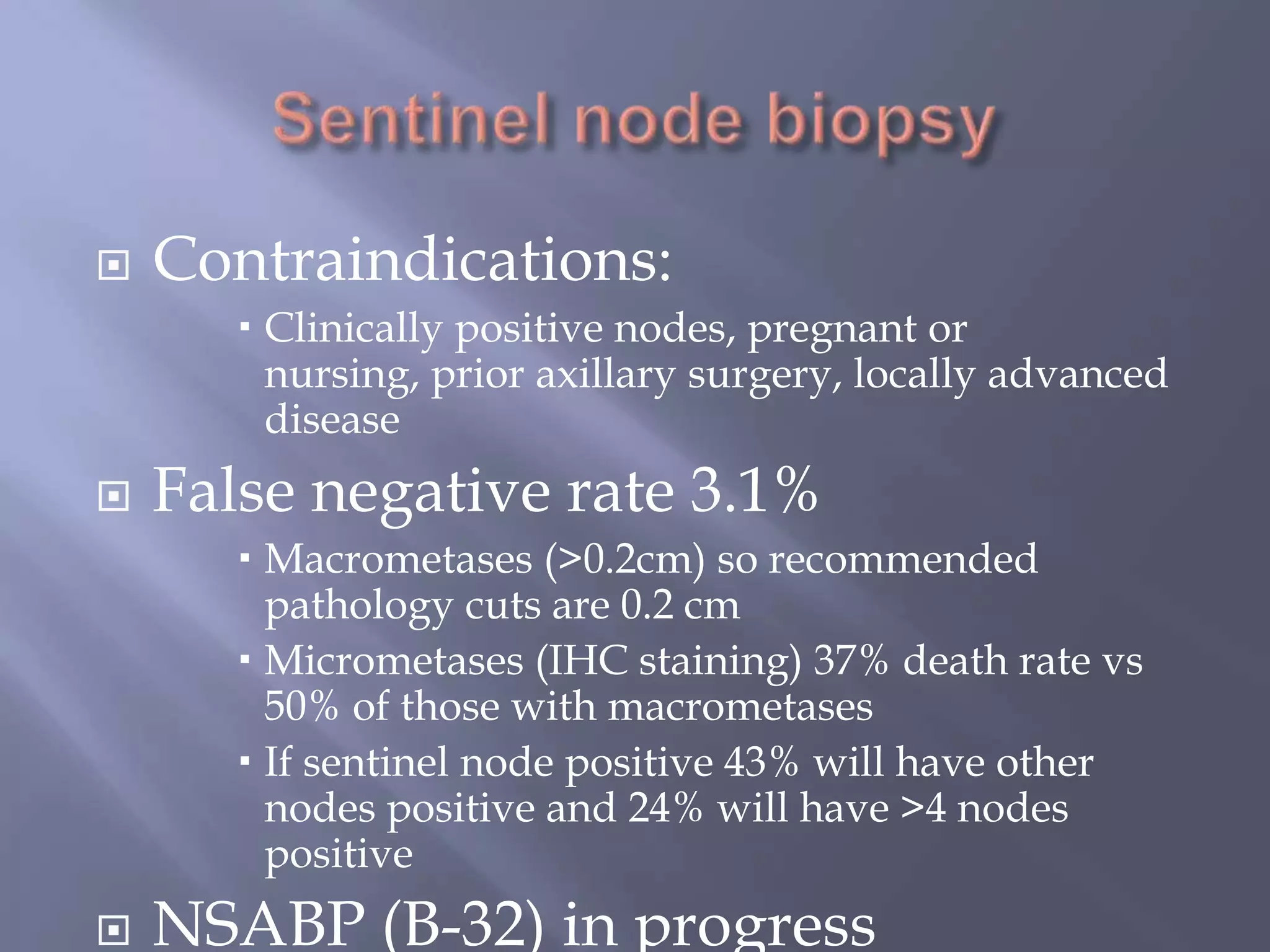
Sentinel node biopsyContraindications:Clinically positive nodes, pregnant or nursing, prior axillary surgery, locally advanced diseaseFalse negative rate 3.1%Macrometases (>0.2cm) so recommended pathology cuts are 0.2 cmMicrometases (IHC staining) 37% death rate vs 50% of those with macrometasesIf sentinel node positive 43% will have other nodes positive and 24% will have >4 nodes positiveNSABP (B-32) in progress
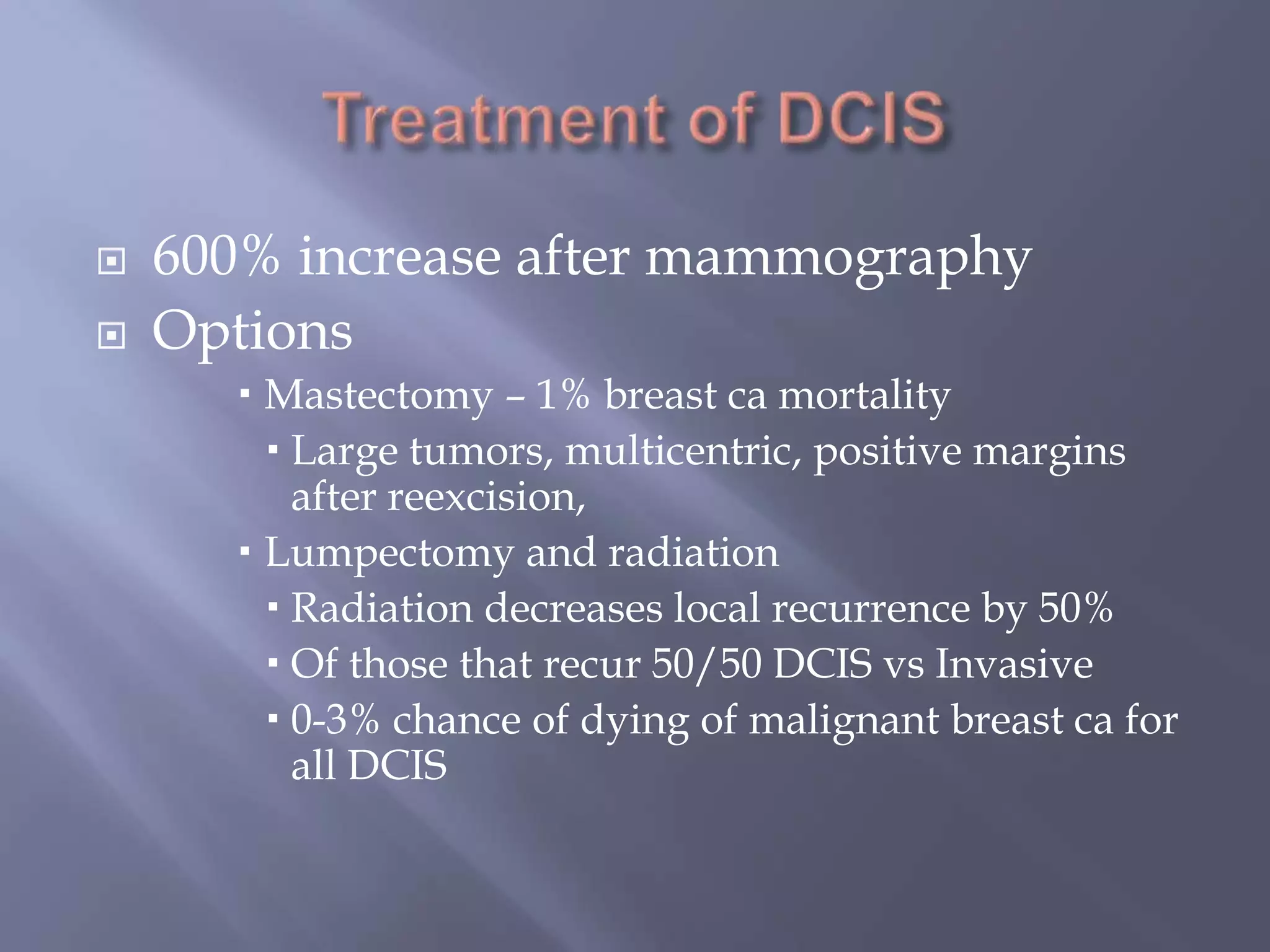
Treatment of DCIS600% increase after mammographyOptionsMastectomy – 1% breast ca mortalityLarge tumors, multicentric, positive margins after reexcision, Lumpectomy and radiationRadiation decreases local recurrence by 50%Of those that recur 50/50 DCIS vs Invasive0-3% chance of dying of malignant breast ca for all DCIS
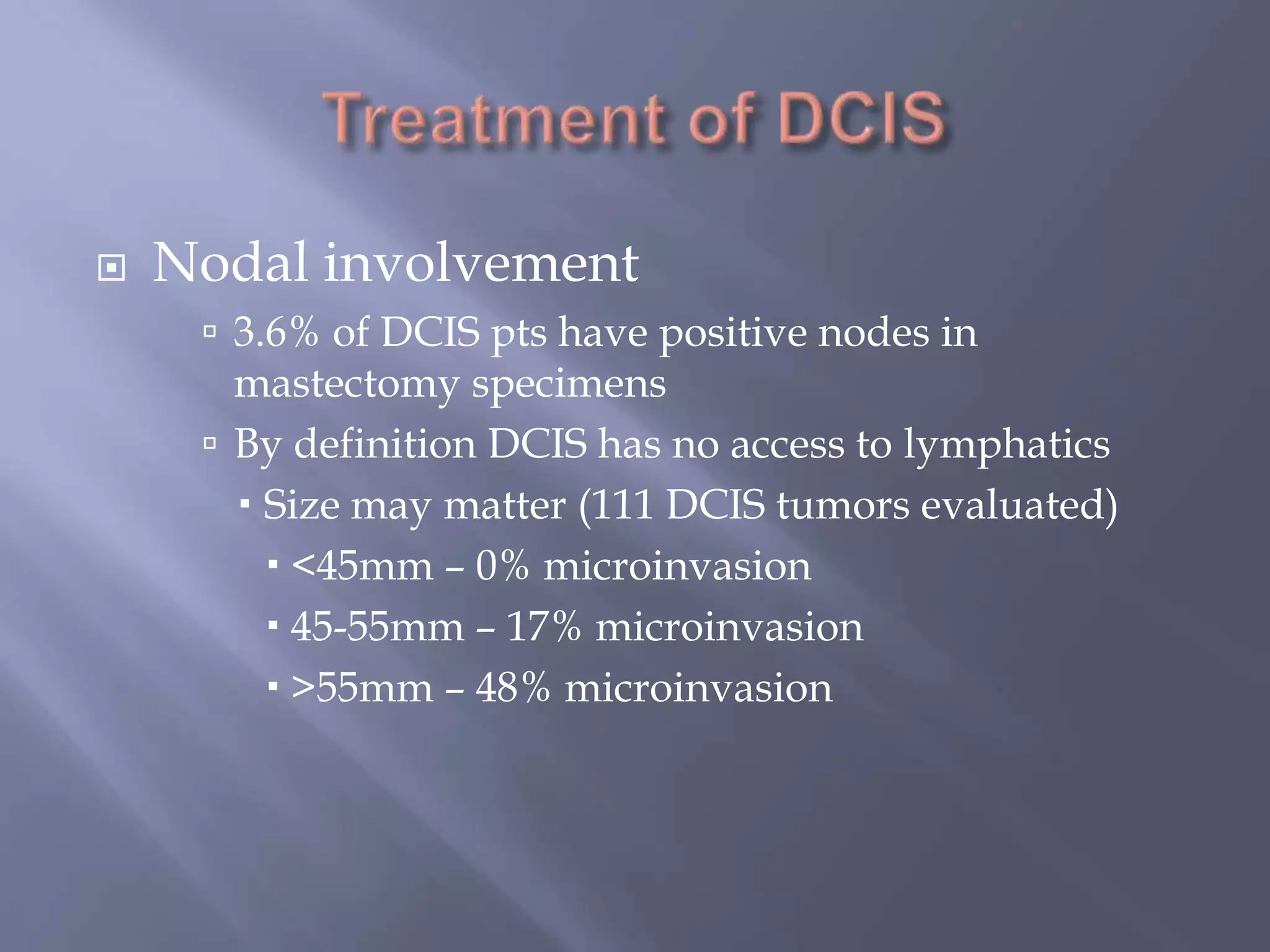
Treatment of DCISNodal involvement3.6% of DCIS pts have positive nodes in mastectomy specimensBy definition DCIS has no access to lymphaticsSize may matter (111 DCIS tumors evaluated)<45mm – 0% microinvasion45-55mm – 17% microinvasion>55mm – 48% microinvasion
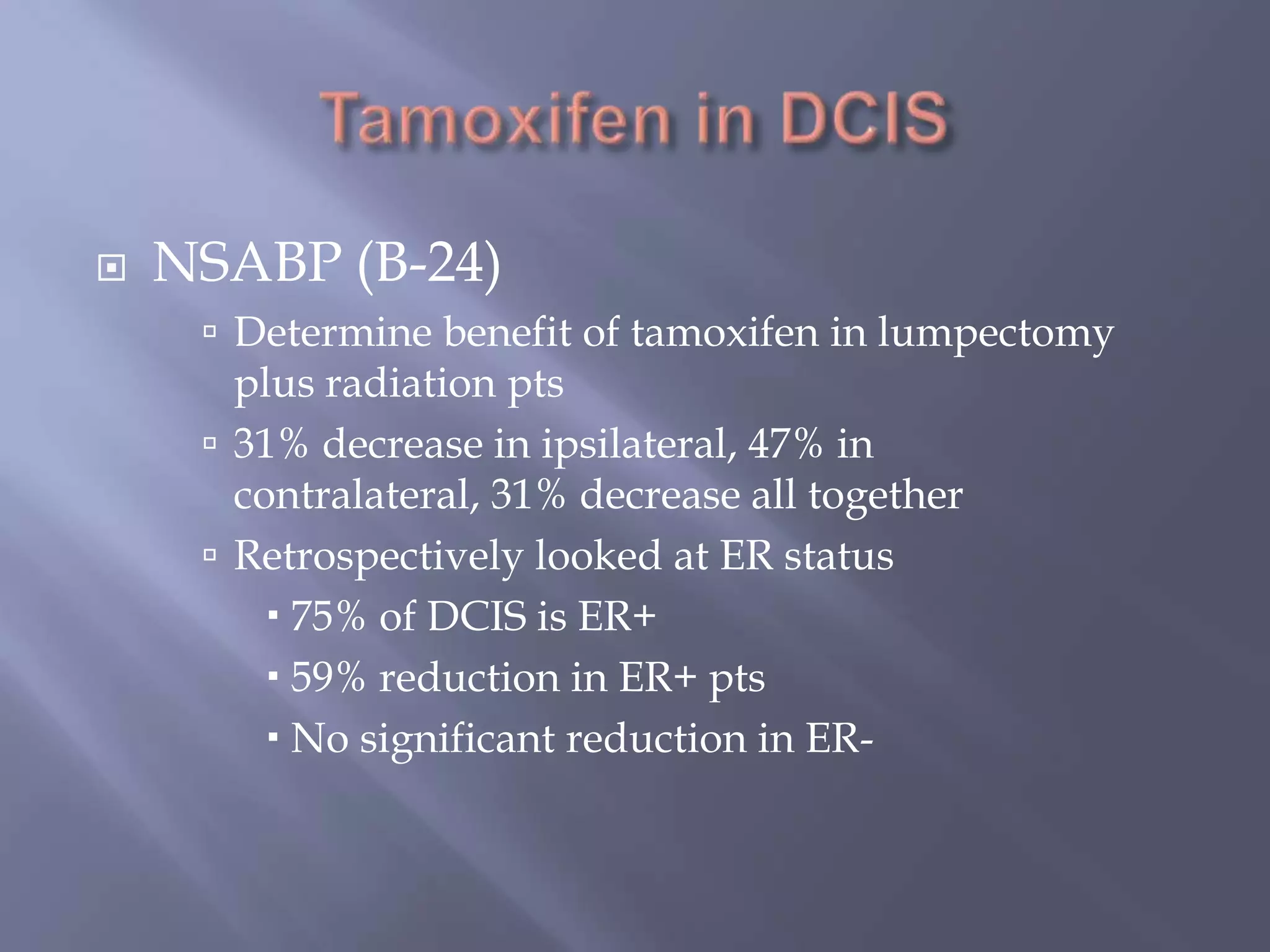
Tamoxifen in DCISNSABP (B-24)Determine benefit of tamoxifen in lumpectomy plus radiation pts31% decrease in ipsilateral, 47% in contralateral, 31% decrease all together Retrospectively looked at ER status75% of DCIS is ER+59% reduction in ER+ ptsNo significant reduction in ER-
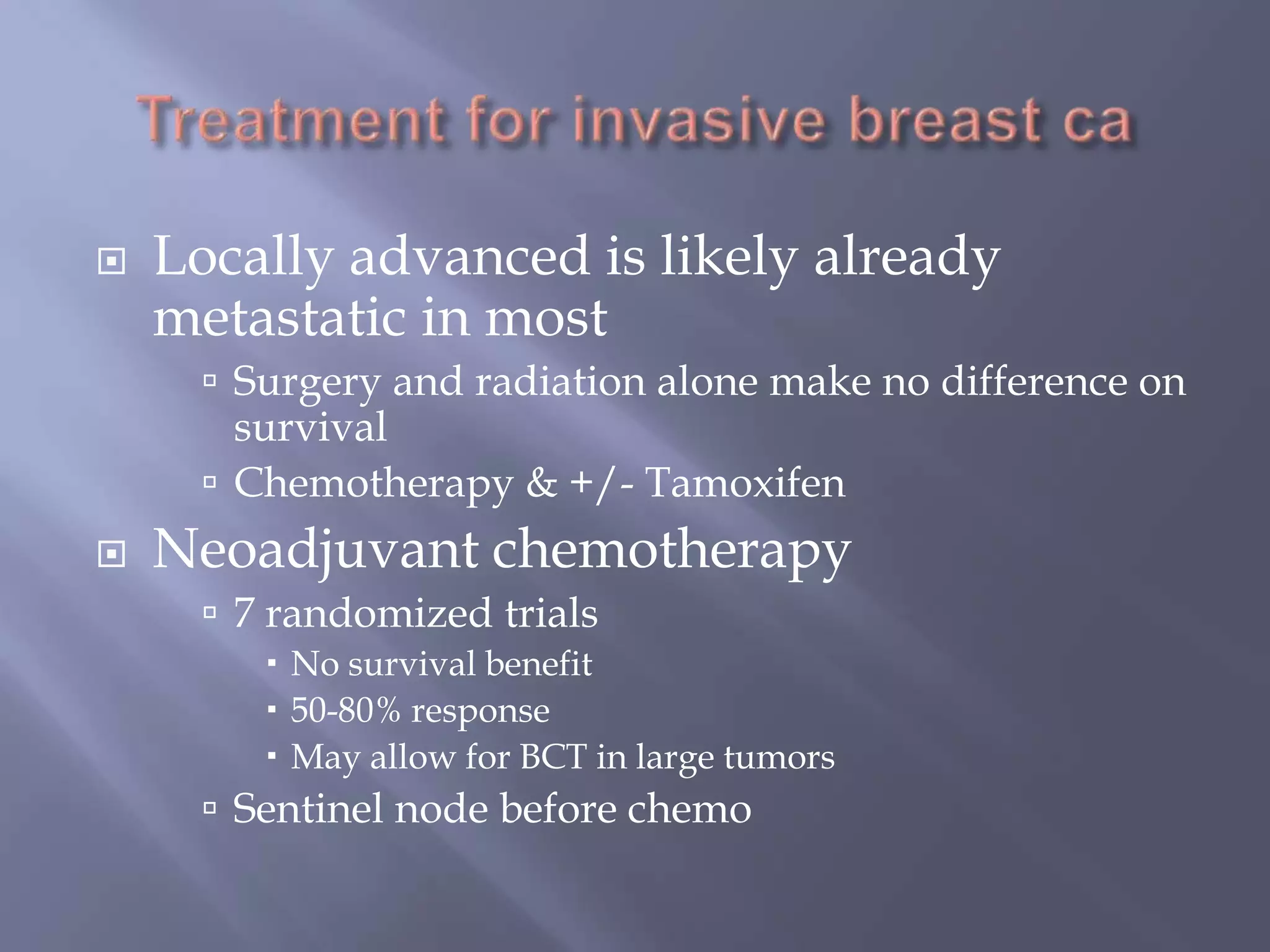
Treatment for invasive breast caLocally advanced is likely already metastatic in mostSurgery and radiation alone make no difference on survivalChemotherapy & +/- TamoxifenNeoadjuvant chemotherapy7 randomized trialsNo survival benefit50-80% responseMay allow for BCT in large tumorsSentinel node before chemo
TamoxifenIndicationsER + breast caLCISBRCA1/2Increased overall riskBenefitsDecreases risk of ca in other breast by 47-80% Draw backsIncreases endometrial ca risk by 2.5, PE 3.0, DVT 1.7Source: NSABP P-1 trial
ChemotherapyEarly Breast Cancer Trialists’ Collaborative GroupDecreases recurrence (12%) and death (11%) regardless of nodal statusIndicationsAll patients except node negative, <10mm tumorsRegimensMultidrug combination chemotherapyTamoxifen or aromatse inhibitor - ER positive tumorsHerceptin (trastuzumab) – HER2/neu positive tumorsNSABP B-31 – 33% reduction in risk of death
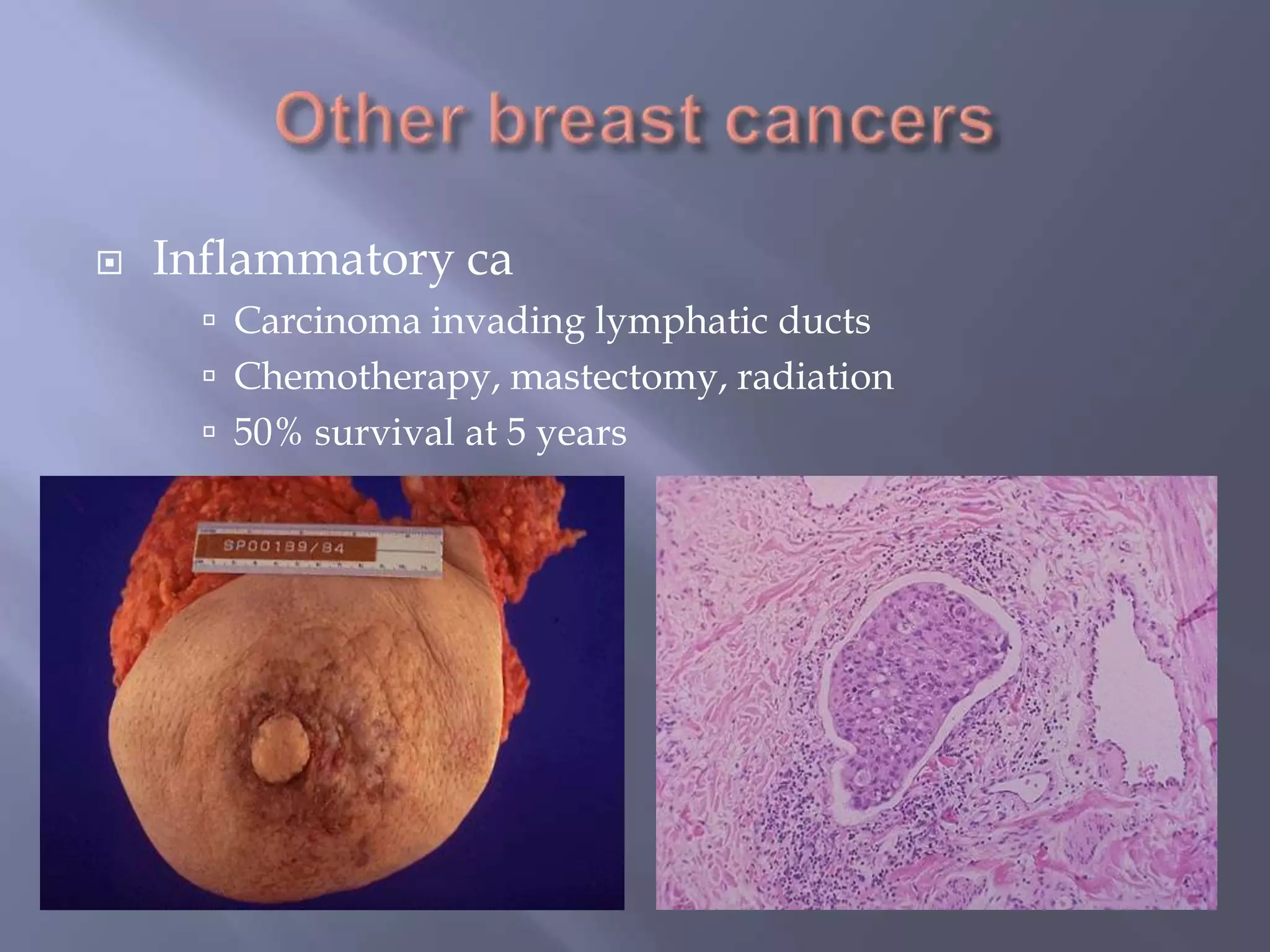
Other breast cancersInflammatory caCarcinoma invading lymphatic ductsChemotherapy, mastectomy, radiation50% survival at 5 years
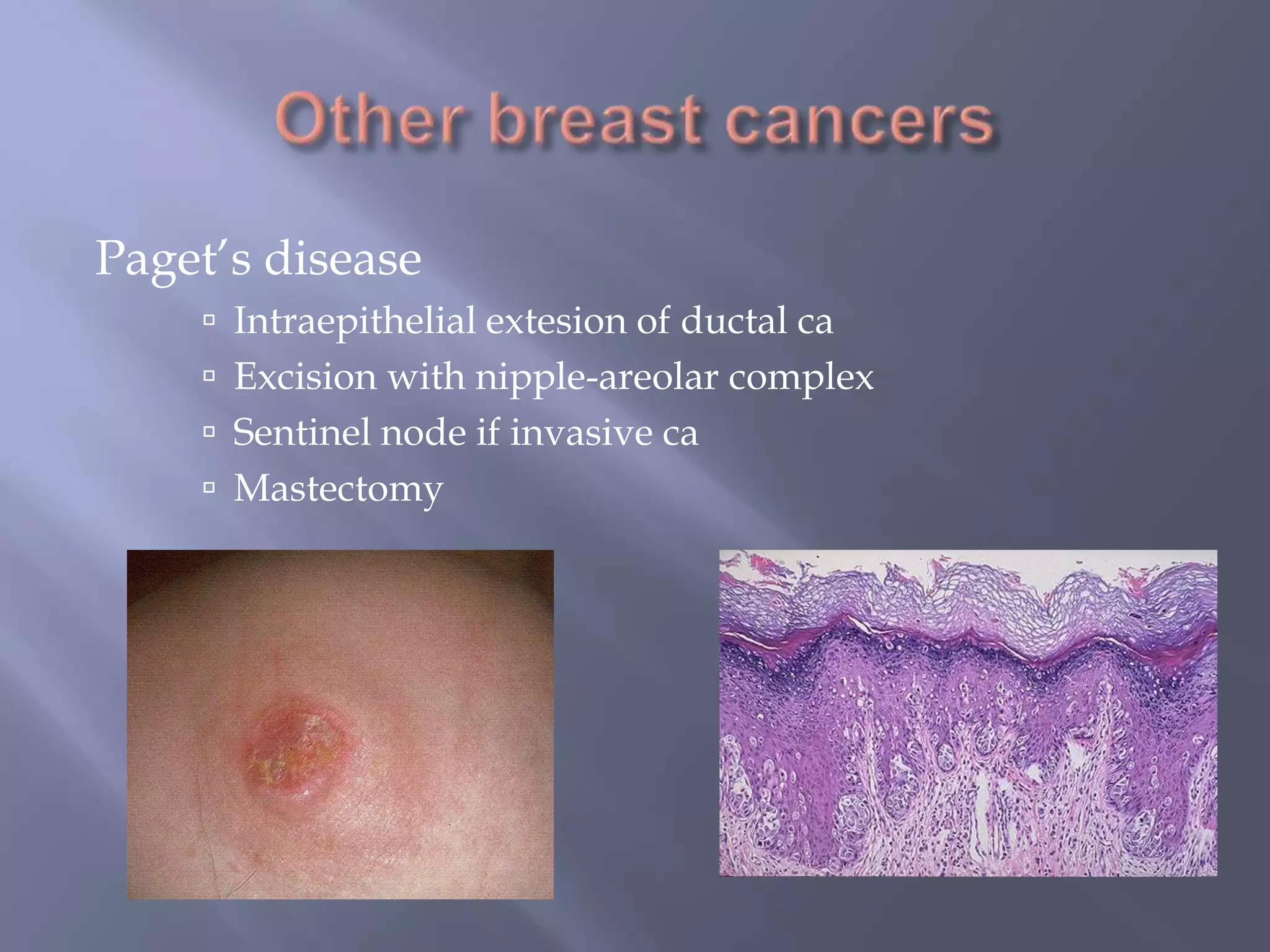
Other breast cancersPaget’s diseaseIntraepithelial extesion of ductal caExcision with nipple-areolar complexSentinel node if invasive caMastectomy
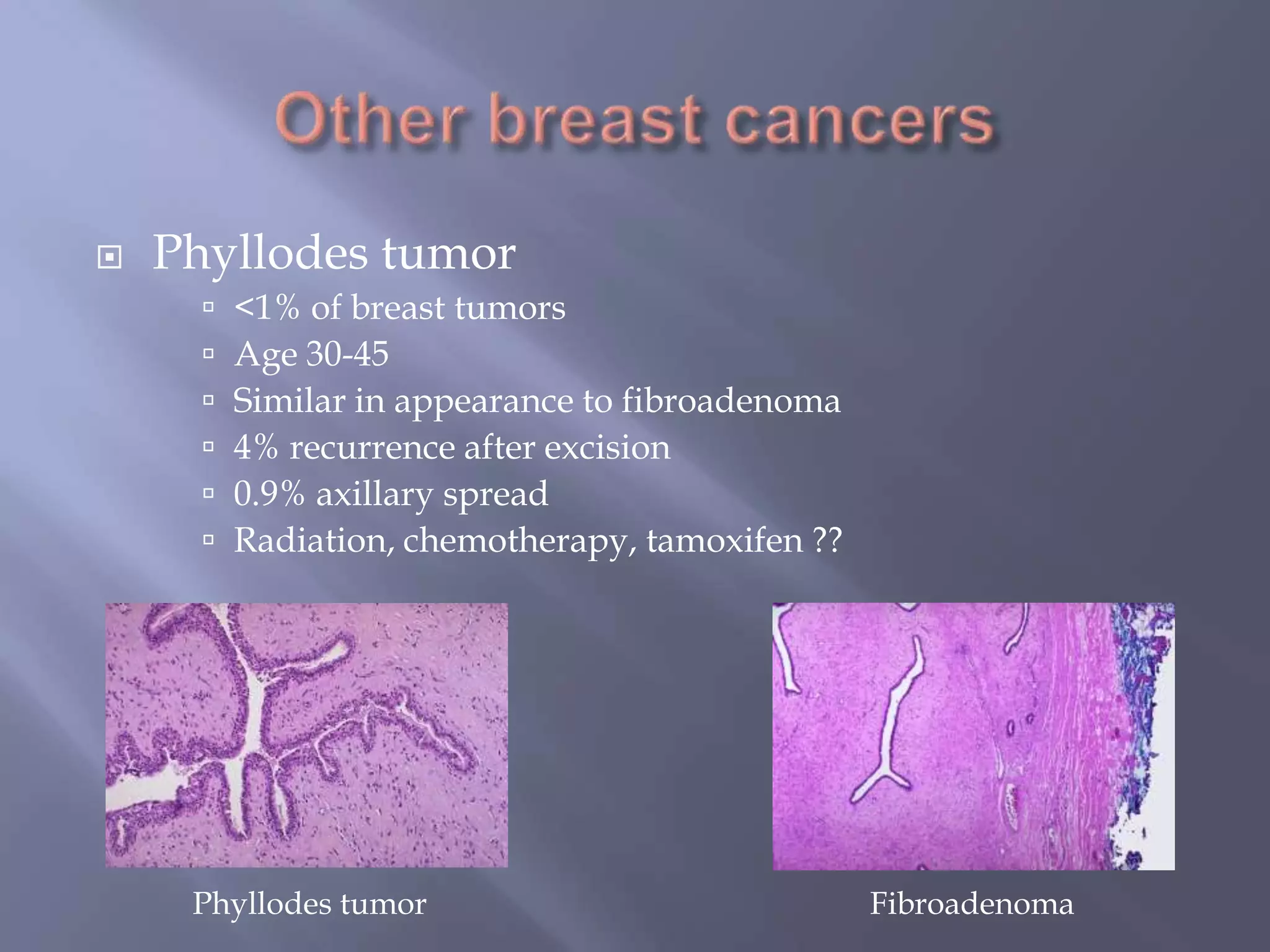
Other breast cancersPhyllodes tumor<1% of breast tumorsAge 30-45Similar in appearance to fibroadenoma4% recurrence after excision0.9% axillary spreadRadiation, chemotherapy, tamoxifen ??Phyllodes tumorFibroadenoma
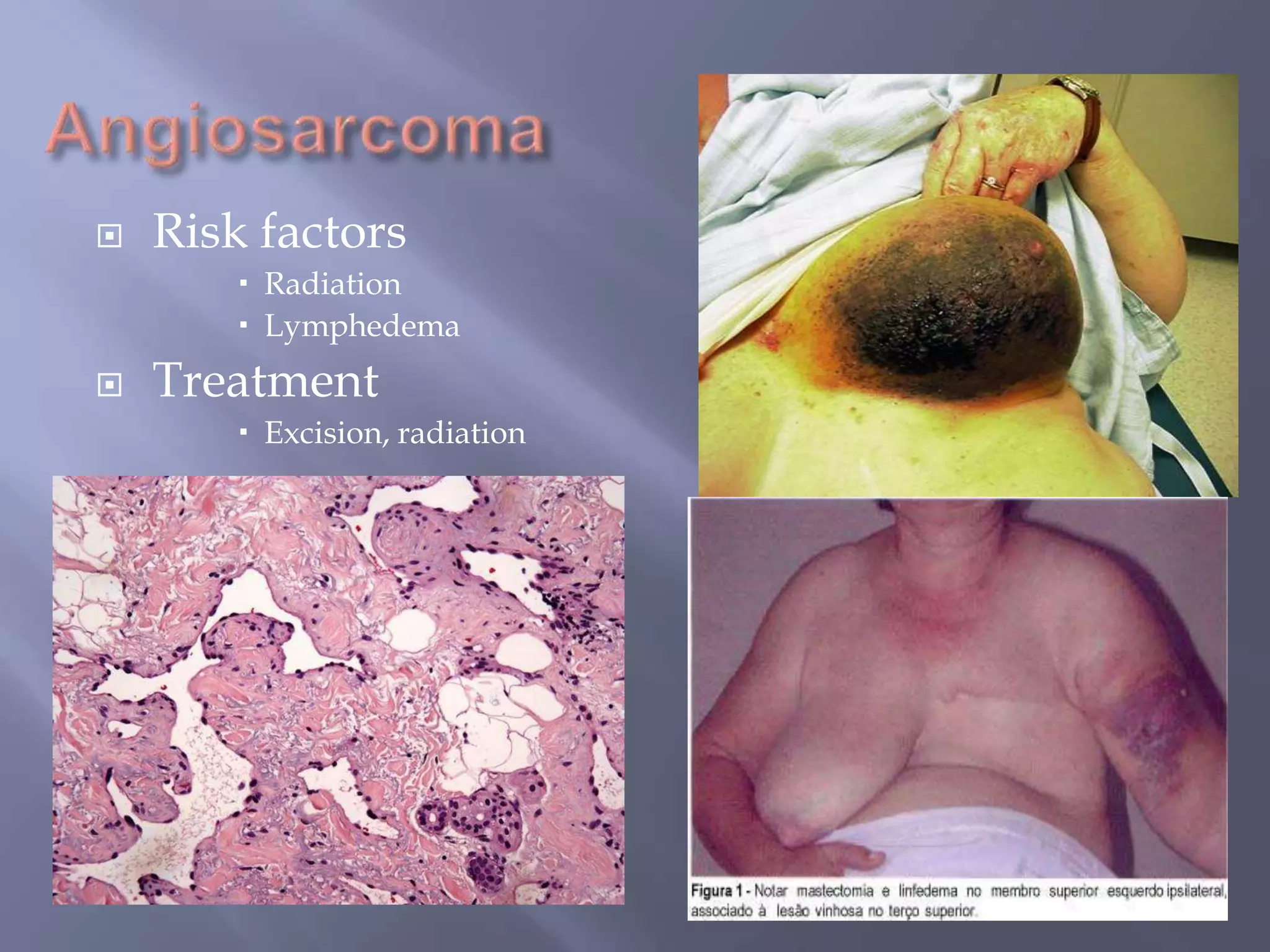
AngiosarcomaRisk factorsRadiationLymphedemaTreatmentExcision, radiation
Male breast cancer90% are invasive at time of diagnosis80% ER+, 75% PR+, 30% HER2/neuMore invade into pectoralisTreatment same as for female ca

C A B R E A S T

  • 1.
  • 2.
    IntroductionMost common femalecancerAccounts for 32% of all female cancer211,300 new cases yearly and rising40,000 deaths yearly
  • 3.
    Gross AnatomySappy’s plexus– lymphatics under areolar complex
  • 4.
    75% of lymphaticsflow to axillaMicroscopic AnatomyStromal tissueConnective tissue, capillaries, lymphocytes, etc.Adipose tissueDuctal tissueSquamous epitheliumColumnar or cuboidal epitheliumLobular tissue
  • 5.
  • 6.
    Familial Breast CancerCause5-10% of all cancer and 25% in women <30 y/oBRCA2Causes 40% of familial breast CA50-70% - breast15-45% - ovarianIncreased risk for prostate, colonBRCA150-70% - breast20-30% - ovarianIncreased risk for prostate, pancreatic, laryngeal,
  • 7.
    Screening MammographyRecommendationsBiannually orannually in 40-49 y/oAnnually in >50 y/o15% relative risk reductionBirads0 - Incomplete assessment; need additional imaging evaluation 1 - Negative; routine mammogram in 1 year recommended 2 - Benign finding; routine mammogram in 1 year recommended 3 - Probably benign finding; short-term follow-up suggested (3%)4 - Suspicious abnormality; biopsy should be considered (30%)5 - Highly suggestive of malignancy; appropriate action should be taken (94%)
  • 8.
    Biopsy techniquesFNADiagnostic andtherapeutic in cystic lesionsCore needleU/S guided or sterotatic90% effective in establishing diagnosisAtypia – need excisionStereotaticNeedle localizationExcision biopsy
  • 9.
    Risk of FutureInvasive Breast CarcinomaNo Increase AdenosisApocrinemetaplasiaCysts, small or largeMild hyperplasia (>2 but <5 cells deep)Duct ectasiaFibroadenomaFibrosisMastitis, inflammatoryPeriductal mastitisSquamousmetaplasiaSlightly Increased (relative risk, 1.5–2) Moderate or florid hyperplasia, solid or papillaryDuct papilloma with fibrovascular coreSclerosingadenosis, well-developedModerately Increased (relative risk, 4–5) Atypical hyperplasia, ductal or lobular
  • 10.
  • 11.
    Maligant Breast MassesDuctalcarcinomaDCISInvasiveLobular carcinomaLCISInvasiveInflammatory carcinomaPaget’s diseasePhyllodes tumorAngiosarcoma
  • 12.
  • 13.
    DCISDuctal carcinoma insitu (DCIS)1. Solid type*2. Cribiform type3. Papillary type4. Comedo type*
  • 14.
  • 15.
  • 16.
    StagingTumorTis: in situT1:<2cmT2: 2-5cmT3: >5cmT4: invasion of skin or chest wallNodeN1: 1-3 axillary nodes or intmam nodeN2: 4-9 axillary nodes or palpable intmam nodeN3: >10 nodes or combo of axillary and intmam nodes{micmicoroscopicposivitiy, mol molecular posiivityMetastasis
  • 17.
    Modified Radical MastectomyEntirebreast tissue and Level I & II nodesSurvival at 10 yrsNegative nodes – 82% (5% local recurrence)Positive nodes – 48% (5% local recurrence)Modified radicalSimple mastectomy
  • 18.
    Breast Treatment TrialsNSABP(1971 with B-04 update in 2002)Compared radical, vs modified radical +/- radiationNo survival diff for node neg or pos between three arms75% of recurrences occur in 5 yearsTumor location not important
  • 19.
    Breast Treatment TrialsOntariostudyAll pts got lumpectomy, randomized to radiation or no radiation25% failure rate without radiation, 5% withNSABP B-06Mastecomyvs lumpectomy vs lumpectomy with radiationNo difference in survival39% recur with lumpectomy, reduced to 14% with radiation, 3-4% with mastectomy0.5-1% per year recurrence rate for life with BCT and radiation2-5% complication rate with radiation (rib fx, pericarditis, cosmesis)
  • 20.
    Radiation after mastectomy?2Danish studies and one Britsh studyRecommend in: >3 nodes positive, aggressive/large tumors or extranodal invasionDecreased local or regional recurrence+/- survival benefit
  • 21.
    Sentinel node biopsyContraindications:Clinicallypositive nodes, pregnant or nursing, prior axillary surgery, locally advanced diseaseFalse negative rate 3.1%Macrometases (>0.2cm) so recommended pathology cuts are 0.2 cmMicrometases (IHC staining) 37% death rate vs 50% of those with macrometasesIf sentinel node positive 43% will have other nodes positive and 24% will have >4 nodes positiveNSABP (B-32) in progress
  • 22.
    Treatment of DCIS600%increase after mammographyOptionsMastectomy – 1% breast ca mortalityLarge tumors, multicentric, positive margins after reexcision, Lumpectomy and radiationRadiation decreases local recurrence by 50%Of those that recur 50/50 DCIS vs Invasive0-3% chance of dying of malignant breast ca for all DCIS
  • 23.
    Treatment of DCISNodalinvolvement3.6% of DCIS pts have positive nodes in mastectomy specimensBy definition DCIS has no access to lymphaticsSize may matter (111 DCIS tumors evaluated)<45mm – 0% microinvasion45-55mm – 17% microinvasion>55mm – 48% microinvasion
  • 24.
    Tamoxifen in DCISNSABP(B-24)Determine benefit of tamoxifen in lumpectomy plus radiation pts31% decrease in ipsilateral, 47% in contralateral, 31% decrease all together Retrospectively looked at ER status75% of DCIS is ER+59% reduction in ER+ ptsNo significant reduction in ER-
  • 25.
    Treatment for invasivebreast caLocally advanced is likely already metastatic in mostSurgery and radiation alone make no difference on survivalChemotherapy & +/- TamoxifenNeoadjuvant chemotherapy7 randomized trialsNo survival benefit50-80% responseMay allow for BCT in large tumorsSentinel node before chemo
  • 26.
    TamoxifenIndicationsER + breastcaLCISBRCA1/2Increased overall riskBenefitsDecreases risk of ca in other breast by 47-80% Draw backsIncreases endometrial ca risk by 2.5, PE 3.0, DVT 1.7Source: NSABP P-1 trial
  • 27.
    ChemotherapyEarly Breast CancerTrialists’ Collaborative GroupDecreases recurrence (12%) and death (11%) regardless of nodal statusIndicationsAll patients except node negative, <10mm tumorsRegimensMultidrug combination chemotherapyTamoxifen or aromatse inhibitor - ER positive tumorsHerceptin (trastuzumab) – HER2/neu positive tumorsNSABP B-31 – 33% reduction in risk of death
  • 28.
    Other breast cancersInflammatorycaCarcinoma invading lymphatic ductsChemotherapy, mastectomy, radiation50% survival at 5 years
  • 29.
    Other breast cancersPaget’sdiseaseIntraepithelial extesion of ductal caExcision with nipple-areolar complexSentinel node if invasive caMastectomy
  • 30.
    Other breast cancersPhyllodestumor<1% of breast tumorsAge 30-45Similar in appearance to fibroadenoma4% recurrence after excision0.9% axillary spreadRadiation, chemotherapy, tamoxifen ??Phyllodes tumorFibroadenoma
  • 31.
  • 32.
    Male breast cancer90%are invasive at time of diagnosis80% ER+, 75% PR+, 30% HER2/neuMore invade into pectoralisTreatment same as for female ca