PERSONAL REFLECTIVE WRITING
Choosing what to write about It shouldn’t be too hard for you to choose a topic. After all, you know yourself better than anyone else does.  Only you have lived your life.  You are the only person in the world who has had your particular set of experiences.  You are the only person in history who ever had the exact set of family and friends that you have.  Your brain is the only one in the entire universe to hold your set of memories, thoughts and feelings. You are unique, interesting and well worth writing about.
TASK - Now try this… Stop and think.  Is there a  childhood experience  you have had which matters to you very much, one that you’d like to write about in your Personal Reflective essay? If there is, write it down now and keep that note.
Narrowing down your ideas
Different Experiences… If you don’t already have a subject in mind, then it may help you to think very quickly about a lot of different experiences you may have had, to see if any of them are suitable for a longer piece.
TASK - Now try this… Can you write just one paragraph for each option below? What is the worst thing that has ever happened to you? What is the hardest thing that has ever happened to you? What is the happiest thing that has ever happened to you? What is the saddest thing that has ever happened to you? What is the most frightening thing that has ever happened to you? What is the strangest thing that has ever happened to you?
TASK - Now try this… Can you write just one paragraph for each of these options below? Which event or time in your life: has most shaped you has made you grow up or mature has most changed your family has been most confusing showed you the best of people/someone showed you the worst of people/someone?
TASK - Now try this… Now you are going to think about some ways a person could make an impact on life. Again, can you write just one paragraph for each option below?
Which person: has most influenced you ? has most helped you ? has most hurt you ? do you miss most ? are you most glad to be rid of ?
Now try this…. You should now have up to seventeen short paragraphs in front of you.  Read them over. Is there one you could write about in depth in your Personal Reflective essay?  If there is, write it down now and put your note somewhere safe.
Thoughts and feelings
Details and descriptions Because your memories are important to you, when you bring them to mind they will be full of tiny details, things you noticed at the time.  Many of these details might not be very important in themselves, but they become important because they bring that memory to life.
The most forbidden of places was my father’s bedside drawer. I had never been told not to go there; I just knew it was out of bounds. A secret place. An ivory coloured drawer set in a glossy black table, gold handle, its perfect patina interrupted only by a ring burned in the top by a hot mug. My mother’s, on the other hand, was an open book. A jumble of tissues and hairpins, powder compacts and sweets. Home to one of the many Ventolin inhalers tucked discreetly around the house. His drawer was neat, and smelled of the cortisone cream he smoothed into his hands in the autumn when each year a weird rash would flare up. There were several opened tubes of Setlers. There were several menus of dinners he had been to, often with the signatures of those who had attended inside. Setlers were as much a part of my dad’s DNA as his pipe and his Daily Telegraph. The chalky white tablets went everywhere with him; half and quarter packets were in every jacket pocket, including the one in his suede waistcoat, and in the glove box of the car. Ten times a day he would rub his sternum and tear another strip of wrapper off his indigestion pills.
This short passage is stuffed with tiny details.  We know exactly what each of Nigel Slater’s parents kept in their bedside drawers, and what one of the table tops looked like.  We know all about his father’s addiction to indigestion tablets.
TASK - Now try this… Read the following extract from Chris Stewart’s book The Almond Blossom Appreciation Society.  As you read it, make a list of the small details which make it seem vivid and Convincing.
At the beginning of the year, my daughter Chloe and I decided that we had to get fit, and that the best way to do this would be to create a running track in the riverbed. We go there every evening now and our pounding feet have marked out a fairly clear circuit. The grass is long and makes a pleasant thripping noise as you race along, and in spring the ground is sprinkled with dandelions and daisies which grow so dense that, through half-shut eyes, you might be running though a field of cream. The track, however, remains just a bit too rustic for a good sprint. You have to be careful to hop over the thistles, skip to avoid an ankle-cracker of a stone, and cut close to the broom bush on the third turn while ducking to avoid a poke in the eye. The second turn is between the third and fourth euphorbia bushes and the start and finish is at the tamarisk tree where we hang our sweaters. The going is soft sandy turf.
As we returned from our run the other night Chloe called me excitedly to the gate. I turned back and looked where she was pointing. There, battling its way across the track was a dung beetle. This particular beetle had lost its jet—black shine under a thick covering of dust. It was steering a ball of dung with its back legs, while it scrabbled for purchase with its horny front legs. Progress was unthinkably difficult as the ground was rough, and of course it was quite unable to see where it was going, head down, facing away from the desired direction of travel. The ball kept going out of control and rolling over the poor creature, yet without so much as a moment to dust itself down, the beetle picked itself up and patiently resumed rolling on its intended course.
Using Dialogue
Using dialogue One more thing you can do to bring your writing to life is to put speech into it. If you can’t remember the exact words you and other people said, you can make up something which sounds like what you remember.
For Example…. Here is Andrew Collins writing about when he was a student in London, and went to see a flat he and his friend Rob were interested in renting.
There was no sign of Mr. Rabbit outside at the pre- arranged time. We rang the bell. No answer. Then we heard a disembodied posh voice. ‘ Are you looking for Claire?’ Rob and I stepped back from the door into the apology for a front garden and craned our necks. A dark-haired woman had her head out of the window on the top floor. ‘ No, we’ve come to see Flat 2.’ ‘ Oh. OK.’ She put her head back in and closed the window Then a light came on in the hail and the front door opened.A girl who looked like she had hauled herself out of her sickbed was standing at the crack in the front door. Rob went forward. ‘We’re supposed to be meeting Mr. Rabbit?’ ‘ Rabeet.’ She said his name the way the poor of Nottingham in Robin Hood’s time must have uttered the name of the sheriff. ‘You can come in if you like.’ She introduced us to a second pallid girl. They were student nurses. They didn’t exactly sell the place. ‘ You’ve got access to the garden, but it’s so overgrown we’ve never been out there to be honest.’ ‘ What’s the central heating like?’ The nurse gave a rueful but not unkind Snort. ‘There are gas fires in both fireplaces. Bit dodgy, but we leave them on all evening.’ ‘ That sounds a bit pricey,’ said Rob through a sharp intake of breath, the very picture of his own dad as usual. ‘ It’s the only way to warm the place up.’
TASK - Now try this… Just to show why the version with dialogue is better, try to rewrite this piece so that we get all the same information, but without any of the characters speaking.
Being Reflective
Being reflective So far, in looking at using thoughts, feelings, details, descriptions and dialogue, we have been concentrating on the basic skills of Personal Writing.  However this task is called  Personal Reflective Writing.   To be able to pass, you need to write reflectively. This is something that only mature and insightful writers are able to do. This means  two things  at once.
Something to think about.. If you stand in front of a mirror you can examine yourself pretty thoroughly by looking at your reflection.  Every spot and blemish will be visible, but you’ll also be able to see all your good features and everything that you like about yourself.
The  first  meaning of reflection…. That’s the first meaning of being reflective in Writing —  examining yourself. You might question and criticise yourself. On the other hand you might realise that you handled the situation well. You may realise that certain experiences have shaped you and made you into the person you are, just as growing up changes the way your face looks in the mirror.
Something to think about.. Now think of the rear view mirror in a car. The driver can keep his or her eyes on the road ahead, while using the mirror to see what is happening behind.
The  second  meaning of reflection That’s the second meaning of reflection:  looking back .  Often events in our lives make much more sense once they are over and we are older and wiser. Perhaps when something happened to you it was a really terrible experience, but now you realise that you benefited from it in some way.  Events may be confusing when they happen, but when you look back on them they may make more sense.
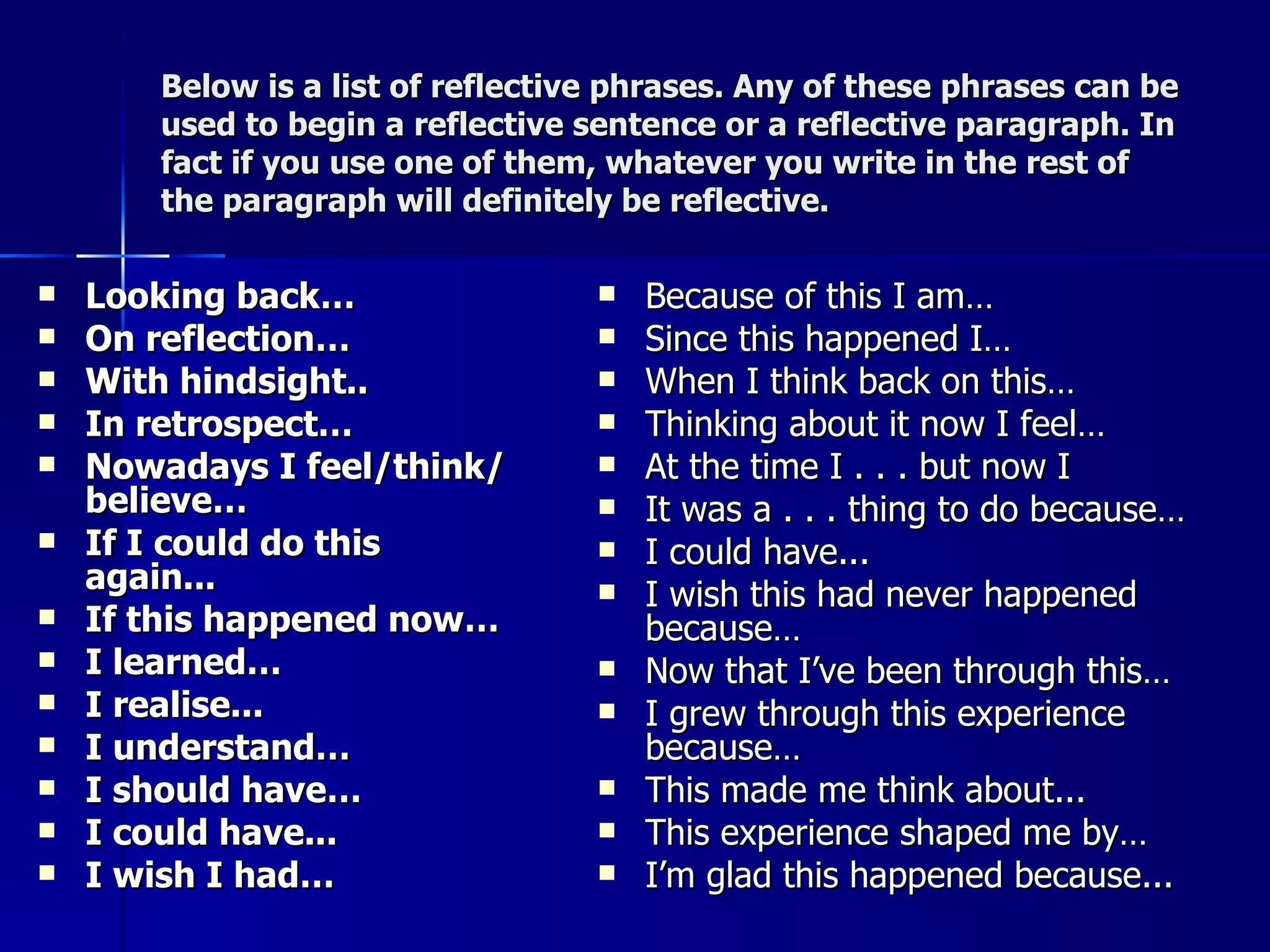
Below is a list of reflective phrases. Any of these phrases can be used to begin a reflective sentence or a reflective paragraph. In fact if you use one of them, whatever you write in the rest of the paragraph will definitely be reflective. Looking back… On reflection… With hindsight.. In retrospect… Nowadays I feel/think/believe… If I could do this again... If this happened now… I learned… I realise... I understand… I should have… I could have... I wish I had… Because of this I am… Since this happened I… When I think back on this… Thinking about it now I feel… At the time I . . . but now I It was a . . . thing to do because… I could have... I wish this had never happened because… Now that I’ve been through this… I grew through this experience because… This made me think about... This experience shaped me by… I’m glad this happened because...
Writing your personal reflective piece
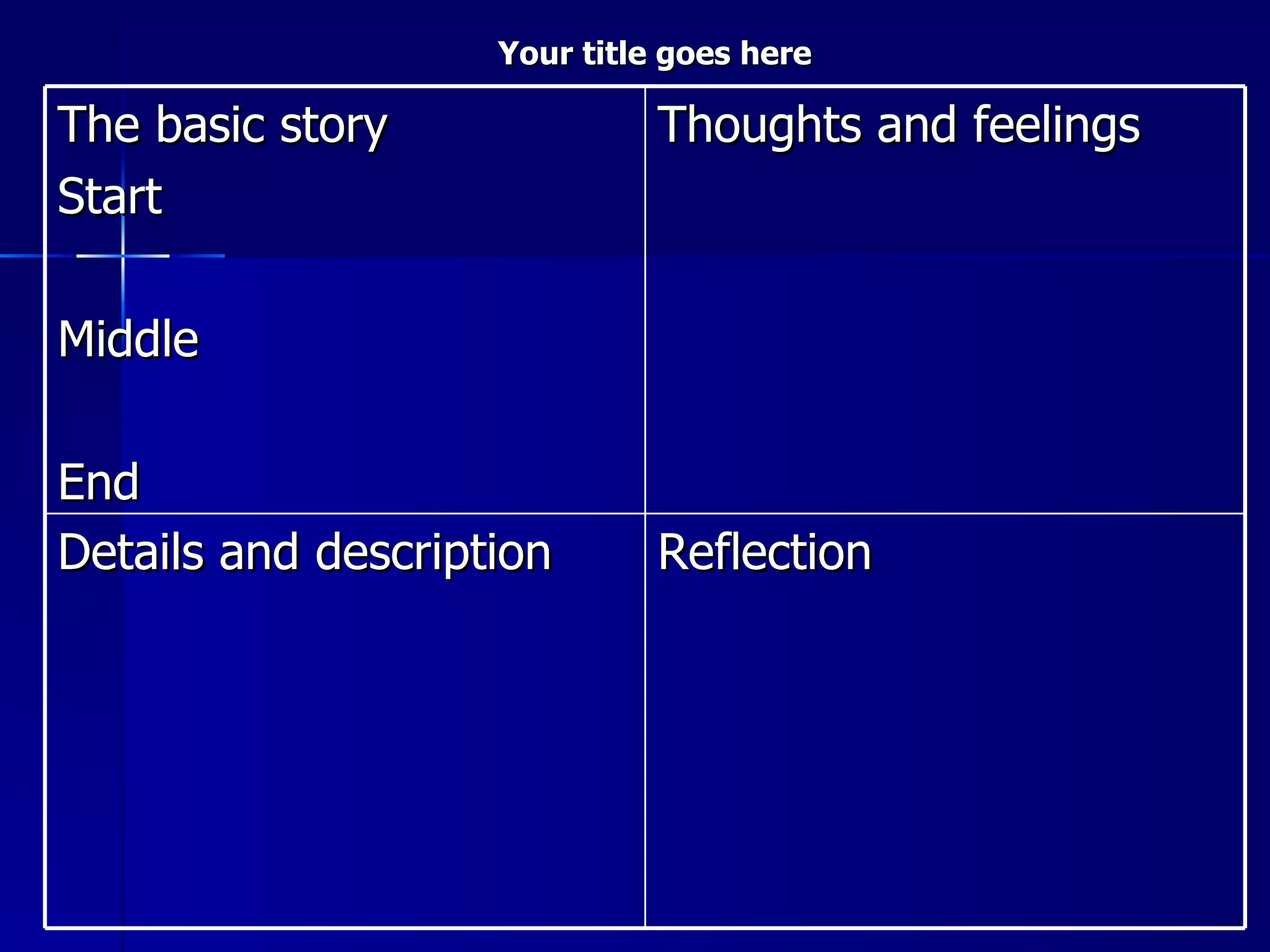
TASK - Now try this… Take a new sheet of paper, at least A4 size. At the top write the task you have chosen.  Then divide the rest of the page into 4 squares with headings as shown on the next page.
Now… Then use the four squares to plan what you want to put in to your piece of work.  Key words, phrases or bullet points will do fine.  It’s probably easiest if you start with the top left box, where you slot in the rough outline of the story that you’re telling.  Then go on and fill in the other boxes.
Your title goes here The basic story  Start Middle End Thoughts and feelings Details and description  Reflection
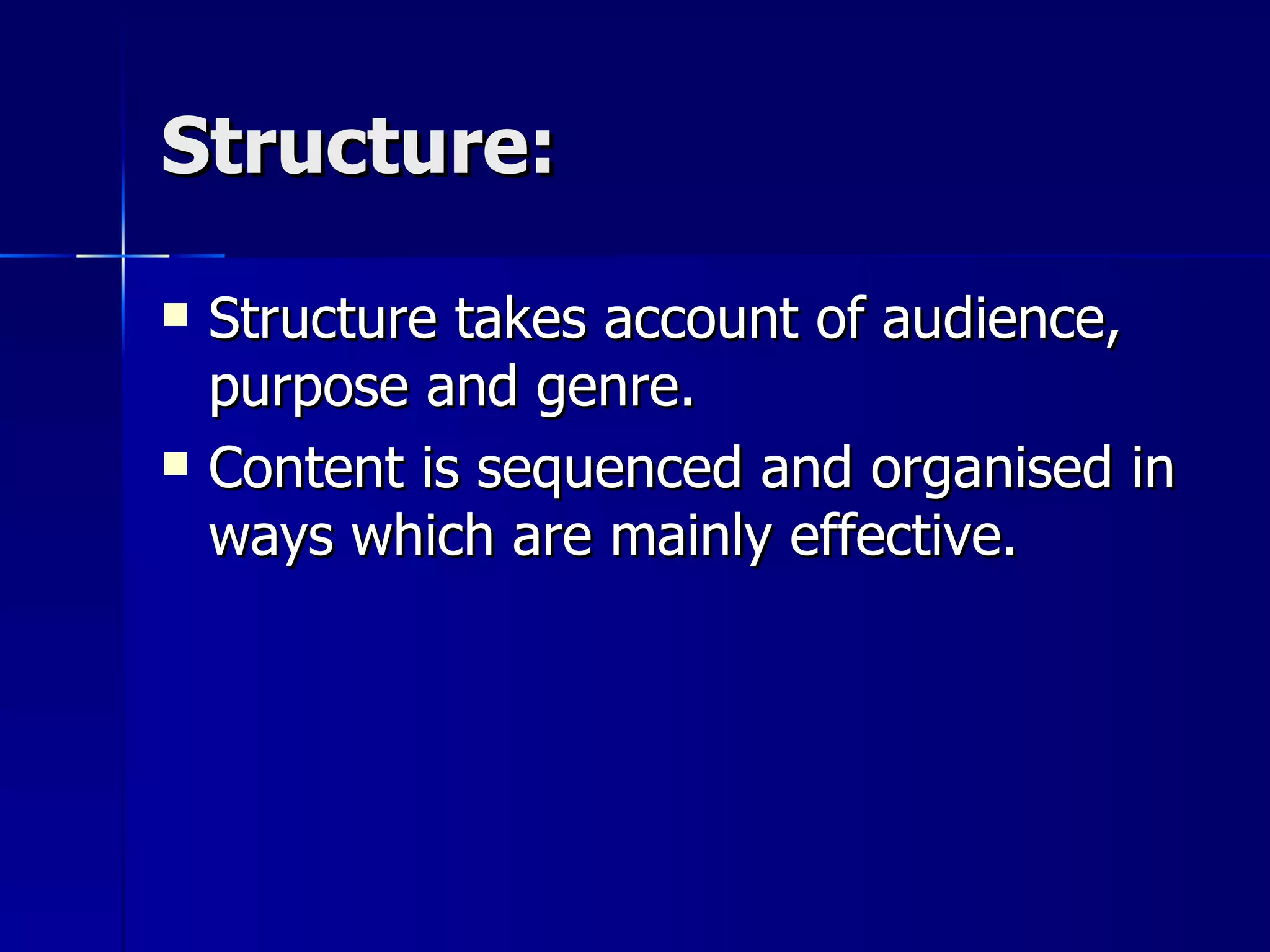
Structure: Structure takes account of audience, purpose and genre. Content is sequenced and organised in ways which are mainly effective.
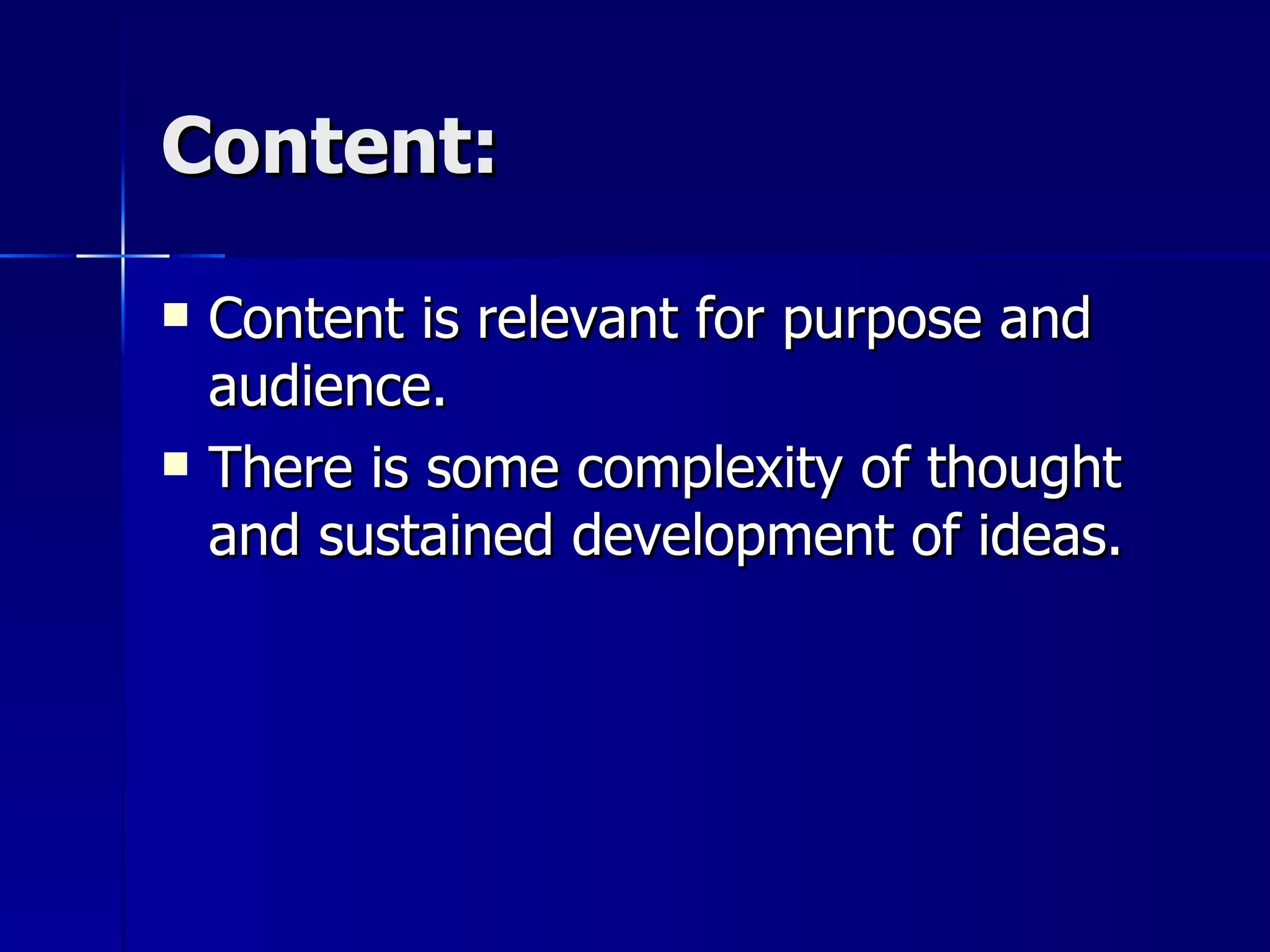
Content: Content is relevant for purpose and audience.  There is some complexity of thought and sustained development of ideas.
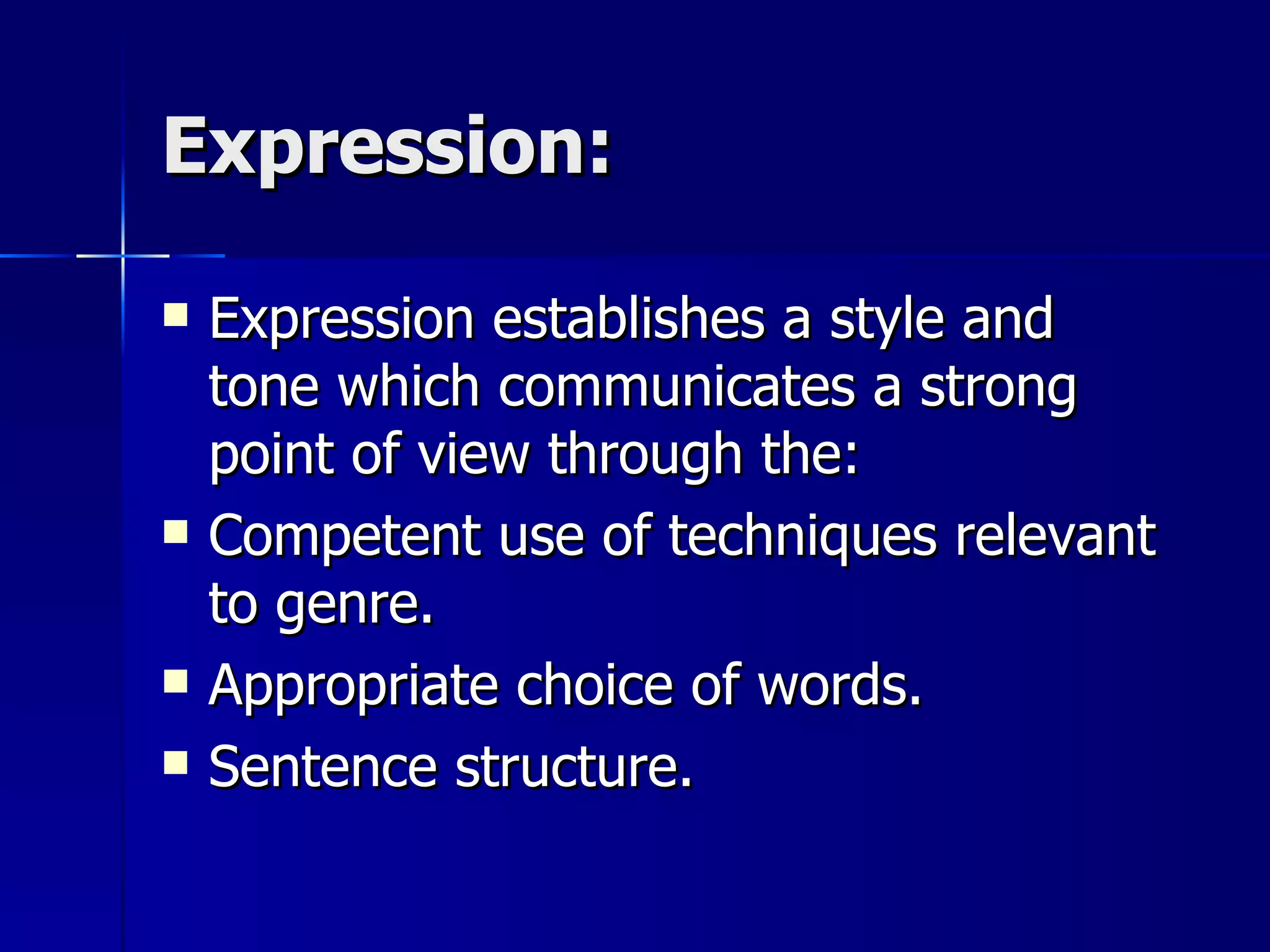
Expression: Expression establishes a style and tone which communicates a strong point of view through the: Competent use of techniques relevant to genre. Appropriate choice of words. Sentence structure.
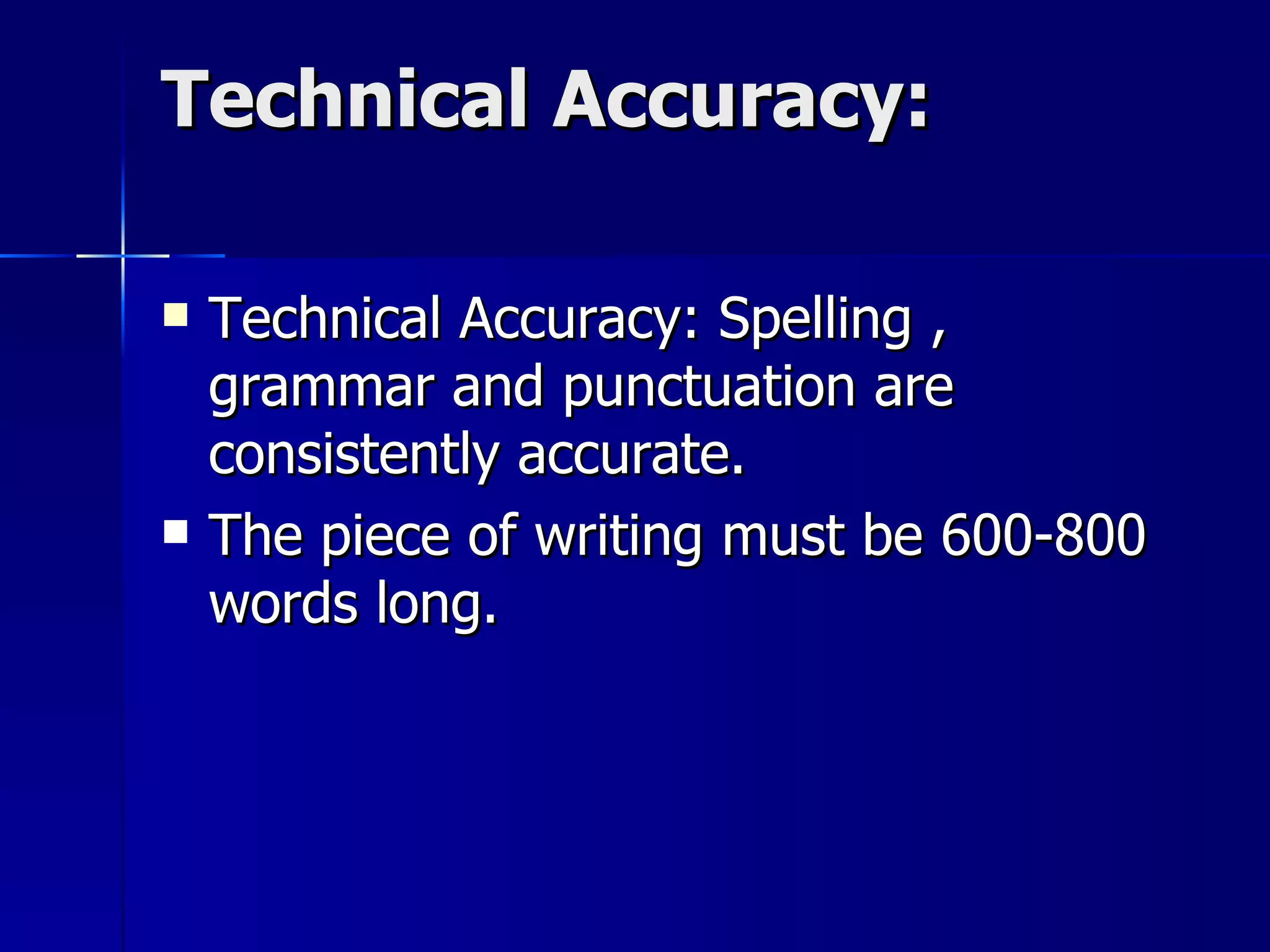
Technical Accuracy: Technical Accuracy: Spelling , grammar and punctuation are consistently accurate.  The piece of writing must be 600-800 words long.
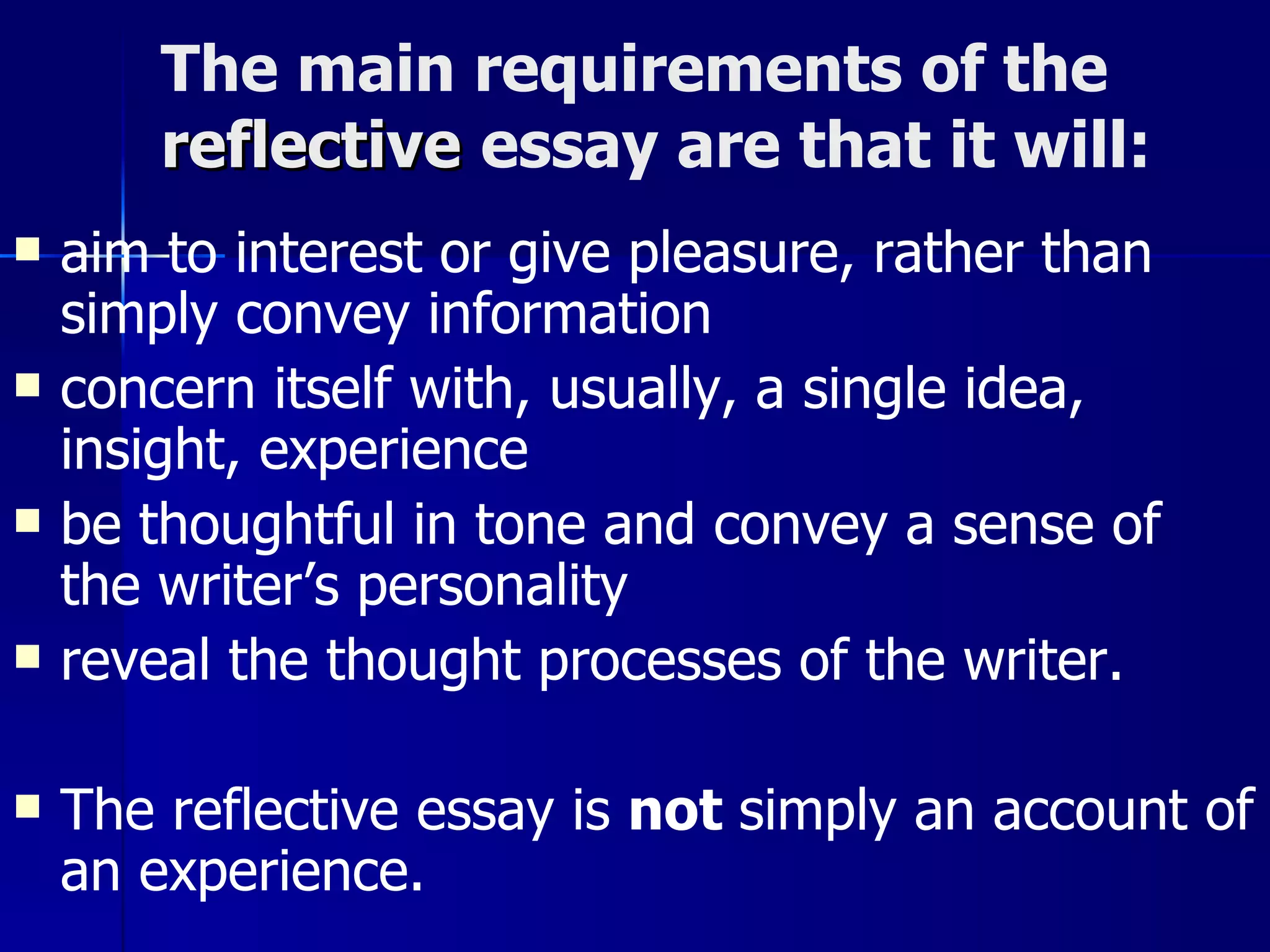
The main requirements of the  reflective   essay are that it will:  aim to interest or give pleasure, rather than simply convey information  concern itself with, usually, a single idea, insight, experience  be thoughtful in tone and convey a sense of the writer’s personality  reveal the thought processes of the writer.  The reflective essay is  not  simply an account of an experience.

Reflective writing sg

  • 1.
  • 2.
    Choosing what towrite about It shouldn’t be too hard for you to choose a topic. After all, you know yourself better than anyone else does. Only you have lived your life. You are the only person in the world who has had your particular set of experiences. You are the only person in history who ever had the exact set of family and friends that you have. Your brain is the only one in the entire universe to hold your set of memories, thoughts and feelings. You are unique, interesting and well worth writing about.
  • 3.
    TASK - Nowtry this… Stop and think. Is there a childhood experience you have had which matters to you very much, one that you’d like to write about in your Personal Reflective essay? If there is, write it down now and keep that note.
  • 4.
  • 5.
    Different Experiences… Ifyou don’t already have a subject in mind, then it may help you to think very quickly about a lot of different experiences you may have had, to see if any of them are suitable for a longer piece.
  • 6.
    TASK - Nowtry this… Can you write just one paragraph for each option below? What is the worst thing that has ever happened to you? What is the hardest thing that has ever happened to you? What is the happiest thing that has ever happened to you? What is the saddest thing that has ever happened to you? What is the most frightening thing that has ever happened to you? What is the strangest thing that has ever happened to you?
  • 7.
    TASK - Nowtry this… Can you write just one paragraph for each of these options below? Which event or time in your life: has most shaped you has made you grow up or mature has most changed your family has been most confusing showed you the best of people/someone showed you the worst of people/someone?
  • 8.
    TASK - Nowtry this… Now you are going to think about some ways a person could make an impact on life. Again, can you write just one paragraph for each option below?
  • 9.
    Which person: hasmost influenced you ? has most helped you ? has most hurt you ? do you miss most ? are you most glad to be rid of ?
  • 10.
    Now try this….You should now have up to seventeen short paragraphs in front of you. Read them over. Is there one you could write about in depth in your Personal Reflective essay? If there is, write it down now and put your note somewhere safe.
  • 11.
  • 12.
    Details and descriptionsBecause your memories are important to you, when you bring them to mind they will be full of tiny details, things you noticed at the time. Many of these details might not be very important in themselves, but they become important because they bring that memory to life.
  • 13.
    The most forbiddenof places was my father’s bedside drawer. I had never been told not to go there; I just knew it was out of bounds. A secret place. An ivory coloured drawer set in a glossy black table, gold handle, its perfect patina interrupted only by a ring burned in the top by a hot mug. My mother’s, on the other hand, was an open book. A jumble of tissues and hairpins, powder compacts and sweets. Home to one of the many Ventolin inhalers tucked discreetly around the house. His drawer was neat, and smelled of the cortisone cream he smoothed into his hands in the autumn when each year a weird rash would flare up. There were several opened tubes of Setlers. There were several menus of dinners he had been to, often with the signatures of those who had attended inside. Setlers were as much a part of my dad’s DNA as his pipe and his Daily Telegraph. The chalky white tablets went everywhere with him; half and quarter packets were in every jacket pocket, including the one in his suede waistcoat, and in the glove box of the car. Ten times a day he would rub his sternum and tear another strip of wrapper off his indigestion pills.
  • 14.
    This short passageis stuffed with tiny details. We know exactly what each of Nigel Slater’s parents kept in their bedside drawers, and what one of the table tops looked like. We know all about his father’s addiction to indigestion tablets.
  • 15.
    TASK - Nowtry this… Read the following extract from Chris Stewart’s book The Almond Blossom Appreciation Society. As you read it, make a list of the small details which make it seem vivid and Convincing.
  • 16.
    At the beginningof the year, my daughter Chloe and I decided that we had to get fit, and that the best way to do this would be to create a running track in the riverbed. We go there every evening now and our pounding feet have marked out a fairly clear circuit. The grass is long and makes a pleasant thripping noise as you race along, and in spring the ground is sprinkled with dandelions and daisies which grow so dense that, through half-shut eyes, you might be running though a field of cream. The track, however, remains just a bit too rustic for a good sprint. You have to be careful to hop over the thistles, skip to avoid an ankle-cracker of a stone, and cut close to the broom bush on the third turn while ducking to avoid a poke in the eye. The second turn is between the third and fourth euphorbia bushes and the start and finish is at the tamarisk tree where we hang our sweaters. The going is soft sandy turf.
  • 17.
    As we returnedfrom our run the other night Chloe called me excitedly to the gate. I turned back and looked where she was pointing. There, battling its way across the track was a dung beetle. This particular beetle had lost its jet—black shine under a thick covering of dust. It was steering a ball of dung with its back legs, while it scrabbled for purchase with its horny front legs. Progress was unthinkably difficult as the ground was rough, and of course it was quite unable to see where it was going, head down, facing away from the desired direction of travel. The ball kept going out of control and rolling over the poor creature, yet without so much as a moment to dust itself down, the beetle picked itself up and patiently resumed rolling on its intended course.
  • 18.
  • 19.
    Using dialogue Onemore thing you can do to bring your writing to life is to put speech into it. If you can’t remember the exact words you and other people said, you can make up something which sounds like what you remember.
  • 20.
    For Example…. Hereis Andrew Collins writing about when he was a student in London, and went to see a flat he and his friend Rob were interested in renting.
  • 21.
    There was nosign of Mr. Rabbit outside at the pre- arranged time. We rang the bell. No answer. Then we heard a disembodied posh voice. ‘ Are you looking for Claire?’ Rob and I stepped back from the door into the apology for a front garden and craned our necks. A dark-haired woman had her head out of the window on the top floor. ‘ No, we’ve come to see Flat 2.’ ‘ Oh. OK.’ She put her head back in and closed the window Then a light came on in the hail and the front door opened.A girl who looked like she had hauled herself out of her sickbed was standing at the crack in the front door. Rob went forward. ‘We’re supposed to be meeting Mr. Rabbit?’ ‘ Rabeet.’ She said his name the way the poor of Nottingham in Robin Hood’s time must have uttered the name of the sheriff. ‘You can come in if you like.’ She introduced us to a second pallid girl. They were student nurses. They didn’t exactly sell the place. ‘ You’ve got access to the garden, but it’s so overgrown we’ve never been out there to be honest.’ ‘ What’s the central heating like?’ The nurse gave a rueful but not unkind Snort. ‘There are gas fires in both fireplaces. Bit dodgy, but we leave them on all evening.’ ‘ That sounds a bit pricey,’ said Rob through a sharp intake of breath, the very picture of his own dad as usual. ‘ It’s the only way to warm the place up.’
  • 22.
    TASK - Nowtry this… Just to show why the version with dialogue is better, try to rewrite this piece so that we get all the same information, but without any of the characters speaking.
  • 23.
  • 24.
    Being reflective Sofar, in looking at using thoughts, feelings, details, descriptions and dialogue, we have been concentrating on the basic skills of Personal Writing. However this task is called Personal Reflective Writing. To be able to pass, you need to write reflectively. This is something that only mature and insightful writers are able to do. This means two things at once.
  • 25.
    Something to thinkabout.. If you stand in front of a mirror you can examine yourself pretty thoroughly by looking at your reflection. Every spot and blemish will be visible, but you’ll also be able to see all your good features and everything that you like about yourself.
  • 26.
    The first meaning of reflection…. That’s the first meaning of being reflective in Writing — examining yourself. You might question and criticise yourself. On the other hand you might realise that you handled the situation well. You may realise that certain experiences have shaped you and made you into the person you are, just as growing up changes the way your face looks in the mirror.
  • 27.
    Something to thinkabout.. Now think of the rear view mirror in a car. The driver can keep his or her eyes on the road ahead, while using the mirror to see what is happening behind.
  • 28.
    The second meaning of reflection That’s the second meaning of reflection: looking back . Often events in our lives make much more sense once they are over and we are older and wiser. Perhaps when something happened to you it was a really terrible experience, but now you realise that you benefited from it in some way. Events may be confusing when they happen, but when you look back on them they may make more sense.
  • 29.
    Below is alist of reflective phrases. Any of these phrases can be used to begin a reflective sentence or a reflective paragraph. In fact if you use one of them, whatever you write in the rest of the paragraph will definitely be reflective. Looking back… On reflection… With hindsight.. In retrospect… Nowadays I feel/think/believe… If I could do this again... If this happened now… I learned… I realise... I understand… I should have… I could have... I wish I had… Because of this I am… Since this happened I… When I think back on this… Thinking about it now I feel… At the time I . . . but now I It was a . . . thing to do because… I could have... I wish this had never happened because… Now that I’ve been through this… I grew through this experience because… This made me think about... This experience shaped me by… I’m glad this happened because...
  • 30.
    Writing your personalreflective piece
  • 31.
    TASK - Nowtry this… Take a new sheet of paper, at least A4 size. At the top write the task you have chosen. Then divide the rest of the page into 4 squares with headings as shown on the next page.
  • 32.
    Now… Then usethe four squares to plan what you want to put in to your piece of work. Key words, phrases or bullet points will do fine. It’s probably easiest if you start with the top left box, where you slot in the rough outline of the story that you’re telling. Then go on and fill in the other boxes.
  • 33.
    Your title goeshere The basic story Start Middle End Thoughts and feelings Details and description Reflection
  • 34.
    Structure: Structure takesaccount of audience, purpose and genre. Content is sequenced and organised in ways which are mainly effective.
  • 35.
    Content: Content isrelevant for purpose and audience. There is some complexity of thought and sustained development of ideas.
  • 36.
    Expression: Expression establishesa style and tone which communicates a strong point of view through the: Competent use of techniques relevant to genre. Appropriate choice of words. Sentence structure.
  • 37.
    Technical Accuracy: TechnicalAccuracy: Spelling , grammar and punctuation are consistently accurate. The piece of writing must be 600-800 words long.
  • 38.
    The main requirementsof the reflective essay are that it will: aim to interest or give pleasure, rather than simply convey information concern itself with, usually, a single idea, insight, experience be thoughtful in tone and convey a sense of the writer’s personality reveal the thought processes of the writer. The reflective essay is not simply an account of an experience.