CV554/CV555
       Rope Switch Replacement
                              Paraburdoo

Presenter: Phil Rohrlach
Last Edited : 10 April 2007
Objectives
• Eliminate nuisance trips

• Ensure that the conveyor safety system
  complies with Mines Safety and Inspection
  Regulations 1995

• Ensure that the conveyor safety system
  complies with Australian Standard AS1755

• Renew components to provide a long
  maintenance free period in future
Nuisance Trips?
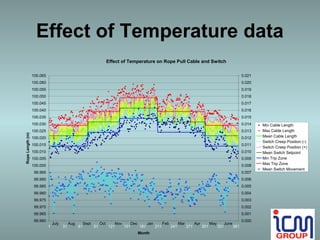
• Nuisance trips are primarily caused by ambient
  temperature change, which lengthens or shortens
  the steel lanyard rope.
• The temperature delta in the Pilbara is up to 45
  deg C. Allowing for a steel expansion co-efficient
  of 0.013m/m/deg = approx 50mm per 100 metres
• With a spring at the anchor end and an integral
  spring in the switch, it means that approx 25mm
  of this travel (without considering friction, rope
  elasticity etc) will act on the switch.
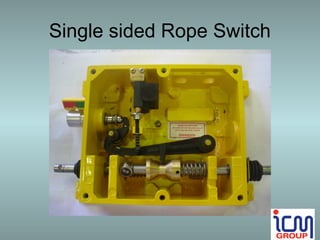
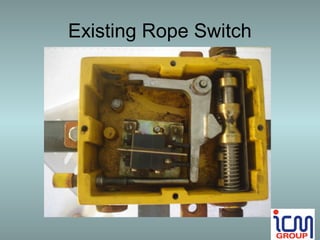
Single sided Rope Switch
Existing Rope Switch
Nuisance Trips? cont..
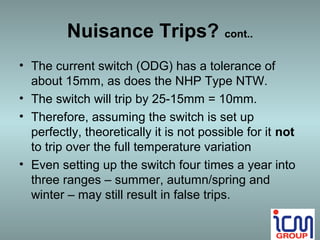
• The current switch (ODG) has a tolerance of
  about 15mm, as does the NHP Type NTW.
• The switch will trip by 25-15mm = 10mm.
• Therefore, assuming the switch is set up
  perfectly, theoretically it is not possible for it not
  to trip over the full temperature variation
• Even setting up the switch four times a year into
  three ranges – summer, autumn/spring and
  winter – may still result in false trips.
Effect of Temperature data
                                                                         Effect of Temperature on Rope Pull Cable and Switch

                  100.065                                                                                                                      0.021
                  100.060                                                                                                                      0.020
                  100.055                                                                                                                      0.019
                  100.050                                                                                                                      0.018
                  100.045                                                                                                                      0.017
                  100.040                                                                                                                      0.016
                  100.035                                                                                                                      0.015
                  100.030                                                                                                                      0.014   Min Cable Length
                  100.025                                                                                                                      0.013   Max Cable Length
Rope Length (m)


                  100.020                                                                                                                      0.012   Mean Cable Length
                                                                                                                                                       Switch Creep Position (-)
                  100.015                                                                                                                      0.011
                                                                                                                                                       Switch Creep Position (+)
                  100.010                                                                                                                      0.010   Mean Switch Setpoint
                  100.005                                                                                                                      0.009   Min Trip Zone
                  100.000                                                                                                                      0.008   Max Trip Zone
                                                                                                                                                       Mean Switch Movement
                   99.995                                                                                                                      0.007
                   99.990                                                                                                                      0.006
                   99.985                                                                                                                      0.005
                   99.980                                                                                                                      0.004
                   99.975                                                                                                                      0.003
                   99.970                                                                                                                      0.002
                   99.965                                                                                                                      0.001
                   99.960                                                                                                                      0.000
                                July        Aug        Sept        Oct      Nov     Dec     Jan     Feb     Mar     Apr     May     June
                            1          31         61          91         121    151     181     211     241     271     301     331      361
                                                                                        Month
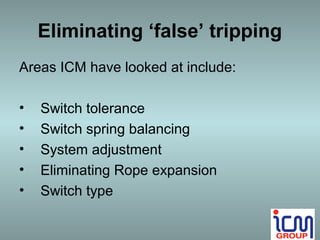
Eliminating ‘false’ tripping
Areas ICM have looked at include:

•   Switch tolerance
•   Switch spring balancing
•   System adjustment
•   Eliminating Rope expansion
•   Switch type
Eliminating ‘false’ tripping cont..
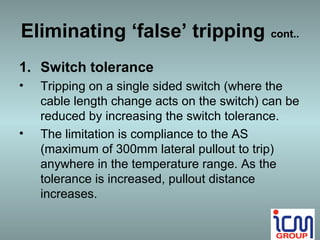
1. Switch tolerance
•   Tripping on a single sided switch (where the
    cable length change acts on the switch) can be
    reduced by increasing the switch tolerance.
•   The limitation is compliance to the AS
    (maximum of 300mm lateral pullout to trip)
    anywhere in the temperature range. As the
    tolerance is increased, pullout distance
    increases.
Eliminating ‘false’ tripping cont..
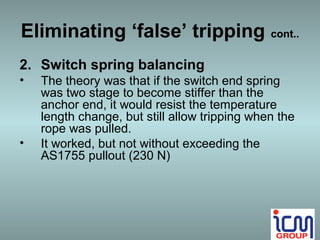
2. Switch spring balancing
•   The theory was that if the switch end spring
    was two stage to become stiffer than the
    anchor end, it would resist the temperature
    length change, but still allow tripping when the
    rope was pulled.
•   It worked, but not without exceeding the
    AS1755 pullout (230 N)
Eliminating ‘false’ tripping cont..
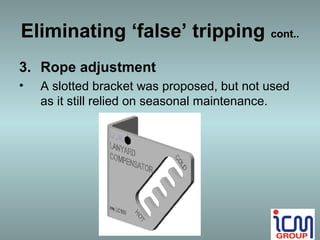
3. Rope adjustment
•   A slotted bracket was proposed, but not used
    as it still relied on seasonal maintenance.
Eliminating ‘false’ tripping cont..
4. Eliminating Rope expansion
• Reducing or eliminating rope expansion is an
  obvious factor to look at
• Polymers, resins, kevlars etc have very low
  expansion co-efficients (say less than 0.0001
  compared to 0.013 for steel) but have high
  elasticity and creep (stress relaxation) when
  compared to steel.
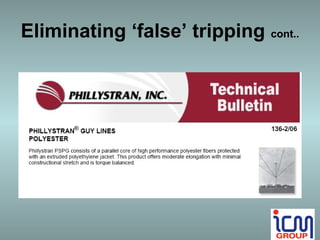
• Phillystran [modified polyester] quoted up to 7%
  length variation at 10% of rated load. Their
  10mm rope at 230n (AS pullout limit) would be
  approx. 7% loaded.
Eliminating ‘false’ tripping cont..
• Creep (load relaxation) is also high at part loads.
  It seems modified polymer manufacturers like to
  quote their maximum load figures, good strength
  to weight etc. and how good they are for guy
  wires and climbing/rigging equipment.
• Almost no UV resistance of itself (“above rope in
  6 mths would be powder”) without jacket.
  Therefore, if the jacket is worn through in the
  future, the breakages may be as frequent as the
  current ‘false’ trips.
Eliminating ‘false’ tripping cont..
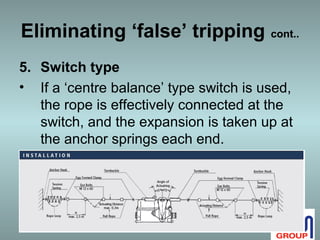
5. Switch type
• If a ‘centre balance’ type switch is used,
   the rope is effectively connected at the
   switch, and the expansion is taken up at
   the anchor springs each end.
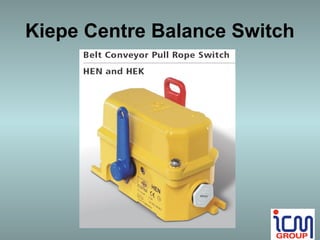
Kiepe Centre Balance Switch
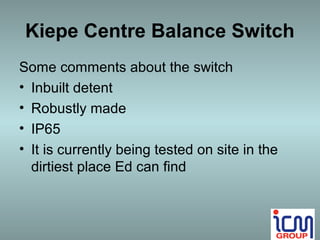
Some comments about the switch
• Inbuilt detent
• Robustly made
• IP65
• It is currently being tested on site in the
  dirtiest place Ed can find
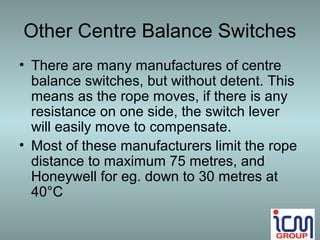
Other Centre Balance Switches
• There are many manufactures of centre
  balance switches, but without detent. This
  means as the rope moves, if there is any
  resistance on one side, the switch lever
  will easily move to compensate.
• Most of these manufacturers limit the rope
  distance to maximum 75 metres, and
  Honeywell for eg. down to 30 metres at
  40°C
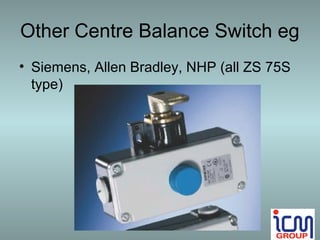
Other Centre Balance Switch eg
• Siemens, Allen Bradley, NHP (all ZS 75S
  type)
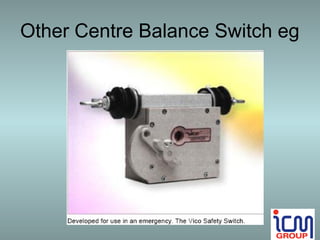
Other Centre Balance Switch eg
Compliance of Kiepe Switch
• QLD Mines Department has given approvals
• Australian Standards have stated in writing that
  they deem the ‘centre-balance’ switch concept
  complies. The simultaneous failure of both ropes
  are deemed so unlikely as to be neglible.
• The WA Mines Dept states that the relevant
  Standards approval is all they require
AS1755 Compliance
•   Switch indication
•   Latching
•   Reset
•   Breaking/slackening of rope shall activate device
•   Pullout force not to exceed 230 N along rope axis
•   Pullout (midway) not to exceed 300mm distance and 70 N
•   Closed fittings?
•   Signs shall be every 30m
•   Red rope (should not shall)
•   Red actuators (shall)
•   Devices signed re purpose
ICM Proposal
Our proposal is to:

•   Supply and Install Kiepe centre balance
    Switches on adaptor brackets
•   Supply and Replace ropes, pigtails, anchors
    and springs, adjusters etc
•   Carry out the work safely without shutdowns
ICM Proposal cont..
• The Kiepe centre balance switch is approved by
  Kiepe for use with up to 100 metres of rope each
  side
• Mounting – use an adaptor bracket that bolts to
  existing holes
• Installation – no shutdown will be required by
  using portable E-stops at 30 metre spacing
  (refer AS1755) as safety system for each 200
  metre section while installing
Installation of Safety System
• E-stop stands
• Barricades
• Signs

Reliable Rope Switches Presentation

  • 1.
    CV554/CV555 Rope Switch Replacement Paraburdoo Presenter: Phil Rohrlach Last Edited : 10 April 2007
  • 2.
    Objectives • Eliminate nuisancetrips • Ensure that the conveyor safety system complies with Mines Safety and Inspection Regulations 1995 • Ensure that the conveyor safety system complies with Australian Standard AS1755 • Renew components to provide a long maintenance free period in future
  • 3.
    Nuisance Trips? • Nuisancetrips are primarily caused by ambient temperature change, which lengthens or shortens the steel lanyard rope. • The temperature delta in the Pilbara is up to 45 deg C. Allowing for a steel expansion co-efficient of 0.013m/m/deg = approx 50mm per 100 metres • With a spring at the anchor end and an integral spring in the switch, it means that approx 25mm of this travel (without considering friction, rope elasticity etc) will act on the switch.
  • 4.
  • 5.
  • 6.
    Nuisance Trips? cont.. •The current switch (ODG) has a tolerance of about 15mm, as does the NHP Type NTW. • The switch will trip by 25-15mm = 10mm. • Therefore, assuming the switch is set up perfectly, theoretically it is not possible for it not to trip over the full temperature variation • Even setting up the switch four times a year into three ranges – summer, autumn/spring and winter – may still result in false trips.
  • 7.
    Effect of Temperaturedata Effect of Temperature on Rope Pull Cable and Switch 100.065 0.021 100.060 0.020 100.055 0.019 100.050 0.018 100.045 0.017 100.040 0.016 100.035 0.015 100.030 0.014 Min Cable Length 100.025 0.013 Max Cable Length Rope Length (m) 100.020 0.012 Mean Cable Length Switch Creep Position (-) 100.015 0.011 Switch Creep Position (+) 100.010 0.010 Mean Switch Setpoint 100.005 0.009 Min Trip Zone 100.000 0.008 Max Trip Zone Mean Switch Movement 99.995 0.007 99.990 0.006 99.985 0.005 99.980 0.004 99.975 0.003 99.970 0.002 99.965 0.001 99.960 0.000 July Aug Sept Oct Nov Dec Jan Feb Mar Apr May June 1 31 61 91 121 151 181 211 241 271 301 331 361 Month
  • 8.
    Eliminating ‘false’ tripping AreasICM have looked at include: • Switch tolerance • Switch spring balancing • System adjustment • Eliminating Rope expansion • Switch type
  • 9.
    Eliminating ‘false’ trippingcont.. 1. Switch tolerance • Tripping on a single sided switch (where the cable length change acts on the switch) can be reduced by increasing the switch tolerance. • The limitation is compliance to the AS (maximum of 300mm lateral pullout to trip) anywhere in the temperature range. As the tolerance is increased, pullout distance increases.
  • 10.
    Eliminating ‘false’ trippingcont.. 2. Switch spring balancing • The theory was that if the switch end spring was two stage to become stiffer than the anchor end, it would resist the temperature length change, but still allow tripping when the rope was pulled. • It worked, but not without exceeding the AS1755 pullout (230 N)
  • 11.
    Eliminating ‘false’ trippingcont.. 3. Rope adjustment • A slotted bracket was proposed, but not used as it still relied on seasonal maintenance.
  • 12.
    Eliminating ‘false’ trippingcont.. 4. Eliminating Rope expansion • Reducing or eliminating rope expansion is an obvious factor to look at • Polymers, resins, kevlars etc have very low expansion co-efficients (say less than 0.0001 compared to 0.013 for steel) but have high elasticity and creep (stress relaxation) when compared to steel. • Phillystran [modified polyester] quoted up to 7% length variation at 10% of rated load. Their 10mm rope at 230n (AS pullout limit) would be approx. 7% loaded.
  • 13.
  • 14.
    Eliminating ‘false’ trippingcont.. • Creep (load relaxation) is also high at part loads. It seems modified polymer manufacturers like to quote their maximum load figures, good strength to weight etc. and how good they are for guy wires and climbing/rigging equipment. • Almost no UV resistance of itself (“above rope in 6 mths would be powder”) without jacket. Therefore, if the jacket is worn through in the future, the breakages may be as frequent as the current ‘false’ trips.
  • 15.
    Eliminating ‘false’ trippingcont.. 5. Switch type • If a ‘centre balance’ type switch is used, the rope is effectively connected at the switch, and the expansion is taken up at the anchor springs each end.
  • 16.
  • 17.
    Kiepe Centre BalanceSwitch Some comments about the switch • Inbuilt detent • Robustly made • IP65 • It is currently being tested on site in the dirtiest place Ed can find
  • 18.
    Other Centre BalanceSwitches • There are many manufactures of centre balance switches, but without detent. This means as the rope moves, if there is any resistance on one side, the switch lever will easily move to compensate. • Most of these manufacturers limit the rope distance to maximum 75 metres, and Honeywell for eg. down to 30 metres at 40°C
  • 19.
    Other Centre BalanceSwitch eg • Siemens, Allen Bradley, NHP (all ZS 75S type)
  • 20.
  • 21.
    Compliance of KiepeSwitch • QLD Mines Department has given approvals • Australian Standards have stated in writing that they deem the ‘centre-balance’ switch concept complies. The simultaneous failure of both ropes are deemed so unlikely as to be neglible. • The WA Mines Dept states that the relevant Standards approval is all they require
  • 22.
    AS1755 Compliance • Switch indication • Latching • Reset • Breaking/slackening of rope shall activate device • Pullout force not to exceed 230 N along rope axis • Pullout (midway) not to exceed 300mm distance and 70 N • Closed fittings? • Signs shall be every 30m • Red rope (should not shall) • Red actuators (shall) • Devices signed re purpose
  • 23.
    ICM Proposal Our proposalis to: • Supply and Install Kiepe centre balance Switches on adaptor brackets • Supply and Replace ropes, pigtails, anchors and springs, adjusters etc • Carry out the work safely without shutdowns
  • 24.
    ICM Proposal cont.. •The Kiepe centre balance switch is approved by Kiepe for use with up to 100 metres of rope each side • Mounting – use an adaptor bracket that bolts to existing holes • Installation – no shutdown will be required by using portable E-stops at 30 metre spacing (refer AS1755) as safety system for each 200 metre section while installing
  • 25.
    Installation of SafetySystem • E-stop stands • Barricades • Signs