•Akal Academy Dhindsa
• Project: S.St.
• Session: 2012-2013
• Submitted to: Renu Bala
• Submitted by: Harshpreet Singh
Earthquakes
Introduction
• Earthquake is a terrible kind of natural
calamity. where earthquake occurs the earth
shakes. If the earth shakes violently, the result
is disastrous. Man may escape other kinds of
calamity. But if earthquake occurs, there is no
way out.
What is an earthquake?
• Used to describe both sudden slip on a fault,
and the resulting ground shaking and radiated
seismic energy caused by the slip
• Caused by volcanic or magmatic activity,
• Caused by other sudden stress changes in the
earth.
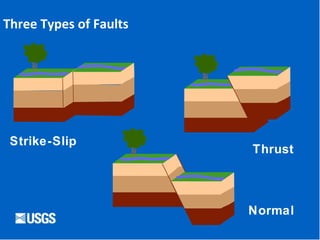
Three Types of Faults
Strike-Slip
Thrust
Normal
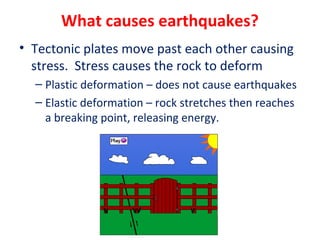
What causes earthquakes?
• Tectonic plates move past each other causing
stress. Stress causes the rock to deform
– Plastic deformation – does not cause earthquakes
– Elastic deformation – rock stretches then reaches
a breaking point, releasing energy.
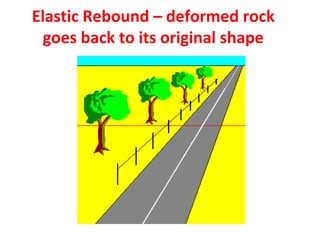
Elastic Rebound – deformed rock
goes back to its original shape
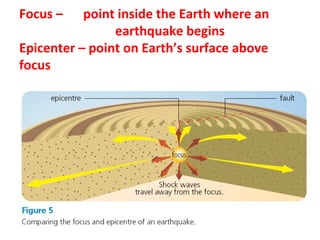
Focus – point inside the Earth where an
earthquake begins
Epicenter – point on Earth’s surface above
focus
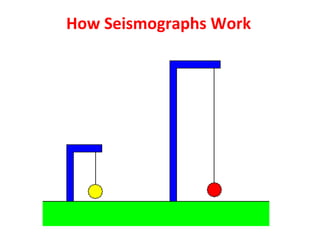
How Seismographs Work
the pendulum remains
fixed as the ground
moves beneath it
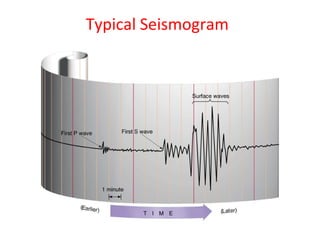
Typical Seismogram
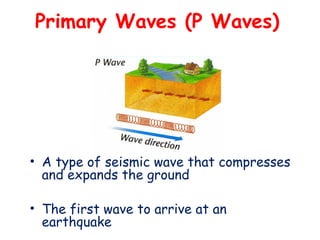
Primary Waves (P Waves)
• A type of seismic wave that compresses
and expands the ground
• The first wave to arrive at an
earthquake
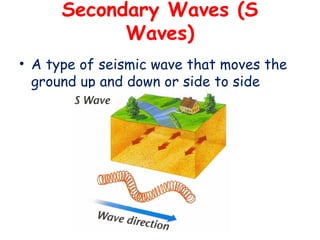
Secondary Waves (S
Waves)
• A type of seismic wave that moves the
ground up and down or side to side
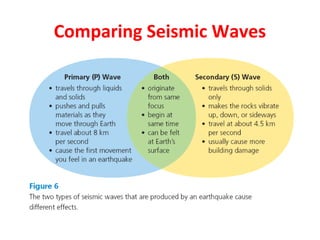
Comparing Seismic Waves
Surface Waves
• Move along the Earth’s surface
• Produces motion in the upper crust
– Motion can be up and down
– Motion can be around
– Motion can be back and forth
• Travel more slowly than S and P waves
• More destructive
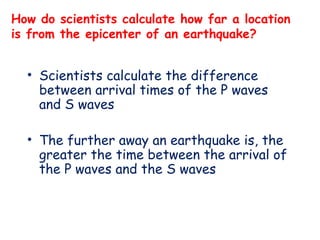
How do scientists calculate how far a location
is from the epicenter of an earthquake?
• Scientists calculate the difference
between arrival times of the P waves
and S waves
• The further away an earthquake is, the
greater the time between the arrival of
the P waves and the S waves
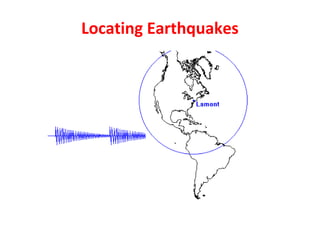
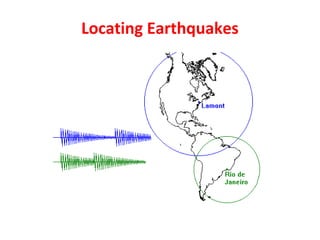
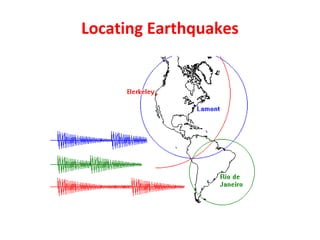
Locating Earthquakes
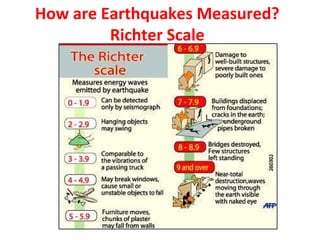
How are Earthquakes Measured?
Richter Scale
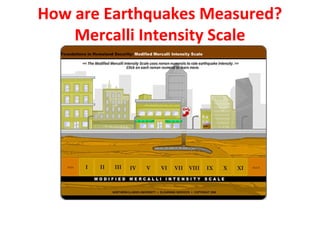
How are Earthquakes Measured?
Mercalli Intensity Scale
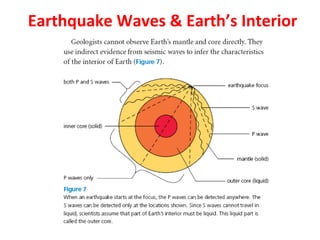
Earthquake Waves & Earth’s Interior
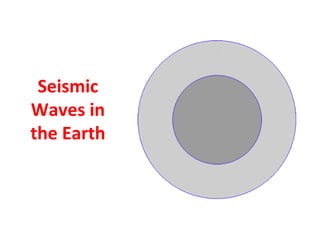
Seismic
Waves in
the Earth
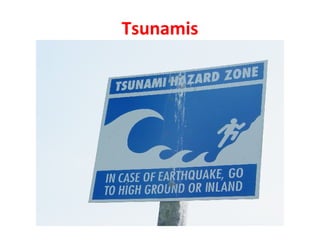
Tsunamis
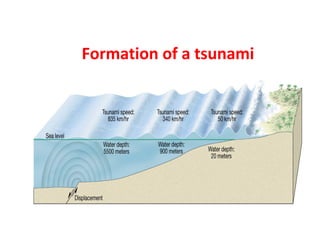
Formation of a tsunami
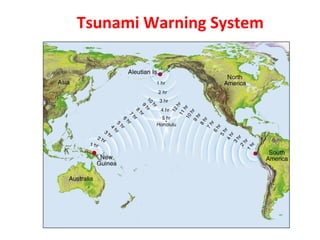
Tsunami Warning System
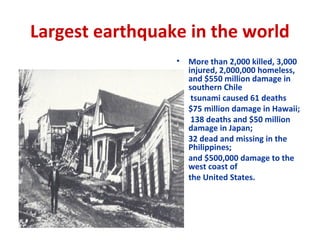
Largest earthquake in the world
• More than 2,000 killed, 3,000
injured, 2,000,000 homeless,
and $550 million damage in
southern Chile
• tsunami caused 61 deaths
• $75 million damage in Hawaii;
• 138 deaths and $50 million
damage in Japan;
• 32 dead and missing in the
Philippines;
• and $500,000 damage to the
west coast of
• the United States.
Conclusion
• Earthquakes are not new to the world. It is a very
common thing on many parts of the earth. Japan
is the constant victim of earthquakes. So, the
Japanese make houses of paper boards. India,
too is not altogether free from this natural
calamity. But in India, it is very few and far
between. In 1993 Maharashtra had faced a
terrible shock from a divesting earthquake and
the Latoor are was completely damaged.
Earthquake cannot be prevented. They catch up
by surprise. Hence, let us wait for the scientific
developments that may find a remedy to this
terrible upsurge.

Earthquakes notes

  • 1.
    •Akal Academy Dhindsa •Project: S.St. • Session: 2012-2013 • Submitted to: Renu Bala • Submitted by: Harshpreet Singh
  • 2.
  • 3.
    Introduction • Earthquake isa terrible kind of natural calamity. where earthquake occurs the earth shakes. If the earth shakes violently, the result is disastrous. Man may escape other kinds of calamity. But if earthquake occurs, there is no way out.
  • 4.
    What is anearthquake? • Used to describe both sudden slip on a fault, and the resulting ground shaking and radiated seismic energy caused by the slip • Caused by volcanic or magmatic activity, • Caused by other sudden stress changes in the earth.
  • 5.
    Three Types ofFaults Strike-Slip Thrust Normal
  • 6.
    What causes earthquakes? •Tectonic plates move past each other causing stress. Stress causes the rock to deform – Plastic deformation – does not cause earthquakes – Elastic deformation – rock stretches then reaches a breaking point, releasing energy.
  • 7.
    Elastic Rebound –deformed rock goes back to its original shape
  • 8.
    Focus – pointinside the Earth where an earthquake begins Epicenter – point on Earth’s surface above focus
  • 9.
    How Seismographs Work thependulum remains fixed as the ground moves beneath it
  • 10.
  • 11.
    Primary Waves (PWaves) • A type of seismic wave that compresses and expands the ground • The first wave to arrive at an earthquake
  • 12.
    Secondary Waves (S Waves) •A type of seismic wave that moves the ground up and down or side to side
  • 13.
  • 14.
    Surface Waves • Movealong the Earth’s surface • Produces motion in the upper crust – Motion can be up and down – Motion can be around – Motion can be back and forth • Travel more slowly than S and P waves • More destructive
  • 15.
    How do scientistscalculate how far a location is from the epicenter of an earthquake? • Scientists calculate the difference between arrival times of the P waves and S waves • The further away an earthquake is, the greater the time between the arrival of the P waves and the S waves
  • 16.
  • 17.
  • 18.
  • 19.
    How are EarthquakesMeasured? Richter Scale
  • 20.
    How are EarthquakesMeasured? Mercalli Intensity Scale
  • 21.
    Earthquake Waves &Earth’s Interior
  • 22.
  • 23.
  • 24.
  • 25.
  • 26.
    Largest earthquake inthe world • More than 2,000 killed, 3,000 injured, 2,000,000 homeless, and $550 million damage in southern Chile • tsunami caused 61 deaths • $75 million damage in Hawaii; • 138 deaths and $50 million damage in Japan; • 32 dead and missing in the Philippines; • and $500,000 damage to the west coast of • the United States.
  • 27.
    Conclusion • Earthquakes arenot new to the world. It is a very common thing on many parts of the earth. Japan is the constant victim of earthquakes. So, the Japanese make houses of paper boards. India, too is not altogether free from this natural calamity. But in India, it is very few and far between. In 1993 Maharashtra had faced a terrible shock from a divesting earthquake and the Latoor are was completely damaged. Earthquake cannot be prevented. They catch up by surprise. Hence, let us wait for the scientific developments that may find a remedy to this terrible upsurge.

Editor's Notes

  • #6 Three types of faults Form depending on type of plate motion and complex reaction of earth’s lithospheric blocks Strike-slip Normal Thrust