Deptt. Community Medicine
SAMPLING
PROCEDURES
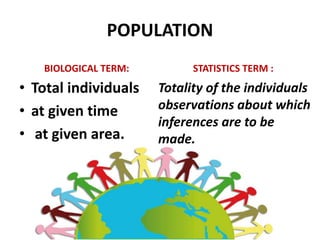
POPULATION
BIOLOGICAL TERM:
• Total individuals
• at given time
• at given area.
STATISTICS TERM :
Totality of the individuals
observations about which
inferences are to be
made.
• World population day :
• world population 2017 :
• Indian population 2016 :
Wednesday , 11 July 2018
7.6 billion as of October 2017
1.324 billion .2016.
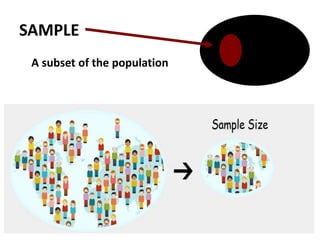
SAMPLE
A subset of the population
WHY SAMPLING?
1. Get information about large populations.
2. Less field time.
3. Less costs.
4. More accuracy i.e. Can Do A Better Job of Data
Collection
5. When it’s impossible to study the whole
population
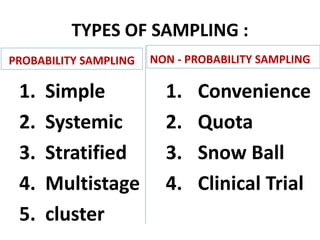
TYPES OF SAMPLING :
PROBABILITY SAMPLING
1. Simple
2. Systemic
3. Stratified
4. Multistage
5. cluster
NON - PROBABILITY SAMPLING
1. Convenience
2. Quota
3. Snow Ball
4. Clinical Trial
SYNONYMS
RANDOM SAMPLING :
Probability samples
Non – purposive sampling
NON - RANDOM SAMPLING :
Non-probability samples
purposive sampling
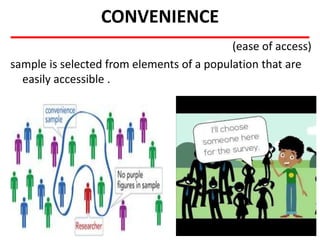
CONVENIENCE
(ease of access)
sample is selected from elements of a population that are
easily accessible .
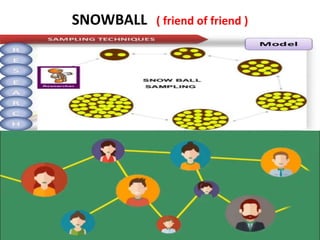
SNOWBALL ( friend of friend )
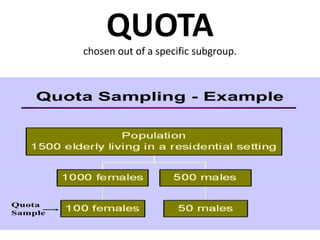
QUOTA
chosen out of a specific subgroup.
CLINICAL TRIALS SAMPLING
Methods used in probability samples
Simple random sampling
Systematic sampling
Stratified sampling
Multi-stage sampling
Cluster sampling
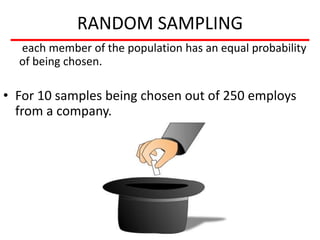
RANDOM SAMPLING
each member of the population has an equal probability
of being chosen.
• For 10 samples being chosen out of 250 employs
from a company.
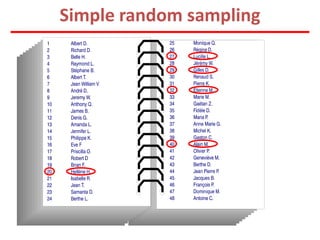
Simple random sampling
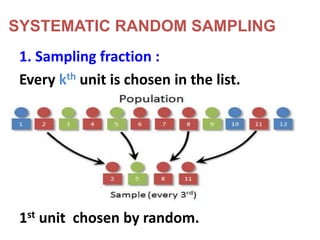
1. Sampling fraction :
Every kth unit is chosen in the list.
1st unit chosen by random.
SYSTEMATIC RANDOM SAMPLING
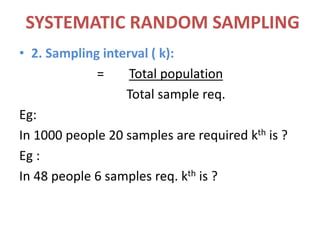
• 2. Sampling interval ( k):
= Total population
Total sample req.
Eg:
In 1000 people 20 samples are required kth is ?
Eg :
In 48 people 6 samples req. kth is ?
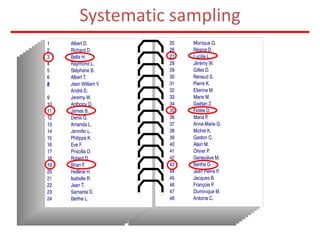
Systematic sampling
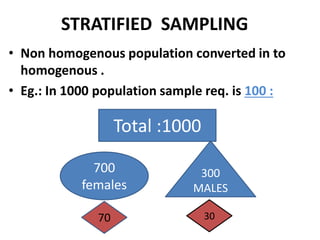
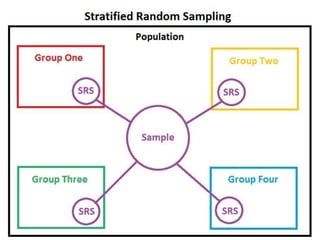
STRATIFIED SAMPLING
• Non homogenous population converted in to
homogenous .
• Eg.: In 1000 population sample req. is 100 :
Total :1000
700
females
300
MALES
70 30
Q & A
• For a study every 10th person is selected from a
population , this type of random sampling is :
a) Simple random sampling
b) Stratified random sampling
c) Systematic random sampling
d) Cluster random sampling
All are probability sampling methods except :
a) Quota sampling
b) Stratified sampling
c) Multi-stage sampling
d) Cluster sampling
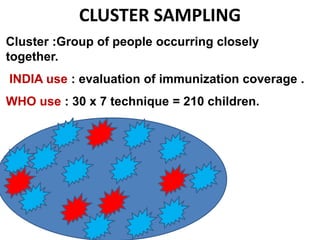
CLUSTER SAMPLING
Cluster :Group of people occurring closely
together.
INDIA use : evaluation of immunization coverage .
WHO use : 30 x 7 technique = 210 children.
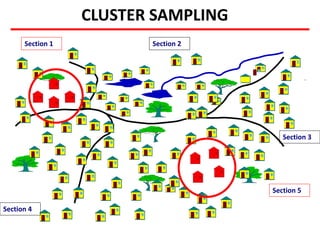
CLUSTER SAMPLING
Section 4
Section 5
Section 3
Section 2Section 1
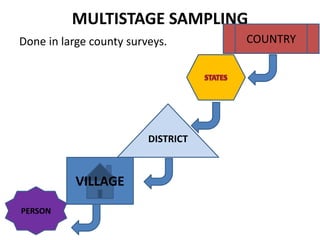
MULTISTAGE SAMPLING
Done in large county surveys.
PERSON
VILLAGE
DISTRICT
COUNTRY
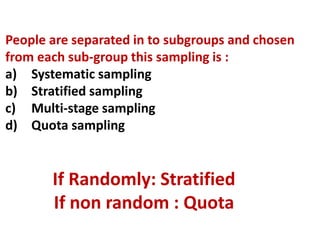
If Randomly: Stratified
If non random : Quota
People are separated in to subgroups and chosen
from each sub-group this sampling is :
a) Systematic sampling
b) Stratified sampling
c) Multi-stage sampling
d) Quota sampling

Sampling techniques

  • 1.
  • 2.
    POPULATION BIOLOGICAL TERM: • Totalindividuals • at given time • at given area. STATISTICS TERM : Totality of the individuals observations about which inferences are to be made.
  • 3.
    • World populationday : • world population 2017 : • Indian population 2016 : Wednesday , 11 July 2018 7.6 billion as of October 2017 1.324 billion .2016.
  • 4.
    SAMPLE A subset ofthe population
  • 5.
    WHY SAMPLING? 1. Getinformation about large populations. 2. Less field time. 3. Less costs. 4. More accuracy i.e. Can Do A Better Job of Data Collection 5. When it’s impossible to study the whole population
  • 6.
    TYPES OF SAMPLING: PROBABILITY SAMPLING 1. Simple 2. Systemic 3. Stratified 4. Multistage 5. cluster NON - PROBABILITY SAMPLING 1. Convenience 2. Quota 3. Snow Ball 4. Clinical Trial
  • 7.
    SYNONYMS RANDOM SAMPLING : Probabilitysamples Non – purposive sampling NON - RANDOM SAMPLING : Non-probability samples purposive sampling
  • 8.
    CONVENIENCE (ease of access) sampleis selected from elements of a population that are easily accessible .
  • 9.
    SNOWBALL ( friendof friend )
  • 10.
    QUOTA chosen out ofa specific subgroup.
  • 11.
  • 12.
    Methods used inprobability samples Simple random sampling Systematic sampling Stratified sampling Multi-stage sampling Cluster sampling
  • 13.
    RANDOM SAMPLING each memberof the population has an equal probability of being chosen. • For 10 samples being chosen out of 250 employs from a company.
  • 14.
  • 15.
    1. Sampling fraction: Every kth unit is chosen in the list. 1st unit chosen by random. SYSTEMATIC RANDOM SAMPLING
  • 16.
    SYSTEMATIC RANDOM SAMPLING •2. Sampling interval ( k): = Total population Total sample req. Eg: In 1000 people 20 samples are required kth is ? Eg : In 48 people 6 samples req. kth is ?
  • 17.
  • 18.
    STRATIFIED SAMPLING • Nonhomogenous population converted in to homogenous . • Eg.: In 1000 population sample req. is 100 : Total :1000 700 females 300 MALES 70 30
  • 19.
    Q & A •For a study every 10th person is selected from a population , this type of random sampling is : a) Simple random sampling b) Stratified random sampling c) Systematic random sampling d) Cluster random sampling All are probability sampling methods except : a) Quota sampling b) Stratified sampling c) Multi-stage sampling d) Cluster sampling
  • 21.
    CLUSTER SAMPLING Cluster :Groupof people occurring closely together. INDIA use : evaluation of immunization coverage . WHO use : 30 x 7 technique = 210 children.
  • 22.
    CLUSTER SAMPLING Section 4 Section5 Section 3 Section 2Section 1
  • 23.
    MULTISTAGE SAMPLING Done inlarge county surveys. PERSON VILLAGE DISTRICT COUNTRY
  • 24.
    If Randomly: Stratified Ifnon random : Quota People are separated in to subgroups and chosen from each sub-group this sampling is : a) Systematic sampling b) Stratified sampling c) Multi-stage sampling d) Quota sampling