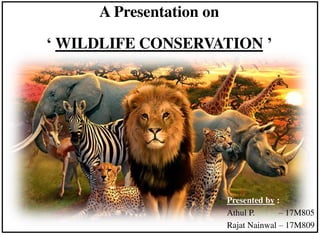

A Presentation on
‘ WILDLIFE CONSERVATION ’
Presented by :
Athul P. – 17M805
Rajat Nainwal – 17M809
WHAT DOES WILDLIFE CONSERVATION MEANS ?
• According to the Wildlife Protection Act of 1972, wildlife includes any animal,
bees, butterfly, crustacean, fish and moth and aquatic or land vegetation, which
form part of any habitat.
• Therefore, wildlife refers to living organisms (flora and fauna) in their natural
habitats.
• Example: lion, deer, crocodiles, whales, trees and shrubs in dense forests etc.
BENEFITS OF WILDLIFE
• Wildlife is an essential component of various food chains, food webs,
biogeochemical cycles and energy flow through various trophic levels.
• Preserves vitality and health of environment and provides stability to various
ecosystems.
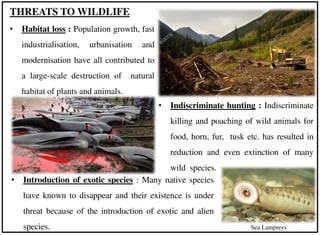
• Habitat loss : Population growth, fast
industrialisation, urbanisation and
modernisation have all contributed to
a large-scale destruction of natural
habitat of plants and animals.
THREATS TO WILDLIFE
• Indiscriminate hunting : Indiscriminate
killing and poaching of wild animals for
food, horn, fur, tusk etc. has resulted in
reduction and even extinction of many
wild species.
• Introduction of exotic species : Many native species
have known to disappear and their existence is under
threat because of the introduction of exotic and alien
species. Sea Lampreys
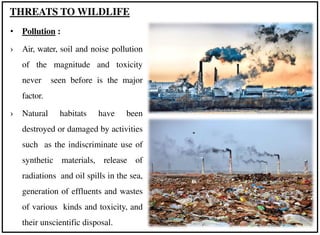
• Pollution :
› Air, water, soil and noise pollution
of the magnitude and toxicity
never seen before is the major
factor.
› Natural habitats have been
destroyed or damaged by activities
such as the indiscriminate use of
synthetic materials, release of
radiations and oil spills in the sea,
generation of effluents and wastes
of various kinds and toxicity, and
their unscientific disposal.
THREATS TO WILDLIFE
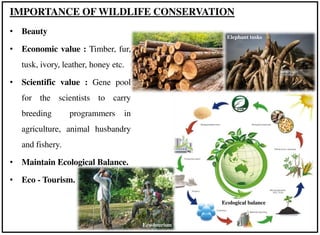
• Beauty
• Economic value : Timber, fur,
tusk, ivory, leather, honey etc.
• Scientific value : Gene pool
for the scientists to carry
breeding programmers in
agriculture, animal husbandry
and fishery.
• Maintain Ecological Balance.
• Eco - Tourism.
IMPORTANCE OF WILDLIFE CONSERVATION
Elephant tusks
Ecological balance
Eco-tourism
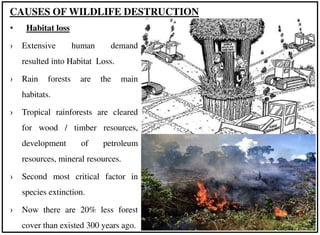
CAUSES OF WILDLIFE DESTRUCTION
• Habitat loss
› Extensive human demand
resulted into Habitat Loss.
› Rain forests are the main
habitats.
› Tropical rainforests are cleared
for wood / timber resources,
development of petroleum
resources, mineral resources.
› Second most critical factor in
species extinction.
› Now there are 20% less forest
cover than existed 300 years ago.
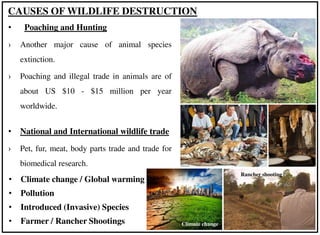
CAUSES OF WILDLIFE DESTRUCTION
• Poaching and Hunting
› Another major cause of animal species
extinction.
› Poaching and illegal trade in animals are of
about US $10 - $15 million per year
worldwide.
• National and International wildlife trade
› Pet, fur, meat, body parts trade and trade for
biomedical research.
• Climate change / Global warming
• Pollution
• Introduced (Invasive) Species
• Farmer / Rancher Shootings
Rancher shooting
Climate change
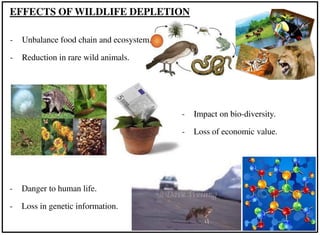
EFFECTS OF WILDLIFE DEPLETION
- Unbalance food chain and ecosystem.
- Reduction in rare wild animals.
- Impact on bio-diversity.
- Loss of economic value.
- Danger to human life.
- Loss in genetic information.
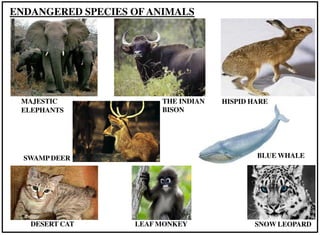
MAJESTIC
ELEPHANTS
SNOW LEOPARD
SWAMP DEER
DESERT CAT LEAF MONKEY
ENDANGERED SPECIES OF ANIMALS
THE INDIAN
BISON
HISPID HARE
BLUE WHALE
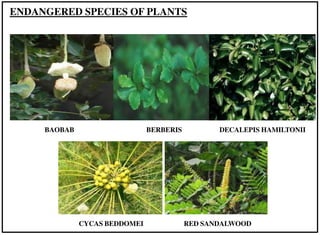
CYCAS BEDDOMEI RED SANDALWOOD
BAOBAB BERBERIS DECALEPIS HAMILTONII
ENDANGERED SPECIES OF PLANTS
• Many people are under the impression that India does not have strong wildlife
conservation laws. On the contrary, we have some of the most stringent
legislations to protect wildlife and habitats.
• The Government of India has introduced various types of legislation in response to
the growing destruction of wildlife and forests. These are:
› The Wildlife (Protection) Act, 1972 (Last amended in 2006).
› National Wildlife Action Plan (2002-2016).
› The Environment (Protection) Act (1986).
› The Biological Diversity Act (2002).
› The Indian Fisheries Act (1897).
› The Indian Forest Act (1927).
› The Forest Conservation Act (1980).
LEGAL FRAMEWORK FOR WILDLIFE CONSERVATION IN INDIA
• The Wildlife (Protection) Act (WLPA), 1972 is an important statute that provides a
powerful legal framework for:
› Prohibition of hunting
› Protection and management of wildlife habitats
› Establishment of protected areas
› Regulation and control of trade in parts and products derived from wildlife
› Management of zoos.
• The WLPA provides for several categories of Protected Areas/Reserves:
› National Parks
› Wildlife Sanctuaries
› Tiger Reserves
› Conservation Reserves
› Community Reserves
• Apart from protected area establishment, other important aspects of the WLPA
include procedures for the appointment of state wildlife authorities and wildlife
boards, the regulation of trade in wildlife products and the prevention, detection and
punishment of violations of the WLPA.
1. THE WILDLIFE PROTECTION ACT, 1972 (LAST AMENDED IN 2006)
SR. NO. NAME STATE ANIMAL(s) PROTECTED
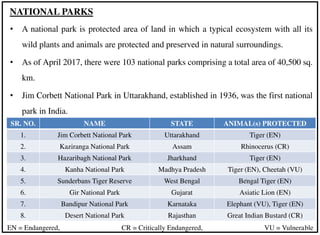
1. Jim Corbett National Park Uttarakhand Tiger (EN)
2. Kaziranga National Park Assam Rhinocerus (CR)
3. Hazaribagh National Park Jharkhand Tiger (EN)
4. Kanha National Park Madhya Pradesh Tiger (EN), Cheetah (VU)
5. Sunderbans Tiger Reserve West Bengal Bengal Tiger (EN)
6. Gir National Park Gujarat Asiatic Lion (EN)
7. Bandipur National Park Karnataka Elephant (VU), Tiger (EN)
8. Desert National Park Rajasthan Great Indian Bustard (CR)
NATIONAL PARKS
• A national park is protected area of land in which a typical ecosystem with all its
wild plants and animals are protected and preserved in natural surroundings.
• As of April 2017, there were 103 national parks comprising a total area of 40,500 sq.
km.
• Jim Corbett National Park in Uttarakhand, established in 1936, was the first national
park in India.
EN = Endangered, CR = Critically Endangered, VU = Vulnerable
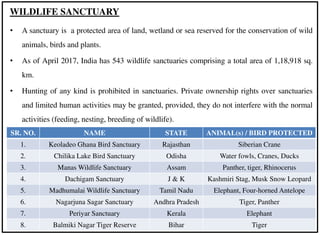
WILDLIFE SANCTUARY
• A sanctuary is a protected area of land, wetland or sea reserved for the conservation of wild
animals, birds and plants.
• As of April 2017, India has 543 wildlife sanctuaries comprising a total area of 1,18,918 sq.
km.
• Hunting of any kind is prohibited in sanctuaries. Private ownership rights over sanctuaries
and limited human activities may be granted, provided, they do not interfere with the normal
activities (feeding, nesting, breeding of wildlife).
SR. NO. NAME STATE ANIMAL(s) / BIRD PROTECTED
1. Keoladeo Ghana Bird Sanctuary Rajasthan Siberian Crane
2. Chilika Lake Bird Sanctuary Odisha Water fowls, Cranes, Ducks
3. Manas Wildlife Sanctuary Assam Panther, tiger, Rhinocerus
4. Dachigam Sanctuary J & K Kashmiri Stag, Musk Snow Leopard
5. Madhumalai Wildlife Sanctuary Tamil Nadu Elephant, Four-horned Antelope
6. Nagarjuna Sagar Sanctuary Andhra Pradesh Tiger, Panther
7. Periyar Sanctuary Kerala Elephant
8. Balmiki Nagar Tiger Reserve Bihar Tiger
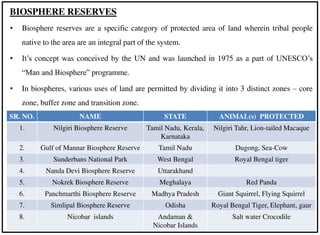
BIOSPHERE RESERVES
• Biosphere reserves are a specific category of protected area of land wherein tribal people
native to the area are an integral part of the system.
• It’s concept was conceived by the UN and was launched in 1975 as a part of UNESCO’s
“Man and Biosphere” programme.
• In biospheres, various uses of land are permitted by dividing it into 3 distinct zones – core
zone, buffer zone and transition zone.
SR. NO. NAME STATE ANIMAL(s) PROTECTED
1. Nilgiri Biosphere Reserve Tamil Nadu, Kerala,
Karnataka
Nilgiri Tahr, Lion-tailed Macaque
2. Gulf of Mannar Biosphere Reserve Tamil Nadu Dugong, Sea-Cow
3. Sunderbans National Park West Bengal Royal Bengal tiger
4. Nanda Devi Biosphere Reserve Uttarakhand
5. Nokrek Biosphere Reserve Meghalaya Red Panda
6. Panchmarthi Biosphere Reserve Madhya Pradesh Giant Squirrel, Flying Squirrel
7. Simlipal Biosphere Reserve Odisha Royal Bengal Tiger, Elephant, gaur
8. Nicobar islands Andaman &
Nicobar Islands
Salt water Crocodile
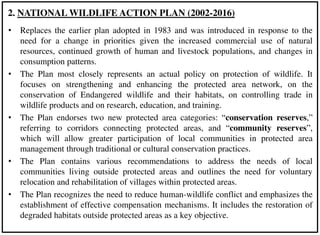
• Replaces the earlier plan adopted in 1983 and was introduced in response to the
need for a change in priorities given the increased commercial use of natural
resources, continued growth of human and livestock populations, and changes in
consumption patterns.
• The Plan most closely represents an actual policy on protection of wildlife. It
focuses on strengthening and enhancing the protected area network, on the
conservation of Endangered wildlife and their habitats, on controlling trade in
wildlife products and on research, education, and training.
• The Plan endorses two new protected area categories: “conservation reserves,”
referring to corridors connecting protected areas, and “community reserves”,
which will allow greater participation of local communities in protected area
management through traditional or cultural conservation practices.
• The Plan contains various recommendations to address the needs of local
communities living outside protected areas and outlines the need for voluntary
relocation and rehabilitation of villages within protected areas.
• The Plan recognizes the need to reduce human-wildlife conflict and emphasizes the
establishment of effective compensation mechanisms. It includes the restoration of
degraded habitats outside protected areas as a key objective.
2. NATIONAL WILDLIFE ACTION PLAN (2002-2016)
• It is an important legislation that provides for coordination of activities of the
various regulatory agencies, creation of authorities with adequate powers for
environmental protection, regulation of the discharge of environmental pollutants,
handling of hazardous substances, etc.
• The Act provided an opportunity to extend legal protection to non-forest habitats
(‘Ecologically Sensitive Areas’) such as grasslands, wetlands and coastal zones.
3. THE ENVIRONMENT PROTECTION ACT (1986)
4. THE BIOLOGICAL DIVERSITY ACT (2002)
• India is a party to the United Nations Convention on Biological Diversity.
• The provisions of the Biological Diversity Act are in addition to and not in
derogation of the provisions in any other law relating to forests or wildlife.
• The main objective of the Indian Forest Act (1927) is to secure exclusive state
control over forests to meet the demand for timber. Most of these untitled lands had
traditionally belonged to the forest dwelling communities. The Act defined state
ownership, regulated its use and appropriated the power to substitute or extinguish
customary rights. The Act facilitates three categories of forests, namely :
› Reserved forests
› Village forests
› Protected forests
 Reserved forests are the most protected within these categories. No rights can be
acquired in reserved forests except by succession or under a grant or contract with
the government. Felling trees, grazing cattle, removing forest products, quarrying,
fishing, and hunting are punishable with a fine or imprisonment.
5. THE INDIAN FOREST ACT (1927)
• In order to check rapid deforestation due to forestlands being released by state
governments for agriculture, industry and other development projects (allowed under the
Indian Forest Act), the federal government enacted the Forest Conservation Act in 1980
with an amendment in 1988.
• The Act made the prior approval of the federal government necessary for de-reservation
of reserved forests, logging and for use of forestland for non-forest purposes.
• This powerful legislation has, to a large extent, curtailed the indiscriminate logging and
release of forestland for non-forestry purposes by state governments.
• While the federal government imposed such strict restrictions, it did not simultaneously
evolve a mechanism to compensate state governments for loss of timber logging
revenues.
• The Supreme Court of India has currently imposed a complete ban on the release of
forestland for non-forestry activities without the prior approval of the federal government.
6. THE FOREST CONSERVATION ACT (1980)
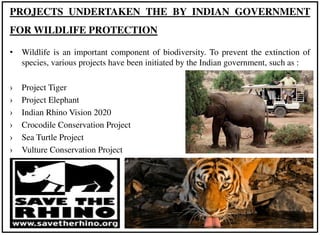
• Wildlife is an important component of biodiversity. To prevent the extinction of
species, various projects have been initiated by the Indian government, such as :
› Project Tiger
› Project Elephant
› Indian Rhino Vision 2020
› Crocodile Conservation Project
› Sea Turtle Project
› Vulture Conservation Project
PROJECTS UNDERTAKEN THE BY INDIAN GOVERNMENT
FOR WILDLIFE PROTECTION
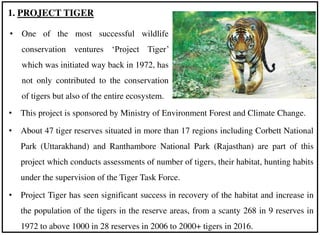
• This project is sponsored by Ministry of Environment Forest and Climate Change.
• About 47 tiger reserves situated in more than 17 regions including Corbett National
Park (Uttarakhand) and Ranthambore National Park (Rajasthan) are part of this
project which conducts assessments of number of tigers, their habitat, hunting habits
under the supervision of the Tiger Task Force.
• Project Tiger has seen significant success in recovery of the habitat and increase in
the population of the tigers in the reserve areas, from a scanty 268 in 9 reserves in
1972 to above 1000 in 28 reserves in 2006 to 2000+ tigers in 2016.
1. PROJECT TIGER
• One of the most successful wildlife
conservation ventures ‘Project Tiger’
which was initiated way back in 1972, has
not only contributed to the conservation
of tigers but also of the entire ecosystem.
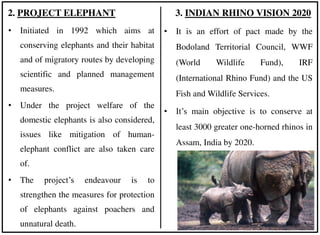
• Initiated in 1992 which aims at
conserving elephants and their habitat
and of migratory routes by developing
scientific and planned management
measures.
• Under the project welfare of the
domestic elephants is also considered,
issues like mitigation of human-
elephant conflict are also taken care
of.
• The project’s endeavour is to
strengthen the measures for protection
of elephants against poachers and
unnatural death.
2. PROJECT ELEPHANT 3. INDIAN RHINO VISION 2020
• It is an effort of pact made by the
Bodoland Territorial Council, WWF
(World Wildlife Fund), IRF
(International Rhino Fund) and the US
Fish and Wildlife Services.
• It’s main objective is to conserve at
least 3000 greater one-horned rhinos in
Assam, India by 2020.
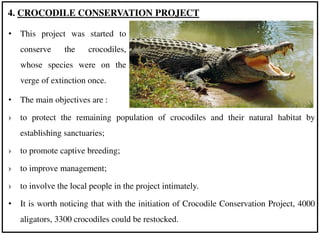
• The main objectives are :
› to protect the remaining population of crocodiles and their natural habitat by
establishing sanctuaries;
› to promote captive breeding;
› to improve management;
› to involve the local people in the project intimately.
• It is worth noticing that with the initiation of Crocodile Conservation Project, 4000
aligators, 3300 crocodiles could be restocked.
4. CROCODILE CONSERVATION PROJECT
• This project was started to
conserve the crocodiles,
whose species were on the
verge of extinction once.
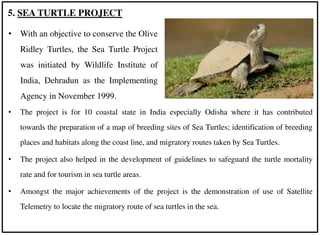
• The project is for 10 coastal state in India especially Odisha where it has contributed
towards the preparation of a map of breeding sites of Sea Turtles; identification of breeding
places and habitats along the coast line, and migratory routes taken by Sea Turtles.
• The project also helped in the development of guidelines to safeguard the turtle mortality
rate and for tourism in sea turtle areas.
• Amongst the major achievements of the project is the demonstration of use of Satellite
Telemetry to locate the migratory route of sea turtles in the sea.
5. SEA TURTLE PROJECT
• With an objective to conserve the Olive
Ridley Turtles, the Sea Turtle Project
was initiated by Wildlife Institute of
India, Dehradun as the Implementing
Agency in November 1999.
• Keeping in view the recent human encroachment, the Indian Government did take effective
initiatives to conserve wildlife in the country, and amongst it, most commendable initiatives
is the Wildlife Protection Act of 1972, which prohibits trade of rare and endangered species.
• However, this is not the only laudatory measure taken by the Government of India (GOI),
there is so much more that needs to be told about the various Wildlife Conservation
Societies that have helped the country maintain its rich wildlife.
• Here is a glance at the important Wildlife Conservation Societies of India :
› The Corbett Foundation.
› Wildlife Institute of India.
› Wildlife Protection Society of India.
› Wildlife Conservation Trust.
› Wildlife SOS.
› World Wildlife Fund (WWF).
› Centre for Wildlife Studies.
IMPORTANT WILDLIFE CONSERVATION SOCIETIES OF INDIA
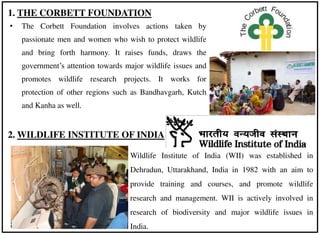
• The Corbett Foundation involves actions taken by
passionate men and women who wish to protect wildlife
and bring forth harmony. It raises funds, draws the
government’s attention towards major wildlife issues and
promotes wildlife research projects. It works for
protection of other regions such as Bandhavgarh, Kutch
and Kanha as well.
1. THE CORBETT FOUNDATION
2. WILDLIFE INSTITUTE OF INDIA
• Wildlife Institute of India (WII) was established in
Dehradun, Uttarakhand, India in 1982 with an aim to
provide training and courses, and promote wildlife
research and management. WII is actively involved in
research of biodiversity and major wildlife issues in
India.
• The main aim of WPSI is to inform the government
about poaching and wildlife trade, especially of
tigers. WPSI even works for mitigating human-
animal conflicts and promotes research projects.
3. WILDLIFE PROTECTION SOCIETY OF INDIA
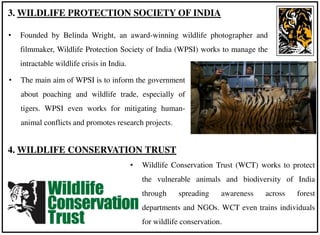
• Founded by Belinda Wright, an award-winning wildlife photographer and
filmmaker, Wildlife Protection Society of India (WPSI) works to manage the
intractable wildlife crisis in India.
4. WILDLIFE CONSERVATION TRUST
• Wildlife Conservation Trust (WCT) works to protect
the vulnerable animals and biodiversity of India
through spreading awareness across forest
departments and NGOs. WCT even trains individuals
for wildlife conservation.
• WWF- India promotes various academic, field projects for biodiversity and even spreads
awareness about enviro-legal actions.
• Established in 1995 by Kartick Satyanarayan and Geeta Seshamani, Wildlife
SOS works against animal violence, resolves human-animal conflicts,
rescues wildlife during crisis and educates people about habitat protection.
5. WILDLIFE SOS, INDIA
6. WORLD WILDLIFE FUND (WWF), INDIA
• World Wildlife Fund- India started working at Horn Bill House, Mumbai.
Today, WWF- India happens to be the largest voluntary organization which
works for wildlife as well as nature conservation.
7. CENTRE FOR WILDLIFE STUDIES
• Centre for Wildlife Studies (CWS) was established in 1984 in Bengaluru with an aim to
promote conservation of the tiger and other large mammals, along with equal emphasis for
ecology through collaboration with State and Central Governments.
• Initially started to stop bears from dancing in circuses, today Wildlife SOS even has projects
to rescue elephants, leopards, reptiles and various other animals.
RECOMMENDATIONS
• Love towards mother earth, nature and animals.
• Conservation laws for wildlife should be practiced properly.
• Strict actions against, who do not abide laws.
• Non-balable arrest to person found acused.
• Non-industrial activities besides reserve forest.
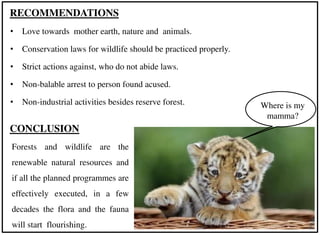
CONCLUSION
Forests and wildlife are the
renewable natural resources and
if all the planned programmes are
effectively executed, in a few
decades the flora and the fauna
will start flourishing.
Where is my
mamma?
• http://www.wiienvis.nic.in/Content/GovernmentPolicyDocuments_8100.aspx
• http://www.polkacafe.com/wildlife-conservation-organizations-and-initiatives-in-
india-878.html
• http://www.conservationindia.org/resources/the-legal-framework-for-wildlife-
conservation-in-india-2
• https://www.ranthamborenationalpark.com/blog/wildlife-conservation-initiatives-
indian-government/
• http://www.yourarticlelibrary.com/wildlife/wildlife-protection-projects-undertaken-
by-govt-of-india-for-wildlife-protection/11157/
• http://nbaindia.org/uploaded/Biodiversityindia/1.%20Fisheries%20Act.pdf
REFERENCES
• National Wildlife Database Cell, Wildlife Institute of India.
• http://www.envfor.nic.in/legis/wildlife/wildlife1.html
Wildlife presentation

Wildlife presentation

  • 1.
    A Presentation on ‘WILDLIFE CONSERVATION ’ Presented by : Athul P. – 17M805 Rajat Nainwal – 17M809
  • 2.
    WHAT DOES WILDLIFECONSERVATION MEANS ? • According to the Wildlife Protection Act of 1972, wildlife includes any animal, bees, butterfly, crustacean, fish and moth and aquatic or land vegetation, which form part of any habitat. • Therefore, wildlife refers to living organisms (flora and fauna) in their natural habitats. • Example: lion, deer, crocodiles, whales, trees and shrubs in dense forests etc. BENEFITS OF WILDLIFE • Wildlife is an essential component of various food chains, food webs, biogeochemical cycles and energy flow through various trophic levels. • Preserves vitality and health of environment and provides stability to various ecosystems.
  • 3.
    • Habitat loss: Population growth, fast industrialisation, urbanisation and modernisation have all contributed to a large-scale destruction of natural habitat of plants and animals. THREATS TO WILDLIFE • Indiscriminate hunting : Indiscriminate killing and poaching of wild animals for food, horn, fur, tusk etc. has resulted in reduction and even extinction of many wild species. • Introduction of exotic species : Many native species have known to disappear and their existence is under threat because of the introduction of exotic and alien species. Sea Lampreys
  • 4.
    • Pollution : ›Air, water, soil and noise pollution of the magnitude and toxicity never seen before is the major factor. › Natural habitats have been destroyed or damaged by activities such as the indiscriminate use of synthetic materials, release of radiations and oil spills in the sea, generation of effluents and wastes of various kinds and toxicity, and their unscientific disposal. THREATS TO WILDLIFE
  • 5.
    • Beauty • Economicvalue : Timber, fur, tusk, ivory, leather, honey etc. • Scientific value : Gene pool for the scientists to carry breeding programmers in agriculture, animal husbandry and fishery. • Maintain Ecological Balance. • Eco - Tourism. IMPORTANCE OF WILDLIFE CONSERVATION Elephant tusks Ecological balance Eco-tourism
  • 6.
    CAUSES OF WILDLIFEDESTRUCTION • Habitat loss › Extensive human demand resulted into Habitat Loss. › Rain forests are the main habitats. › Tropical rainforests are cleared for wood / timber resources, development of petroleum resources, mineral resources. › Second most critical factor in species extinction. › Now there are 20% less forest cover than existed 300 years ago.
  • 7.
    CAUSES OF WILDLIFEDESTRUCTION • Poaching and Hunting › Another major cause of animal species extinction. › Poaching and illegal trade in animals are of about US $10 - $15 million per year worldwide. • National and International wildlife trade › Pet, fur, meat, body parts trade and trade for biomedical research. • Climate change / Global warming • Pollution • Introduced (Invasive) Species • Farmer / Rancher Shootings Rancher shooting Climate change
  • 8.
    EFFECTS OF WILDLIFEDEPLETION - Unbalance food chain and ecosystem. - Reduction in rare wild animals. - Impact on bio-diversity. - Loss of economic value. - Danger to human life. - Loss in genetic information.
  • 9.
    MAJESTIC ELEPHANTS SNOW LEOPARD SWAMP DEER DESERTCAT LEAF MONKEY ENDANGERED SPECIES OF ANIMALS THE INDIAN BISON HISPID HARE BLUE WHALE
  • 10.
    CYCAS BEDDOMEI REDSANDALWOOD BAOBAB BERBERIS DECALEPIS HAMILTONII ENDANGERED SPECIES OF PLANTS
  • 11.
    • Many peopleare under the impression that India does not have strong wildlife conservation laws. On the contrary, we have some of the most stringent legislations to protect wildlife and habitats. • The Government of India has introduced various types of legislation in response to the growing destruction of wildlife and forests. These are: › The Wildlife (Protection) Act, 1972 (Last amended in 2006). › National Wildlife Action Plan (2002-2016). › The Environment (Protection) Act (1986). › The Biological Diversity Act (2002). › The Indian Fisheries Act (1897). › The Indian Forest Act (1927). › The Forest Conservation Act (1980). LEGAL FRAMEWORK FOR WILDLIFE CONSERVATION IN INDIA
  • 12.
    • The Wildlife(Protection) Act (WLPA), 1972 is an important statute that provides a powerful legal framework for: › Prohibition of hunting › Protection and management of wildlife habitats › Establishment of protected areas › Regulation and control of trade in parts and products derived from wildlife › Management of zoos. • The WLPA provides for several categories of Protected Areas/Reserves: › National Parks › Wildlife Sanctuaries › Tiger Reserves › Conservation Reserves › Community Reserves • Apart from protected area establishment, other important aspects of the WLPA include procedures for the appointment of state wildlife authorities and wildlife boards, the regulation of trade in wildlife products and the prevention, detection and punishment of violations of the WLPA. 1. THE WILDLIFE PROTECTION ACT, 1972 (LAST AMENDED IN 2006)
  • 13.
    SR. NO. NAMESTATE ANIMAL(s) PROTECTED 1. Jim Corbett National Park Uttarakhand Tiger (EN) 2. Kaziranga National Park Assam Rhinocerus (CR) 3. Hazaribagh National Park Jharkhand Tiger (EN) 4. Kanha National Park Madhya Pradesh Tiger (EN), Cheetah (VU) 5. Sunderbans Tiger Reserve West Bengal Bengal Tiger (EN) 6. Gir National Park Gujarat Asiatic Lion (EN) 7. Bandipur National Park Karnataka Elephant (VU), Tiger (EN) 8. Desert National Park Rajasthan Great Indian Bustard (CR) NATIONAL PARKS • A national park is protected area of land in which a typical ecosystem with all its wild plants and animals are protected and preserved in natural surroundings. • As of April 2017, there were 103 national parks comprising a total area of 40,500 sq. km. • Jim Corbett National Park in Uttarakhand, established in 1936, was the first national park in India. EN = Endangered, CR = Critically Endangered, VU = Vulnerable
  • 14.
    WILDLIFE SANCTUARY • Asanctuary is a protected area of land, wetland or sea reserved for the conservation of wild animals, birds and plants. • As of April 2017, India has 543 wildlife sanctuaries comprising a total area of 1,18,918 sq. km. • Hunting of any kind is prohibited in sanctuaries. Private ownership rights over sanctuaries and limited human activities may be granted, provided, they do not interfere with the normal activities (feeding, nesting, breeding of wildlife). SR. NO. NAME STATE ANIMAL(s) / BIRD PROTECTED 1. Keoladeo Ghana Bird Sanctuary Rajasthan Siberian Crane 2. Chilika Lake Bird Sanctuary Odisha Water fowls, Cranes, Ducks 3. Manas Wildlife Sanctuary Assam Panther, tiger, Rhinocerus 4. Dachigam Sanctuary J & K Kashmiri Stag, Musk Snow Leopard 5. Madhumalai Wildlife Sanctuary Tamil Nadu Elephant, Four-horned Antelope 6. Nagarjuna Sagar Sanctuary Andhra Pradesh Tiger, Panther 7. Periyar Sanctuary Kerala Elephant 8. Balmiki Nagar Tiger Reserve Bihar Tiger
  • 15.
    BIOSPHERE RESERVES • Biospherereserves are a specific category of protected area of land wherein tribal people native to the area are an integral part of the system. • It’s concept was conceived by the UN and was launched in 1975 as a part of UNESCO’s “Man and Biosphere” programme. • In biospheres, various uses of land are permitted by dividing it into 3 distinct zones – core zone, buffer zone and transition zone. SR. NO. NAME STATE ANIMAL(s) PROTECTED 1. Nilgiri Biosphere Reserve Tamil Nadu, Kerala, Karnataka Nilgiri Tahr, Lion-tailed Macaque 2. Gulf of Mannar Biosphere Reserve Tamil Nadu Dugong, Sea-Cow 3. Sunderbans National Park West Bengal Royal Bengal tiger 4. Nanda Devi Biosphere Reserve Uttarakhand 5. Nokrek Biosphere Reserve Meghalaya Red Panda 6. Panchmarthi Biosphere Reserve Madhya Pradesh Giant Squirrel, Flying Squirrel 7. Simlipal Biosphere Reserve Odisha Royal Bengal Tiger, Elephant, gaur 8. Nicobar islands Andaman & Nicobar Islands Salt water Crocodile
  • 16.
    • Replaces theearlier plan adopted in 1983 and was introduced in response to the need for a change in priorities given the increased commercial use of natural resources, continued growth of human and livestock populations, and changes in consumption patterns. • The Plan most closely represents an actual policy on protection of wildlife. It focuses on strengthening and enhancing the protected area network, on the conservation of Endangered wildlife and their habitats, on controlling trade in wildlife products and on research, education, and training. • The Plan endorses two new protected area categories: “conservation reserves,” referring to corridors connecting protected areas, and “community reserves”, which will allow greater participation of local communities in protected area management through traditional or cultural conservation practices. • The Plan contains various recommendations to address the needs of local communities living outside protected areas and outlines the need for voluntary relocation and rehabilitation of villages within protected areas. • The Plan recognizes the need to reduce human-wildlife conflict and emphasizes the establishment of effective compensation mechanisms. It includes the restoration of degraded habitats outside protected areas as a key objective. 2. NATIONAL WILDLIFE ACTION PLAN (2002-2016)
  • 17.
    • It isan important legislation that provides for coordination of activities of the various regulatory agencies, creation of authorities with adequate powers for environmental protection, regulation of the discharge of environmental pollutants, handling of hazardous substances, etc. • The Act provided an opportunity to extend legal protection to non-forest habitats (‘Ecologically Sensitive Areas’) such as grasslands, wetlands and coastal zones. 3. THE ENVIRONMENT PROTECTION ACT (1986) 4. THE BIOLOGICAL DIVERSITY ACT (2002) • India is a party to the United Nations Convention on Biological Diversity. • The provisions of the Biological Diversity Act are in addition to and not in derogation of the provisions in any other law relating to forests or wildlife.
  • 18.
    • The mainobjective of the Indian Forest Act (1927) is to secure exclusive state control over forests to meet the demand for timber. Most of these untitled lands had traditionally belonged to the forest dwelling communities. The Act defined state ownership, regulated its use and appropriated the power to substitute or extinguish customary rights. The Act facilitates three categories of forests, namely : › Reserved forests › Village forests › Protected forests  Reserved forests are the most protected within these categories. No rights can be acquired in reserved forests except by succession or under a grant or contract with the government. Felling trees, grazing cattle, removing forest products, quarrying, fishing, and hunting are punishable with a fine or imprisonment. 5. THE INDIAN FOREST ACT (1927)
  • 19.
    • In orderto check rapid deforestation due to forestlands being released by state governments for agriculture, industry and other development projects (allowed under the Indian Forest Act), the federal government enacted the Forest Conservation Act in 1980 with an amendment in 1988. • The Act made the prior approval of the federal government necessary for de-reservation of reserved forests, logging and for use of forestland for non-forest purposes. • This powerful legislation has, to a large extent, curtailed the indiscriminate logging and release of forestland for non-forestry purposes by state governments. • While the federal government imposed such strict restrictions, it did not simultaneously evolve a mechanism to compensate state governments for loss of timber logging revenues. • The Supreme Court of India has currently imposed a complete ban on the release of forestland for non-forestry activities without the prior approval of the federal government. 6. THE FOREST CONSERVATION ACT (1980)
  • 20.
    • Wildlife isan important component of biodiversity. To prevent the extinction of species, various projects have been initiated by the Indian government, such as : › Project Tiger › Project Elephant › Indian Rhino Vision 2020 › Crocodile Conservation Project › Sea Turtle Project › Vulture Conservation Project PROJECTS UNDERTAKEN THE BY INDIAN GOVERNMENT FOR WILDLIFE PROTECTION
  • 21.
    • This projectis sponsored by Ministry of Environment Forest and Climate Change. • About 47 tiger reserves situated in more than 17 regions including Corbett National Park (Uttarakhand) and Ranthambore National Park (Rajasthan) are part of this project which conducts assessments of number of tigers, their habitat, hunting habits under the supervision of the Tiger Task Force. • Project Tiger has seen significant success in recovery of the habitat and increase in the population of the tigers in the reserve areas, from a scanty 268 in 9 reserves in 1972 to above 1000 in 28 reserves in 2006 to 2000+ tigers in 2016. 1. PROJECT TIGER • One of the most successful wildlife conservation ventures ‘Project Tiger’ which was initiated way back in 1972, has not only contributed to the conservation of tigers but also of the entire ecosystem.
  • 22.
    • Initiated in1992 which aims at conserving elephants and their habitat and of migratory routes by developing scientific and planned management measures. • Under the project welfare of the domestic elephants is also considered, issues like mitigation of human- elephant conflict are also taken care of. • The project’s endeavour is to strengthen the measures for protection of elephants against poachers and unnatural death. 2. PROJECT ELEPHANT 3. INDIAN RHINO VISION 2020 • It is an effort of pact made by the Bodoland Territorial Council, WWF (World Wildlife Fund), IRF (International Rhino Fund) and the US Fish and Wildlife Services. • It’s main objective is to conserve at least 3000 greater one-horned rhinos in Assam, India by 2020.
  • 23.
    • The mainobjectives are : › to protect the remaining population of crocodiles and their natural habitat by establishing sanctuaries; › to promote captive breeding; › to improve management; › to involve the local people in the project intimately. • It is worth noticing that with the initiation of Crocodile Conservation Project, 4000 aligators, 3300 crocodiles could be restocked. 4. CROCODILE CONSERVATION PROJECT • This project was started to conserve the crocodiles, whose species were on the verge of extinction once.
  • 24.
    • The projectis for 10 coastal state in India especially Odisha where it has contributed towards the preparation of a map of breeding sites of Sea Turtles; identification of breeding places and habitats along the coast line, and migratory routes taken by Sea Turtles. • The project also helped in the development of guidelines to safeguard the turtle mortality rate and for tourism in sea turtle areas. • Amongst the major achievements of the project is the demonstration of use of Satellite Telemetry to locate the migratory route of sea turtles in the sea. 5. SEA TURTLE PROJECT • With an objective to conserve the Olive Ridley Turtles, the Sea Turtle Project was initiated by Wildlife Institute of India, Dehradun as the Implementing Agency in November 1999.
  • 25.
    • Keeping inview the recent human encroachment, the Indian Government did take effective initiatives to conserve wildlife in the country, and amongst it, most commendable initiatives is the Wildlife Protection Act of 1972, which prohibits trade of rare and endangered species. • However, this is not the only laudatory measure taken by the Government of India (GOI), there is so much more that needs to be told about the various Wildlife Conservation Societies that have helped the country maintain its rich wildlife. • Here is a glance at the important Wildlife Conservation Societies of India : › The Corbett Foundation. › Wildlife Institute of India. › Wildlife Protection Society of India. › Wildlife Conservation Trust. › Wildlife SOS. › World Wildlife Fund (WWF). › Centre for Wildlife Studies. IMPORTANT WILDLIFE CONSERVATION SOCIETIES OF INDIA
  • 26.
    • The CorbettFoundation involves actions taken by passionate men and women who wish to protect wildlife and bring forth harmony. It raises funds, draws the government’s attention towards major wildlife issues and promotes wildlife research projects. It works for protection of other regions such as Bandhavgarh, Kutch and Kanha as well. 1. THE CORBETT FOUNDATION 2. WILDLIFE INSTITUTE OF INDIA • Wildlife Institute of India (WII) was established in Dehradun, Uttarakhand, India in 1982 with an aim to provide training and courses, and promote wildlife research and management. WII is actively involved in research of biodiversity and major wildlife issues in India.
  • 27.
    • The mainaim of WPSI is to inform the government about poaching and wildlife trade, especially of tigers. WPSI even works for mitigating human- animal conflicts and promotes research projects. 3. WILDLIFE PROTECTION SOCIETY OF INDIA • Founded by Belinda Wright, an award-winning wildlife photographer and filmmaker, Wildlife Protection Society of India (WPSI) works to manage the intractable wildlife crisis in India. 4. WILDLIFE CONSERVATION TRUST • Wildlife Conservation Trust (WCT) works to protect the vulnerable animals and biodiversity of India through spreading awareness across forest departments and NGOs. WCT even trains individuals for wildlife conservation.
  • 28.
    • WWF- Indiapromotes various academic, field projects for biodiversity and even spreads awareness about enviro-legal actions. • Established in 1995 by Kartick Satyanarayan and Geeta Seshamani, Wildlife SOS works against animal violence, resolves human-animal conflicts, rescues wildlife during crisis and educates people about habitat protection. 5. WILDLIFE SOS, INDIA 6. WORLD WILDLIFE FUND (WWF), INDIA • World Wildlife Fund- India started working at Horn Bill House, Mumbai. Today, WWF- India happens to be the largest voluntary organization which works for wildlife as well as nature conservation. 7. CENTRE FOR WILDLIFE STUDIES • Centre for Wildlife Studies (CWS) was established in 1984 in Bengaluru with an aim to promote conservation of the tiger and other large mammals, along with equal emphasis for ecology through collaboration with State and Central Governments. • Initially started to stop bears from dancing in circuses, today Wildlife SOS even has projects to rescue elephants, leopards, reptiles and various other animals.
  • 29.
    RECOMMENDATIONS • Love towardsmother earth, nature and animals. • Conservation laws for wildlife should be practiced properly. • Strict actions against, who do not abide laws. • Non-balable arrest to person found acused. • Non-industrial activities besides reserve forest. CONCLUSION Forests and wildlife are the renewable natural resources and if all the planned programmes are effectively executed, in a few decades the flora and the fauna will start flourishing. Where is my mamma?
  • 30.
    • http://www.wiienvis.nic.in/Content/GovernmentPolicyDocuments_8100.aspx • http://www.polkacafe.com/wildlife-conservation-organizations-and-initiatives-in- india-878.html •http://www.conservationindia.org/resources/the-legal-framework-for-wildlife- conservation-in-india-2 • https://www.ranthamborenationalpark.com/blog/wildlife-conservation-initiatives- indian-government/ • http://www.yourarticlelibrary.com/wildlife/wildlife-protection-projects-undertaken- by-govt-of-india-for-wildlife-protection/11157/ • http://nbaindia.org/uploaded/Biodiversityindia/1.%20Fisheries%20Act.pdf REFERENCES • National Wildlife Database Cell, Wildlife Institute of India. • http://www.envfor.nic.in/legis/wildlife/wildlife1.html