INTRODUCTION
TO
INTeRNaTIONal law
Course: LLB II
Subject : Public International Law
Unit: 1
INTRODUCTION
TO
INTERNATIONAL LAW
1
The definition of ‘nations’ or ‘states’
• Political bodies
• Societies of men
• Who have united together and combined
their forces
• In order to procure their mutual welfare
and security
WHAT IS MEANT BY THE LAW OF NATIONS?
• The Law of Nations is the science of the rights exist
between Nations and States, and of the obligations
corresponding to these rights.
2
The meaning of international law
• Modern approach:
“the body of law that regulates the activities
of entities possessing international
personality”
• Traditional approach:
“the conduct and relationships of states”
What is international law?
• Basically defined, international law is simply the set of rules that countries
follow in dealing with each other. There are three distinct legal processes
that can be indentified in International Law that include Public
International Law (The relationship between sovereign states and
international entities such as International Criminal Court), Private
International Law
• (Addressing questions of jurisdiction in conflict), and Supranational Law
(The set of collective laws that sovereign states voluntarily yield
to). But this basic definition must be supplemented with three more-
complex explanations—is international law really law, the way the laws of
the United States, enforced by courts and police, are? Where do we find
the rules of international law? Are they written down somewhere? Finally,
how is international law enforced, if there is no world government?
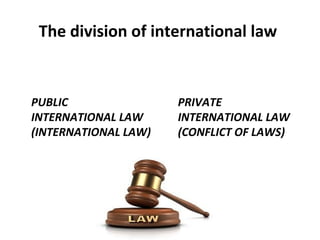
The division of international law
PUBLIC
INTERNATIONAL LAW
(INTERNATIONAL LAW)
PRIVATE
INTERNATIONAL LAW
(CONFLICT OF LAWS)
What is “private international law”?
• The body of law of law that regulates the relations
between persons and entities in different states
• Private international law = “conflict of laws”
THE NATURE OF INTERNATIONAL LAW
Definition
“International law is the collection of rules
and norms that states and other actors feel an
obligation to obey in their mutual relations
and commonly do obey”
Conwey W. Henderson, Understanding
International Law, 2010.
THE NATURE OF INTERNATIONAL LAW
Definition
In the past, international law was commonly
described as “the law that regulates the
relations between states, amongst each other”
or “the system of legal norms regulating
mutual relations between states”, or “the set
of rules recognized by states and concerning
their external relations”, or “the set of rules
binding within the international community”.
THE NATURE OF INTERNATIONAL LAW
An interesting definition of international law was
formulated in the 1970s by a Russian international
lawyer Prof. G. I.Tunkin:
“contemporary international law is the aggregate of
norms which are created by agreement between states of
different social systems, reflect the concordant wills of
states and have a generally democratic character,
regulate relations between them in the process of
struggle and cooperation in the direction of ensuring
peace and peaceful coexistence and freedom and
independence of peoples, and are secured when
necessary by coercion effectuated by states individually
or collectively”.
THE NATURE OF INTERNATIONAL LAW
Some examples of more recent
definitions of international law include:
o “The system of law regulating the interrelationship of
sovereign states and their rights and duties with regard
to one another. In addition, certain international
organizations (such as the United Nations), companies,
and sometimes individuals (e.g. in the sphere of human
rights) may have rights or duties under international
law.”(Oxford Dictionary of Law, 1997, p. 240)
THE NATURE OF INTERNATIONAL LAW
• “ Today, international law refers to those rules and
norms which regulate the conduct of states and other
entities which at any time are recognized as being
endowed with international personality, for example
international organizations and individuals, in their
relations with each other” (Rebecca M.M. Wallace,
International Law (Sweet and Maxwell, 1995, p. 1).
THE NATURE OF INTERNATIONAL LAW
Is international law a ‘real’ law?
o International law is practiced on a daily
basis in the Foreign Offices, national
courts and other governmental organs
of states;
“The evidence is that reference to international law has
been a normal part of the process of decision-making” I.
Brownlie
o States do not claim that they are above
the law or that international law does
not bind them;
THE NATURE OF INTERNATIONAL LAW
o The overwhelming majority of international
legal rules are consistently obeyed;
“It is probably the case that almost all nations
observe almost all principles of international
law and almost all of their obligations almost
all of the time” (L. Henkin, How Nations
Behave, p. 47).
THE NATURE OF INTERNATIONAL LAW
Basic characteristics of international law:
• International law has only a limited
number of developed legal institutions;
• In comparison with national law,
international law is decentralised:
THE NATURE OF INTERNATIONAL LAW
Basic characteristics of international law
 Decentralised international law-making;
 Decentralised international law enforcement;
 Decentralised, voluntary international law
adjudication.
THE NATURE OF INTERNATIONAL LAW
• Why is international law binding on
States and other actors?
 The command theory;
 The consensual theory/consensus;
 Natural law.
THE Functions OF INTERNATIONAL LAW
The Functions of International Law:
• To arrange for the cooperation most actors
wish to have most of the time;
• To identify the membership of an
international society of sovereign states;
• To regulate the competing interests of the
various actors and to carry their agreements
into the future;
THE Functions OF INTERNATIONAL LAW
• To empower weaker states as they press for
change against the will of the powerful;
• To promote justice;
• To outlaw war.
Weakness of international laws
• 1. Lack of institutions
• 2. Lack of certainty
• 3. Vital interests
• 4. Vital rules
Development of Public
international law in India
• International law can be divided into Eight stages.
• 1. The primitive and Ancient Period
• 2. The Middle Age
• 3. International Law in the 15th
and 16th
Centuries
• 4. The Era of Hugo Grotius -the thereafter
• 5. The 19th
Century
• 6.The First World War-and thereafter
• 7.The Second-World War- and thereafter
• 8. The Present-day Statue of International Law
References:
• 1. (L. Henkin, How Nations Behave, p. 47).
• 2. immigrationlawyersperth.wordpress.com
• 3. Ethics and Authority in International Law
By Alfred P. Rubin
THANK YOU VERY MUCH

International law-int

  • 1.
    INTRODUCTION TO INTeRNaTIONal law Course: LLBII Subject : Public International Law Unit: 1
  • 2.
  • 3.
    The definition of‘nations’ or ‘states’ • Political bodies • Societies of men • Who have united together and combined their forces • In order to procure their mutual welfare and security
  • 4.
    WHAT IS MEANTBY THE LAW OF NATIONS? • The Law of Nations is the science of the rights exist between Nations and States, and of the obligations corresponding to these rights. 2
  • 5.
    The meaning ofinternational law • Modern approach: “the body of law that regulates the activities of entities possessing international personality” • Traditional approach: “the conduct and relationships of states”
  • 6.
    What is internationallaw? • Basically defined, international law is simply the set of rules that countries follow in dealing with each other. There are three distinct legal processes that can be indentified in International Law that include Public International Law (The relationship between sovereign states and international entities such as International Criminal Court), Private International Law • (Addressing questions of jurisdiction in conflict), and Supranational Law (The set of collective laws that sovereign states voluntarily yield to). But this basic definition must be supplemented with three more- complex explanations—is international law really law, the way the laws of the United States, enforced by courts and police, are? Where do we find the rules of international law? Are they written down somewhere? Finally, how is international law enforced, if there is no world government?
  • 7.
    The division ofinternational law PUBLIC INTERNATIONAL LAW (INTERNATIONAL LAW) PRIVATE INTERNATIONAL LAW (CONFLICT OF LAWS)
  • 8.
    What is “privateinternational law”? • The body of law of law that regulates the relations between persons and entities in different states • Private international law = “conflict of laws”
  • 9.
    THE NATURE OFINTERNATIONAL LAW Definition “International law is the collection of rules and norms that states and other actors feel an obligation to obey in their mutual relations and commonly do obey” Conwey W. Henderson, Understanding International Law, 2010.
  • 10.
    THE NATURE OFINTERNATIONAL LAW Definition In the past, international law was commonly described as “the law that regulates the relations between states, amongst each other” or “the system of legal norms regulating mutual relations between states”, or “the set of rules recognized by states and concerning their external relations”, or “the set of rules binding within the international community”.
  • 11.
    THE NATURE OFINTERNATIONAL LAW An interesting definition of international law was formulated in the 1970s by a Russian international lawyer Prof. G. I.Tunkin: “contemporary international law is the aggregate of norms which are created by agreement between states of different social systems, reflect the concordant wills of states and have a generally democratic character, regulate relations between them in the process of struggle and cooperation in the direction of ensuring peace and peaceful coexistence and freedom and independence of peoples, and are secured when necessary by coercion effectuated by states individually or collectively”.
  • 12.
    THE NATURE OFINTERNATIONAL LAW Some examples of more recent definitions of international law include: o “The system of law regulating the interrelationship of sovereign states and their rights and duties with regard to one another. In addition, certain international organizations (such as the United Nations), companies, and sometimes individuals (e.g. in the sphere of human rights) may have rights or duties under international law.”(Oxford Dictionary of Law, 1997, p. 240)
  • 13.
    THE NATURE OFINTERNATIONAL LAW • “ Today, international law refers to those rules and norms which regulate the conduct of states and other entities which at any time are recognized as being endowed with international personality, for example international organizations and individuals, in their relations with each other” (Rebecca M.M. Wallace, International Law (Sweet and Maxwell, 1995, p. 1).
  • 14.
    THE NATURE OFINTERNATIONAL LAW Is international law a ‘real’ law? o International law is practiced on a daily basis in the Foreign Offices, national courts and other governmental organs of states; “The evidence is that reference to international law has been a normal part of the process of decision-making” I. Brownlie o States do not claim that they are above the law or that international law does not bind them;
  • 15.
    THE NATURE OFINTERNATIONAL LAW o The overwhelming majority of international legal rules are consistently obeyed; “It is probably the case that almost all nations observe almost all principles of international law and almost all of their obligations almost all of the time” (L. Henkin, How Nations Behave, p. 47).
  • 16.
    THE NATURE OFINTERNATIONAL LAW Basic characteristics of international law: • International law has only a limited number of developed legal institutions; • In comparison with national law, international law is decentralised:
  • 17.
    THE NATURE OFINTERNATIONAL LAW Basic characteristics of international law  Decentralised international law-making;  Decentralised international law enforcement;  Decentralised, voluntary international law adjudication.
  • 18.
    THE NATURE OFINTERNATIONAL LAW • Why is international law binding on States and other actors?  The command theory;  The consensual theory/consensus;  Natural law.
  • 19.
    THE Functions OFINTERNATIONAL LAW The Functions of International Law: • To arrange for the cooperation most actors wish to have most of the time; • To identify the membership of an international society of sovereign states; • To regulate the competing interests of the various actors and to carry their agreements into the future;
  • 20.
    THE Functions OFINTERNATIONAL LAW • To empower weaker states as they press for change against the will of the powerful; • To promote justice; • To outlaw war.
  • 21.
    Weakness of internationallaws • 1. Lack of institutions • 2. Lack of certainty • 3. Vital interests • 4. Vital rules
  • 22.
    Development of Public internationallaw in India • International law can be divided into Eight stages. • 1. The primitive and Ancient Period • 2. The Middle Age • 3. International Law in the 15th and 16th Centuries • 4. The Era of Hugo Grotius -the thereafter • 5. The 19th Century • 6.The First World War-and thereafter • 7.The Second-World War- and thereafter • 8. The Present-day Statue of International Law
  • 23.
    References: • 1. (L.Henkin, How Nations Behave, p. 47). • 2. immigrationlawyersperth.wordpress.com • 3. Ethics and Authority in International Law By Alfred P. Rubin
  • 24.