BY
S.PRADEEP KUMAR
DEPARTMENT OF PHARMACOLOGY








INTRODUCION
MAGNITUDE(WORLD AND INDIA)
EPIDEMIOLOGY
TYPES OF FLUOROSIS
DIAGNOSIS
PREVENTION
REFERENCE

SWAMI VIVEKANANDA INSTITUTE OF PHARMACEUTICAL
SCIENCES(SVIPS), VANGAPALLY, BHONGIR




By the end of this lecture reader should understand
that Fluorosis is a public health problem in many
parts of the world. Onset of fluorosis is not
determined simply by fluoride but a large number
of agent , host and environmental factors determine
its occurrence.
Although fluorosis once established is irreversible
but it can be prevented through simple
interventions.
SWAMI VIVEKANANDA INSTITUTE OF PHARMACEUTICAL
SCIENCES(SVIPS), VANGAPALLY, BHONGIR






Fluorosis is a disease caused by deposition of
fluorides in the hard and soft tissues of the body.
It is not merely caused by excess intake of fluoride
but there are many other attributes and variables
which determine the onset of fluorosis in human
population.
It is usually characterized by discoloration of teeth
and crippling disorders.
SWAMI VIVEKANANDA INSTITUTE OF PHARMACEUTICAL
SCIENCES(SVIPS), VANGAPALLY, BHONGIR
Magnitude of Fluorosis







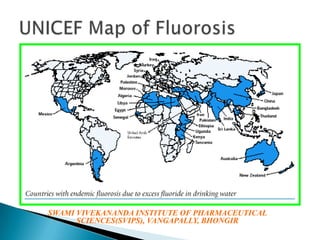
Worldwide in distribution.
Endemic in 22 countries.
Asia and in Asia, India and China are worst
affected.
Mexico in North and Argentina in Latin America.
East and North Africa are also endemic.

SWAMI VIVEKANANDA INSTITUTE OF PHARMACEUTICAL
SCIENCES(SVIPS), VANGAPALLY, BHONGIR
SWAMI VIVEKANANDA INSTITUTE OF PHARMACEUTICAL
SCIENCES(SVIPS), VANGAPALLY, BHONGIR







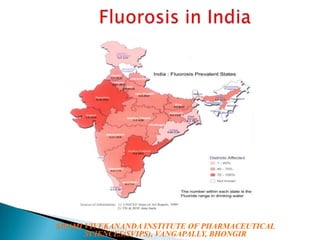
Rajasthan and Gujarat in North India and Andhra
in South India are worst affected.
Punjab, Haryana, M.P. and Maharashtra are
moderately affected.
T.N.,W.B.,U.P.,Bihar and Assam are mildly affected.
Throughout
India
fluorosis
is
essentially
Hydrofluorosis except in parts of Gujarat and U.P.
where industrial fluorosis is also seen.
In worst affected states, maps have been prepared of
geographic pathology on the basis of fluoride
distribution in the drinking water.

SWAMI VIVEKANANDA INSTITUTE OF PHARMACEUTICAL
SCIENCES(SVIPS), VANGAPALLY, BHONGIR
SWAMI VIVEKANANDA INSTITUTE OF PHARMACEUTICAL
SCIENCES(SVIPS), VANGAPALLY, BHONGIR












Primarily it is Fluoride which is present in drinking water
when F in water is more than 1.5 mg per liter, it is toxic to
health.
pH in terms of alkalinity of water promotes the
absorption of F.
calcium in the diet reduces the absorption of F.
Hard water rich in Calcium reduces the F toxicity.
Fresh Fruits and Vit.C reduces the effect of F.
Trace elements like Molubdenum enhances the effect of F.
SWAMI VIVEKANANDA INSTITUTE OF PHARMACEUTICAL
SCIENCES(SVIPS), VANGAPALLY, BHONGIR








In School going children seen as dental fluorosis.
In third and fourth decade of life seen as Skeletal
Fluorosis.
Males suffer more than females.
Illiterates suffer more frequently in the fluorotic
belts.
Where aluminium ores are mined, it is seen as
occupational health hazard.
SWAMI VIVEKANANDA INSTITUTE OF PHARMACEUTICAL
SCIENCES(SVIPS), VANGAPALLY, BHONGIR











High Annual Mean Temperature
Low Rainfall
Low humidity
F rich Natural subsoil rocks
Vegetables from high F belts
Fluoridated tooth paste particularly when used by
children
Tropical climate
Developing Countries
SWAMI VIVEKANANDA INSTITUTE OF PHARMACEUTICAL
SCIENCES(SVIPS), VANGAPALLY, BHONGIR
Dental Fluorosis in Children
 Skeletal Fluorosis in Adults
 Non Skeletal Fluorosis


SWAMI VIVEKANANDA INSTITUTE OF PHARMACEUTICAL
SCIENCES(SVIPS), VANGAPALLY, BHONGIR










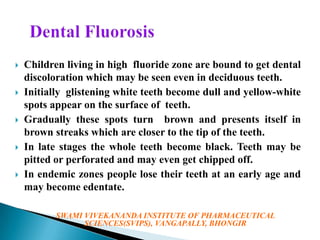
Children living in high fluoride zone are bound to get dental
discoloration which may be seen even in deciduous teeth.
Initially glistening white teeth become dull and yellow-white
spots appear on the surface of teeth.
Gradually these spots turn brown and presents itself in
brown streaks which are closer to the tip of the teeth.
In late stages the whole teeth become black. Teeth may be
pitted or perforated and may even get chipped off.
In endemic zones people lose their teeth at an early age and
may become edentate.
SWAMI VIVEKANANDA INSTITUTE OF PHARMACEUTICAL
SCIENCES(SVIPS), VANGAPALLY, BHONGIR
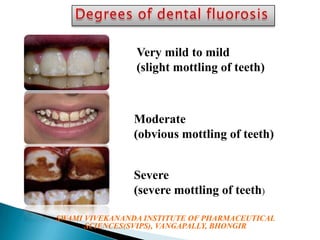
Very mild to mild
(slight mottling of teeth)

Moderate
(obvious mottling of teeth)
Severe
(severe mottling of teeth)
SWAMI VIVEKANANDA INSTITUTE OF PHARMACEUTICAL
SCIENCES(SVIPS), VANGAPALLY, BHONGIR


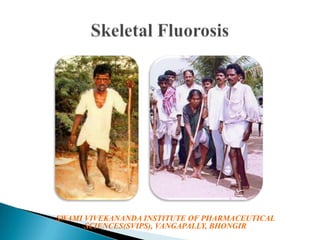
It affects young as well as old. The symptoms include severe
pain and stiffness in the backbone, joints and/or rigidity in
hip bones.



X-ray examinations of the bones reveals thickening and high
density of bones. In some patients with calcium deficiency
osteomalacia type changes are seen.



Constriction of vertebral canal and intervertebral foramen pressure on nerves leads to paralysis.

SWAMI VIVEKANANDA INSTITUTE OF PHARMACEUTICAL
SCIENCES(SVIPS), VANGAPALLY, BHONGIR
SWAMI VIVEKANANDA INSTITUTE OF PHARMACEUTICAL
SCIENCES(SVIPS), VANGAPALLY, BHONGIR








There are convincing evidence of involvement of skeletal
muscles, erythrocytes, G-I mucosa, ligaments and
spermatozoa on consuming more than optimal intake of
fluorides. Detection of Fluorosis at early stage is possible by
understanding the soft tissue manifestation.
In the fluorosed muscles, actin and myosin filaments are
destroyed and mitochondria lose their structural integrity
thereby providing evidence of depletion of muscle energy.
The erythrocyte membrane loses its calcium content in
presence of high fluoride.
Non-ulcer dyspeptic complaints are manifested by consuming
high F in water and food.
SWAMI VIVEKANANDA INSTITUTE OF PHARMACEUTICAL
SCIENCES(SVIPS), VANGAPALLY, BHONGIR
◦
◦
◦
◦
◦
◦

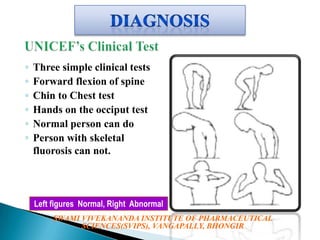
Three simple clinical tests
Forward flexion of spine
Chin to Chest test
Hands on the occiput test
Normal person can do
Person with skeletal
fluorosis can not.

Left figures Normal, Right Abnormal
SWAMI VIVEKANANDA INSTITUTE OF PHARMACEUTICAL
SCIENCES(SVIPS), VANGAPALLY, BHONGIR


COIN TEST: The subject is asked to lift a coin from the
floor without bending the knee. A fluorotic subject would
not be able to lift the coin without flexing the large joints of
lower extremity.



CHIN TEST: The subject is asked to touch the anterior wall
of the chest with the chin. If there is pain or stiffness in the
neck, it indicates the presence of fluorosis.



STRETCH TEST: The individual is made to stretch the arm
sideways, fold at elbow and touch the back of the head.
When there is pain and stiffness, it would not be possible to
reach to the occiput indicating presence of Fluorosis.
SWAMI VIVEKANANDA INSTITUTE OF PHARMACEUTICAL
SCIENCES(SVIPS), VANGAPALLY, BHONGIR
How does fluoride treatment prevent tooth
decay ?










Human teeth (and bones) are primarily composed of the
mineral calcium hydroxyapatite.
Calcium hydroxyapatite has the chemical formula:
Ca5[(PO4)3OH]. One of the main components of this mineral
is the hydroxyl ion.
Fluoride substitutes for the hydroxyl ion, producing calcium
fluoroapatite, with the chemical formula: Ca5[(PO4)3F]
Calcium fluoroapatite is chemically stable than calcium
hydroxyapatite in acid environment of the mouth.
This means that a higher concentration of calcium
fluoroapatite in tooth enamel decreases tooth dissolution, and
therefore can decrease the incidence of tooth decay.
SWAMI VIVEKANANDA INSTITUTE OF PHARMACEUTICAL
SCIENCES(SVIPS), VANGAPALLY, BHONGIR


Since the major source of fluoride is drinking water,
de-fluoridation is the best preventive measure which
can be carried out at domestic as well as community
level



Nutritional interventions like high intake of vitamin
C and Calcium also helps reduce the problem

SWAMI VIVEKANANDA INSTITUTE OF PHARMACEUTICAL
SCIENCES(SVIPS), VANGAPALLY, BHONGIR








Precipitation methods are commonly used for de-fluoridation.
Lime treatment routinely used for hardness removal can
remove F particularly when water is having high Mg
hardness.
Alum is used at domestic level in high doses to remove the F.
In India scientists have developed a method known as
“Nalgonda technique” in which based on the amount of F in
drinking water and alkalinity of the Water (expressed as
mgCaCO3), amount of Alum to be mixed with water is
calculated.
Resins and other filter beds are also available filtering through
which reduces the amount of F in water.
SWAMI VIVEKANANDA INSTITUTE OF PHARMACEUTICAL
SCIENCES(SVIPS), VANGAPALLY, BHONGIR






W.H.O. Monograph on Fluoride and Human
Health, W.H.O., Geneva,1970.
ShivChandra et al:Determination of Optimal Fluoride
Intake,Comm Dent. & Oral Epidemiol,8:35-40,1980.
Susheela A.K.: A Treatise on Fluorosis; Fluorosis
Research and Rural Development Foundation,New
Delhi, 2001.

SWAMI VIVEKANANDA INSTITUTE OF PHARMACEUTICAL
SCIENCES(SVIPS), VANGAPALLY, BHONGIR
SWAMI VIVEKANANDA INSTITUTE OF PHARMACEUTICAL
SCIENCES(SVIPS), VANGAPALLY, BHONGIR

Fluorosis

  • 1.
  • 2.
           INTRODUCION MAGNITUDE(WORLD AND INDIA) EPIDEMIOLOGY TYPESOF FLUOROSIS DIAGNOSIS PREVENTION REFERENCE SWAMI VIVEKANANDA INSTITUTE OF PHARMACEUTICAL SCIENCES(SVIPS), VANGAPALLY, BHONGIR
  • 3.
      By the endof this lecture reader should understand that Fluorosis is a public health problem in many parts of the world. Onset of fluorosis is not determined simply by fluoride but a large number of agent , host and environmental factors determine its occurrence. Although fluorosis once established is irreversible but it can be prevented through simple interventions. SWAMI VIVEKANANDA INSTITUTE OF PHARMACEUTICAL SCIENCES(SVIPS), VANGAPALLY, BHONGIR
  • 4.
       Fluorosis is adisease caused by deposition of fluorides in the hard and soft tissues of the body. It is not merely caused by excess intake of fluoride but there are many other attributes and variables which determine the onset of fluorosis in human population. It is usually characterized by discoloration of teeth and crippling disorders. SWAMI VIVEKANANDA INSTITUTE OF PHARMACEUTICAL SCIENCES(SVIPS), VANGAPALLY, BHONGIR
  • 5.
    Magnitude of Fluorosis      Worldwidein distribution. Endemic in 22 countries. Asia and in Asia, India and China are worst affected. Mexico in North and Argentina in Latin America. East and North Africa are also endemic. SWAMI VIVEKANANDA INSTITUTE OF PHARMACEUTICAL SCIENCES(SVIPS), VANGAPALLY, BHONGIR
  • 6.
    SWAMI VIVEKANANDA INSTITUTEOF PHARMACEUTICAL SCIENCES(SVIPS), VANGAPALLY, BHONGIR
  • 7.
         Rajasthan and Gujaratin North India and Andhra in South India are worst affected. Punjab, Haryana, M.P. and Maharashtra are moderately affected. T.N.,W.B.,U.P.,Bihar and Assam are mildly affected. Throughout India fluorosis is essentially Hydrofluorosis except in parts of Gujarat and U.P. where industrial fluorosis is also seen. In worst affected states, maps have been prepared of geographic pathology on the basis of fluoride distribution in the drinking water. SWAMI VIVEKANANDA INSTITUTE OF PHARMACEUTICAL SCIENCES(SVIPS), VANGAPALLY, BHONGIR
  • 8.
    SWAMI VIVEKANANDA INSTITUTEOF PHARMACEUTICAL SCIENCES(SVIPS), VANGAPALLY, BHONGIR
  • 9.
           Primarily it isFluoride which is present in drinking water when F in water is more than 1.5 mg per liter, it is toxic to health. pH in terms of alkalinity of water promotes the absorption of F. calcium in the diet reduces the absorption of F. Hard water rich in Calcium reduces the F toxicity. Fresh Fruits and Vit.C reduces the effect of F. Trace elements like Molubdenum enhances the effect of F. SWAMI VIVEKANANDA INSTITUTE OF PHARMACEUTICAL SCIENCES(SVIPS), VANGAPALLY, BHONGIR
  • 10.
         In School goingchildren seen as dental fluorosis. In third and fourth decade of life seen as Skeletal Fluorosis. Males suffer more than females. Illiterates suffer more frequently in the fluorotic belts. Where aluminium ores are mined, it is seen as occupational health hazard. SWAMI VIVEKANANDA INSTITUTE OF PHARMACEUTICAL SCIENCES(SVIPS), VANGAPALLY, BHONGIR
  • 11.
            High Annual MeanTemperature Low Rainfall Low humidity F rich Natural subsoil rocks Vegetables from high F belts Fluoridated tooth paste particularly when used by children Tropical climate Developing Countries SWAMI VIVEKANANDA INSTITUTE OF PHARMACEUTICAL SCIENCES(SVIPS), VANGAPALLY, BHONGIR
  • 12.
    Dental Fluorosis inChildren  Skeletal Fluorosis in Adults  Non Skeletal Fluorosis  SWAMI VIVEKANANDA INSTITUTE OF PHARMACEUTICAL SCIENCES(SVIPS), VANGAPALLY, BHONGIR
  • 13.
         Children living inhigh fluoride zone are bound to get dental discoloration which may be seen even in deciduous teeth. Initially glistening white teeth become dull and yellow-white spots appear on the surface of teeth. Gradually these spots turn brown and presents itself in brown streaks which are closer to the tip of the teeth. In late stages the whole teeth become black. Teeth may be pitted or perforated and may even get chipped off. In endemic zones people lose their teeth at an early age and may become edentate. SWAMI VIVEKANANDA INSTITUTE OF PHARMACEUTICAL SCIENCES(SVIPS), VANGAPALLY, BHONGIR
  • 14.
    Very mild tomild (slight mottling of teeth) Moderate (obvious mottling of teeth) Severe (severe mottling of teeth) SWAMI VIVEKANANDA INSTITUTE OF PHARMACEUTICAL SCIENCES(SVIPS), VANGAPALLY, BHONGIR
  • 15.
     It affects youngas well as old. The symptoms include severe pain and stiffness in the backbone, joints and/or rigidity in hip bones.  X-ray examinations of the bones reveals thickening and high density of bones. In some patients with calcium deficiency osteomalacia type changes are seen.  Constriction of vertebral canal and intervertebral foramen pressure on nerves leads to paralysis. SWAMI VIVEKANANDA INSTITUTE OF PHARMACEUTICAL SCIENCES(SVIPS), VANGAPALLY, BHONGIR
  • 16.
    SWAMI VIVEKANANDA INSTITUTEOF PHARMACEUTICAL SCIENCES(SVIPS), VANGAPALLY, BHONGIR
  • 17.
        There are convincingevidence of involvement of skeletal muscles, erythrocytes, G-I mucosa, ligaments and spermatozoa on consuming more than optimal intake of fluorides. Detection of Fluorosis at early stage is possible by understanding the soft tissue manifestation. In the fluorosed muscles, actin and myosin filaments are destroyed and mitochondria lose their structural integrity thereby providing evidence of depletion of muscle energy. The erythrocyte membrane loses its calcium content in presence of high fluoride. Non-ulcer dyspeptic complaints are manifested by consuming high F in water and food. SWAMI VIVEKANANDA INSTITUTE OF PHARMACEUTICAL SCIENCES(SVIPS), VANGAPALLY, BHONGIR
  • 18.
    ◦ ◦ ◦ ◦ ◦ ◦ Three simple clinicaltests Forward flexion of spine Chin to Chest test Hands on the occiput test Normal person can do Person with skeletal fluorosis can not. Left figures Normal, Right Abnormal SWAMI VIVEKANANDA INSTITUTE OF PHARMACEUTICAL SCIENCES(SVIPS), VANGAPALLY, BHONGIR
  • 19.
     COIN TEST: Thesubject is asked to lift a coin from the floor without bending the knee. A fluorotic subject would not be able to lift the coin without flexing the large joints of lower extremity.  CHIN TEST: The subject is asked to touch the anterior wall of the chest with the chin. If there is pain or stiffness in the neck, it indicates the presence of fluorosis.  STRETCH TEST: The individual is made to stretch the arm sideways, fold at elbow and touch the back of the head. When there is pain and stiffness, it would not be possible to reach to the occiput indicating presence of Fluorosis. SWAMI VIVEKANANDA INSTITUTE OF PHARMACEUTICAL SCIENCES(SVIPS), VANGAPALLY, BHONGIR
  • 20.
    How does fluoridetreatment prevent tooth decay ?      Human teeth (and bones) are primarily composed of the mineral calcium hydroxyapatite. Calcium hydroxyapatite has the chemical formula: Ca5[(PO4)3OH]. One of the main components of this mineral is the hydroxyl ion. Fluoride substitutes for the hydroxyl ion, producing calcium fluoroapatite, with the chemical formula: Ca5[(PO4)3F] Calcium fluoroapatite is chemically stable than calcium hydroxyapatite in acid environment of the mouth. This means that a higher concentration of calcium fluoroapatite in tooth enamel decreases tooth dissolution, and therefore can decrease the incidence of tooth decay. SWAMI VIVEKANANDA INSTITUTE OF PHARMACEUTICAL SCIENCES(SVIPS), VANGAPALLY, BHONGIR
  • 21.
     Since the majorsource of fluoride is drinking water, de-fluoridation is the best preventive measure which can be carried out at domestic as well as community level  Nutritional interventions like high intake of vitamin C and Calcium also helps reduce the problem SWAMI VIVEKANANDA INSTITUTE OF PHARMACEUTICAL SCIENCES(SVIPS), VANGAPALLY, BHONGIR
  • 22.
         Precipitation methods arecommonly used for de-fluoridation. Lime treatment routinely used for hardness removal can remove F particularly when water is having high Mg hardness. Alum is used at domestic level in high doses to remove the F. In India scientists have developed a method known as “Nalgonda technique” in which based on the amount of F in drinking water and alkalinity of the Water (expressed as mgCaCO3), amount of Alum to be mixed with water is calculated. Resins and other filter beds are also available filtering through which reduces the amount of F in water. SWAMI VIVEKANANDA INSTITUTE OF PHARMACEUTICAL SCIENCES(SVIPS), VANGAPALLY, BHONGIR
  • 23.
       W.H.O. Monograph onFluoride and Human Health, W.H.O., Geneva,1970. ShivChandra et al:Determination of Optimal Fluoride Intake,Comm Dent. & Oral Epidemiol,8:35-40,1980. Susheela A.K.: A Treatise on Fluorosis; Fluorosis Research and Rural Development Foundation,New Delhi, 2001. SWAMI VIVEKANANDA INSTITUTE OF PHARMACEUTICAL SCIENCES(SVIPS), VANGAPALLY, BHONGIR
  • 24.
    SWAMI VIVEKANANDA INSTITUTEOF PHARMACEUTICAL SCIENCES(SVIPS), VANGAPALLY, BHONGIR