Masterclass on the DID Universal Resolver
Markus Sabadello
Danube Tech, Decentralized Identity Foundation,
Sovrin Foundation, W3C VCWG, W3C CCG, OASIS XDI TC
https://danubetech.com/
Identiverse, Boston, 27th
June 2018
Masterclass on the DID Universal Resolver
1. Decentralized Identifiers (DIDs)
2. DID Universal Resolver
3. What to do with DIDs?
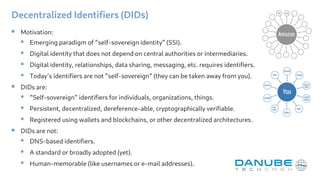
Decentralized Identifiers (DIDs)
 Motivation:
 Emerging paradigm of “self-sovereign identity” (SSI).
 Digital identity that does not depend on central authorities or intermediaries.
 Digital identity, relationships, data sharing, messaging, etc. requires identifiers.
 Today’s identifiers are not “self-sovereign” (they can be taken away from you).
 DIDs are:
 “Self-sovereign” identifiers for individuals, organizations, things.
 Persistent, decentralized, dereference-able, cryptographically verifiable.
 Registered using wallets and blockchains, or other decentralized architectures.
 DIDs are not:
 DNS-based identifiers.
 A standard or broadly adopted (yet).
 Human-memorable (like usernames or e-mail addresses).
Decentralized Identifiers (DIDs)
 Background:
 W3C Web Payments Working Group and Verifiable Claims Task Force
 OASIS XDI TC Registry Working Group
 Internet Identity Workshop, Rebooting-the-Web-of-Trust
 Grant by U.S. Department of Homeland Security
 Decentralized Public Key Infrastructure DPKI (December 2015)
 Decentralized Identifiers 1.0 Implementer’s Draft 01 (November 2016)
 More Community Drafts (2017-2018)
 W3C Working Group (2019)
Decentralized Identifiers (DIDs)
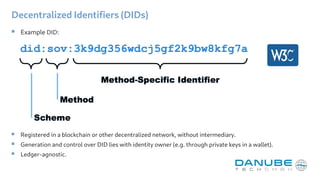
 Example DID:
 Registered in a blockchain or other decentralized network, without intermediary.
 Generation and control over DID lies with identity owner (e.g. through private keys in a wallet).
 Ledger-agnostic.
DID Resolution
 DID Resolution: DID → DID Document
 Set of public keys
 Set of service endpoints
 Timestamps, proofs
 Other identifier metadata
 May be dynamically constructed
rather than actually stored in this form.
 Resolution parameters can select
parts of the DID document.
{
"@context": "https://w3id.org/did/v1",
"id": "did:sov:WRfXPg8dantKVubE3HX8pw",
"service": {
"type": "hub",
"serviceEndpoint":
"https://azure.microsoft.com/dif/hub/did:sov:WRfXPg8dantKVubE3H"
},
"publicKey": [
{
"id": "did:sov:WRfXPg8dantKVubE3HX8pw#key-1",
"type": "Ed25519VerificationKey2018",
"publicKeyBase58": "H3C2AVvLMv6gmMNam3uVAjZpfkcJCwDmqPV"
}
],
"authentication": {
"type": "Ed25519SignatureAuthentication2018",
"publicKey": [
"did:sov:WRfXPg8dantKVubE3HX8pw#key-1"
]
}
}
 Example DID Document:
DID Methods
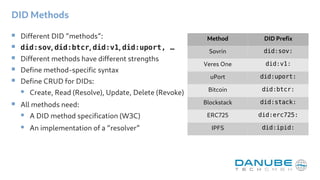
 Different DID “methods”:
 did:sov, did:btcr, did:v1, did:uport, …
 Different methods have different strengths
 Define method-specific syntax
 Define CRUD for DIDs:
 Create, Read (Resolve), Update, Delete (Revoke)
 All methods need:
 A DID method specification (W3C)
 An implementation of a “resolver”
Method DID Prefix
Sovrin did:sov:
Veres One did:v1:
uPort did:uport:
Bitcoin did:btcr:
Blockstack did:stack:
ERC725 did:erc725:
IPFS did:ipid:
Masterclass on the DID Universal Resolver
1. Decentralized Identifiers (DIDs)
2. DID Universal Resolver
3. What to do with DIDs?
DID Universal Resolver
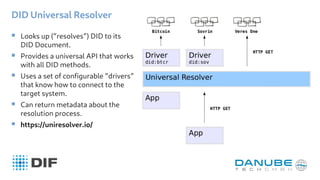
 Looks up (“resolves”) DID to its
DID Document.
 Provides a universal API that works
with all DID methods.
 Uses a set of configurable “drivers”
that know how to connect to the
target system.
 Can return metadata about the
resolution process.
 https://uniresolver.io/
DID Universal Resolver
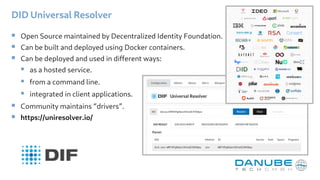
 Open Source maintained by Decentralized Identity Foundation.
 Can be built and deployed using Docker containers.
 Can be deployed and used in different ways:
 as a hosted service.
 from a command line.
 integrated in client applications.
 Community maintains “drivers”.
 https://uniresolver.io/
DID Universal Resolver
 Demo + Discussion
 https://uniresolver.io/
Masterclass on the DID Universal Resolver
1. Decentralized Identifiers (DIDs)
2. DID Universal Resolver
3. What to do with DIDs?
Verifiable Credentials
 Example:
{
"@context": "https://w3id.org/credentials/v1",
"id": "did:sov:WRfXPg8dantKVubE3HX8pw/credentials/1",
"type": ["Credential", "NameCredential"],
"issuer": "did:sov:WRfXPg8dantKVubE3HX8pw",
"issued": "2018-05-01",
"claim": {
"id": "did:btcr:x6lj-wzvr-qqrv-m80w",
"name": "Jane Doe"
},
"proof": {
"type": "RsaSignature2018",
"created": "2017-06-18T21:19:10Z",
"creator": "did:sov:WRfXPg8dantKVubE3HX8pw#key-1",
"nonce": "c0ae1c8e-c7e7-469f-b252-86e6a0e7387e",
"signatureValue": "BavEll0/I1zpYw8XNi1bgVg/sCneO4Jugez8RwDg/+
MCRVpjOboDoe4SxxKjkCOvKiCHGDvc4krqi6Z1n0UfqzxGfmatCuFibcC1wps
PRdW+gGsutPTLzvueMWmFhwYmfIFpbBu95t501+rSLHIEuujM/+PXr9Cky6Ed
+W3JT24="
}
}
DID Auth
 DID-based authentication protocol.
 Identity owner interacts with a
relying party.
 Prove control over a DID using a
cryptographic challenge/response
protocol.
 Uses “publicKey” and “authentication”
blocks in a DID document.
 Different architectures and scenarios.
 See RWoT did_auth_draft.md
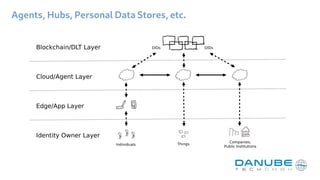
Agents, Hubs, Personal Data Stores, etc.
Identity Owner Layer
Edge/App Layer
Cloud/Agent Layer
Blockchain/DLT Layer
Things
Companies,
Public Institutions
Individuals
DIDs DIDs
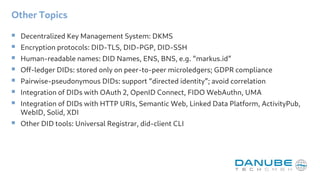
Other Topics
 Decentralized Key Management System: DKMS
 Encryption protocols: DID-TLS, DID-PGP, DID-SSH
 Human-readable names: DID Names, ENS, BNS, e.g. “markus.id”
 Off-ledger DIDs: stored only on peer-to-peer microledgers; GDPR compliance
 Pairwise-pseudonymous DIDs: support “directed identity”; avoid correlation
 Integration of DIDs with OAuth 2, OpenID Connect, FIDO WebAuthn, UMA
 Integration of DIDs with HTTP URIs, Semantic Web, Linked Data Platform, ActivityPub,
WebID, Solid, XDI
 Other DID tools: Universal Registrar, did-client CLI
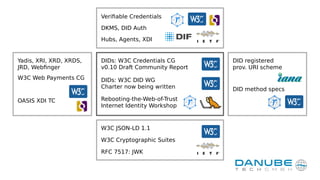
Rebooting-the-Web-of-Trust
Internet Identity Workshop
DIDs: W3C Credentials CG
v0.10 Draft Community Report
DIDs: W3C DID WG
Charter now being written
Yadis, XRI, XRD, XRDS,
JRD, Webfinger
DID registered
prov. URI scheme
DID method specs
W3C Web Payments CG
OASIS XDI TC
W3C JSON-LD 1.1
W3C Cryptographic Suites
RFC 7517: JWK
Verifiable Credentials
DKMS, DID Auth
Hubs, Agents, XDI
Thank You
 https://danubetech.com/
 markus@danubetech.com
 Decentralized Identity Foundation: https://identity.foundation/
 Universal Resolver: https://uniresolver.io/

Masterclass on the DID Universal Resolver

  • 1.
    Masterclass on theDID Universal Resolver Markus Sabadello Danube Tech, Decentralized Identity Foundation, Sovrin Foundation, W3C VCWG, W3C CCG, OASIS XDI TC https://danubetech.com/ Identiverse, Boston, 27th June 2018
  • 2.
    Masterclass on theDID Universal Resolver 1. Decentralized Identifiers (DIDs) 2. DID Universal Resolver 3. What to do with DIDs?
  • 3.
    Decentralized Identifiers (DIDs) Motivation:  Emerging paradigm of “self-sovereign identity” (SSI).  Digital identity that does not depend on central authorities or intermediaries.  Digital identity, relationships, data sharing, messaging, etc. requires identifiers.  Today’s identifiers are not “self-sovereign” (they can be taken away from you).  DIDs are:  “Self-sovereign” identifiers for individuals, organizations, things.  Persistent, decentralized, dereference-able, cryptographically verifiable.  Registered using wallets and blockchains, or other decentralized architectures.  DIDs are not:  DNS-based identifiers.  A standard or broadly adopted (yet).  Human-memorable (like usernames or e-mail addresses).
  • 4.
    Decentralized Identifiers (DIDs) Background:  W3C Web Payments Working Group and Verifiable Claims Task Force  OASIS XDI TC Registry Working Group  Internet Identity Workshop, Rebooting-the-Web-of-Trust  Grant by U.S. Department of Homeland Security  Decentralized Public Key Infrastructure DPKI (December 2015)  Decentralized Identifiers 1.0 Implementer’s Draft 01 (November 2016)  More Community Drafts (2017-2018)  W3C Working Group (2019)
  • 5.
    Decentralized Identifiers (DIDs) Example DID:  Registered in a blockchain or other decentralized network, without intermediary.  Generation and control over DID lies with identity owner (e.g. through private keys in a wallet).  Ledger-agnostic.
  • 6.
    DID Resolution  DIDResolution: DID → DID Document  Set of public keys  Set of service endpoints  Timestamps, proofs  Other identifier metadata  May be dynamically constructed rather than actually stored in this form.  Resolution parameters can select parts of the DID document. { "@context": "https://w3id.org/did/v1", "id": "did:sov:WRfXPg8dantKVubE3HX8pw", "service": { "type": "hub", "serviceEndpoint": "https://azure.microsoft.com/dif/hub/did:sov:WRfXPg8dantKVubE3H" }, "publicKey": [ { "id": "did:sov:WRfXPg8dantKVubE3HX8pw#key-1", "type": "Ed25519VerificationKey2018", "publicKeyBase58": "H3C2AVvLMv6gmMNam3uVAjZpfkcJCwDmqPV" } ], "authentication": { "type": "Ed25519SignatureAuthentication2018", "publicKey": [ "did:sov:WRfXPg8dantKVubE3HX8pw#key-1" ] } }  Example DID Document:
  • 7.
    DID Methods  DifferentDID “methods”:  did:sov, did:btcr, did:v1, did:uport, …  Different methods have different strengths  Define method-specific syntax  Define CRUD for DIDs:  Create, Read (Resolve), Update, Delete (Revoke)  All methods need:  A DID method specification (W3C)  An implementation of a “resolver” Method DID Prefix Sovrin did:sov: Veres One did:v1: uPort did:uport: Bitcoin did:btcr: Blockstack did:stack: ERC725 did:erc725: IPFS did:ipid:
  • 8.
    Masterclass on theDID Universal Resolver 1. Decentralized Identifiers (DIDs) 2. DID Universal Resolver 3. What to do with DIDs?
  • 9.
    DID Universal Resolver Looks up (“resolves”) DID to its DID Document.  Provides a universal API that works with all DID methods.  Uses a set of configurable “drivers” that know how to connect to the target system.  Can return metadata about the resolution process.  https://uniresolver.io/
  • 10.
    DID Universal Resolver Open Source maintained by Decentralized Identity Foundation.  Can be built and deployed using Docker containers.  Can be deployed and used in different ways:  as a hosted service.  from a command line.  integrated in client applications.  Community maintains “drivers”.  https://uniresolver.io/
  • 11.
    DID Universal Resolver Demo + Discussion  https://uniresolver.io/
  • 12.
    Masterclass on theDID Universal Resolver 1. Decentralized Identifiers (DIDs) 2. DID Universal Resolver 3. What to do with DIDs?
  • 13.
    Verifiable Credentials  Example: { "@context":"https://w3id.org/credentials/v1", "id": "did:sov:WRfXPg8dantKVubE3HX8pw/credentials/1", "type": ["Credential", "NameCredential"], "issuer": "did:sov:WRfXPg8dantKVubE3HX8pw", "issued": "2018-05-01", "claim": { "id": "did:btcr:x6lj-wzvr-qqrv-m80w", "name": "Jane Doe" }, "proof": { "type": "RsaSignature2018", "created": "2017-06-18T21:19:10Z", "creator": "did:sov:WRfXPg8dantKVubE3HX8pw#key-1", "nonce": "c0ae1c8e-c7e7-469f-b252-86e6a0e7387e", "signatureValue": "BavEll0/I1zpYw8XNi1bgVg/sCneO4Jugez8RwDg/+ MCRVpjOboDoe4SxxKjkCOvKiCHGDvc4krqi6Z1n0UfqzxGfmatCuFibcC1wps PRdW+gGsutPTLzvueMWmFhwYmfIFpbBu95t501+rSLHIEuujM/+PXr9Cky6Ed +W3JT24=" } }
  • 14.
    DID Auth  DID-basedauthentication protocol.  Identity owner interacts with a relying party.  Prove control over a DID using a cryptographic challenge/response protocol.  Uses “publicKey” and “authentication” blocks in a DID document.  Different architectures and scenarios.  See RWoT did_auth_draft.md
  • 15.
    Agents, Hubs, PersonalData Stores, etc. Identity Owner Layer Edge/App Layer Cloud/Agent Layer Blockchain/DLT Layer Things Companies, Public Institutions Individuals DIDs DIDs
  • 16.
    Other Topics  DecentralizedKey Management System: DKMS  Encryption protocols: DID-TLS, DID-PGP, DID-SSH  Human-readable names: DID Names, ENS, BNS, e.g. “markus.id”  Off-ledger DIDs: stored only on peer-to-peer microledgers; GDPR compliance  Pairwise-pseudonymous DIDs: support “directed identity”; avoid correlation  Integration of DIDs with OAuth 2, OpenID Connect, FIDO WebAuthn, UMA  Integration of DIDs with HTTP URIs, Semantic Web, Linked Data Platform, ActivityPub, WebID, Solid, XDI  Other DID tools: Universal Registrar, did-client CLI
  • 17.
    Rebooting-the-Web-of-Trust Internet Identity Workshop DIDs:W3C Credentials CG v0.10 Draft Community Report DIDs: W3C DID WG Charter now being written Yadis, XRI, XRD, XRDS, JRD, Webfinger DID registered prov. URI scheme DID method specs W3C Web Payments CG OASIS XDI TC W3C JSON-LD 1.1 W3C Cryptographic Suites RFC 7517: JWK Verifiable Credentials DKMS, DID Auth Hubs, Agents, XDI
  • 18.
    Thank You  https://danubetech.com/ markus@danubetech.com  Decentralized Identity Foundation: https://identity.foundation/  Universal Resolver: https://uniresolver.io/