




DEVELOPMENT OF
FINANCIAL
INSTITUTION IN NEPAL.
FINANCIAL INSTITUTION
Financial institutions are the firms that provide financial
services and advice to their clients. The financial institutions are
generally regulated by the financial laws of the government
authority.
Financial institution is an institution that provides financial
services for its clients or members. Probably the most important
financial service provided by financial institutions is acting
as financial intermediaries. Most financial institutions
are regulated by the government.
• It also focuses on dealing with financial transactions,
such as investments, loans and deposits.
Conventionally, financial institutions are composed
of organizations such as banks, trust companies,
insurance companies and investment dealers.
• Almost everyone has deal with a financial institution
on a regular basis. Everything from depositing
money to taking out loans and exchange currencies
must be done through financial institutions.
There are three major types of financial
institutions
• Depositary Institutions
• Contractual Institutions
• Investment Institutes
• Depositary Institutions : Deposit-taking institutions that accept and
manage deposits and make loans, including banks, building
societies, credit unions, trust companies, and mortgage
loan companies
• Contractual Institutions : Insurance companies and pension funds;
and
• Investment Institutes : Investment Banks, underwriters, brokerage
firms
Other types of Financial institution…
• Commercial Banks
• Credit Unions
• Stock Brokerage Firms
• Asset Management Firms
• Insurance Companies
• Commercial Banks: Is a type of bank that provides services, such as accepting
deposits, giving business loans and basic investment products.Commercial bank
can also refer to a bank or a division of a bank that mostly deals with deposits
and loans from corporations or large businesses, as opposed to individual
members of the public
• Credit Unions : The credit unions are the co-operative financial institutions that
are owned by the members of the union. The major difference between the
credit unions and banks is that the credit unions are owned by the members
unlike banks.
• Stock Brokerage Firms : The stock brokerage firms are those entities, that are
responsible for helping the investors put their money in the stock market. The
stock brokerage firms are useful as they can help the investors get the maximum
return from their investments in the stock market.
• Asset Management Firms : Asset Management firms are companies that invests its
clients pooled fund into securities that match its declared financial objectives. Asset
management companies provide investors with more diversification and investing
options than they would have by themselves & attain their investment goals by
proper management of assets.
• Insurance Companies: Insurance is defined as the equitable transfer of the risk of a
loss, from one entity to another, in exchange for payment.
An insurer is a company selling the insurance an insured or policyholder is the person
or entity buying the insurance policy.
Role of Financial Institutions
• The various financial institutions generally act as an
intermediary between the capital market and debt market.
But the services provided by a particular institution
depends on its type.
• The financial institutions are also responsible to transfer
funds from investors to the companies.
• Typically, these are the key entities that control the flow of
money in the economy.
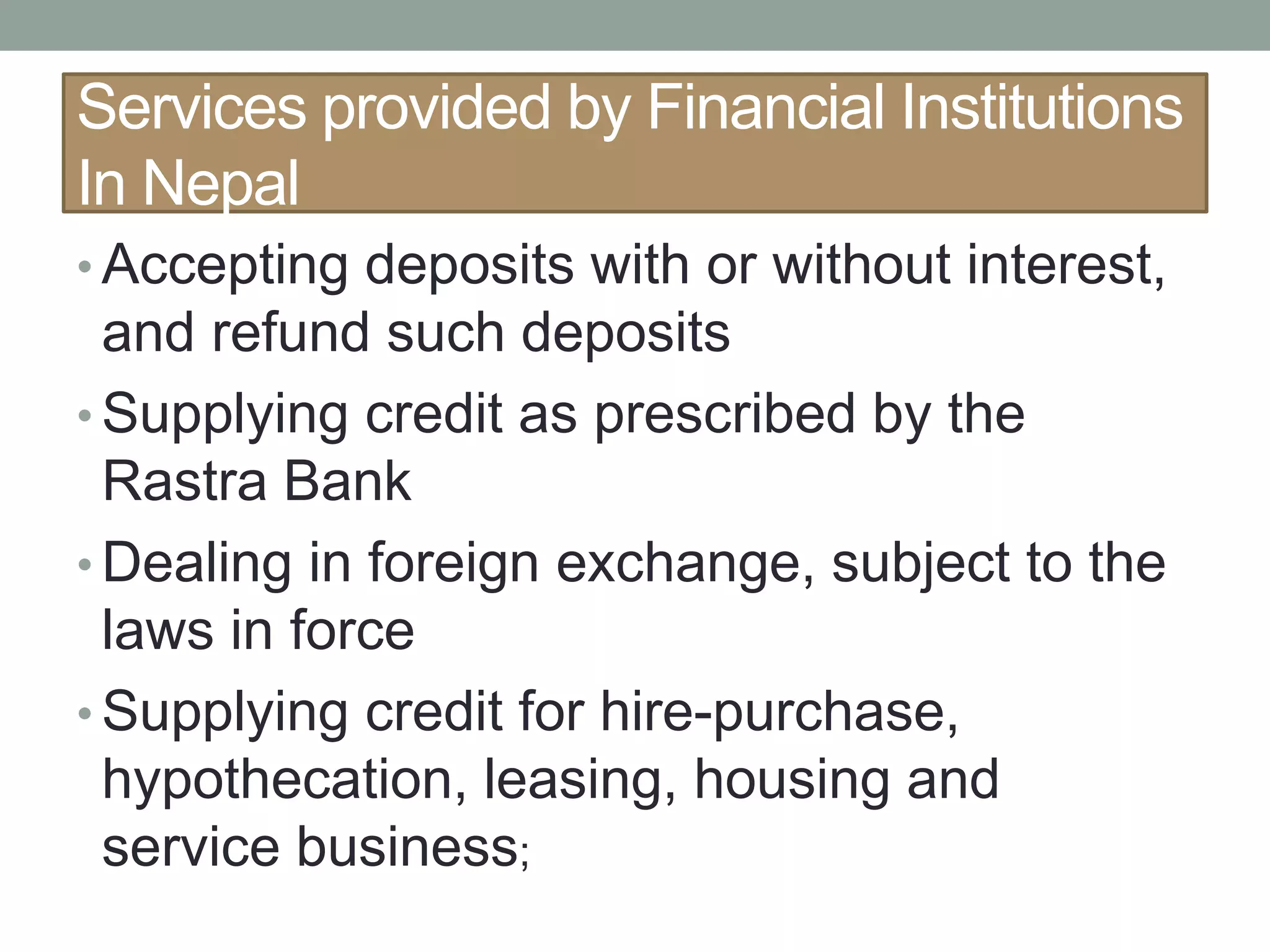
Services provided by Financial Institutions
In Nepal
• Accepting deposits with or without interest,
and refund such deposits
• Supplying credit as prescribed by the
Rastra Bank
• Dealing in foreign exchange, subject to the
laws in force
• Supplying credit for hire-purchase,
hypothecation, leasing, housing and
service business;
• Engaging in merchant banking business, subject to the
directives of the Rastra Bank
• Issuing guarantees on behalf of its customers, having
such customers execute necessary bonds in
consideration thereof, obtaining security, and acquire their
movable or immovable assets as collateral or on
mortgage, or the assets of third persons as collateral
• Supplying credit against the guarantee provided by any
native or foreign bank or financial institution
• Issuing, accepting, paying, discounting or purchasing and
selling letters of credit, bills of exchange, promissory
notes, cheques, travelers cheques, drafts or other
financial instruments
Services provided by Financial Institutions
internationally
• Business account services enable a business to transact its day-to-day affairs, for
example paying wages into employee's accounts, paying bills, and taking up
periods of credit when applicable.
• Cheques, credit cards and bank drafts enable a business to smoothly manage its
day-to-day payments and transactions. Bank statements enable the business to
keep a regular check on its accounting position.
• The bank will also provide systematic and ongoing advice, particularly to small
businesses and start ups. For example, the bank will provide detailed advice on
how to construct and organise a business plan.
• Banks also provide long-term finance in the form of mortgages for the purchase
of land and property.
• Loans provide businesses with expansion capital. A
secured loan is one that is guaranteed by some form
of asset such as buildings and property. An unsecured
loan is not backed in the same way.
• To help businesses manage risks e.g. by providing
insurance in the case of insurance companies.
• To provide corporate finance as is the case with
banks, or investment trusts, which enable lots of
investors to own shares in a range of companies.
•
• Overdraft facilities enable a business to have a short
period of credit to smooth out cash flow difficulties. The
business arranges an overdraft limit with its bank and is
permitted to borrow up to the arranged overdraft ceiling.
Interest is only charged on the amount overdrawn each
day.
• Merchant banks and issuing houses also support
companies in the management of share issues, for
example, by arranging for financial institutions to
underwrite a new share issue.
LIST OF FINANCIAL
INSTITUTIONS IN
NEPAL
• Class A : Commercial Banks
• Class B : Development Banks
• Class C : Finance Companies
• Class D : Micro Credit Development Banks
• Saving and Credit Cooperatives
• Non Government Organizations
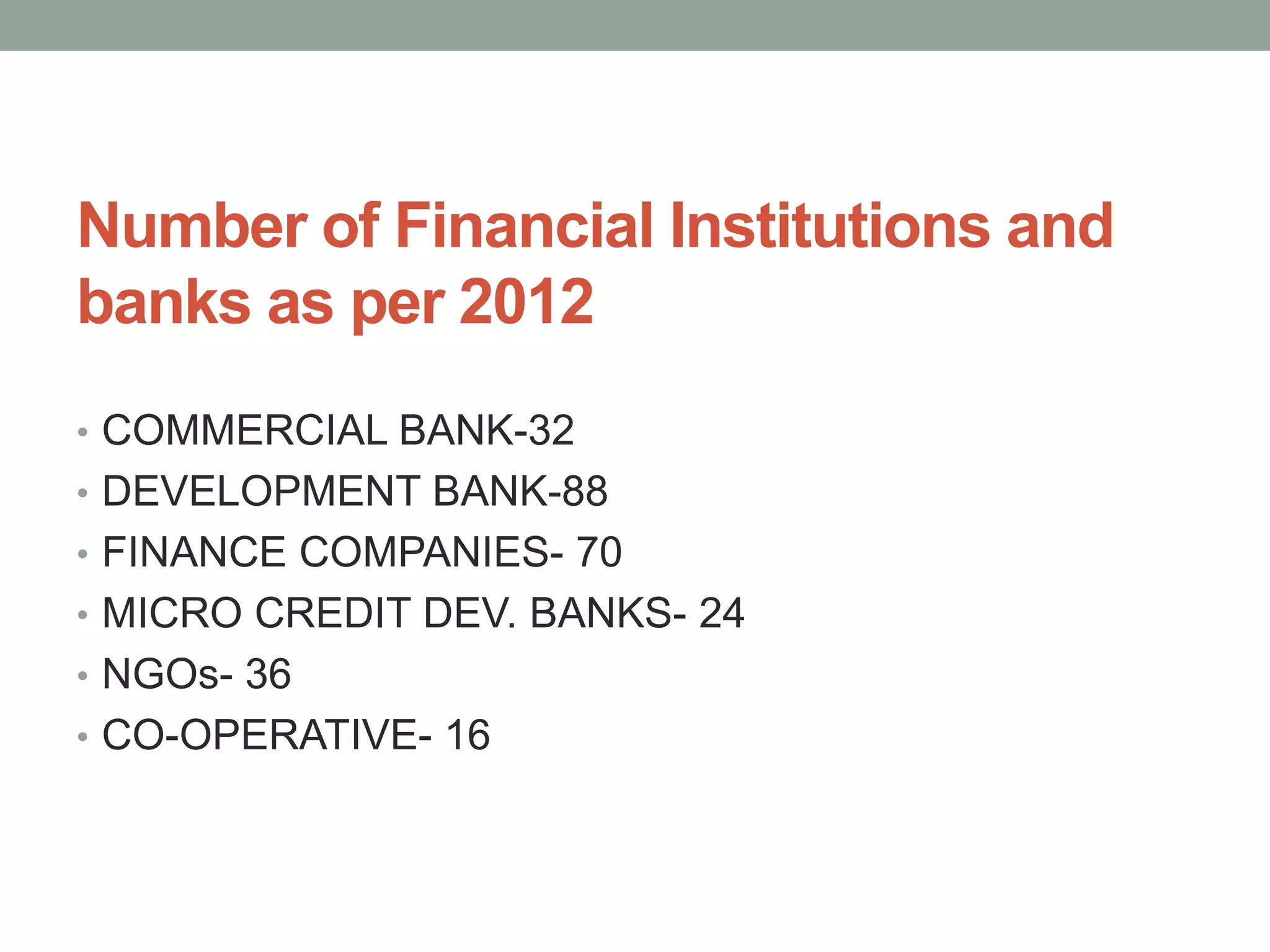
Number of Financial Institutions and
banks as per 2012
• COMMERCIAL BANK-32
• DEVELOPMENT BANK-88
• FINANCE COMPANIES- 70
• MICRO CREDIT DEV. BANKS- 24
• NGOs- 36
• CO-OPERATIVE- 16
Commercial Banks
• A financial institution that provides services, such as
accepting deposits, giving business loans and auto loans,
mortgage lending, and basic investment products like
savings accounts and certificates of deposit.
• The traditional commercial bank is a brick and mortar
institution with tellers, safe deposit boxes, vaults and
ATMs.
• Nepal Bank ltd is the first commercial bank of Nepal
whereas Nepal Rastriya Banijya Bank is the fully
government owned and the largest commercial bank in
Nepal .
Roles of commercial Banks in Nepal
• Accepting deposits
• current A/c
• Saving bank a/c
• Fixed deposit a/c
• Providing loan
• Serving with agency function
• Exchanging foreign currency
• Transfer of Money.
• Providing guarantee on the behalf of client
• Issuing capital
Futures of Commercial Banks In Nepal
• Ensuring that the banks attract quality management and
service.
• Protecting and building up their deposit base.
• Building their capacity for creating products in different
areas of operation:
• Strengthening thier ability to manage credit in a second
way as well as maintaning compatibility to the
privatisation, joint ventures, industrial policies of the
country etc
• Enhancing their ability for providing services as per
customer needs.
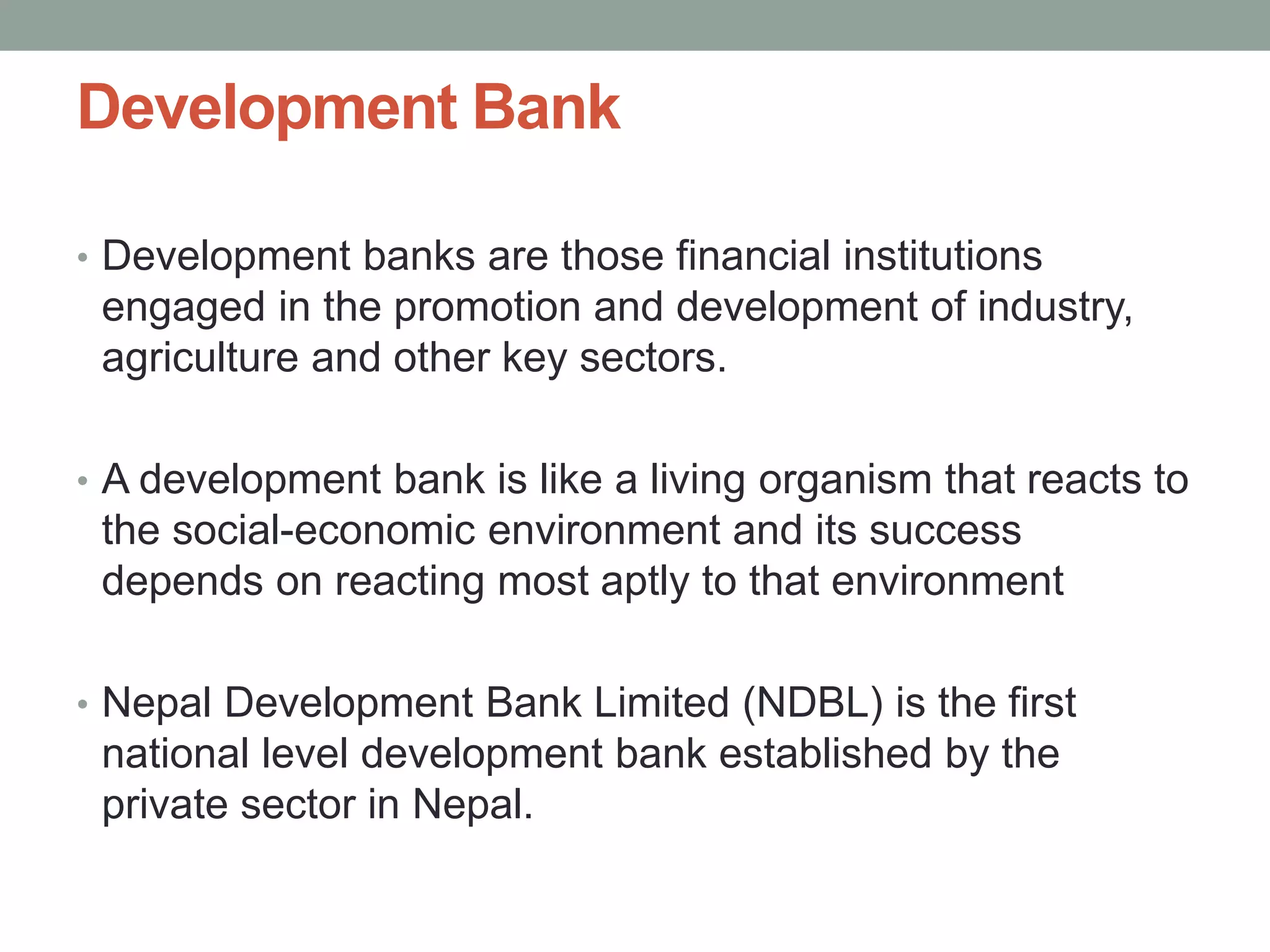
Development Bank
• Development banks are those financial institutions
engaged in the promotion and development of industry,
agriculture and other key sectors.
• A development bank is like a living organism that reacts to
the social-economic environment and its success
depends on reacting most aptly to that environment
• Nepal Development Bank Limited (NDBL) is the first
national level development bank established by the
private sector in Nepal.
Industrial development bank
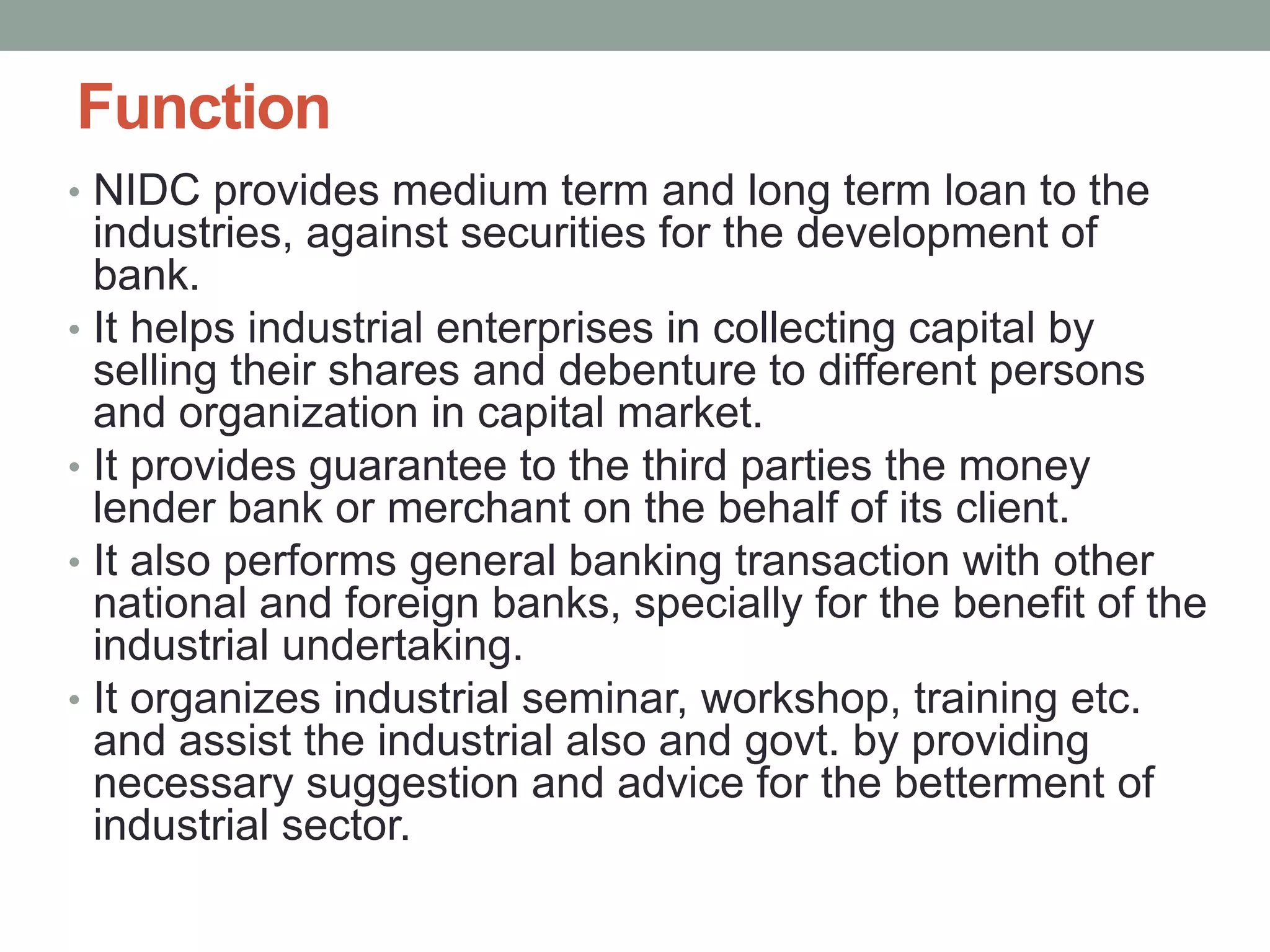
Function
• NIDC provides medium term and long term loan to the
industries, against securities for the development of
bank.
• It helps industrial enterprises in collecting capital by
selling their shares and debenture to different persons
and organization in capital market.
• It provides guarantee to the third parties the money
lender bank or merchant on the behalf of its client.
• It also performs general banking transaction with other
national and foreign banks, specially for the benefit of the
industrial undertaking.
• It organizes industrial seminar, workshop, training etc.
and assist the industrial also and govt. by providing
necessary suggestion and advice for the betterment of
industrial sector.
Agricultural Development
bank
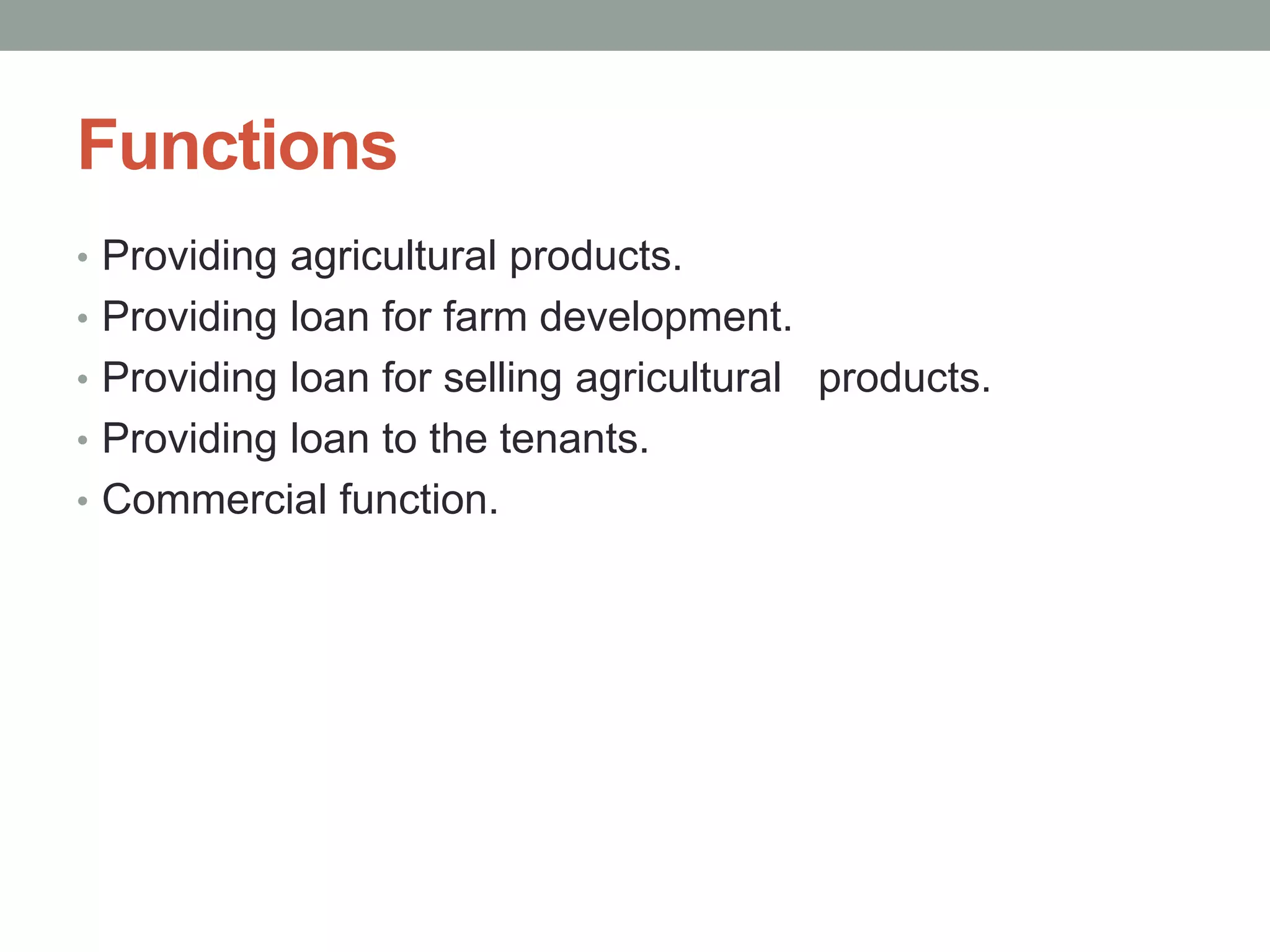
Functions
• Providing agricultural products.
• Providing loan for farm development.
• Providing loan for selling agricultural products.
• Providing loan to the tenants.
• Commercial function.
Roles of Development Banks in Nepal
• It is a specialized financial institution which provides
medium term and long-term lending facilities
• It is a multipurpose financial institution. Besides providing
financial help it undertakes promotional activities also. It
helps an enterprises from planning to operational level
• It provides financial assistance to both private as well as
public sector institutions
• The objective of these banks is to serve public interest
rather than earning profits.
• Development banks react to the socio-economic needs of
development.
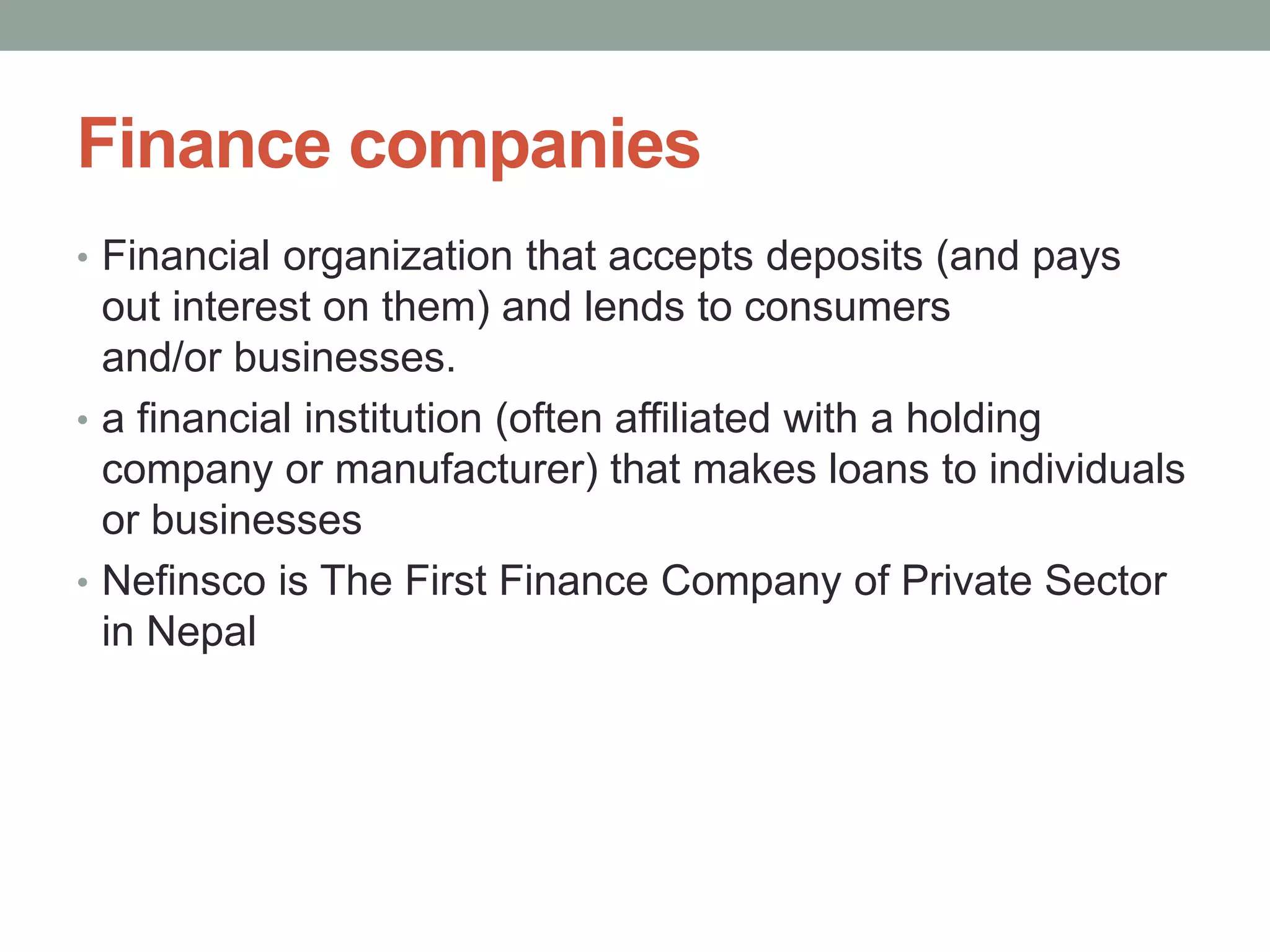
Finance companies
• Financial organization that accepts deposits (and pays
out interest on them) and lends to consumers
and/or businesses.
• a financial institution (often affiliated with a holding
company or manufacturer) that makes loans to individuals
or businesses
• Nefinsco is The First Finance Company of Private Sector
in Nepal
Roles of finance companies in Nepal
• Traditionally, they relied on their personalized and flexible
services to attract clients.
• This is because there are always consumers who are
rejected by the commercial banks because adding these
consumers to their portfolios would be uneconomical for
these commercial banks as their economies of scale
cannot offset the transactional costs these clients would
bring because of the small margins these smaller
consumers bring.
• These mainly include people or companies who do not
have the capital to meet the relatively higher capital
requirements of the commercial banks compared to
finance companies.
Micro credit Development Banks
• Microcredit is the extension of very small loans
(microloans) to impoverished borrowers who typically
lack collateral, steady employment and a verifiable credit
history.
• It is designed not only to support entrepreneurship and
alleviate poverty, but also in many cases to empower
women and uplift entire communities by extension. In
many communities, women lack the highly stable
employment histories that traditional lenders tend to
require.
• Purbanchal Grameen Bikas Bank Ltd. Biratnagar, Morang
was the first micro credit development banks in Nepal.
Why micro credit development banks
is popular in Nepal?
• Targeted to poor
• Door step service
• Collateral less
• Repeated and increased volume of loans
• Focus on women
• Fast growing
Scenario of micro credit development
banks (2011)
• Five ‘Grameen Bikas banks’ operating in the country’s
five development region have decided to
merge. Purbanchal, Sudur Pashchimancal,
Pashchimanchal, Madhya Pashchimanchal and
Madhyamanchal Grameen Bikas signed a memorandum
of understanding (MoU) to merge into a single entity,
which will become a national-level rural development
bank.
• The banks were established to bring the rural population
into the formal financial channel and provide them the
micro-credit to alleviate poverty. The Nepal Rastra Bank
(NRB) has categorised them under D level of financial
institution
• Along with the NRB, commercial banks, including
Standard Chartered Bank Nepal, Nabil Bank, Himalayan
Bank, Bank of Kathmandu, Nepal Bangladesh Bank,
Agriculture Development Bank have investments in the
five banks and they will all retain their stake in the merged
entity.
Non government organization
Non-governmental organizations (NGOs)
are legally constituted corporations created
by natural or legal people that operate
independently from any form of
government.
Pattern of NGO Interventions and their
problems in Nepal
• So far, most NGOs in Nepal have concentrated their
attention to development work, primarily because this is
where the funding is available and that is what attracts
people easily.
• They operate through multi-dimensional programs, not
limiting themselves to one or other sectors at the village
level.
• Most of the NGOs have added income generation/saving
credit components to their programs to attract
participation.
• A few NGOs are focusing on advocacy for
human rights, women’s rights and child
rights. Of particular interest is the recent
NGO assistance to Kamaiyas for their
collective action against bonded labor
conditions in the Far-West, their subsequent
liberation and the NGO advocacy for low
caste rights of job-choice in another eastern
district
Saving and credit cooperatives
• Savings and Credit Co-operative (SACCO) is a type of co-
operative whose objective is to pool savings for the
members and in turn provide them with credit facilities.
• Other objectives of SACCOs are to encourage thrift
amongst the members arid also to encourage them on the
proper management of money and proper investments
practices.
• Whereas in urban areas salary and wage earners have
formed Urban SACC0s, in rural areas, farmers have
formed Rural SACCOs.
Relationship between
financial institutions and
banks and Trend of
Financial institution.
Relationship between financial institutions
and banks
• It is a tough task to compare bank and financial
institutions owing to the fact there exist several financial
institutions, and each of these differ from banks by a
significant extent.
• Basically, relationship between banks and financial
institutions is similar to comparing a deposit taking
financial institution with a non-deposit taking financial
institutions.
Cont..
• Banks and Financial Institutions are the most highly
regulated sector in the Nepalese Economy; with Nepal
Rastra Bank (NRB) in a continuous effort in issuing new
rules and regulations to safeguard the investors and the
public interests.
• So, banks and financial institutions face an ongoing
period of change: increasing competition and regulations
are shaping the markets.
Cont..
• As the Nepalese financial sector expanded, financial
institutions felt a need to differentiate from each other. As a
result, the degree of homogeneity in the market gradually
declined.
• The expansion of financial market can be credited to some
major forces at work. “Technical change has reduced the cost
of communication and computation, as well as the cost of
acquiring, processing, and storing information.
• Deregulation has removed artificial barriers preventing entry
or competition between products, institutions, markets and
jurisdictions.
• Finally, the process of institutional change has created new
entities within the financial sector”.
Cont..
• Due to increasing diversity in the activities of financial
institutions, the Ministry of Finance has divided the
financial sector into two groups based on their primary
functions:
1.banking sector and
2. nonbanking sector.
Banking sector is composed of :
NRB, the central bank and all the commercial banks.
The non-banking sector comprises
• Finance Companies, Development Banks, Micro-finance
Development Banks, Co-operative
• Financial Institutions, and Non-Governmental
Organizations (NGOs) involved in minor banking activities
Trends of financial institutions in Nepal
• Financial institutions in Nepal is relatively new
compared to countries around the globe.
• A financial institution is an establishment that
conducts financial transactions such as
investments, loans and deposits. Almost
everyone deals with financial institutions on a
regular basis. Everything from depositing money
to taking out loans and exchanging currencies
must be done through financial institutions.
Cont..
• The first bank established in Nepal was Nepal Bank
Limited (NBL) . This was established in 1937 A.D. Nepal
Bank has been inaugurated by King Tribhuvan Bir Bikram
Shah Dev. Nepal bank was established as a semi
government bank with the authorized capital of Rs.10
million and the paid -up capital of Rs. 892 thousand. Until
mid-1940s, only metallic coins were used as medium of
exchange. So the Nepal Government (His Majesty
Government on that time) felt the need of separate
institution or body to issue national currencies and
promote financial organization in the country.
Cont..
• Nepal Bank Ltd. remained the only financial institution of
the country until the foundation of Nepal Rastra Bank in
1956 A.D. Due to the absence of the central bank, Nepal
Bank has to play the role of central bank and operate the
function of central bank. Hence, the Nepal Rastra Bank
Act 1955 was formulated, which was approved by Nepal
Government accordingly, the Nepal Rastra Bank was
established in 1956 A.D. as the central bank of Nepal.
Nepal Rastra Bank makes various guidelines for the
banking sector of the country.
• Hence there was a central authority of the financial sector.
In 1966, Government of Nepal established Rastriya
Banijya Bank, the largest commercial bank in Nepal.
Cont..
• Two decades later in 1984, financial liberalization
commenced. Several sweeping changes and reforms
were made.
• .So, in 1957 A.D. Industrial Development Bank was
established to promote the industrialization in Nepal,
which was later converted into Nepal Industrial
Development Corporation (NIDC) in 1959 A.D.
• As the agriculture is the basic occupation of major
Nepalese, the development of this sector plays in the
prime role in the economy. So, separate Agricultural
Development Bank was established in 1968 A.D. This is
the first institution in agricultural financing.
Cont..
• For more than two decades, no more banks have been
established in the country. After declaring free economy
and privatization policy, the government of Nepal
encouraged the foreign banks for joint venture in Nepal.
• . When banking sector started carrying out current
activities of finance company, large number of finance
companies was established and they expanded at a rapid
pace.
• In the context of Nepal, there were few insurance
companies and Karmachari Sanchaya Kosh working as
non-banking financial institution before enactment of
Finance Company Act, 2042. Need of Finance Company.
Cont..
• NRB refresh and change in financial sector policies,
regulations and institutional developments in 1980 A.D
• These policies opened the doors for foreigners to enter
into banking sector in Nepal under joint venture.
• Some foreign ventures are also established in Nepal such
as Nepal Bangladesh Bank, Standard Chartered Bank,
Nepal Arab Bank, State Bank of India, ICICI Bank,
Everest Bank, Himalayan Bank, Bank of Kathmandu,
Nepal Indo-Suez Bank and Nepal Sri Lanka Merchant
Bank etc.
Cont..
• Today there are various types of bank working in modern
banking system in Nepal. It includes central,
development, commercial, financial, co-operative and
Micro Credit banks.
• Technology is changing day by day. And changed
technology affects the traditional method of the service of
bank.
• Banking software, ATM, E-banking, Mobile Banking, Debit
Card, Credit Card, Prepaid Card etc. services are
available in banking system in Nepal. It helps both
customer and banks to operate and conduct activities
more efficiently and effectively.
Cont..
• The NRB will classify the institutions into “A” “B” “C” “D”
groups on the basis of the minimum paid-up capital and
provide the suitable license to the bank or financial
institution. Group ‘A’ is for commercial bank, ‘B’ for the
development bank, ‘C’ for the financial institution and and
‘D’ for the Micro Finance Development Banks.
• Generally financial institutions in Nepal are opened 9 am
to 3 pm Sunday to Thursday and 9 am to 1 am on Friday.
But nowadays some of them in Kathmandu are opened
throughout the week.
• There are 32 commercial banks, 88 development banks,
70 financial companies, 24 micro credit development
banks and 16 saving and credit co-operation and many
NGO’s.
Conclusion
• In Nepal, nonbank financial institutions are mostly
concentrated in the urban areas.
• Employees working in the nonbank financial institutions
lack technical skills related to the use of modern
technologies.
• For making stability among existing nonbank financial
institutions, the NRB lacks effective supervision.
• The paid-up capital base of the development banks has
been raised. However, the capital requirement for opening
new financial institutions has not changed till now.
• To minimize the risk an adequate level of capital reserve
is essential.
• Financial institutions fail to address the urgent need to
expand their financial services.
• The financial system lacks adequate provision of buying
and selling active loan between one financial institution and
another.
• The financial system lacks strong legal and information
system.
• The major challenge lies in maintaining financial stability.
• A large scale of development lending is required to support
the development of agricultural and industrial sector.
• The deposits of the non-bank financial institutions grew
significantly over the years even though the country needs
to do a lot of homework to set up a strong foundation for
making a healthy financial system.
Recommendation
• Implement and enforce the new regulations regarding the
minimum capital requirements, provisioning policy, etc.
• Private bond markets are currently non existent due to
legal and regulatory hurdles.
But their development would provide an alternate
funding possibility for the private
sector development banks and other financial
institutions.
• The NRB should develop a more robust off-site,
supervision system, and have followed in time by a
reinforcing system of onsite supervision.
• The NRB should undertake a complete audit of the
finance companies to benchmark their current status as
well as to check undesirable practices.
• The microfinance sector needs to articulate a vision and
strategy based on a consensus of all stakeholders.
• The taxation of cooperatives should be reviewed so that
"real cooperatives" can generate operating surpluses to
build up their capital.
• The overall regulation and supervision of all microcredit
activities needs to be improved.
Development of financial institutions in Nepal

Development of financial institutions in Nepal

  • 1.
  • 2.
    FINANCIAL INSTITUTION Financial institutionsare the firms that provide financial services and advice to their clients. The financial institutions are generally regulated by the financial laws of the government authority. Financial institution is an institution that provides financial services for its clients or members. Probably the most important financial service provided by financial institutions is acting as financial intermediaries. Most financial institutions are regulated by the government.
  • 3.
    • It alsofocuses on dealing with financial transactions, such as investments, loans and deposits. Conventionally, financial institutions are composed of organizations such as banks, trust companies, insurance companies and investment dealers. • Almost everyone has deal with a financial institution on a regular basis. Everything from depositing money to taking out loans and exchange currencies must be done through financial institutions.
  • 4.
    There are threemajor types of financial institutions • Depositary Institutions • Contractual Institutions • Investment Institutes
  • 5.
    • Depositary Institutions: Deposit-taking institutions that accept and manage deposits and make loans, including banks, building societies, credit unions, trust companies, and mortgage loan companies • Contractual Institutions : Insurance companies and pension funds; and • Investment Institutes : Investment Banks, underwriters, brokerage firms
  • 6.
    Other types ofFinancial institution… • Commercial Banks • Credit Unions • Stock Brokerage Firms • Asset Management Firms • Insurance Companies
  • 7.
    • Commercial Banks:Is a type of bank that provides services, such as accepting deposits, giving business loans and basic investment products.Commercial bank can also refer to a bank or a division of a bank that mostly deals with deposits and loans from corporations or large businesses, as opposed to individual members of the public • Credit Unions : The credit unions are the co-operative financial institutions that are owned by the members of the union. The major difference between the credit unions and banks is that the credit unions are owned by the members unlike banks. • Stock Brokerage Firms : The stock brokerage firms are those entities, that are responsible for helping the investors put their money in the stock market. The stock brokerage firms are useful as they can help the investors get the maximum return from their investments in the stock market.
  • 8.
    • Asset ManagementFirms : Asset Management firms are companies that invests its clients pooled fund into securities that match its declared financial objectives. Asset management companies provide investors with more diversification and investing options than they would have by themselves & attain their investment goals by proper management of assets. • Insurance Companies: Insurance is defined as the equitable transfer of the risk of a loss, from one entity to another, in exchange for payment. An insurer is a company selling the insurance an insured or policyholder is the person or entity buying the insurance policy.
  • 9.
    Role of FinancialInstitutions • The various financial institutions generally act as an intermediary between the capital market and debt market. But the services provided by a particular institution depends on its type. • The financial institutions are also responsible to transfer funds from investors to the companies. • Typically, these are the key entities that control the flow of money in the economy.
  • 10.
    Services provided byFinancial Institutions In Nepal • Accepting deposits with or without interest, and refund such deposits • Supplying credit as prescribed by the Rastra Bank • Dealing in foreign exchange, subject to the laws in force • Supplying credit for hire-purchase, hypothecation, leasing, housing and service business;
  • 11.
    • Engaging inmerchant banking business, subject to the directives of the Rastra Bank • Issuing guarantees on behalf of its customers, having such customers execute necessary bonds in consideration thereof, obtaining security, and acquire their movable or immovable assets as collateral or on mortgage, or the assets of third persons as collateral • Supplying credit against the guarantee provided by any native or foreign bank or financial institution • Issuing, accepting, paying, discounting or purchasing and selling letters of credit, bills of exchange, promissory notes, cheques, travelers cheques, drafts or other financial instruments
  • 12.
    Services provided byFinancial Institutions internationally • Business account services enable a business to transact its day-to-day affairs, for example paying wages into employee's accounts, paying bills, and taking up periods of credit when applicable. • Cheques, credit cards and bank drafts enable a business to smoothly manage its day-to-day payments and transactions. Bank statements enable the business to keep a regular check on its accounting position. • The bank will also provide systematic and ongoing advice, particularly to small businesses and start ups. For example, the bank will provide detailed advice on how to construct and organise a business plan. • Banks also provide long-term finance in the form of mortgages for the purchase of land and property.
  • 13.
    • Loans providebusinesses with expansion capital. A secured loan is one that is guaranteed by some form of asset such as buildings and property. An unsecured loan is not backed in the same way. • To help businesses manage risks e.g. by providing insurance in the case of insurance companies. • To provide corporate finance as is the case with banks, or investment trusts, which enable lots of investors to own shares in a range of companies. •
  • 14.
    • Overdraft facilitiesenable a business to have a short period of credit to smooth out cash flow difficulties. The business arranges an overdraft limit with its bank and is permitted to borrow up to the arranged overdraft ceiling. Interest is only charged on the amount overdrawn each day. • Merchant banks and issuing houses also support companies in the management of share issues, for example, by arranging for financial institutions to underwrite a new share issue.
  • 15.
    LIST OF FINANCIAL INSTITUTIONSIN NEPAL • Class A : Commercial Banks • Class B : Development Banks • Class C : Finance Companies • Class D : Micro Credit Development Banks • Saving and Credit Cooperatives • Non Government Organizations
  • 16.
    Number of FinancialInstitutions and banks as per 2012 • COMMERCIAL BANK-32 • DEVELOPMENT BANK-88 • FINANCE COMPANIES- 70 • MICRO CREDIT DEV. BANKS- 24 • NGOs- 36 • CO-OPERATIVE- 16
  • 17.
    Commercial Banks • Afinancial institution that provides services, such as accepting deposits, giving business loans and auto loans, mortgage lending, and basic investment products like savings accounts and certificates of deposit. • The traditional commercial bank is a brick and mortar institution with tellers, safe deposit boxes, vaults and ATMs. • Nepal Bank ltd is the first commercial bank of Nepal whereas Nepal Rastriya Banijya Bank is the fully government owned and the largest commercial bank in Nepal .
  • 18.
    Roles of commercialBanks in Nepal • Accepting deposits • current A/c • Saving bank a/c • Fixed deposit a/c • Providing loan • Serving with agency function • Exchanging foreign currency • Transfer of Money. • Providing guarantee on the behalf of client • Issuing capital
  • 19.
    Futures of CommercialBanks In Nepal • Ensuring that the banks attract quality management and service. • Protecting and building up their deposit base. • Building their capacity for creating products in different areas of operation: • Strengthening thier ability to manage credit in a second way as well as maintaning compatibility to the privatisation, joint ventures, industrial policies of the country etc • Enhancing their ability for providing services as per customer needs.
  • 20.
    Development Bank • Developmentbanks are those financial institutions engaged in the promotion and development of industry, agriculture and other key sectors. • A development bank is like a living organism that reacts to the social-economic environment and its success depends on reacting most aptly to that environment • Nepal Development Bank Limited (NDBL) is the first national level development bank established by the private sector in Nepal.
  • 21.
  • 22.
    Function • NIDC providesmedium term and long term loan to the industries, against securities for the development of bank. • It helps industrial enterprises in collecting capital by selling their shares and debenture to different persons and organization in capital market. • It provides guarantee to the third parties the money lender bank or merchant on the behalf of its client. • It also performs general banking transaction with other national and foreign banks, specially for the benefit of the industrial undertaking. • It organizes industrial seminar, workshop, training etc. and assist the industrial also and govt. by providing necessary suggestion and advice for the betterment of industrial sector.
  • 23.
  • 24.
    Functions • Providing agriculturalproducts. • Providing loan for farm development. • Providing loan for selling agricultural products. • Providing loan to the tenants. • Commercial function.
  • 25.
    Roles of DevelopmentBanks in Nepal • It is a specialized financial institution which provides medium term and long-term lending facilities • It is a multipurpose financial institution. Besides providing financial help it undertakes promotional activities also. It helps an enterprises from planning to operational level • It provides financial assistance to both private as well as public sector institutions • The objective of these banks is to serve public interest rather than earning profits. • Development banks react to the socio-economic needs of development.
  • 26.
    Finance companies • Financialorganization that accepts deposits (and pays out interest on them) and lends to consumers and/or businesses. • a financial institution (often affiliated with a holding company or manufacturer) that makes loans to individuals or businesses • Nefinsco is The First Finance Company of Private Sector in Nepal
  • 27.
    Roles of financecompanies in Nepal • Traditionally, they relied on their personalized and flexible services to attract clients. • This is because there are always consumers who are rejected by the commercial banks because adding these consumers to their portfolios would be uneconomical for these commercial banks as their economies of scale cannot offset the transactional costs these clients would bring because of the small margins these smaller consumers bring. • These mainly include people or companies who do not have the capital to meet the relatively higher capital requirements of the commercial banks compared to finance companies.
  • 28.
    Micro credit DevelopmentBanks • Microcredit is the extension of very small loans (microloans) to impoverished borrowers who typically lack collateral, steady employment and a verifiable credit history. • It is designed not only to support entrepreneurship and alleviate poverty, but also in many cases to empower women and uplift entire communities by extension. In many communities, women lack the highly stable employment histories that traditional lenders tend to require. • Purbanchal Grameen Bikas Bank Ltd. Biratnagar, Morang was the first micro credit development banks in Nepal.
  • 29.
    Why micro creditdevelopment banks is popular in Nepal? • Targeted to poor • Door step service • Collateral less • Repeated and increased volume of loans • Focus on women • Fast growing
  • 30.
    Scenario of microcredit development banks (2011) • Five ‘Grameen Bikas banks’ operating in the country’s five development region have decided to merge. Purbanchal, Sudur Pashchimancal, Pashchimanchal, Madhya Pashchimanchal and Madhyamanchal Grameen Bikas signed a memorandum of understanding (MoU) to merge into a single entity, which will become a national-level rural development bank.
  • 31.
    • The bankswere established to bring the rural population into the formal financial channel and provide them the micro-credit to alleviate poverty. The Nepal Rastra Bank (NRB) has categorised them under D level of financial institution • Along with the NRB, commercial banks, including Standard Chartered Bank Nepal, Nabil Bank, Himalayan Bank, Bank of Kathmandu, Nepal Bangladesh Bank, Agriculture Development Bank have investments in the five banks and they will all retain their stake in the merged entity.
  • 32.
    Non government organization Non-governmentalorganizations (NGOs) are legally constituted corporations created by natural or legal people that operate independently from any form of government.
  • 33.
    Pattern of NGOInterventions and their problems in Nepal • So far, most NGOs in Nepal have concentrated their attention to development work, primarily because this is where the funding is available and that is what attracts people easily. • They operate through multi-dimensional programs, not limiting themselves to one or other sectors at the village level. • Most of the NGOs have added income generation/saving credit components to their programs to attract participation.
  • 34.
    • A fewNGOs are focusing on advocacy for human rights, women’s rights and child rights. Of particular interest is the recent NGO assistance to Kamaiyas for their collective action against bonded labor conditions in the Far-West, their subsequent liberation and the NGO advocacy for low caste rights of job-choice in another eastern district
  • 35.
    Saving and creditcooperatives • Savings and Credit Co-operative (SACCO) is a type of co- operative whose objective is to pool savings for the members and in turn provide them with credit facilities. • Other objectives of SACCOs are to encourage thrift amongst the members arid also to encourage them on the proper management of money and proper investments practices. • Whereas in urban areas salary and wage earners have formed Urban SACC0s, in rural areas, farmers have formed Rural SACCOs.
  • 36.
    Relationship between financial institutionsand banks and Trend of Financial institution.
  • 37.
    Relationship between financialinstitutions and banks • It is a tough task to compare bank and financial institutions owing to the fact there exist several financial institutions, and each of these differ from banks by a significant extent. • Basically, relationship between banks and financial institutions is similar to comparing a deposit taking financial institution with a non-deposit taking financial institutions.
  • 38.
    Cont.. • Banks andFinancial Institutions are the most highly regulated sector in the Nepalese Economy; with Nepal Rastra Bank (NRB) in a continuous effort in issuing new rules and regulations to safeguard the investors and the public interests. • So, banks and financial institutions face an ongoing period of change: increasing competition and regulations are shaping the markets.
  • 39.
    Cont.. • As theNepalese financial sector expanded, financial institutions felt a need to differentiate from each other. As a result, the degree of homogeneity in the market gradually declined. • The expansion of financial market can be credited to some major forces at work. “Technical change has reduced the cost of communication and computation, as well as the cost of acquiring, processing, and storing information. • Deregulation has removed artificial barriers preventing entry or competition between products, institutions, markets and jurisdictions. • Finally, the process of institutional change has created new entities within the financial sector”.
  • 40.
    Cont.. • Due toincreasing diversity in the activities of financial institutions, the Ministry of Finance has divided the financial sector into two groups based on their primary functions: 1.banking sector and 2. nonbanking sector.
  • 41.
    Banking sector iscomposed of : NRB, the central bank and all the commercial banks.
  • 42.
    The non-banking sectorcomprises • Finance Companies, Development Banks, Micro-finance Development Banks, Co-operative • Financial Institutions, and Non-Governmental Organizations (NGOs) involved in minor banking activities
  • 43.
    Trends of financialinstitutions in Nepal • Financial institutions in Nepal is relatively new compared to countries around the globe. • A financial institution is an establishment that conducts financial transactions such as investments, loans and deposits. Almost everyone deals with financial institutions on a regular basis. Everything from depositing money to taking out loans and exchanging currencies must be done through financial institutions.
  • 44.
    Cont.. • The firstbank established in Nepal was Nepal Bank Limited (NBL) . This was established in 1937 A.D. Nepal Bank has been inaugurated by King Tribhuvan Bir Bikram Shah Dev. Nepal bank was established as a semi government bank with the authorized capital of Rs.10 million and the paid -up capital of Rs. 892 thousand. Until mid-1940s, only metallic coins were used as medium of exchange. So the Nepal Government (His Majesty Government on that time) felt the need of separate institution or body to issue national currencies and promote financial organization in the country.
  • 45.
    Cont.. • Nepal BankLtd. remained the only financial institution of the country until the foundation of Nepal Rastra Bank in 1956 A.D. Due to the absence of the central bank, Nepal Bank has to play the role of central bank and operate the function of central bank. Hence, the Nepal Rastra Bank Act 1955 was formulated, which was approved by Nepal Government accordingly, the Nepal Rastra Bank was established in 1956 A.D. as the central bank of Nepal. Nepal Rastra Bank makes various guidelines for the banking sector of the country. • Hence there was a central authority of the financial sector. In 1966, Government of Nepal established Rastriya Banijya Bank, the largest commercial bank in Nepal.
  • 46.
    Cont.. • Two decadeslater in 1984, financial liberalization commenced. Several sweeping changes and reforms were made. • .So, in 1957 A.D. Industrial Development Bank was established to promote the industrialization in Nepal, which was later converted into Nepal Industrial Development Corporation (NIDC) in 1959 A.D. • As the agriculture is the basic occupation of major Nepalese, the development of this sector plays in the prime role in the economy. So, separate Agricultural Development Bank was established in 1968 A.D. This is the first institution in agricultural financing.
  • 47.
    Cont.. • For morethan two decades, no more banks have been established in the country. After declaring free economy and privatization policy, the government of Nepal encouraged the foreign banks for joint venture in Nepal. • . When banking sector started carrying out current activities of finance company, large number of finance companies was established and they expanded at a rapid pace. • In the context of Nepal, there were few insurance companies and Karmachari Sanchaya Kosh working as non-banking financial institution before enactment of Finance Company Act, 2042. Need of Finance Company.
  • 48.
    Cont.. • NRB refreshand change in financial sector policies, regulations and institutional developments in 1980 A.D • These policies opened the doors for foreigners to enter into banking sector in Nepal under joint venture. • Some foreign ventures are also established in Nepal such as Nepal Bangladesh Bank, Standard Chartered Bank, Nepal Arab Bank, State Bank of India, ICICI Bank, Everest Bank, Himalayan Bank, Bank of Kathmandu, Nepal Indo-Suez Bank and Nepal Sri Lanka Merchant Bank etc.
  • 49.
    Cont.. • Today thereare various types of bank working in modern banking system in Nepal. It includes central, development, commercial, financial, co-operative and Micro Credit banks. • Technology is changing day by day. And changed technology affects the traditional method of the service of bank. • Banking software, ATM, E-banking, Mobile Banking, Debit Card, Credit Card, Prepaid Card etc. services are available in banking system in Nepal. It helps both customer and banks to operate and conduct activities more efficiently and effectively.
  • 50.
    Cont.. • The NRBwill classify the institutions into “A” “B” “C” “D” groups on the basis of the minimum paid-up capital and provide the suitable license to the bank or financial institution. Group ‘A’ is for commercial bank, ‘B’ for the development bank, ‘C’ for the financial institution and and ‘D’ for the Micro Finance Development Banks. • Generally financial institutions in Nepal are opened 9 am to 3 pm Sunday to Thursday and 9 am to 1 am on Friday. But nowadays some of them in Kathmandu are opened throughout the week. • There are 32 commercial banks, 88 development banks, 70 financial companies, 24 micro credit development banks and 16 saving and credit co-operation and many NGO’s.
  • 51.
    Conclusion • In Nepal,nonbank financial institutions are mostly concentrated in the urban areas. • Employees working in the nonbank financial institutions lack technical skills related to the use of modern technologies. • For making stability among existing nonbank financial institutions, the NRB lacks effective supervision. • The paid-up capital base of the development banks has been raised. However, the capital requirement for opening new financial institutions has not changed till now. • To minimize the risk an adequate level of capital reserve is essential.
  • 52.
    • Financial institutionsfail to address the urgent need to expand their financial services. • The financial system lacks adequate provision of buying and selling active loan between one financial institution and another. • The financial system lacks strong legal and information system. • The major challenge lies in maintaining financial stability. • A large scale of development lending is required to support the development of agricultural and industrial sector. • The deposits of the non-bank financial institutions grew significantly over the years even though the country needs to do a lot of homework to set up a strong foundation for making a healthy financial system.
  • 53.
    Recommendation • Implement andenforce the new regulations regarding the minimum capital requirements, provisioning policy, etc. • Private bond markets are currently non existent due to legal and regulatory hurdles. But their development would provide an alternate funding possibility for the private sector development banks and other financial institutions.
  • 54.
    • The NRBshould develop a more robust off-site, supervision system, and have followed in time by a reinforcing system of onsite supervision. • The NRB should undertake a complete audit of the finance companies to benchmark their current status as well as to check undesirable practices. • The microfinance sector needs to articulate a vision and strategy based on a consensus of all stakeholders.
  • 55.
    • The taxationof cooperatives should be reviewed so that "real cooperatives" can generate operating surpluses to build up their capital. • The overall regulation and supervision of all microcredit activities needs to be improved.