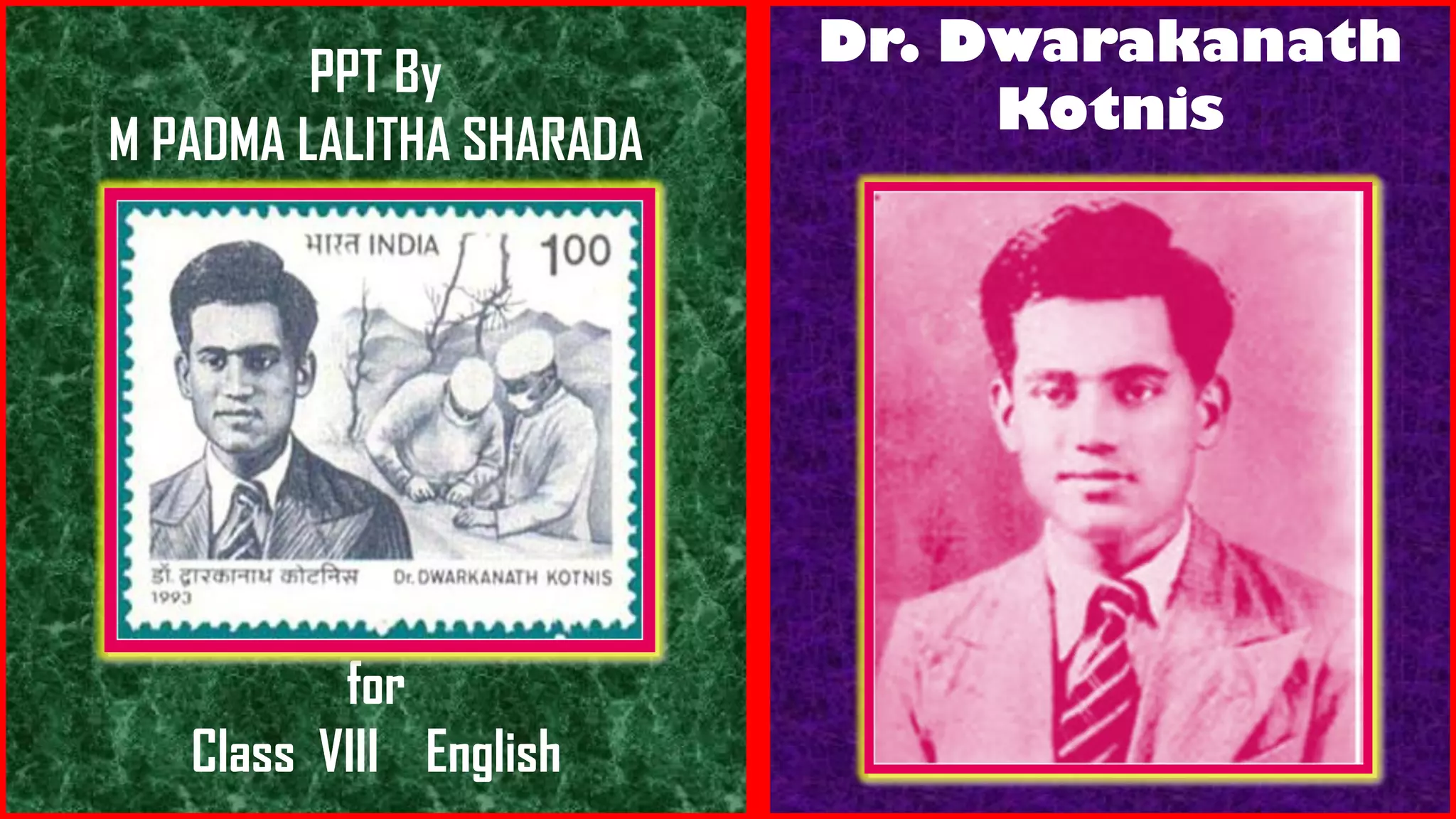
PPT By
M PADMA LALITHA SHARADA
for
Class VIII English
Dr. Dwarakanath
Kotnis
No other Indian can
claim the kind of
adulation and respect
Dr. Dwarakanath
Kotnis enjoys in China.
Coming from a family
of doctors, Dr. Kotnis
had always dreamt of
becoming a physician.
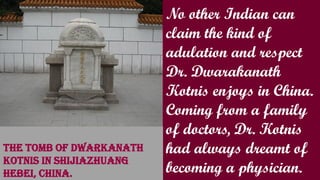
The tomb of Dwarkanath
Kotnis in Shijiazhuang
Hebei, China.
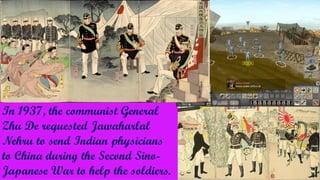
And the War of Resistance gave him the perfect
opportunity to make himself useful in the battle field.
Chinese War of
Resistance against
Japanese Aggression
He dedicated his entire life working as a battlefront
doctor in China and rendered his selfless service to
the injured Chinese soldiers during the Second
Sino-Japanese War.
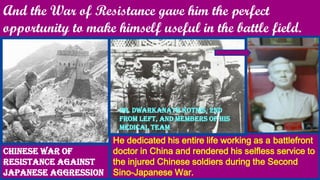
Dr. Dwarkanath Kotnis, 2nd
from left, and members of his
medical team
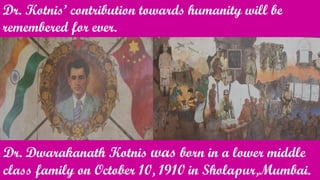
Dr. Kotnis’ contribution towards humanity will be
remembered for ever.
Dr. Dwarakanath Kotnis was born in a lower middle
class family on October 10, 1910 in Sholapur,Mumbai.
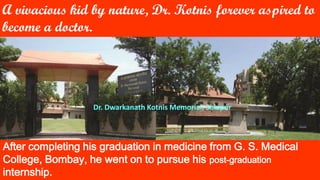
A vivacious kid by nature, Dr. Kotnis forever aspired to
become a doctor.
After completing his graduation in medicine from G. S. Medical
College, Bombay, he went on to pursue his post-graduation
internship.
Dr. Dwarkanath Kotnis Memorial, Solapur
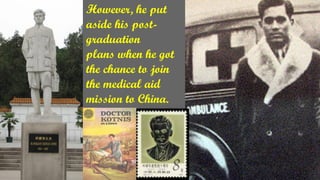
However, he put
aside his post-
graduation
plans when he got
the chance to join
the medical aid
mission to China.
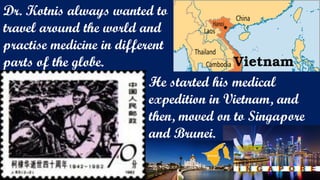
Dr. Kotnis always wanted to
travel around the world and
practise medicine in different
parts of the globe.
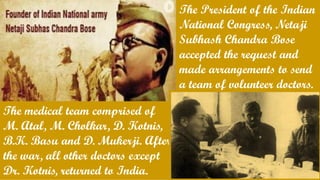
The President of the Indian
National Congress, Netaji
Subhash Chandra Bose
accepted the request and
made arrangements to send
a team of volunteer doctors.
The medical team comprised of
M. Atal, M. Cholkar, D. Kotnis,
B.K. Basu and D. Mukerji. After
the war, all other doctors except
Dr. Kotnis, returned to India.
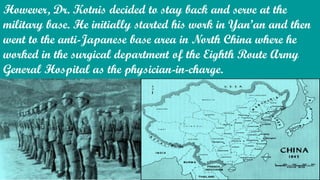
However, Dr. Kotnis decided to stay back and serve at the
military base. He initially started his work in Yan’an and then
went to the anti-Japanese base area in North China where he
worked in the surgical department of the Eighth Route Army
General Hospital as the physician-in-charge.
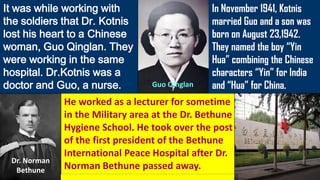
It was while working with
the soldiers that Dr. Kotnis
lost his heart to a Chinese
woman, Guo Qinglan. They
were working in the same
hospital. Dr.Kotnis was a
doctor and Guo, a nurse.
In November 1941, Kotnis
married Guo and a son was
born on August 23,1942.
They named the boy “Yin
Hua” combining the Chinese
characters “Yin” for India
and “Hua” for China.
He worked as a lecturer for sometime
in the Military area at the Dr. Bethune
Hygiene School. He took over the post
of the first president of the Bethune
International Peace Hospital after Dr.
Norman Bethune passed away.
Dr. Norman
Bethune
Guo Qinglan
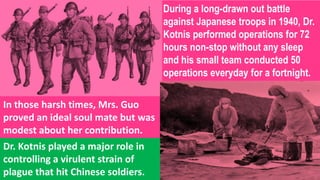
During a long-drawn out battle
against Japanese troops in 1940, Dr.
Kotnis performed operations for 72
hours non-stop without any sleep
and his small team conducted 50
operations everyday for a fortnight.
In those harsh times, Mrs. Guo
proved an ideal soul mate but was
modest about her contribution.
Dr. Kotnis played a major role in
controlling a virulent strain of
plague that hit Chinese soldiers.
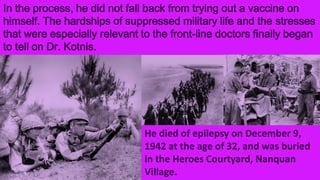
In the process, he did not fall back from trying out a vaccine on
himself. The hardships of suppressed military life and the stresses
that were especially relevant to the front-line doctors finally began
to tell on Dr. Kotnis.
He died of epilepsy on December 9,
1942 at the age of 32, and was buried
in the Heroes Courtyard, Nanquan
Village.
In order to cherish the memory
of Dr. Kotnis, the Chinese
government built a memorial
hall for him in Shijiazhuang
city, Hebei Province in 1976.
No single Indian has been so
much revered by ordinary
Chinese as this doctor from
a middle class family in
Northern India.
Shijiazhuang City of Hebei Province
Along with the Canadian
Dr. Norman Bethune, he
continues to be revered
by the Chinese people.
In April 2005, both their graves were covered completely in flowers
donated by the Chinese people during the Qingming Festival, a day
used by the Chinese to commemorate their ancestors.
Qingming Festival
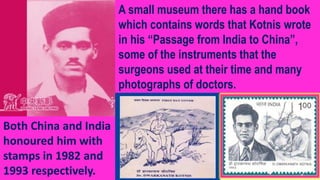
Both China and India
honoured him with
stamps in 1982 and
1993 respectively.
A small museum there has a hand book
which contains words that Kotnis wrote
in his “Passage from India to China”,
some of the instruments that the
surgeons used at their time and many
photographs of doctors.
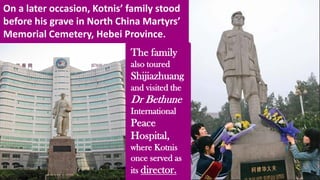
On a later occasion, Kotnis’ family stood
before his grave in North China Martyrs’
Memorial Cemetery, Hebei Province.
The family
also toured
Shijiazhuang
and visited the
Dr Bethune
International
Peace
Hospital,
where Kotnis
once served as
its director.
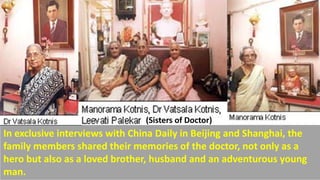
In exclusive interviews with China Daily in Beijing and Shanghai, the
family members shared their memories of the doctor, not only as a
hero but also as a loved brother, husband and an adventurous young
man.
(Sisters of Doctor)
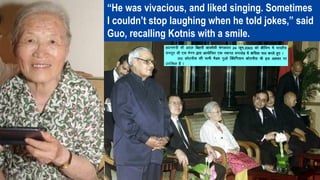
“He was vivacious, and liked singing. Sometimes
I couldn’t stop laughing when he told jokes,” said
Guo, recalling Kotnis with a smile.
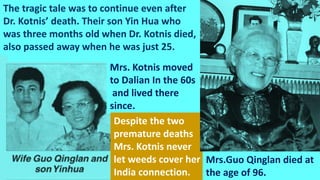
The tragic tale was to continue even after
Dr. Kotnis’ death. Their son Yin Hua who
was three months old when Dr. Kotnis died,
also passed away when he was just 25.
Mrs. Kotnis moved
to Dalian In the 60s
and lived there
since.
Despite the two
premature deaths
Mrs. Kotnis never
let weeds cover her
India connection.
Mrs.Guo Qinglan died at
the age of 96.
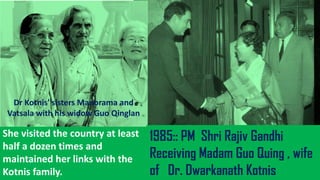
She visited the country at least
half a dozen times and
maintained her links with the
Kotnis family.
Dr Kotnis' sisters Manorama and
Vatsala with his widow Guo Qinglan
1985:: PM Shri Rajiv Gandhi
Receiving Madam Guo Quing , wife
of Dr. Dwarkanath Kotnis
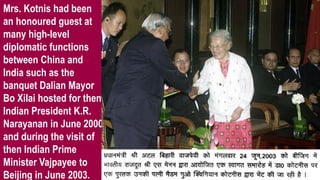
Mrs. Kotnis had been
an honoured guest at
many high-level
diplomatic functions
between China and
India such as the
banquet Dalian Mayor
Bo Xilai hosted for then
Indian President K.R.
Narayanan in June 2000
and during the visit of
then Indian Prime
Minister Vajpayee to
Beijing in June 2003.
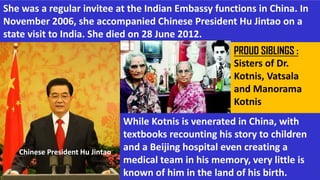
She was a regular invitee at the Indian Embassy functions in China. In
November 2006, she accompanied Chinese President Hu Jintao on a
state visit to India. She died on 28 June 2012.
Chinese President Hu Jintao
While Kotnis is venerated in China, with
textbooks recounting his story to children
and a Beijing hospital even creating a
medical team in his memory, very little is
known of him in the land of his birth.
PROUD SIBLINGS :
Sisters of Dr.
Kotnis, Vatsala
and Manorama
Kotnis
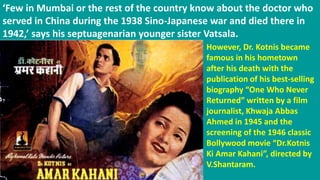
‘Few in Mumbai or the rest of the country know about the doctor who
served in China during the 1938 Sino-Japanese war and died there in
1942,’ says his septuagenarian younger sister Vatsala.
However, Dr. Kotnis became
famous in his hometown
after his death with the
publication of his best-selling
biography “One Who Never
Returned” written by a film
journalist, Khwaja Abbas
Ahmed in 1945 and the
screening of the 1946 classic
Bollywood movie “Dr.Kotnis
Ki Amar Kahani”, directed by
V.Shantaram.
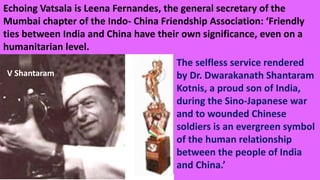
Echoing Vatsala is Leena Fernandes, the general secretary of the
Mumbai chapter of the Indo- China Friendship Association: ‘Friendly
ties between India and China have their own significance, even on a
humanitarian level.
V Shantaram
The selfless service rendered
by Dr. Dwarakanath Shantaram
Kotnis, a proud son of India,
during the Sino-Japanese war
and to wounded Chinese
soldiers is an evergreen symbol
of the human relationship
between the people of India
and China.’
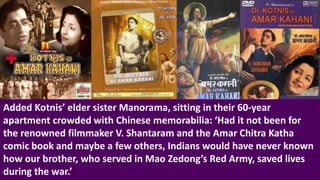
Added Kotnis’ elder sister Manorama, sitting in their 60-year
apartment crowded with Chinese memorabilia: ‘Had it not been for
the renowned filmmaker V. Shantaram and the Amar Chitra Katha
comic book and maybe a few others, Indians would have never known
how our brother, who served in Mao Zedong’s Red Army, saved lives
during the war.’
THANK YOU ONE & ALL
SHARADA

Dr. dwarakanath kotnis

  • 1.
    PPT By M PADMALALITHA SHARADA for Class VIII English Dr. Dwarakanath Kotnis
  • 2.
    No other Indiancan claim the kind of adulation and respect Dr. Dwarakanath Kotnis enjoys in China. Coming from a family of doctors, Dr. Kotnis had always dreamt of becoming a physician. The tomb of Dwarkanath Kotnis in Shijiazhuang Hebei, China.
  • 3.
    And the Warof Resistance gave him the perfect opportunity to make himself useful in the battle field. Chinese War of Resistance against Japanese Aggression He dedicated his entire life working as a battlefront doctor in China and rendered his selfless service to the injured Chinese soldiers during the Second Sino-Japanese War. Dr. Dwarkanath Kotnis, 2nd from left, and members of his medical team
  • 4.
    Dr. Kotnis’ contributiontowards humanity will be remembered for ever. Dr. Dwarakanath Kotnis was born in a lower middle class family on October 10, 1910 in Sholapur,Mumbai.
  • 5.
    A vivacious kidby nature, Dr. Kotnis forever aspired to become a doctor. After completing his graduation in medicine from G. S. Medical College, Bombay, he went on to pursue his post-graduation internship. Dr. Dwarkanath Kotnis Memorial, Solapur
  • 6.
    However, he put asidehis post- graduation plans when he got the chance to join the medical aid mission to China.
  • 7.
    Dr. Kotnis alwayswanted to travel around the world and practise medicine in different parts of the globe.
  • 9.
    The President ofthe Indian National Congress, Netaji Subhash Chandra Bose accepted the request and made arrangements to send a team of volunteer doctors. The medical team comprised of M. Atal, M. Cholkar, D. Kotnis, B.K. Basu and D. Mukerji. After the war, all other doctors except Dr. Kotnis, returned to India.
  • 10.
    However, Dr. Kotnisdecided to stay back and serve at the military base. He initially started his work in Yan’an and then went to the anti-Japanese base area in North China where he worked in the surgical department of the Eighth Route Army General Hospital as the physician-in-charge.
  • 11.
    It was whileworking with the soldiers that Dr. Kotnis lost his heart to a Chinese woman, Guo Qinglan. They were working in the same hospital. Dr.Kotnis was a doctor and Guo, a nurse. In November 1941, Kotnis married Guo and a son was born on August 23,1942. They named the boy “Yin Hua” combining the Chinese characters “Yin” for India and “Hua” for China. He worked as a lecturer for sometime in the Military area at the Dr. Bethune Hygiene School. He took over the post of the first president of the Bethune International Peace Hospital after Dr. Norman Bethune passed away. Dr. Norman Bethune Guo Qinglan
  • 12.
    During a long-drawnout battle against Japanese troops in 1940, Dr. Kotnis performed operations for 72 hours non-stop without any sleep and his small team conducted 50 operations everyday for a fortnight. In those harsh times, Mrs. Guo proved an ideal soul mate but was modest about her contribution. Dr. Kotnis played a major role in controlling a virulent strain of plague that hit Chinese soldiers.
  • 13.
    In the process,he did not fall back from trying out a vaccine on himself. The hardships of suppressed military life and the stresses that were especially relevant to the front-line doctors finally began to tell on Dr. Kotnis. He died of epilepsy on December 9, 1942 at the age of 32, and was buried in the Heroes Courtyard, Nanquan Village.
  • 14.
    In order tocherish the memory of Dr. Kotnis, the Chinese government built a memorial hall for him in Shijiazhuang city, Hebei Province in 1976. No single Indian has been so much revered by ordinary Chinese as this doctor from a middle class family in Northern India. Shijiazhuang City of Hebei Province
  • 15.
    Along with theCanadian Dr. Norman Bethune, he continues to be revered by the Chinese people. In April 2005, both their graves were covered completely in flowers donated by the Chinese people during the Qingming Festival, a day used by the Chinese to commemorate their ancestors. Qingming Festival
  • 16.
    Both China andIndia honoured him with stamps in 1982 and 1993 respectively. A small museum there has a hand book which contains words that Kotnis wrote in his “Passage from India to China”, some of the instruments that the surgeons used at their time and many photographs of doctors.
  • 17.
    On a lateroccasion, Kotnis’ family stood before his grave in North China Martyrs’ Memorial Cemetery, Hebei Province. The family also toured Shijiazhuang and visited the Dr Bethune International Peace Hospital, where Kotnis once served as its director.
  • 18.
    In exclusive interviewswith China Daily in Beijing and Shanghai, the family members shared their memories of the doctor, not only as a hero but also as a loved brother, husband and an adventurous young man. (Sisters of Doctor)
  • 19.
    “He was vivacious,and liked singing. Sometimes I couldn’t stop laughing when he told jokes,” said Guo, recalling Kotnis with a smile.
  • 20.
    The tragic talewas to continue even after Dr. Kotnis’ death. Their son Yin Hua who was three months old when Dr. Kotnis died, also passed away when he was just 25. Mrs. Kotnis moved to Dalian In the 60s and lived there since. Despite the two premature deaths Mrs. Kotnis never let weeds cover her India connection. Mrs.Guo Qinglan died at the age of 96.
  • 21.
    She visited thecountry at least half a dozen times and maintained her links with the Kotnis family. Dr Kotnis' sisters Manorama and Vatsala with his widow Guo Qinglan 1985:: PM Shri Rajiv Gandhi Receiving Madam Guo Quing , wife of Dr. Dwarkanath Kotnis
  • 22.
    Mrs. Kotnis hadbeen an honoured guest at many high-level diplomatic functions between China and India such as the banquet Dalian Mayor Bo Xilai hosted for then Indian President K.R. Narayanan in June 2000 and during the visit of then Indian Prime Minister Vajpayee to Beijing in June 2003.
  • 23.
    She was aregular invitee at the Indian Embassy functions in China. In November 2006, she accompanied Chinese President Hu Jintao on a state visit to India. She died on 28 June 2012. Chinese President Hu Jintao While Kotnis is venerated in China, with textbooks recounting his story to children and a Beijing hospital even creating a medical team in his memory, very little is known of him in the land of his birth. PROUD SIBLINGS : Sisters of Dr. Kotnis, Vatsala and Manorama Kotnis
  • 24.
    ‘Few in Mumbaior the rest of the country know about the doctor who served in China during the 1938 Sino-Japanese war and died there in 1942,’ says his septuagenarian younger sister Vatsala. However, Dr. Kotnis became famous in his hometown after his death with the publication of his best-selling biography “One Who Never Returned” written by a film journalist, Khwaja Abbas Ahmed in 1945 and the screening of the 1946 classic Bollywood movie “Dr.Kotnis Ki Amar Kahani”, directed by V.Shantaram.
  • 25.
    Echoing Vatsala isLeena Fernandes, the general secretary of the Mumbai chapter of the Indo- China Friendship Association: ‘Friendly ties between India and China have their own significance, even on a humanitarian level. V Shantaram The selfless service rendered by Dr. Dwarakanath Shantaram Kotnis, a proud son of India, during the Sino-Japanese war and to wounded Chinese soldiers is an evergreen symbol of the human relationship between the people of India and China.’
  • 26.
    Added Kotnis’ eldersister Manorama, sitting in their 60-year apartment crowded with Chinese memorabilia: ‘Had it not been for the renowned filmmaker V. Shantaram and the Amar Chitra Katha comic book and maybe a few others, Indians would have never known how our brother, who served in Mao Zedong’s Red Army, saved lives during the war.’
  • 27.
    THANK YOU ONE& ALL SHARADA