
Oge Marques
Florida Atlantic University
     Boca Raton, FL - USA
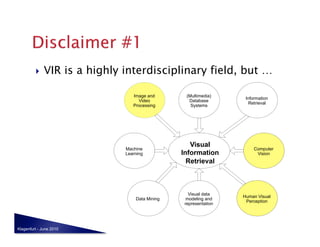
    VIR is a highly interdisciplinary field, but …

                                 Image and       (Multimedia)
                                                                  Information
                                   Video          Database
                                                                    Retrieval
                                 Processing        Systems


                                                   Visual
                              Machine                                 Computer
                              Learning          Information            Vision
                                                  Retrieval


                                                  Visual data
                                                                 Human Visual
                                  Data Mining    modeling and
                                                                  Perception
                                                representation


Klagenfurt - June 2010
    There are many things that I believe…


             … but cannot prove


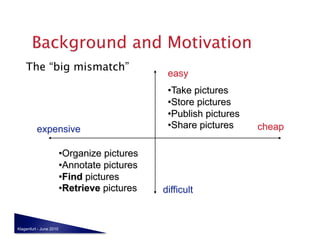
Klagenfurt - June 2010
The “big mismatch”


Klagenfurt - June 2010
    Part I
              ◦  10 years after the “end of the early years”
                    Where are we now?
             Part II
              ◦  Medical image retrieval
                    Challenges and opportunities
             Part III
              ◦  Where is VIR headed?
                    Advice for young researchers


Klagenfurt - June 2010
    It’s been 10 years since the “end of the early
              years” [Smeulders et al., 2000]


              ◦  Are the challenges from 2000 still relevant?
              ◦  Are the directions and guidelines from 2000 still
                 appropriate?

Klagenfurt - June 2010
    Revisiting the ‘Concluding Remarks’ from
              [Smeulders et al., 2000]:

              ◦  Driving forces
                    “[…] content-based image retrieval (CBIR) will continue
                     to grow in every direction: new audiences, new
                     purposes, new styles of use, new modes of interaction,
                     larger data sets, and new methods to solve the
                     problems.”


Klagenfurt - June 2010
    Yes, we have seen many new audiences, new
              purposes, new styles of use, and new modes
              of interaction emerge.

             Each of these usually requires new methods
              to solve the problems that they bring.

             However, not too many researchers see them
              as a driving force (as they should).


Klagenfurt - June 2010
    Revisiting the ‘Concluding Remarks’ from
              [Smeulders et al., 2000]:

              ◦  Heritage of computer vision
                    “An important obstacle to overcome […] is to realize
                     that image retrieval does not entail solving the general
                     image understanding problem.”


Klagenfurt - June 2010
    I’m afraid I have bad news…
              ◦  Computer vision hasn’t made so much progress
                 during the past 10 years.

              ◦  Some classical problems 

                 (including image 

                 understanding)

                 remain unresolved.

              ◦  Similarly, CBIR from a 

                 pure computer vision

                 perspective didn’t work 

                 too well either.


Klagenfurt - June 2010
    Revisiting the ‘Concluding Remarks’ from
              [Smeulders et al., 2000]:

              ◦  Influence on computer vision
                    “[…] CBIR offers a different look at traditional computer
                     vision problems: large data sets, no reliance on strong
                     segmentation, and revitalized interest in color image
                     processing and invariance.”


Klagenfurt - June 2010
    The adoption of large data sets became standard
              practice in computer vision (see Torralba’s work).
             No reliance on strong segmentation (still
              unresolved)  new areas of research, e.g.,
              automatic ROI extraction and RBIR.
             Color image processing and color descriptors
              became incredibly popular, useful, and (to some
              degree) effective.
              Invariance still a huge problem
              ◦  But it’s cheaper than ever to have multiple views.


Klagenfurt - June 2010
    Revisiting the ‘Concluding Remarks’ from
              [Smeulders et al., 2000]:

              ◦  Similarity and learning
                    “We make a pledge for the importance of human-
                     based similarity rather than general similarity. Also,
                     the connection between image semantics, image data,
                     and query context will have to be made clearer in the
                     future.”
                    “[…] in order to bring semantics to the user, learning is
                     inevitable.”


Klagenfurt - June 2010
    The authors were pointing in the right
              direction (human in the loop, role of context,
              benefits from learning,…)

             However:
              ◦  Similarity is a tough problem to crack and model.
                    Even the understanding of how humans judge image
                     similarity is very limited.
              ◦  Machine learning is almost inevitable…
                    … but sometimes it can be abused.


Klagenfurt - June 2010
    Revisiting the ‘Concluding Remarks’ from
              [Smeulders et al., 2000]:

              ◦  Interaction
                    Better visualization options, more control to the user,
                     ability to provide feedback […]


Klagenfurt - June 2010
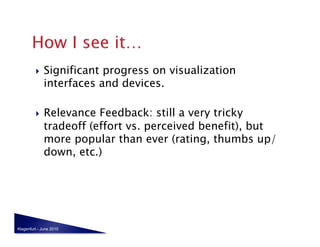
    Significant progress on visualization
              interfaces and devices.

             Relevance Feedback: still a very tricky
              tradeoff (effort vs. perceived benefit), but
              more popular than ever (rating, thumbs up/
              down, etc.)


Klagenfurt - June 2010
    Revisiting the ‘Concluding Remarks’ from
              [Smeulders et al., 2000]:

              ◦  Need for databases
                    “The connection between CBIR and database research
                     is likely to increase in the future. […] problems like the
                     definition of suitable query languages, efficient search
                     in high dimensional feature space, search in the
                     presence of changing similarity measures are largely
                     unsolved […]”


Klagenfurt - June 2010
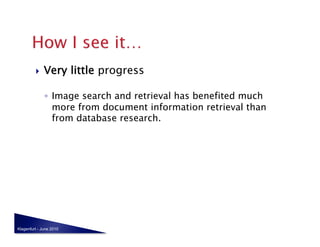
    Very little progress

              ◦  Image search and retrieval has benefited much
                 more from document information retrieval than
                 from database research.


Klagenfurt - June 2010
    Revisiting the ‘Concluding Remarks’ from
              [Smeulders et al., 2000]:

              ◦  The problem of evaluation
                    CBIR could use a reference standard against which new
                     algorithms could be evaluated (similar to TREC in the
                     field of text recognition).
                    “A comprehensive and publicly available collection of
                     images, sorted by class and retrieval purposes,
                     together with a protocol to standardize experimental
                     practices, will be instrumental in the next phase of
                     CBIR.”


Klagenfurt - June 2010
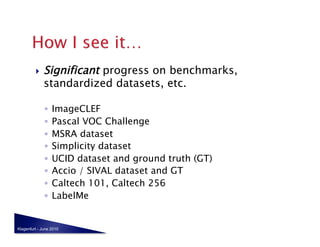
    Significant progress on benchmarks,
              standardized datasets, etc.

              ◦  ImageCLEF
              ◦  Pascal VOC Challenge
              ◦  MSRA dataset
              ◦  Simplicity dataset
              ◦  UCID dataset and ground truth (GT)
              ◦  Accio / SIVAL dataset and GT
              ◦  Caltech 101, Caltech 256
              ◦  LabelMe


Klagenfurt - June 2010
    Revisiting the ‘Concluding Remarks’ from
              [Smeulders et al., 2000]:

              ◦  Semantic gap and other sources
                    “A critical point in the advancement of CBIR is the
                     semantic gap, where the meaning of an image is rarely
                     self-evident. […] One way to resolve the semantic gap
                     comes from sources outside the image by integrating
                     other sources of information about the image in the
                     query.”


Klagenfurt - June 2010
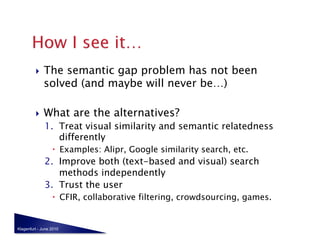
    The semantic gap problem has not been
              solved (and maybe will never be…)

             What are the alternatives?
              1.  Treat visual similarity and semantic relatedness
                  differently
                    Examples: Alipr, Google similarity search, etc.
              2.  Improve both (text-based and visual) search
                  methods independently
              3.  Trust the user
                    CFIR, collaborative filtering, crowdsourcing, games.


Klagenfurt - June 2010
    Challenges
              ◦  We’re entering a new country…
                        How much can we bring?
                        Do we speak the language?
                        Do we know their culture?
                        Do they understand us and where we come from?
             Opportunities
              ◦  They use images (extensively)
              ◦  They have expert knowledge
              ◦  Domains are narrow (almost by definition)
              ◦  Fewer clients, but potentially more $$


Klagenfurt - June 2010
    An overview of the challenges

              ◦  Different terminology
              ◦  Standards (e.g., DICOM)
              ◦  Modality dependencies
              ◦  Equipment dependencies
              ◦  Privacy issues
              ◦  Proprietary data
              ◦  A tough sell?


Klagenfurt - June 2010
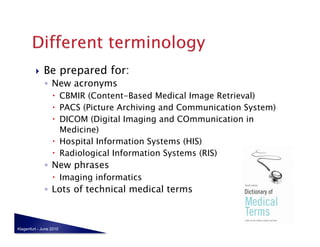
    Be prepared for:
              ◦  New acronyms
                    CBMIR (Content-Based Medical Image Retrieval)
                    PACS (Picture Archiving and Communication System)
                    DICOM (Digital Imaging and COmmunication in
                     Medicine)
                    Hospital Information Systems (HIS)
                    Radiological Information Systems (RIS)
              ◦  New phrases
                    Imaging informatics
              ◦  Lots of technical medical terms


Klagenfurt - June 2010
    DICOM (http://medical.nema.org/)
              ◦  Global IT standard, created in 1993, used in
                 virtually all hospitals worldwide.
              ◦  Designed to ensure the interoperability of different
                 systems and manage related workflow.
              ◦  Will be required by all EHR systems that include
                 imaging information as an integral part of the
                 patient record.
              ◦  750+ technical and medical experts participate in
                 20+ active DICOM working groups.
              ◦  Standard is updated 4-5 times per year.
              ◦  Many available tools! (see http://www.idoimaging.com/)

Klagenfurt - June 2010
    The IRMA code [Lehmann et al., 2003]
              ◦  4 axes with 3 to 4 positions, each in
                 {0,...9,a,...,z}, where "0" denotes "unspecified" to
                 determine the end of a path along an axis.
                   Technical code (T) describes the imaging
                    modality
                   Directional code (D) models body orientations
                   Anatomical code (A) refers to the body region
                    examined
                   Biological code (B) describes the biological
                    system examined.


Klagenfurt - June 2010
    The IRMA code [Lehmann et al., 2003]
              ◦  The entire code results in a character string of <14
                 characters (IRMA: TTTT – DDD – AAA – BBB).


           Example: “x-ray, projection radiography,
           analog, high energy – sagittal, left lateral
           decubitus, inspiration – chest, lung –
           respiratory system, lung”


                                   Source: [Lehmann et al., 2003]
Klagenfurt - June 2010
    The IRMA code
             [Lehmann et
             al., 2003]

             ◦  The companion
                tool…


                         Source: [Lehmann et al., 2004]


Klagenfurt - June 2010
    Most current retrieval systems in clinical use rely
              on text keywords such as DICOM header
              information to perform retrieval.
             CBIR has been widely researched in a variety of
              domains and provides an intuitive and expressive
              method for querying visual data using features,
              e.g. color, shape, and texture.
             Current CBIR systems:
              ◦  are not easily integrated into the healthcare
                 environment;
              ◦  have not been widely evaluated using a large dataset;
                 and
              ◦  lack the ability to perform relevance feedback to refine
                 retrieval results.


                               Source: [Hsu et al., 2009]
Klagenfurt - June 2010
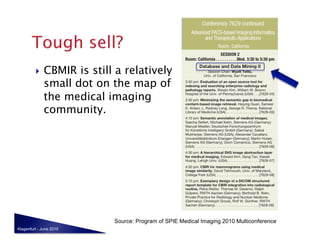
    CBMIR is still a relatively
              small dot on the map of
              the medical imaging
              community.


                            Source: Program of SPIE Medical Imaging 2010 Multiconference
Klagenfurt - June 2010
    New gaps!

              ◦  Just when you
                 thought the
                 semantic gap
                 was your only
                 problem…


              Source: [Deserno, Antani, and Long, 2009]


Klagenfurt - June 2010
    USA
              ◦  NIH (National Institutes of Health)
                    NIBIB - National Institute of Biomedical Imaging and
                     Bioengineering
                    NCI - National Cancer Institute
                    NLM – National Libraries of Medicine
              ◦  Several universities and hospitals
             Europe
              ◦  Aachen University (Germany)
              ◦  Geneva University (Switzerland)
             Big companies (Siemens, GE, etc.)

Klagenfurt - June 2010
    IRMA (Image Retrieval in Medical Applications)

              ◦  Aachen University (Germany)
                    http://ganymed.imib.rwth-aachen.de/irma/

              ◦  3 online demos:
                    IRMA Query demo: allows the evaluation of CBIR on several
                     databases.
                    IRMA Extended Query Refinement demo: CBIR from the IRMA
                     database (a subset of 10,000 images).
                    Spine Pathology and Image Retrieval Systems (SPIRS)
                     designed by the NLM/NIH (USA): holds information of
                     ~17,000 spine x-rays.


Klagenfurt - June 2010
    MedGIFT (GNU Image Finding Tool)

              ◦  Geneva University (Switzerland)
                    http://www.sim.hcuge.ch/medgift/

              ◦  Large effort, including projects such as:
                        Talisman (lung image retrieval)
                        Case-based fracture image retrieval system
                        Onco-Media: medical image retrieval + grid computing
                        ImageCLEF: evaluation and validation
                        medSearch


Klagenfurt - June 2010
    WebMIRS

              ◦  NIH / NLM (USA)
                    http://archive.nlm.nih.gov/proj/webmirs/index.php

              ◦  Query by text + navigation by categories

              ◦  Uses datasets and related x-ray images from the
                 National Health and Nutrition Examination Survey
                 (NHANES)


Klagenfurt - June 2010
    SPIRS (Spine Pathology & Image Retrieval
              System): Web-based image retrieval system
              for large biomedical databases
              ◦  NIH / UCLA (USA)
              ◦  Great case study on highly specialized CBMIR


Klagenfurt - June 2010           Source: [Hsu et al., 2009]
    National Biomedical Imaging Archive (NBIA)

              ◦  NCI / NIH (USA)
                    https://imaging.nci.nih.gov/

              ◦  Search based on metadata (DICOM fields)
              ◦  3 search options:
                    Simple
                    Advanced
                    Dynamic


Klagenfurt - June 2010
    ARSS Goldminer

              ◦  American Roentgen Ray Society (USA)
                    http://goldminer.arrs.org/

              ◦  Query by text
              ◦  Results can be filtered by:
                    Modality
                    Age
                    Sex


Klagenfurt - June 2010
    Yottalook Images

              ◦  iVirtuoso (USA)
                    http://www.yottalook.com/

              ◦  Developed and maintained by four radiologists
              ◦  Query by text
              ◦  Claims to use 4 “core technologies”:
                        "natural query analysis”
                        "semantic ontology”
                        “relevance algorithm”
                        a specialized content delivery system that provides
                         high yield content based on the search term.


Klagenfurt - June 2010
    ImageCLEF Medical Image Retrieval 2010
                    http://www.imageclef.org/2010/medical
              ◦  Data set: 77,000 images from articles published in
                 Radiology and Radiographics including text of the
                 captions and link to the html of the full text articles.
              ◦  3 types of tasks:
                    Modality Classification: given an image, return its
                     modality (MR, CT, XR, etc.)
                    Ad-hoc retrieval: classic medical retrieval task, with 3
                     “flavors”: textual, mixed and semantic queries
                    Case-based retrieval: retrieve cases including images
                     that might best suit the provided case description.


Klagenfurt - June 2010
    Better user interfaces, which are responsive,
              highly interactive, and capable of supporting
              relevance feedback.
              ◦  In other words, address the “Performance Gap
                 Category” and the “Usability Gap Category”.


Klagenfurt - June 2010
    New applications of CBMIR, including:
              ◦  Teaching
              ◦  Research
              ◦  Diagnosis
              ◦  PACS and Electronic Patient Records


             CBMIR evaluation using medical experts

             Integration of local and global features


Klagenfurt - June 2010
    New descriptors
              ◦  Example: the Fuzzy Rule Based Compact Composite
                 Descriptor (CCD), which includes global image
                 features capturing both brightness and texture
                 characteristics in a 1D Histogram [Chatzichristofis &
                 Boutalis, 2009]


Klagenfurt - June 2010
    Partial match schemes (see [Hsu et al., 2009])


                              Source: [Hsu et al., 2009]
Klagenfurt - June 2010
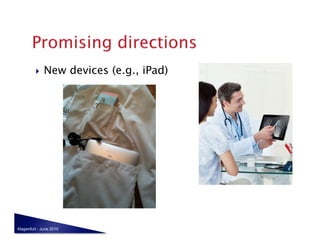
    New devices (e.g., iPad)


Klagenfurt - June 2010
    Advice for [young] researchers

              ◦  In this last part, I’ve compiled pieces and bits of
                 advice that I believe might help researchers who are
                 entering the field.

              ◦  They focus on research avenues that I personally
                 consider to be the most promising.


Klagenfurt - June 2010
    LOOK…

              ◦  at yourself (how do you search for images and
                 videos?)

              ◦  around (related areas and how they have grown)

              ◦  at Google (and other major players)


Klagenfurt - June 2010
    Which sites do you use?
              ◦  Why?
             Which search options do you use?
              ◦  What do you do when the returned results aren’t
                 good?
             What is the single most useful feature that
              you wish those sites had?

             What are your intentions and how do you
              express them?


Klagenfurt - June 2010
  Semi-automatic image annotation
           Tag recommendation systems

           Story annotation engines
           Content-based image filtering

           Copyright detection
           Watermark detection
              ◦  and many more


Klagenfurt - June 2010
    Google Similarity Search (VisualRank) [Jing &
              Baluja, 2008]


             Google Goggles (mobile visual search)


Klagenfurt - June 2010
    THINK…

              ◦  mobile devices

              ◦  new devices and services

              ◦  social networks

              ◦  games


Klagenfurt - June 2010
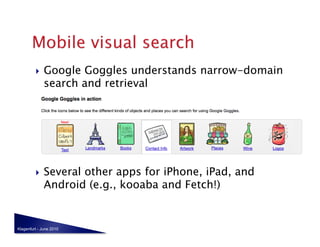
    Google Goggles understands narrow-domain
              search and retrieval


             Several other apps for iPhone, iPad, and
              Android (e.g., kooaba and Fetch!)


Klagenfurt - June 2010
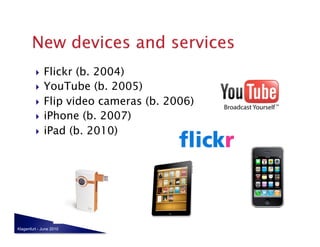
  Flickr (b. 2004)
           YouTube (b. 2005)

           Flip video cameras (b. 2006)
           iPhone (b. 2007)

           iPad (b. 2010)


Klagenfurt - June 2010
    The Web 2.0 has brought about:
              ◦  New data sources
              ◦  New usage patterns
              ◦  New understanding about the users, their needs,
                 habits, preferences
              ◦  New opportunities
              ◦  Lots of metadata!

              ◦  A chance to experience a true paradigm shift
                    Before: image annotation is tedious, labor-intensive,
                     expensive
                    After: image annotation is fun!

Klagenfurt - June 2010
◦    Google Image Labeler

         ◦    Games with a purpose (GWAP):
                The ESP Game
                Squigl
                Matchin


Klagenfurt - June 2010
    UNDERSTAND…

              ◦  human intentions

              ◦  human emotions

              ◦  user’s preferences and needs


Klagenfurt - June 2010
    CREATE…

              ◦  better interfaces

              ◦  better user experience

              ◦  new business opportunities (added value)


Klagenfurt - June 2010
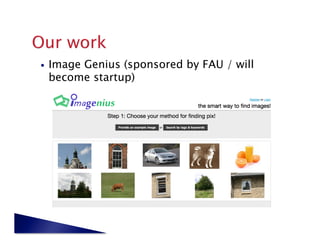
    Image Genius (sponsored by FAU / will
     become startup)
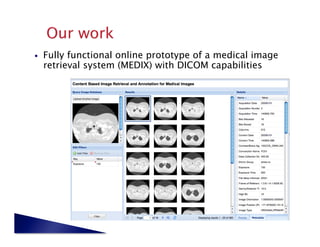
    Fully functional online prototype of a medical image
     retrieval system (MEDIX) with DICOM capabilities
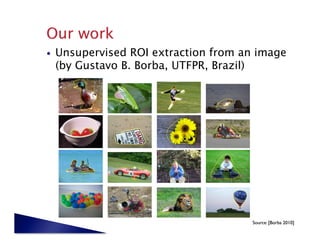
    Unsupervised ROI extraction from an image
     (by Gustavo B. Borba, UTFPR, Brazil)
–    I believe (but cannot prove…) that successful
            VIR solutions will:
            •  combine content-based image retrieval (CBIR) with
               metadata (high-level semantic-based image
               retrieval)
            •  only be truly successful in narrow domains
            •  include the user in the loop
                –  Relevance Feedback (RF)
                –  Collaborative efforts (tagging, rating, annotating)
            •  provide friendly, intuitive interfaces
            •  incorporate results and insights from cognitive
               science, particularly human visual attention,
               perception, and memory


Klagenfurt - June 2010
    “Image search and retrieval” is not a problem,
            but rather a collection of related problems that
            look like one.

           There is a great need for good solutions to
            specific problems.

           10 years after “the end of the early years”,
            research in visual information retrieval still has
            many open problems, challenges, and
            opportunities.

Klagenfurt - June 2010
Questions?


                         omarques@fau.edu

Klagenfurt - June 2010

Recent advances in visual information retrieval marques klu june 2010

  • 1.
    Oge Marques Florida AtlanticUniversity Boca Raton, FL - USA
  • 2.
      VIR is a highly interdisciplinary field, but … Image and (Multimedia) Information Video Database Retrieval Processing Systems Visual Machine Computer Learning Information Vision Retrieval Visual data Human Visual Data Mining modeling and Perception representation Klagenfurt - June 2010
  • 3.
      There are many things that I believe…   … but cannot prove Klagenfurt - June 2010
  • 4.
  • 5.
      Part I ◦  10 years after the “end of the early years”   Where are we now?   Part II ◦  Medical image retrieval   Challenges and opportunities   Part III ◦  Where is VIR headed?   Advice for young researchers Klagenfurt - June 2010
  • 7.
      It’s been 10 years since the “end of the early years” [Smeulders et al., 2000] ◦  Are the challenges from 2000 still relevant? ◦  Are the directions and guidelines from 2000 still appropriate? Klagenfurt - June 2010
  • 8.
      Revisiting the ‘Concluding Remarks’ from [Smeulders et al., 2000]: ◦  Driving forces   “[…] content-based image retrieval (CBIR) will continue to grow in every direction: new audiences, new purposes, new styles of use, new modes of interaction, larger data sets, and new methods to solve the problems.” Klagenfurt - June 2010
  • 9.
      Yes, we have seen many new audiences, new purposes, new styles of use, and new modes of interaction emerge.   Each of these usually requires new methods to solve the problems that they bring.   However, not too many researchers see them as a driving force (as they should). Klagenfurt - June 2010
  • 10.
      Revisiting the ‘Concluding Remarks’ from [Smeulders et al., 2000]: ◦  Heritage of computer vision   “An important obstacle to overcome […] is to realize that image retrieval does not entail solving the general image understanding problem.” Klagenfurt - June 2010
  • 11.
      I’m afraid I have bad news… ◦  Computer vision hasn’t made so much progress during the past 10 years. ◦  Some classical problems 
 (including image 
 understanding)
 remain unresolved. ◦  Similarly, CBIR from a 
 pure computer vision
 perspective didn’t work 
 too well either. Klagenfurt - June 2010
  • 12.
      Revisiting the ‘Concluding Remarks’ from [Smeulders et al., 2000]: ◦  Influence on computer vision   “[…] CBIR offers a different look at traditional computer vision problems: large data sets, no reliance on strong segmentation, and revitalized interest in color image processing and invariance.” Klagenfurt - June 2010
  • 13.
      The adoption of large data sets became standard practice in computer vision (see Torralba’s work).   No reliance on strong segmentation (still unresolved)  new areas of research, e.g., automatic ROI extraction and RBIR.   Color image processing and color descriptors became incredibly popular, useful, and (to some degree) effective.   Invariance still a huge problem ◦  But it’s cheaper than ever to have multiple views. Klagenfurt - June 2010
  • 14.
      Revisiting the ‘Concluding Remarks’ from [Smeulders et al., 2000]: ◦  Similarity and learning   “We make a pledge for the importance of human- based similarity rather than general similarity. Also, the connection between image semantics, image data, and query context will have to be made clearer in the future.”   “[…] in order to bring semantics to the user, learning is inevitable.” Klagenfurt - June 2010
  • 15.
      The authors were pointing in the right direction (human in the loop, role of context, benefits from learning,…)   However: ◦  Similarity is a tough problem to crack and model.   Even the understanding of how humans judge image similarity is very limited. ◦  Machine learning is almost inevitable…   … but sometimes it can be abused. Klagenfurt - June 2010
  • 16.
      Revisiting the ‘Concluding Remarks’ from [Smeulders et al., 2000]: ◦  Interaction   Better visualization options, more control to the user, ability to provide feedback […] Klagenfurt - June 2010
  • 17.
      Significant progress on visualization interfaces and devices.   Relevance Feedback: still a very tricky tradeoff (effort vs. perceived benefit), but more popular than ever (rating, thumbs up/ down, etc.) Klagenfurt - June 2010
  • 18.
      Revisiting the ‘Concluding Remarks’ from [Smeulders et al., 2000]: ◦  Need for databases   “The connection between CBIR and database research is likely to increase in the future. […] problems like the definition of suitable query languages, efficient search in high dimensional feature space, search in the presence of changing similarity measures are largely unsolved […]” Klagenfurt - June 2010
  • 19.
      Very little progress ◦  Image search and retrieval has benefited much more from document information retrieval than from database research. Klagenfurt - June 2010
  • 20.
      Revisiting the ‘Concluding Remarks’ from [Smeulders et al., 2000]: ◦  The problem of evaluation   CBIR could use a reference standard against which new algorithms could be evaluated (similar to TREC in the field of text recognition).   “A comprehensive and publicly available collection of images, sorted by class and retrieval purposes, together with a protocol to standardize experimental practices, will be instrumental in the next phase of CBIR.” Klagenfurt - June 2010
  • 21.
      Significant progress on benchmarks, standardized datasets, etc. ◦  ImageCLEF ◦  Pascal VOC Challenge ◦  MSRA dataset ◦  Simplicity dataset ◦  UCID dataset and ground truth (GT) ◦  Accio / SIVAL dataset and GT ◦  Caltech 101, Caltech 256 ◦  LabelMe Klagenfurt - June 2010
  • 22.
      Revisiting the ‘Concluding Remarks’ from [Smeulders et al., 2000]: ◦  Semantic gap and other sources   “A critical point in the advancement of CBIR is the semantic gap, where the meaning of an image is rarely self-evident. […] One way to resolve the semantic gap comes from sources outside the image by integrating other sources of information about the image in the query.” Klagenfurt - June 2010
  • 23.
      The semantic gap problem has not been solved (and maybe will never be…)   What are the alternatives? 1.  Treat visual similarity and semantic relatedness differently   Examples: Alipr, Google similarity search, etc. 2.  Improve both (text-based and visual) search methods independently 3.  Trust the user   CFIR, collaborative filtering, crowdsourcing, games. Klagenfurt - June 2010
  • 25.
      Challenges ◦  We’re entering a new country…   How much can we bring?   Do we speak the language?   Do we know their culture?   Do they understand us and where we come from?   Opportunities ◦  They use images (extensively) ◦  They have expert knowledge ◦  Domains are narrow (almost by definition) ◦  Fewer clients, but potentially more $$ Klagenfurt - June 2010
  • 26.
      An overview of the challenges ◦  Different terminology ◦  Standards (e.g., DICOM) ◦  Modality dependencies ◦  Equipment dependencies ◦  Privacy issues ◦  Proprietary data ◦  A tough sell? Klagenfurt - June 2010
  • 27.
      Be prepared for: ◦  New acronyms   CBMIR (Content-Based Medical Image Retrieval)   PACS (Picture Archiving and Communication System)   DICOM (Digital Imaging and COmmunication in Medicine)   Hospital Information Systems (HIS)   Radiological Information Systems (RIS) ◦  New phrases   Imaging informatics ◦  Lots of technical medical terms Klagenfurt - June 2010
  • 28.
      DICOM (http://medical.nema.org/) ◦  Global IT standard, created in 1993, used in virtually all hospitals worldwide. ◦  Designed to ensure the interoperability of different systems and manage related workflow. ◦  Will be required by all EHR systems that include imaging information as an integral part of the patient record. ◦  750+ technical and medical experts participate in 20+ active DICOM working groups. ◦  Standard is updated 4-5 times per year. ◦  Many available tools! (see http://www.idoimaging.com/) Klagenfurt - June 2010
  • 29.
      The IRMA code [Lehmann et al., 2003] ◦  4 axes with 3 to 4 positions, each in {0,...9,a,...,z}, where "0" denotes "unspecified" to determine the end of a path along an axis.   Technical code (T) describes the imaging modality   Directional code (D) models body orientations   Anatomical code (A) refers to the body region examined   Biological code (B) describes the biological system examined. Klagenfurt - June 2010
  • 30.
      The IRMA code [Lehmann et al., 2003] ◦  The entire code results in a character string of <14 characters (IRMA: TTTT – DDD – AAA – BBB). Example: “x-ray, projection radiography, analog, high energy – sagittal, left lateral decubitus, inspiration – chest, lung – respiratory system, lung” Source: [Lehmann et al., 2003] Klagenfurt - June 2010
  • 31.
      The IRMA code [Lehmann et al., 2003] ◦  The companion tool… Source: [Lehmann et al., 2004] Klagenfurt - June 2010
  • 32.
      Most current retrieval systems in clinical use rely on text keywords such as DICOM header information to perform retrieval.   CBIR has been widely researched in a variety of domains and provides an intuitive and expressive method for querying visual data using features, e.g. color, shape, and texture.   Current CBIR systems: ◦  are not easily integrated into the healthcare environment; ◦  have not been widely evaluated using a large dataset; and ◦  lack the ability to perform relevance feedback to refine retrieval results. Source: [Hsu et al., 2009] Klagenfurt - June 2010
  • 33.
      CBMIR is still a relatively small dot on the map of the medical imaging community. Source: Program of SPIE Medical Imaging 2010 Multiconference Klagenfurt - June 2010
  • 34.
      New gaps! ◦  Just when you thought the semantic gap was your only problem… Source: [Deserno, Antani, and Long, 2009] Klagenfurt - June 2010
  • 35.
      USA ◦  NIH (National Institutes of Health)   NIBIB - National Institute of Biomedical Imaging and Bioengineering   NCI - National Cancer Institute   NLM – National Libraries of Medicine ◦  Several universities and hospitals   Europe ◦  Aachen University (Germany) ◦  Geneva University (Switzerland)   Big companies (Siemens, GE, etc.) Klagenfurt - June 2010
  • 36.
      IRMA (Image Retrieval in Medical Applications) ◦  Aachen University (Germany)   http://ganymed.imib.rwth-aachen.de/irma/ ◦  3 online demos:   IRMA Query demo: allows the evaluation of CBIR on several databases.   IRMA Extended Query Refinement demo: CBIR from the IRMA database (a subset of 10,000 images).   Spine Pathology and Image Retrieval Systems (SPIRS) designed by the NLM/NIH (USA): holds information of ~17,000 spine x-rays. Klagenfurt - June 2010
  • 37.
      MedGIFT (GNU Image Finding Tool) ◦  Geneva University (Switzerland)   http://www.sim.hcuge.ch/medgift/ ◦  Large effort, including projects such as:   Talisman (lung image retrieval)   Case-based fracture image retrieval system   Onco-Media: medical image retrieval + grid computing   ImageCLEF: evaluation and validation   medSearch Klagenfurt - June 2010
  • 38.
      WebMIRS ◦  NIH / NLM (USA)   http://archive.nlm.nih.gov/proj/webmirs/index.php ◦  Query by text + navigation by categories ◦  Uses datasets and related x-ray images from the National Health and Nutrition Examination Survey (NHANES) Klagenfurt - June 2010
  • 39.
      SPIRS (Spine Pathology & Image Retrieval System): Web-based image retrieval system for large biomedical databases ◦  NIH / UCLA (USA) ◦  Great case study on highly specialized CBMIR Klagenfurt - June 2010 Source: [Hsu et al., 2009]
  • 40.
      National Biomedical Imaging Archive (NBIA) ◦  NCI / NIH (USA)   https://imaging.nci.nih.gov/ ◦  Search based on metadata (DICOM fields) ◦  3 search options:   Simple   Advanced   Dynamic Klagenfurt - June 2010
  • 41.
      ARSS Goldminer ◦  American Roentgen Ray Society (USA)   http://goldminer.arrs.org/ ◦  Query by text ◦  Results can be filtered by:   Modality   Age   Sex Klagenfurt - June 2010
  • 42.
      Yottalook Images ◦  iVirtuoso (USA)   http://www.yottalook.com/ ◦  Developed and maintained by four radiologists ◦  Query by text ◦  Claims to use 4 “core technologies”:   "natural query analysis”   "semantic ontology”   “relevance algorithm”   a specialized content delivery system that provides high yield content based on the search term. Klagenfurt - June 2010
  • 43.
      ImageCLEF Medical Image Retrieval 2010   http://www.imageclef.org/2010/medical ◦  Data set: 77,000 images from articles published in Radiology and Radiographics including text of the captions and link to the html of the full text articles. ◦  3 types of tasks:   Modality Classification: given an image, return its modality (MR, CT, XR, etc.)   Ad-hoc retrieval: classic medical retrieval task, with 3 “flavors”: textual, mixed and semantic queries   Case-based retrieval: retrieve cases including images that might best suit the provided case description. Klagenfurt - June 2010
  • 44.
      Better user interfaces, which are responsive, highly interactive, and capable of supporting relevance feedback. ◦  In other words, address the “Performance Gap Category” and the “Usability Gap Category”. Klagenfurt - June 2010
  • 45.
      New applications of CBMIR, including: ◦  Teaching ◦  Research ◦  Diagnosis ◦  PACS and Electronic Patient Records   CBMIR evaluation using medical experts   Integration of local and global features Klagenfurt - June 2010
  • 46.
      New descriptors ◦  Example: the Fuzzy Rule Based Compact Composite Descriptor (CCD), which includes global image features capturing both brightness and texture characteristics in a 1D Histogram [Chatzichristofis & Boutalis, 2009] Klagenfurt - June 2010
  • 47.
      Partial match schemes (see [Hsu et al., 2009]) Source: [Hsu et al., 2009] Klagenfurt - June 2010
  • 48.
      New devices (e.g., iPad) Klagenfurt - June 2010
  • 50.
      Advice for [young] researchers ◦  In this last part, I’ve compiled pieces and bits of advice that I believe might help researchers who are entering the field. ◦  They focus on research avenues that I personally consider to be the most promising. Klagenfurt - June 2010
  • 51.
      LOOK… ◦  at yourself (how do you search for images and videos?) ◦  around (related areas and how they have grown) ◦  at Google (and other major players) Klagenfurt - June 2010
  • 52.
      Which sites do you use? ◦  Why?   Which search options do you use? ◦  What do you do when the returned results aren’t good?   What is the single most useful feature that you wish those sites had?   What are your intentions and how do you express them? Klagenfurt - June 2010
  • 53.
      Semi-automatic imageannotation   Tag recommendation systems   Story annotation engines   Content-based image filtering   Copyright detection   Watermark detection ◦  and many more Klagenfurt - June 2010
  • 54.
      Google Similarity Search (VisualRank) [Jing & Baluja, 2008]   Google Goggles (mobile visual search) Klagenfurt - June 2010
  • 55.
      THINK… ◦  mobile devices ◦  new devices and services ◦  social networks ◦  games Klagenfurt - June 2010
  • 56.
      Google Goggles understands narrow-domain search and retrieval   Several other apps for iPhone, iPad, and Android (e.g., kooaba and Fetch!) Klagenfurt - June 2010
  • 57.
      Flickr (b.2004)   YouTube (b. 2005)   Flip video cameras (b. 2006)   iPhone (b. 2007)   iPad (b. 2010) Klagenfurt - June 2010
  • 58.
      The Web 2.0 has brought about: ◦  New data sources ◦  New usage patterns ◦  New understanding about the users, their needs, habits, preferences ◦  New opportunities ◦  Lots of metadata! ◦  A chance to experience a true paradigm shift   Before: image annotation is tedious, labor-intensive, expensive   After: image annotation is fun! Klagenfurt - June 2010
  • 59.
    ◦  Google Image Labeler ◦  Games with a purpose (GWAP):   The ESP Game   Squigl   Matchin Klagenfurt - June 2010
  • 60.
      UNDERSTAND… ◦  human intentions ◦  human emotions ◦  user’s preferences and needs Klagenfurt - June 2010
  • 61.
      CREATE… ◦  better interfaces ◦  better user experience ◦  new business opportunities (added value) Klagenfurt - June 2010
  • 62.
      Image Genius (sponsored by FAU / will become startup)
  • 63.
      Fully functional online prototype of a medical image retrieval system (MEDIX) with DICOM capabilities
  • 64.
      Unsupervised ROI extraction from an image (by Gustavo B. Borba, UTFPR, Brazil)
  • 65.
    –  I believe (but cannot prove…) that successful VIR solutions will: •  combine content-based image retrieval (CBIR) with metadata (high-level semantic-based image retrieval) •  only be truly successful in narrow domains •  include the user in the loop –  Relevance Feedback (RF) –  Collaborative efforts (tagging, rating, annotating) •  provide friendly, intuitive interfaces •  incorporate results and insights from cognitive science, particularly human visual attention, perception, and memory Klagenfurt - June 2010
  • 66.
      “Image search and retrieval” is not a problem, but rather a collection of related problems that look like one.   There is a great need for good solutions to specific problems.   10 years after “the end of the early years”, research in visual information retrieval still has many open problems, challenges, and opportunities. Klagenfurt - June 2010
  • 67.
    Questions? omarques@fau.edu Klagenfurt - June 2010