1 of 14
By:
Dastagiri,
Software Engineer.
@dast999 | dast.sofiya@facebook.com
Decoy Documents
Contents
2 of 14
 Introduction to decoy documents
 Threat Model
 Generating and Distributing bait
 Questions
Introduction to decoy documents
Decoy Document:
“On demand machine generated document. It contains the content
to entice the attacker into steeling bogus information”.
Contains:
 Different types of bogus credentials (Honeytokens)
 Stealthy beacons
 Embedded markers
Development:
 At Intrusion Detection Systems Lab,
Columbia University
3 of 14
4 of 14
Introduction to decoy documents
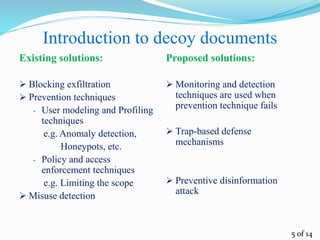
Basic Idea:
Insider attack.
Detect insider actions against the enterprise system as well
as individual hosts and laptops
Report back to the control server or Alerting administrators
Configuring the system and setting policies using management
platform
Introduction to decoy documents
Existing solutions:
 Blocking exfiltration
 Prevention techniques
- User modeling and Profiling
techniques
e.g. Anomaly detection,
Honeypots, etc.
- Policy and access
enforcement techniques
e.g. Limiting the scope
 Misuse detection
Proposed solutions:
 Monitoring and detection
techniques are used when
prevention technique fails
 Trap-based defense
mechanisms
 Preventive disinformation
attack
5 of 14
6 of 14
Threat Model
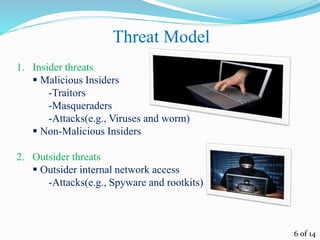
1. Insider threats
 Malicious Insiders
-Traitors
-Masqueraders
-Attacks(e.g., Viruses and worm)
 Non-Malicious Insiders
2. Outsider threats
 Outsider internal network access
-Attacks(e.g., Spyware and rootkits)
Threat Model
Level of Sophistication of the attacker
1. Low - Direct observation
2. Medium - Thorough investigation, decisions based on other,
Possibly outside evidence
3. High - Super computers and other informed people who have
organizational information
4. Highly privileged - being aware of baiting and using tools to
analyze, avoid and disable decoys entirely
7 of 14
Generating and Distributing bait
Properties of decoy documents:
 Used to guide decoy design and maximize the deception
(achieved by hiding)
 Deception -masking, repacking, dazzling, mimicking,
inventing and decoying.
1. Believable - Appearing true
Using realistic names, addresses and logins
2. Enticing - Highly attractive.
Creating decoys based on attacker interest(passwords,
credit card numbers).
8 of 14
Properties of decoy documents(contd.):
3. Conspicuous - easily visible or obvious to the eye or mind
4. Detectable - To discover/catch in the performance of some act
5. Variability - The quality of being subject to variation
6. Non-interference - Easily identified by the actual user
7. Differentiable - Constitute a difference that distinguishes
Generating and Distributing bait
9 of 14
Generating and Distributing bait
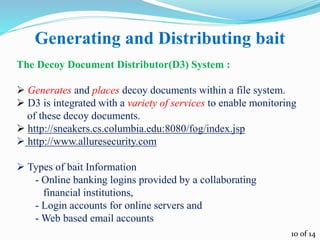
The Decoy Document Distributor(D3) System :
 Generates and places decoy documents within a file system.
 D3 is integrated with a variety of services to enable monitoring
of these decoy documents.
 http://sneakers.cs.columbia.edu:8080/fog/index.jsp
 http://www.alluresecurity.com
 Types of bait Information
- Online banking logins provided by a collaborating
financial institutions,
- Login accounts for online servers and
- Web based email accounts
10 of 14
Generating and Distributing bait
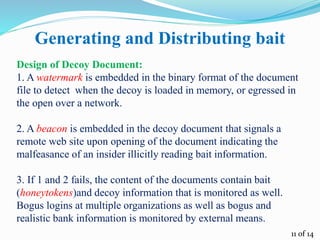
Design of Decoy Document:
1. A watermark is embedded in the binary format of the document
file to detect when the decoy is loaded in memory, or egressed in
the open over a network.
2. A beacon is embedded in the decoy document that signals a
remote web site upon opening of the document indicating the
malfeasance of an insider illicitly reading bait information.
3. If 1 and 2 fails, the content of the documents contain bait
(honeytokens)and decoy information that is monitored as well.
Bogus logins at multiple organizations as well as bogus and
realistic bank information is monitored by external means.
11 of 14
Generating and Distributing bait
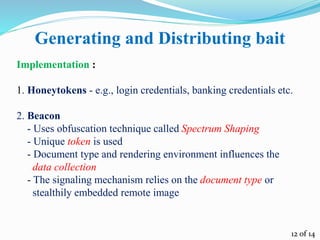
Implementation :
1. Honeytokens - e.g., login credentials, banking credentials etc.
2. Beacon
- Uses obfuscation technique called Spectrum Shaping
- Unique token is used
- Document type and rendering environment influences the
data collection
- The signaling mechanism relies on the document type or
stealthily embedded remote image
12 of 14
Generating and Distributing bait
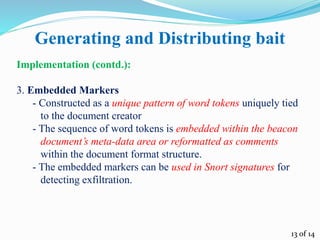
Implementation (contd.):
3. Embedded Markers
- Constructed as a unique pattern of word tokens uniquely tied
to the document creator
- The sequence of word tokens is embedded within the beacon
document’s meta-data area or reformatted as comments
within the document format structure.
- The embedded markers can be used in Snort signatures for
detecting exfiltration.
13 of 14
Questions
14 of 14

Decoy documents

  • 1.
    1 of 14 By: Dastagiri, SoftwareEngineer. @dast999 | dast.sofiya@facebook.com Decoy Documents
  • 2.
    Contents 2 of 14 Introduction to decoy documents  Threat Model  Generating and Distributing bait  Questions
  • 3.
    Introduction to decoydocuments Decoy Document: “On demand machine generated document. It contains the content to entice the attacker into steeling bogus information”. Contains:  Different types of bogus credentials (Honeytokens)  Stealthy beacons  Embedded markers Development:  At Intrusion Detection Systems Lab, Columbia University 3 of 14
  • 4.
    4 of 14 Introductionto decoy documents Basic Idea: Insider attack. Detect insider actions against the enterprise system as well as individual hosts and laptops Report back to the control server or Alerting administrators Configuring the system and setting policies using management platform
  • 5.
    Introduction to decoydocuments Existing solutions:  Blocking exfiltration  Prevention techniques - User modeling and Profiling techniques e.g. Anomaly detection, Honeypots, etc. - Policy and access enforcement techniques e.g. Limiting the scope  Misuse detection Proposed solutions:  Monitoring and detection techniques are used when prevention technique fails  Trap-based defense mechanisms  Preventive disinformation attack 5 of 14
  • 6.
    6 of 14 ThreatModel 1. Insider threats  Malicious Insiders -Traitors -Masqueraders -Attacks(e.g., Viruses and worm)  Non-Malicious Insiders 2. Outsider threats  Outsider internal network access -Attacks(e.g., Spyware and rootkits)
  • 7.
    Threat Model Level ofSophistication of the attacker 1. Low - Direct observation 2. Medium - Thorough investigation, decisions based on other, Possibly outside evidence 3. High - Super computers and other informed people who have organizational information 4. Highly privileged - being aware of baiting and using tools to analyze, avoid and disable decoys entirely 7 of 14
  • 8.
    Generating and Distributingbait Properties of decoy documents:  Used to guide decoy design and maximize the deception (achieved by hiding)  Deception -masking, repacking, dazzling, mimicking, inventing and decoying. 1. Believable - Appearing true Using realistic names, addresses and logins 2. Enticing - Highly attractive. Creating decoys based on attacker interest(passwords, credit card numbers). 8 of 14
  • 9.
    Properties of decoydocuments(contd.): 3. Conspicuous - easily visible or obvious to the eye or mind 4. Detectable - To discover/catch in the performance of some act 5. Variability - The quality of being subject to variation 6. Non-interference - Easily identified by the actual user 7. Differentiable - Constitute a difference that distinguishes Generating and Distributing bait 9 of 14
  • 10.
    Generating and Distributingbait The Decoy Document Distributor(D3) System :  Generates and places decoy documents within a file system.  D3 is integrated with a variety of services to enable monitoring of these decoy documents.  http://sneakers.cs.columbia.edu:8080/fog/index.jsp  http://www.alluresecurity.com  Types of bait Information - Online banking logins provided by a collaborating financial institutions, - Login accounts for online servers and - Web based email accounts 10 of 14
  • 11.
    Generating and Distributingbait Design of Decoy Document: 1. A watermark is embedded in the binary format of the document file to detect when the decoy is loaded in memory, or egressed in the open over a network. 2. A beacon is embedded in the decoy document that signals a remote web site upon opening of the document indicating the malfeasance of an insider illicitly reading bait information. 3. If 1 and 2 fails, the content of the documents contain bait (honeytokens)and decoy information that is monitored as well. Bogus logins at multiple organizations as well as bogus and realistic bank information is monitored by external means. 11 of 14
  • 12.
    Generating and Distributingbait Implementation : 1. Honeytokens - e.g., login credentials, banking credentials etc. 2. Beacon - Uses obfuscation technique called Spectrum Shaping - Unique token is used - Document type and rendering environment influences the data collection - The signaling mechanism relies on the document type or stealthily embedded remote image 12 of 14
  • 13.
    Generating and Distributingbait Implementation (contd.): 3. Embedded Markers - Constructed as a unique pattern of word tokens uniquely tied to the document creator - The sequence of word tokens is embedded within the beacon document’s meta-data area or reformatted as comments within the document format structure. - The embedded markers can be used in Snort signatures for detecting exfiltration. 13 of 14
  • 14.