Why You Should
Treat APIs as Products
Tips for a Successful API Program
Jason Harmon – CTO @ Stoplight
2
Jason Harmon
Chief Technology Officer, Stoplight
Engineering, Product, Security, IT
Host of #APIIntersection Podcast
Background:
● Previously:
→ Senior Director of Platform Architecture @Expedia Group
→ Chief Platform Officer and CTO at @Typeform
→ Head of API Design @Paypal
→ API Architect @uShip
● Co-founded Austin API Meetup
● Founding member of OpenAPI Initiative (inactive)
● Founding member of RAML Working Group (inactive)
3
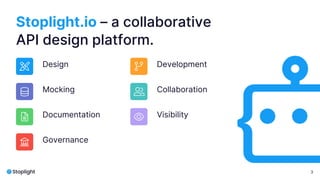
Stoplight.io – a collaborative
API design platform.
Design
Mocking
Documentation
Governance
Visibility
Collaboration
Development
4
Understanding the
Business Value of APIs
5
“
Why should leaders care about APIs?
“Over a four-year period that firms
using APIs saw 12.7% more growth in
market capitalization compared to those
that did not adopt APIs” (+38% growth
over a 16-year period)
Marshall Van Alstyne, Forbes (2021)
6
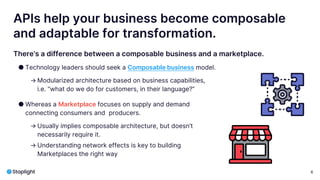
APIs help your business become composable
and adaptable for transformation.
There’s a difference between a composable business and a marketplace.
● Technology leaders should seek a Composable business model.
→ Modularized architecture based on business capabilities,
i.e. “what do we do for customers, in their language?”
● Whereas a Marketplace focuses on supply and demand
connecting consumers and producers.
→ Usually implies composable architecture, but doesn’t
necessarily require it.
→ Understanding network effects is key to building
Marketplaces the right way
7
Okay, so APIs
are important.
But how should
we treat them?
8
Your API
is just another
product…
Let’s discuss
how to treat them
as such.
9
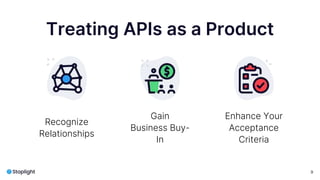
Treating APIs as a Product
Recognize
Relationships
Gain
Business Buy-
In
Enhance Your
Acceptance
Criteria
10
Recognize Relationships
11
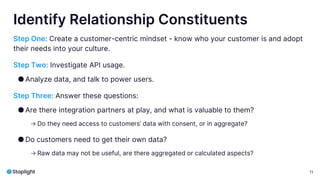
Identify Relationship Constituents
Step One: Create a customer-centric mindset - know who your customer is and adopt
their needs into your culture.
Step Two: Investigate API usage.
● Analyze data, and talk to power users.
Step Three: Answer these questions:
● Are there integration partners at play, and what is valuable to them?
→ Do they need access to customers’ data with consent, or in aggregate?
● Do customers need to get their own data?
→ Raw data may not be useful, are there aggregated or calculated aspects?
“
12
Product Managers: Know who the consumer will be
and the business relationship that you will be building.
If you understand how you're operating your
business, with adequate success measures, you’re
on your way to building a great API.
13
One relationship type at a time.
Don’t boil the ocean.
14
Gain Executive Buy-In
15
“
“An API is no different than
an other product.
You need to help traditional
business management into
understanding the relevance
behind the API program.”
16
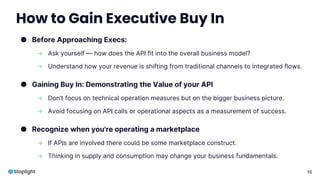
How to Gain Executive Buy In
● Before Approaching Execs:
→ Ask yourself — how does the API fit into the overall business model?
→ Understand how your revenue is shifting from traditional channels to integrated flows.
● Gaining Buy In: Demonstrating the Value of your API
→ Don’t focus on technical operation measures but on the bigger business picture.
→ Avoid focusing on API calls or operational aspects as a measurement of success.
● Recognize when you're operating a marketplace
→ If APIs are involved there could be some marketplace construct.
→ Thinking in supply and consumption may change your business fundamentals.
17
And most importantly…
18
“
“If you’re not putting the
business perspective around
why you're building APIs, it's
really easy to kill it from a
management POV."
19
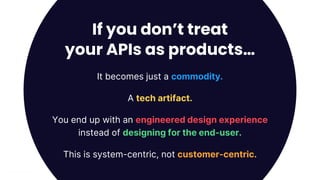
If you don’t treat
your APIs as products…
It becomes just a commodity.
A tech artifact.
You end up with an engineered design experience
instead of designing for the end-user.
This is system-centric, not customer-centric.
20
Enhance Your
Acceptance Criteria
21
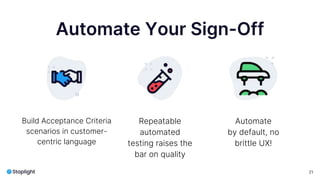
Automate Your Sign-Off
Build Acceptance Criteria
scenarios in customer-
centric language
Repeatable
automated
testing raises the
bar on quality
Automate
by default, no
brittle UX!
22
Bonus Tip:
API Products are
Better with Great
Documentation
23
“In API Product Management, documentation
is a critical and expected part of the delivery.
Developers must understand how to use the
API, what data or functionality it provides, and
how to integrate it with their systems. This
documentation often "sells" a developer on a
given offering. Because of that,
documentation has greater importance to API
product management.”
- Matthew Reinbold, Net API Notes
24
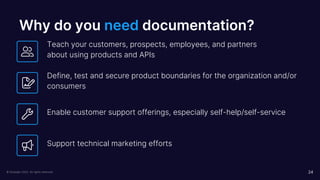
Define, test and secure product boundaries for the organization and/or
consumers
Why do you need documentation?
© Stoplight 2023. All rights reserved.
Teach your customers, prospects, employees, and partners
about using products and APIs
Enable customer support offerings, especially self-help/self-service
Support technical marketing efforts
25
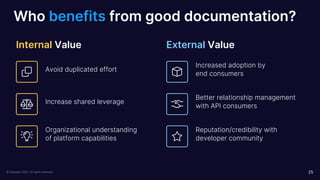
Who benefits from good documentation?
© Stoplight 2023. All rights reserved.
Internal Value External Value
Avoid duplicated effort
Increase shared leverage
Organizational understanding
of platform capabilities
Increased adoption by
end consumers
Better relationship management
with API consumers
Reputation/credibility with
developer community
26
https://www.apisecuniversity.com/courses/api-documentation-best-practices
27
For more tips and tricks
on the API space…
28
Check out Stoplight’s
API Intersection Podcast
The podcast on the intersection between
API design and digital transformation.
Available Wherever You Listen to Podcasts
29
Questions?

API-as-a-product: The Key to a Successful API Program

  • 1.
    Why You Should TreatAPIs as Products Tips for a Successful API Program Jason Harmon – CTO @ Stoplight
  • 2.
    2 Jason Harmon Chief TechnologyOfficer, Stoplight Engineering, Product, Security, IT Host of #APIIntersection Podcast Background: ● Previously: → Senior Director of Platform Architecture @Expedia Group → Chief Platform Officer and CTO at @Typeform → Head of API Design @Paypal → API Architect @uShip ● Co-founded Austin API Meetup ● Founding member of OpenAPI Initiative (inactive) ● Founding member of RAML Working Group (inactive)
  • 3.
    3 Stoplight.io – acollaborative API design platform. Design Mocking Documentation Governance Visibility Collaboration Development
  • 4.
  • 5.
    5 “ Why should leaderscare about APIs? “Over a four-year period that firms using APIs saw 12.7% more growth in market capitalization compared to those that did not adopt APIs” (+38% growth over a 16-year period) Marshall Van Alstyne, Forbes (2021)
  • 6.
    6 APIs help yourbusiness become composable and adaptable for transformation. There’s a difference between a composable business and a marketplace. ● Technology leaders should seek a Composable business model. → Modularized architecture based on business capabilities, i.e. “what do we do for customers, in their language?” ● Whereas a Marketplace focuses on supply and demand connecting consumers and producers. → Usually implies composable architecture, but doesn’t necessarily require it. → Understanding network effects is key to building Marketplaces the right way
  • 7.
    7 Okay, so APIs areimportant. But how should we treat them?
  • 8.
    8 Your API is justanother product… Let’s discuss how to treat them as such.
  • 9.
    9 Treating APIs asa Product Recognize Relationships Gain Business Buy- In Enhance Your Acceptance Criteria
  • 10.
  • 11.
    11 Identify Relationship Constituents StepOne: Create a customer-centric mindset - know who your customer is and adopt their needs into your culture. Step Two: Investigate API usage. ● Analyze data, and talk to power users. Step Three: Answer these questions: ● Are there integration partners at play, and what is valuable to them? → Do they need access to customers’ data with consent, or in aggregate? ● Do customers need to get their own data? → Raw data may not be useful, are there aggregated or calculated aspects?
  • 12.
    “ 12 Product Managers: Knowwho the consumer will be and the business relationship that you will be building. If you understand how you're operating your business, with adequate success measures, you’re on your way to building a great API.
  • 13.
    13 One relationship typeat a time. Don’t boil the ocean.
  • 14.
  • 15.
    15 “ “An API isno different than an other product. You need to help traditional business management into understanding the relevance behind the API program.”
  • 16.
    16 How to GainExecutive Buy In ● Before Approaching Execs: → Ask yourself — how does the API fit into the overall business model? → Understand how your revenue is shifting from traditional channels to integrated flows. ● Gaining Buy In: Demonstrating the Value of your API → Don’t focus on technical operation measures but on the bigger business picture. → Avoid focusing on API calls or operational aspects as a measurement of success. ● Recognize when you're operating a marketplace → If APIs are involved there could be some marketplace construct. → Thinking in supply and consumption may change your business fundamentals.
  • 17.
  • 18.
    18 “ “If you’re notputting the business perspective around why you're building APIs, it's really easy to kill it from a management POV."
  • 19.
    19 If you don’ttreat your APIs as products… It becomes just a commodity. A tech artifact. You end up with an engineered design experience instead of designing for the end-user. This is system-centric, not customer-centric.
  • 20.
  • 21.
    21 Automate Your Sign-Off BuildAcceptance Criteria scenarios in customer- centric language Repeatable automated testing raises the bar on quality Automate by default, no brittle UX!
  • 22.
    22 Bonus Tip: API Productsare Better with Great Documentation
  • 23.
    23 “In API ProductManagement, documentation is a critical and expected part of the delivery. Developers must understand how to use the API, what data or functionality it provides, and how to integrate it with their systems. This documentation often "sells" a developer on a given offering. Because of that, documentation has greater importance to API product management.” - Matthew Reinbold, Net API Notes
  • 24.
    24 Define, test andsecure product boundaries for the organization and/or consumers Why do you need documentation? © Stoplight 2023. All rights reserved. Teach your customers, prospects, employees, and partners about using products and APIs Enable customer support offerings, especially self-help/self-service Support technical marketing efforts
  • 25.
    25 Who benefits fromgood documentation? © Stoplight 2023. All rights reserved. Internal Value External Value Avoid duplicated effort Increase shared leverage Organizational understanding of platform capabilities Increased adoption by end consumers Better relationship management with API consumers Reputation/credibility with developer community
  • 26.
  • 27.
    27 For more tipsand tricks on the API space…
  • 28.
    28 Check out Stoplight’s APIIntersection Podcast The podcast on the intersection between API design and digital transformation. Available Wherever You Listen to Podcasts
  • 29.

Editor's Notes

  • #6 Hard research
  • #7 Resources: https://quixy.com/blog/composable-business-101-everything-you-need-to-know/ https://ewave.com/composable-commerce
  • #9 Explain why it’s a product- no different than any other product -> bring in traditional business management into understanding the relevance behind the API program
  • #12 API Business Models: 20 Models in 30 Minutes - John Musser, API Science
  • #14 Don’t try to build a customer API while building multiple types of Partner APIs, everything will be mixed up
  • #17 Business leader buy in- the API fits into the overall business model, executive buy in is important. If you're integrating into existing assumptions, realize that and take a closer look at how your revenue is shifting from traditional sources into API sourced revenue, good way to build that justification.
  • #22 Cucumber scenarios; don’t get sucked into technical testing; reduce your technical barriers Don’t release bugs to production; and never more than once
  • #25 Teach customers, prospects, employees, and partners about products and APIs Define product boundaries for customer support Enable customer support offerings, especially self-help/self-service Support technical marketing efforts
  • #26 Teach customers, prospects, employees, and partners about products and APIs Define product boundaries for customer support Enable customer support offerings, especially self-help/self-service Support technical marketing efforts
  • #29 We’ve learned many things from interacting with API experts on our podcast.