



SOURCES OF
FINANCE
&
INTERNATIONAL
SOURCES
PRESENTED BY-
NITUL SARAWAGI
SOURCES
OF
FINANCE
LEASING
A lease is a legal document outlining
the terms under which one party
agrees to rent property from another
party. A lease guarantees
the lessee (the renter) use of an asset
and guarantees the lessor (the
property owner) regular payments
from the lessee for a specified number
of months or years.
Both the lessee and the lessor must
uphold the terms of the contract for
the lease to remain valid.
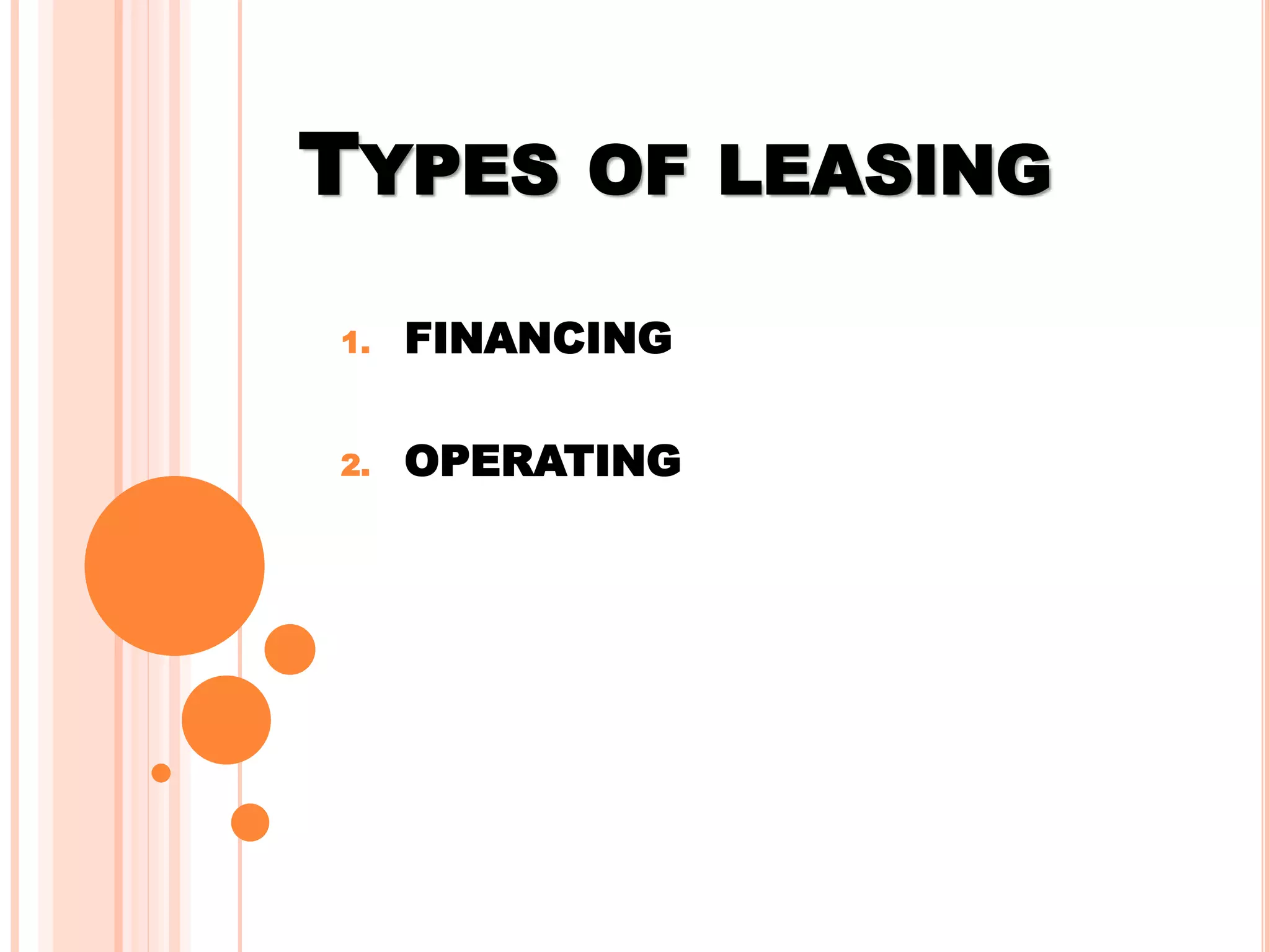
TYPES OF LEASING
1. FINANCING
2. OPERATING
VENTURE CAPITAL
Venture capital is money provided by
investors to startup firms and small
businesses with perceived long-term
growth potential.
This is a very important source of
funding for startups that do not have
access to capital markets.
It typically entails high risk for the
investor, but it has the potential for
above-average returns.
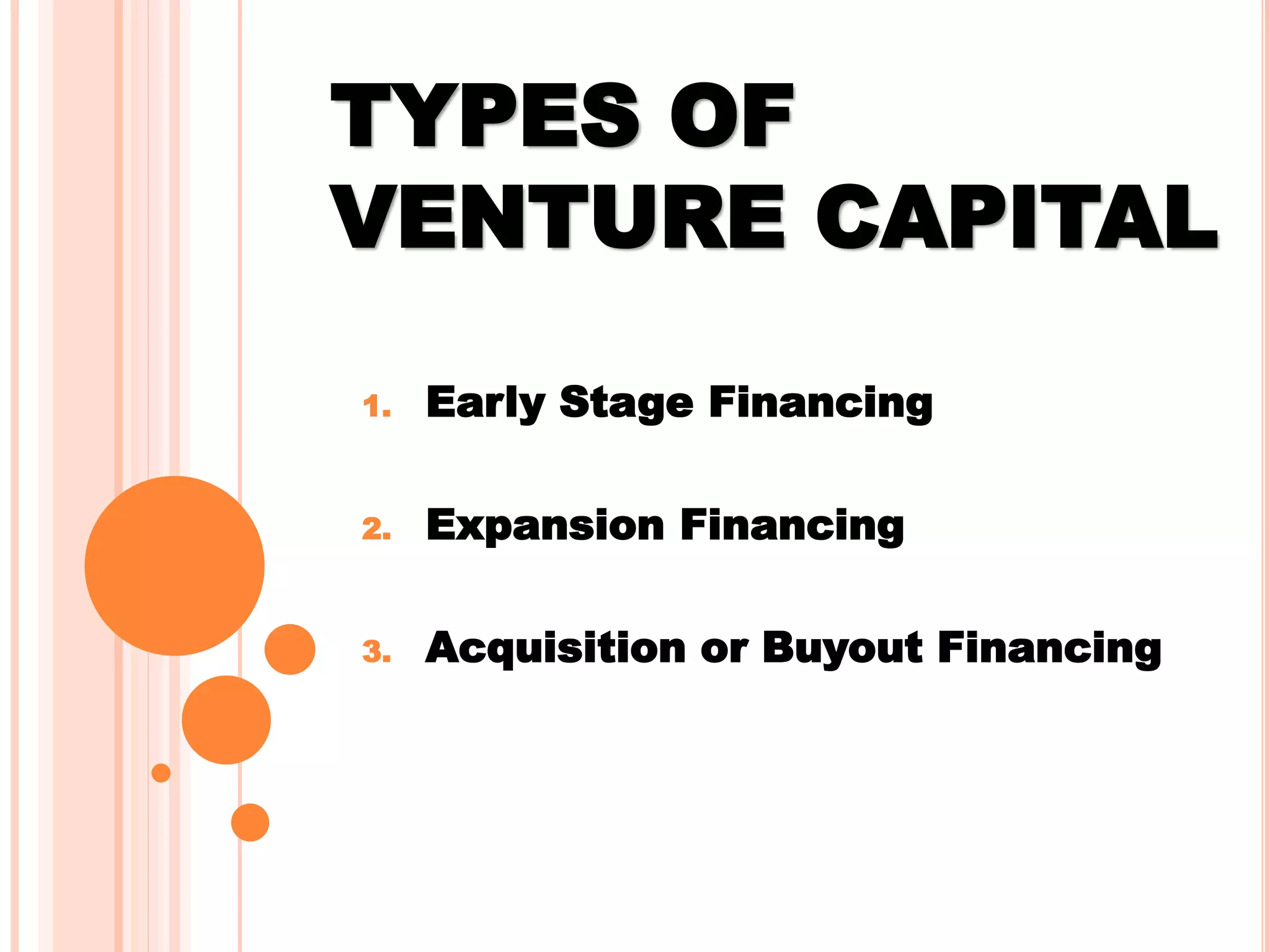
TYPES OF
VENTURE CAPITAL
1. Early Stage Financing
2. Expansion Financing
3. Acquisition or Buyout Financing
FACTORING
Factoring is a financial
transaction and a type of debtor
finance in which a
business sells its accounts
receivable (i.e., invoices) to a third
party (called a factor) at a discount.
A business will sometimes factor its
receivable assets to meet its present
and immediate cash needs.
Forfaiting is a factoring arrangement
used in international trade
finance by exporters who wish to sell
their receivables to a forfaiter.
EXIM BANK
Export-Import Bank of India is the
premier export finance institution of
the country.
It commenced operations in 1982
under the Export-Import Bank of
India Act 1981.
Government of India launched the
institution with a mandate to not just
enhance exports from India, but also
to integrate the country’s foreign
trade and investment with the overall
economic growth.
FUNCTIONS OF
EXIM BANK
(i) It provides direct financial assistance to
exporters of plant, machinery and related
service in the form of medium-term credit.
(ii) Underwriting the issue of shares, stocks,
bonds, debentures of any company engaged in
exports.
(iii) The bank gives overseas buyers credit to
foreign importers for import of Indian capital
goods and related services.
(iv) Developing and financing export oriented
industries.
(v) Collecting and compiling the market and
credit information about foreign trade.
HIRE PURCHASE &
INSTALLMENT CREDIT
Hire purchase is a method of
financing of the fixed asset to be
purchased on future date.
Under this method of financing, the
purchase price is paid in installments.
Ownership of the asset is transferred
after the payment of the last
installment.
Installment credit is a type
of credit that has a fixed number of
payments, in contrast to revolving
credit.
INTERNATIONAL
SOURCES
FDI
A foreign direct investment (FDI) is
an investment made by a company
or entity based in one country, into
a company or entity based in
another country.
Foreign direct investments differ
substantially from indirect
investments such as portfolio
flows, wherein overseas
institutions invest in equities listed
on a nation's stock exchange.
FII
A foreign institutional investor (FII) is
an investor or investment fund that is
from or registered in a country outside
of the one in which it is currently
investing.
Institutional investors include hedge
funds, insurance companies, pension
funds and mutual funds.
ADR
An American depositary receipt
(ADR) is a negotiable certificate
issued by a U.S. bank representing
a specified number of shares (or
one share) in a foreign stock that is
traded on a U.S. exchange.
ADRs are denominated in U.S.
dollars, with the underlying
security held by a U.S. financial
institution overseas. ADRs help to
reduce administration and duty
costs that would otherwise be
levied on each transaction.
GDR
A global depositary receipt (GDR) is
a bank certificate issued in more
than one country for shares in a
foreign company.
The shares are held by a foreign
branch of an international bank.
The shares trade as domestic
shares, but are offered for sale
globally through the various bank
branches.
THANK YOU

Source of finance and international sources

  • 1.
  • 2.
  • 3.
    LEASING A lease isa legal document outlining the terms under which one party agrees to rent property from another party. A lease guarantees the lessee (the renter) use of an asset and guarantees the lessor (the property owner) regular payments from the lessee for a specified number of months or years. Both the lessee and the lessor must uphold the terms of the contract for the lease to remain valid.
  • 4.
    TYPES OF LEASING 1.FINANCING 2. OPERATING
  • 5.
    VENTURE CAPITAL Venture capitalis money provided by investors to startup firms and small businesses with perceived long-term growth potential. This is a very important source of funding for startups that do not have access to capital markets. It typically entails high risk for the investor, but it has the potential for above-average returns.
  • 6.
    TYPES OF VENTURE CAPITAL 1.Early Stage Financing 2. Expansion Financing 3. Acquisition or Buyout Financing
  • 7.
    FACTORING Factoring is afinancial transaction and a type of debtor finance in which a business sells its accounts receivable (i.e., invoices) to a third party (called a factor) at a discount. A business will sometimes factor its receivable assets to meet its present and immediate cash needs. Forfaiting is a factoring arrangement used in international trade finance by exporters who wish to sell their receivables to a forfaiter.
  • 8.
    EXIM BANK Export-Import Bankof India is the premier export finance institution of the country. It commenced operations in 1982 under the Export-Import Bank of India Act 1981. Government of India launched the institution with a mandate to not just enhance exports from India, but also to integrate the country’s foreign trade and investment with the overall economic growth.
  • 9.
    FUNCTIONS OF EXIM BANK (i)It provides direct financial assistance to exporters of plant, machinery and related service in the form of medium-term credit. (ii) Underwriting the issue of shares, stocks, bonds, debentures of any company engaged in exports. (iii) The bank gives overseas buyers credit to foreign importers for import of Indian capital goods and related services. (iv) Developing and financing export oriented industries. (v) Collecting and compiling the market and credit information about foreign trade.
  • 10.
    HIRE PURCHASE & INSTALLMENTCREDIT Hire purchase is a method of financing of the fixed asset to be purchased on future date. Under this method of financing, the purchase price is paid in installments. Ownership of the asset is transferred after the payment of the last installment. Installment credit is a type of credit that has a fixed number of payments, in contrast to revolving credit.
  • 11.
  • 12.
    FDI A foreign directinvestment (FDI) is an investment made by a company or entity based in one country, into a company or entity based in another country. Foreign direct investments differ substantially from indirect investments such as portfolio flows, wherein overseas institutions invest in equities listed on a nation's stock exchange.
  • 13.
    FII A foreign institutionalinvestor (FII) is an investor or investment fund that is from or registered in a country outside of the one in which it is currently investing. Institutional investors include hedge funds, insurance companies, pension funds and mutual funds.
  • 14.
    ADR An American depositaryreceipt (ADR) is a negotiable certificate issued by a U.S. bank representing a specified number of shares (or one share) in a foreign stock that is traded on a U.S. exchange. ADRs are denominated in U.S. dollars, with the underlying security held by a U.S. financial institution overseas. ADRs help to reduce administration and duty costs that would otherwise be levied on each transaction.
  • 15.
    GDR A global depositaryreceipt (GDR) is a bank certificate issued in more than one country for shares in a foreign company. The shares are held by a foreign branch of an international bank. The shares trade as domestic shares, but are offered for sale globally through the various bank branches.
  • 16.