REST without PUT
REST
REST stands for Representational State Transfer. (It
is sometimes spelled "ReST".) It relies on a
stateless, client-server, cacheable
communications protocol
Resource
“The key abstraction of information in REST is a resource.
Any information that can be named can be a resource: a
document or image, a temporal service (e.g. "today's
weather in Los Angeles"), a collection of other resources,
a non-virtual object (e.g. a person), and so on. In other
words, any concept that might be the target of an author's
hypertext reference must fit within the definition of a
resource. A resource is a conceptual mapping to a set of
entities, not the entity that corresponds to the mapping at
any particular point in time.”
- Roy Fielding’s dissertation.
Resource
• Examples:
• in a blog domain
• post, comment, image, tag
• in a bank domain
• customer, account
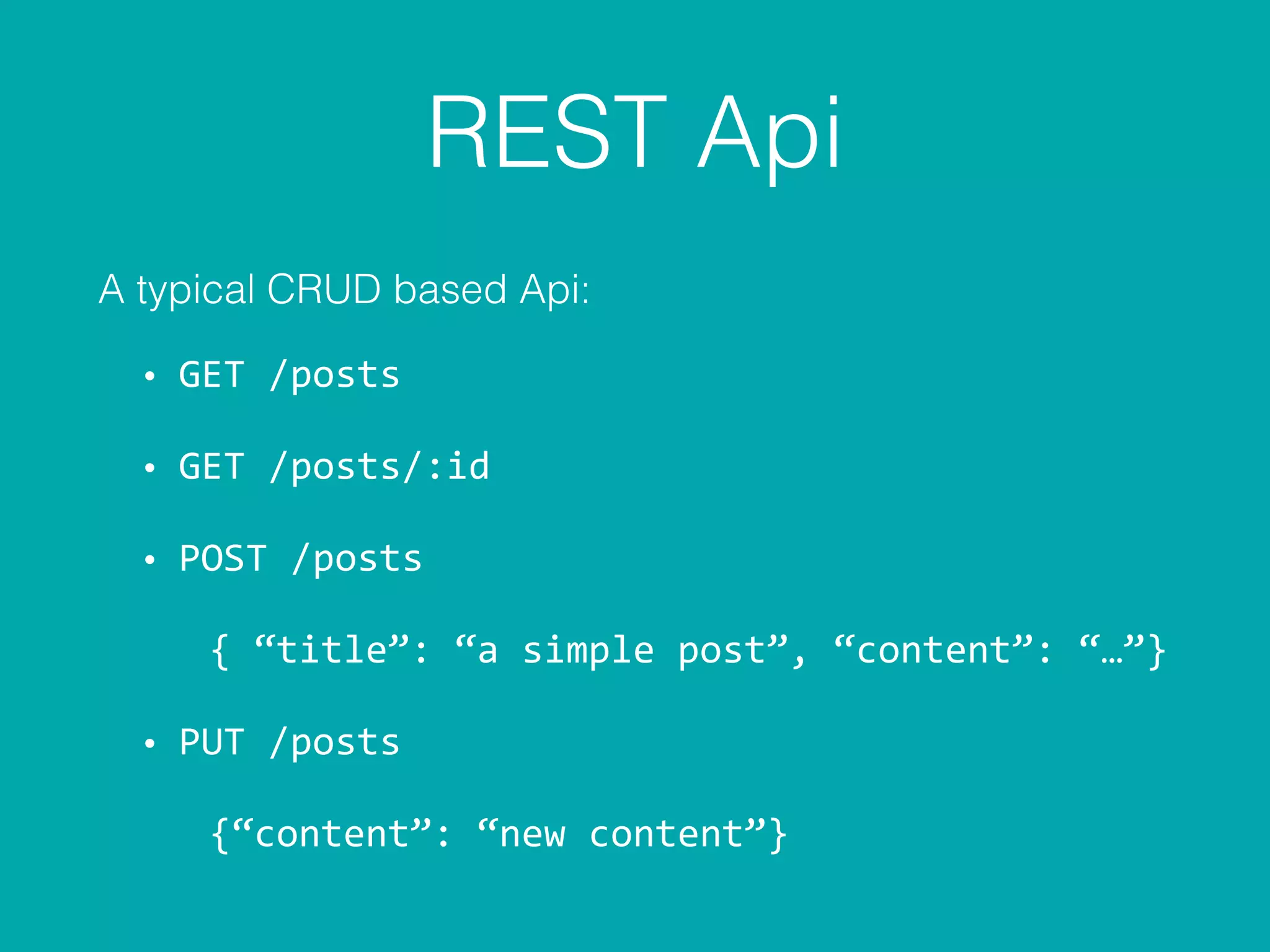
REST Api
A typical CRUD based Api:
• GET	
  /posts	
  
• GET	
  /posts/:id	
  
• POST	
  /posts	


  {	
  “title”:	
  “a	
  simple	
  post”,	
  “content”:	
  “…”}	
  
• PUT	
  /posts	


  {“content”:	
  “new	
  content”}
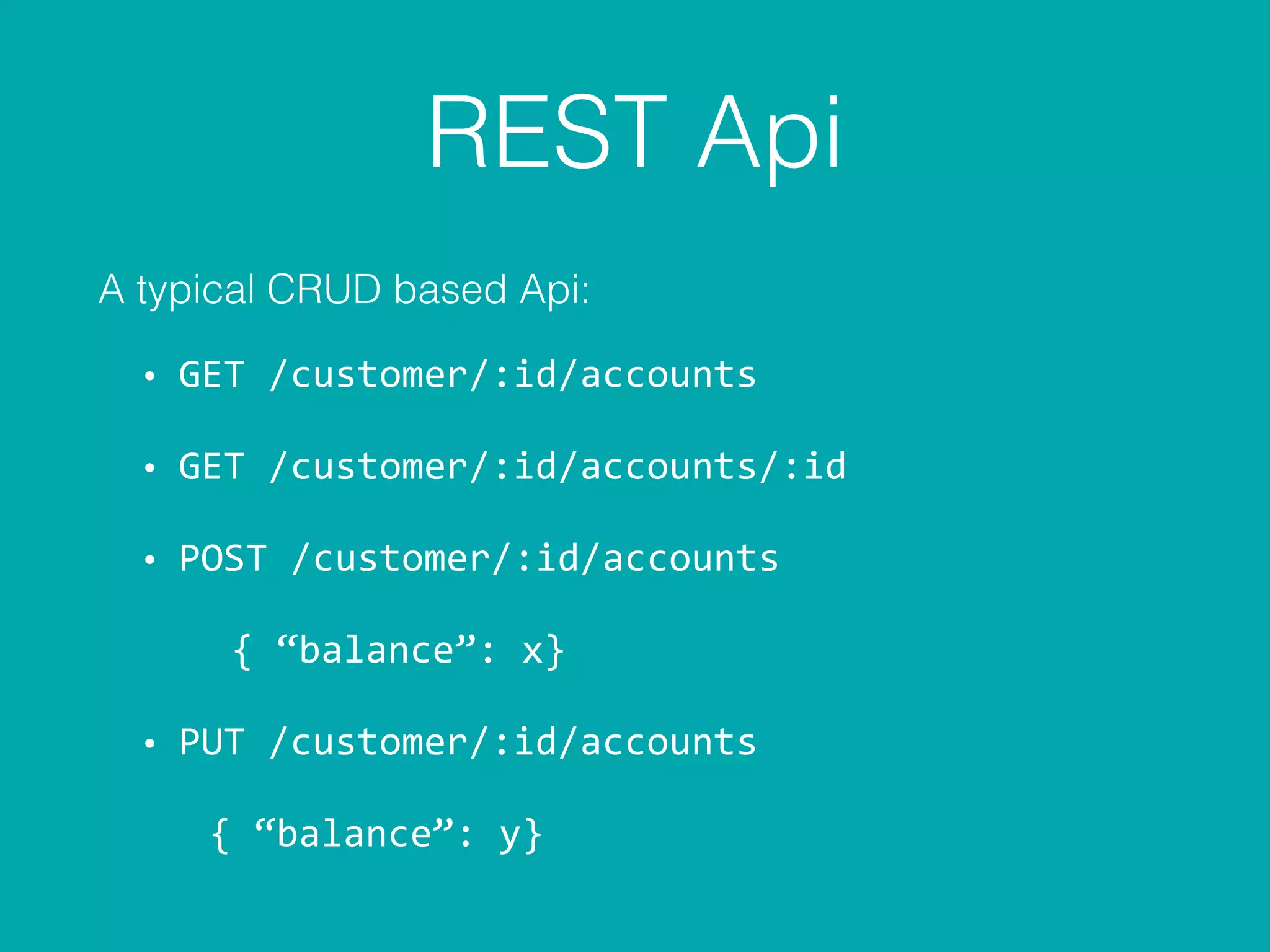
REST Api
A typical CRUD based Api:
• GET	
  /customer/:id/accounts	
  
• GET	
  /customer/:id/accounts/:id	
  
• POST	
  /customer/:id/accounts	


  {	
  “balance”:	
  x}	
  
• PUT	
  /customer/:id/accounts	


  {	
  “balance”:	
  y}
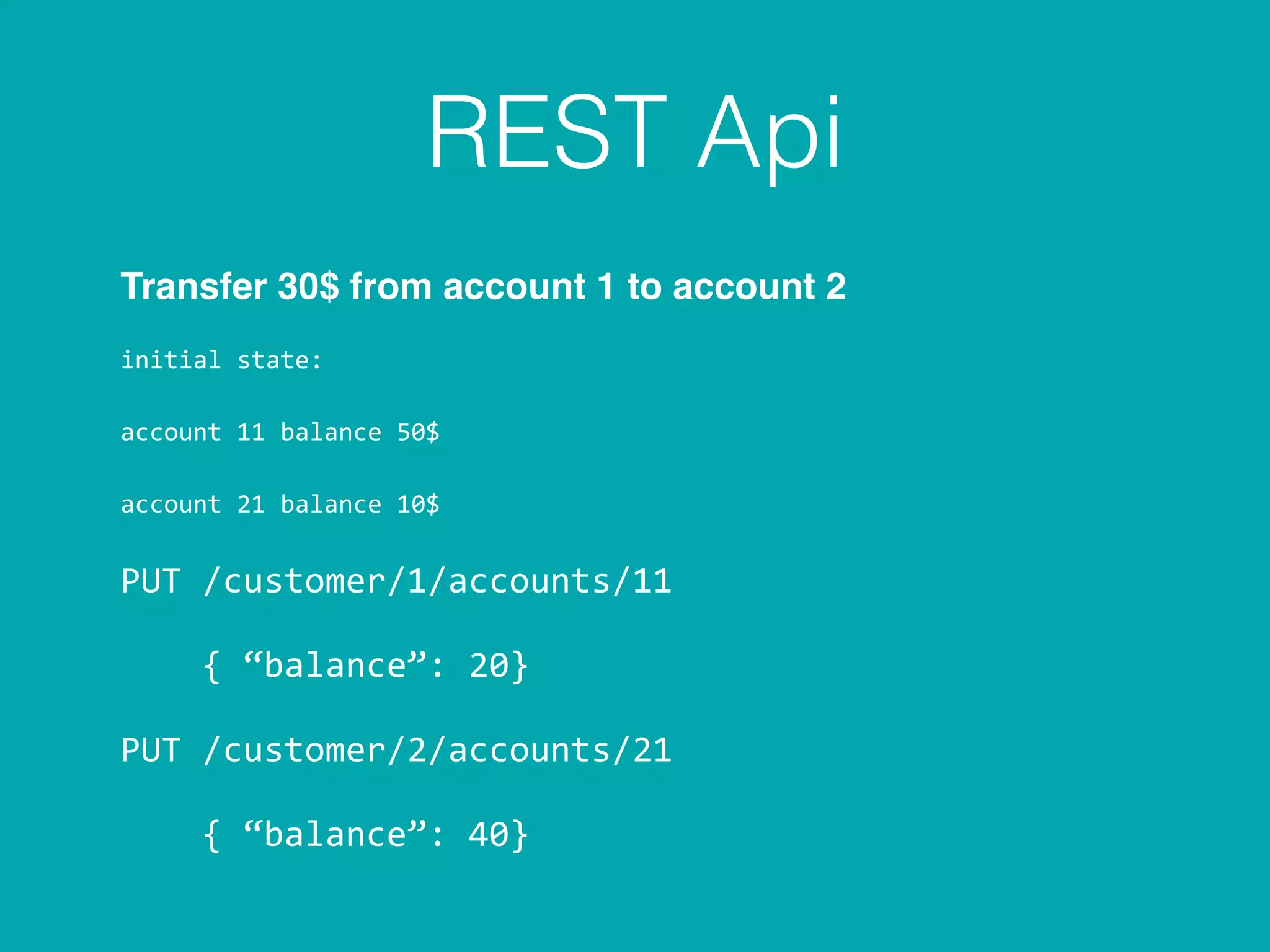
REST Api
Transfer 30$ from account 1 to account 2
initial	
  state:	
  
account	
  11	
  balance	
  50$	
  
account	
  21	
  balance	
  10$	
  
PUT	
  /customer/1/accounts/11	


  {	
  “balance”:	
  20}	
  
PUT	
  /customer/2/accounts/21	


  {	
  “balance”:	
  40}
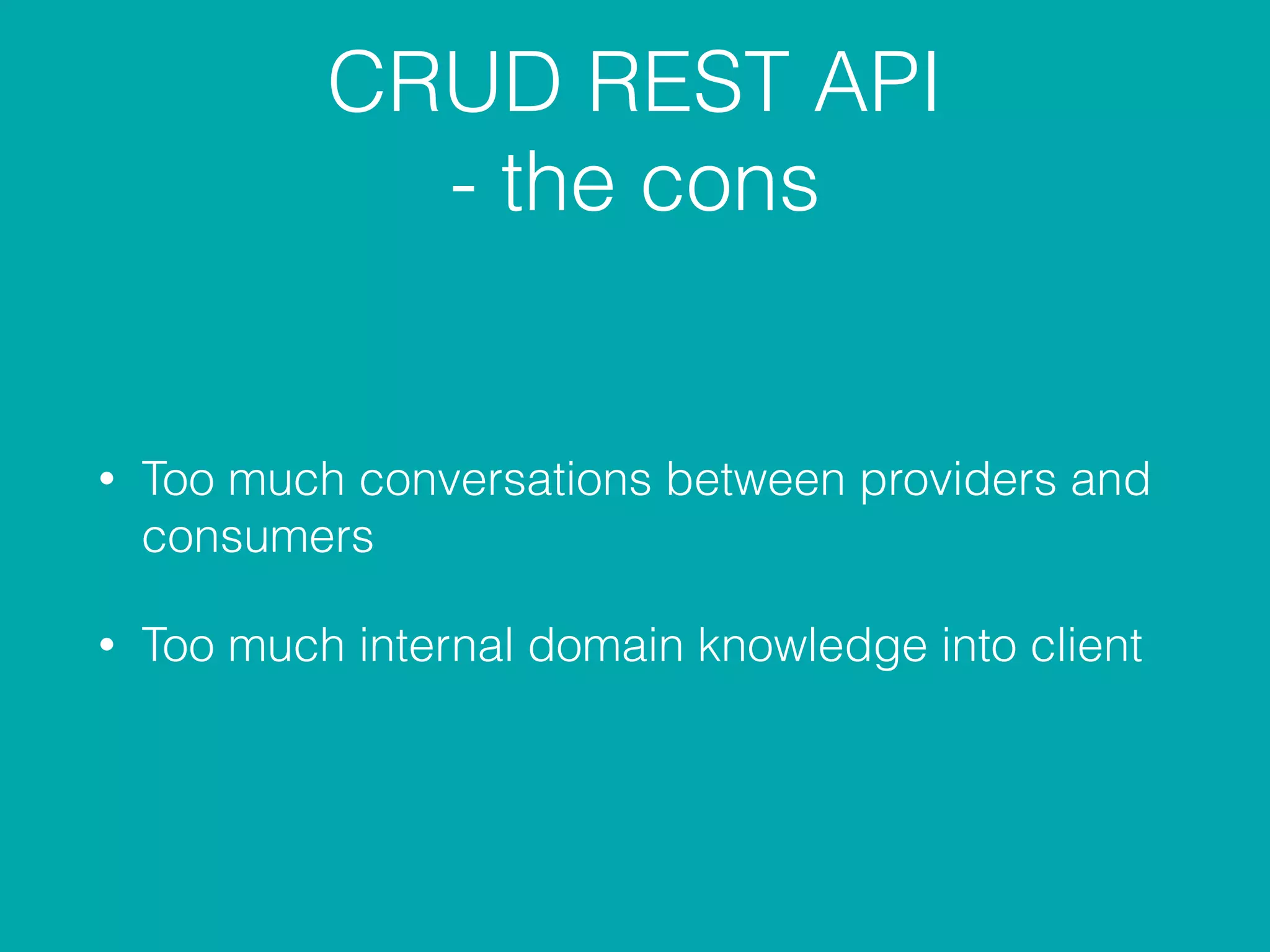
CRUD REST API
- the cons
• Too much conversations between providers and
consumers
• Too much internal domain knowledge into client
problem of PUT
• complex state transitions can lead to
synchronous cruddy CRUD
• usually throws away a lot of information that was
available at the time the update was triggered
Resource(revisit)
any concept that might be the target of an author's
hypertext reference must fit within the definition of
a resource
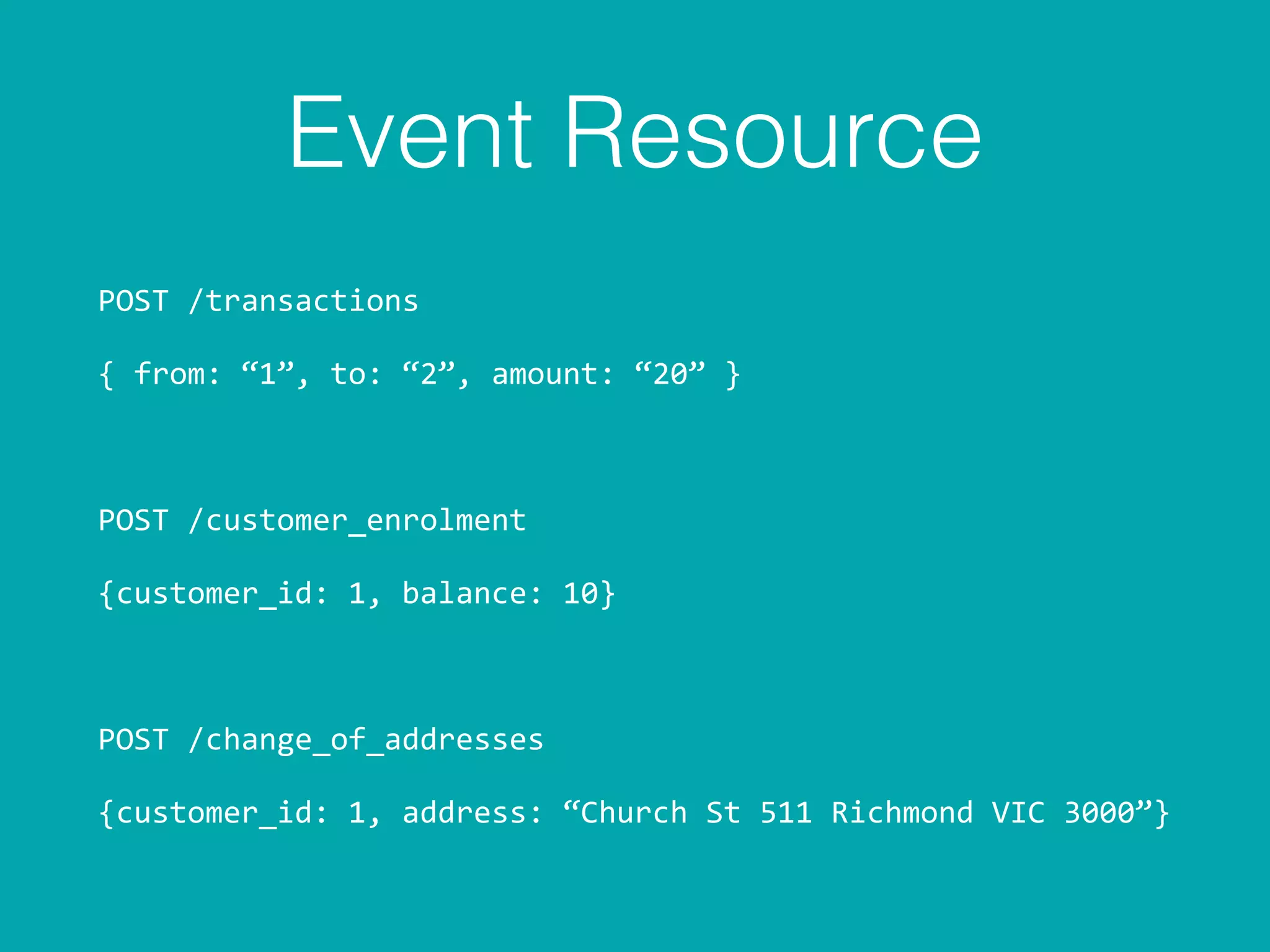
Event Resource
POST	
  /transactions	
  
{	
  from:	
  “1”,	
  to:	
  “2”,	
  amount:	
  “20”	
  }	
  
POST	
  /customer_enrolment	
  
{customer_id:	
  1,	
  balance:	
  10}	
  
POST	
  /change_of_addresses	
  
{customer_id:	
  1,	
  address:	
  “Church	
  St	
  511	
  Richmond	
  VIC	
  3000”}
REST without PUT
• consumers are forced to post new 'nounified'
request resources
• make our mutations be first class citizen nouns
Coarse grained resource API
- the pros
• fits perfectly with event sourcing
• CQRS api
• Reification of abstract concept
Coarse grained resource API
- the cons
• not enough variations to support all API
consumers
• the API may be difficult to maintain
key tips
• Granularity of resource
• There’s no hard dependency between Resource
and Domain model
• Domain driven design applies to the
implementation side of things (including API
implementation)
• Resources in REST API drive the API design and
contract.
References
• http://www.thoughtworks.com/insights/blog/rest-
api-design-resource-modeling
• http://engineering.linkedin.com/distributed-
systems/log-what-every-software-engineer-should-
know-about-real-time-datas-unifying
• http://martinfowler.com/eaaDev/
EventSourcing.html
• http://martinfowler.com/bliki/CQRS.html

rest without put

  • 1.
  • 2.
    REST REST stands forRepresentational State Transfer. (It is sometimes spelled "ReST".) It relies on a stateless, client-server, cacheable communications protocol
  • 3.
    Resource “The key abstractionof information in REST is a resource. Any information that can be named can be a resource: a document or image, a temporal service (e.g. "today's weather in Los Angeles"), a collection of other resources, a non-virtual object (e.g. a person), and so on. In other words, any concept that might be the target of an author's hypertext reference must fit within the definition of a resource. A resource is a conceptual mapping to a set of entities, not the entity that corresponds to the mapping at any particular point in time.” - Roy Fielding’s dissertation.
  • 4.
    Resource • Examples: • ina blog domain • post, comment, image, tag • in a bank domain • customer, account
  • 5.
    REST Api A typicalCRUD based Api: • GET  /posts   • GET  /posts/:id   • POST  /posts            {  “title”:  “a  simple  post”,  “content”:  “…”}   • PUT  /posts          {“content”:  “new  content”}
  • 6.
    REST Api A typicalCRUD based Api: • GET  /customer/:id/accounts   • GET  /customer/:id/accounts/:id   • POST  /customer/:id/accounts            {  “balance”:  x}   • PUT  /customer/:id/accounts          {  “balance”:  y}
  • 7.
    REST Api Transfer 30$from account 1 to account 2 initial  state:   account  11  balance  50$   account  21  balance  10$   PUT  /customer/1/accounts/11          {  “balance”:  20}   PUT  /customer/2/accounts/21          {  “balance”:  40}
  • 8.
    CRUD REST API -the cons • Too much conversations between providers and consumers • Too much internal domain knowledge into client
  • 9.
    problem of PUT •complex state transitions can lead to synchronous cruddy CRUD • usually throws away a lot of information that was available at the time the update was triggered
  • 10.
    Resource(revisit) any concept thatmight be the target of an author's hypertext reference must fit within the definition of a resource
  • 11.
    Event Resource POST  /transactions   {  from:  “1”,  to:  “2”,  amount:  “20”  }   POST  /customer_enrolment   {customer_id:  1,  balance:  10}   POST  /change_of_addresses   {customer_id:  1,  address:  “Church  St  511  Richmond  VIC  3000”}
  • 12.
    REST without PUT •consumers are forced to post new 'nounified' request resources • make our mutations be first class citizen nouns
  • 13.
    Coarse grained resourceAPI - the pros • fits perfectly with event sourcing • CQRS api • Reification of abstract concept
  • 14.
    Coarse grained resourceAPI - the cons • not enough variations to support all API consumers • the API may be difficult to maintain
  • 15.
    key tips • Granularityof resource • There’s no hard dependency between Resource and Domain model • Domain driven design applies to the implementation side of things (including API implementation) • Resources in REST API drive the API design and contract.
  • 16.