Personality Profiles
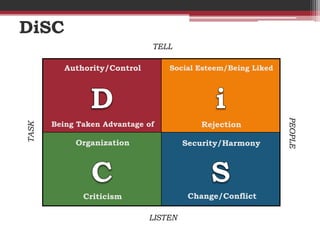
DiSC
                              TELL

          Authority/Control       Social Esteem/Being Liked


                                                              PEOPLE
       Being Taken Advantage of           Rejection
TASK


            Organization               Security/Harmony


              Criticism                 Change/Conflict

                              LISTEN
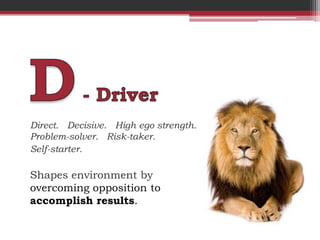
Direct. Decisive. High ego strength.
Problem-solver. Risk-taker.
Self-starter.

Shapes environment by
overcoming opposition to
accomplish results.
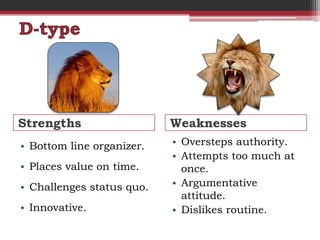
Strengths                  Weaknesses
• Bottom line organizer.   • Oversteps authority.
                           • Attempts too much at
• Places value on time.      once.
• Challenges status quo.   • Argumentative
                             attitude.
• Innovative.              • Dislikes routine.
Motivators
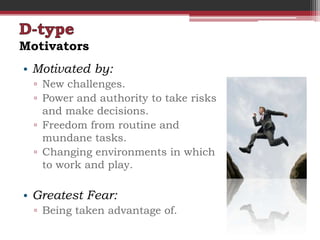
• Motivated by:
  ▫ New challenges.
  ▫ Power and authority to take risks
    and make decisions.
  ▫ Freedom from routine and
    mundane tasks.
  ▫ Changing environments in which
    to work and play.

• Greatest Fear:
  ▫ Being taken advantage of.
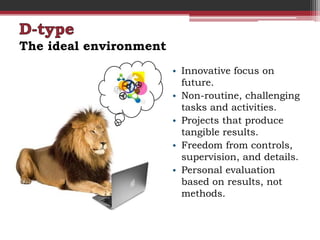
The ideal environment
                        • Innovative focus on
                          future.
                        • Non-routine, challenging
                          tasks and activities.
                        • Projects that produce
                          tangible results.
                        • Freedom from controls,
                          supervision, and details.
                        • Personal evaluation
                          based on results, not
                          methods.
Data handling

While analyzing information a D-type may:
  − Ignore potential risks.
  − Not weigh pros and cons.
  − Not consider the opinions of others.
  + Offer innovative and progressive systems and
    ideas.
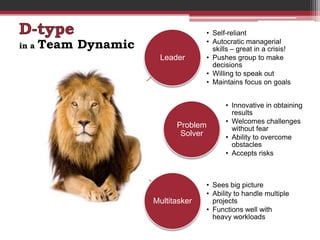
• Self-reliant
in a   Team Dynamic                 • Autocratic managerial
                                      skills – great in a crisis!
                       Leader       • Pushes group to make
                                      decisions
                                    • Willing to speak out
                                    • Maintains focus on goals


                                          • Innovative in obtaining
                                            results
                                          • Welcomes challenges
                            Problem         without fear
                             Solver       • Ability to overcome
                                            obstacles
                                          • Accepts risks


                                    • Sees big picture
                                    • Ability to handle multiple
                      Multitasker     projects
                                    • Functions well with
                                      heavy workloads
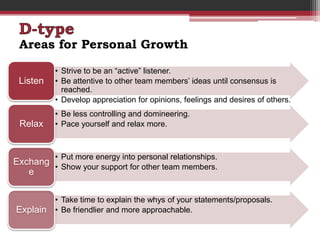
Areas for Personal Growth

          • Strive to be an “active” listener.
 Listen   • Be attentive to other team members’ ideas until consensus is
            reached.
          • Develop appreciation for opinions, feelings and desires of others.
          • Be less controlling and domineering.
 Relax    • Pace yourself and relax more.


          • Put more energy into personal relationships.
Exchang
        • Show your support for other team members.
   e

          • Take time to explain the whys of your statements/proposals.
Explain   • Be friendlier and more approachable.
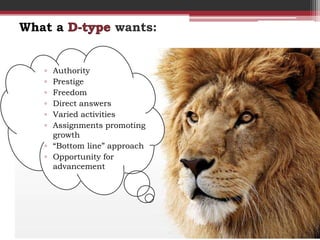
What a             wants:


   ▫ Authority
   ▫ Prestige
   ▫ Freedom
   ▫ Direct answers
   ▫ Varied activities
   ▫ Assignments promoting
     growth
   ▫ “Bottom line” approach
   ▫ Opportunity for
     advancement
Interacting with a


Do:                  • Be brief, direct, to the
                       point.
                     • Ask what, not how
                       questions.
                     • Focus on business:
                       remember D-types desire
                       results.
                     • Suggest ways to achieve
                       results, lead, solve
                       problems.
                     • Highlight logical benefits
                       of featured ideas and
                       approaches.
Interacting with a


                     • Ramble.
                     • Repeat yourself.
                     • Focus only on
                       problems.
                     • Be too sociable.
                     • Make generalizations.
                     • Make statements
                       without support.


Don’t:
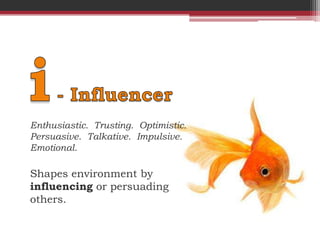
Enthusiastic. Trusting. Optimistic.
Persuasive. Talkative. Impulsive.
Emotional.

Shapes environment by
influencing or persuading
others.
Good
                   morning,
                   sunshine
                       !


Strengths                     Weaknesses
• Creative problem solver.    • More concerned with
• Great encourager.             popularity than tangible
• Motivates others to           results.
  achieve.                    • Inattentive to detail.
• Positive sense of humor.    • Overuses gestures and
                                facial expressions.
• Negotiates conflicts.
                              • Tends to listen only when it
• Peacemaker.                   is convenient.
Motivators
• Motivated by:
  ▫ Flattery, praise, popularity and
    acceptance.
  ▫ A friendly environment.
  ▫ Freedom from many rules and
    regulations.
  ▫ Other people available to handle
    details.

• Greatest Fear:
  ▫ Rejection.
The ideal environment

                                  • Practical procedures.
         Ok team! Ready
         to do our swim
                                  • Few conflicts and
        thang? Waddaya              arguments.
               say!               • Freedom from controls
                          Woot!     and details.
                                  • A forum to express
     Doubl
       e
                                    ideas.
     woot!                        • Coaching and
                                    counseling.
                                  • Group activities in
                                    professional and social
                                    environments.
Data handling

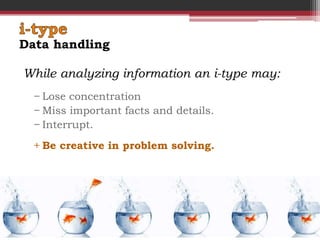
While analyzing information an i-type may:
  − Lose concentration
  − Miss important facts and details.
  − Interrupt.
  + Be creative in problem solving.
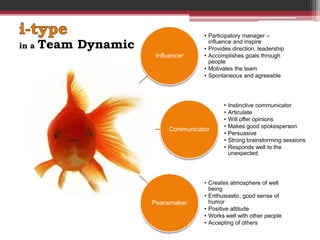
• Participatory manager –
in a   Team Dynamic                    influence and inspire
                                     • Provides direction, leadership
                       Influencer    • Accomplishes goals through
                                       people
                                     • Motivates the team
                                     • Spontaneous and agreeable


                                            •   Instinctive communicator
                                            •   Articulate
                                            •   Will offer opinions
                                            •   Makes good spokesperson
                           Communicator
                                            •   Persuasive
                                            •   Strong brainstorming sessions
                                            •   Responds well to the
                                                unexpected


                                     • Creates atmosphere of well
                                       being
                                     • Enthusiastic, good sense of
                      Peacemaker       humor
                                     • Positive attitude
                                     • Works well with other people
                                     • Accepting of others
Areas for Personal Growth
            • Be less impulsive.
            • Weigh the pros and cons before making a decision.
 Control    • Exercise control over your actions, words, emotions.


            • Be more results oriented.
            • Concentrate on following through with tasks.
  Focus     • Focus more on details and facts.


          • Remember to slow down your pace for other team
            members.
Cooperate • Talk less, listen more.
          • Consider and evaluate ideas from other team members.
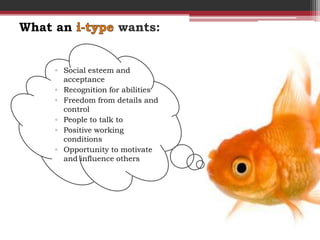
What an             wants:


    ▫ Social esteem and
      acceptance
    ▫ Recognition for abilities
    ▫ Freedom from details and
      control
    ▫ People to talk to
    ▫ Positive working
      conditions
    ▫ Opportunity to motivate
      and influence others
Interacting with an


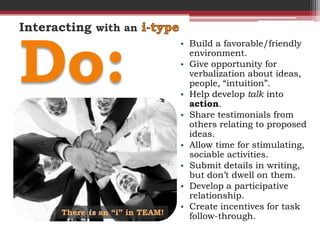
Do:
                                 • Build a favorable/friendly
                                   environment.
                                 • Give opportunity for
                                   verbalization about ideas,
                                   people, “intuition”.
                                 • Help develop talk into
                                   action.
                                 • Share testimonials from
                                   others relating to proposed
                                   ideas.
                                 • Allow time for stimulating,
                                   sociable activities.
                                 • Submit details in writing,
                                   but don’t dwell on them.
                                 • Develop a participative
                                   relationship.
                                 • Create incentives for task
      There is an “i” in TEAM!     follow-through.
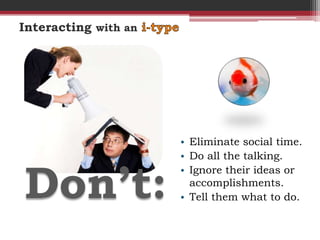
Interacting with an


                      • Eliminate social time.
                      • Do all the talking.


Don’t:
                      • Ignore their ideas or
                        accomplishments.
                      • Tell them what to do.
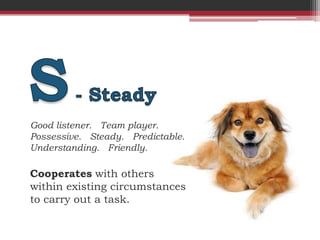
Good listener. Team player.
Possessive. Steady. Predictable.
Understanding. Friendly.

Cooperates with others
within existing circumstances
to carry out a task.
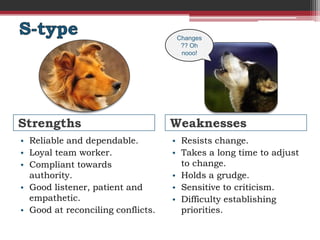
Changes
                                     ?? Oh
                                     nooo!


Strengths                          Weaknesses
• Reliable and dependable.         • Resists change.
• Loyal team worker.               • Takes a long time to adjust
• Compliant towards                  to change.
  authority.                       • Holds a grudge.
• Good listener, patient and       • Sensitive to criticism.
  empathetic.                      • Difficulty establishing
• Good at reconciling conflicts.     priorities.
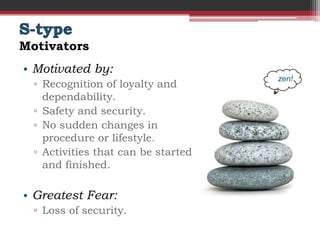
Motivators
• Motivated by:
                                     zen!
  ▫ Recognition of loyalty and
    dependability.
  ▫ Safety and security.
  ▫ No sudden changes in
    procedure or lifestyle.
  ▫ Activities that can be started
    and finished.

• Greatest Fear:
  ▫ Loss of security.
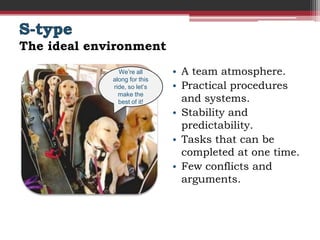
The ideal environment
               We’re all      • A team atmosphere.
             along for this
             ride, so let’s   • Practical procedures
               make the
               best of it!      and systems.
                              • Stability and
                                predictability.
                              • Tasks that can be
                                completed at one time.
                              • Few conflicts and
                                arguments.
Data handling

While analyzing information an S-type may:
  − Be outwardly agreeable but inwardly unyielding.
  − Internalize their concerns and doubts.
  − Hesitate to share feedback during presentation.
  − Slow down the action.
  + Provide valuable support for team goals.
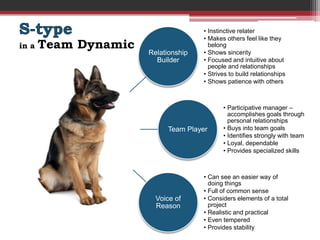
• Instinctive relater
                                     • Makes others feel like they
in a   Team Dynamic                    belong
                                     • Shows sincerity
                      Relationship
                        Builder      • Focused and intuitive about
                                       people and relationships
                                     • Strives to build relationships
                                     • Shows patience with others


                                            • Participative manager –
                                              accomplishes goals through
                                              personal relationships
                           Team Player      • Buys into team goals
                                            • Identifies strongly with team
                                            • Loyal, dependable
                                            • Provides specialized skills


                                     • Can see an easier way of
                                       doing things
                                     • Full of common sense
                        Voice of     • Considers elements of a total
                        Reason         project
                                     • Realistic and practical
                                     • Even tempered
                                     • Provides stability
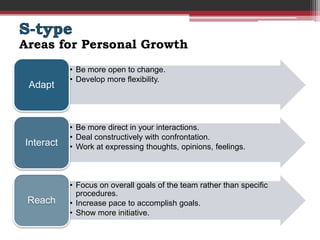
Areas for Personal Growth
           • Be more open to change.
           • Develop more flexibility.
 Adapt


           • Be more direct in your interactions.
           • Deal constructively with confrontation.
Interact   • Work at expressing thoughts, opinions, feelings.


           • Focus on overall goals of the team rather than specific
             procedures.
 Reach     • Increase pace to accomplish goals.
           • Show more initiative.
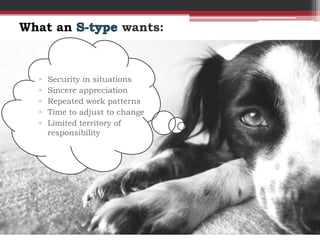
What an                 wants:


  ▫   Security in situations
  ▫   Sincere appreciation
  ▫   Repeated work patterns
  ▫   Time to adjust to change
  ▫   Limited territory of
      responsibility
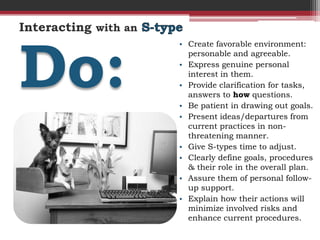
Interacting with an


Do:
                      • Create favorable environment:
                        personable and agreeable.
                      • Express genuine personal
                        interest in them.
                      • Provide clarification for tasks,
                        answers to how questions.
                      • Be patient in drawing out goals.
                      • Present ideas/departures from
                        current practices in non-
                        threatening manner.
                      • Give S-types time to adjust.
                      • Clearly define goals, procedures
                        & their role in the overall plan.
                      • Assure them of personal follow-
                        up support.
                      • Explain how their actions will
                        minimize involved risks and
                        enhance current procedures.
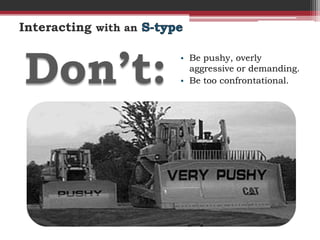
Interacting with an


Don’t:
                      • Be pushy, overly
                        aggressive or demanding.
                      • Be too confrontational.
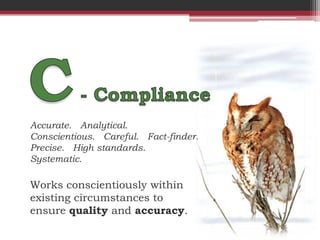
Accurate. Analytical.
Conscientious. Careful. Fact-finder.
Precise. High standards.
Systematic.

Works conscientiously within
existing circumstances to
ensure quality and accuracy.
Strengths                         Weaknesses
• Perspective: “the anchor of     • Needs clear-cut boundaries
  reality”.                         for actions/relationships.
• Conscientious and even-         • Bound by procedures and
  tempered.                         methods.
• Thorough in all activities.     • Gets bogged down in details.
• Defines situation.              • Prefers not to verbalize
• Gathers, criticizes and tests     feelings.
  information.                    • Will give in rather than argue.
Motivators
• Motivated by:
  ▫ Standards of high quality.
  ▫ Limited social interaction.
  ▫ Detailed tasks.
  ▫ Opportunities to
    demonstrate expertise.
  ▫ Logical organization of
    information.

• Greatest Fear:
  ▫ Criticism.
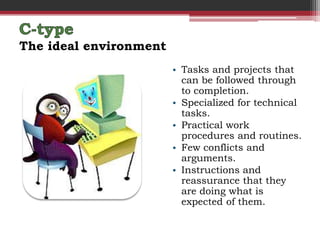
The ideal environment
                        • Tasks and projects that
                          can be followed through
                          to completion.
                        • Specialized for technical
                          tasks.
                        • Practical work
                          procedures and routines.
                        • Few conflicts and
                          arguments.
                        • Instructions and
                          reassurance that they
                          are doing what is
                          expected of them.
Data handling

While analyzing information a C-type may:
  − Become overly cautious and conservative.
  − Get too bogged down in details.
  − Avoid or postpone decisions, especially if they
    perceive a risk.
                                           Well ya see, that’s
  + Be an effective troubleshooter.         where things got
                                             all wonky. All
                                           better now though!
• Instinctive organizer
                                    • “Do it yourself” manager
in a   Team Dynamic   Organizer
                                      – creates and maintains
                                      systems
                                    • Thinks logically
                                    • Works systematically


                                               • Strives for logical,
                                                 consistent environment
                                  Quality      • Controls details
                                  Control      • Conscientious
                                               • Emphasizes quality


                                               • Analyzes obstacles
                                               • Evaluates team’s
                                   Data          progress
                                  Analyst      • Maintains focus on tasks
                                               • Asks important
                                                 questions


                                    • Diplomatic
                                    • Will strive for consensus
                      Diplomat      • Offers subtle/indirect
                                      approaches
                                    • Will share risks and
                                      responsibilities
Areas for Personal Growth
              • Respond more quickly to team goals.
              • Be more decisive.
    Act       • Take risks along with other team members.


              • Concentrate on doing the right things, not just doing
                things right.
 Prioritize   • Focus less on facts and more on people.


              • Be less critical of others’ ideas and methods.
Compromis     • Strive to build relationships with other team members.
   e
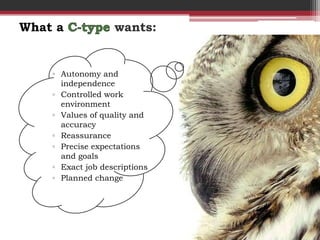
What a             wants:


    ▫ Autonomy and
      independence
    ▫ Controlled work
      environment
    ▫ Values of quality and
      accuracy
    ▫ Reassurance
    ▫ Precise expectations
      and goals
    ▫ Exact job descriptions
    ▫ Planned change
Interacting with a


Do:
                     • Prepare your case in advance.
                     • Delineate pros/cons of proposed
                       ideas.
                     • Support ideas and statements
                       with accurate data.
                     • Reassure C-types that no
                       surprises will occur.
                     • Submit an exact job description
                       with a precise explanation of how
                       that task fits into the big picture.
                     • Review recommendations with C-
                       type in a systematic and
                       comprehensive manner.
                     • Be specific when agreeing; when
                       disagreeing, disagree with the
                       facts rather than with the person.
                     • Be patient, persistent, diplomatic
                       while providing explanations.
Interacting with a


Don’t:
                       Who?


                     • Refuse to explain
                       details.
                     • Answer questions
                       vaguely or casually.
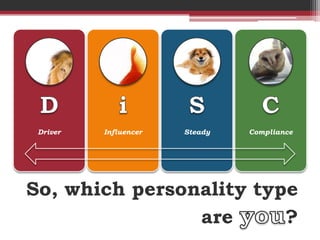
Driver   Influencer   Steady   Compliance


So, which personality type
                are      ?

DiSC Personality Profiles

  • 1.
  • 2.
    DiSC TELL Authority/Control Social Esteem/Being Liked PEOPLE Being Taken Advantage of Rejection TASK Organization Security/Harmony Criticism Change/Conflict LISTEN
  • 3.
    Direct. Decisive. Highego strength. Problem-solver. Risk-taker. Self-starter. Shapes environment by overcoming opposition to accomplish results.
  • 4.
    Strengths Weaknesses • Bottom line organizer. • Oversteps authority. • Attempts too much at • Places value on time. once. • Challenges status quo. • Argumentative attitude. • Innovative. • Dislikes routine.
  • 5.
    Motivators • Motivated by: ▫ New challenges. ▫ Power and authority to take risks and make decisions. ▫ Freedom from routine and mundane tasks. ▫ Changing environments in which to work and play. • Greatest Fear: ▫ Being taken advantage of.
  • 6.
    The ideal environment • Innovative focus on future. • Non-routine, challenging tasks and activities. • Projects that produce tangible results. • Freedom from controls, supervision, and details. • Personal evaluation based on results, not methods.
  • 7.
    Data handling While analyzinginformation a D-type may: − Ignore potential risks. − Not weigh pros and cons. − Not consider the opinions of others. + Offer innovative and progressive systems and ideas.
  • 8.
    • Self-reliant in a Team Dynamic • Autocratic managerial skills – great in a crisis! Leader • Pushes group to make decisions • Willing to speak out • Maintains focus on goals • Innovative in obtaining results • Welcomes challenges Problem without fear Solver • Ability to overcome obstacles • Accepts risks • Sees big picture • Ability to handle multiple Multitasker projects • Functions well with heavy workloads
  • 9.
    Areas for PersonalGrowth • Strive to be an “active” listener. Listen • Be attentive to other team members’ ideas until consensus is reached. • Develop appreciation for opinions, feelings and desires of others. • Be less controlling and domineering. Relax • Pace yourself and relax more. • Put more energy into personal relationships. Exchang • Show your support for other team members. e • Take time to explain the whys of your statements/proposals. Explain • Be friendlier and more approachable.
  • 10.
    What a wants: ▫ Authority ▫ Prestige ▫ Freedom ▫ Direct answers ▫ Varied activities ▫ Assignments promoting growth ▫ “Bottom line” approach ▫ Opportunity for advancement
  • 11.
    Interacting with a Do: • Be brief, direct, to the point. • Ask what, not how questions. • Focus on business: remember D-types desire results. • Suggest ways to achieve results, lead, solve problems. • Highlight logical benefits of featured ideas and approaches.
  • 12.
    Interacting with a • Ramble. • Repeat yourself. • Focus only on problems. • Be too sociable. • Make generalizations. • Make statements without support. Don’t:
  • 13.
    Enthusiastic. Trusting. Optimistic. Persuasive.Talkative. Impulsive. Emotional. Shapes environment by influencing or persuading others.
  • 14.
    Good morning, sunshine ! Strengths Weaknesses • Creative problem solver. • More concerned with • Great encourager. popularity than tangible • Motivates others to results. achieve. • Inattentive to detail. • Positive sense of humor. • Overuses gestures and facial expressions. • Negotiates conflicts. • Tends to listen only when it • Peacemaker. is convenient.
  • 15.
    Motivators • Motivated by: ▫ Flattery, praise, popularity and acceptance. ▫ A friendly environment. ▫ Freedom from many rules and regulations. ▫ Other people available to handle details. • Greatest Fear: ▫ Rejection.
  • 16.
    The ideal environment • Practical procedures. Ok team! Ready to do our swim • Few conflicts and thang? Waddaya arguments. say! • Freedom from controls Woot! and details. • A forum to express Doubl e ideas. woot! • Coaching and counseling. • Group activities in professional and social environments.
  • 17.
    Data handling While analyzinginformation an i-type may: − Lose concentration − Miss important facts and details. − Interrupt. + Be creative in problem solving.
  • 18.
    • Participatory manager– in a Team Dynamic influence and inspire • Provides direction, leadership Influencer • Accomplishes goals through people • Motivates the team • Spontaneous and agreeable • Instinctive communicator • Articulate • Will offer opinions • Makes good spokesperson Communicator • Persuasive • Strong brainstorming sessions • Responds well to the unexpected • Creates atmosphere of well being • Enthusiastic, good sense of Peacemaker humor • Positive attitude • Works well with other people • Accepting of others
  • 19.
    Areas for PersonalGrowth • Be less impulsive. • Weigh the pros and cons before making a decision. Control • Exercise control over your actions, words, emotions. • Be more results oriented. • Concentrate on following through with tasks. Focus • Focus more on details and facts. • Remember to slow down your pace for other team members. Cooperate • Talk less, listen more. • Consider and evaluate ideas from other team members.
  • 20.
    What an wants: ▫ Social esteem and acceptance ▫ Recognition for abilities ▫ Freedom from details and control ▫ People to talk to ▫ Positive working conditions ▫ Opportunity to motivate and influence others
  • 21.
    Interacting with an Do: • Build a favorable/friendly environment. • Give opportunity for verbalization about ideas, people, “intuition”. • Help develop talk into action. • Share testimonials from others relating to proposed ideas. • Allow time for stimulating, sociable activities. • Submit details in writing, but don’t dwell on them. • Develop a participative relationship. • Create incentives for task There is an “i” in TEAM! follow-through.
  • 22.
    Interacting with an • Eliminate social time. • Do all the talking. Don’t: • Ignore their ideas or accomplishments. • Tell them what to do.
  • 23.
    Good listener. Teamplayer. Possessive. Steady. Predictable. Understanding. Friendly. Cooperates with others within existing circumstances to carry out a task.
  • 24.
    Changes ?? Oh nooo! Strengths Weaknesses • Reliable and dependable. • Resists change. • Loyal team worker. • Takes a long time to adjust • Compliant towards to change. authority. • Holds a grudge. • Good listener, patient and • Sensitive to criticism. empathetic. • Difficulty establishing • Good at reconciling conflicts. priorities.
  • 25.
    Motivators • Motivated by: zen! ▫ Recognition of loyalty and dependability. ▫ Safety and security. ▫ No sudden changes in procedure or lifestyle. ▫ Activities that can be started and finished. • Greatest Fear: ▫ Loss of security.
  • 26.
    The ideal environment We’re all • A team atmosphere. along for this ride, so let’s • Practical procedures make the best of it! and systems. • Stability and predictability. • Tasks that can be completed at one time. • Few conflicts and arguments.
  • 27.
    Data handling While analyzinginformation an S-type may: − Be outwardly agreeable but inwardly unyielding. − Internalize their concerns and doubts. − Hesitate to share feedback during presentation. − Slow down the action. + Provide valuable support for team goals.
  • 28.
    • Instinctive relater • Makes others feel like they in a Team Dynamic belong • Shows sincerity Relationship Builder • Focused and intuitive about people and relationships • Strives to build relationships • Shows patience with others • Participative manager – accomplishes goals through personal relationships Team Player • Buys into team goals • Identifies strongly with team • Loyal, dependable • Provides specialized skills • Can see an easier way of doing things • Full of common sense Voice of • Considers elements of a total Reason project • Realistic and practical • Even tempered • Provides stability
  • 29.
    Areas for PersonalGrowth • Be more open to change. • Develop more flexibility. Adapt • Be more direct in your interactions. • Deal constructively with confrontation. Interact • Work at expressing thoughts, opinions, feelings. • Focus on overall goals of the team rather than specific procedures. Reach • Increase pace to accomplish goals. • Show more initiative.
  • 30.
    What an wants: ▫ Security in situations ▫ Sincere appreciation ▫ Repeated work patterns ▫ Time to adjust to change ▫ Limited territory of responsibility
  • 31.
    Interacting with an Do: • Create favorable environment: personable and agreeable. • Express genuine personal interest in them. • Provide clarification for tasks, answers to how questions. • Be patient in drawing out goals. • Present ideas/departures from current practices in non- threatening manner. • Give S-types time to adjust. • Clearly define goals, procedures & their role in the overall plan. • Assure them of personal follow- up support. • Explain how their actions will minimize involved risks and enhance current procedures.
  • 32.
    Interacting with an Don’t: • Be pushy, overly aggressive or demanding. • Be too confrontational.
  • 33.
    Accurate. Analytical. Conscientious. Careful.Fact-finder. Precise. High standards. Systematic. Works conscientiously within existing circumstances to ensure quality and accuracy.
  • 34.
    Strengths Weaknesses • Perspective: “the anchor of • Needs clear-cut boundaries reality”. for actions/relationships. • Conscientious and even- • Bound by procedures and tempered. methods. • Thorough in all activities. • Gets bogged down in details. • Defines situation. • Prefers not to verbalize • Gathers, criticizes and tests feelings. information. • Will give in rather than argue.
  • 35.
    Motivators • Motivated by: ▫ Standards of high quality. ▫ Limited social interaction. ▫ Detailed tasks. ▫ Opportunities to demonstrate expertise. ▫ Logical organization of information. • Greatest Fear: ▫ Criticism.
  • 36.
    The ideal environment • Tasks and projects that can be followed through to completion. • Specialized for technical tasks. • Practical work procedures and routines. • Few conflicts and arguments. • Instructions and reassurance that they are doing what is expected of them.
  • 37.
    Data handling While analyzinginformation a C-type may: − Become overly cautious and conservative. − Get too bogged down in details. − Avoid or postpone decisions, especially if they perceive a risk. Well ya see, that’s + Be an effective troubleshooter. where things got all wonky. All better now though!
  • 38.
    • Instinctive organizer • “Do it yourself” manager in a Team Dynamic Organizer – creates and maintains systems • Thinks logically • Works systematically • Strives for logical, consistent environment Quality • Controls details Control • Conscientious • Emphasizes quality • Analyzes obstacles • Evaluates team’s Data progress Analyst • Maintains focus on tasks • Asks important questions • Diplomatic • Will strive for consensus Diplomat • Offers subtle/indirect approaches • Will share risks and responsibilities
  • 39.
    Areas for PersonalGrowth • Respond more quickly to team goals. • Be more decisive. Act • Take risks along with other team members. • Concentrate on doing the right things, not just doing things right. Prioritize • Focus less on facts and more on people. • Be less critical of others’ ideas and methods. Compromis • Strive to build relationships with other team members. e
  • 40.
    What a wants: ▫ Autonomy and independence ▫ Controlled work environment ▫ Values of quality and accuracy ▫ Reassurance ▫ Precise expectations and goals ▫ Exact job descriptions ▫ Planned change
  • 41.
    Interacting with a Do: • Prepare your case in advance. • Delineate pros/cons of proposed ideas. • Support ideas and statements with accurate data. • Reassure C-types that no surprises will occur. • Submit an exact job description with a precise explanation of how that task fits into the big picture. • Review recommendations with C- type in a systematic and comprehensive manner. • Be specific when agreeing; when disagreeing, disagree with the facts rather than with the person. • Be patient, persistent, diplomatic while providing explanations.
  • 42.
    Interacting with a Don’t: Who? • Refuse to explain details. • Answer questions vaguely or casually.
  • 43.
    Driver Influencer Steady Compliance So, which personality type are ?