TSN Lectures
ETE 310
Prof. A.H.M. Asadul Huq, Ph.D.
http://asadul.drivehq.com/students.htm
asadul@univdhaka.edu
June 5, 2015 A.H. 1
INTRODUCTION
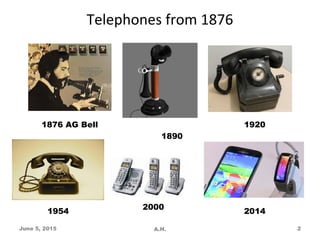
Telephones from 1876
June 5, 2015 A.H. 2
1876 AG Bell
1890
1920
1954
2000
2014
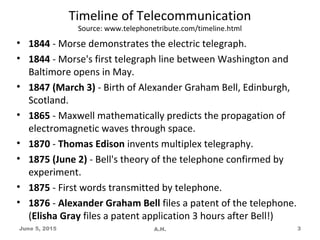
Timeline of Telecommunication
Source: www.telephonetribute.com/timeline.html
• 1844 - Morse demonstrates the electric telegraph.
• 1844 - Morse's first telegraph line between Washington and
Baltimore opens in May.
• 1847 (March 3) - Birth of Alexander Graham Bell, Edinburgh,
Scotland.
• 1865 - Maxwell mathematically predicts the propagation of
electromagnetic waves through space.
• 1870 - Thomas Edison invents multiplex telegraphy.
• 1875 (June 2) - Bell's theory of the telephone confirmed by
experiment.
• 1875 - First words transmitted by telephone.
• 1876 - Alexander Graham Bell files a patent of the telephone.
(Elisha Gray files a patent application 3 hours after Bell!)
June 5, 2015 A.H. 3
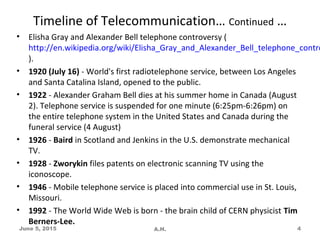
Timeline of Telecommunication… Continued …
• Elisha Gray and Alexander Bell telephone controversy (
http://en.wikipedia.org/wiki/Elisha_Gray_and_Alexander_Bell_telephone_contro
).
• 1920 (July 16) - World's first radiotelephone service, between Los Angeles
and Santa Catalina Island, opened to the public.
• 1922 - Alexander Graham Bell dies at his summer home in Canada (August
2). Telephone service is suspended for one minute (6:25pm-6:26pm) on
the entire telephone system in the United States and Canada during the
funeral service (4 August)
• 1926 - Baird in Scotland and Jenkins in the U.S. demonstrate mechanical
TV.
• 1928 - Zworykin files patents on electronic scanning TV using the
iconoscope.
• 1946 - Mobile telephone service is placed into commercial use in St. Louis,
Missouri.
• 1992 - The World Wide Web is born - the brain child of CERN physicist Tim
Berners-Lee.
June 5, 2015 A.H. 4
Introduction to Telecommunication
Telecommunication is communication at a distance by
technological means, particularly through electrical
signals or electromagnetic waves.
Early telecommunications technologies included visual
signals, such as smoke signals, signal flags, etc. Other
examples of pre-modern telecommunications
include audio messages such as coded drumbeats,
and loud whistles.
Switching is establishing an electrical path between a
given inlet-outlet pair.
June 5, 2015 A.H. 5
Telecommunication
• Telecommunication means communication at a distance,
where tele is a Greek word means “at a distance”.
• Electrical communications are done with one of following 3
media – wire, radio or light (optical fiber).
• Implementation of telecommunication requires two distinct
techniques, switching and transmission.
• Switching: selects and directs communication signals to a
specific user or a group of users.
• Transmission: Delivers the signal from the source to a far-end
user using a suitable technique with an acceptable signal
quality.
June 5, 2015 A.H. 6
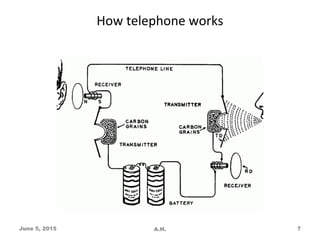
How telephone works
June 5, 2015 A.H. 7
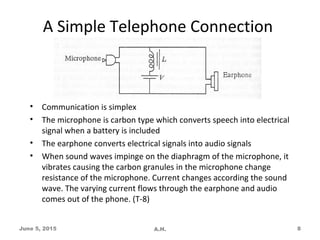
A Simple Telephone Connection
• Communication is simplex
• The microphone is carbon type which converts speech into electrical
signal when a battery is included
• The earphone converts electrical signals into audio signals
• When sound waves impinge on the diaphragm of the microphone, it
vibrates causing the carbon granules in the microphone change
resistance of the microphone. Current changes according the sound
wave. The varying current flows through the earphone and audio
comes out of the phone. (T-8)
June 5, 2015 A.H. 8
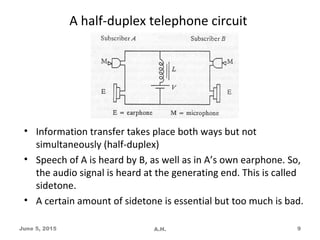
A half-duplex telephone circuit
• Information transfer takes place both ways but not
simultaneously (half-duplex)
• Speech of A is heard by B, as well as in A’s own earphone. So,
the audio signal is heard at the generating end. This is called
sidetone.
• A certain amount of sidetone is essential but too much is bad.
June 5, 2015 A.H. 9
A telephone circuit with sidetone coupling
• A small level of sidetone and the full speech signal from the
other party are coupled to the receiver E.
• The impedance Zb is chosen to be more or less equal to the
impedance seen by the circuit to the right of section AA’.
• From the microphone a small induced voltage is applied on
the receiver circuit. The signal from the other entity is added
by 2 windings P and Q inducing a larger signal at the receiver.
June 5, 2015 A.H. 10
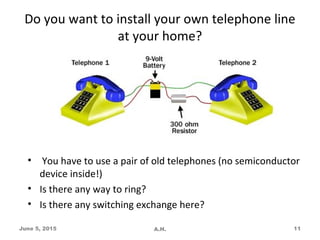
Do you want to install your own telephone line
at your home?
• You have to use a pair of old telephones (no semiconductor
device inside!)
• Is there any way to ring?
• Is there any switching exchange here?
June 5, 2015 A.H. 11
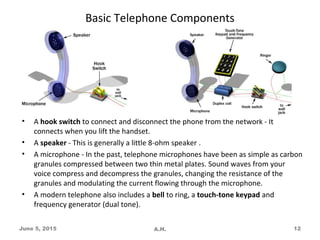
Basic Telephone Components
• A hook switch to connect and disconnect the phone from the network - It
connects when you lift the handset.
• A speaker - This is generally a little 8-ohm speaker .
• A microphone - In the past, telephone microphones have been as simple as carbon
granules compressed between two thin metal plates. Sound waves from your
voice compress and decompress the granules, changing the resistance of the
granules and modulating the current flowing through the microphone.
• A modern telephone also includes a bell to ring, a touch-tone keypad and
frequency generator (dual tone).
June 5, 2015 A.H. 12
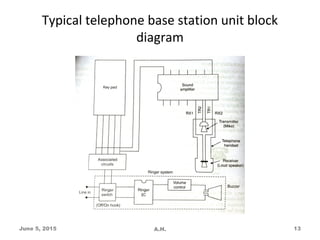
Typical telephone base station unit block
diagram
June 5, 2015 A.H. 13
Communication Application and Services
• Wired and Mobile Telephone: Real time bi-
derectional voice exchange.
• Short message service (SMS): Fast delivery of short
text messages through wired and wireless devices.
• E-mail: Exchange of text messages via computer
servers.
• Web browsing: Retrieval of information from web
servers.
June 5, 2015 A.H. 14
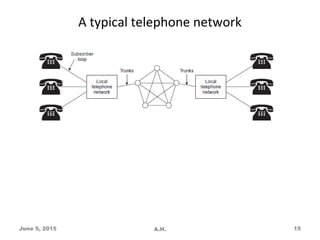
A typical telephone network
June 5, 2015 A.H. 15
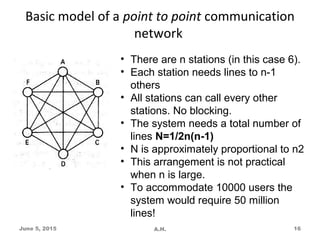
Basic model of a point to point communication
network
June 5, 2015 A.H. 16
• There are n stations (in this case 6).
• Each station needs lines to n-1
others
• All stations can call every other
stations. No blocking.
• The system needs a total number of
lines N=1/2n(n-1)
• N is approximately proportional to n2
• This arrangement is not practical
when n is large.
• To accommodate 10000 users the
system would require 50 million
lines!
How a manual telephone exchange would handle call
connection
• When a subscriber lifted his telephone, he lit a lamp on the lowest section
of the panel in front of the operator. The operator would then insert a
plug into the appropriate jack to connect to the subscriber and say,
"Number please?".
• In front of the of the operator were hundreds of other jacks representing
all the subscribers on the exchange. The operator would insert the
previous plug into the jack of the recipient and ring the bell by rotating a
handle
• The recipient would lift (off hook) the receiver to say hallo to operator.
• The operator would connect the jack of the caller with the jack of the
recipient with a plug.
• Both parties talk.
• When any one of the talking persons put back the receiver on the cradle
(on hook) the operator notices a light bulb put off. Operator pull out the
connecting plug.
June 5, 2015 A.H. 17
TSN Lecture
Volume-1
THE END
THANK YOU
This ppt may be downloaded from my web site:
http://asadul.drivehq.com/students.htm
Password (email address): tsn.ete@ulab.edu.bd
This password does not live long !
Jun 5, 2015 A.H. 18

Tsn lecture vol 1

  • 1.
    TSN Lectures ETE 310 Prof.A.H.M. Asadul Huq, Ph.D. http://asadul.drivehq.com/students.htm asadul@univdhaka.edu June 5, 2015 A.H. 1 INTRODUCTION
  • 2.
    Telephones from 1876 June5, 2015 A.H. 2 1876 AG Bell 1890 1920 1954 2000 2014
  • 3.
    Timeline of Telecommunication Source:www.telephonetribute.com/timeline.html • 1844 - Morse demonstrates the electric telegraph. • 1844 - Morse's first telegraph line between Washington and Baltimore opens in May. • 1847 (March 3) - Birth of Alexander Graham Bell, Edinburgh, Scotland. • 1865 - Maxwell mathematically predicts the propagation of electromagnetic waves through space. • 1870 - Thomas Edison invents multiplex telegraphy. • 1875 (June 2) - Bell's theory of the telephone confirmed by experiment. • 1875 - First words transmitted by telephone. • 1876 - Alexander Graham Bell files a patent of the telephone. (Elisha Gray files a patent application 3 hours after Bell!) June 5, 2015 A.H. 3
  • 4.
    Timeline of Telecommunication…Continued … • Elisha Gray and Alexander Bell telephone controversy ( http://en.wikipedia.org/wiki/Elisha_Gray_and_Alexander_Bell_telephone_contro ). • 1920 (July 16) - World's first radiotelephone service, between Los Angeles and Santa Catalina Island, opened to the public. • 1922 - Alexander Graham Bell dies at his summer home in Canada (August 2). Telephone service is suspended for one minute (6:25pm-6:26pm) on the entire telephone system in the United States and Canada during the funeral service (4 August) • 1926 - Baird in Scotland and Jenkins in the U.S. demonstrate mechanical TV. • 1928 - Zworykin files patents on electronic scanning TV using the iconoscope. • 1946 - Mobile telephone service is placed into commercial use in St. Louis, Missouri. • 1992 - The World Wide Web is born - the brain child of CERN physicist Tim Berners-Lee. June 5, 2015 A.H. 4
  • 5.
    Introduction to Telecommunication Telecommunicationis communication at a distance by technological means, particularly through electrical signals or electromagnetic waves. Early telecommunications technologies included visual signals, such as smoke signals, signal flags, etc. Other examples of pre-modern telecommunications include audio messages such as coded drumbeats, and loud whistles. Switching is establishing an electrical path between a given inlet-outlet pair. June 5, 2015 A.H. 5
  • 6.
    Telecommunication • Telecommunication meanscommunication at a distance, where tele is a Greek word means “at a distance”. • Electrical communications are done with one of following 3 media – wire, radio or light (optical fiber). • Implementation of telecommunication requires two distinct techniques, switching and transmission. • Switching: selects and directs communication signals to a specific user or a group of users. • Transmission: Delivers the signal from the source to a far-end user using a suitable technique with an acceptable signal quality. June 5, 2015 A.H. 6
  • 7.
  • 8.
    A Simple TelephoneConnection • Communication is simplex • The microphone is carbon type which converts speech into electrical signal when a battery is included • The earphone converts electrical signals into audio signals • When sound waves impinge on the diaphragm of the microphone, it vibrates causing the carbon granules in the microphone change resistance of the microphone. Current changes according the sound wave. The varying current flows through the earphone and audio comes out of the phone. (T-8) June 5, 2015 A.H. 8
  • 9.
    A half-duplex telephonecircuit • Information transfer takes place both ways but not simultaneously (half-duplex) • Speech of A is heard by B, as well as in A’s own earphone. So, the audio signal is heard at the generating end. This is called sidetone. • A certain amount of sidetone is essential but too much is bad. June 5, 2015 A.H. 9
  • 10.
    A telephone circuitwith sidetone coupling • A small level of sidetone and the full speech signal from the other party are coupled to the receiver E. • The impedance Zb is chosen to be more or less equal to the impedance seen by the circuit to the right of section AA’. • From the microphone a small induced voltage is applied on the receiver circuit. The signal from the other entity is added by 2 windings P and Q inducing a larger signal at the receiver. June 5, 2015 A.H. 10
  • 11.
    Do you wantto install your own telephone line at your home? • You have to use a pair of old telephones (no semiconductor device inside!) • Is there any way to ring? • Is there any switching exchange here? June 5, 2015 A.H. 11
  • 12.
    Basic Telephone Components •A hook switch to connect and disconnect the phone from the network - It connects when you lift the handset. • A speaker - This is generally a little 8-ohm speaker . • A microphone - In the past, telephone microphones have been as simple as carbon granules compressed between two thin metal plates. Sound waves from your voice compress and decompress the granules, changing the resistance of the granules and modulating the current flowing through the microphone. • A modern telephone also includes a bell to ring, a touch-tone keypad and frequency generator (dual tone). June 5, 2015 A.H. 12
  • 13.
    Typical telephone basestation unit block diagram June 5, 2015 A.H. 13
  • 14.
    Communication Application andServices • Wired and Mobile Telephone: Real time bi- derectional voice exchange. • Short message service (SMS): Fast delivery of short text messages through wired and wireless devices. • E-mail: Exchange of text messages via computer servers. • Web browsing: Retrieval of information from web servers. June 5, 2015 A.H. 14
  • 15.
    A typical telephonenetwork June 5, 2015 A.H. 15
  • 16.
    Basic model ofa point to point communication network June 5, 2015 A.H. 16 • There are n stations (in this case 6). • Each station needs lines to n-1 others • All stations can call every other stations. No blocking. • The system needs a total number of lines N=1/2n(n-1) • N is approximately proportional to n2 • This arrangement is not practical when n is large. • To accommodate 10000 users the system would require 50 million lines!
  • 17.
    How a manualtelephone exchange would handle call connection • When a subscriber lifted his telephone, he lit a lamp on the lowest section of the panel in front of the operator. The operator would then insert a plug into the appropriate jack to connect to the subscriber and say, "Number please?". • In front of the of the operator were hundreds of other jacks representing all the subscribers on the exchange. The operator would insert the previous plug into the jack of the recipient and ring the bell by rotating a handle • The recipient would lift (off hook) the receiver to say hallo to operator. • The operator would connect the jack of the caller with the jack of the recipient with a plug. • Both parties talk. • When any one of the talking persons put back the receiver on the cradle (on hook) the operator notices a light bulb put off. Operator pull out the connecting plug. June 5, 2015 A.H. 17
  • 18.
    TSN Lecture Volume-1 THE END THANKYOU This ppt may be downloaded from my web site: http://asadul.drivehq.com/students.htm Password (email address): tsn.ete@ulab.edu.bd This password does not live long ! Jun 5, 2015 A.H. 18