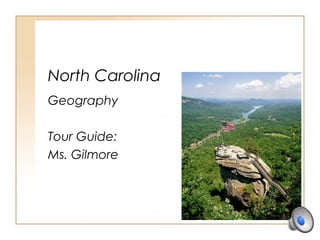
North Carolina
Geography
Tour Guide:
Ms. Gilmore
Flipped Lesson
• Lecture Online
• Students view and take
notes.
• Completed as Homework
• Class time = application
and deeper exploration.
• You will need SS notebook
and pen/pencil
• Make sure your sound is on.
Key Terms
• Geography- study of the
earth’s landscape, people,
places, and environments
• Bonus: What are the five
themes of geography?
Key Terms
• Region: Area defined by
shared landforms, culture,
or climate.
• Sectionalism: Extreme
loyalty to one’s own region
of the country
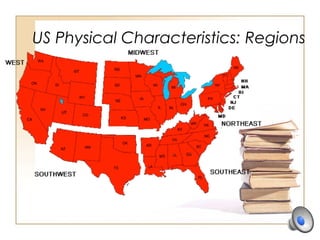
US Physical Characteristics: Regions
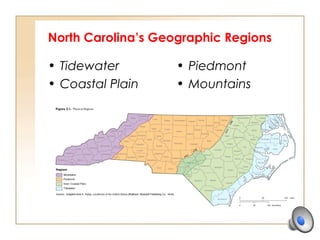
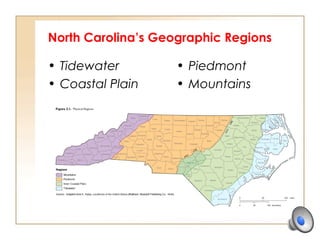
North Carolina’s Geographic Regions
• Tidewater
• Coastal Plain
• Piedmont
• Mountains
The Tidewater Region
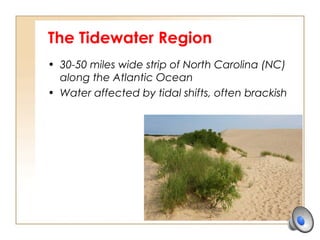
• 30-50 miles wide strip of North Carolina (NC)
along the Atlantic Ocean
• Water affected by tidal shifts, often brackish
The Tidewater Region
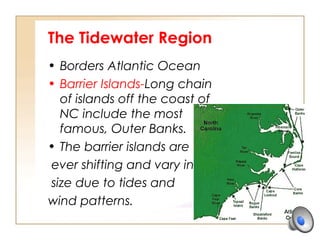
• Borders Atlantic Ocean
• Barrier Islands-Long chain
of islands off the coast of
NC include the most
famous, Outer Banks.
• The barrier islands are
ever shifting and vary in
size due to tides and
wind patterns.
The Tidewater Region
• Among the barrier islands
are some famous Capes in
North Carolina
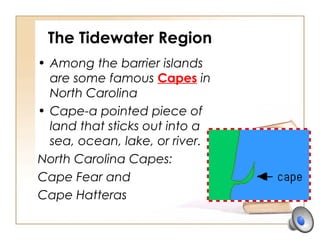
• Cape-a pointed piece of
land that sticks out into a
sea, ocean, lake, or river.
North Carolina Capes:
Cape Fear and
Cape Hatteras
The Tidewater Region
• A sound is a wide inlet
of the sea or ocean
that is parallel to the
coastline; it often
separates a coastline
from a nearby island.
• Major Sounds in North
Carolina:
• Currituck Sound,
Albemarle Sound,
Pamlico Sound, Core
Sound and Bogue
Sound.
• The largest and
deepest sound is
the Pamlico
Sound
• Climate of the
Tidewater Region:
• Mild Winters and
Moderate
Summers make
the climate of this
area welcoming
to visitors.
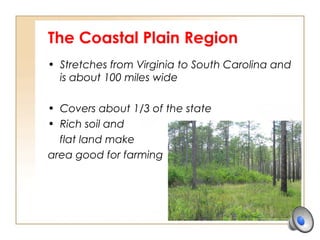
The Coastal Plain Region
• Stretches from Virginia to South Carolina and
is about 100 miles wide
• Covers about 1/3 of the state
• Rich soil and
flat land make
area good for farming
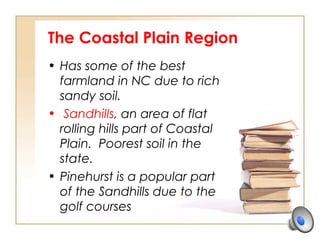
The Coastal Plain Region
• Has some of the best
farmland in NC due to rich
sandy soil.
• Sandhills, an area of flat
rolling hills part of Coastal
Plain. Poorest soil in the
state.
• Pinehurst is a popular part
of the Sandhills due to the
golf courses
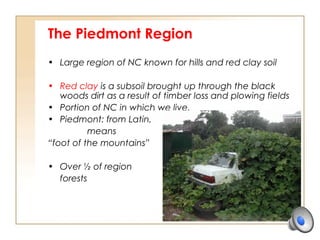
The Piedmont Region
• Large region of NC known for hills and red clay soil
• Red clay is a subsoil brought up through the black
woods dirt as a result of timber loss and plowing fields
• Portion of NC in which we live.
• Piedmont: from Latin,
means
“foot of the mountains”
• Over ½ of region
forests
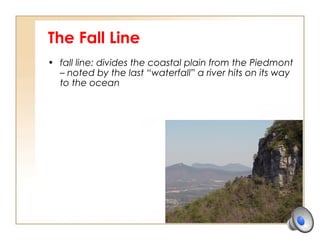
The Fall Line
• fall line: divides the coastal plain from the Piedmont
– noted by the last “waterfall” a river hits on its way
to the ocean
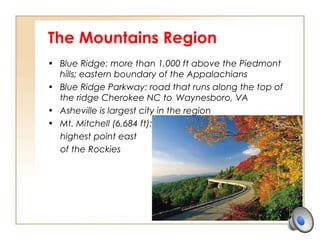
The Mountains Region
• Blue Ridge: more than 1,000 ft above the Piedmont
hills; eastern boundary of the Appalachians
• Blue Ridge Parkway: road that runs along the top of
the ridge Cherokee NC to Waynesboro, VA
• Asheville is largest city in the region
• Mt. Mitchell (6,684 ft):
highest point east
of the Rockies
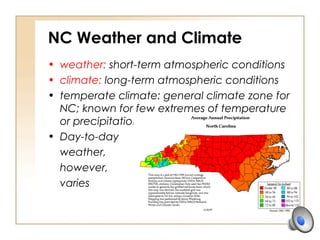
NC Weather and Climate
• weather: short-term atmospheric conditions
• climate: long-term atmospheric conditions
• temperate climate: general climate zone for
NC; known for few extremes of temperature
or precipitation
• Day-to-day
weather,
however,
varies
North Carolina’s Geographic Regions
• Tidewater
• Coastal Plain
• Piedmont
• Mountains

North carolina geography

  • 1.
  • 2.
    Flipped Lesson • LectureOnline • Students view and take notes. • Completed as Homework • Class time = application and deeper exploration. • You will need SS notebook and pen/pencil • Make sure your sound is on.
  • 3.
    Key Terms • Geography-study of the earth’s landscape, people, places, and environments • Bonus: What are the five themes of geography?
  • 4.
    Key Terms • Region:Area defined by shared landforms, culture, or climate. • Sectionalism: Extreme loyalty to one’s own region of the country
  • 5.
  • 6.
    North Carolina’s GeographicRegions • Tidewater • Coastal Plain • Piedmont • Mountains
  • 7.
    The Tidewater Region •30-50 miles wide strip of North Carolina (NC) along the Atlantic Ocean • Water affected by tidal shifts, often brackish
  • 8.
    The Tidewater Region •Borders Atlantic Ocean • Barrier Islands-Long chain of islands off the coast of NC include the most famous, Outer Banks. • The barrier islands are ever shifting and vary in size due to tides and wind patterns.
  • 9.
    The Tidewater Region •Among the barrier islands are some famous Capes in North Carolina • Cape-a pointed piece of land that sticks out into a sea, ocean, lake, or river. North Carolina Capes: Cape Fear and Cape Hatteras
  • 10.
    The Tidewater Region •A sound is a wide inlet of the sea or ocean that is parallel to the coastline; it often separates a coastline from a nearby island. • Major Sounds in North Carolina: • Currituck Sound, Albemarle Sound, Pamlico Sound, Core Sound and Bogue Sound. • The largest and deepest sound is the Pamlico Sound • Climate of the Tidewater Region: • Mild Winters and Moderate Summers make the climate of this area welcoming to visitors.
  • 11.
    The Coastal PlainRegion • Stretches from Virginia to South Carolina and is about 100 miles wide • Covers about 1/3 of the state • Rich soil and flat land make area good for farming
  • 12.
    The Coastal PlainRegion • Has some of the best farmland in NC due to rich sandy soil. • Sandhills, an area of flat rolling hills part of Coastal Plain. Poorest soil in the state. • Pinehurst is a popular part of the Sandhills due to the golf courses
  • 13.
    The Piedmont Region •Large region of NC known for hills and red clay soil • Red clay is a subsoil brought up through the black woods dirt as a result of timber loss and plowing fields • Portion of NC in which we live. • Piedmont: from Latin, means “foot of the mountains” • Over ½ of region forests
  • 14.
    The Fall Line •fall line: divides the coastal plain from the Piedmont – noted by the last “waterfall” a river hits on its way to the ocean
  • 15.
    The Mountains Region •Blue Ridge: more than 1,000 ft above the Piedmont hills; eastern boundary of the Appalachians • Blue Ridge Parkway: road that runs along the top of the ridge Cherokee NC to Waynesboro, VA • Asheville is largest city in the region • Mt. Mitchell (6,684 ft): highest point east of the Rockies
  • 16.
    NC Weather andClimate • weather: short-term atmospheric conditions • climate: long-term atmospheric conditions • temperate climate: general climate zone for NC; known for few extremes of temperature or precipitation • Day-to-day weather, however, varies
  • 17.
    North Carolina’s GeographicRegions • Tidewater • Coastal Plain • Piedmont • Mountains