Sectionalism
A Nation Divides
Sectionalism
• The Country divides over:
– Economy Differences
– Expansion out West
– Slavery Issues
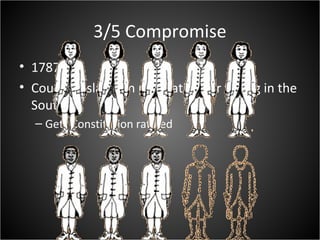
3/5 Compromise
• 1787
• Counting slaves in population for voting in the
South
– Gets Constitution ratified
Northwest Ordinance
• 1787
• Early law outlawed slavery in new territories
out West
Missouri Compromise
• 1819
• Henry Clay: Keeps balance in Union with
compromise
– Missouri: Slave state
– Maine: Free state
Wilmot Proviso
• 1846
• David Wilmot [PA]: New bill BANS slavery in
lands won in the Mexican War [Southwest &
West]
– It does NOT get passed
Compromise of 1850
• Henry Clay: Creates another compromise
– California: Free state
– New Mexico & Utah: Popular Sovereignty
• Border Dispute: Texas & New Mexico settled
• Congress Power: NO POWER over slave trade
between states
Compromise of 1850
• Washington D.C.: Slave trade BANNED
• Fugitive Slave Law: Required ALL citizens to
help catch runaway slaves.
– 6months or $1,000 fine
– Special Courts were created
– North HATED this new law
Kansas-Nebraska Act
• 1854
• Popular Sovereignty: People vote to decide
on slavery for the states
• Border Ruffians: Moved across state lines to
influence the voting
Kansas-Nebraska Act
• Kansas: Pro slave government
– DEATH PENALTY for helping runaway slaves
– 2-yr Prison term for speaking out against slavery
• Bleeding Kansas: John Brown leads
abolitionists in guerilla warfare. Killed 200
people
END
Slavery
• Slavery: Dividing the nation
– Slaveholders [SOUTH]
– Abolitionists [NORTH]
– Moderates
Slaveholders
• Their way of life was being threatened
– Economy would be crushed
– Wanted slavery in ALL STATES
– Wanted North to help catch runaway slaves
Abolitionists
• Felt the South was like a “foreign country”
– Wanted slavery stopped EVERYWHERE
– Slavery was a moral wrong
Moderates
• Wanted Missouri Compromise to go across
the entire nation
– Wanted Popular Sovereignty to decide slave
issues in new territories
Uncle Tom’s Cabin
• Harriet Beecher Stowe: Writes novel about
slavery
• Showed the “Evils of Slavery”
• Showed brutality of slave life in the South
– South HATED the book
– North LIKED it
Uncle Tom’s Cabin
• Tom refuses to tell Simon Legree where two
slaves have gone, so he orders his overseers
to kill Tom. As Tom is dying, he forgives the
overseers who savagely beat him. Humbled by
the character of the man they have killed,
both men become Christians. Shortly before
Tom's death, George Shelby arrives to buy
Tom’s freedom but finds he is too late.
Dred Scott Case
• 1857
• Dred Scott: Slave from Missouri
– Moved to Wisconsin with owner. Owner died and
Scott sued for freedom
• U.S. Supreme Court: Ruled that he had NO
RIGHTS as a slave, therefore could not sue for
his freedom, he was NOT a citizen
– North was outraged
Government
• Free Soil Party: 1848
• Created: Northern Democrats & Whigs who
opposed slavery.
– “Free Soil, Free Speech, Free Labor & Free Men!”
– STOP the spread of slavery, not abolish it
Government
• Republican Party: 1854
• Created: Free Soil, Democrats & Whigs who
wanted to STOP the spread of slavery into the
West
– John Fremont: Presidential candidate lost to
James Buchanan
Government
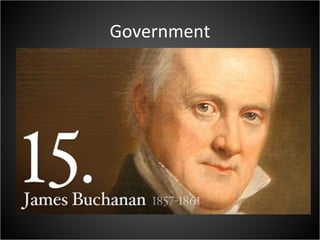
• President James Buchanan: Won election in
1856
– Compromise Candidate
– “Northern man, with Southern principles”
Government
• Abraham Lincoln: 1858
• Lincoln challenged Stephen Douglas for
Senate seat in Illinois
– Lincoln didn’t win, but people liked him
– Great public speaker
– Just Folks
Government
• Lincoln v Douglas Debates: These two men
had many debates
• Douglas: Believed in Popular Sovereignty
• Lincoln: Thought slavery was a “moral, social
& political wrong”
– All citizens had the right to “Life, Liberty & Pursuit
of Happiness”
– NOT an abolitionist, did not want slavery to
spread
For Quiz
• Henry Clay Fugitive Slave Law
• Harriet Tubman Uncle Tom’s Cabin
• John Brown Popular Sovereignty
• Stephen Douglas Free Soil Party
• Dred Scott Bleeding Kansas
• Border Ruffians Missouri Compromise
• Abolitionists William Lloyd Garrison
• Compromise of 1850
Questions
• What issue was dividing the U.S.
– What are the three sides to this issue
• How did the government try to solve this problem?
– List them:
• What happened in Kansas?
• Who was the “Great Compromiser?”
• Who was the “Northern man with Southern
principles?”
• Who wrote the “big book” that started the Civil War?
• Who was the famous conductor on the Underground
RR?
• How did the government “fail” to stop slavery from
END

Sectionalism Part 2

  • 1.
  • 2.
    Sectionalism • The Countrydivides over: – Economy Differences – Expansion out West – Slavery Issues
  • 4.
    3/5 Compromise • 1787 •Counting slaves in population for voting in the South – Gets Constitution ratified
  • 5.
    Northwest Ordinance • 1787 •Early law outlawed slavery in new territories out West
  • 6.
    Missouri Compromise • 1819 •Henry Clay: Keeps balance in Union with compromise – Missouri: Slave state – Maine: Free state
  • 7.
    Wilmot Proviso • 1846 •David Wilmot [PA]: New bill BANS slavery in lands won in the Mexican War [Southwest & West] – It does NOT get passed
  • 8.
    Compromise of 1850 •Henry Clay: Creates another compromise – California: Free state – New Mexico & Utah: Popular Sovereignty • Border Dispute: Texas & New Mexico settled • Congress Power: NO POWER over slave trade between states
  • 9.
    Compromise of 1850 •Washington D.C.: Slave trade BANNED • Fugitive Slave Law: Required ALL citizens to help catch runaway slaves. – 6months or $1,000 fine – Special Courts were created – North HATED this new law
  • 11.
    Kansas-Nebraska Act • 1854 •Popular Sovereignty: People vote to decide on slavery for the states • Border Ruffians: Moved across state lines to influence the voting
  • 13.
    Kansas-Nebraska Act • Kansas:Pro slave government – DEATH PENALTY for helping runaway slaves – 2-yr Prison term for speaking out against slavery • Bleeding Kansas: John Brown leads abolitionists in guerilla warfare. Killed 200 people
  • 14.
  • 15.
    Slavery • Slavery: Dividingthe nation – Slaveholders [SOUTH] – Abolitionists [NORTH] – Moderates
  • 16.
    Slaveholders • Their wayof life was being threatened – Economy would be crushed – Wanted slavery in ALL STATES – Wanted North to help catch runaway slaves
  • 17.
    Abolitionists • Felt theSouth was like a “foreign country” – Wanted slavery stopped EVERYWHERE – Slavery was a moral wrong
  • 18.
    Moderates • Wanted MissouriCompromise to go across the entire nation – Wanted Popular Sovereignty to decide slave issues in new territories
  • 19.
    Uncle Tom’s Cabin •Harriet Beecher Stowe: Writes novel about slavery • Showed the “Evils of Slavery” • Showed brutality of slave life in the South – South HATED the book – North LIKED it
  • 20.
    Uncle Tom’s Cabin •Tom refuses to tell Simon Legree where two slaves have gone, so he orders his overseers to kill Tom. As Tom is dying, he forgives the overseers who savagely beat him. Humbled by the character of the man they have killed, both men become Christians. Shortly before Tom's death, George Shelby arrives to buy Tom’s freedom but finds he is too late.
  • 21.
    Dred Scott Case •1857 • Dred Scott: Slave from Missouri – Moved to Wisconsin with owner. Owner died and Scott sued for freedom • U.S. Supreme Court: Ruled that he had NO RIGHTS as a slave, therefore could not sue for his freedom, he was NOT a citizen – North was outraged
  • 22.
    Government • Free SoilParty: 1848 • Created: Northern Democrats & Whigs who opposed slavery. – “Free Soil, Free Speech, Free Labor & Free Men!” – STOP the spread of slavery, not abolish it
  • 23.
    Government • Republican Party:1854 • Created: Free Soil, Democrats & Whigs who wanted to STOP the spread of slavery into the West – John Fremont: Presidential candidate lost to James Buchanan
  • 24.
    Government • President JamesBuchanan: Won election in 1856 – Compromise Candidate – “Northern man, with Southern principles”
  • 25.
    Government • Abraham Lincoln:1858 • Lincoln challenged Stephen Douglas for Senate seat in Illinois – Lincoln didn’t win, but people liked him – Great public speaker – Just Folks
  • 26.
    Government • Lincoln vDouglas Debates: These two men had many debates • Douglas: Believed in Popular Sovereignty • Lincoln: Thought slavery was a “moral, social & political wrong” – All citizens had the right to “Life, Liberty & Pursuit of Happiness” – NOT an abolitionist, did not want slavery to spread
  • 27.
    For Quiz • HenryClay Fugitive Slave Law • Harriet Tubman Uncle Tom’s Cabin • John Brown Popular Sovereignty • Stephen Douglas Free Soil Party • Dred Scott Bleeding Kansas • Border Ruffians Missouri Compromise • Abolitionists William Lloyd Garrison • Compromise of 1850
  • 28.
    Questions • What issuewas dividing the U.S. – What are the three sides to this issue • How did the government try to solve this problem? – List them: • What happened in Kansas? • Who was the “Great Compromiser?” • Who was the “Northern man with Southern principles?” • Who wrote the “big book” that started the Civil War? • Who was the famous conductor on the Underground RR? • How did the government “fail” to stop slavery from
  • 29.