This presentation outlines the process you can take to implement a classroom mission statement in your classroom. It also includes how to incorporate classroom mottos, emblems and collaborative learning strategies.
Classroom
Mission Statements
How tocreate a positive and
collaborative classroom culture
Written by Monika Gruss
Monika Gruss
Teaching Authentically
www.monikagruss.com.au
2.
1. Work withyour class as a team
You are creating a class mission, so it needs to be
created as a team.
Ensure that your students see you as being part of the
team and not as a leader.
Discuss why it is important to make a class mission
statement
(working as a team towards a common goal – learning new things, a
sense of pride, developing team skills, etc.)
Monika Gruss
Teaching Authentically
3.
3. Create aclass motto
You can tie this in nicely within your literacy
block, learning about advertising and how different
companies choose mottos that makes their company
unique. Discuss this with the grade and see what
mottos they come up with, that best describes them.
A few mottos I have used are..
Team 5M: Individually we are one drop, together we are the ocean.
Junior Butterflies: Can we do it? Yes we can!
Monika Gruss
Teaching Authentically
4.
4. Creating yourstatement
Decide on actions your class wants to take. This can be a
little tricky for students. You may wish to help them out a
little here while you brainstorm as a class.
Some actions might relate to academics, work habits and
behavior.
You may choose to write these as bullet points or turn
them into sentences.
It’s a good idea to keep it short… something the students
can remember and talk to others about (2-3 sentences).
Monika Gruss
Teaching Authentically
5.
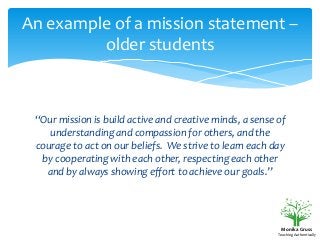
An example ofa mission statement –
older students
“Our mission is build active and creative minds, a sense of
understanding and compassion for others, and the
courage to act on our beliefs. We strive to learn each day
by cooperating with each other, respecting each other
and by always showing effort to achieve our goals.”
Monika Gruss
Teaching Authentically
6.
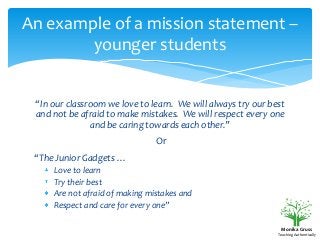
An example ofa mission statement –
younger students
“In our classroom we love to learn. We will always try our best
and not be afraid to make mistakes. We will respect every one
and be caring towards each other.”
Or
“The Junior Gadgets …
Love to learn
Try their best
Are not afraid of making mistakes and
Respect and care for every one”
Monika Gruss
Teaching Authentically
7.
5. Create aclass Emblem
Looking at your mission statement, discuss how their
class emblem may look like. This makes another great
literacy lesson looking at different emblems. I like
looking at the national emblem and discussing how
each part represents the country. Most students are
not aware of what is on our national emblem.
Monika Gruss
Teaching Authentically
8.
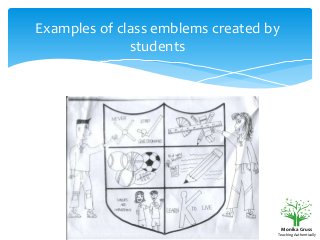
Examples of classemblems created by
students
Monika Gruss
Teaching Authentically
9.
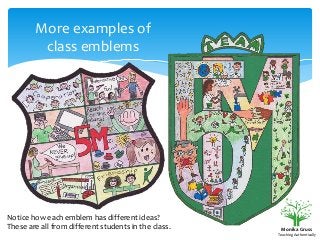
More examples of
classemblems
Notice how each emblem has different ideas?
These are all from different students in the class.
Monika Gruss
Teaching Authentically
10.
Display your missionstatement and
emblem
Display your mission statement and emblem in a spot
where every one can see.
Many classes display these on the front door as a
reminder and for all guests to look and read.
I like to take coloured copies and post one on the
door and one in the classroom for all to see, so I can
make reference to it through out the year (works a
treat!)
Monika Gruss
Teaching Authentically
11.
Collaborate Learning
The importantthing to remember during this process is
the art of making sure each student has a say and
agrees at each step of making the class mission.
We want every child to feel they have input into the
final product. A good way to do this is to use
collaborate learning strategies.
Monika Gruss
Teaching Authentically
12.
Collaborative Learning Strategy:
SharingSticks
To ensure that all students have had a say (and others don’t
control the conversation), create sharing sticks by placing
every student’s name on a paddle pop stick and placing it in a
bucket labeled “It’s my turn to share”.
Pull out a stick and the student on the stick can contribute, or
decide to share later. Once the student has shared, they can
be placed in another bucket labeled “I have shared”.
This is a good strategy for teachers to keep track of who has
shared, and who hasn’t.
N.B. Put your sharing tubs up high away from students as they have been
known to put their sticks in the “I have shared” bucket without you
knowing!!! Trust me, I know… cheeky little kids!
Monika Gruss
Teaching Authentically
13.
Collaborative Learning Strategy:
BlindVoting
Once you have a number of different
names/mottos, it is important for students to choose
fairly. To do this I often do ‘blind voting’ where
students cover their eyes, and put up their hand when
they want to vote for something. I find this really
important as a lot of students like to copy others. I
stress the importance of students using their own
minds, and this works best as they don’t have to
succumb to peer pressure by choosing what their
friends want.
Tally up the votes, and show the students the results.Monika Gruss
Teaching Authentically
14.
Collaborative Learning Strategy:
HotDotting & Bus Stop
1.
2.
3.
4.
Post all student’s drawings around the classroom in a circle.
Each student is given 3 or more sticker dots.
Begin the Bustop: All students walk around looking at each of the designs,
thinking about the ideas/concepts they like best.
Once the students have returned to their spot, ask them to now go and put
their dots on the ideas/designs they liked best.
N.B. Have extra stickers for you to put dots on students work that does not have many
dots. You want to make sure that no student feels bad that their work isn’t liked.
5.
6.
7.
8.
9.
Allow students to talk about the designs and what they liked. Write these
comments down.
Collect all the samples and comments and get a group of students (ask for the
class artists) to put all the ideas together to form one emblem.
Once complete, Artists present the emblem to the class and ask for feedback.
The artists make adjustments if necessary.
Repeat until the whole class agrees with the end product.
Monika Gruss
Teaching Authentically
15.
Ta Da!
You areon your way to creating a positive and
collaborate classroom culture.
If you are interested in further professional learning
opportunities, please check out my website.
www.monikagruss.com.au
Monika Gruss
Teaching Authentically