FLOW OF PRESENTATION

 Introduction
 Tetley

 Tale of Tata Tea

 LBO

 Structure of the Deal

 Synergies

 Pre-Post Merger
INTRODUCTION
   One of the most important milestones in the Indian
    corporate history.
   In the Year 2000, Tata Tea acquired the iconic Tetley
    Brand in a 450 m. $ deal from Schroeder Ventures
    and PPM ventures.
   Tata Tea managed to fend off bids from Sara Lee and
    Nestle
   At the time of acquisition, Tata Tea’s net worth was
    only $ 114 m.
   It was also the largest cross-border acquisition by an
    Indian company at that time.
   This was also the first ever leveraged buy-out by an
    Indian Company.
TETLEY

 Established by Joseph and Edward Tetley in
  1837 in Yorkshire, England.
 An Iconic brand, Tetley is considered to be
  the inventor of teabags
 At the time of acquisition, Tetley was the
  Second largest tea company in the World
 In India, Tata and Tetley Tea entered into a
  joint venture to produce tea bags in the Year
  1992
THE TALE OF TATA TEA
 Incorporated in 1962 as Tata Finlay Limited
 Tea factory in Munnar(Kerala) and
  blending/packaging unit in Banglore
 In 1982, renamed Tata Tea ltd. after Tata
  Industries Ltd. bought out the entire stake of
  James Finlay and co.
 Set up Tata tea Inc in Florida to meet the
  demands of US market
 In order to meet the needs of Japan market
  entered into JV with Hitachi to form Tata Hitachi
  Sales Limited
 In 1984, set up R&D facility in Munnar
 In 1989, bought 52% stake in Consolidate
  coffee limited of Karnataka
 By 1994 bought 64.5% stake in Asian Coffee
  to consolidate its position in the coffee
  industry
WHY THE DEAL MADE SENSE?

 Complementary specializations.
 Readymade access to the European and
  North American market.
 Financial setbacks for Tetley in recent years.

 Acquisition enabled Tetley to reduce its debt-
  equity ratio.
 Integration structure.
LEVERAGE BUY-OUT

 ●   Acquisition of a company through a combination of equity and
     debt
 ●   Jerome Kohlberg, Jr. and Henry Kravis coined the term
 ●   Formation of SPV
 ●   Stock Purchase Format
 ●   Asset Purchase Format
 ●   Management Buyout
 ●   Future Cash Flows or the Assets of the company as security
 ●   Increased Debt Equity ratio
ADVANTAGES OF LBO:


 ●   Heavy Interest & principal forces management to improve
     performance & operating efficiencies such as
 ●   Cost improvisation – cost reduction
 ●   Divesting non-core business
 ●   Investing in technological upgrades
 ●   Significant reduction in agency cost
 ●   Tax shield
DISADVANTAGES OF LBO


●   Financial distress – uncertainties
●   Increased fixed costs associated with debt financing
    can worn out the effect in case of downturn in
    business cycles.
●   In Leveraged acquisition, banks have a say in what is
    being done.
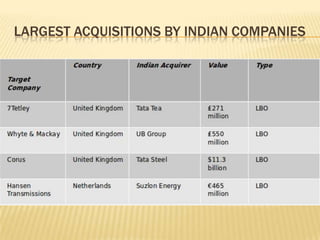
LARGEST ACQUISITIONS BY INDIAN COMPANIES
STRUCTURE OF THE DEAL

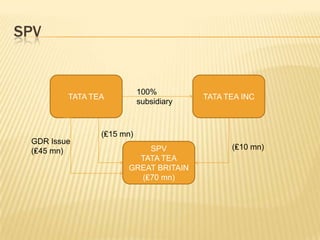
 Special Purpose Vehicle - Tata Tea(Great
  Britain)
 To acquire all the assets of Tetley

 To ensure that Tata Tea's balance sheet does
  not suffer additional funding costs
 Will be merged into Tata Tea Ltd, once it has
  paid its debt obligations
SPV


                           100%
         TATA TEA                       TATA TEA INC
                           subsidiary


                (₤15 mn)
 GDR Issue
 (₤45 mn)                 SPV                 (₤10 mn)
                        TATA TEA
                      GREAT BRITAIN
                        (₤70 mn)
SPV
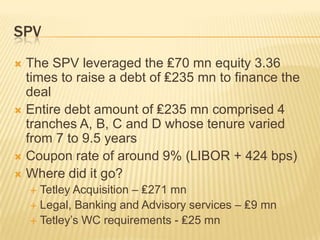
 The SPV leveraged the ₤70 mn equity 3.36
  times to raise a debt of ₤235 mn to finance the
  deal
 Entire debt amount of ₤235 mn comprised 4
  tranches A, B, C and D whose tenure varied
  from 7 to 9.5 years
 Coupon rate of around 9% (LIBOR + 424 bps)
 Where did it go?
     Tetley Acquisition – ₤271 mn
     Legal, Banking and Advisory services – ₤9 mn
     Tetley’s WC requirements - ₤25 mn
 Netherland based RABOBANK - ₤185mn
 Intermediate Capital Group - ₤30 mn

 Venture capital funds
     Mezzanine  - ₤10 mn
     Schroders - ₤10 mn

 Debt raised against Tetley’s brands and
  physical assets
 Valuation on the basis of future cash flows
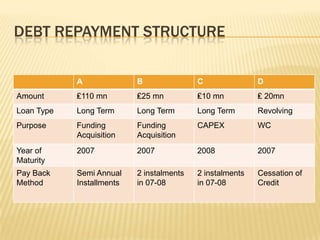
DEBT REPAYMENT STRUCTURE

            A              B               C               D
Amount      ₤110 mn        ₤25 mn          ₤10 mn          ₤ 20mn
Loan Type   Long Term      Long Term       Long Term       Revolving
Purpose     Funding        Funding         CAPEX           WC
            Acquisition    Acquisition
Year of     2007           2007            2008            2007
Maturity
Pay Back    Semi Annual    2 instalments   2 instalments   Cessation of
Method      Installments   in 07-08        in 07-08        Credit
TATA TEA                                                         SCHRODER
                      TATA TEA                   MEZZANINE
                                                                     S
  INC

                                          ₤10 mn       ₤10 mn
             GDR           ₤15 mn                                         INTERMEDIA
             ₤45 mn                                                        TE CAPITAL
                                                                             GROUP
                                                                ₤30 mn

    ₤10 mn                          TATA TEA
                                       GB                                 RADO BANK
                                                                ₤185 mn


                         EQUITY                           DEBT
                         ₤70 MN                          ₤235 MN
           ₤271 mn                       ₤9 mn                              ₤25 mn


        TETLEY                          LEGAL AND
       ACQUISITIO                          BANK                           TETLEY WC
           N                             CHARGES
MERGER - THE PROCESS

   In structured finance the word tranche refers to
    one of several related securitized bonds that are
    offered as part of the same deal. They are called
    tranches since each bond is a slice of the deal's
    risk.
   All the tranches together make up what is referred
    to as the deal's capital structure or liability structure
STRUCTURED FINANCE….


   Tailored financing solutions
   Financing with hybrid securities
   Asset-backed securitization
   Leveraged and acquisition finance
   Uses of structured finance:
       aligning securities to investor needs - term, credit
        risk, prepayment risk, interest rate risk, etc
CONCEPT OF SPV - EXPLAINED


   Tata Tea (GB) and SPV was created as a part of
    securitization process.
   Securitization is the process of pooling and
    repackaging of homogenous illiquid financial assets
    into marketable securities, that can be sold to
    investors.
   Tata Tea (GB) took over all the properties of Tetley
CONCEPT OF SPV - EXPLAINED

 Tata Tea originated Assets of Tetley through
  receivables, leases, any other form of debts and
  funded the same on it‟s BS. ( Originator)
 Portfolio of Tetley assets were then sold to Tata Tea
  (GB) – SPV for funding the assets.
CONCEPT OF SPV - EXPLAINED

 Tata Tea (GB) issues debts and purchased the assets
  from Tata Tea.
 Tata Tea (GB) was owned by Tata Tea

 Debts issued by Tata Tea are secured by assets
  acquired from Tetley ( Obligor).
 Tata Tea (GB) subcontracts the administration of
  assets back to Tata Tea.
CONCEPT OF SPV - EXPLAINED

 Tata Tea (GB) issued tradable securities – tranches to
  fund the purchase of assets.
 The performances of these tranches were directly
  linked to the performance of the assets
 RaboBank, Prudential Mezzanine Capital, Schroder
  Ventures and Intermediate Capital Group purchased
  the securities offered by Tata Tea (GB).
CONCEPT OF SPV - EXPLAINED

 They all invested because they were confident that the
  securities would be paid in full and on time from the
  cash flows that is made available from the asset pool.
 Money collected by Tata Tea (GB) was paid to Tata
  Tea.
 As cash flow arises on the assets, Tata Tea (GB) used
  for repaying funds to the investors in the securities.
SECURITIZATION – THE PROCESS
Advisor of the program
- Financial Advisor                         Receivables
- Legal Advisor            Originator                     Obligors
- Tax/Accounting Advisor
                                 Sales of pool       Third parties
                                   of assets
                                                     • Transaction Servicer
                                                     • Transaction Administrator
                                                     • Corporate Administrator
Credit Enhancement            SPV                    • Bondholders Representative
• Credit Enhancer
                                                     • Paying Agent
• Liquidity Provider               ABS               • Credit Rating Agency
• etc.                           Issuance            • Underwriter(s)


                           Investors
SECURITIZATION – THE PROCESS

   Tetley               Ancillary Service
   Obligor                  Provider
          Sale of Assets                    Issue of Securities


  Tata Tea               Tata Tea ( GB )
                                                      Investors
  Originator         Special Purpose Vehicle

             Consideration                  Subscription of securities
             for Assets purchased
SECURITIZATION – THE PROCESS

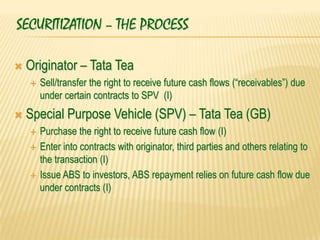
   Originator – Tata Tea
       Sell/transfer the right to receive future cash flows (“receivables”) due
        under certain contracts to SPV (I)
   Special Purpose Vehicle (SPV) – Tata Tea (GB)
       Purchase the right to receive future cash flow (I)
       Enter into contracts with originator, third parties and others relating to
        the transaction (I)
       Issue ABS to investors, ABS repayment relies on future cash flow due
        under contracts (I)
SECURITIZATION – THE PROCESS
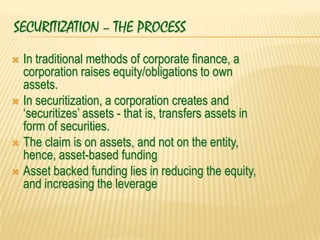
 In traditional methods of corporate finance, a
  corporation raises equity/obligations to own
  assets.
 In securitization, a corporation creates and
  „securitizes‟ assets - that is, transfers assets in
  form of securities.
 The claim is on assets, and not on the entity,
  hence, asset-based funding
 Asset backed funding lies in reducing the equity,
  and increasing the leverage
SECURITIZATION – THE PROCESS

 SPV are used in securitization transactions as devices
  of hiving off assets and converting assets into
  securities.
 SPV are not companies in substantive operations; they
  do not have any business except acting as a legal
  instrumentality. This is necessary to ensure “asset-
  backed” securities
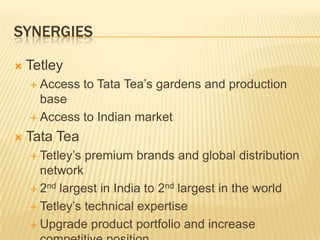
SYNERGIES

   Tetley
     Access     to Tata Tea’s gardens and production
      base
     Access to Indian market

   Tata Tea
     Tetley’s   premium brands and global distribution
      network
     2nd largest in India to 2nd largest in the world

     Tetley’s technical expertise

     Upgrade product portfolio and increase
POST MERGER
•Tetley was expected to bring TTL volumes in the
short term and greater opportunities in the long
term
•Tata and Tetley formed several groups – tea
procurement group, geographic expansion group,
R&D sharing
•Legal merger took time as Tetley D/E ratio was too
high and it needed to come down to 1:1
•Initial Cultural differences
•Acquisition contributed to significant increase in sales
volume – Rs. 6870 mn before acquisition to Rs. 67256 mn
in FY12 (CAGR of 18% approx.)


•As of FY12, Tetley brand contributes to 40% of Tata
Global Beverages revenue


•As of FY12, Tetley is the only brand under Tata Global
Beverages stable with presence across the globe
THANK YOU
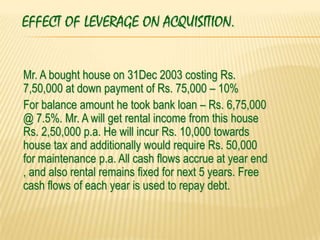
EFFECT OF LEVERAGE ON ACQUISITION.


Mr. A bought house on 31Dec 2003 costing Rs.
7,50,000 at down payment of Rs. 75,000 – 10%
For balance amount he took bank loan – Rs. 6,75,000
@ 7.5%. Mr. A will get rental income from this house
Rs. 2,50,000 p.a. He will incur Rs. 10,000 towards
house tax and additionally would require Rs. 50,000
for maintenance p.a. All cash flows accrue at year end
, and also rental remains fixed for next 5 years. Free
cash flows of each year is used to repay debt.
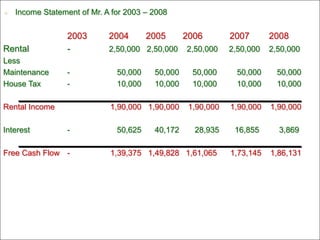
   Income Statement of Mr. A for 2003 – 2008


                  2003       2004       2005      2006        2007       2008
Rental            -          2,50,000 2,50,000    2,50,000    2,50,000   2,50,000
Less
Maintenance       -            50,000    50,000     50,000      50,000     50,000
House Tax         -            10,000    10,000     10,000      10,000     10,000

Rental Income                1,90,000 1,90,000     1,90,000   1,90,000   1,90,000

Interest          -            50,625    40,172     28,935     16,855      3,869

Free Cash Flow -             1,39,375 1,49,828 1,61,065       1,73,145   1,86,131
   Income Statement of Mr. A for 2003 – 2008
                  2003        2004       2005        2006        2007       2008
Loan Amount       6,75,000   6,75,000    5,35,625    3,85,797   2,24,732   51,587

Payments
Free Cash flows --              1,39,375 1,49,828 1,61,065 1,73,145 51,587
 - Free Cash flow as calculated earlier from rental income after expenses & interest.
Closing Bal.         6,75,000 5,35,625 3,85,797 2,24,732 51,587               0
Interest             --           50,625    40,172      28,935 16,855         3,869
- Closing bal = (opening bal – free cash flow )
  Interest is calculated on closing bal.

Debt              6,75,000   5,35,625     3,85,797    2,24,732 51,587      0
Equity              75,000   2,14,375     3,64,203    5,25,268 6,98,413 7,50,000

Ratio
Debt              90%         71.4%       51.4%       30%        6.9%        0%
Equity            10%         28.6%       48.6%       70%       93.1%       100%
LBO - INFERENCES

 Thus it is evident from Equity ownership as % of total
  capitalization increases from 10% to 100%.
 We can conclude that advantage of leverage in
  financing enable to own an asset of relatively
  significant equity value with regards to amount of initial
  equity investment.
Tata tetley

Tata tetley

  • 2.
    FLOW OF PRESENTATION Introduction  Tetley  Tale of Tata Tea  LBO  Structure of the Deal  Synergies  Pre-Post Merger
  • 3.
    INTRODUCTION  One of the most important milestones in the Indian corporate history.  In the Year 2000, Tata Tea acquired the iconic Tetley Brand in a 450 m. $ deal from Schroeder Ventures and PPM ventures.  Tata Tea managed to fend off bids from Sara Lee and Nestle  At the time of acquisition, Tata Tea’s net worth was only $ 114 m.  It was also the largest cross-border acquisition by an Indian company at that time.  This was also the first ever leveraged buy-out by an Indian Company.
  • 4.
    TETLEY  Established byJoseph and Edward Tetley in 1837 in Yorkshire, England.  An Iconic brand, Tetley is considered to be the inventor of teabags  At the time of acquisition, Tetley was the Second largest tea company in the World  In India, Tata and Tetley Tea entered into a joint venture to produce tea bags in the Year 1992
  • 5.
    THE TALE OFTATA TEA  Incorporated in 1962 as Tata Finlay Limited  Tea factory in Munnar(Kerala) and blending/packaging unit in Banglore  In 1982, renamed Tata Tea ltd. after Tata Industries Ltd. bought out the entire stake of James Finlay and co.  Set up Tata tea Inc in Florida to meet the demands of US market  In order to meet the needs of Japan market entered into JV with Hitachi to form Tata Hitachi Sales Limited
  • 6.
     In 1984,set up R&D facility in Munnar  In 1989, bought 52% stake in Consolidate coffee limited of Karnataka  By 1994 bought 64.5% stake in Asian Coffee to consolidate its position in the coffee industry
  • 7.
    WHY THE DEALMADE SENSE?  Complementary specializations.  Readymade access to the European and North American market.  Financial setbacks for Tetley in recent years.  Acquisition enabled Tetley to reduce its debt- equity ratio.  Integration structure.
  • 8.
    LEVERAGE BUY-OUT ● Acquisition of a company through a combination of equity and debt ● Jerome Kohlberg, Jr. and Henry Kravis coined the term ● Formation of SPV ● Stock Purchase Format ● Asset Purchase Format ● Management Buyout ● Future Cash Flows or the Assets of the company as security ● Increased Debt Equity ratio
  • 10.
    ADVANTAGES OF LBO: ● Heavy Interest & principal forces management to improve performance & operating efficiencies such as ● Cost improvisation – cost reduction ● Divesting non-core business ● Investing in technological upgrades ● Significant reduction in agency cost ● Tax shield
  • 11.
    DISADVANTAGES OF LBO ● Financial distress – uncertainties ● Increased fixed costs associated with debt financing can worn out the effect in case of downturn in business cycles. ● In Leveraged acquisition, banks have a say in what is being done.
  • 12.
    LARGEST ACQUISITIONS BYINDIAN COMPANIES
  • 13.
    STRUCTURE OF THEDEAL  Special Purpose Vehicle - Tata Tea(Great Britain)  To acquire all the assets of Tetley  To ensure that Tata Tea's balance sheet does not suffer additional funding costs  Will be merged into Tata Tea Ltd, once it has paid its debt obligations
  • 14.
    SPV 100% TATA TEA TATA TEA INC subsidiary (₤15 mn) GDR Issue (₤45 mn) SPV (₤10 mn) TATA TEA GREAT BRITAIN (₤70 mn)
  • 15.
    SPV  The SPVleveraged the ₤70 mn equity 3.36 times to raise a debt of ₤235 mn to finance the deal  Entire debt amount of ₤235 mn comprised 4 tranches A, B, C and D whose tenure varied from 7 to 9.5 years  Coupon rate of around 9% (LIBOR + 424 bps)  Where did it go?  Tetley Acquisition – ₤271 mn  Legal, Banking and Advisory services – ₤9 mn  Tetley’s WC requirements - ₤25 mn
  • 16.
     Netherland basedRABOBANK - ₤185mn  Intermediate Capital Group - ₤30 mn  Venture capital funds  Mezzanine - ₤10 mn  Schroders - ₤10 mn  Debt raised against Tetley’s brands and physical assets  Valuation on the basis of future cash flows
  • 17.
    DEBT REPAYMENT STRUCTURE A B C D Amount ₤110 mn ₤25 mn ₤10 mn ₤ 20mn Loan Type Long Term Long Term Long Term Revolving Purpose Funding Funding CAPEX WC Acquisition Acquisition Year of 2007 2007 2008 2007 Maturity Pay Back Semi Annual 2 instalments 2 instalments Cessation of Method Installments in 07-08 in 07-08 Credit
  • 18.
    TATA TEA SCHRODER TATA TEA MEZZANINE S INC ₤10 mn ₤10 mn GDR ₤15 mn INTERMEDIA ₤45 mn TE CAPITAL GROUP ₤30 mn ₤10 mn TATA TEA GB RADO BANK ₤185 mn EQUITY DEBT ₤70 MN ₤235 MN ₤271 mn ₤9 mn ₤25 mn TETLEY LEGAL AND ACQUISITIO BANK TETLEY WC N CHARGES
  • 19.
    MERGER - THEPROCESS  In structured finance the word tranche refers to one of several related securitized bonds that are offered as part of the same deal. They are called tranches since each bond is a slice of the deal's risk.  All the tranches together make up what is referred to as the deal's capital structure or liability structure
  • 20.
    STRUCTURED FINANCE….  Tailored financing solutions  Financing with hybrid securities  Asset-backed securitization  Leveraged and acquisition finance  Uses of structured finance:  aligning securities to investor needs - term, credit risk, prepayment risk, interest rate risk, etc
  • 21.
    CONCEPT OF SPV- EXPLAINED  Tata Tea (GB) and SPV was created as a part of securitization process.  Securitization is the process of pooling and repackaging of homogenous illiquid financial assets into marketable securities, that can be sold to investors.  Tata Tea (GB) took over all the properties of Tetley
  • 22.
    CONCEPT OF SPV- EXPLAINED  Tata Tea originated Assets of Tetley through receivables, leases, any other form of debts and funded the same on it‟s BS. ( Originator)  Portfolio of Tetley assets were then sold to Tata Tea (GB) – SPV for funding the assets.
  • 23.
    CONCEPT OF SPV- EXPLAINED  Tata Tea (GB) issues debts and purchased the assets from Tata Tea.  Tata Tea (GB) was owned by Tata Tea  Debts issued by Tata Tea are secured by assets acquired from Tetley ( Obligor).  Tata Tea (GB) subcontracts the administration of assets back to Tata Tea.
  • 24.
    CONCEPT OF SPV- EXPLAINED  Tata Tea (GB) issued tradable securities – tranches to fund the purchase of assets.  The performances of these tranches were directly linked to the performance of the assets  RaboBank, Prudential Mezzanine Capital, Schroder Ventures and Intermediate Capital Group purchased the securities offered by Tata Tea (GB).
  • 25.
    CONCEPT OF SPV- EXPLAINED  They all invested because they were confident that the securities would be paid in full and on time from the cash flows that is made available from the asset pool.  Money collected by Tata Tea (GB) was paid to Tata Tea.  As cash flow arises on the assets, Tata Tea (GB) used for repaying funds to the investors in the securities.
  • 26.
    SECURITIZATION – THEPROCESS Advisor of the program - Financial Advisor Receivables - Legal Advisor Originator Obligors - Tax/Accounting Advisor Sales of pool Third parties of assets • Transaction Servicer • Transaction Administrator • Corporate Administrator Credit Enhancement SPV • Bondholders Representative • Credit Enhancer • Paying Agent • Liquidity Provider ABS • Credit Rating Agency • etc. Issuance • Underwriter(s) Investors
  • 27.
    SECURITIZATION – THEPROCESS Tetley Ancillary Service Obligor Provider Sale of Assets Issue of Securities Tata Tea Tata Tea ( GB ) Investors Originator Special Purpose Vehicle Consideration Subscription of securities for Assets purchased
  • 28.
    SECURITIZATION – THEPROCESS  Originator – Tata Tea  Sell/transfer the right to receive future cash flows (“receivables”) due under certain contracts to SPV (I)  Special Purpose Vehicle (SPV) – Tata Tea (GB)  Purchase the right to receive future cash flow (I)  Enter into contracts with originator, third parties and others relating to the transaction (I)  Issue ABS to investors, ABS repayment relies on future cash flow due under contracts (I)
  • 29.
    SECURITIZATION – THEPROCESS  In traditional methods of corporate finance, a corporation raises equity/obligations to own assets.  In securitization, a corporation creates and „securitizes‟ assets - that is, transfers assets in form of securities.  The claim is on assets, and not on the entity, hence, asset-based funding  Asset backed funding lies in reducing the equity, and increasing the leverage
  • 30.
    SECURITIZATION – THEPROCESS  SPV are used in securitization transactions as devices of hiving off assets and converting assets into securities.  SPV are not companies in substantive operations; they do not have any business except acting as a legal instrumentality. This is necessary to ensure “asset- backed” securities
  • 31.
    SYNERGIES  Tetley  Access to Tata Tea’s gardens and production base  Access to Indian market  Tata Tea  Tetley’s premium brands and global distribution network  2nd largest in India to 2nd largest in the world  Tetley’s technical expertise  Upgrade product portfolio and increase
  • 32.
    POST MERGER •Tetley wasexpected to bring TTL volumes in the short term and greater opportunities in the long term •Tata and Tetley formed several groups – tea procurement group, geographic expansion group, R&D sharing •Legal merger took time as Tetley D/E ratio was too high and it needed to come down to 1:1 •Initial Cultural differences
  • 33.
    •Acquisition contributed tosignificant increase in sales volume – Rs. 6870 mn before acquisition to Rs. 67256 mn in FY12 (CAGR of 18% approx.) •As of FY12, Tetley brand contributes to 40% of Tata Global Beverages revenue •As of FY12, Tetley is the only brand under Tata Global Beverages stable with presence across the globe
  • 34.
  • 35.
    EFFECT OF LEVERAGEON ACQUISITION. Mr. A bought house on 31Dec 2003 costing Rs. 7,50,000 at down payment of Rs. 75,000 – 10% For balance amount he took bank loan – Rs. 6,75,000 @ 7.5%. Mr. A will get rental income from this house Rs. 2,50,000 p.a. He will incur Rs. 10,000 towards house tax and additionally would require Rs. 50,000 for maintenance p.a. All cash flows accrue at year end , and also rental remains fixed for next 5 years. Free cash flows of each year is used to repay debt.
  • 36.
    Income Statement of Mr. A for 2003 – 2008 2003 2004 2005 2006 2007 2008 Rental - 2,50,000 2,50,000 2,50,000 2,50,000 2,50,000 Less Maintenance - 50,000 50,000 50,000 50,000 50,000 House Tax - 10,000 10,000 10,000 10,000 10,000 Rental Income 1,90,000 1,90,000 1,90,000 1,90,000 1,90,000 Interest - 50,625 40,172 28,935 16,855 3,869 Free Cash Flow - 1,39,375 1,49,828 1,61,065 1,73,145 1,86,131
  • 37.
    Income Statement of Mr. A for 2003 – 2008 2003 2004 2005 2006 2007 2008 Loan Amount 6,75,000 6,75,000 5,35,625 3,85,797 2,24,732 51,587 Payments Free Cash flows -- 1,39,375 1,49,828 1,61,065 1,73,145 51,587 - Free Cash flow as calculated earlier from rental income after expenses & interest. Closing Bal. 6,75,000 5,35,625 3,85,797 2,24,732 51,587 0 Interest -- 50,625 40,172 28,935 16,855 3,869 - Closing bal = (opening bal – free cash flow ) Interest is calculated on closing bal. Debt 6,75,000 5,35,625 3,85,797 2,24,732 51,587 0 Equity 75,000 2,14,375 3,64,203 5,25,268 6,98,413 7,50,000 Ratio Debt 90% 71.4% 51.4% 30% 6.9% 0% Equity 10% 28.6% 48.6% 70% 93.1% 100%
  • 38.
    LBO - INFERENCES Thus it is evident from Equity ownership as % of total capitalization increases from 10% to 100%.  We can conclude that advantage of leverage in financing enable to own an asset of relatively significant equity value with regards to amount of initial equity investment.