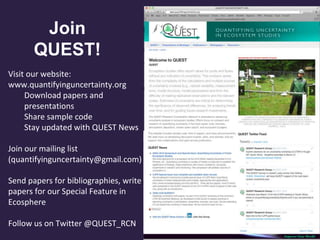
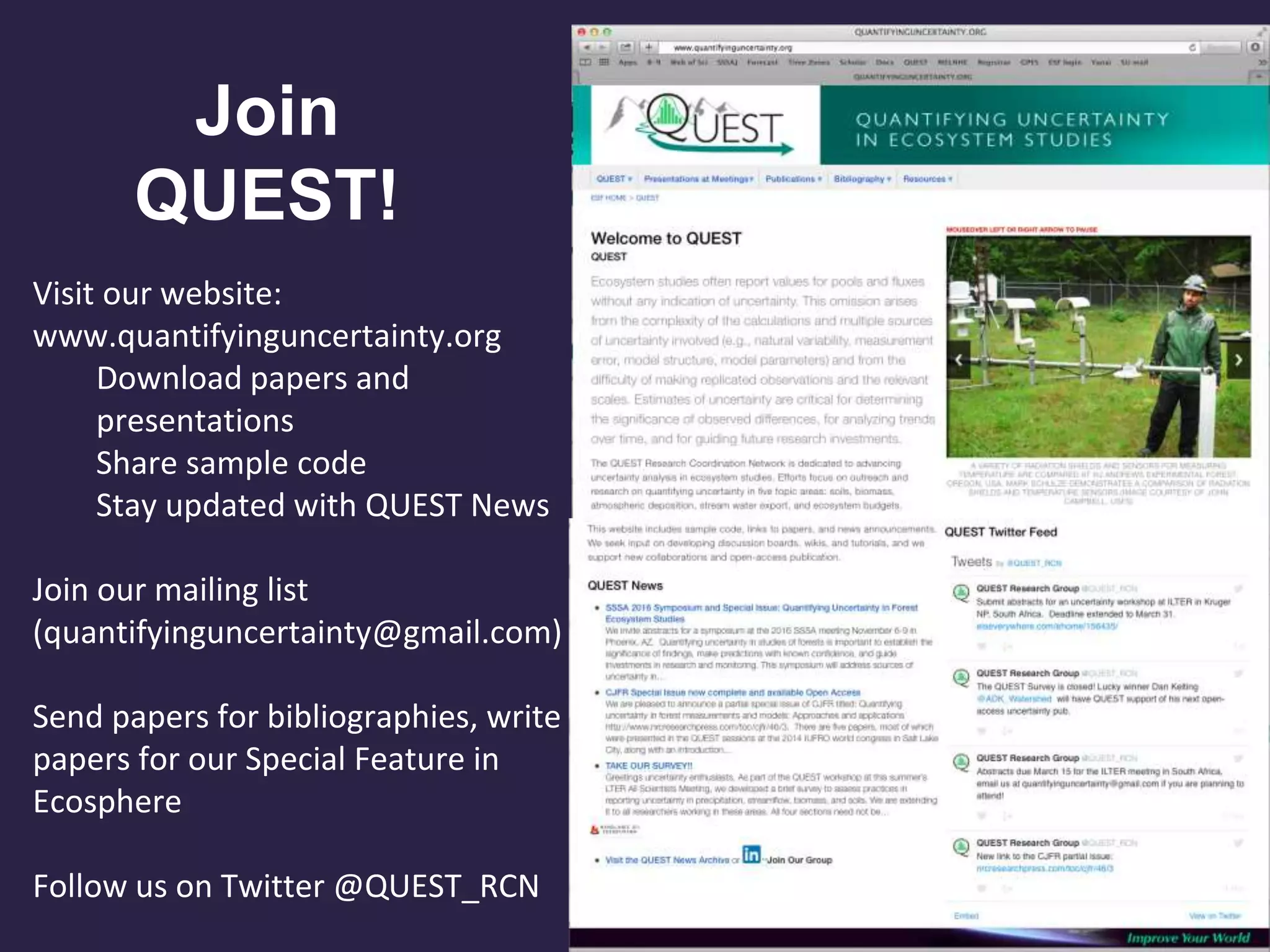
Visit our website:
www.quantifyinguncertainty.org
Download papers and
presentations
Share sample code
Stay updated with QUEST News
Join our mailing list
(quantifyinguncertainty@gmail.com)
Send papers for bibliographies, write
papers for our Special Feature in
Ecosphere
Follow us on Twitter @QUEST_RCN
Join
QUEST!
We don’t want to sample too little and not detect an
important effect.
But collecting and analyzing samples is expensive,
so we don’t want to sample more intensively than
necessary.
Quantifying the relationship between sampling
intensity and minimum detectable differences can help
Better Monitoring through Uncertainty Analysis:
Optimize allocation of effort,
save time and money
Plan for the Workshop
Introductions: name, where you are from, what you
monitor, what are your concerns (too much, too little, how
can we help you today)
Presentations (5 minutes each, followed by discussion, no
more than 10 minutes total for each)
• Craig See: Taxonomy of Uncertainty, Results of the
QUEST Survey (we may not know what uncertainties are
important)
• Christine Laney: NEON examples
• Mark Green: rain gauge reduction example (HBR)
• Yang Yang: Hg monitoring, loons and fish (detectable
difference or rate of change)
• Ruth Yanai: NH roots, Calhoun soils (detectable
difference or rate of change)
• Alex Young: monitoring measurement uncertainty in the
FIA (confidence in inputs, waiting on sensitivity)
General Discussion: Did this help you? What do you still
need, and how can we help with that?
Current Practices in
Reporting Uncertainty
in Ecosystem Ecology
Ruth Yanai, State University of New York
Craig See, University of Minnesota
John Campbell, United States Forest Service
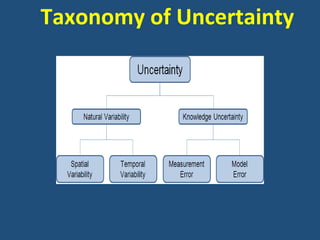
Taxonomy of Uncertainty
Survey Distribution
Listserves: Additional
Distribution:
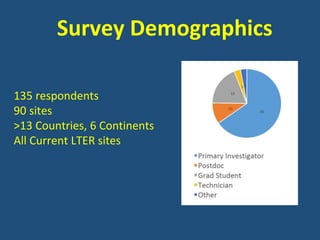
Survey Demographics
135 respondents
90 sites
>13 Countries, 6 Continents
All Current LTER sites
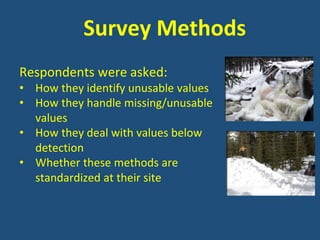
Survey Methods
Respondents were asked:
• How they identify unusable values
• How they handle missing/unusable
values
• How they deal with values below
detection
• Whether these methods are
standardized at their site
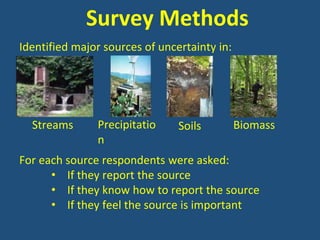
Survey Methods
Identified major sources of uncertainty in:
For each source respondents were asked:
• If they report the source
• If they know how to report the source
• If they feel the source is important
Streams Precipitatio
n
Soils Biomass
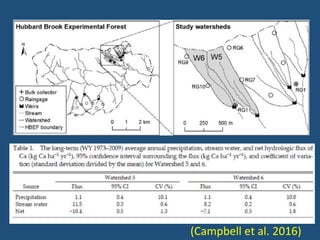
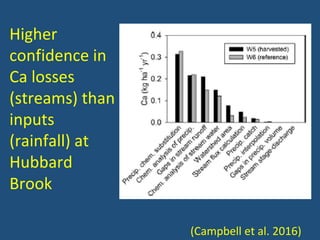
(Campbell et al. 2016)
Higher
confidence in
Ca losses
(streams) than
inputs
(rainfall) at
Hubbard
Brook
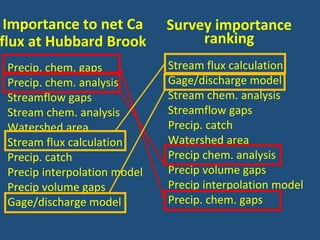
Importance to net Ca
flux at Hubbard Brook
Precip. chem. gaps
Precip. chem. analysis
Streamflow gaps
Stream chem. analysis
Watershed area
Stream flux calculation
Precip. catch
Precip interpolation model
Precip volume gaps
Gage/discharge model
Stream flux calculation
Gage/discharge model
Stream chem. analysis
Streamflow gaps
Precip. catch
Watershed area
Precip chem. analysis
Precip volume gaps
Precip interpolation model
Precip. chem. gaps
Survey importance
ranking
Summary
We did a survey
It can be hard to tell which sources of uncertainty
matter, so it’s important to formally check
This can save you time and money! You can do
more with less!
Thank You

Intro for asm workshop see

  • 1.
    Visit our website: www.quantifyinguncertainty.org Downloadpapers and presentations Share sample code Stay updated with QUEST News Join our mailing list (quantifyinguncertainty@gmail.com) Send papers for bibliographies, write papers for our Special Feature in Ecosphere Follow us on Twitter @QUEST_RCN Join QUEST!
  • 2.
    We don’t wantto sample too little and not detect an important effect. But collecting and analyzing samples is expensive, so we don’t want to sample more intensively than necessary. Quantifying the relationship between sampling intensity and minimum detectable differences can help Better Monitoring through Uncertainty Analysis: Optimize allocation of effort, save time and money
  • 3.
    Plan for theWorkshop Introductions: name, where you are from, what you monitor, what are your concerns (too much, too little, how can we help you today) Presentations (5 minutes each, followed by discussion, no more than 10 minutes total for each) • Craig See: Taxonomy of Uncertainty, Results of the QUEST Survey (we may not know what uncertainties are important) • Christine Laney: NEON examples • Mark Green: rain gauge reduction example (HBR) • Yang Yang: Hg monitoring, loons and fish (detectable difference or rate of change) • Ruth Yanai: NH roots, Calhoun soils (detectable difference or rate of change) • Alex Young: monitoring measurement uncertainty in the FIA (confidence in inputs, waiting on sensitivity) General Discussion: Did this help you? What do you still need, and how can we help with that?
  • 4.
    Current Practices in ReportingUncertainty in Ecosystem Ecology Ruth Yanai, State University of New York Craig See, University of Minnesota John Campbell, United States Forest Service
  • 5.
  • 6.
  • 7.
    Survey Demographics 135 respondents 90sites >13 Countries, 6 Continents All Current LTER sites
  • 8.
    Survey Methods Respondents wereasked: • How they identify unusable values • How they handle missing/unusable values • How they deal with values below detection • Whether these methods are standardized at their site
  • 9.
    Survey Methods Identified majorsources of uncertainty in: For each source respondents were asked: • If they report the source • If they know how to report the source • If they feel the source is important Streams Precipitatio n Soils Biomass
  • 11.
  • 12.
    (Campbell et al.2016) Higher confidence in Ca losses (streams) than inputs (rainfall) at Hubbard Brook
  • 13.
    Importance to netCa flux at Hubbard Brook Precip. chem. gaps Precip. chem. analysis Streamflow gaps Stream chem. analysis Watershed area Stream flux calculation Precip. catch Precip interpolation model Precip volume gaps Gage/discharge model Stream flux calculation Gage/discharge model Stream chem. analysis Streamflow gaps Precip. catch Watershed area Precip chem. analysis Precip volume gaps Precip interpolation model Precip. chem. gaps Survey importance ranking
  • 14.
    Summary We did asurvey It can be hard to tell which sources of uncertainty matter, so it’s important to formally check This can save you time and money! You can do more with less!
  • 15.