For any Assignment related queries, Call us at : - +1 678 648 4277
You can mail us at : - info@mathsassignmenthelp.com or
reach us at : - https://www.mathsassignmenthelp.com/
mathsassignmenthel.com
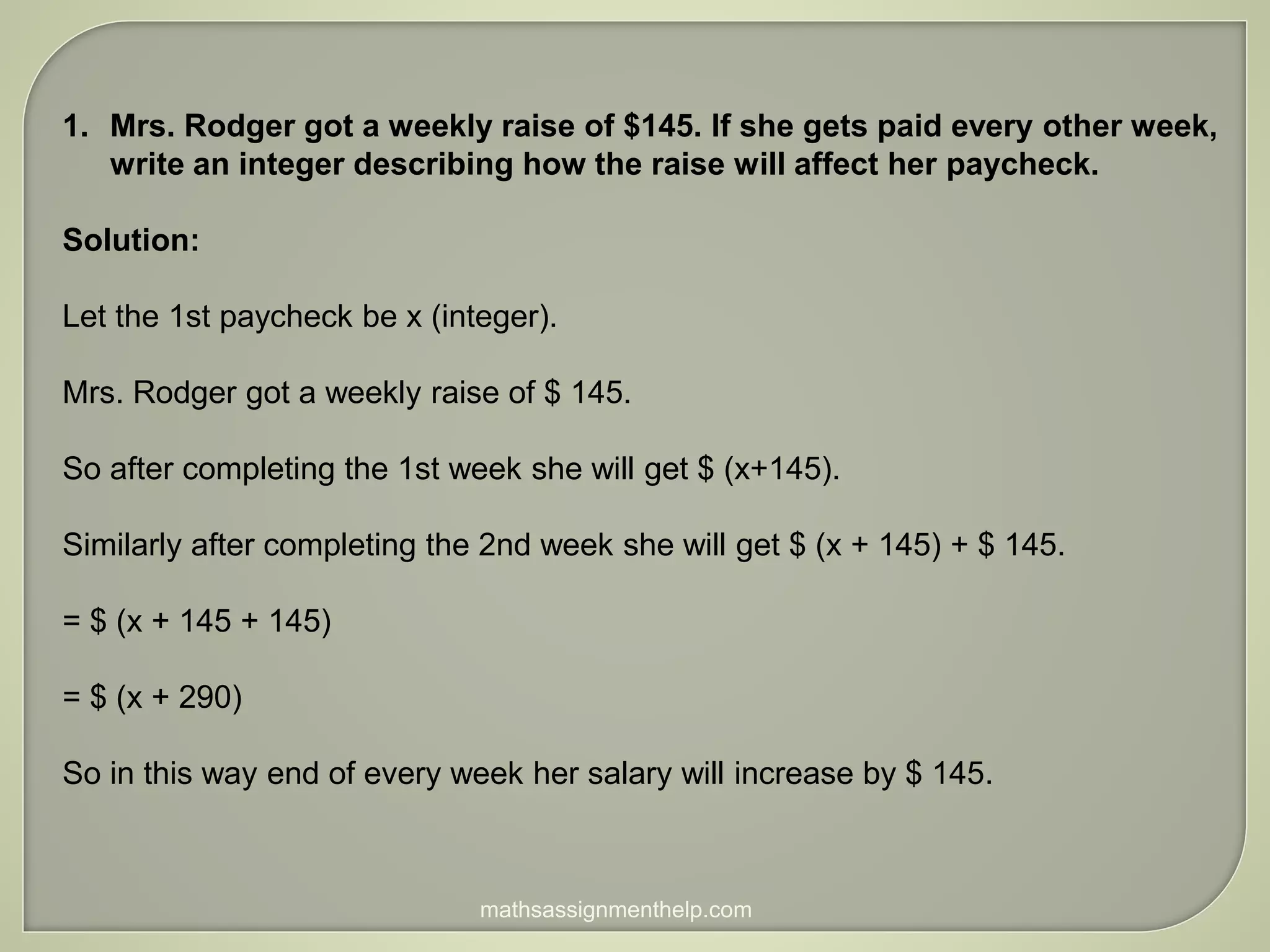
1. Mrs. Rodger got a weekly raise of $145. If she gets paid every other week,
write an integer describing how the raise will affect her paycheck.
Solution:
Let the 1st paycheck be x (integer).
Mrs. Rodger got a weekly raise of $ 145.
So after completing the 1st week she will get $ (x+145).
Similarly after completing the 2nd week she will get $ (x + 145) + $ 145.
= $ (x + 145 + 145)
= $ (x + 290)
So in this way end of every week her salary will increase by $ 145.
mathsassignmenthelp.com
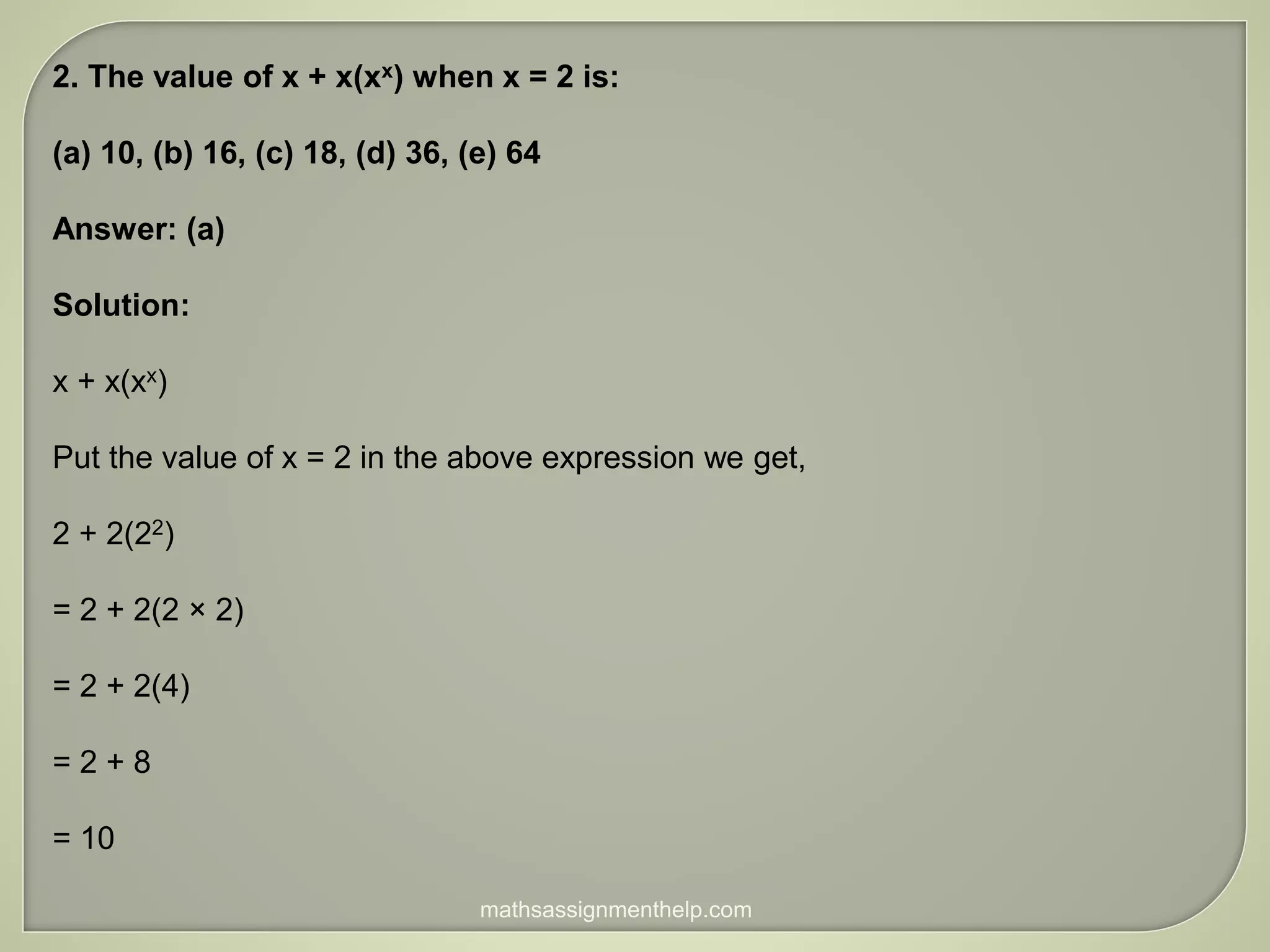
2. The value of x + x(xx) when x = 2 is:
(a) 10, (b) 16, (c) 18, (d) 36, (e) 64
Answer: (a)
Solution:
x + x(xx)
Put the value of x = 2 in the above expression we get,
2 + 2(22)
= 2 + 2(2 × 2)
= 2 + 2(4)
= 2 + 8
= 10
mathsassignmenthelp.com
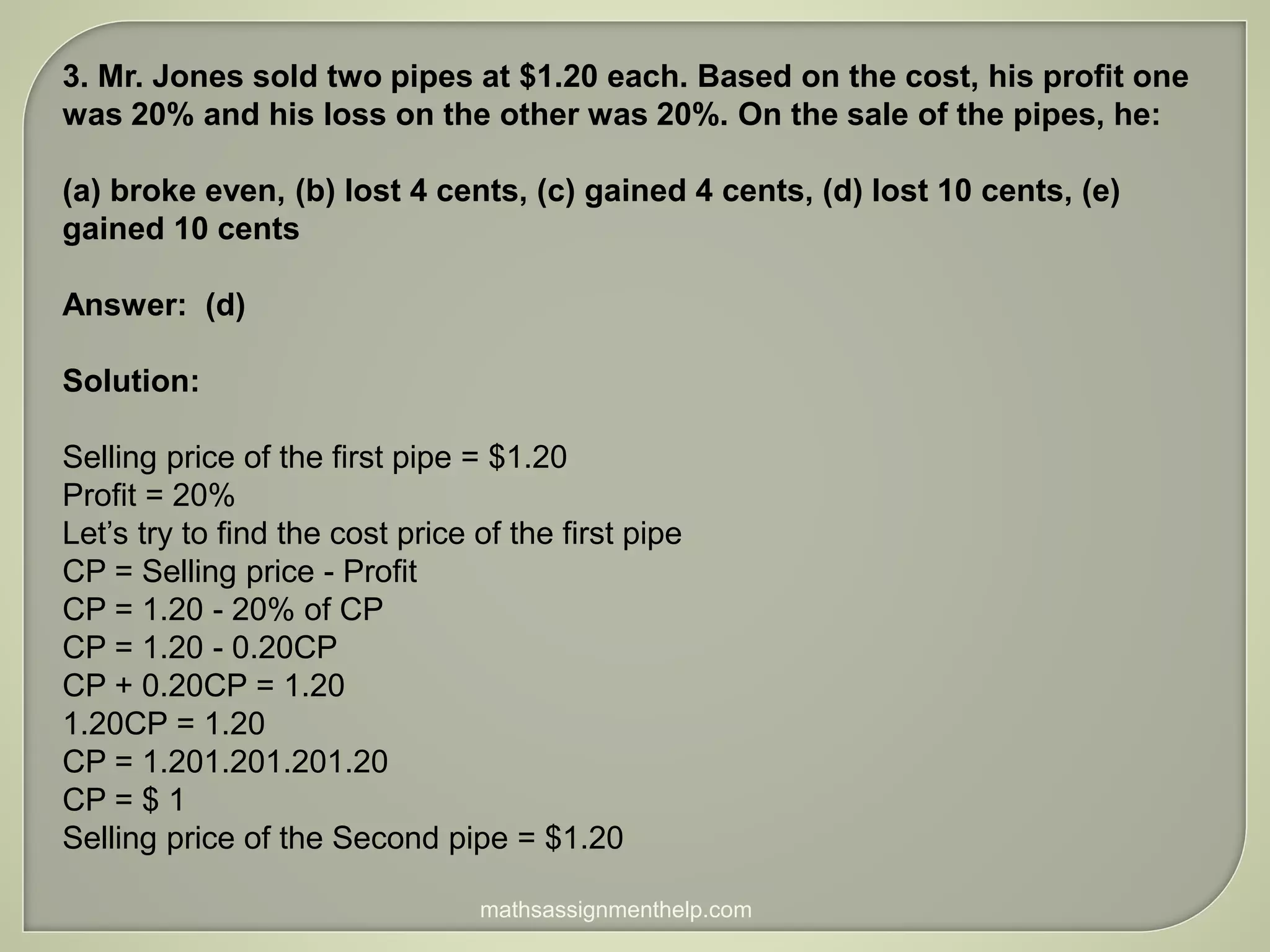
3. Mr. Jones sold two pipes at $1.20 each. Based on the cost, his profit one
was 20% and his loss on the other was 20%. On the sale of the pipes, he:
(a) broke even, (b) lost 4 cents, (c) gained 4 cents, (d) lost 10 cents, (e)
gained 10 cents
Answer: (d)
Solution:
Selling price of the first pipe = $1.20
Profit = 20%
Let’s try to find the cost price of the first pipe
CP = Selling price - Profit
CP = 1.20 - 20% of CP
CP = 1.20 - 0.20CP
CP + 0.20CP = 1.20
1.20CP = 1.20
CP = 1.201.201.201.20
CP = $ 1
Selling price of the Second pipe = $1.20
mathsassignmenthelp.com
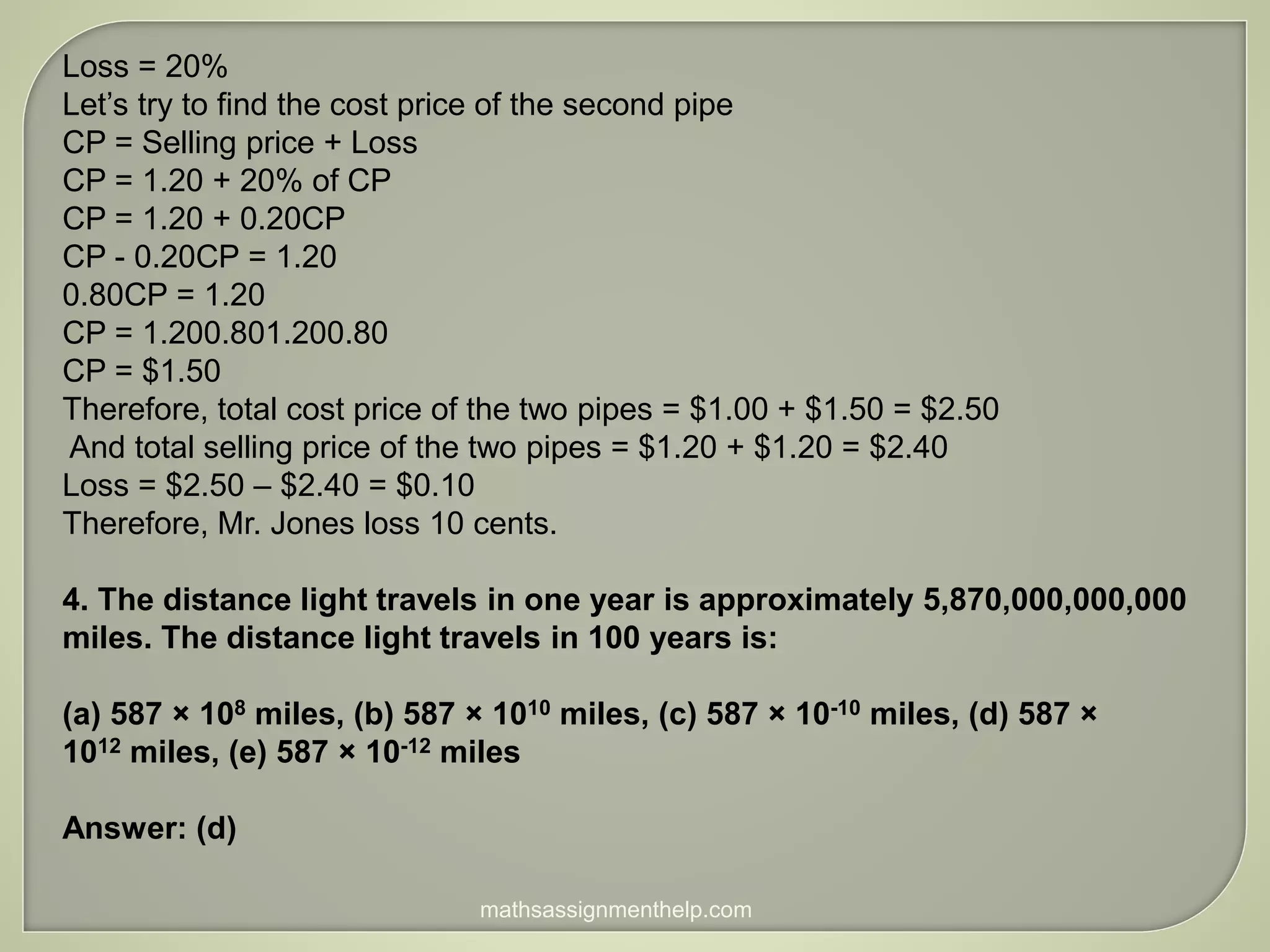
Loss = 20%
Let’s try to find the cost price of the second pipe
CP = Selling price + Loss
CP = 1.20 + 20% of CP
CP = 1.20 + 0.20CP
CP - 0.20CP = 1.20
0.80CP = 1.20
CP = 1.200.801.200.80
CP = $1.50
Therefore, total cost price of the two pipes = $1.00 + $1.50 = $2.50
And total selling price of the two pipes = $1.20 + $1.20 = $2.40
Loss = $2.50 – $2.40 = $0.10
Therefore, Mr. Jones loss 10 cents.
4. The distance light travels in one year is approximately 5,870,000,000,000
miles. The distance light travels in 100 years is:
(a) 587 × 108 miles, (b) 587 × 1010 miles, (c) 587 × 10-10 miles, (d) 587 ×
1012 miles, (e) 587 × 10-12 miles
Answer: (d)
mathsassignmenthelp.com
Solution:
The distance of the light travels in 100 years is:
5,870,000,000,000 × 100 miles.
= 587,000,000,000,000 miles.
= 587 × 1012 miles.
5. A man has $ 10,000 to invest. He invests $ 4000 at 5 % and $ 3500 at 4 %. In
order to have a yearly income of $ 500, he must invest the remainder at:
(a) 6 % , (b) 6.1 %, (c) 6.2 %, (d) 6.3 %, (e) 6.4 %
Answer: (e)
Solution:
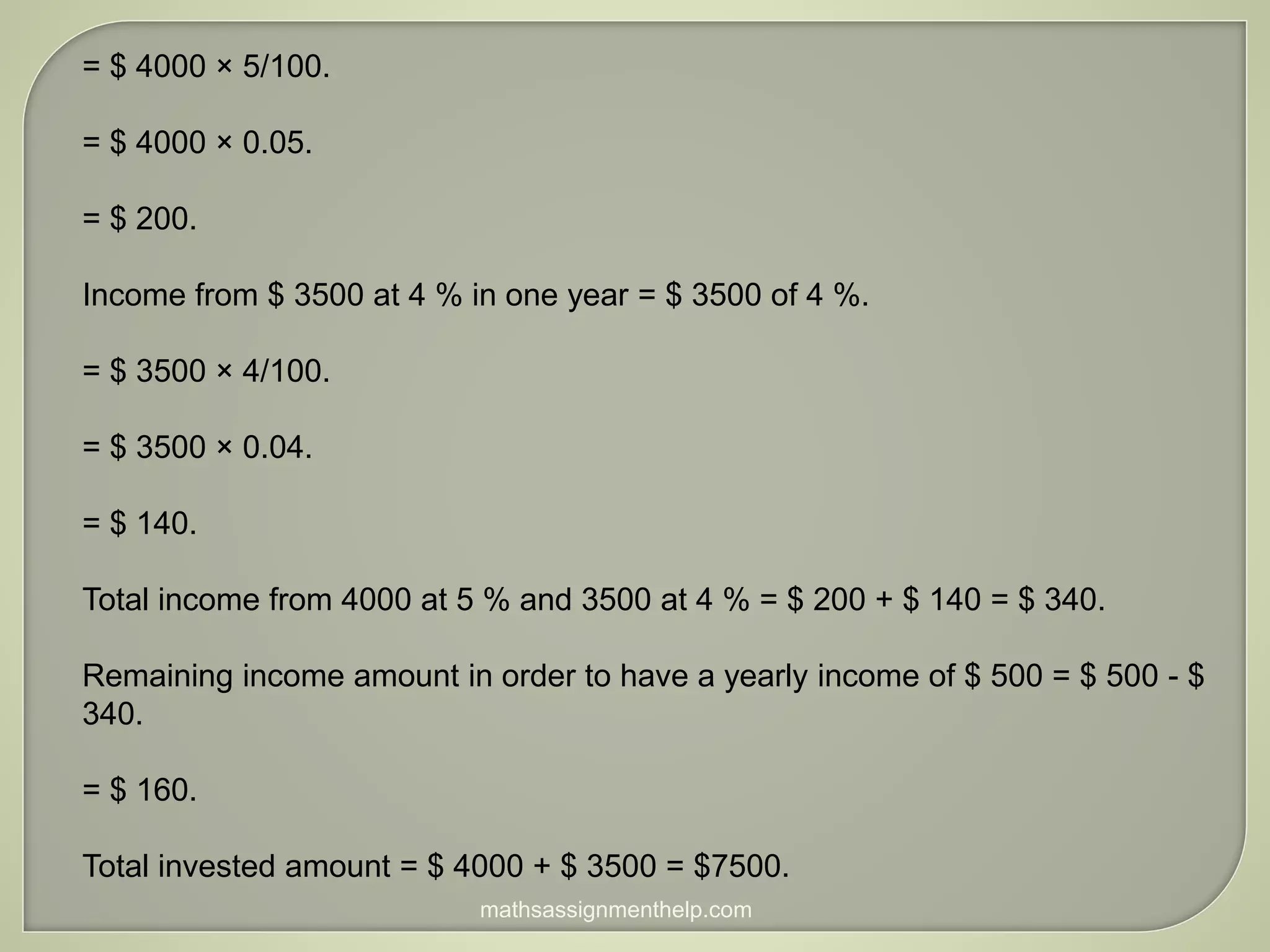
Income from $ 4000 at 5 % in one year = $ 4000 of 5 %.
mathsassignmenthelp.com
= $ 4000 × 5/100.
= $ 4000 × 0.05.
= $ 200.
Income from $ 3500 at 4 % in one year = $ 3500 of 4 %.
= $ 3500 × 4/100.
= $ 3500 × 0.04.
= $ 140.
Total income from 4000 at 5 % and 3500 at 4 % = $ 200 + $ 140 = $ 340.
Remaining income amount in order to have a yearly income of $ 500 = $ 500 - $
340.
= $ 160.
Total invested amount = $ 4000 + $ 3500 = $7500.
mathsassignmenthelp.com
Remaining invest amount = $ 10000 - $ 7500 = $ 2500.
We know that, Interest = Principal × Rate × Time
Interest = $ 160,
Principal = $ 2500,
Rate = r [we need to find the value of r],
Time = 1 year.
160 = 2500 × r × 1.
160 = 2500r
160/2500 = 2500r/2500 [divide both sides by 2500]
0.064 = r
r = 0.064
mathsassignmenthelp.com
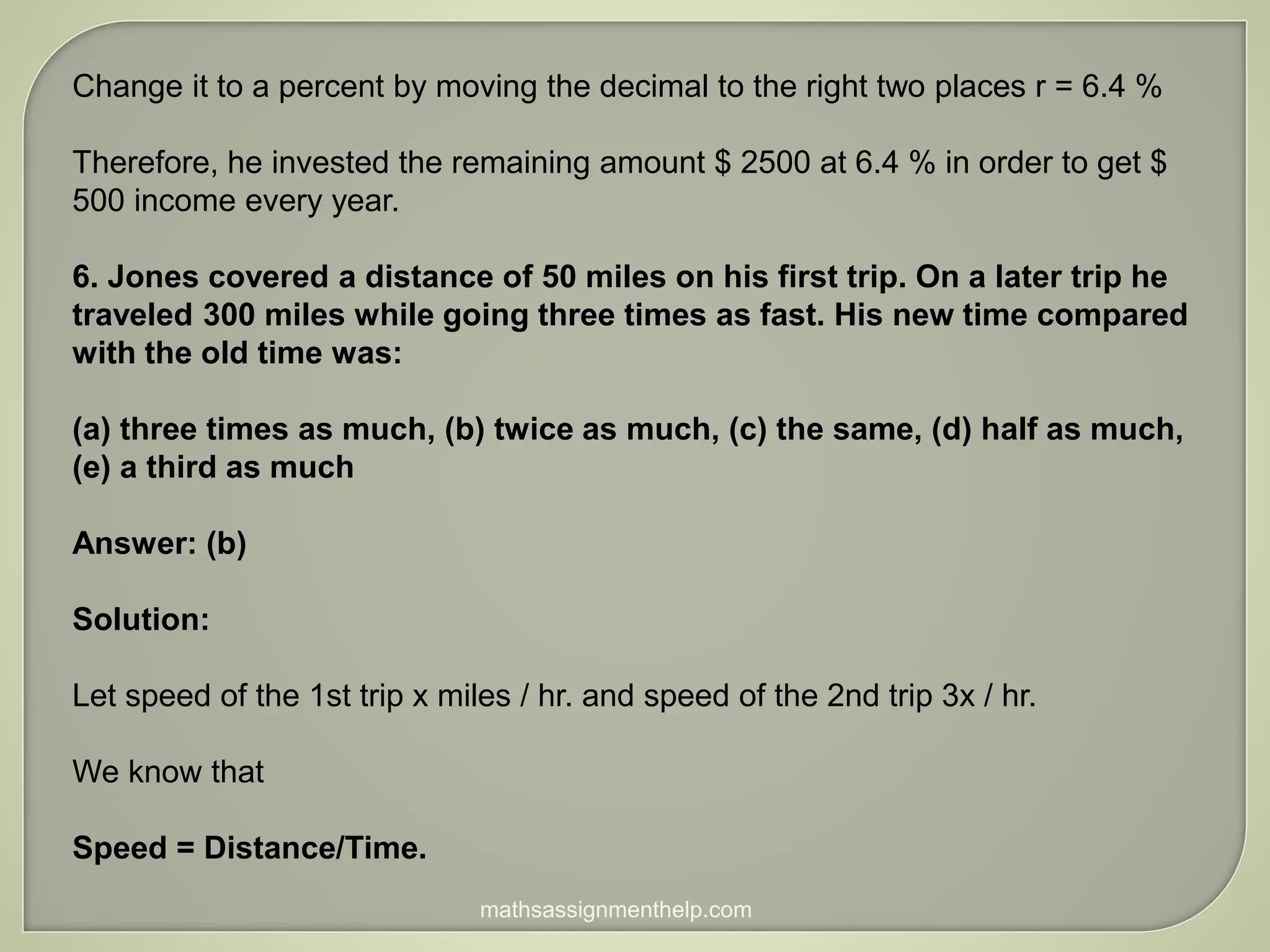
Change it to a percent by moving the decimal to the right two places r = 6.4 %
Therefore, he invested the remaining amount $ 2500 at 6.4 % in order to get $
500 income every year.
6. Jones covered a distance of 50 miles on his first trip. On a later trip he
traveled 300 miles while going three times as fast. His new time compared
with the old time was:
(a) three times as much, (b) twice as much, (c) the same, (d) half as much,
(e) a third as much
Answer: (b)
Solution:
Let speed of the 1st trip x miles / hr. and speed of the 2nd trip 3x / hr.
We know that
Speed = Distance/Time.
mathsassignmenthelp.com
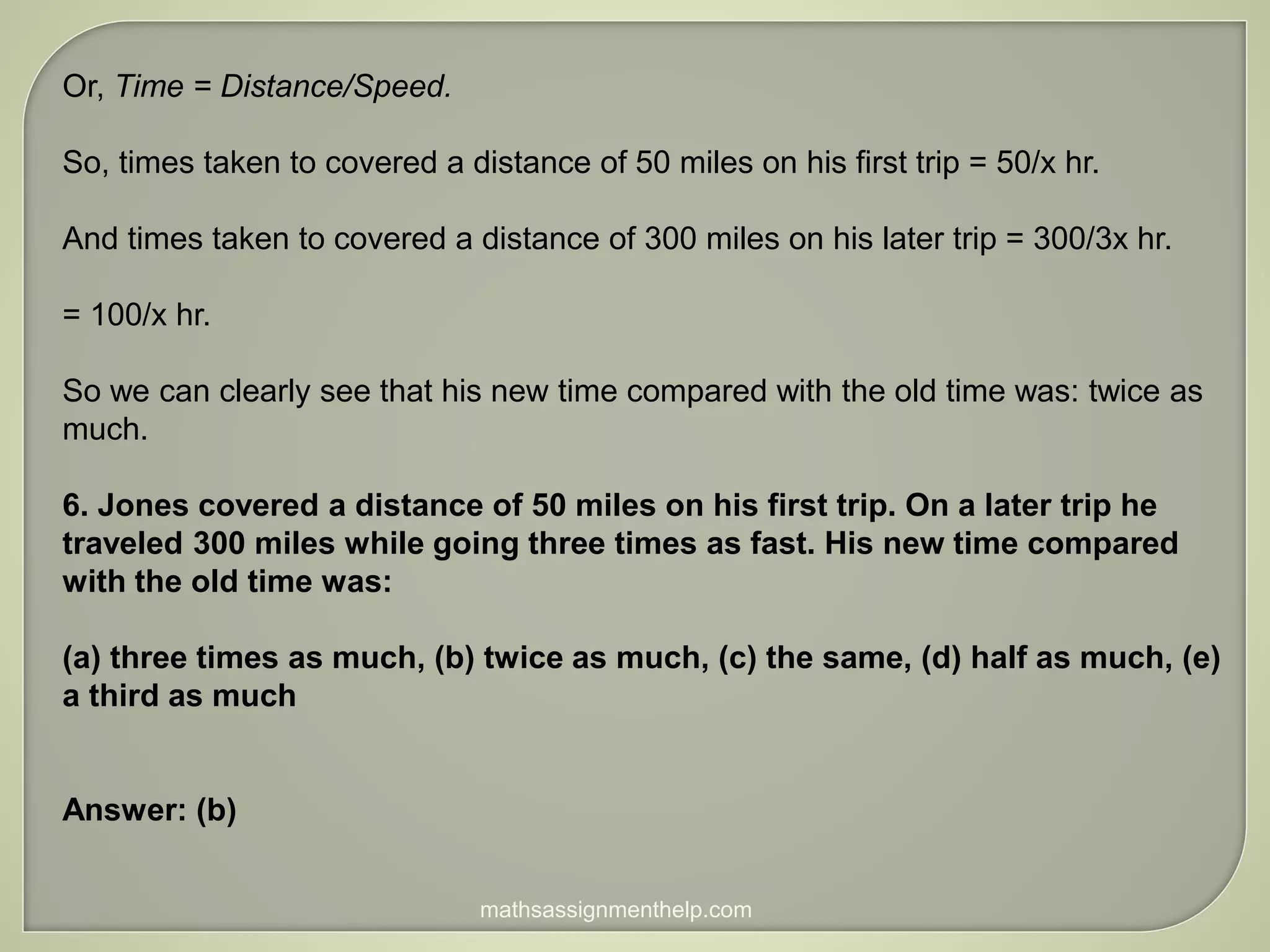
Or, Time = Distance/Speed.
So, times taken to covered a distance of 50 miles on his first trip = 50/x hr.
And times taken to covered a distance of 300 miles on his later trip = 300/3x hr.
= 100/x hr.
So we can clearly see that his new time compared with the old time was: twice as
much.
6. Jones covered a distance of 50 miles on his first trip. On a later trip he
traveled 300 miles while going three times as fast. His new time compared
with the old time was:
(a) three times as much, (b) twice as much, (c) the same, (d) half as much, (e)
a third as much
Answer: (b)
mathsassignmenthelp.com
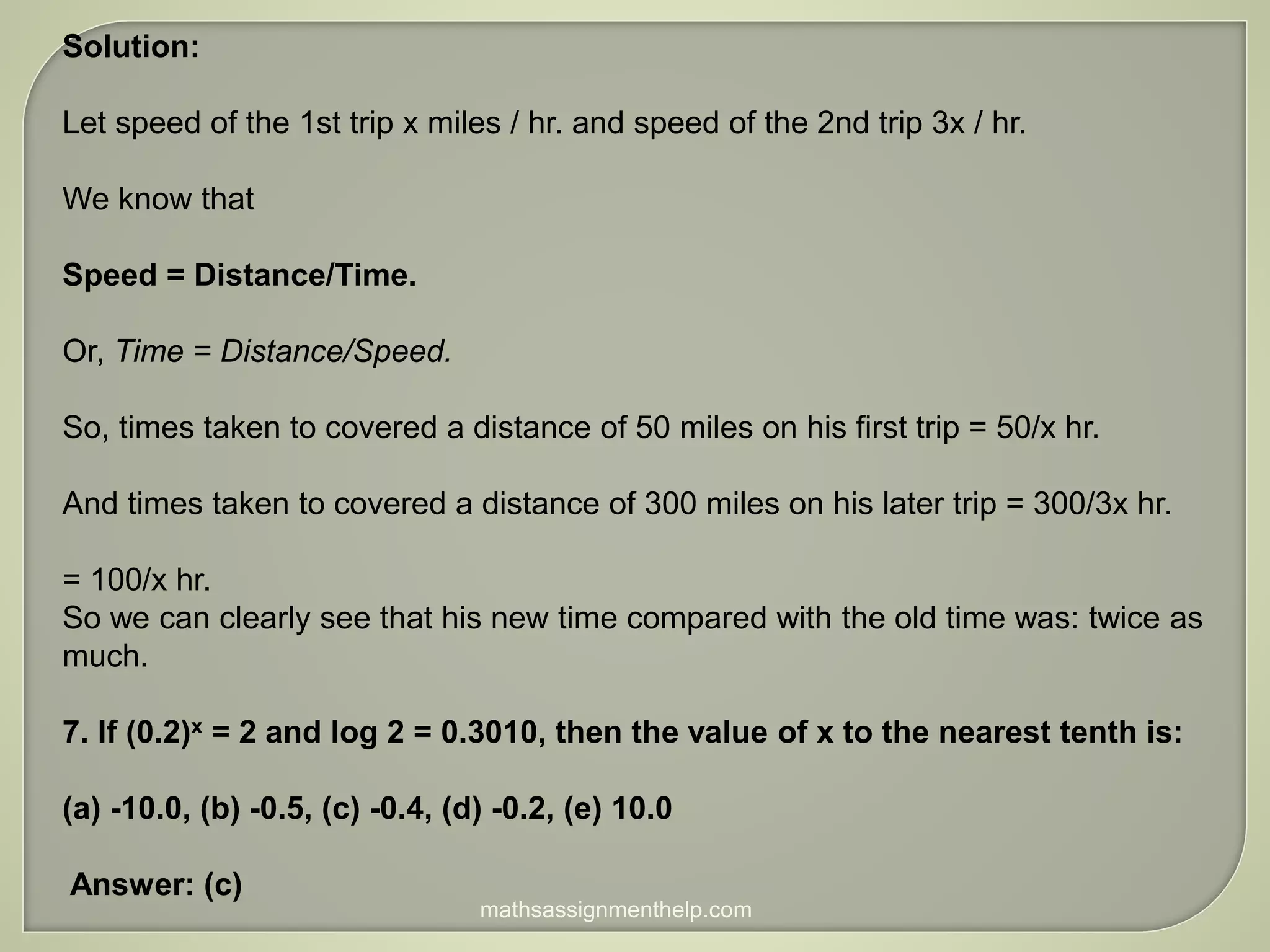
Solution:
Let speed of the 1st trip x miles / hr. and speed of the 2nd trip 3x / hr.
We know that
Speed = Distance/Time.
Or, Time = Distance/Speed.
So, times taken to covered a distance of 50 miles on his first trip = 50/x hr.
And times taken to covered a distance of 300 miles on his later trip = 300/3x hr.
= 100/x hr.
So we can clearly see that his new time compared with the old time was: twice as
much.
7. If (0.2)x = 2 and log 2 = 0.3010, then the value of x to the nearest tenth is:
(a) -10.0, (b) -0.5, (c) -0.4, (d) -0.2, (e) 10.0
Answer: (c)
mathsassignmenthelp.com
Solution:
(0.2)x = 2.
Taking log on both sides
log (0.2)x = log 2.
x log (0.2) = 0.3010, [since log 2 = 0.3010].
x log (2/10) = 0.3010.
x [log 2 - log 10] = 0.3010.
x [log 2 - 1] = 0.3010,[since log 10=1].
x [0.3010 -1] = 0.3010, [since log 2 = 0.3010].
x[-0.699] = 0.3010.
x = 0.3010/-0.699.
x = -0.4306….
x = -0.4 (nearest tenth)
mathsassignmenthelp.com
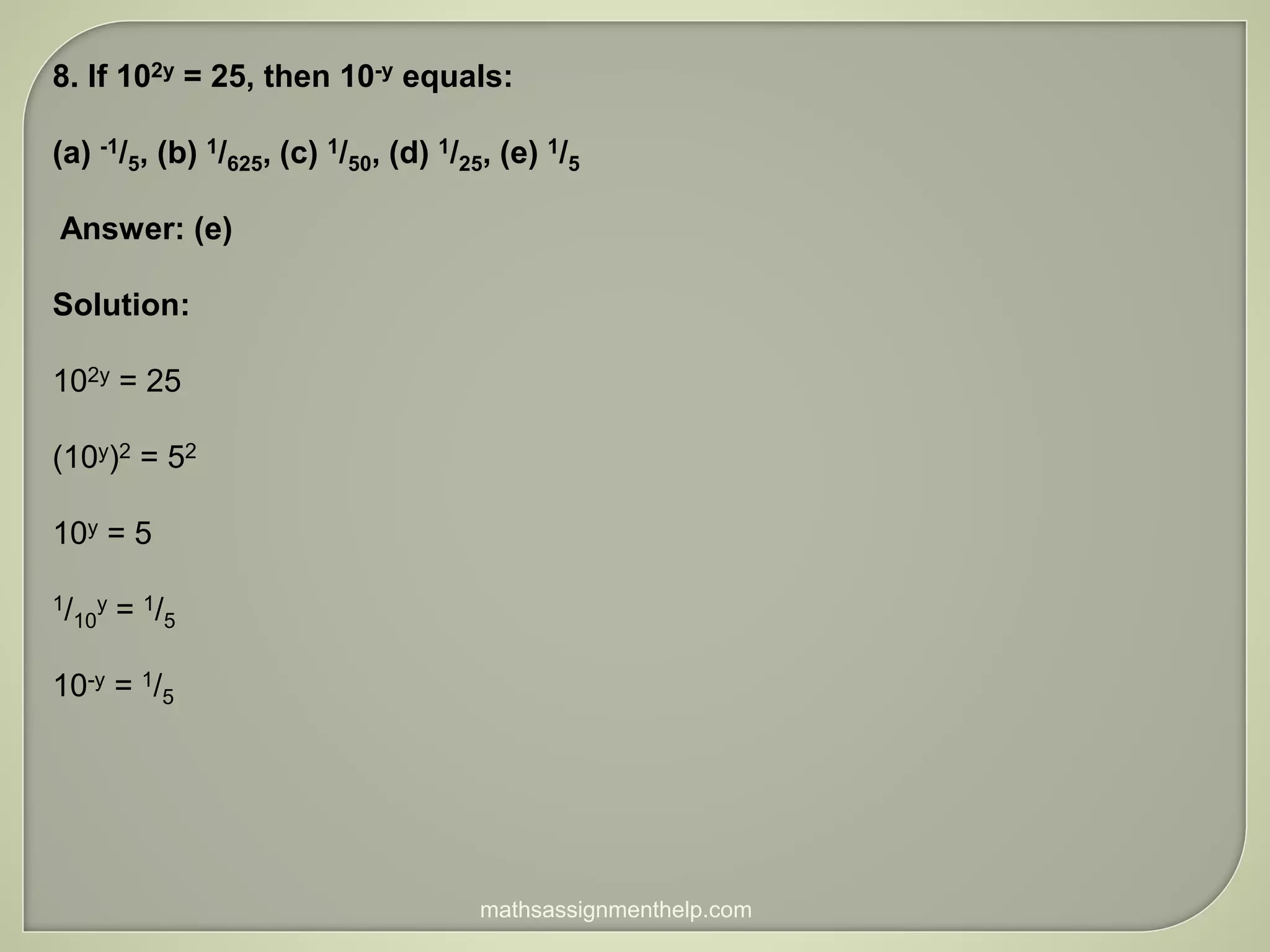
8. If 102y = 25, then 10-y equals:
(a) -1/5, (b) 1/625, (c) 1/50, (d) 1/25, (e) 1/5
Answer: (e)
Solution:
102y = 25
(10y)2 = 52
10y = 5
1/10
y = 1/5
10-y = 1/5
mathsassignmenthelp.com
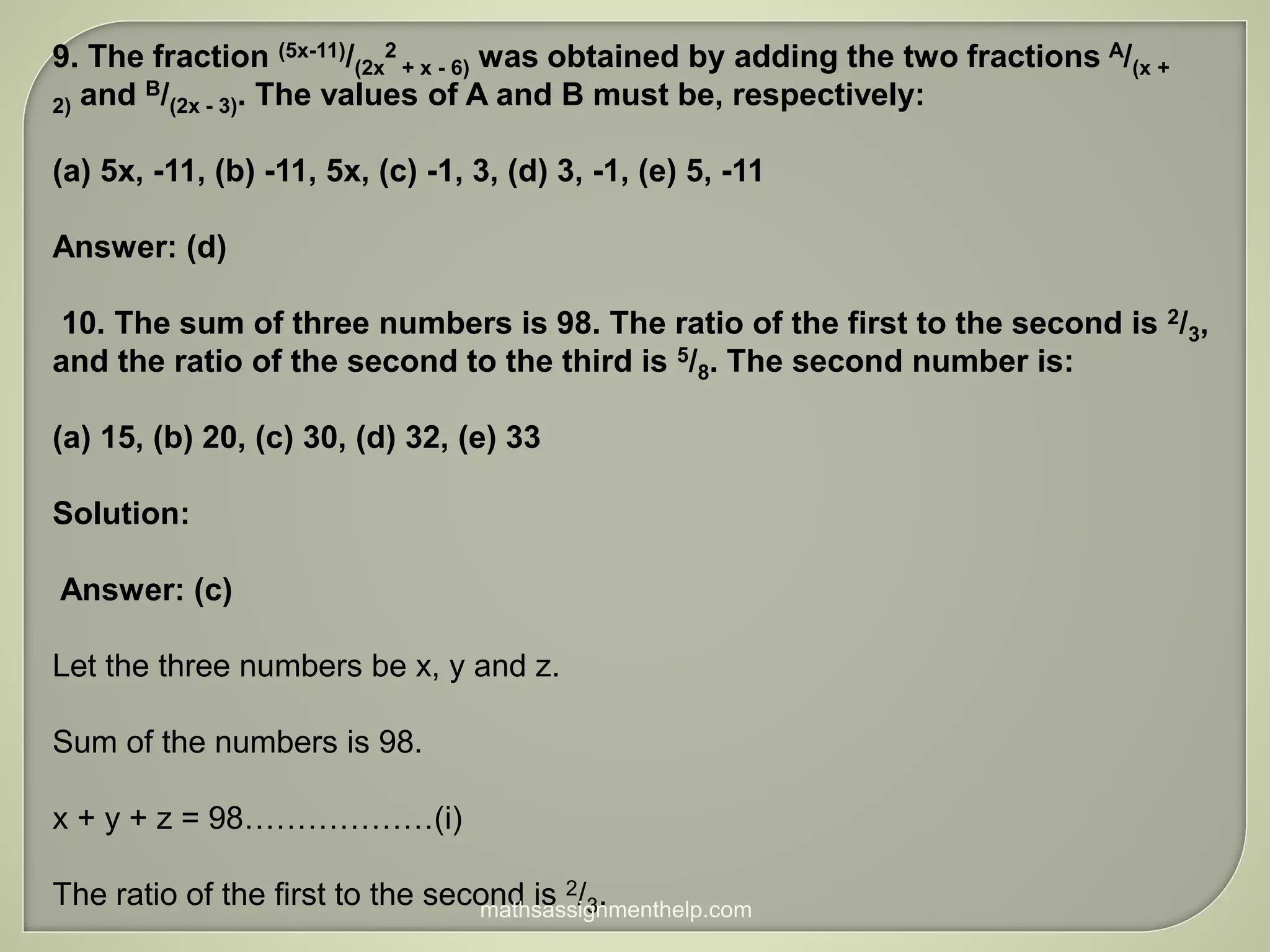
9. The fraction (5x-11)/(2x
2
+ x - 6) was obtained by adding the two fractions A/(x +
2) and B/(2x - 3). The values of A and B must be, respectively:
(a) 5x, -11, (b) -11, 5x, (c) -1, 3, (d) 3, -1, (e) 5, -11
Answer: (d)
10. The sum of three numbers is 98. The ratio of the first to the second is 2/3,
and the ratio of the second to the third is 5/8. The second number is:
(a) 15, (b) 20, (c) 30, (d) 32, (e) 33
Solution:
Answer: (c)
Let the three numbers be x, y and z.
Sum of the numbers is 98.
x + y + z = 98………………(i)
The ratio of the first to the second is 2/3.
mathsassignmenthelp.com
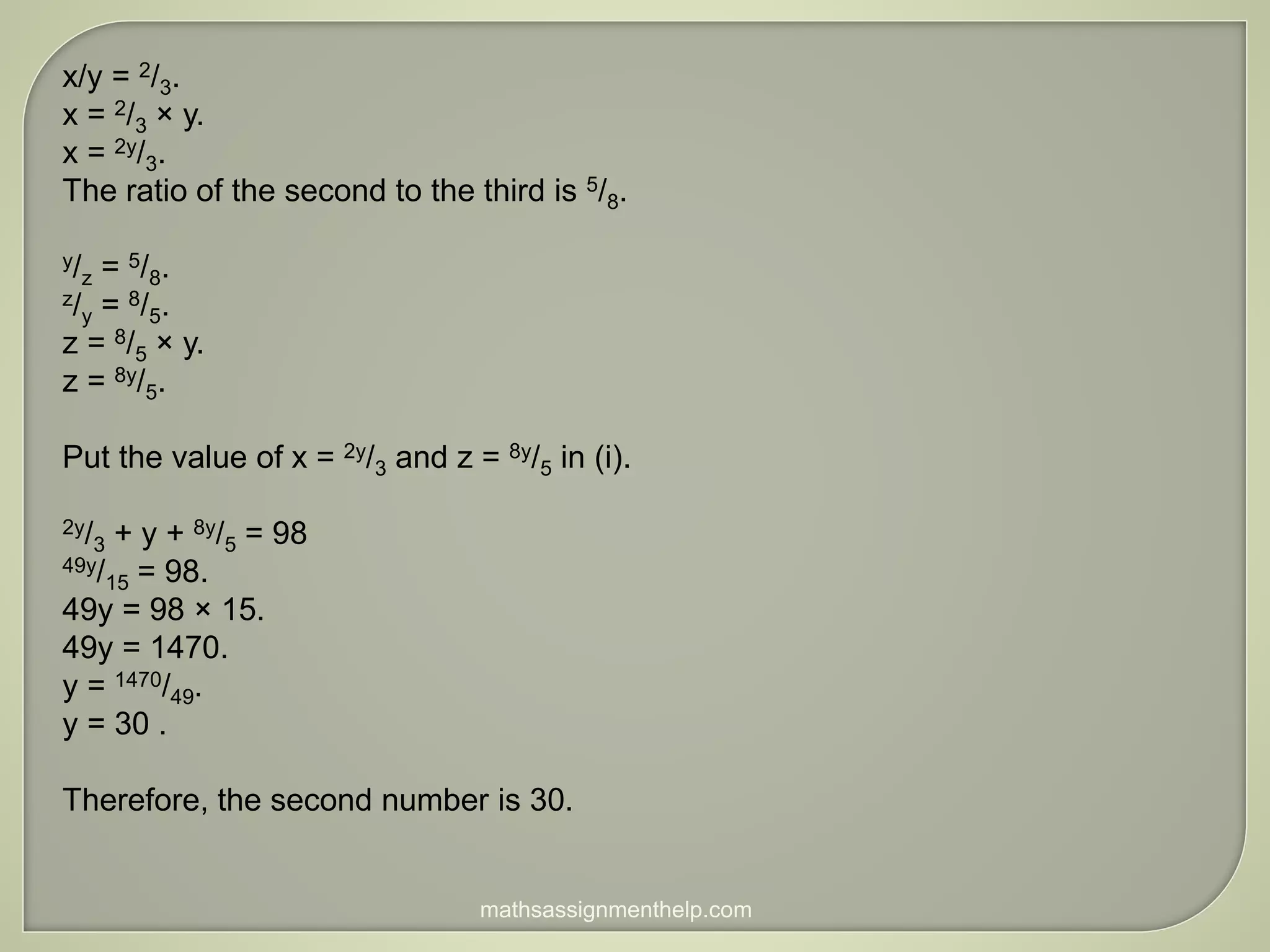
x/y = 2/3.
x = 2/3 × y.
x = 2y/3.
The ratio of the second to the third is 5/8.
y/z = 5/8.
z/y = 8/5.
z = 8/5 × y.
z = 8y/5.
Put the value of x = 2y/3 and z = 8y/5 in (i).
2y/3 + y + 8y/5 = 98
49y/15 = 98.
49y = 98 × 15.
49y = 1470.
y = 1470/49.
y = 30 .
Therefore, the second number is 30.
mathsassignmenthelp.com

NUMBER THEORY ASSIGNMENT HELP

  • 1.
    For any Assignmentrelated queries, Call us at : - +1 678 648 4277 You can mail us at : - info@mathsassignmenthelp.com or reach us at : - https://www.mathsassignmenthelp.com/ mathsassignmenthel.com
  • 2.
    1. Mrs. Rodgergot a weekly raise of $145. If she gets paid every other week, write an integer describing how the raise will affect her paycheck. Solution: Let the 1st paycheck be x (integer). Mrs. Rodger got a weekly raise of $ 145. So after completing the 1st week she will get $ (x+145). Similarly after completing the 2nd week she will get $ (x + 145) + $ 145. = $ (x + 145 + 145) = $ (x + 290) So in this way end of every week her salary will increase by $ 145. mathsassignmenthelp.com
  • 3.
    2. The valueof x + x(xx) when x = 2 is: (a) 10, (b) 16, (c) 18, (d) 36, (e) 64 Answer: (a) Solution: x + x(xx) Put the value of x = 2 in the above expression we get, 2 + 2(22) = 2 + 2(2 × 2) = 2 + 2(4) = 2 + 8 = 10 mathsassignmenthelp.com
  • 4.
    3. Mr. Jonessold two pipes at $1.20 each. Based on the cost, his profit one was 20% and his loss on the other was 20%. On the sale of the pipes, he: (a) broke even, (b) lost 4 cents, (c) gained 4 cents, (d) lost 10 cents, (e) gained 10 cents Answer: (d) Solution: Selling price of the first pipe = $1.20 Profit = 20% Let’s try to find the cost price of the first pipe CP = Selling price - Profit CP = 1.20 - 20% of CP CP = 1.20 - 0.20CP CP + 0.20CP = 1.20 1.20CP = 1.20 CP = 1.201.201.201.20 CP = $ 1 Selling price of the Second pipe = $1.20 mathsassignmenthelp.com
  • 5.
    Loss = 20% Let’stry to find the cost price of the second pipe CP = Selling price + Loss CP = 1.20 + 20% of CP CP = 1.20 + 0.20CP CP - 0.20CP = 1.20 0.80CP = 1.20 CP = 1.200.801.200.80 CP = $1.50 Therefore, total cost price of the two pipes = $1.00 + $1.50 = $2.50 And total selling price of the two pipes = $1.20 + $1.20 = $2.40 Loss = $2.50 – $2.40 = $0.10 Therefore, Mr. Jones loss 10 cents. 4. The distance light travels in one year is approximately 5,870,000,000,000 miles. The distance light travels in 100 years is: (a) 587 × 108 miles, (b) 587 × 1010 miles, (c) 587 × 10-10 miles, (d) 587 × 1012 miles, (e) 587 × 10-12 miles Answer: (d) mathsassignmenthelp.com
  • 6.
    Solution: The distance ofthe light travels in 100 years is: 5,870,000,000,000 × 100 miles. = 587,000,000,000,000 miles. = 587 × 1012 miles. 5. A man has $ 10,000 to invest. He invests $ 4000 at 5 % and $ 3500 at 4 %. In order to have a yearly income of $ 500, he must invest the remainder at: (a) 6 % , (b) 6.1 %, (c) 6.2 %, (d) 6.3 %, (e) 6.4 % Answer: (e) Solution: Income from $ 4000 at 5 % in one year = $ 4000 of 5 %. mathsassignmenthelp.com
  • 7.
    = $ 4000× 5/100. = $ 4000 × 0.05. = $ 200. Income from $ 3500 at 4 % in one year = $ 3500 of 4 %. = $ 3500 × 4/100. = $ 3500 × 0.04. = $ 140. Total income from 4000 at 5 % and 3500 at 4 % = $ 200 + $ 140 = $ 340. Remaining income amount in order to have a yearly income of $ 500 = $ 500 - $ 340. = $ 160. Total invested amount = $ 4000 + $ 3500 = $7500. mathsassignmenthelp.com
  • 8.
    Remaining invest amount= $ 10000 - $ 7500 = $ 2500. We know that, Interest = Principal × Rate × Time Interest = $ 160, Principal = $ 2500, Rate = r [we need to find the value of r], Time = 1 year. 160 = 2500 × r × 1. 160 = 2500r 160/2500 = 2500r/2500 [divide both sides by 2500] 0.064 = r r = 0.064 mathsassignmenthelp.com
  • 9.
    Change it toa percent by moving the decimal to the right two places r = 6.4 % Therefore, he invested the remaining amount $ 2500 at 6.4 % in order to get $ 500 income every year. 6. Jones covered a distance of 50 miles on his first trip. On a later trip he traveled 300 miles while going three times as fast. His new time compared with the old time was: (a) three times as much, (b) twice as much, (c) the same, (d) half as much, (e) a third as much Answer: (b) Solution: Let speed of the 1st trip x miles / hr. and speed of the 2nd trip 3x / hr. We know that Speed = Distance/Time. mathsassignmenthelp.com
  • 10.
    Or, Time =Distance/Speed. So, times taken to covered a distance of 50 miles on his first trip = 50/x hr. And times taken to covered a distance of 300 miles on his later trip = 300/3x hr. = 100/x hr. So we can clearly see that his new time compared with the old time was: twice as much. 6. Jones covered a distance of 50 miles on his first trip. On a later trip he traveled 300 miles while going three times as fast. His new time compared with the old time was: (a) three times as much, (b) twice as much, (c) the same, (d) half as much, (e) a third as much Answer: (b) mathsassignmenthelp.com
  • 11.
    Solution: Let speed ofthe 1st trip x miles / hr. and speed of the 2nd trip 3x / hr. We know that Speed = Distance/Time. Or, Time = Distance/Speed. So, times taken to covered a distance of 50 miles on his first trip = 50/x hr. And times taken to covered a distance of 300 miles on his later trip = 300/3x hr. = 100/x hr. So we can clearly see that his new time compared with the old time was: twice as much. 7. If (0.2)x = 2 and log 2 = 0.3010, then the value of x to the nearest tenth is: (a) -10.0, (b) -0.5, (c) -0.4, (d) -0.2, (e) 10.0 Answer: (c) mathsassignmenthelp.com
  • 12.
    Solution: (0.2)x = 2. Takinglog on both sides log (0.2)x = log 2. x log (0.2) = 0.3010, [since log 2 = 0.3010]. x log (2/10) = 0.3010. x [log 2 - log 10] = 0.3010. x [log 2 - 1] = 0.3010,[since log 10=1]. x [0.3010 -1] = 0.3010, [since log 2 = 0.3010]. x[-0.699] = 0.3010. x = 0.3010/-0.699. x = -0.4306…. x = -0.4 (nearest tenth) mathsassignmenthelp.com
  • 13.
    8. If 102y= 25, then 10-y equals: (a) -1/5, (b) 1/625, (c) 1/50, (d) 1/25, (e) 1/5 Answer: (e) Solution: 102y = 25 (10y)2 = 52 10y = 5 1/10 y = 1/5 10-y = 1/5 mathsassignmenthelp.com
  • 14.
    9. The fraction(5x-11)/(2x 2 + x - 6) was obtained by adding the two fractions A/(x + 2) and B/(2x - 3). The values of A and B must be, respectively: (a) 5x, -11, (b) -11, 5x, (c) -1, 3, (d) 3, -1, (e) 5, -11 Answer: (d) 10. The sum of three numbers is 98. The ratio of the first to the second is 2/3, and the ratio of the second to the third is 5/8. The second number is: (a) 15, (b) 20, (c) 30, (d) 32, (e) 33 Solution: Answer: (c) Let the three numbers be x, y and z. Sum of the numbers is 98. x + y + z = 98………………(i) The ratio of the first to the second is 2/3. mathsassignmenthelp.com
  • 15.
    x/y = 2/3. x= 2/3 × y. x = 2y/3. The ratio of the second to the third is 5/8. y/z = 5/8. z/y = 8/5. z = 8/5 × y. z = 8y/5. Put the value of x = 2y/3 and z = 8y/5 in (i). 2y/3 + y + 8y/5 = 98 49y/15 = 98. 49y = 98 × 15. 49y = 1470. y = 1470/49. y = 30 . Therefore, the second number is 30. mathsassignmenthelp.com