Bird Mummies from Ancient Egypt
Salima Ikram
“All animals played a crucial role in the lives of
the ancient Egyptians, not only in terms of the
practical and quotidian, but also the spiritual;
however, birds were arguably the most
significant creatures in the religious sphere. “
“Raptors were totems or ba-spirits of the various forms of
the sun god Re as well as of Horus, the eternal king; the
phoenix-like benu-bird was a symbol of creation; the
sacred ibis (Threskiornis aethiopicus) was associated with
Thoth, the god of wisdom; the goddesses Nekhbet and
Mut were both linked to vultures; the goddess Maat,
manifestation of order and balance, was often shown as a
feather; the goddesses Isis and Nephthys could transform
themselves into kites (Milvus migrans); and the different
aspects of the human soul.”
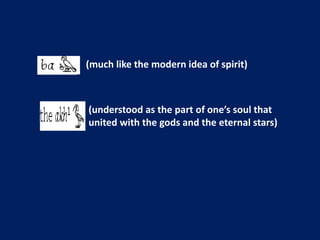
(much like the modern idea of spirit)
(understood as the part of one’s soul that
united with the gods and the eternal stars)
“Although birds played a part in the religious life of
the ancient Egyptians in all eras, the importance of
birds in cult practice is most apparent starting in the
Late Period and continuing through the Roman
period. This is manifested by the significant number
of cult installations of avian deities and the millions
of mummified birds that were buried as votive
offerings in vast catacombs associated with them all
over Egypt.”
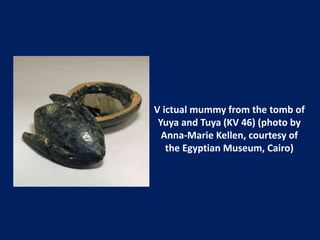
V ictual mummy from the tomb of
Yuya and Tuya (KV 46) (photo by
Anna-Marie Kellen, courtesy of
the Egyptian Museum, Cairo)
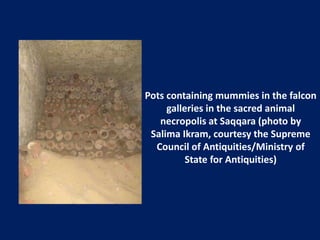
Pots containing mummies in the falcon
galleries in the sacred animal
necropolis at Saqqara (photo by
Salima Ikram, courtesy the Supreme
Council of Antiquities/Ministry of
State for Antiquities)
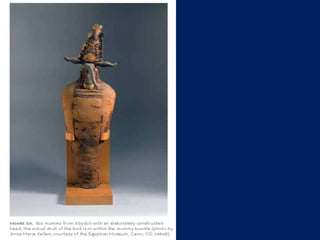
ummy bundle consisting of ibis
feathers and reeds that have
been tied together with strips of
papyrus and then wrapped.
Excavated at Abu Rawash (photo
by Salima Ikram, courtesy of
Michel Baud and the
French Mission to Abu Rawash)
Map of Egypt showing selected
locations of animal cemeteries.
Icons represent the most abundantly
attested mummified birds at these
sites (after Nicholas Warner, in
Ikram 2005, p. xvii)
“Avian mummies continue to be a rich source of information for many aspects of
ancient Egyptian culture: mummification materials and technology, temple and state
economy, religion, the breeding of birds, veterinary practices, bird species found in
antiquity, and the changes in biodiversity. In addition to visual examinations of the
mummies, scientific techniques such as radiography, CT scanning, and other imaging
enable us to identify the different species, their position within the bandages, the
presence of amulets, signs of disease and trauma on the skeleton, and veterinary
interventions. Examination of samples of the bones, flesh, and embalming agents are
also extremely useful — indeed, it is hoped that the Ancient Egyptian Animal
Mummy Bio Bank, based at the University of Manchester, will be a source for such
studies (see Chapter 11). Gas chromatography and mass spectrometry can help to
identify different embalming agents, and elucidate both technology and trade routes
through which these materials arrived in Egypt (Buckley et al. 2004; Ikram, in
preparation). New DNA studies have been launched in order to establish the
evolution in ibis DNA, both diachronic and geographic (Spiegelman et al. 2008). Thus,
these ancient avian mummies continue to provide us with concrete evidence that
allows our imagination to take flight when recreating the landscape and culture of
ancient Egypt.”

Bird mummies from ancient egypt

  • 1.
    Bird Mummies fromAncient Egypt Salima Ikram
  • 2.
    “All animals playeda crucial role in the lives of the ancient Egyptians, not only in terms of the practical and quotidian, but also the spiritual; however, birds were arguably the most significant creatures in the religious sphere. “
  • 3.
    “Raptors were totemsor ba-spirits of the various forms of the sun god Re as well as of Horus, the eternal king; the phoenix-like benu-bird was a symbol of creation; the sacred ibis (Threskiornis aethiopicus) was associated with Thoth, the god of wisdom; the goddesses Nekhbet and Mut were both linked to vultures; the goddess Maat, manifestation of order and balance, was often shown as a feather; the goddesses Isis and Nephthys could transform themselves into kites (Milvus migrans); and the different aspects of the human soul.”
  • 4.
    (much like themodern idea of spirit) (understood as the part of one’s soul that united with the gods and the eternal stars)
  • 5.
    “Although birds playeda part in the religious life of the ancient Egyptians in all eras, the importance of birds in cult practice is most apparent starting in the Late Period and continuing through the Roman period. This is manifested by the significant number of cult installations of avian deities and the millions of mummified birds that were buried as votive offerings in vast catacombs associated with them all over Egypt.”
  • 6.
    V ictual mummyfrom the tomb of Yuya and Tuya (KV 46) (photo by Anna-Marie Kellen, courtesy of the Egyptian Museum, Cairo)
  • 7.
    Pots containing mummiesin the falcon galleries in the sacred animal necropolis at Saqqara (photo by Salima Ikram, courtesy the Supreme Council of Antiquities/Ministry of State for Antiquities)
  • 8.
    ummy bundle consistingof ibis feathers and reeds that have been tied together with strips of papyrus and then wrapped. Excavated at Abu Rawash (photo by Salima Ikram, courtesy of Michel Baud and the French Mission to Abu Rawash)
  • 9.
    Map of Egyptshowing selected locations of animal cemeteries. Icons represent the most abundantly attested mummified birds at these sites (after Nicholas Warner, in Ikram 2005, p. xvii)
  • 13.
    “Avian mummies continueto be a rich source of information for many aspects of ancient Egyptian culture: mummification materials and technology, temple and state economy, religion, the breeding of birds, veterinary practices, bird species found in antiquity, and the changes in biodiversity. In addition to visual examinations of the mummies, scientific techniques such as radiography, CT scanning, and other imaging enable us to identify the different species, their position within the bandages, the presence of amulets, signs of disease and trauma on the skeleton, and veterinary interventions. Examination of samples of the bones, flesh, and embalming agents are also extremely useful — indeed, it is hoped that the Ancient Egyptian Animal Mummy Bio Bank, based at the University of Manchester, will be a source for such studies (see Chapter 11). Gas chromatography and mass spectrometry can help to identify different embalming agents, and elucidate both technology and trade routes through which these materials arrived in Egypt (Buckley et al. 2004; Ikram, in preparation). New DNA studies have been launched in order to establish the evolution in ibis DNA, both diachronic and geographic (Spiegelman et al. 2008). Thus, these ancient avian mummies continue to provide us with concrete evidence that allows our imagination to take flight when recreating the landscape and culture of ancient Egypt.”