

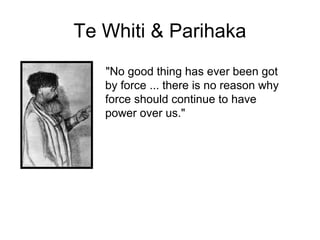
Te Whiti & Parihaka
   "No good thing has ever been got
   by force ... there is no reason why
   force should continue to have
   power over us."
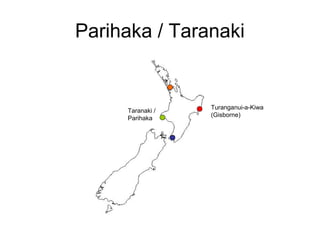
Parihaka / Taranaki


                  Turanganui-a-Kiwa
     Taranaki /
                  (Gisborne)
     Parihaka
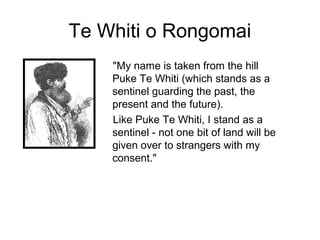
Te Whiti o Rongomai
    "My name is taken from the hill
    Puke Te Whiti (which stands as a
    sentinel guarding the past, the
    present and the future).
    Like Puke Te Whiti, I stand as a
    sentinel - not one bit of land will be
    given over to strangers with my
    consent."
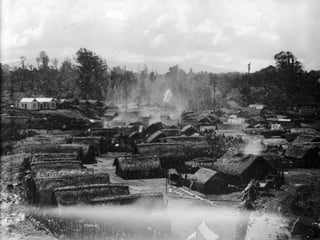
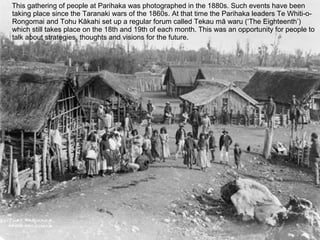
This gathering of people at Parihaka was photographed in the 1880s. Such events have been
taking place since the Taranaki wars of the 1860s. At that time the Parihaka leaders Te Whiti-o-
Rongomai and Tohu Kākahi set up a regular forum called Tekau mā waru (‘The Eighteenth’)
which still takes place on the 18th and 19th of each month. This was an opportunity for people to
talk about strategies, thoughts and visions for the future.
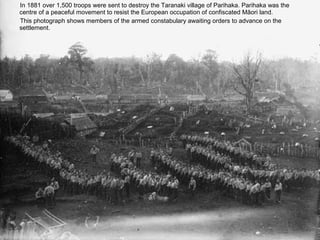
In 1881 over 1,500 troops were sent to destroy the Taranaki village of Parihaka. Parihaka was the
centre of a peaceful movement to resist the European occupation of confiscated Māori land.
This photograph shows members of the armed constabulary awaiting orders to advance on the

         Troops waiting to advance
settlement.
Timeline
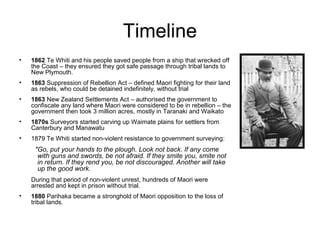
•   1862 Te Whiti and his people saved people from a ship that wrecked off
    the Coast – they ensured they got safe passage through tribal lands to
    New Plymouth.
•   1863 Suppression of Rebellion Act – defined Maori fighting for their land
    as rebels, who could be detained indefinitely, without trial
•   1863 New Zealand Settlements Act – authorised the government to
    confiscate any land where Maori were considered to be in rebellion – the
    government then took 3 million acres, mostly in Taranaki and Waikato
•   1870s Surveyors started carving up Waimate plains for settlers from
    Canterbury and Manawatu
•   1879 Te Whiti started non-violent resistance to government surveying:
     "Go, put your hands to the plough. Look not back. If any come
      with guns and swords, be not afraid. If they smite you, smite not
      in return. If they rend you, be not discouraged. Another will take
      up the good work.
    During that period of non-violent unrest, hundreds of Maori were
    arrested and kept in prison without trial.
•   1880 Parihaka became a stronghold of Maori opposition to the loss of
    tribal lands.
1881 Invasion & Exile
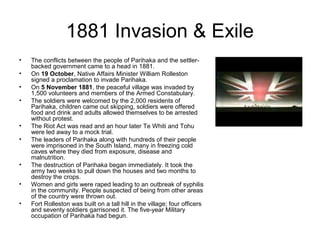
•   The conflicts between the people of Parihaka and the settler-
    backed government came to a head in 1881.
•   On 19 October, Native Affairs Minister William Rolleston
    signed a proclamation to invade Parihaka.
•   On 5 November 1881, the peaceful village was invaded by
    1,500 volunteers and members of the Armed Constabulary.
•   The soldiers were welcomed by the 2,000 residents of
    Parihaka, children came out skipping, soldiers were offered
    food and drink and adults allowed themselves to be arrested
    without protest.
•   The Riot Act was read and an hour later Te Whiti and Tohu
    were led away to a mock trial.
•   The leaders of Parihaka along with hundreds of their people
    were imprisoned in the South Island, many in freezing cold
    caves where they died from exposure, disease and
    malnutrition.
•   The destruction of Parihaka began immediately. It took the
    army two weeks to pull down the houses and two months to
    destroy the crops.
•   Women and girls were raped leading to an outbreak of syphilis
    in the community. People suspected of being from other areas
    of the country were thrown out.
•   Fort Rolleston was built on a tall hill in the village; four officers
    and seventy soldiers garrisoned it. The five-year Military
    occupation of Parihaka had begun.
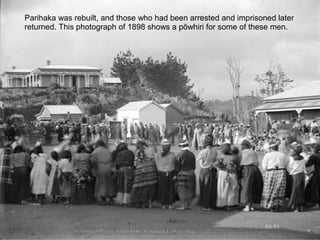
Parihaka was rebuilt, and those who had been arrested and imprisoned later
returned. This photograph of 1898 shows a pōwhiri for some of these men.
Rebuilding Parihaka
•   In 1883 the Parihaka leaders were escorted back to Parihaka.
•   On his arrival home Te Whiti was assaulted by soldiers for
    refusing to accept an order not to resume the monthly meetings.
    He resumed the 18th meetings immediately and used them to
    mount further protest action on confiscated land.
•   In 1886 he was imprisoned again along with Titokowaru his
    protest companion. Days before Te Whiti was released in 1888
    his wife and mother of his children Hikurangi died, he was not
    allowed to return for her tangihanga (funeral).
•   The modernisation of Parihaka continued at a great pace.
    Elaborate guesthouses were built complete with hot and cold
    running water. Streets, lighting and drainage were constructed
    along with a bakery, an abattoir, shops and a bank. Parihaka
    people ran agricultural contracts throughout Taranaki sowing
    seed, cropping and labouring.
•   On the 12th of July 1898 the last of the Parihaka prisoners
    returned to a heroes welcome at Parihaka. Their release brought
    to an end 19 years of imprisonments of Parihaka men and boys.
•   The Parihaka leaders Te Whiti and Tohu died during the year
    1907.
•   The community faced poverty by the 1930’s as its land estate
    was carved up for disposal to Europeans.
•   The Government offered suspensory loans to those who wanted
    it and they paid nothing for the land itself but these schemes were
    available only to Europeans.
Parihaka Today
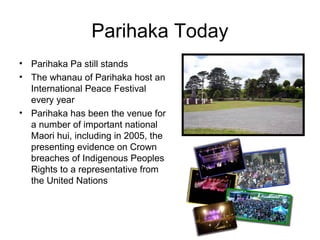
• Parihaka Pa still stands
• The whanau of Parihaka host an
  International Peace Festival
  every year
• Parihaka has been the venue for
  a number of important national
  Maori hui, including in 2005, the
  presenting evidence on Crown
  breaches of Indigenous Peoples
  Rights to a representative from
  the United Nations
More Information
•   Parihaka Peace Festival
•   Parihaka: The Art of Peaceful Resistance (exhibition website):
•   The Pacifist of Parihaka (Puke Ariki cultural centre website):
•   Taranaki Reports (Waitangi Tribunal)
•   Taranaki Stories (Te Ara - The Encyclopedia of NZ)
•   Aotearoa Indigenous Rights Trust
•   Maori and the Draft Declaration on the Rights of Indigenous Peoples
He Whakatauki
    KO TE PO TE KAIHARI I TE RA
KO TE MATE TE KAIHARI I TE ORANGA
   NIGHT IS THE BRINGER OF DAY
  DEATH IS THE BRINGER OF LIFE

       - na Te Whiti me Tohu

Parihaka presentation

  • 2.
    Te Whiti &Parihaka "No good thing has ever been got by force ... there is no reason why force should continue to have power over us."
  • 3.
    Parihaka / Taranaki Turanganui-a-Kiwa Taranaki / (Gisborne) Parihaka
  • 4.
    Te Whiti oRongomai "My name is taken from the hill Puke Te Whiti (which stands as a sentinel guarding the past, the present and the future). Like Puke Te Whiti, I stand as a sentinel - not one bit of land will be given over to strangers with my consent."
  • 6.
    This gathering ofpeople at Parihaka was photographed in the 1880s. Such events have been taking place since the Taranaki wars of the 1860s. At that time the Parihaka leaders Te Whiti-o- Rongomai and Tohu Kākahi set up a regular forum called Tekau mā waru (‘The Eighteenth’) which still takes place on the 18th and 19th of each month. This was an opportunity for people to talk about strategies, thoughts and visions for the future.
  • 7.
    In 1881 over1,500 troops were sent to destroy the Taranaki village of Parihaka. Parihaka was the centre of a peaceful movement to resist the European occupation of confiscated Māori land. This photograph shows members of the armed constabulary awaiting orders to advance on the Troops waiting to advance settlement.
  • 8.
    Timeline • 1862 Te Whiti and his people saved people from a ship that wrecked off the Coast – they ensured they got safe passage through tribal lands to New Plymouth. • 1863 Suppression of Rebellion Act – defined Maori fighting for their land as rebels, who could be detained indefinitely, without trial • 1863 New Zealand Settlements Act – authorised the government to confiscate any land where Maori were considered to be in rebellion – the government then took 3 million acres, mostly in Taranaki and Waikato • 1870s Surveyors started carving up Waimate plains for settlers from Canterbury and Manawatu • 1879 Te Whiti started non-violent resistance to government surveying: "Go, put your hands to the plough. Look not back. If any come with guns and swords, be not afraid. If they smite you, smite not in return. If they rend you, be not discouraged. Another will take up the good work. During that period of non-violent unrest, hundreds of Maori were arrested and kept in prison without trial. • 1880 Parihaka became a stronghold of Maori opposition to the loss of tribal lands.
  • 9.
    1881 Invasion &Exile • The conflicts between the people of Parihaka and the settler- backed government came to a head in 1881. • On 19 October, Native Affairs Minister William Rolleston signed a proclamation to invade Parihaka. • On 5 November 1881, the peaceful village was invaded by 1,500 volunteers and members of the Armed Constabulary. • The soldiers were welcomed by the 2,000 residents of Parihaka, children came out skipping, soldiers were offered food and drink and adults allowed themselves to be arrested without protest. • The Riot Act was read and an hour later Te Whiti and Tohu were led away to a mock trial. • The leaders of Parihaka along with hundreds of their people were imprisoned in the South Island, many in freezing cold caves where they died from exposure, disease and malnutrition. • The destruction of Parihaka began immediately. It took the army two weeks to pull down the houses and two months to destroy the crops. • Women and girls were raped leading to an outbreak of syphilis in the community. People suspected of being from other areas of the country were thrown out. • Fort Rolleston was built on a tall hill in the village; four officers and seventy soldiers garrisoned it. The five-year Military occupation of Parihaka had begun.
  • 10.
    Parihaka was rebuilt,and those who had been arrested and imprisoned later returned. This photograph of 1898 shows a pōwhiri for some of these men.
  • 11.
    Rebuilding Parihaka • In 1883 the Parihaka leaders were escorted back to Parihaka. • On his arrival home Te Whiti was assaulted by soldiers for refusing to accept an order not to resume the monthly meetings. He resumed the 18th meetings immediately and used them to mount further protest action on confiscated land. • In 1886 he was imprisoned again along with Titokowaru his protest companion. Days before Te Whiti was released in 1888 his wife and mother of his children Hikurangi died, he was not allowed to return for her tangihanga (funeral). • The modernisation of Parihaka continued at a great pace. Elaborate guesthouses were built complete with hot and cold running water. Streets, lighting and drainage were constructed along with a bakery, an abattoir, shops and a bank. Parihaka people ran agricultural contracts throughout Taranaki sowing seed, cropping and labouring. • On the 12th of July 1898 the last of the Parihaka prisoners returned to a heroes welcome at Parihaka. Their release brought to an end 19 years of imprisonments of Parihaka men and boys. • The Parihaka leaders Te Whiti and Tohu died during the year 1907. • The community faced poverty by the 1930’s as its land estate was carved up for disposal to Europeans. • The Government offered suspensory loans to those who wanted it and they paid nothing for the land itself but these schemes were available only to Europeans.
  • 12.
    Parihaka Today • ParihakaPa still stands • The whanau of Parihaka host an International Peace Festival every year • Parihaka has been the venue for a number of important national Maori hui, including in 2005, the presenting evidence on Crown breaches of Indigenous Peoples Rights to a representative from the United Nations
  • 13.
    More Information • Parihaka Peace Festival • Parihaka: The Art of Peaceful Resistance (exhibition website): • The Pacifist of Parihaka (Puke Ariki cultural centre website): • Taranaki Reports (Waitangi Tribunal) • Taranaki Stories (Te Ara - The Encyclopedia of NZ) • Aotearoa Indigenous Rights Trust • Maori and the Draft Declaration on the Rights of Indigenous Peoples
  • 14.
    He Whakatauki KO TE PO TE KAIHARI I TE RA KO TE MATE TE KAIHARI I TE ORANGA NIGHT IS THE BRINGER OF DAY DEATH IS THE BRINGER OF LIFE - na Te Whiti me Tohu