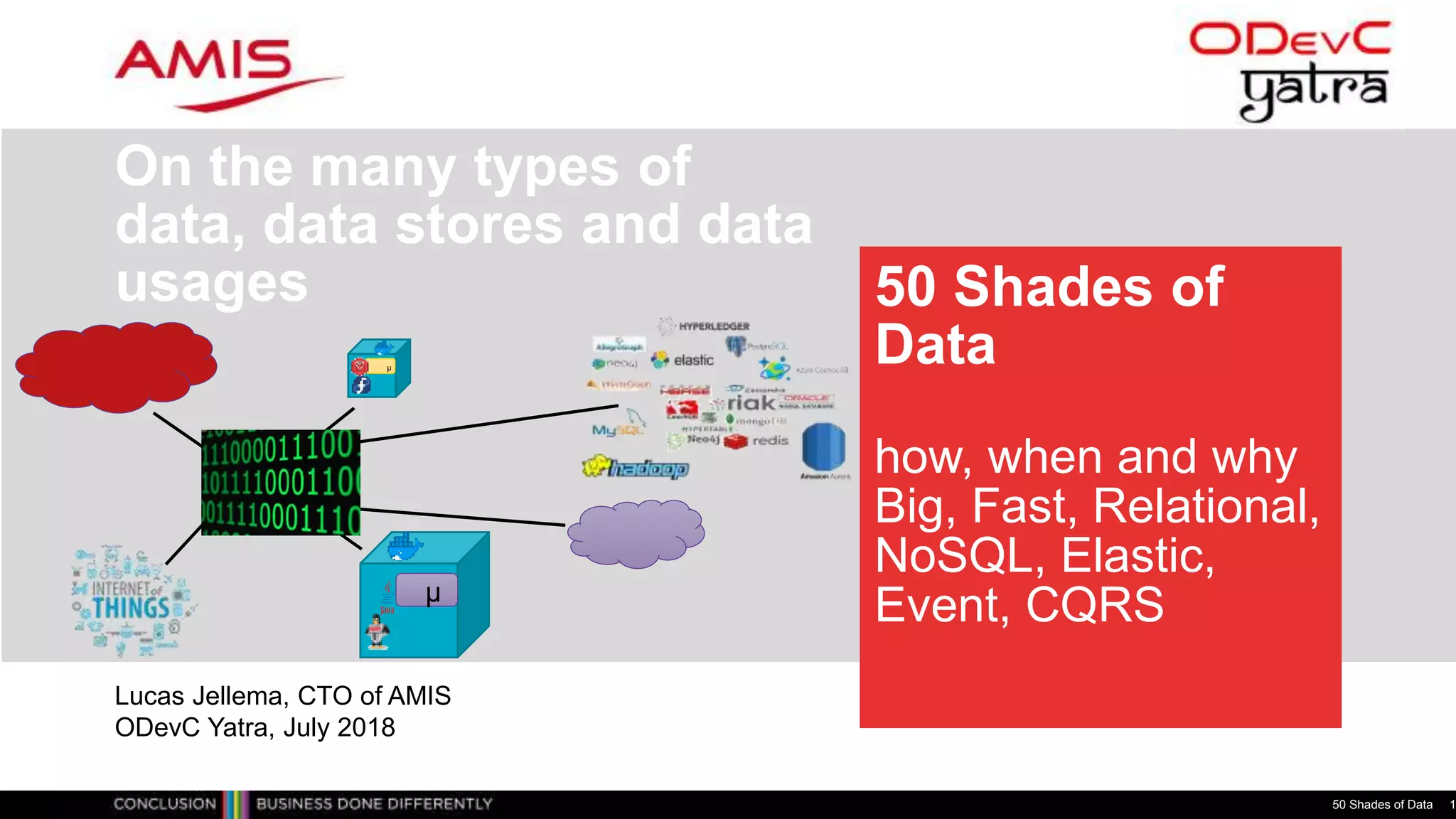









50 Shades of
Data
how, when and why
Big, Fast, Relational,
NoSQL, Elastic,
Event, CQRS
On the many types of
data, data stores and data
usages
50 Shades of Data 1
µ
µ
Lucas Jellema, CTO of AMIS
ODevC Yatra, July 2018
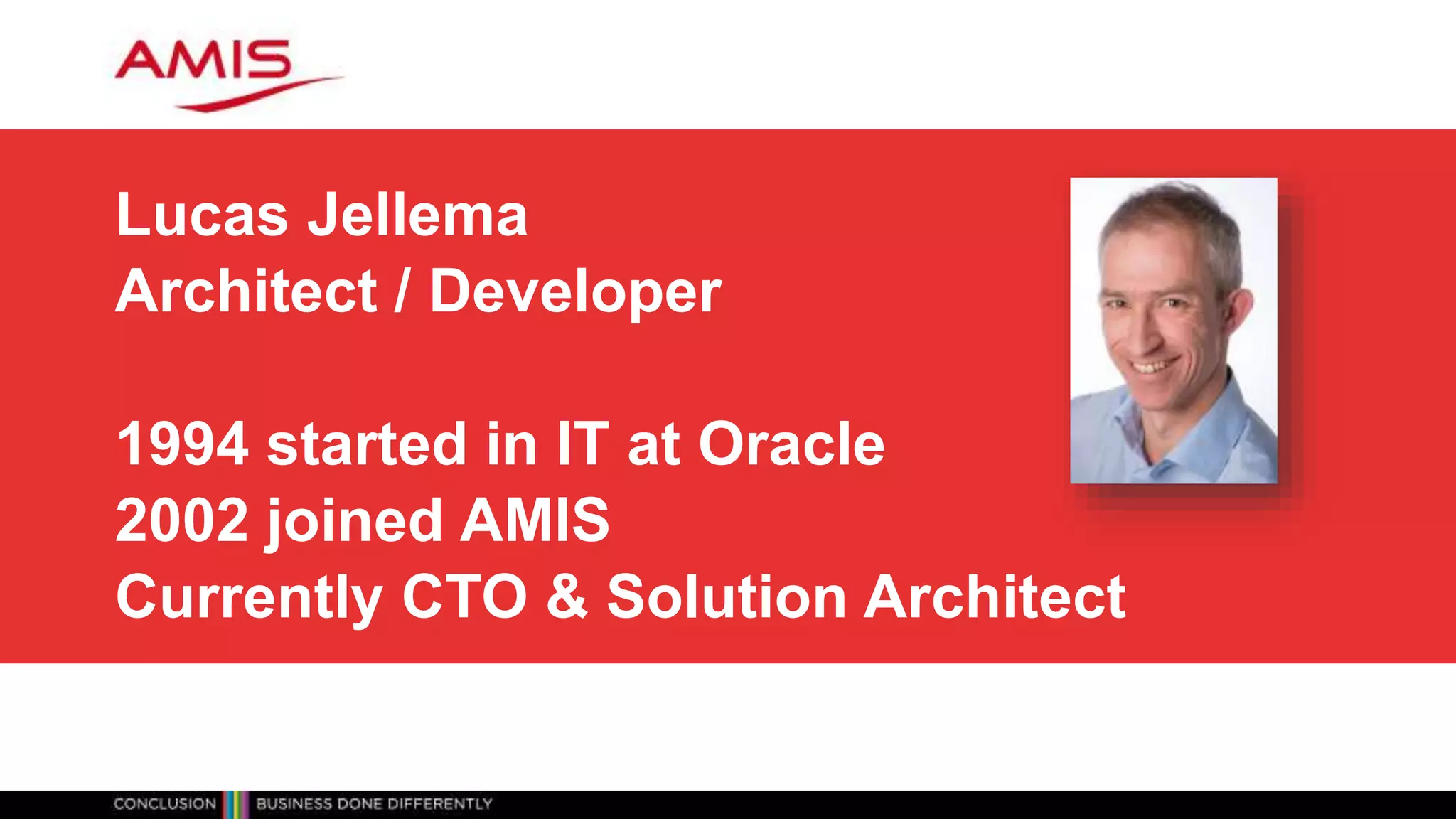
Lucas Jellema
Architect / Developer
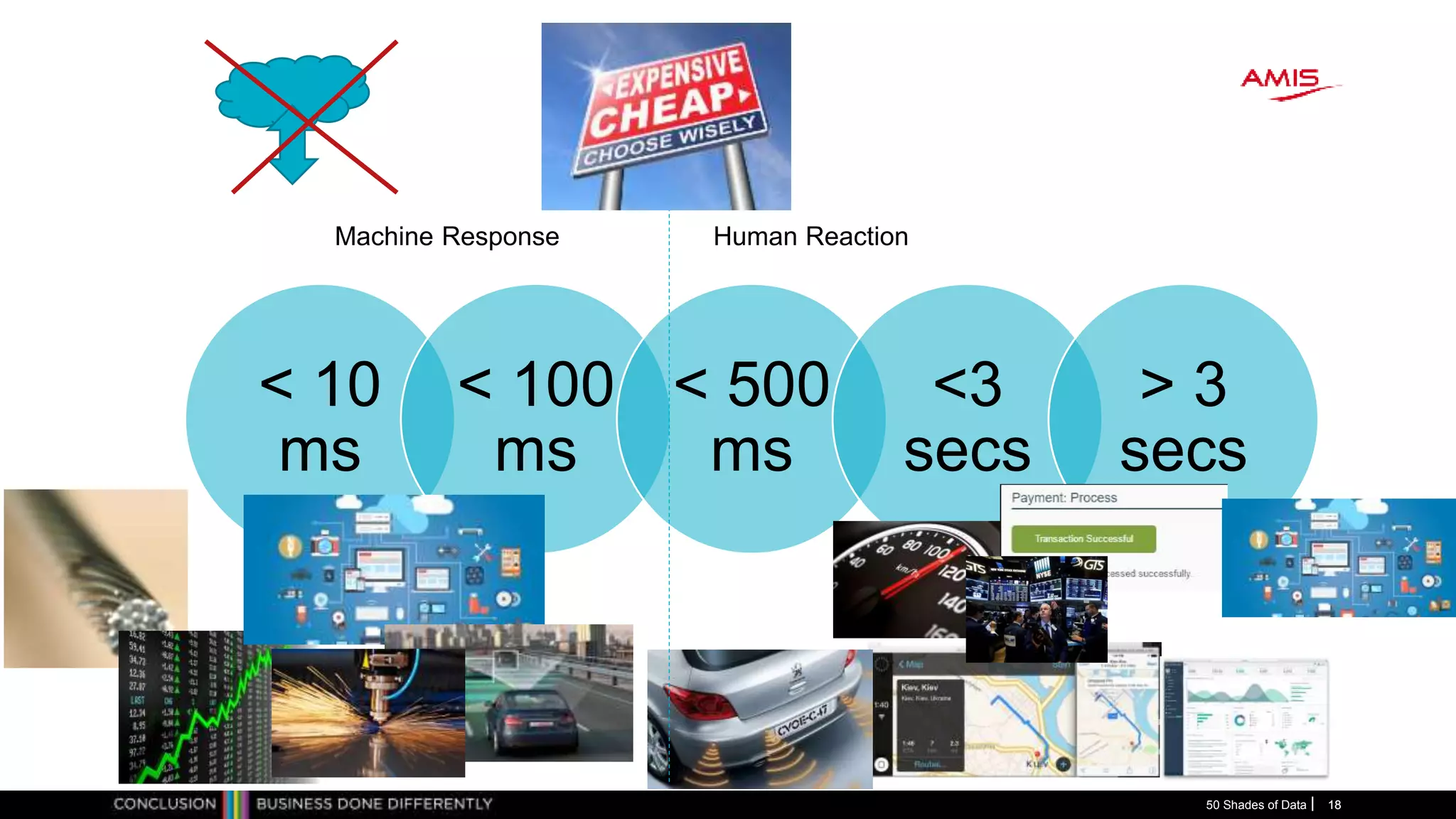
1994 started in IT at Oracle
2002 joined AMIS
Currently CTO & Solution Architect
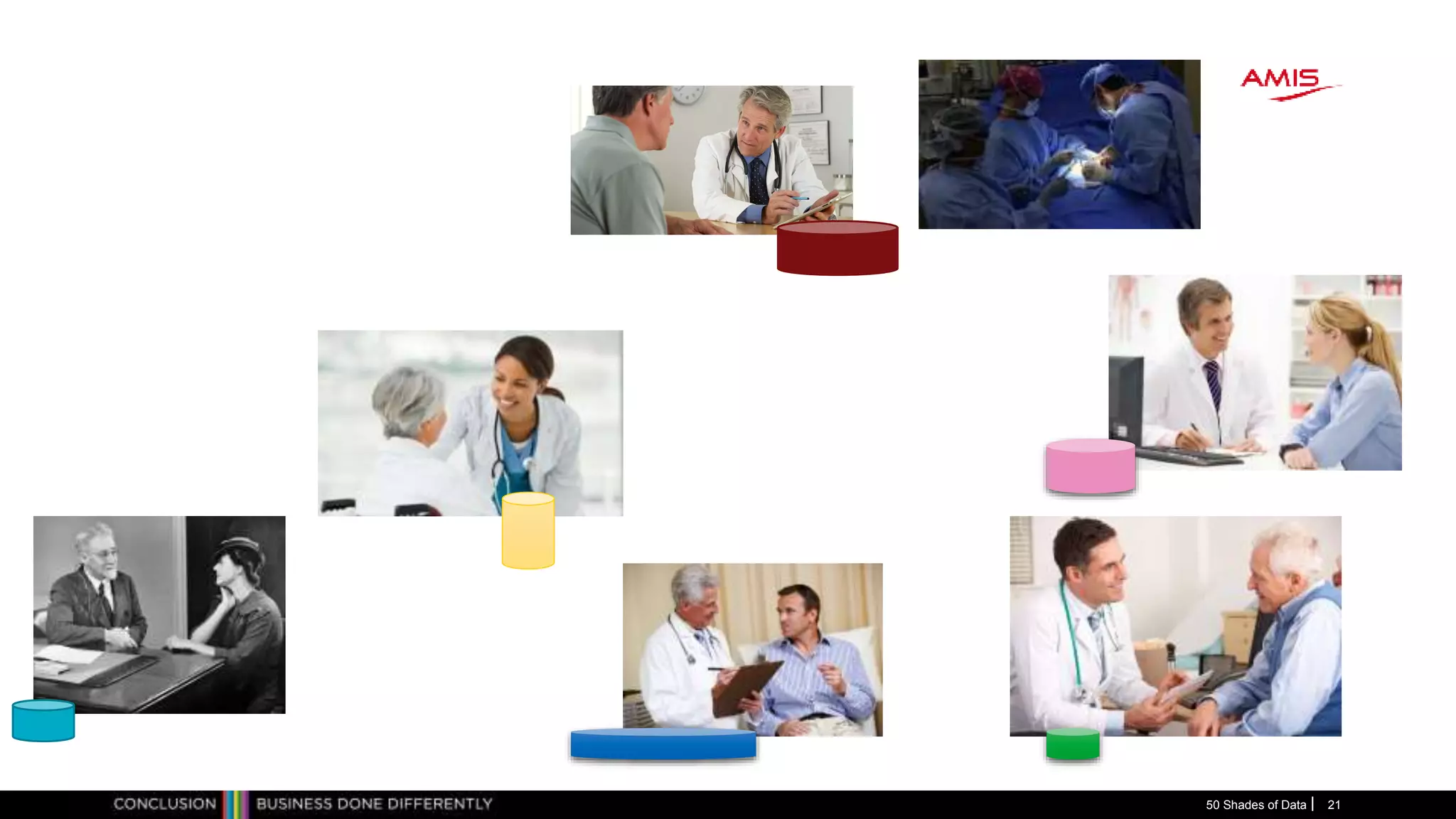
Presenting
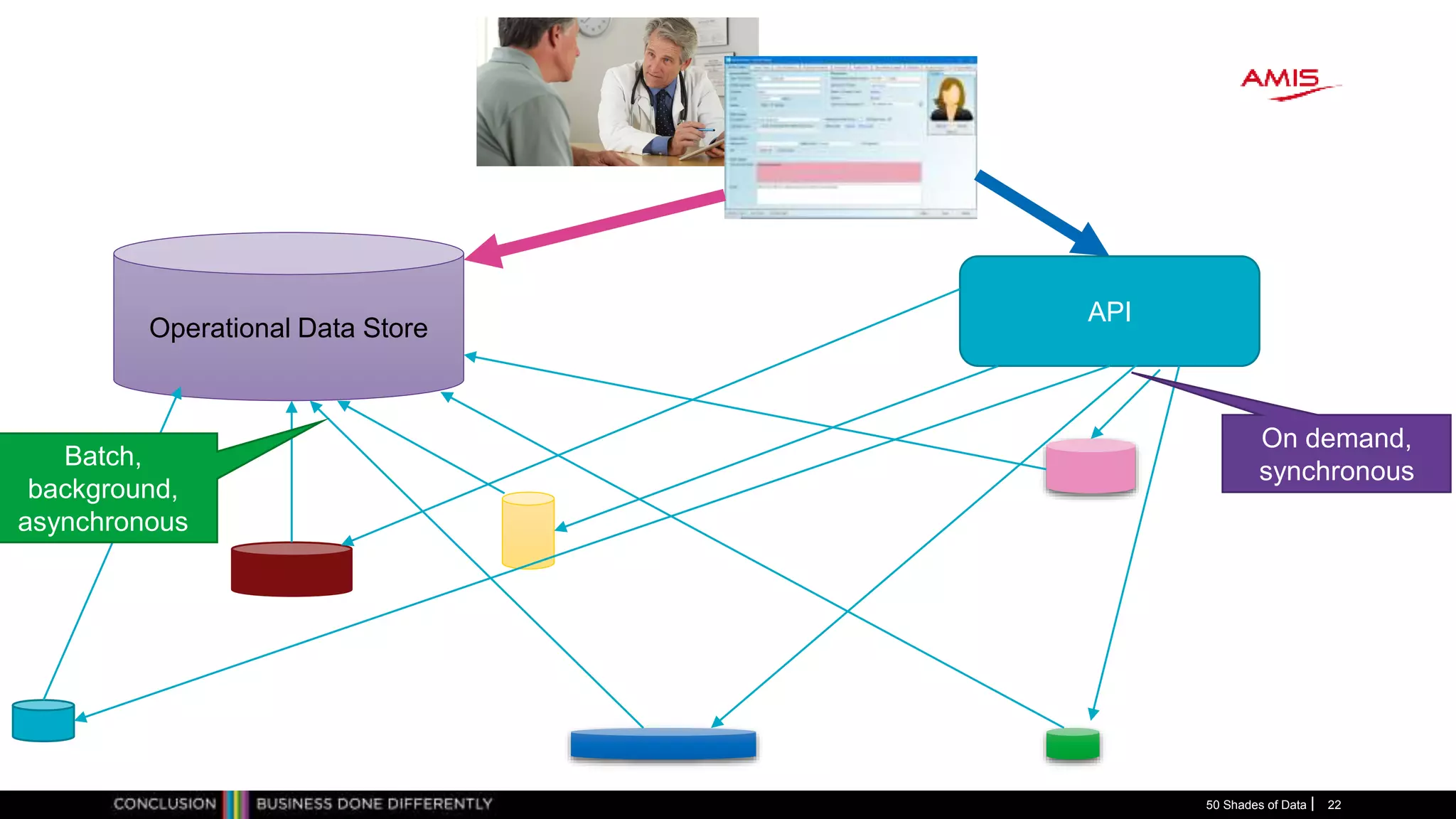
• Oracle OpenWorld
• JavaOne
• Oracle Code
• Devoxx
• Java and Oracle User Group meetups
• Java Rockstar (JavaOne 2015)
• ODevC Yatra 2018
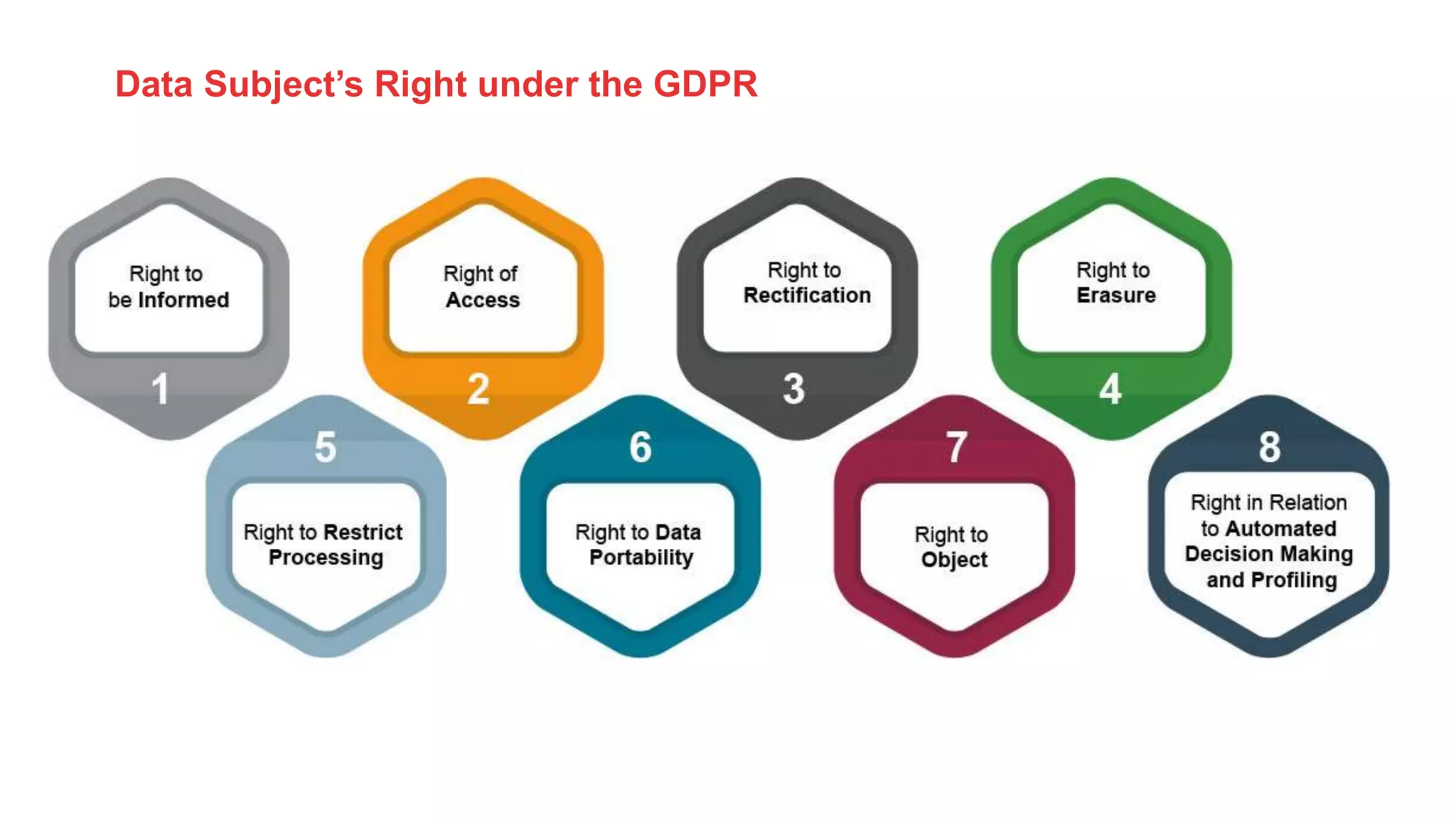
50 Shades of Data 3
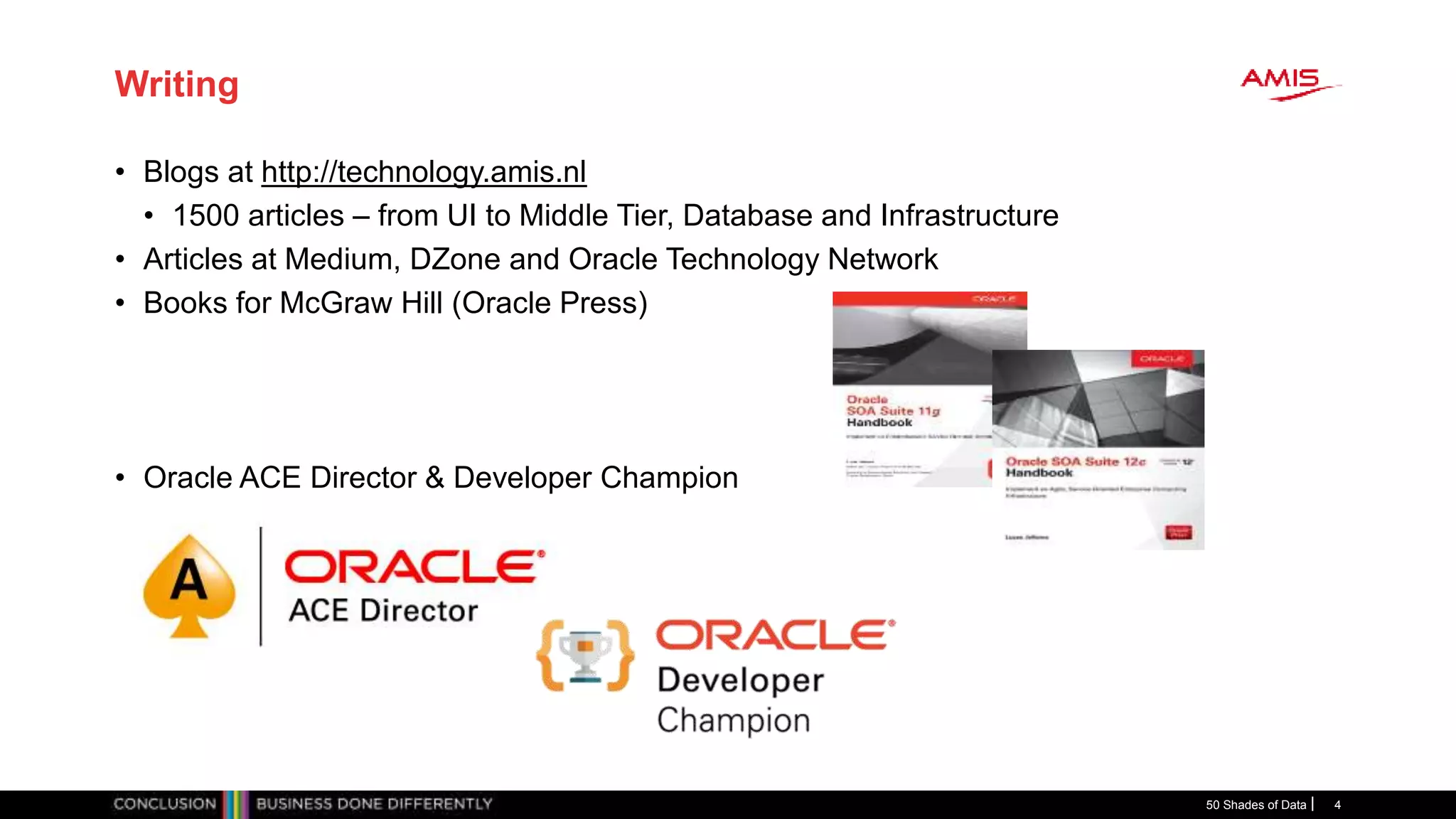
Writing
• Blogs at http://technology.amis.nl
• 1500 articles – from UI to Middle Tier, Database and Infrastructure
• Articles at Medium, DZone and Oracle Technology Network
• Books for McGraw Hill (Oracle Press)
• Oracle ACE Director & Developer Champion
50 Shades of Data 4
From The Netherlands
50 Shades of Data 5
Tweet!
#yatra
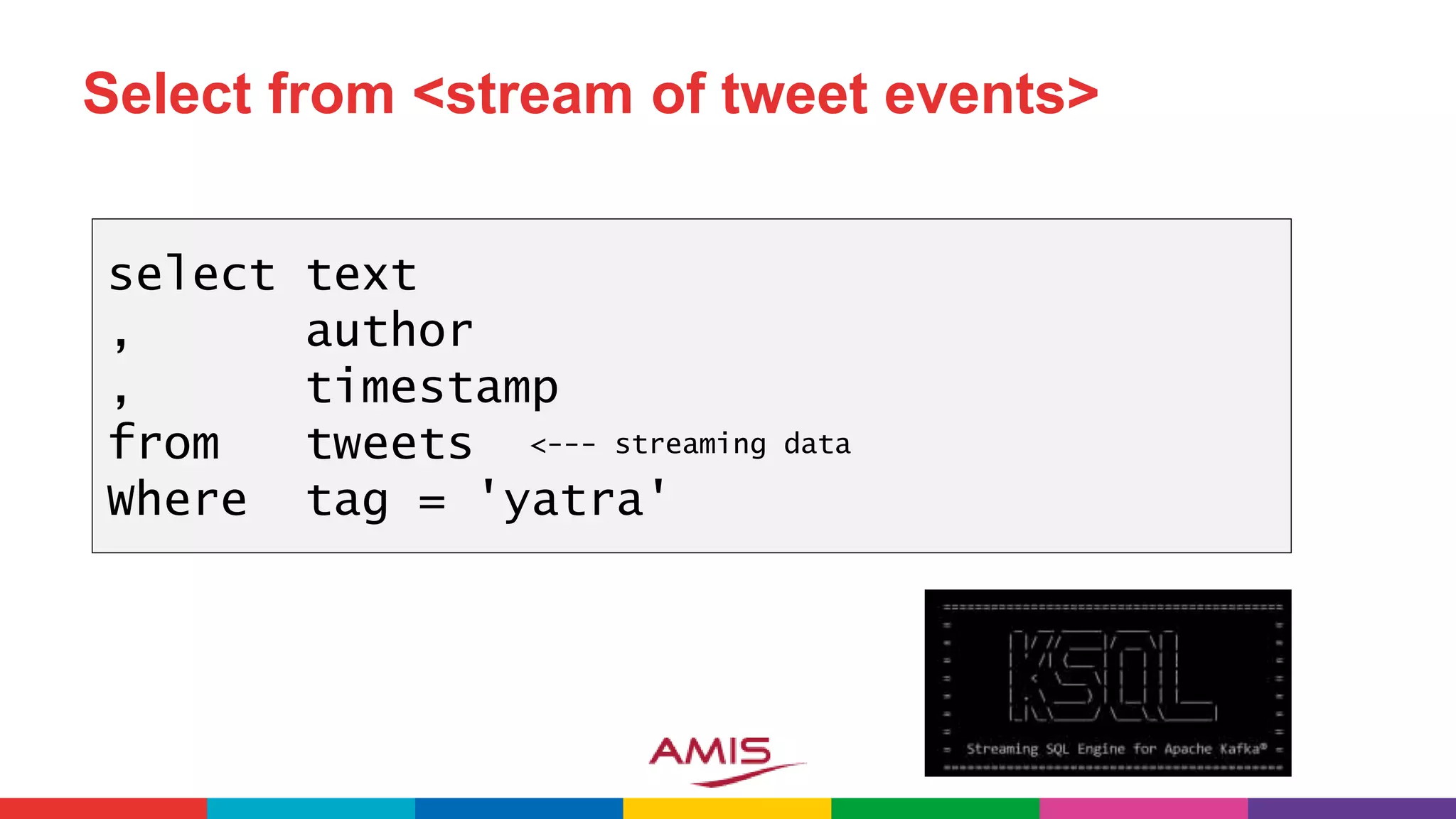
Select from <stream of tweet events>
select text
, author
, timestamp
from tweets
Where tag = 'yatra'
<--- streaming data
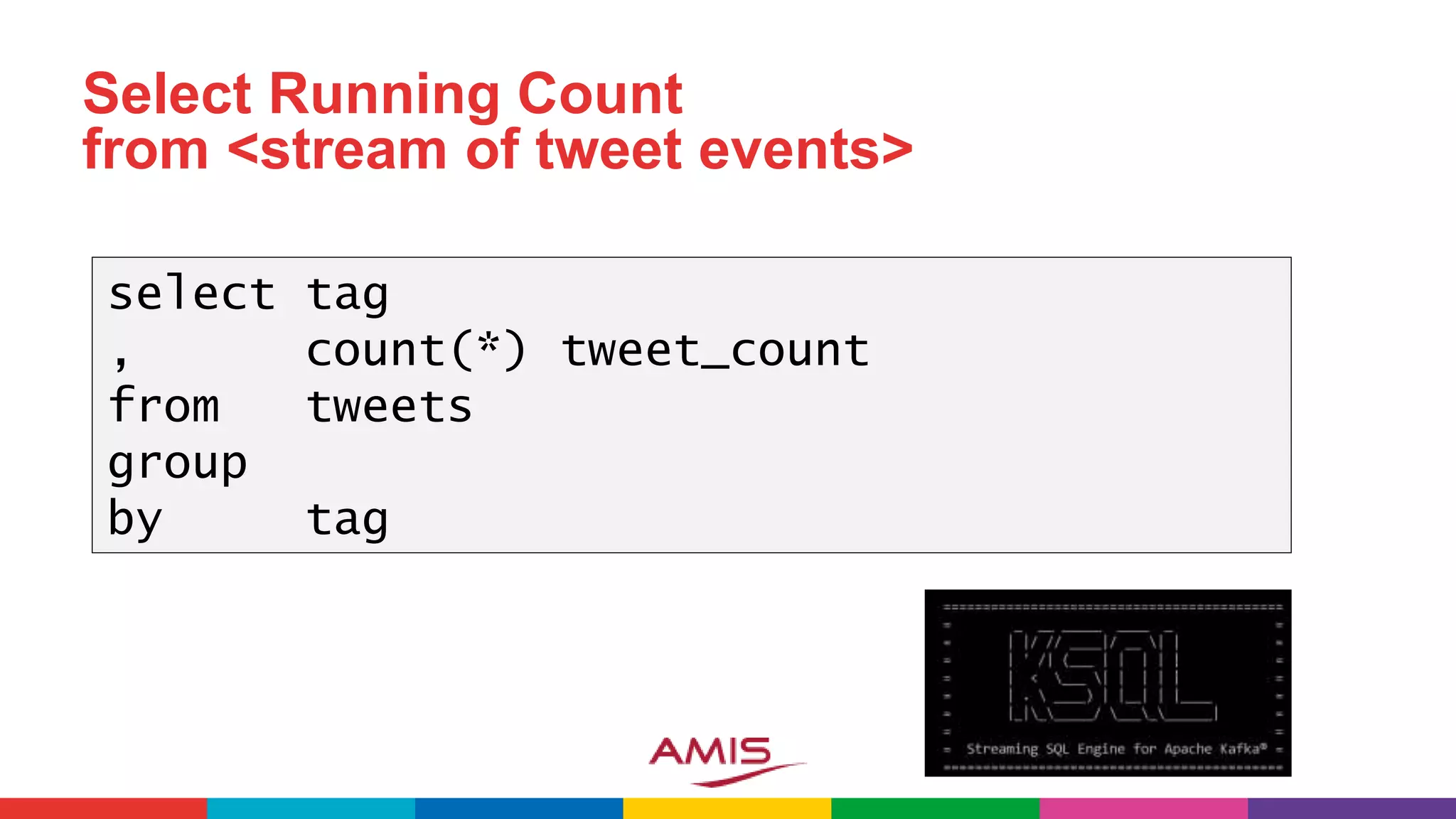
Select Running Count
from <stream of tweet events>
select tag
, count(*) tweet_count
from tweets
group
by tag
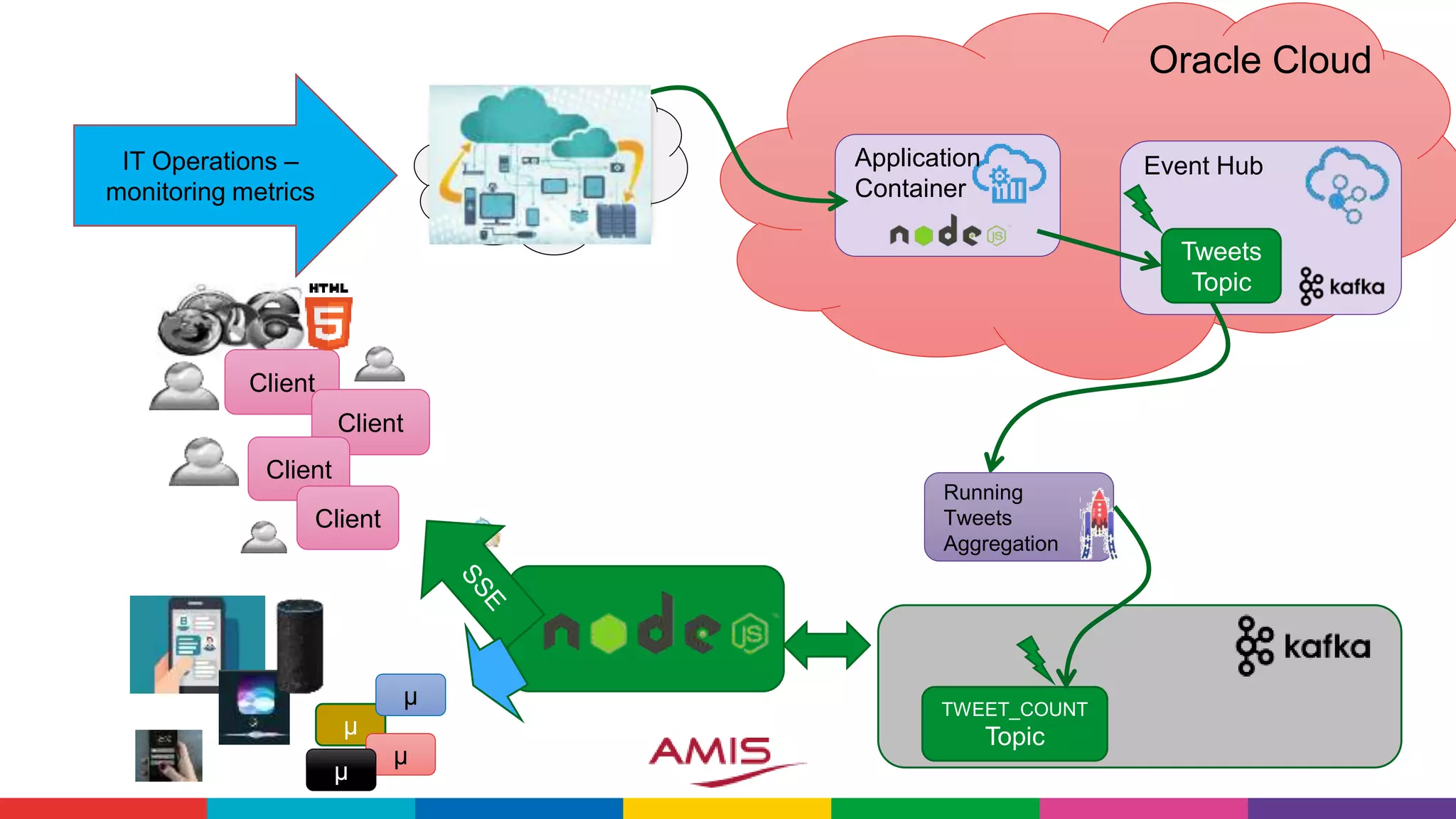
Tweets on #JEEConf
#java #oraclecode
Tweets
Topic
Oracle Cloud
Event HubApplication
Container
TWEET_COUNT
Topic
Running
Tweets
Aggregation
Client
Client
Client
Client
IoT metrics from
hundreds of devices
User actions & click
events from webshop
Live Traffic EventsMicroservices chatter
Social Media events
(Facebook,
Whatsapp, …)
IT Operations –
monitoring metrics
µ
µ
µ
µ
Tweets on #JEEConf
#java #oraclecode
Tweets
Topic
Oracle Cloud
Event HubApplication
Container
TWEET_COUNT
Topic
Running
Tweets
Aggregation
Client
Client
Client
Client
IoT metrics from
hundreds of devices
User actions & click
events from webshop
Live Traffic EventsMicroservices chatter
Social Media events
(Facebook,
Whatsapp, …)
IT Operations –
monitoring metrics
µ
µ
µ
µ
Real Time
live | fresh | instantaneous |
on line | synchronous
50 Shades of Data 14
50 Shades of Data 15
50 Shades of Data 16
< 10
ms
< 100
ms
< 500
ms
<3
secs
> 3
secs
50 Shades of Data 17
Machine Response Human Reaction
17
< 10
ms
< 100
ms
< 500
ms
<3
secs
> 3
secs
50 Shades of Data 18
Machine Response Human Reaction
18
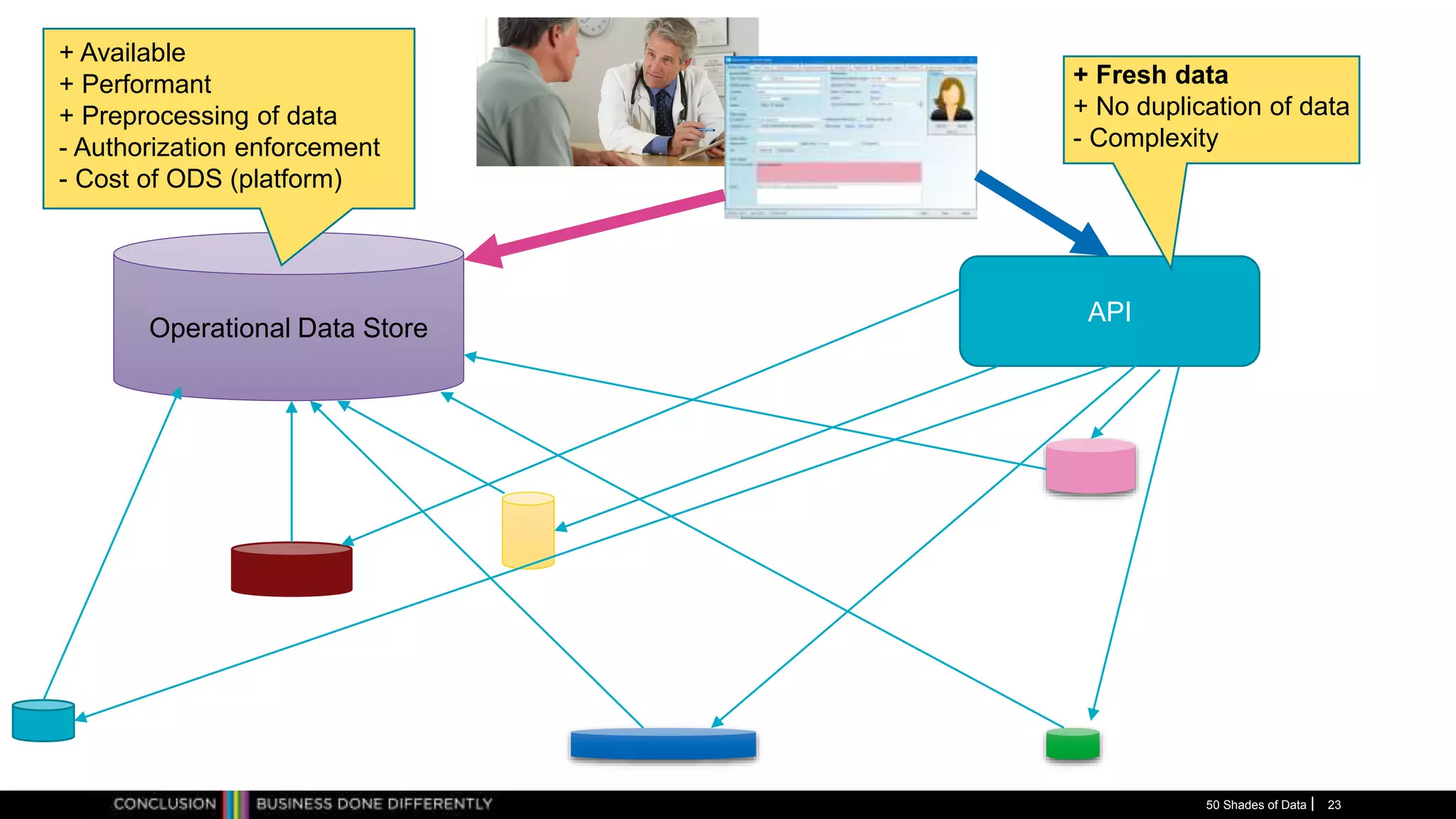
Doctor & Patient
50 Shades of Data 20
50 Shades of Data 21
50 Shades of Data 22
Operational Data Store
API
Batch,
background,
asynchronous
On demand,
synchronous
50 Shades of Data 23
Operational Data Store
API
+ Available
+ Performant
+ Preprocessing of data
- Authorization enforcement
- Cost of ODS (platform)
+ Fresh data
+ No duplication of data
- Complexity
50 Shades of Data 24
50 Shades of Data 25
50 Shades of Data 26
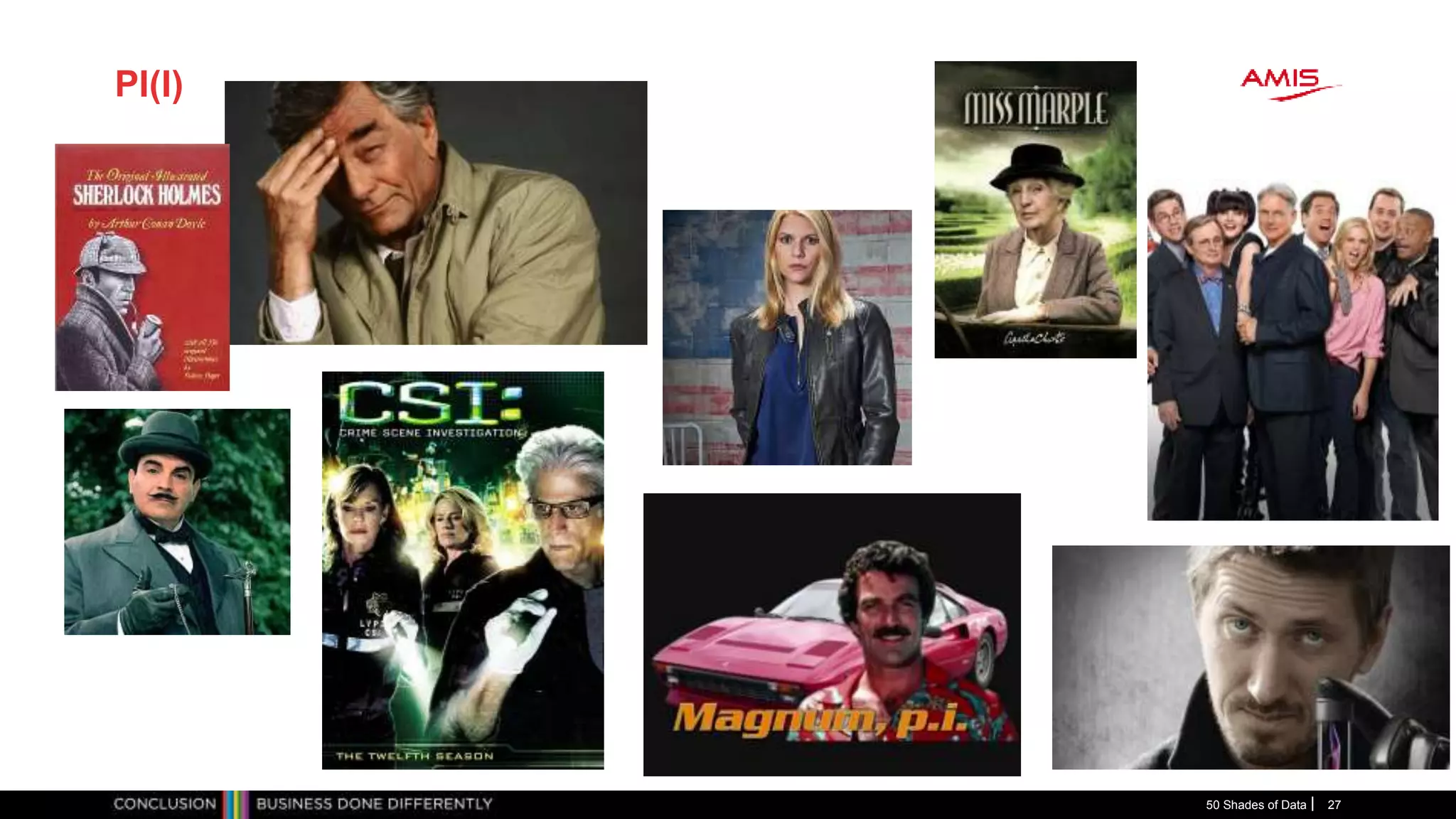
PI(I)
50 Shades of Data 27
50 Shades of Data 28
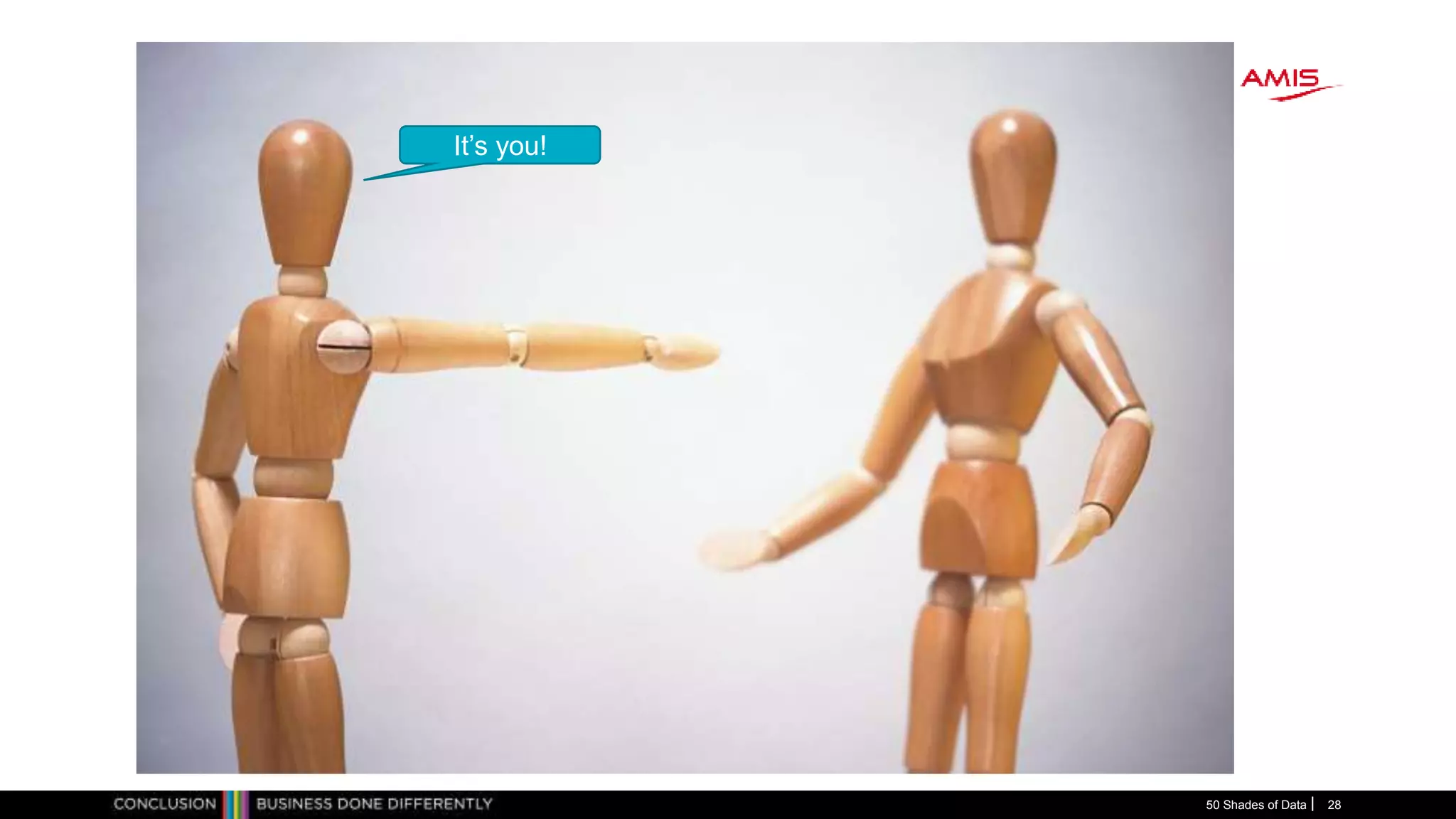
It’s you!
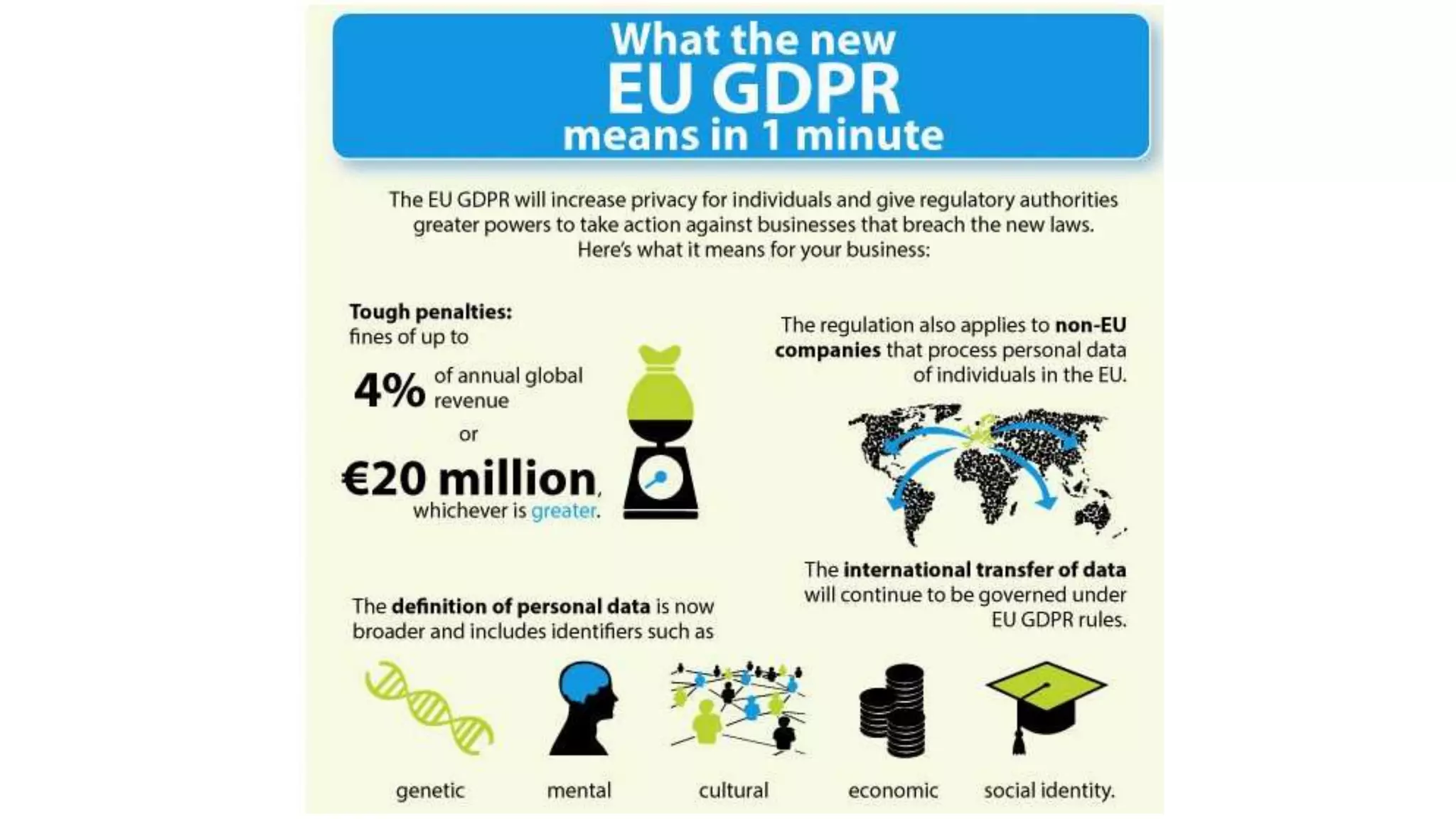
Data Subject’s Right under the GDPR
50 Shades of Data 29
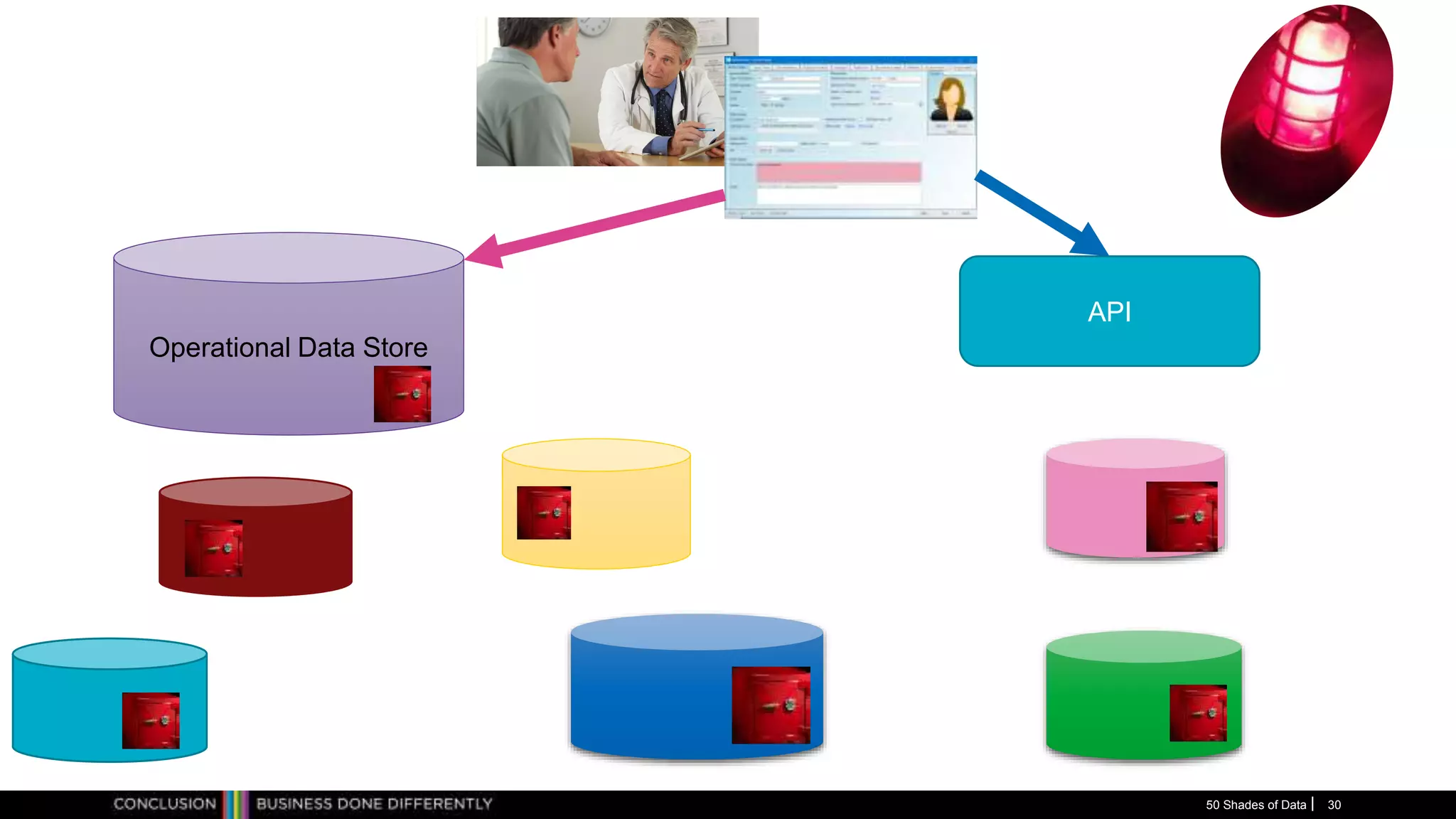
50 Shades of Data 30
Operational Data Store
API
Integrity
• Madelon’s pasje
• Real world vs World of Databases
• Relax!
• Anomaly detection
50 Shades of Data 31
Data Constraints
to protect integrity
• Allowable values
• Mandatory attributes
• (Foreign Key) References
• NULL
• Constraints on
• type
• length
• format
• Spelling
• Character encoding
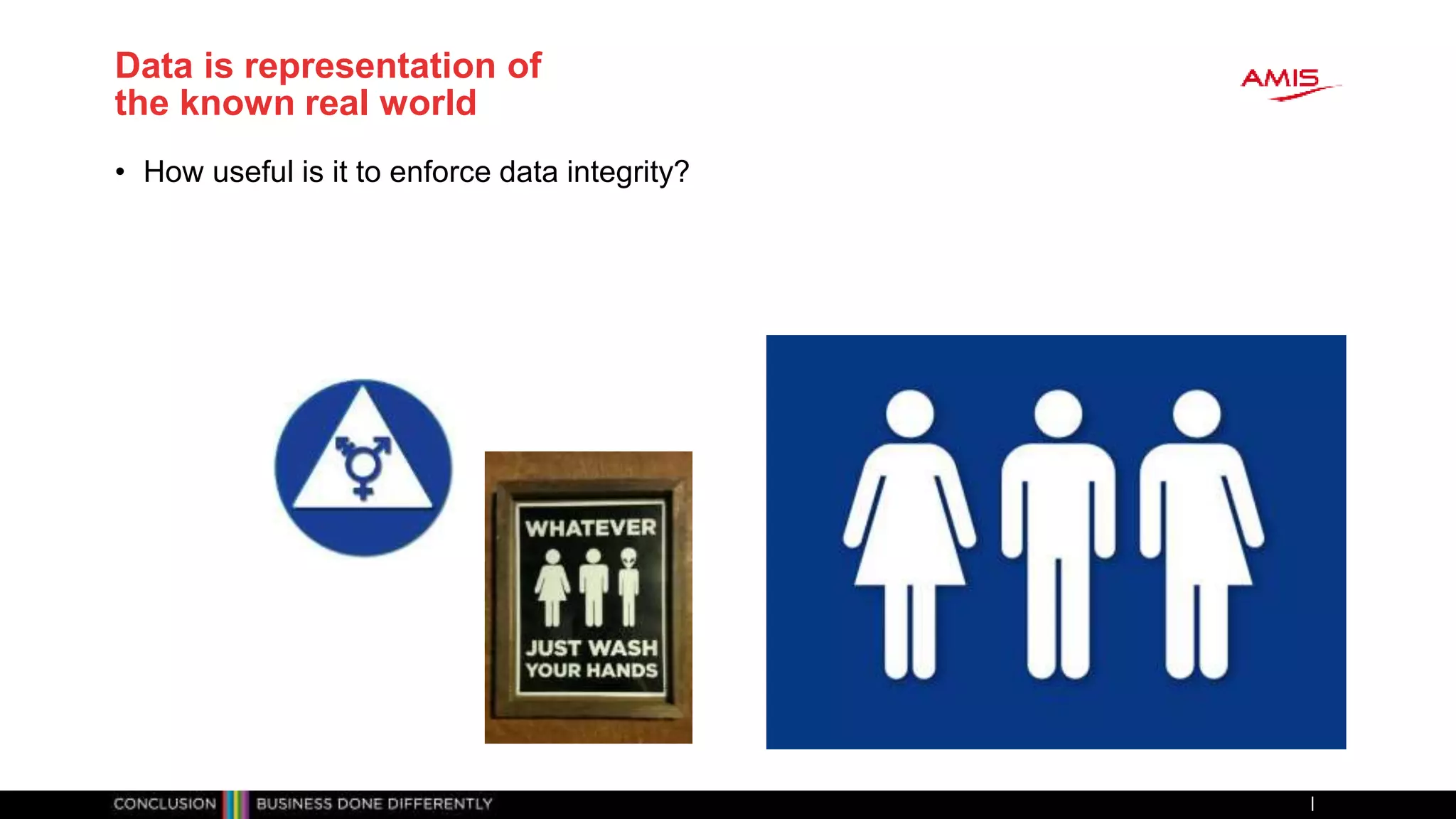
Data is representation of
the known real world
• How useful is it to enforce data integrity?
Data Integrity
• Why?
• Is it about truth?
• About regulations and by-the-book?
• Allow IT systems to run smoothly and not get confused?
• About auditability and non-repudiation?
• What about the real world?
• Data in IT is just a representation;
if the world is not by the book – what should IT do?
50 Shades of Data 36
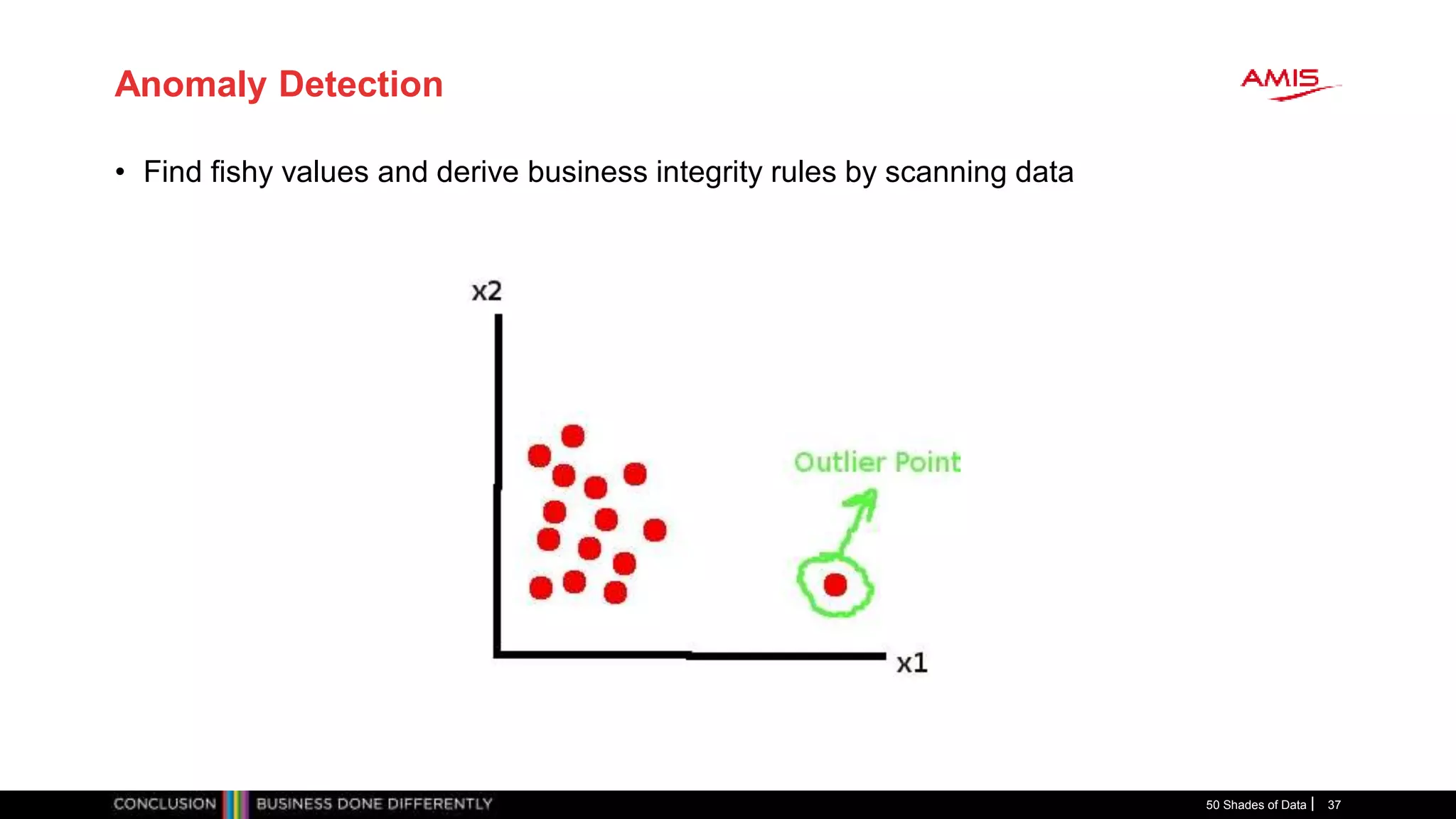
Anomaly Detection
• Find fishy values and derive business integrity rules by scanning data
50 Shades of Data 37
BOL - CQRS
50 Shades of Data 38
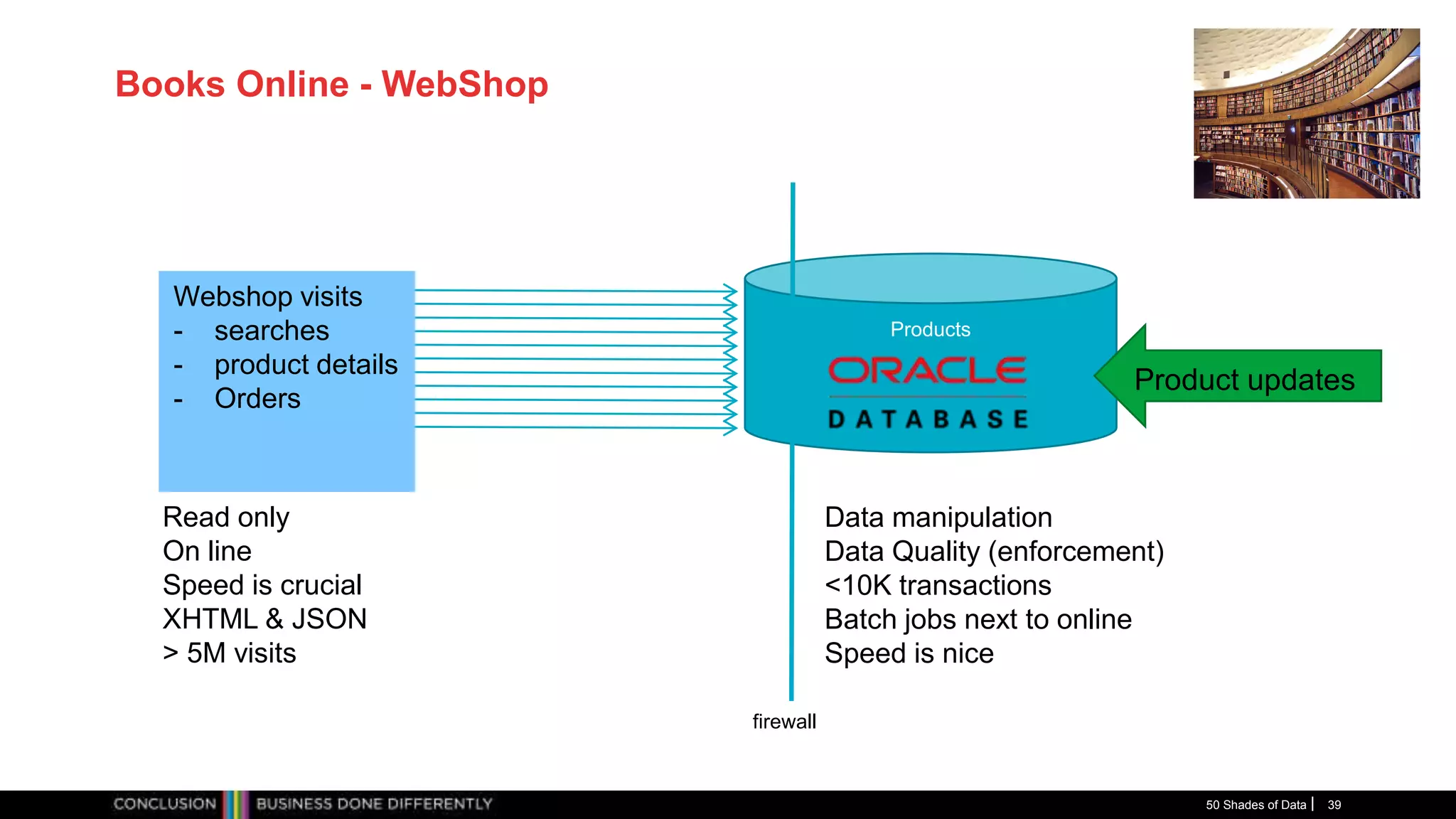
Books Online - WebShop
50 Shades of Data 39
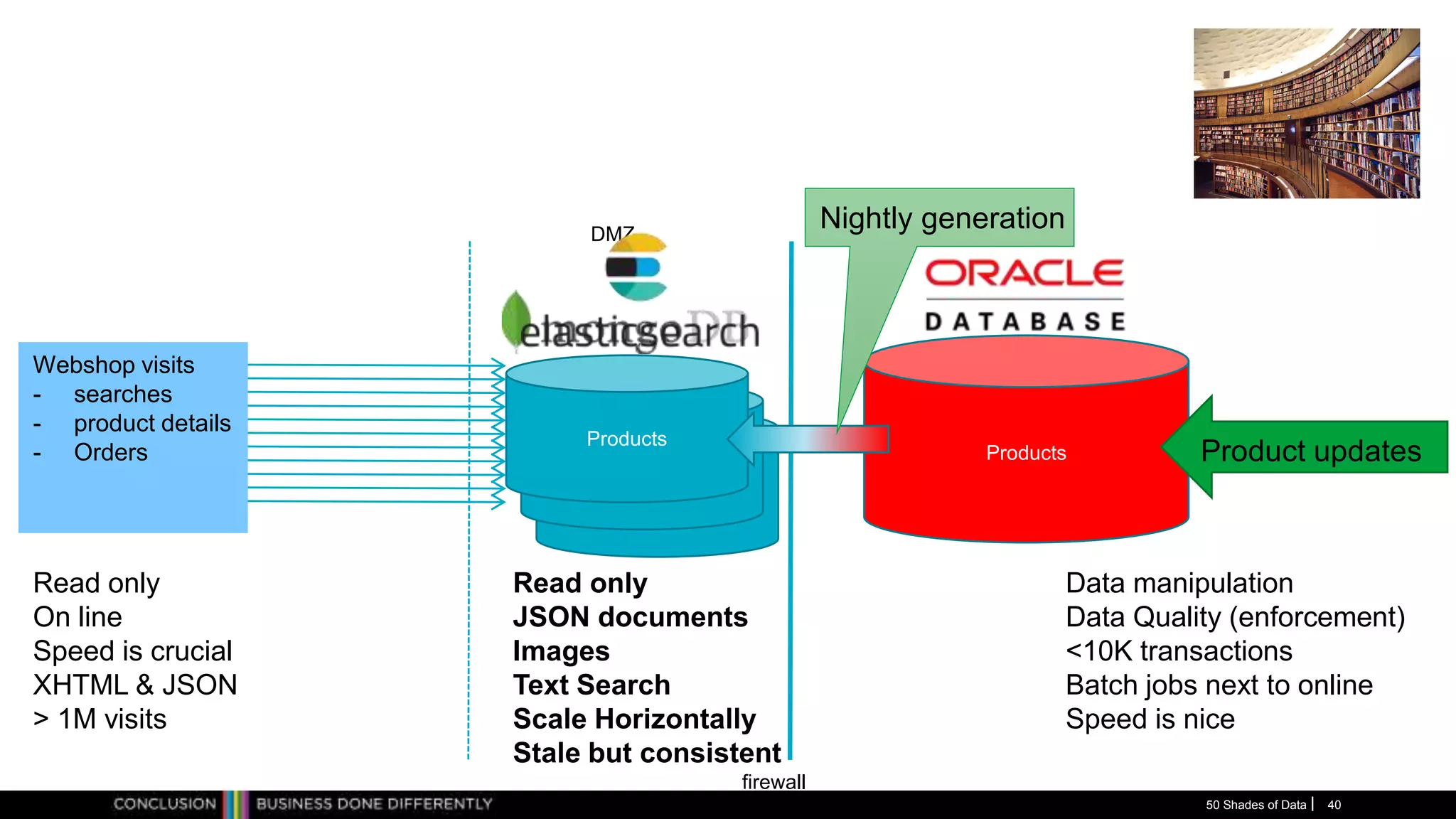
Products
Product updates
firewall
Data manipulation
Data Quality (enforcement)
<10K transactions
Batch jobs next to online
Speed is nice
Read only
On line
Speed is crucial
XHTML & JSON
> 5M visits
Webshop visits
- searches
- product details
- Orders
50 Shades of Data 40
Products
Products
Products
Webshop visits
- searches
- product details
- Orders
firewall
Data manipulation
Data Quality (enforcement)
<10K transactions
Batch jobs next to online
Speed is nice
Read only
On line
Speed is crucial
XHTML & JSON
> 1M visits
DMZ
Read only
JSON documents
Images
Text Search
Scale Horizontally
Stale but consistent
Products
Nightly generation
Product updates
Hoe integreer je applicaties en data? 41
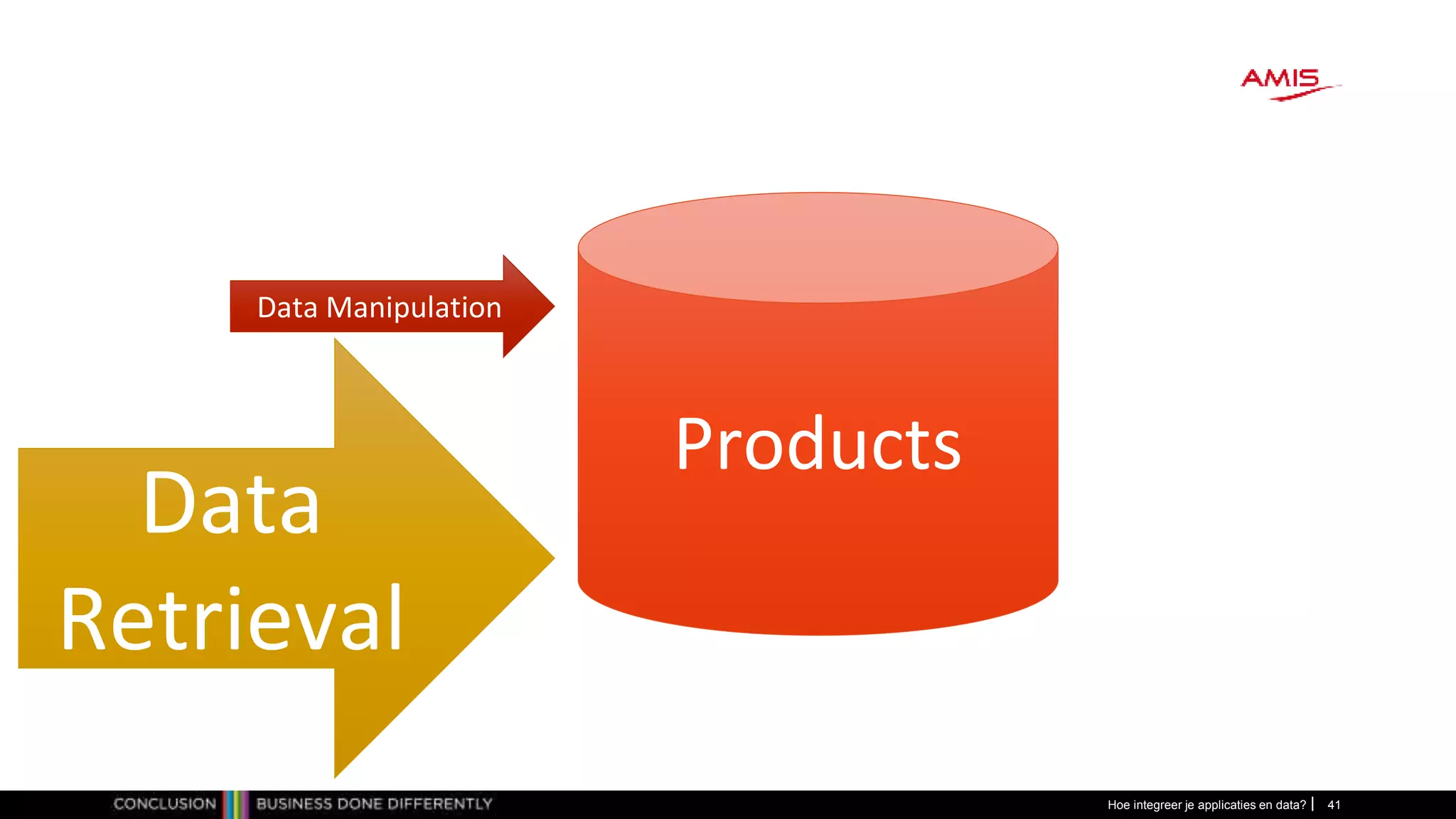
Products
Data Manipulation
Data
Retrieval
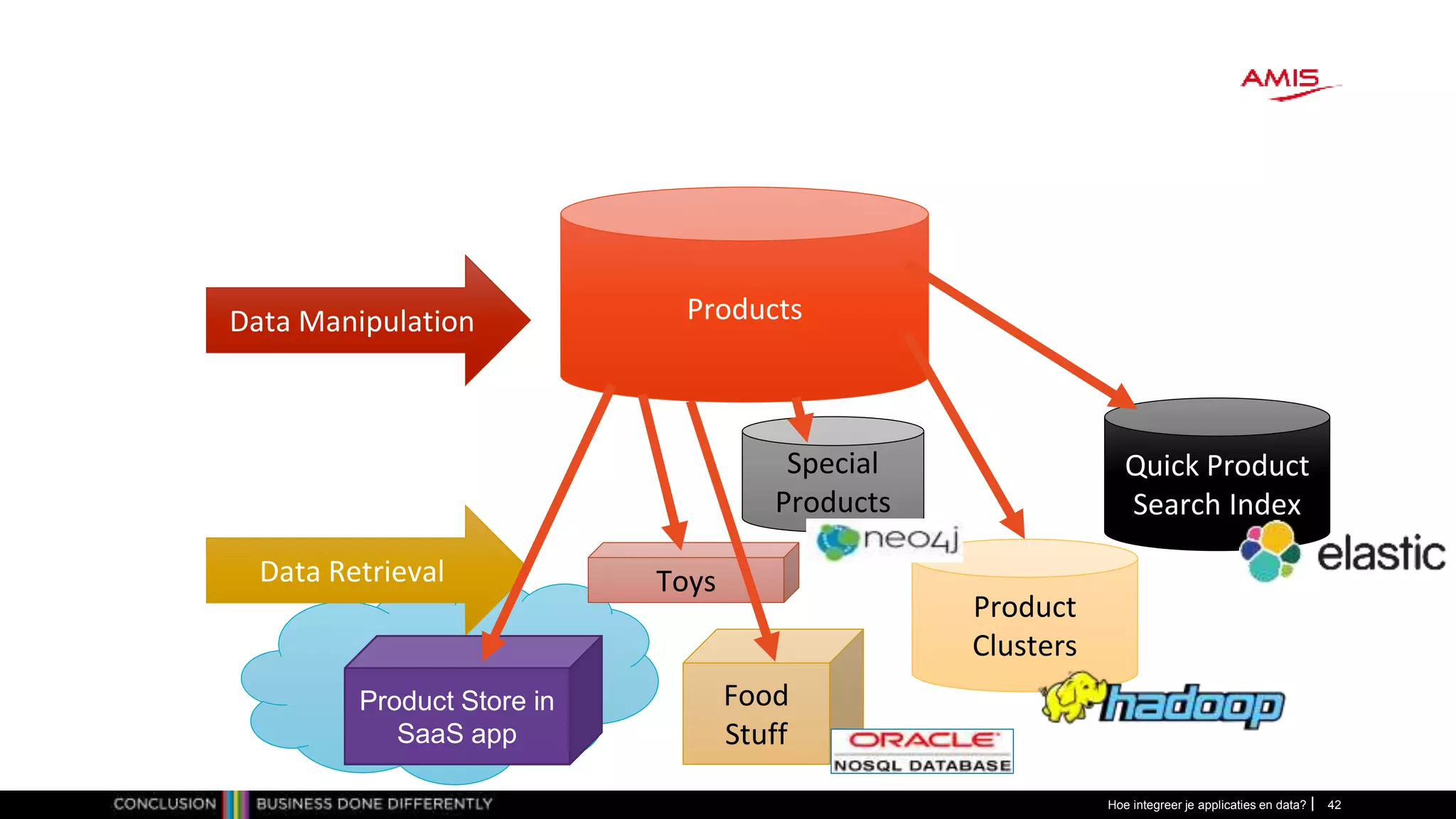
Hoe integreer je applicaties en data? 42
Special
Products
Product
Clusters
ProductsData Manipulation
Data Retrieval
Food
Stuff
Toys
Quick Product
Search Index
Product Store in
SaaS app
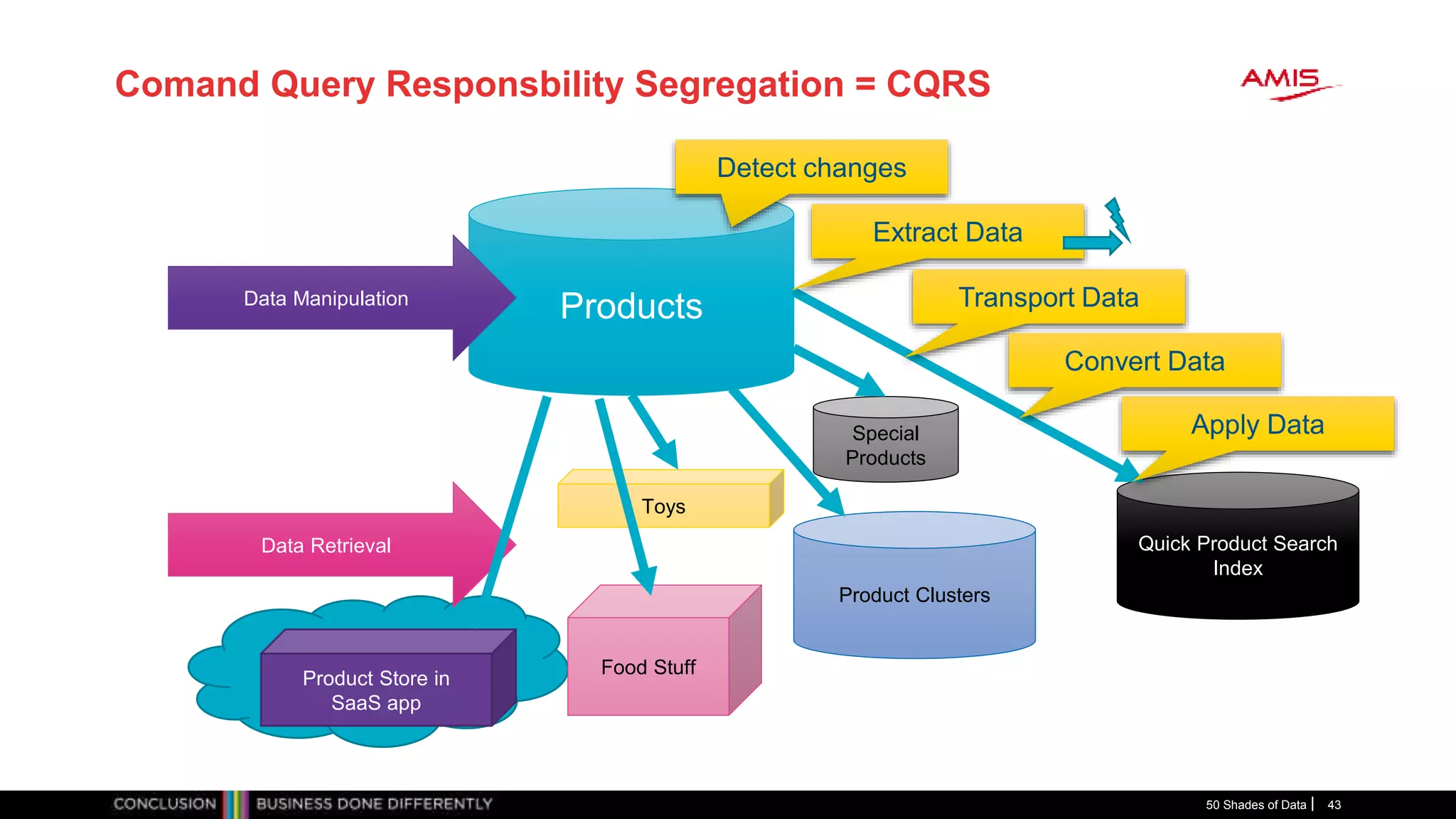
Comand Query Responsbility Segregation = CQRS
50 Shades of Data 43
Special
Products
Product Clusters
ProductsData Manipulation
Data Retrieval
Food Stuff
Toys
Quick Product Search
Index
Product Store in
SaaS app
Detect changes
Extract Data
Transport Data
Convert Data
Apply Data
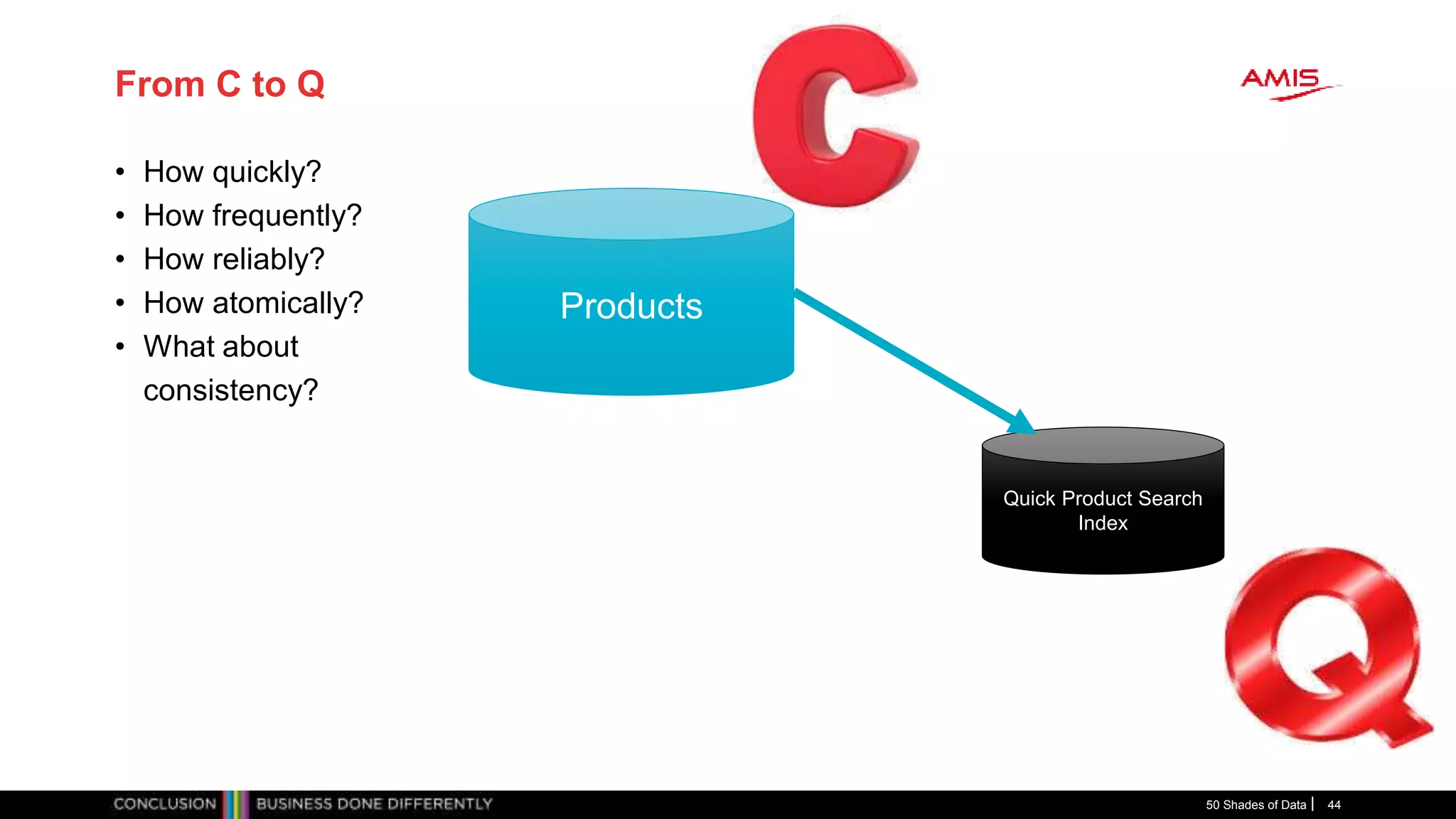
From C to Q
• How quickly?
• How frequently?
• How reliably?
• How atomically?
• What about
consistency?
50 Shades of Data 44
Products
Quick Product Search
Index
50 Shades of Data 45
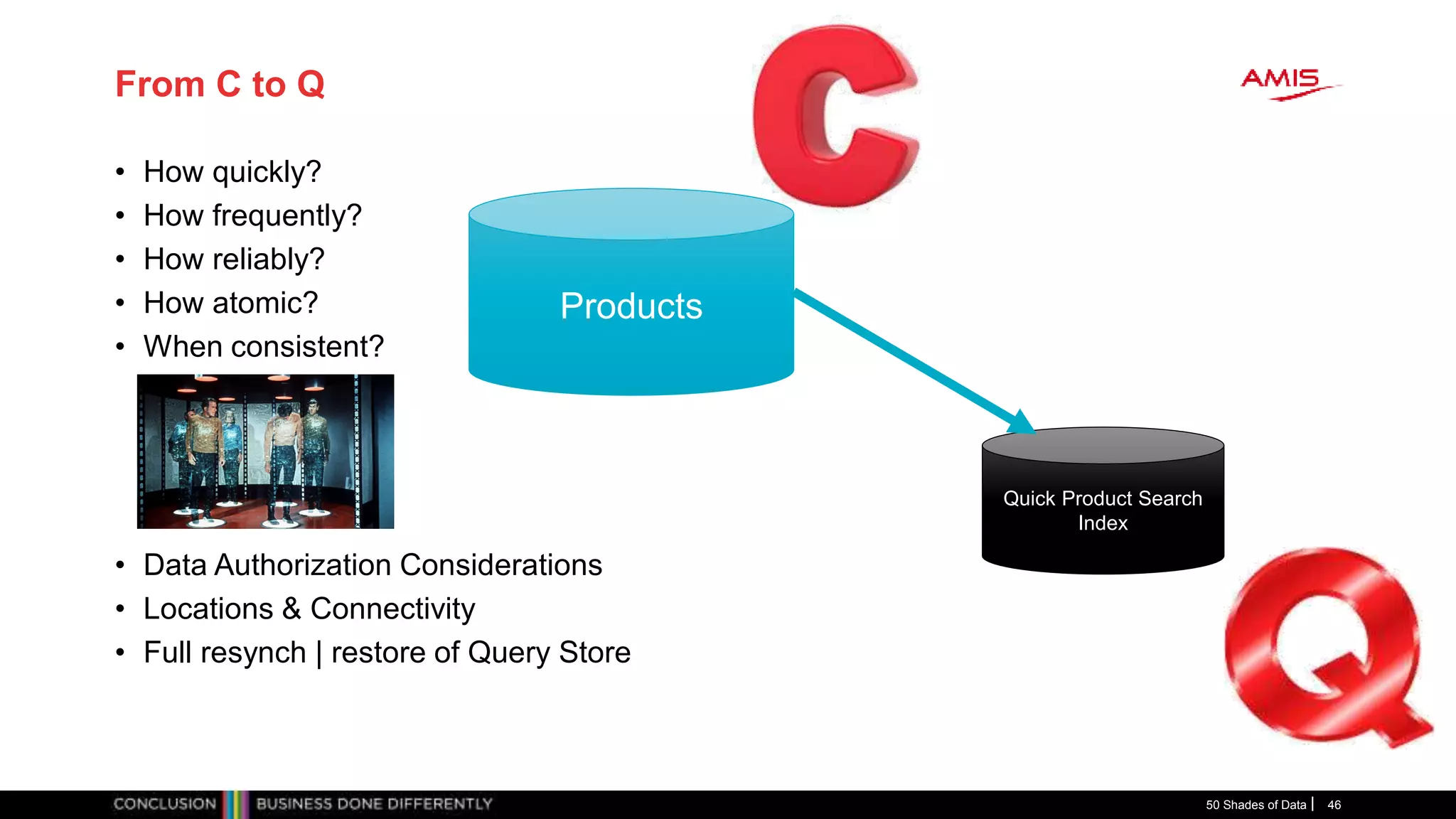
From C to Q
• How quickly?
• How frequently?
• How reliably?
• How atomic?
• When consistent?
• Data Authorization Considerations
• Locations & Connectivity
• Full resynch | restore of Query Store
50 Shades of Data 46
Products
Quick Product Search
Index
[let go of] The Holy Grail of Normalization
• Normalize to prevent
• data redundancy
• discrepancies
(split brain)
• storage waste
50 Shades of Data 47
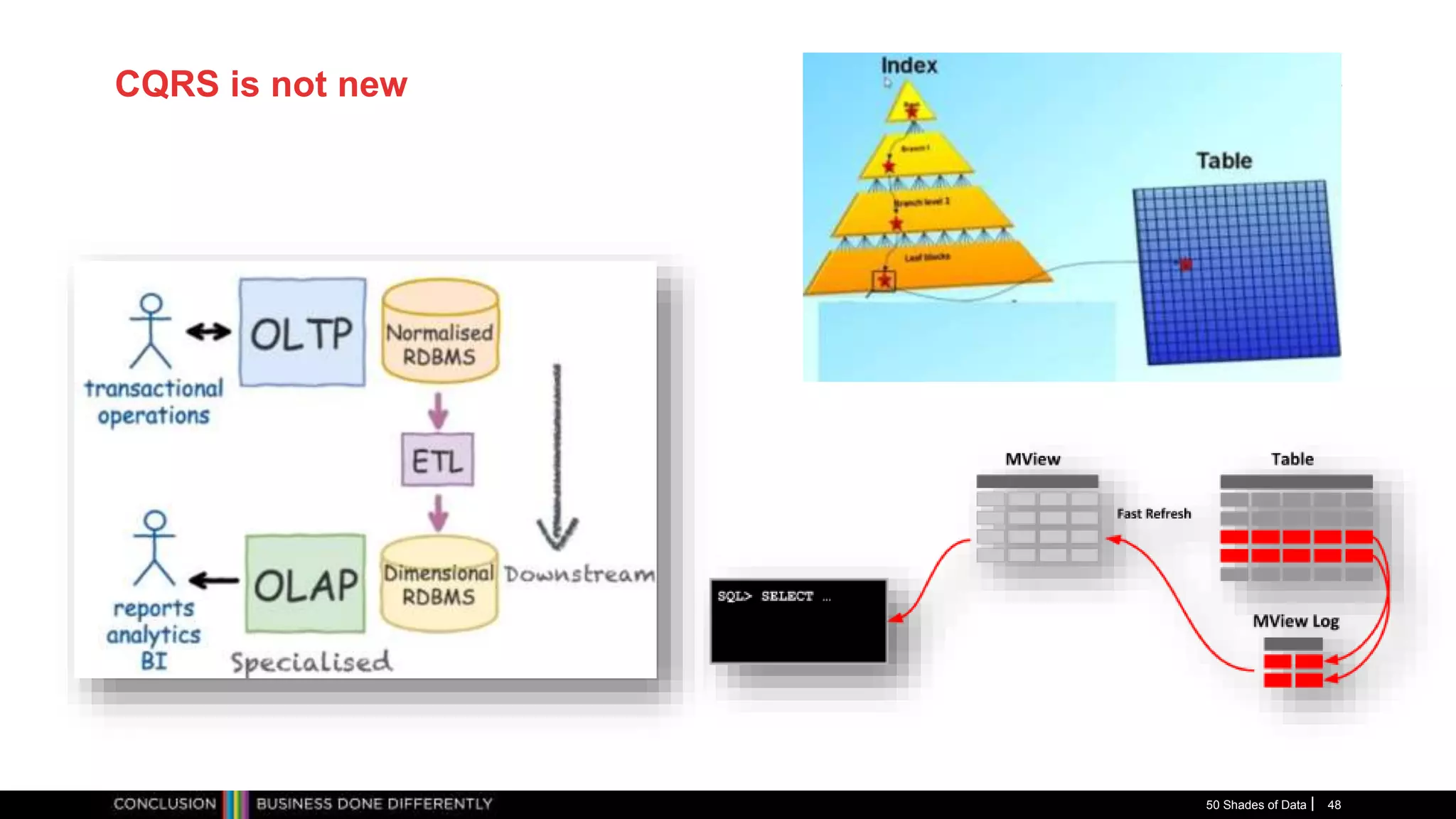
CQRS is not new
50 Shades of Data 48
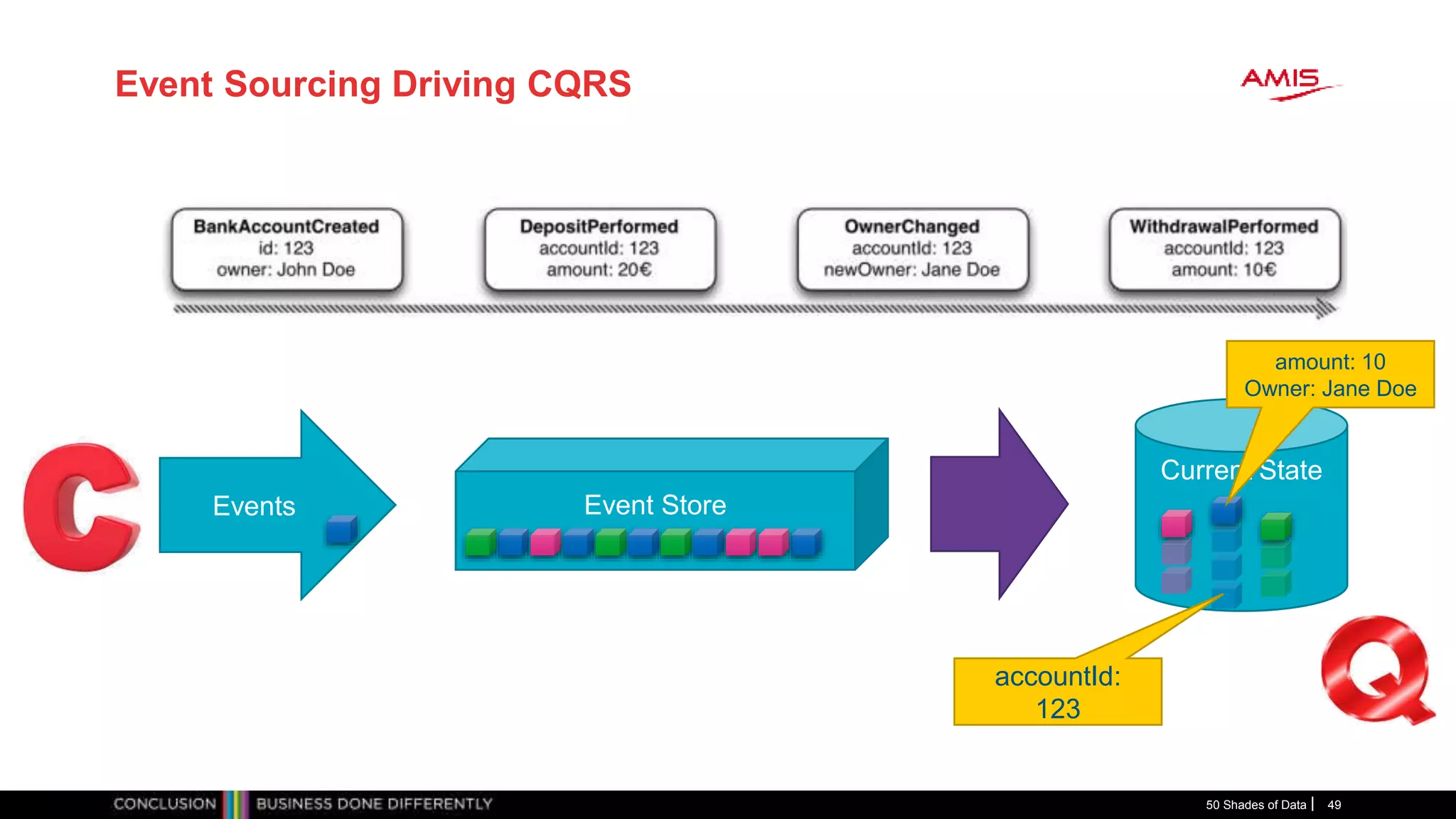
Event Sourcing Driving CQRS
50 Shades of Data 49
Events Event Store
Current State
accountId:
123
amount: 10
Owner: Jane Doe
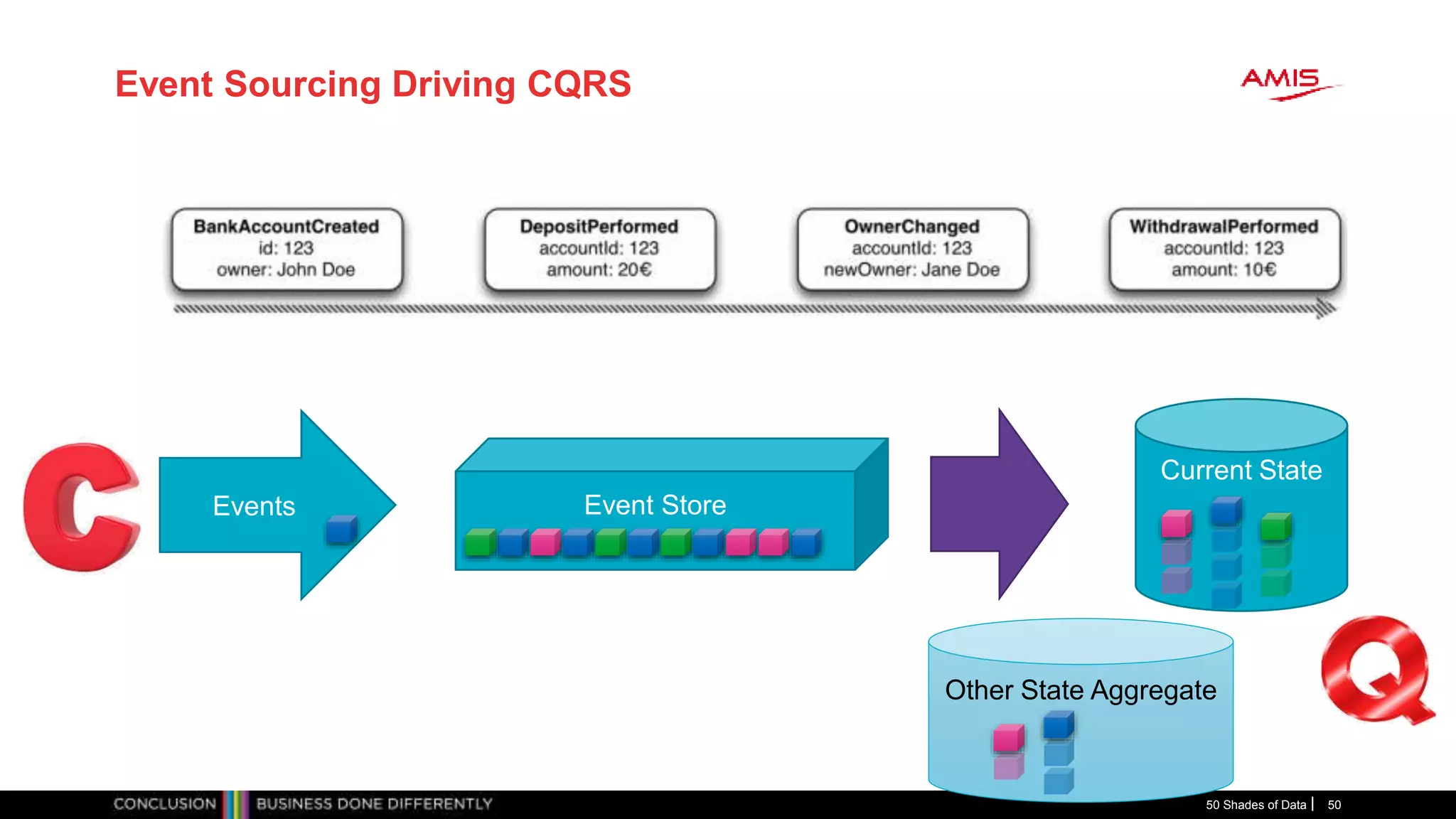
Event Sourcing Driving CQRS
50 Shades of Data 50
Events Event Store
Current State
Other State Aggregate
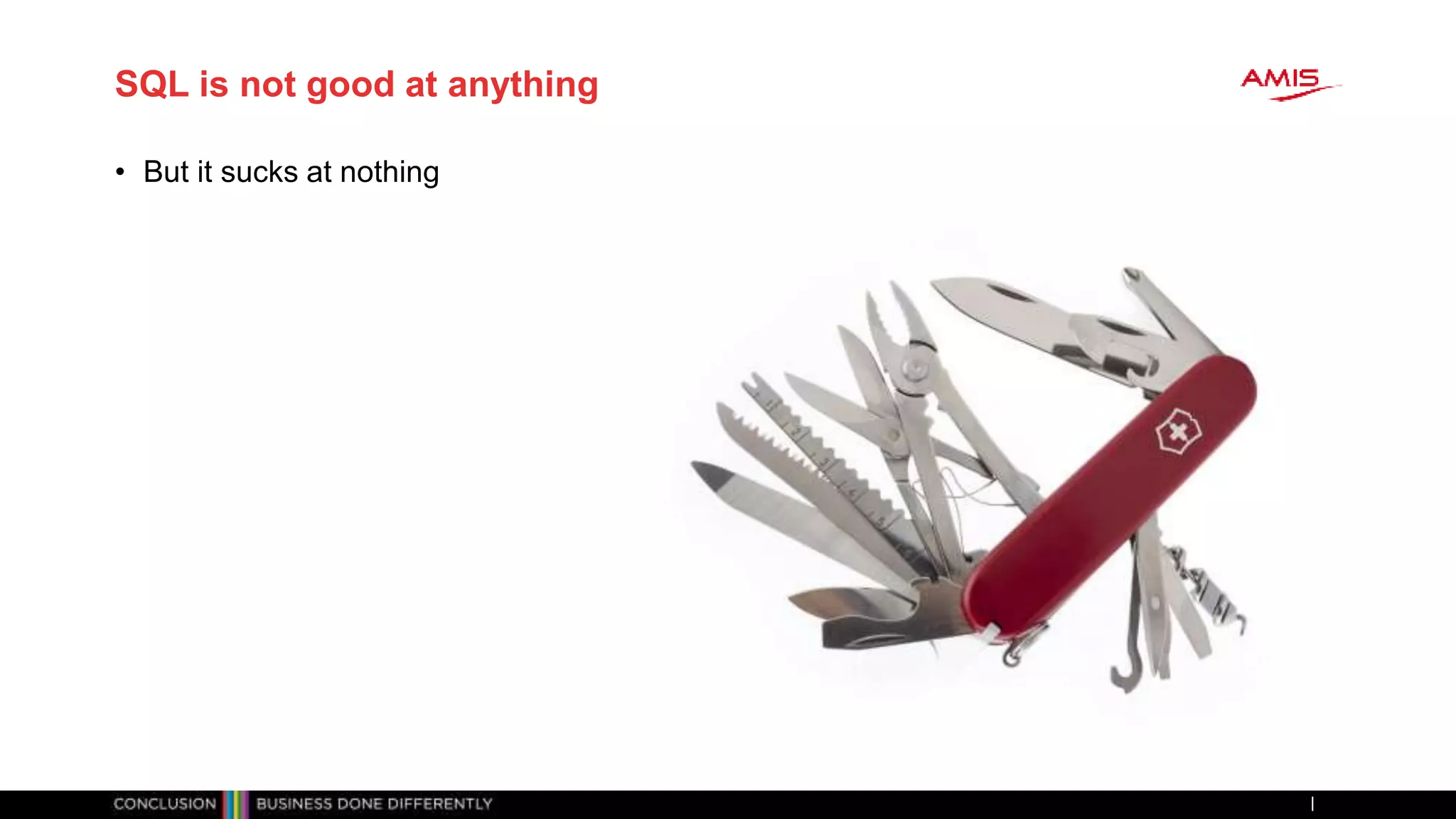
SQL is not good at anything
• But it sucks at nothing
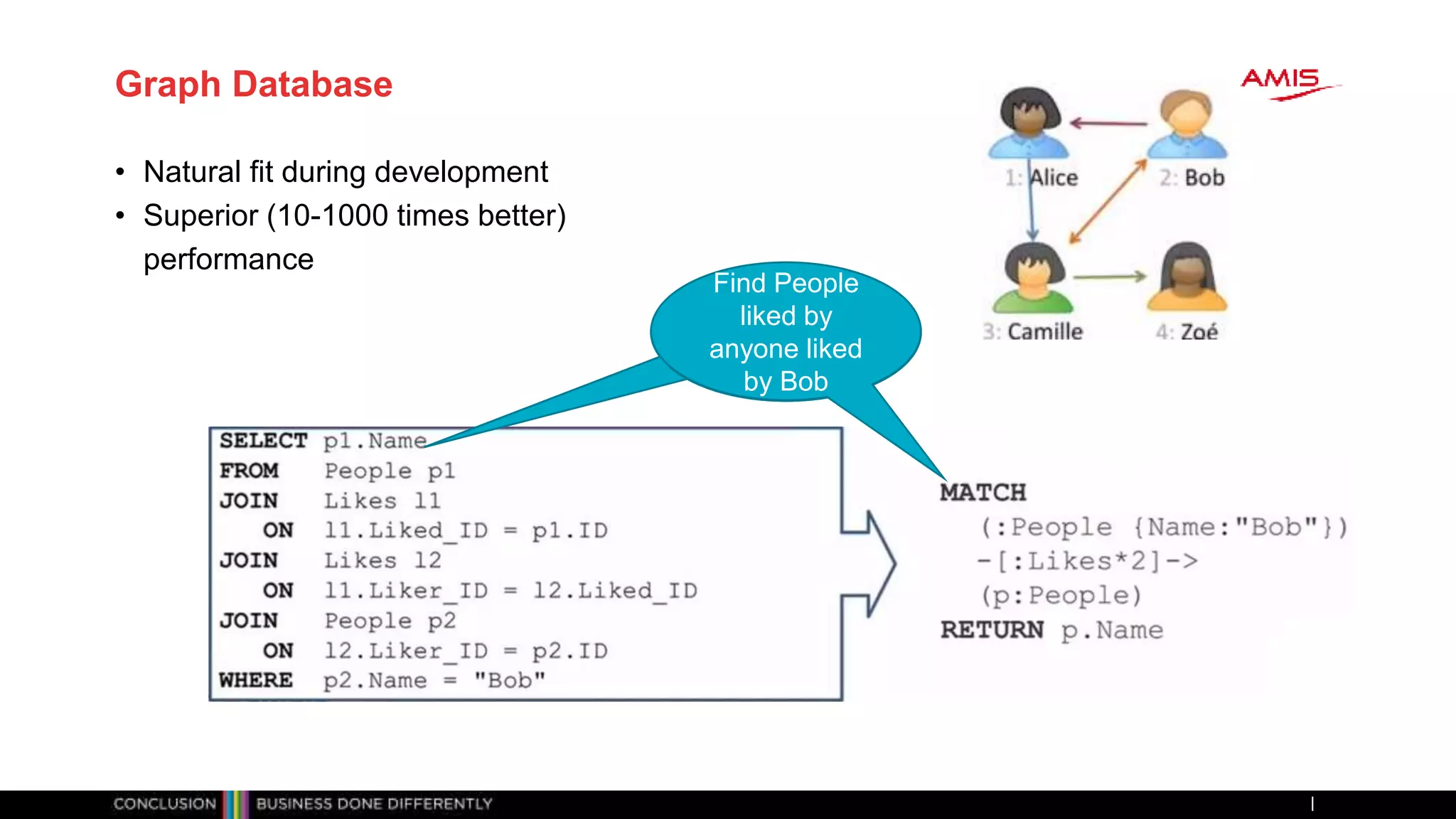
Graph Database
• Natural fit during development
• Superior (10-1000 times better)
performance
Person liked
by anyone
liked by Bob
Find People
liked by
anyone liked
by Bob
Find People
liked by
anyone liked
by Bob
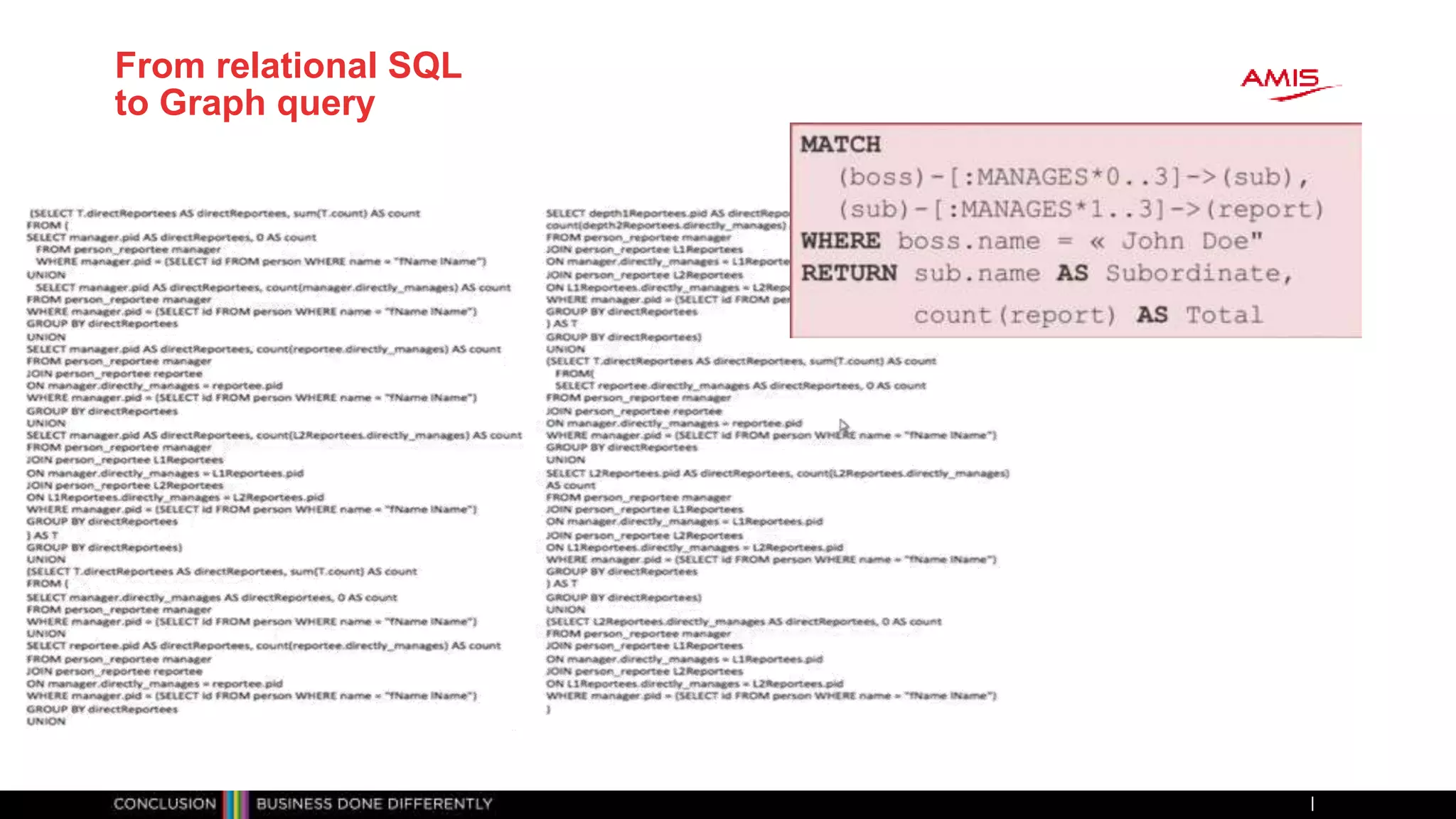
From relational SQL
to Graph query
SQL vs NoSQL
SQL vs NoSQL
ACID vs BASE
Relational vs …
Relational Databases
• Based on relational model of data (E.F. Codd), a mathematical foundation
• Uses SQL for query, DML and DDL
• Transactions are ACID (Atomicity, Consistency, Isolation, Durability)
• All or nothing
• Constraint Compliant
• Individual experience
[in a multi-session environment]
(aka concurrency)
• Down does not hurt
ACID comes at a cost – performance & scalability
• Transaction results have to be persisted [before the transaction completes]
in order to guarantee D
• Concurrency requires some degree of locking (and multi-versioning) in order
to have I
• Constraint compliance (unique key, foreign key) means all data hangs
together (as do all transactions)
in order to have C
• Two-phase commit (across multiple participants)
introduces complexity, dependencies and delays,
yet required for A
50 Shades of Data 59
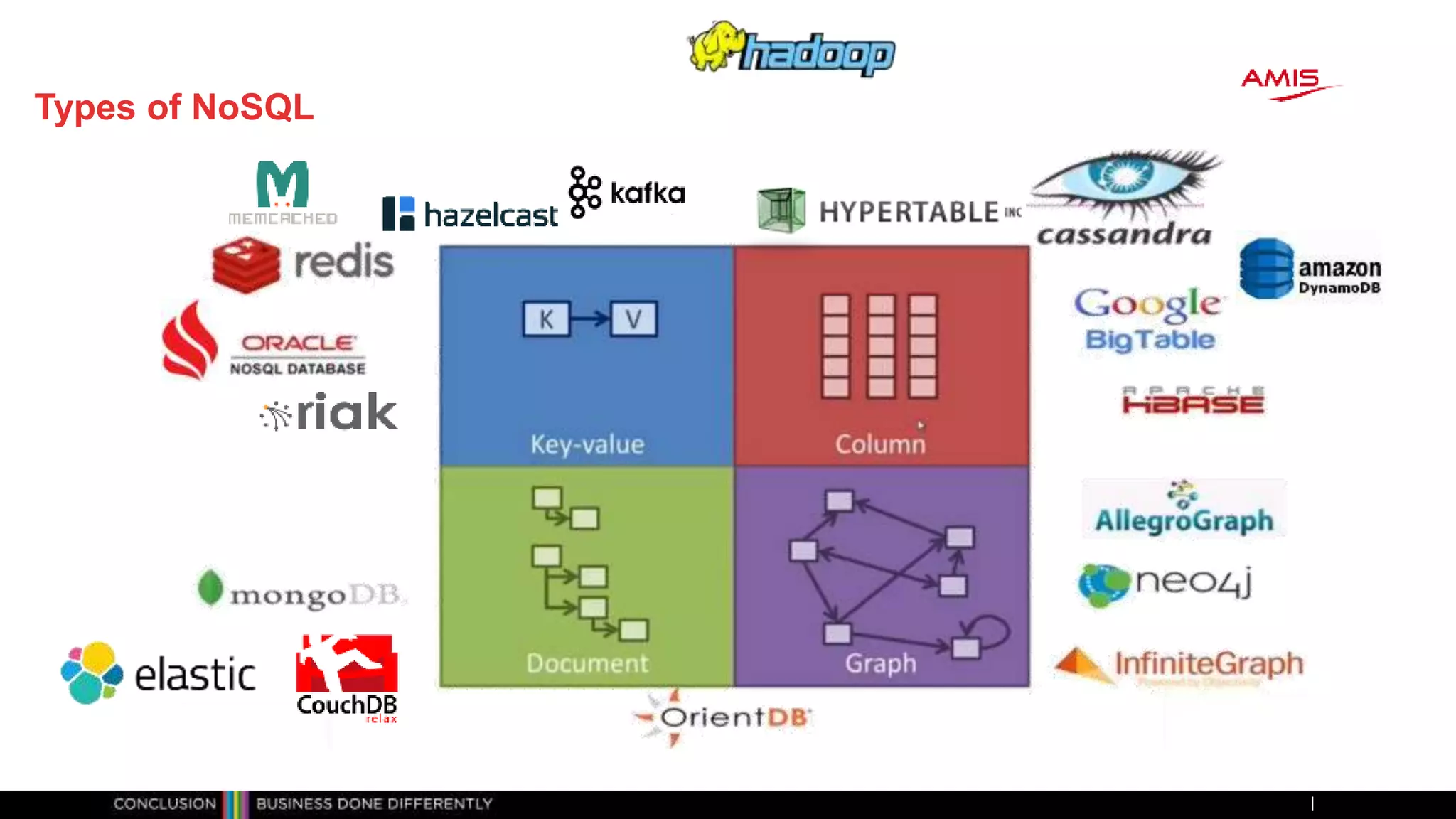
Types of NoSQL
50 Shades of Data 62
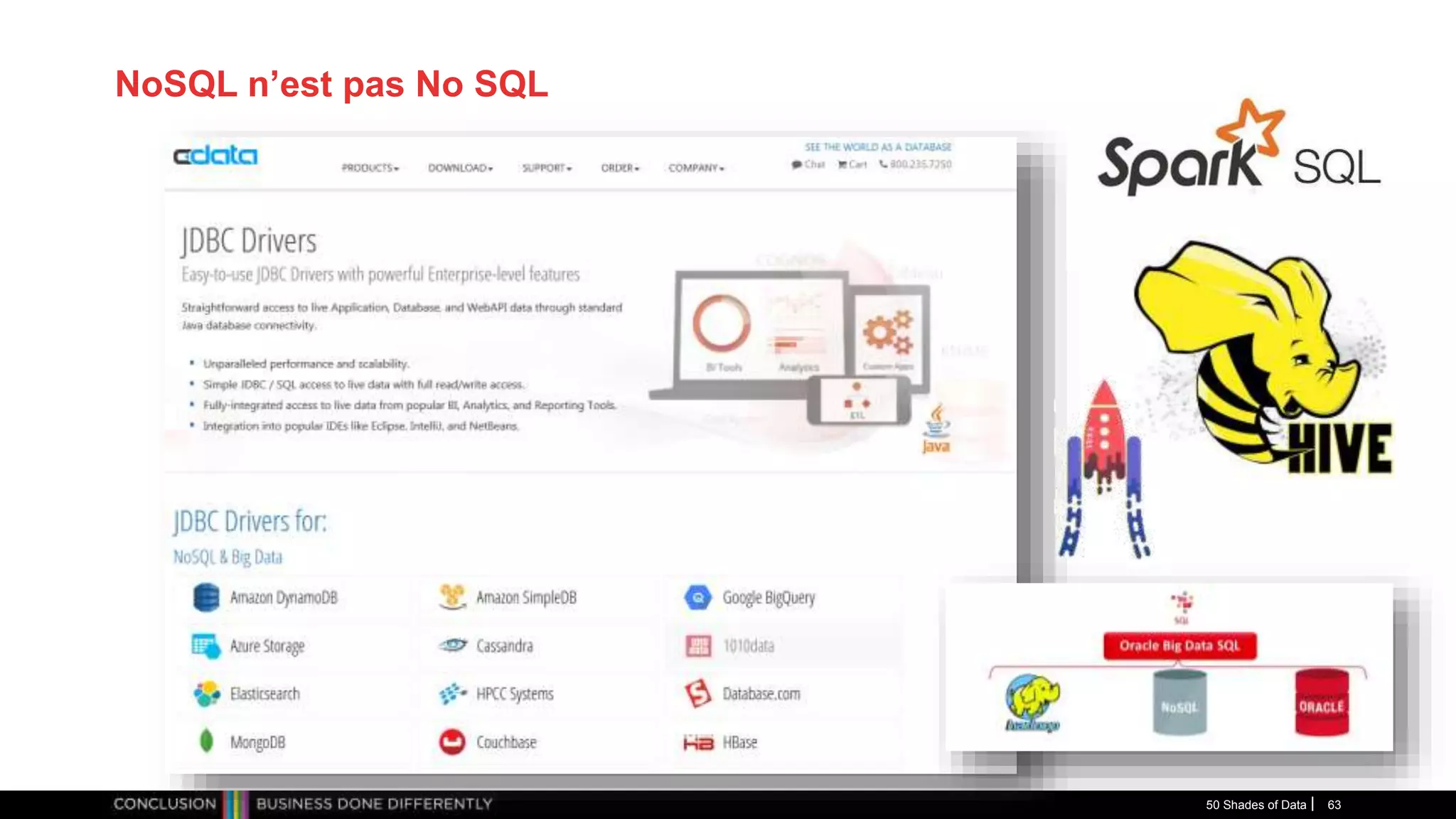
NoSQL n’est pas No SQL
50 Shades of Data 63
50 Shades of Data 64
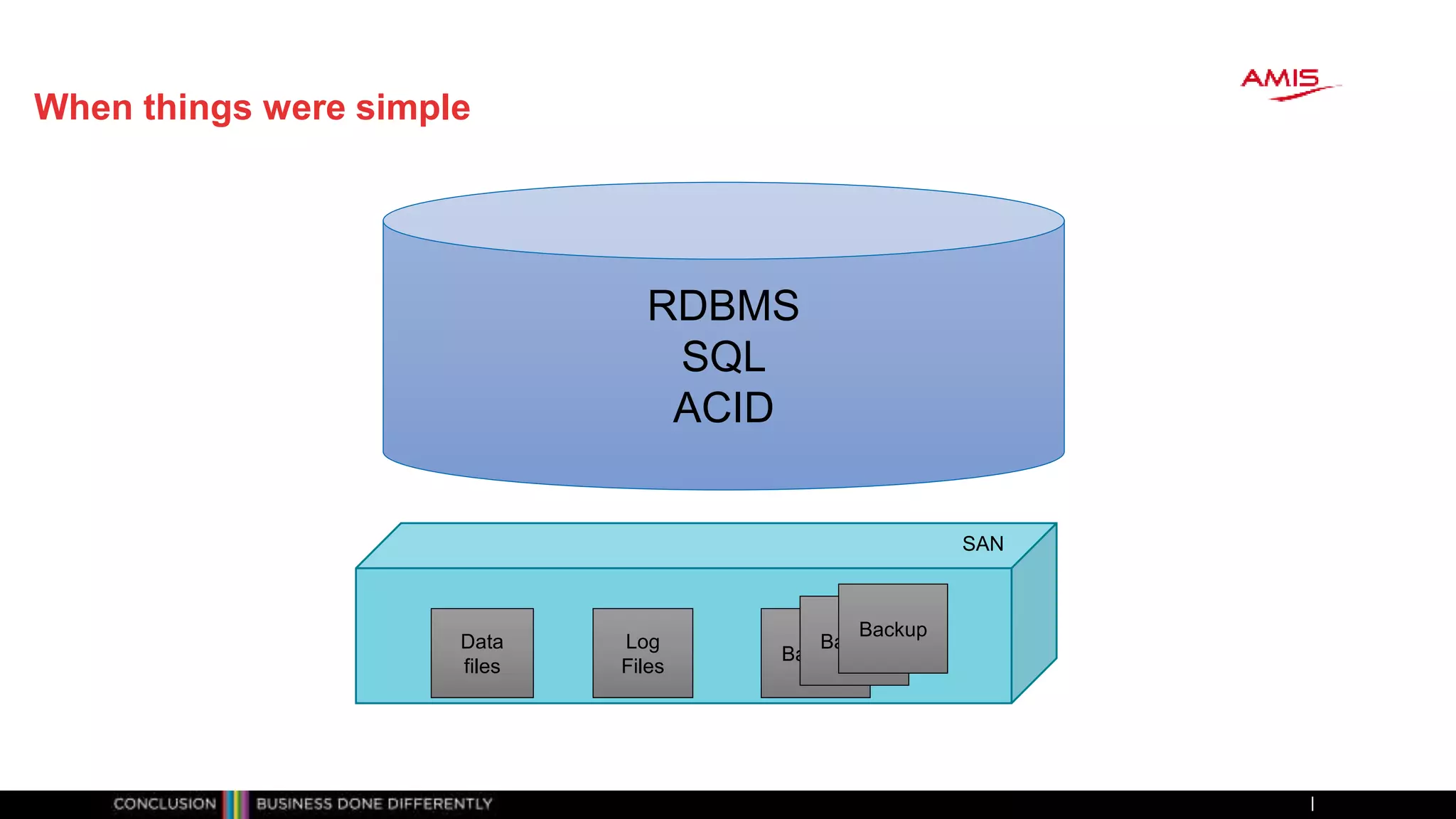
When things were simple
RDBMS
SQL
ACID
Data
files
Log
Files
Backup
Backup
Backup
SAN
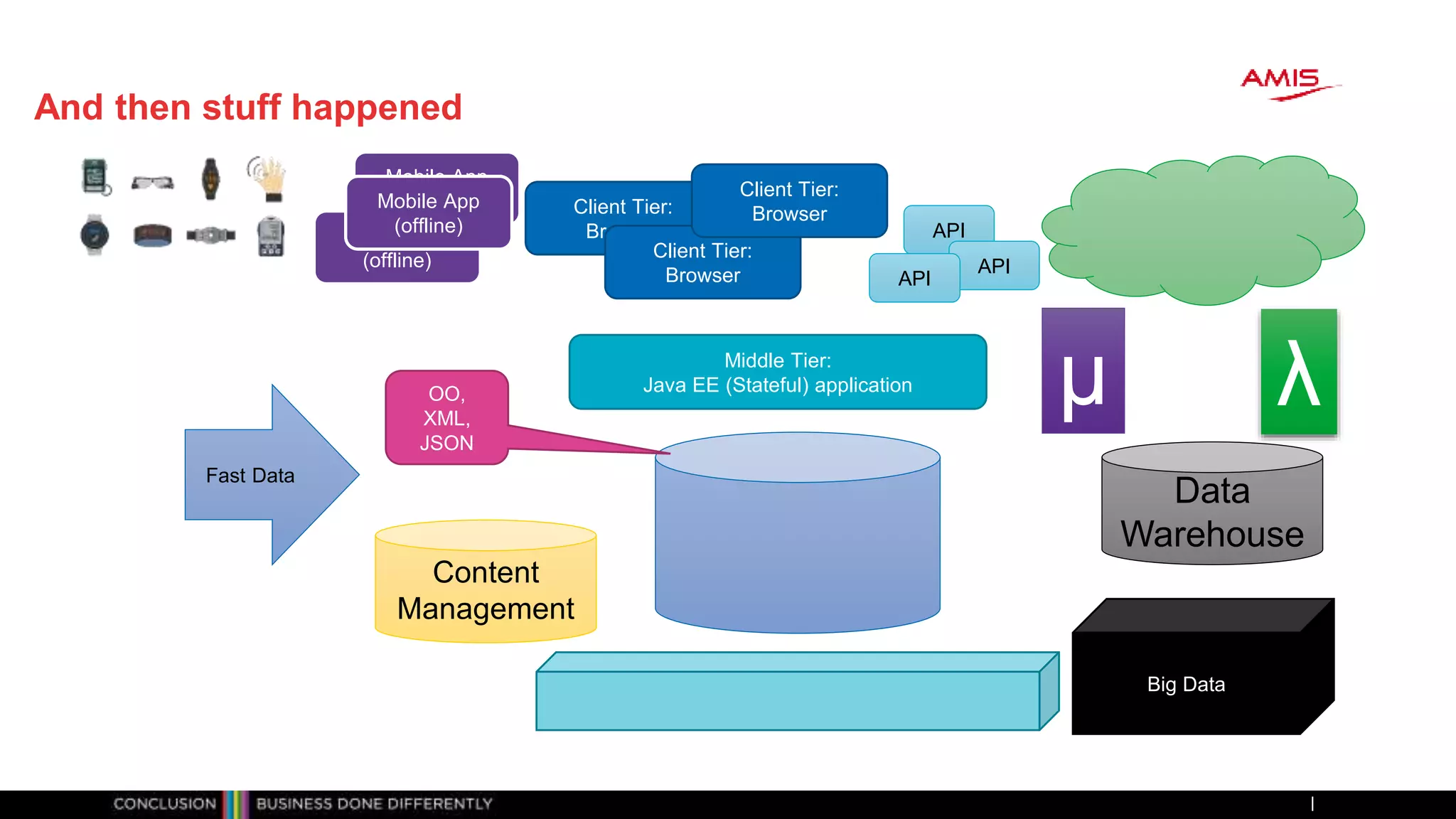
And then stuff happened
Middle Tier:
Java EE (Stateful) application
Client Tier:
Browser
Client Tier:
Browser
Client Tier:
Browser
Mobile App
(offline)
Mobile App
(offline)
Mobile App
(offline)
Data
Warehouse
OO,
XML,
JSON
Content
Management
Big Data
Fast Data
API
API
API
µ λ
50 Shades of Data 67
50 Shades of Data
Oracle Database
SQL
RDBMS
ACID
50 Shades of Data 69
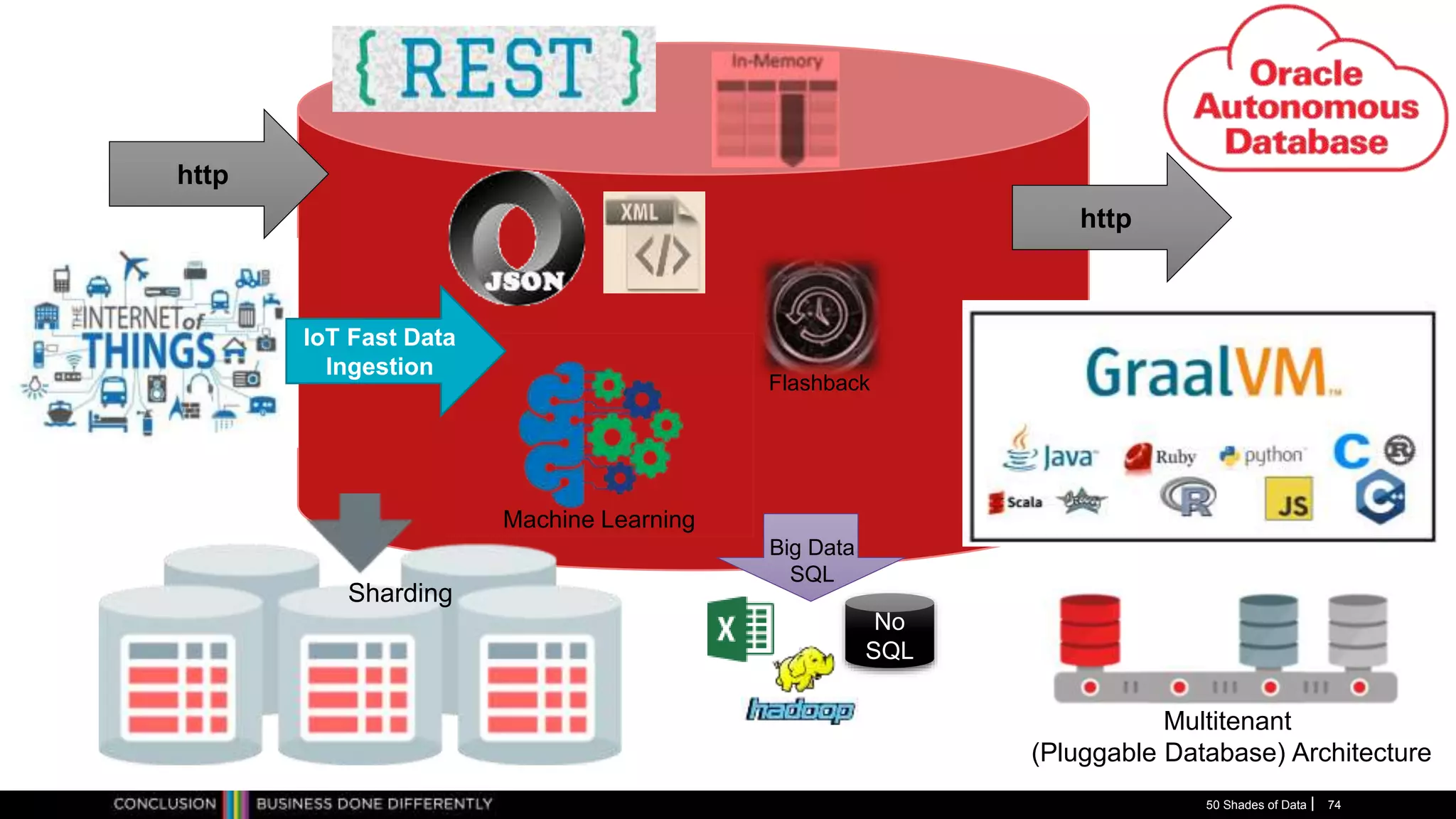
http
IoT Fast Data
Ingestion
Sharding
http
Machine Learning
No
SQL
Big Data
SQL
Multitenant
(Pluggable Database) Architecture
Flashback
50 Shades of Data 70
50 Shades of Data 71
50 Shades of Data 72
50 Shades of Data 73
50 Shades of Data 74
http
IoT Fast Data
Ingestion
Sharding
http
Machine Learning
No
SQL
Big Data
SQL
Multitenant
(Pluggable Database) Architecture
Flashback
50 Shades of Data 75
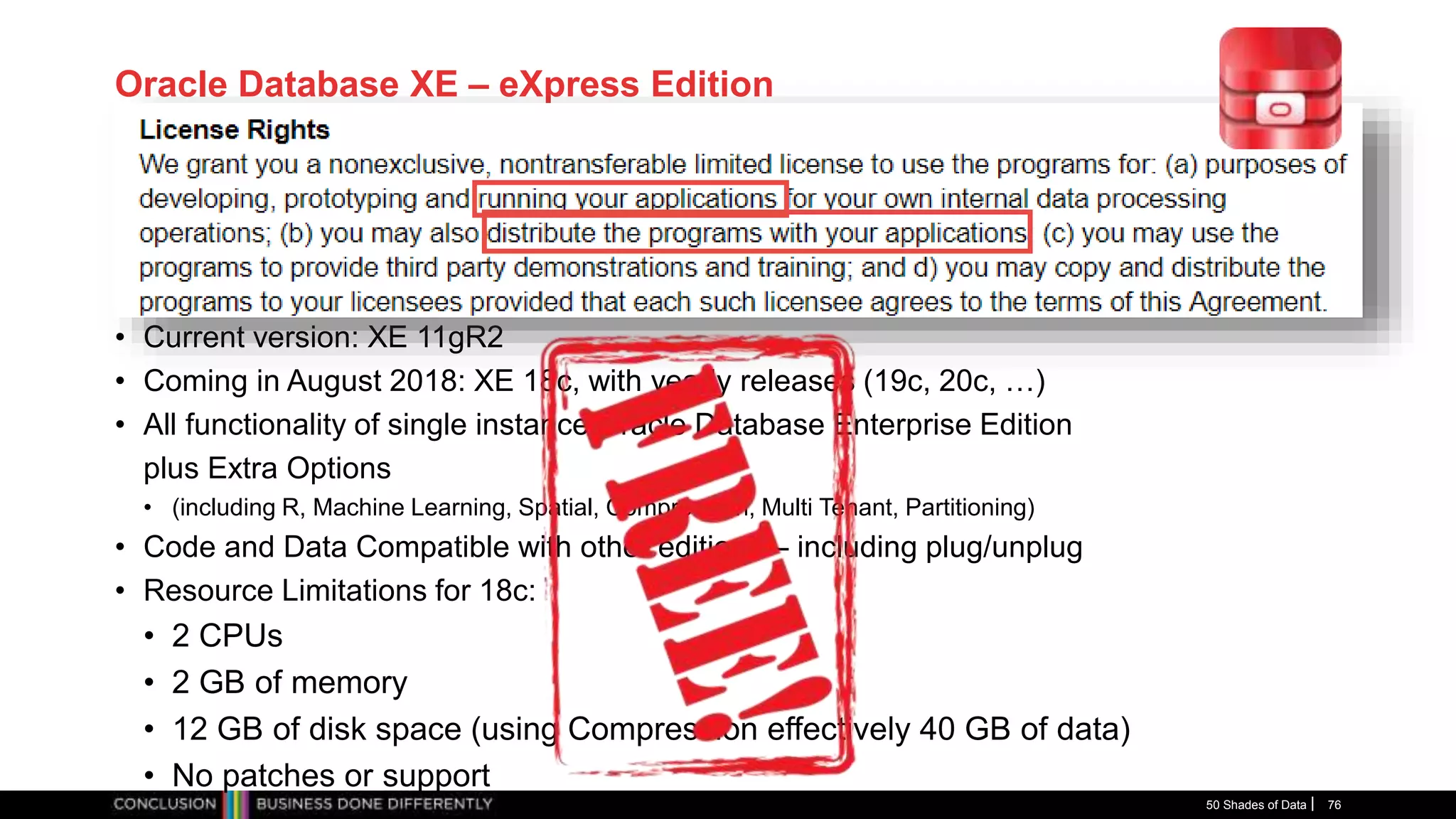
Oracle Database XE – eXpress Edition
• Current version: XE 11gR2
• Coming in August 2018: XE 18c, with yearly releases (19c, 20c, …)
• All functionality of single instance Oracle Database Enterprise Edition
plus Extra Options
• (including R, Machine Learning, Spatial, Compression, Multi Tenant, Partitioning)
• Code and Data Compatible with other editions – including plug/unplug
• Resource Limitations for 18c:
• 2 CPUs
• 2 GB of memory
• 12 GB of disk space (using Compression effectively 40 GB of data)
• No patches or support
50 Shades of Data 76
50 Shades of Data 77
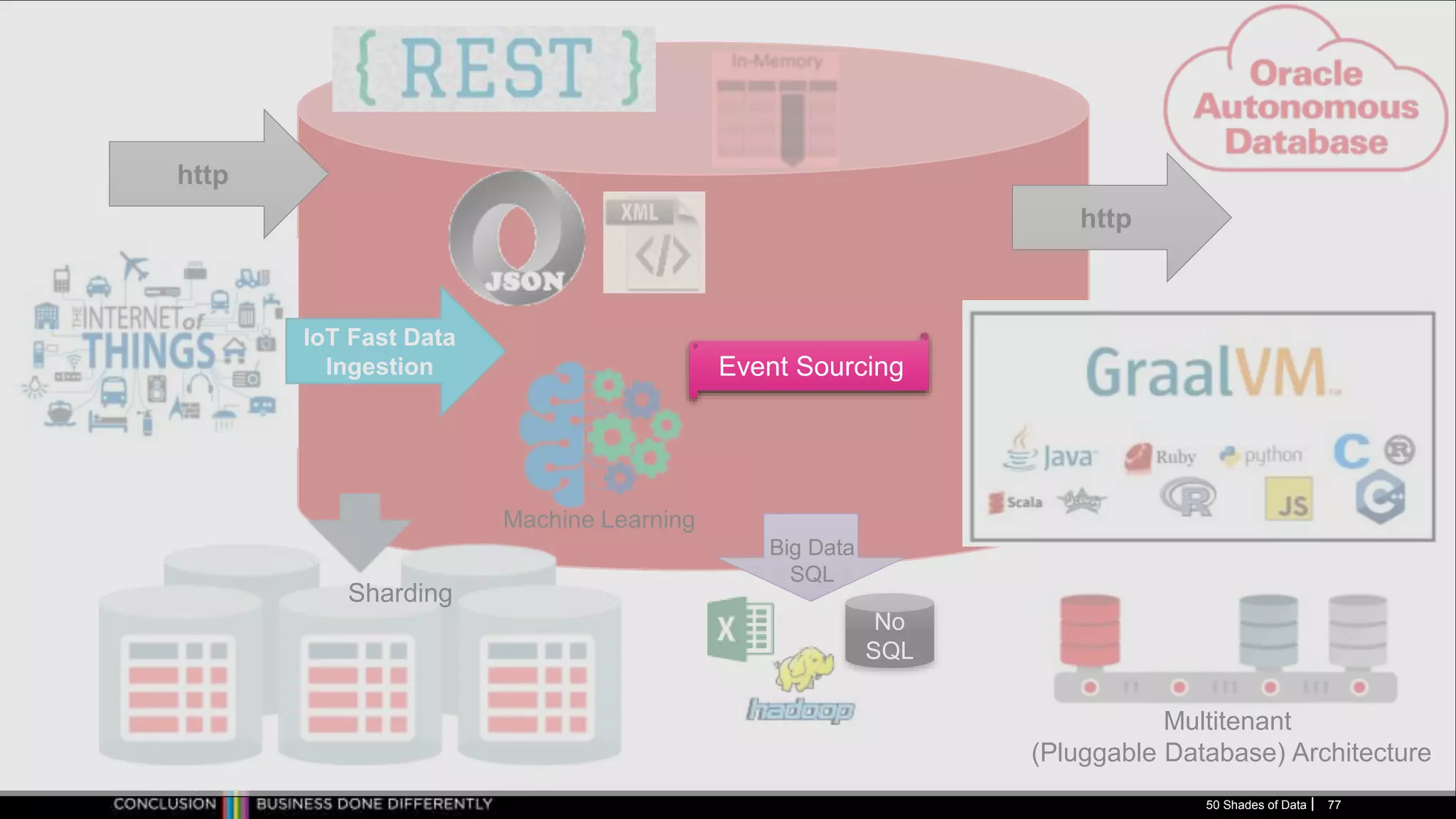
http
IoT Fast Data
Ingestion
Sharding
http
Machine Learning
No
SQL
Big Data
SQL
Multitenant
(Pluggable Database) Architecture
Event Sourcing
50 Shades of Data 78
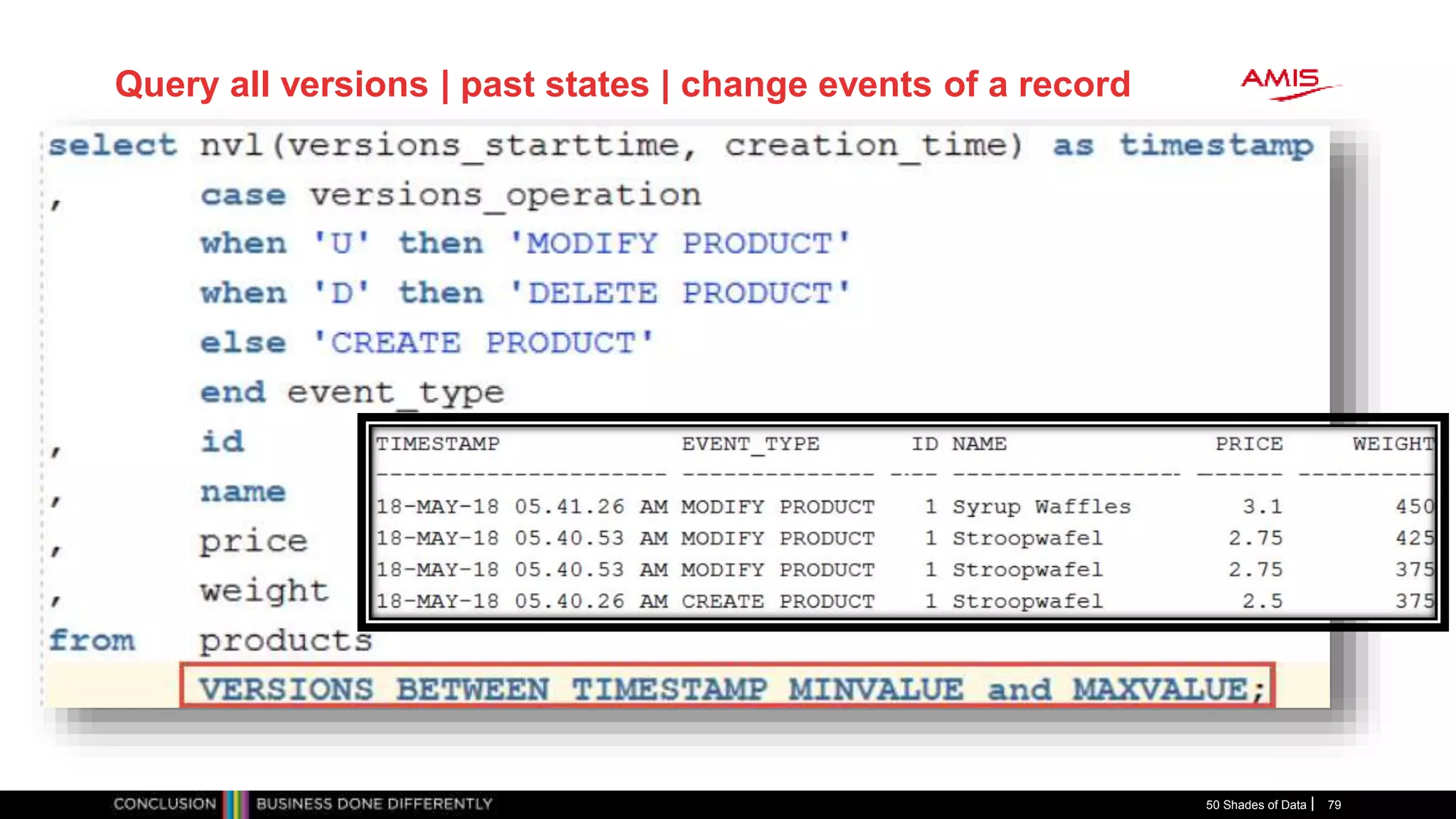
Query all versions | past states | change events of a record
50 Shades of Data 79
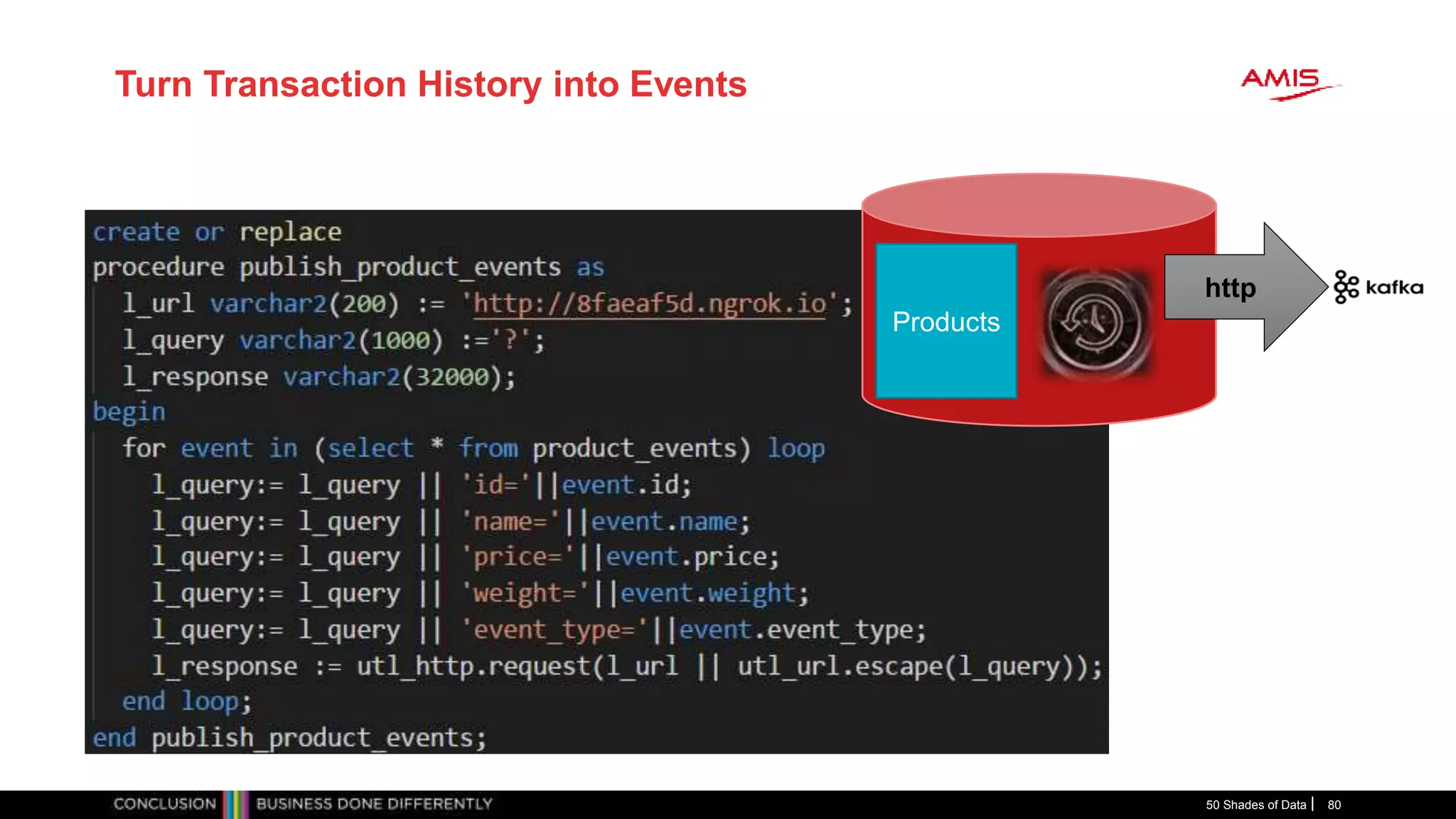
Turn Transaction History into Events
50 Shades of Data 80
http
Products
Final Demo
• Microservice
50 Shades of Data 82
50 Shades of Data 83
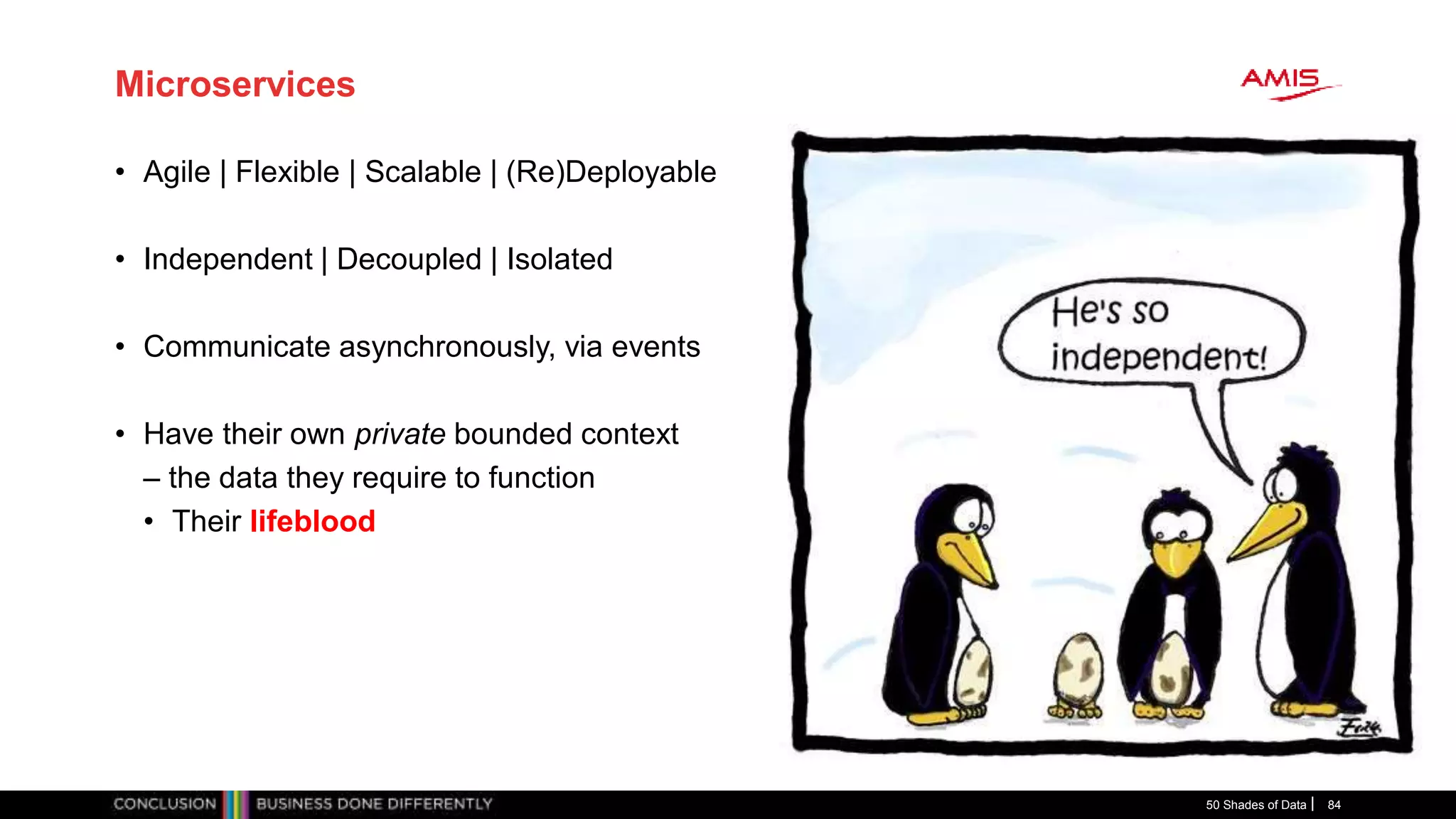
Microservices
• Agile | Flexible | Scalable | (Re)Deployable
• Independent | Decoupled | Isolated
• Communicate asynchronously, via events
• Have their own private bounded context
– the data they require to function
• Their lifeblood
50 Shades of Data 84
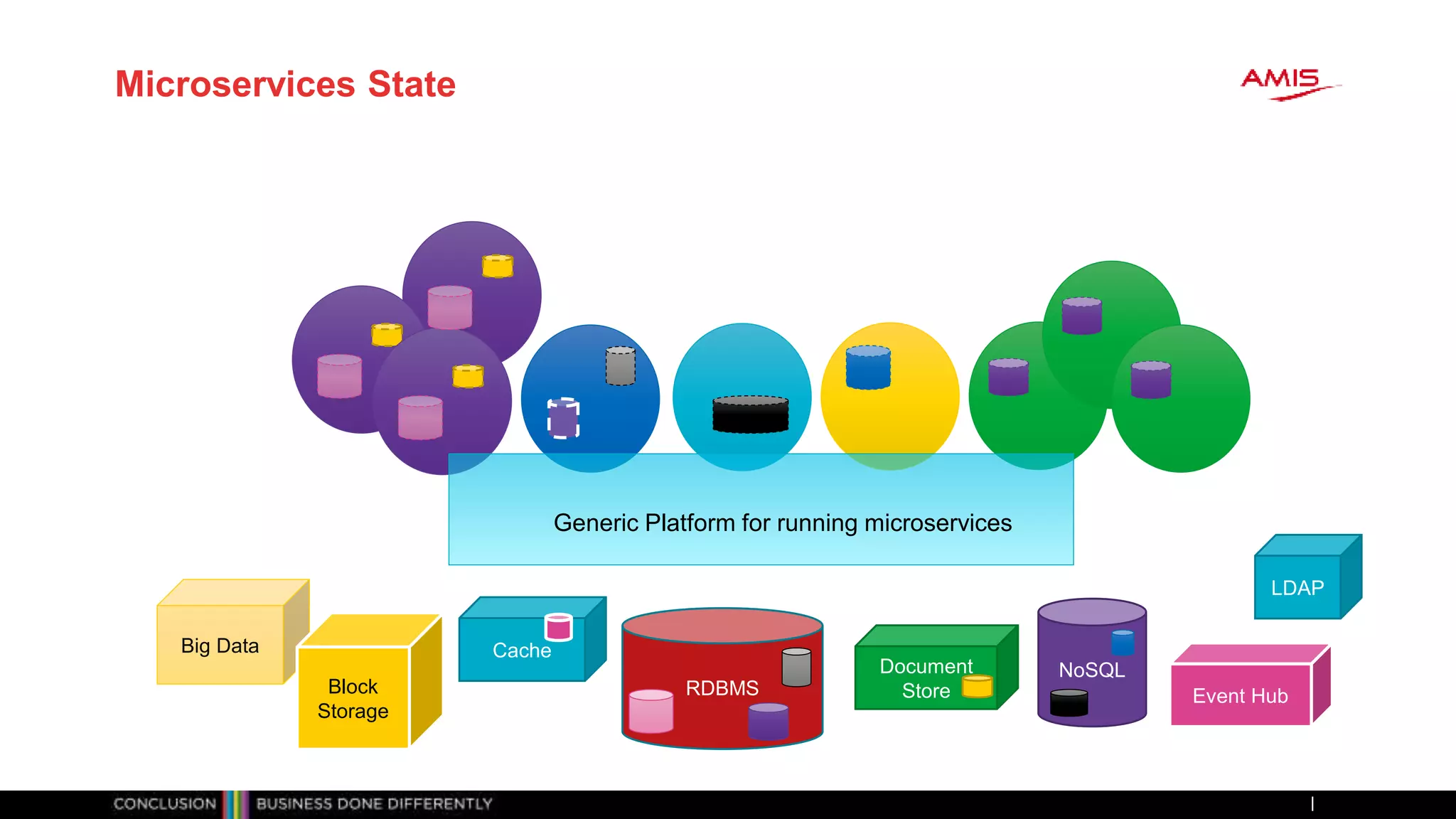
Microservices State
Cache
RDBMS
Document
Store
NoSQL
Generic Platform for running microservices
Event Hub
Big Data
Block
Storage
LDAP
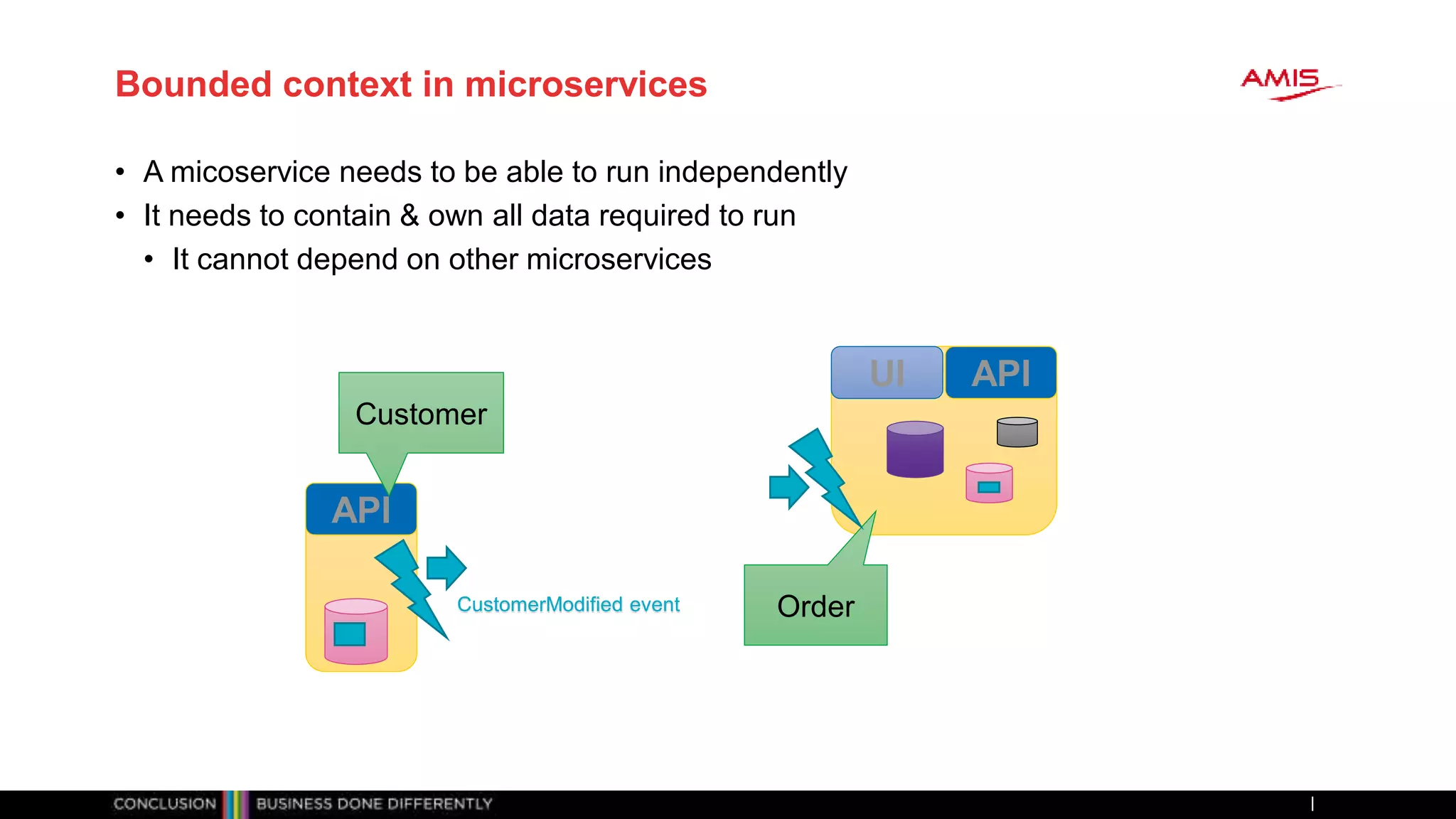
Bounded context in microservices
• A micoservice needs to be able to run independently
• It needs to contain & own all data required to run
• It cannot depend on other microservices
API
Customer
APIUI
OrderCustomerModified event
Order Microservice
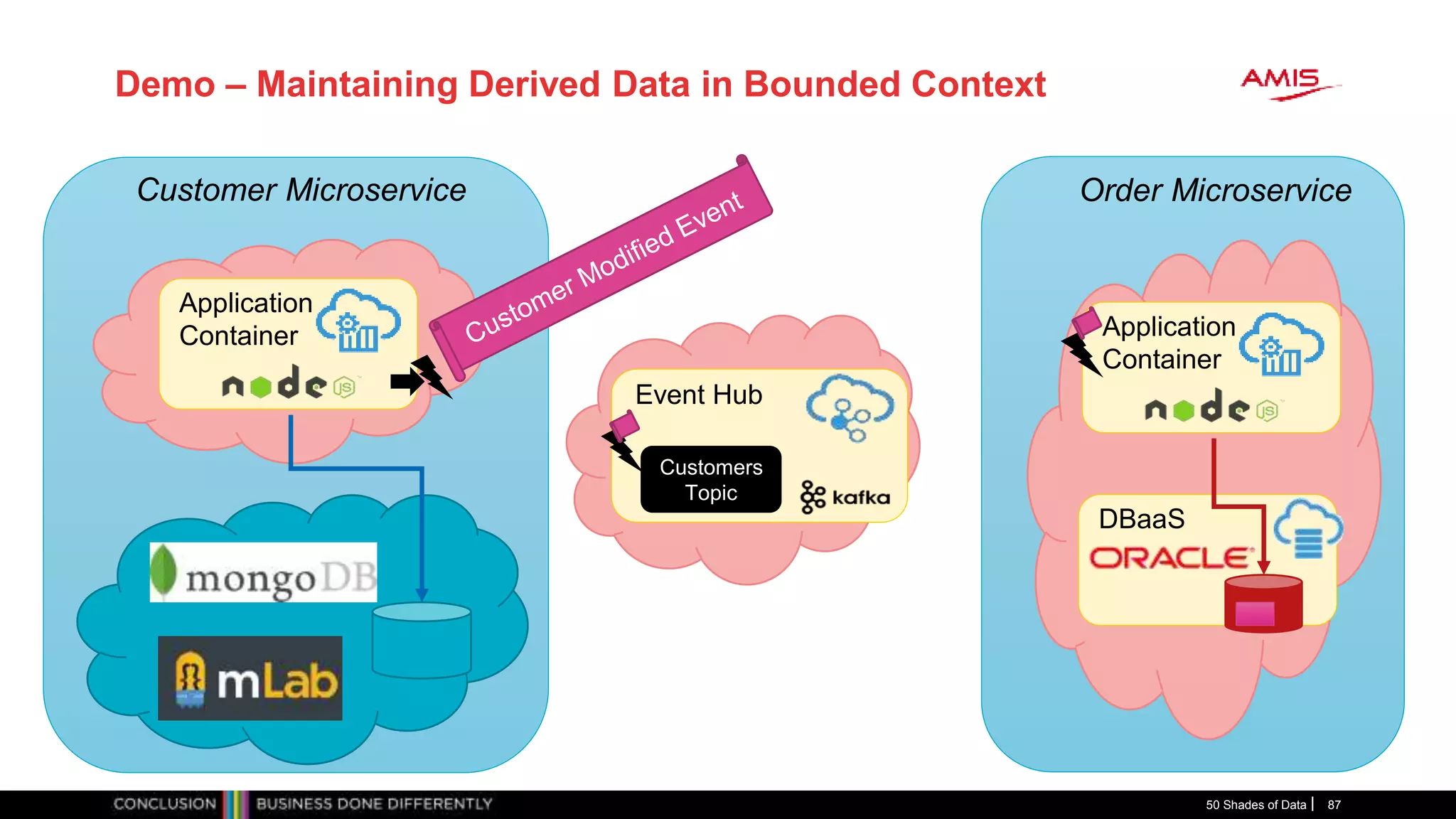
Demo – Maintaining Derived Data in Bounded Context
50 Shades of Data 87
Application
Container
Customer Microservice
Customers
Topic
Event Hub
Application
Container
DBaaS
Wrap Up
89
usage
Total Cost of Data Ownership
authorization
distribution
formatvolatility volume
ACID demands
availability
freshness requirements
(staleness allowance)
location
speed
ownership
required consistency
integrity
query patterns
50 Shades of Data 92
50 Shades of Data 93
50 Shades of Data 94
Wrap Up
DATA
DATADATA
धन्यवाद
dhanyavaad
Thank you
Dank je wel
Hoe integreer je applicaties en data 96
• Blog: technology.amis.nl
• Email: lucas.jellema@amis.nl
• : @lucasjellema
• : lucas-jellema
• : www.amis.nl, info@amis.nl
https://github.com/lucasjellema

50 Shades of Data – how, when and why Big,Relational,NoSQL,Elastic,Graph,Event (ODevC Yatra 2018, July, Hyderabad, Pune and Mumbai)

  • 1.
    50 Shades of Data how,when and why Big, Fast, Relational, NoSQL, Elastic, Event, CQRS On the many types of data, data stores and data usages 50 Shades of Data 1 µ µ Lucas Jellema, CTO of AMIS ODevC Yatra, July 2018
  • 2.
    Lucas Jellema Architect /Developer 1994 started in IT at Oracle 2002 joined AMIS Currently CTO & Solution Architect
  • 3.
    Presenting • Oracle OpenWorld •JavaOne • Oracle Code • Devoxx • Java and Oracle User Group meetups • Java Rockstar (JavaOne 2015) • ODevC Yatra 2018 50 Shades of Data 3
  • 4.
    Writing • Blogs athttp://technology.amis.nl • 1500 articles – from UI to Middle Tier, Database and Infrastructure • Articles at Medium, DZone and Oracle Technology Network • Books for McGraw Hill (Oracle Press) • Oracle ACE Director & Developer Champion 50 Shades of Data 4
  • 5.
    From The Netherlands 50Shades of Data 5
  • 6.
  • 7.
    Select from <streamof tweet events> select text , author , timestamp from tweets Where tag = 'yatra' <--- streaming data
  • 8.
    Select Running Count from<stream of tweet events> select tag , count(*) tweet_count from tweets group by tag
  • 9.
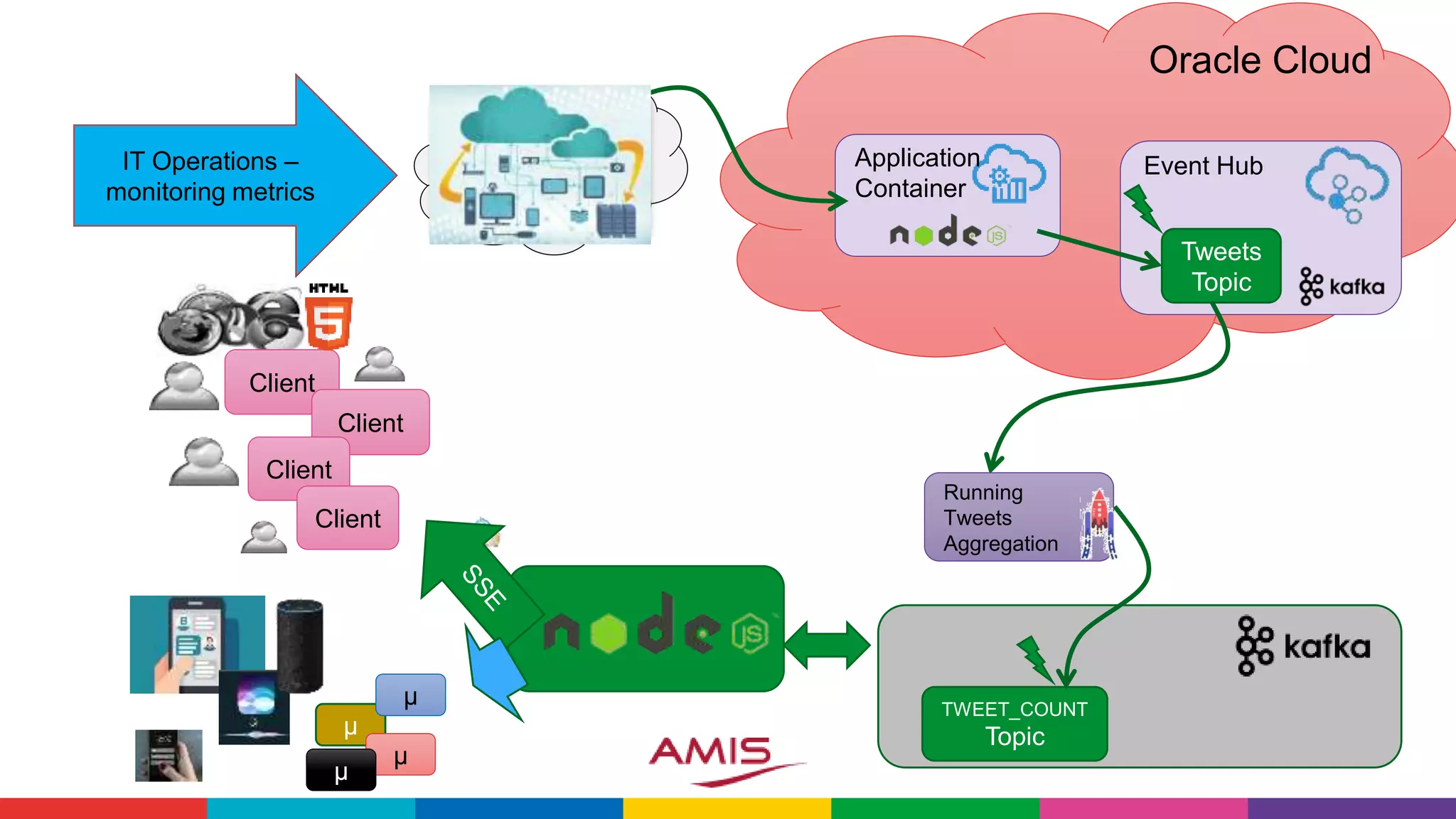
    Tweets on #JEEConf #java#oraclecode Tweets Topic Oracle Cloud Event HubApplication Container TWEET_COUNT Topic Running Tweets Aggregation Client Client Client Client IoT metrics from hundreds of devices User actions & click events from webshop Live Traffic EventsMicroservices chatter Social Media events (Facebook, Whatsapp, …) IT Operations – monitoring metrics µ µ µ µ
  • 10.
    Tweets on #JEEConf #java#oraclecode Tweets Topic Oracle Cloud Event HubApplication Container TWEET_COUNT Topic Running Tweets Aggregation Client Client Client Client IoT metrics from hundreds of devices User actions & click events from webshop Live Traffic EventsMicroservices chatter Social Media events (Facebook, Whatsapp, …) IT Operations – monitoring metrics µ µ µ µ
  • 11.
    Real Time live |fresh | instantaneous | on line | synchronous
  • 13.
    50 Shades ofData 14
  • 14.
    50 Shades ofData 15
  • 15.
    50 Shades ofData 16
  • 16.
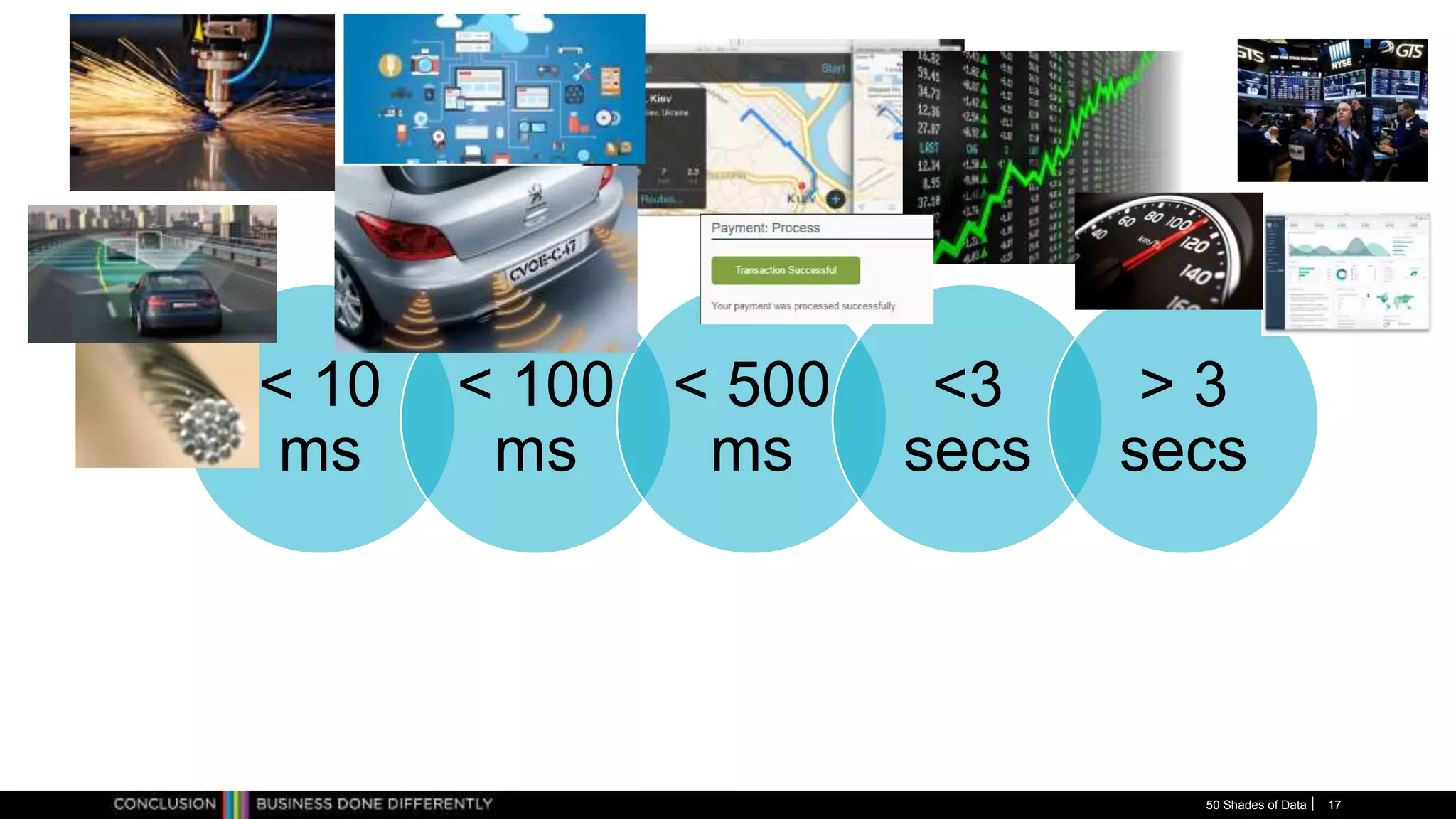
    < 10 ms < 100 ms <500 ms <3 secs > 3 secs 50 Shades of Data 17 Machine Response Human Reaction 17
  • 17.
    < 10 ms < 100 ms <500 ms <3 secs > 3 secs 50 Shades of Data 18 Machine Response Human Reaction 18
  • 18.
    Doctor & Patient 50Shades of Data 20
  • 19.
    50 Shades ofData 21
  • 20.
    50 Shades ofData 22 Operational Data Store API Batch, background, asynchronous On demand, synchronous
  • 21.
    50 Shades ofData 23 Operational Data Store API + Available + Performant + Preprocessing of data - Authorization enforcement - Cost of ODS (platform) + Fresh data + No duplication of data - Complexity
  • 22.
    50 Shades ofData 24
  • 23.
    50 Shades ofData 25
  • 24.
    50 Shades ofData 26
  • 25.
  • 26.
    50 Shades ofData 28 It’s you!
  • 27.
    Data Subject’s Rightunder the GDPR 50 Shades of Data 29
  • 28.
    50 Shades ofData 30 Operational Data Store API
  • 29.
    Integrity • Madelon’s pasje •Real world vs World of Databases • Relax! • Anomaly detection 50 Shades of Data 31
  • 30.
    Data Constraints to protectintegrity • Allowable values • Mandatory attributes • (Foreign Key) References • NULL • Constraints on • type • length • format • Spelling • Character encoding
  • 31.
    Data is representationof the known real world • How useful is it to enforce data integrity?
  • 32.
    Data Integrity • Why? •Is it about truth? • About regulations and by-the-book? • Allow IT systems to run smoothly and not get confused? • About auditability and non-repudiation? • What about the real world? • Data in IT is just a representation; if the world is not by the book – what should IT do?
  • 33.
    50 Shades ofData 36
  • 34.
    Anomaly Detection • Findfishy values and derive business integrity rules by scanning data 50 Shades of Data 37
  • 35.
    BOL - CQRS 50Shades of Data 38
  • 36.
    Books Online -WebShop 50 Shades of Data 39 Products Product updates firewall Data manipulation Data Quality (enforcement) <10K transactions Batch jobs next to online Speed is nice Read only On line Speed is crucial XHTML & JSON > 5M visits Webshop visits - searches - product details - Orders
  • 37.
    50 Shades ofData 40 Products Products Products Webshop visits - searches - product details - Orders firewall Data manipulation Data Quality (enforcement) <10K transactions Batch jobs next to online Speed is nice Read only On line Speed is crucial XHTML & JSON > 1M visits DMZ Read only JSON documents Images Text Search Scale Horizontally Stale but consistent Products Nightly generation Product updates
  • 38.
    Hoe integreer jeapplicaties en data? 41 Products Data Manipulation Data Retrieval
  • 39.
    Hoe integreer jeapplicaties en data? 42 Special Products Product Clusters ProductsData Manipulation Data Retrieval Food Stuff Toys Quick Product Search Index Product Store in SaaS app
  • 40.
    Comand Query ResponsbilitySegregation = CQRS 50 Shades of Data 43 Special Products Product Clusters ProductsData Manipulation Data Retrieval Food Stuff Toys Quick Product Search Index Product Store in SaaS app Detect changes Extract Data Transport Data Convert Data Apply Data
  • 41.
    From C toQ • How quickly? • How frequently? • How reliably? • How atomically? • What about consistency? 50 Shades of Data 44 Products Quick Product Search Index
  • 42.
    50 Shades ofData 45
  • 43.
    From C toQ • How quickly? • How frequently? • How reliably? • How atomic? • When consistent? • Data Authorization Considerations • Locations & Connectivity • Full resynch | restore of Query Store 50 Shades of Data 46 Products Quick Product Search Index
  • 44.
    [let go of]The Holy Grail of Normalization • Normalize to prevent • data redundancy • discrepancies (split brain) • storage waste 50 Shades of Data 47
  • 45.
    CQRS is notnew 50 Shades of Data 48
  • 46.
    Event Sourcing DrivingCQRS 50 Shades of Data 49 Events Event Store Current State accountId: 123 amount: 10 Owner: Jane Doe
  • 47.
    Event Sourcing DrivingCQRS 50 Shades of Data 50 Events Event Store Current State Other State Aggregate
  • 48.
    SQL is notgood at anything • But it sucks at nothing
  • 49.
    Graph Database • Naturalfit during development • Superior (10-1000 times better) performance Person liked by anyone liked by Bob Find People liked by anyone liked by Bob Find People liked by anyone liked by Bob
  • 50.
  • 51.
  • 52.
    SQL vs NoSQL ACIDvs BASE Relational vs …
  • 53.
    Relational Databases • Basedon relational model of data (E.F. Codd), a mathematical foundation • Uses SQL for query, DML and DDL • Transactions are ACID (Atomicity, Consistency, Isolation, Durability) • All or nothing • Constraint Compliant • Individual experience [in a multi-session environment] (aka concurrency) • Down does not hurt
  • 54.
    ACID comes ata cost – performance & scalability • Transaction results have to be persisted [before the transaction completes] in order to guarantee D • Concurrency requires some degree of locking (and multi-versioning) in order to have I • Constraint compliance (unique key, foreign key) means all data hangs together (as do all transactions) in order to have C • Two-phase commit (across multiple participants) introduces complexity, dependencies and delays, yet required for A
  • 55.
    50 Shades ofData 59
  • 56.
  • 57.
    50 Shades ofData 62
  • 58.
    NoSQL n’est pasNo SQL 50 Shades of Data 63
  • 59.
    50 Shades ofData 64
  • 60.
    When things weresimple RDBMS SQL ACID Data files Log Files Backup Backup Backup SAN
  • 61.
    And then stuffhappened Middle Tier: Java EE (Stateful) application Client Tier: Browser Client Tier: Browser Client Tier: Browser Mobile App (offline) Mobile App (offline) Mobile App (offline) Data Warehouse OO, XML, JSON Content Management Big Data Fast Data API API API µ λ
  • 62.
    50 Shades ofData 67
  • 63.
    50 Shades ofData Oracle Database SQL RDBMS ACID
  • 64.
    50 Shades ofData 69 http IoT Fast Data Ingestion Sharding http Machine Learning No SQL Big Data SQL Multitenant (Pluggable Database) Architecture Flashback
  • 65.
    50 Shades ofData 70
  • 66.
    50 Shades ofData 71
  • 67.
    50 Shades ofData 72
  • 68.
    50 Shades ofData 73
  • 69.
    50 Shades ofData 74 http IoT Fast Data Ingestion Sharding http Machine Learning No SQL Big Data SQL Multitenant (Pluggable Database) Architecture Flashback
  • 70.
    50 Shades ofData 75
  • 71.
    Oracle Database XE– eXpress Edition • Current version: XE 11gR2 • Coming in August 2018: XE 18c, with yearly releases (19c, 20c, …) • All functionality of single instance Oracle Database Enterprise Edition plus Extra Options • (including R, Machine Learning, Spatial, Compression, Multi Tenant, Partitioning) • Code and Data Compatible with other editions – including plug/unplug • Resource Limitations for 18c: • 2 CPUs • 2 GB of memory • 12 GB of disk space (using Compression effectively 40 GB of data) • No patches or support 50 Shades of Data 76
  • 72.
    50 Shades ofData 77 http IoT Fast Data Ingestion Sharding http Machine Learning No SQL Big Data SQL Multitenant (Pluggable Database) Architecture Event Sourcing
  • 73.
    50 Shades ofData 78
  • 74.
    Query all versions| past states | change events of a record 50 Shades of Data 79
  • 75.
    Turn Transaction Historyinto Events 50 Shades of Data 80 http Products
  • 76.
  • 77.
    50 Shades ofData 83
  • 78.
    Microservices • Agile |Flexible | Scalable | (Re)Deployable • Independent | Decoupled | Isolated • Communicate asynchronously, via events • Have their own private bounded context – the data they require to function • Their lifeblood 50 Shades of Data 84
  • 79.
    Microservices State Cache RDBMS Document Store NoSQL Generic Platformfor running microservices Event Hub Big Data Block Storage LDAP
  • 80.
    Bounded context inmicroservices • A micoservice needs to be able to run independently • It needs to contain & own all data required to run • It cannot depend on other microservices API Customer APIUI OrderCustomerModified event
  • 81.
    Order Microservice Demo –Maintaining Derived Data in Bounded Context 50 Shades of Data 87 Application Container Customer Microservice Customers Topic Event Hub Application Container DBaaS
  • 82.
  • 83.
  • 85.
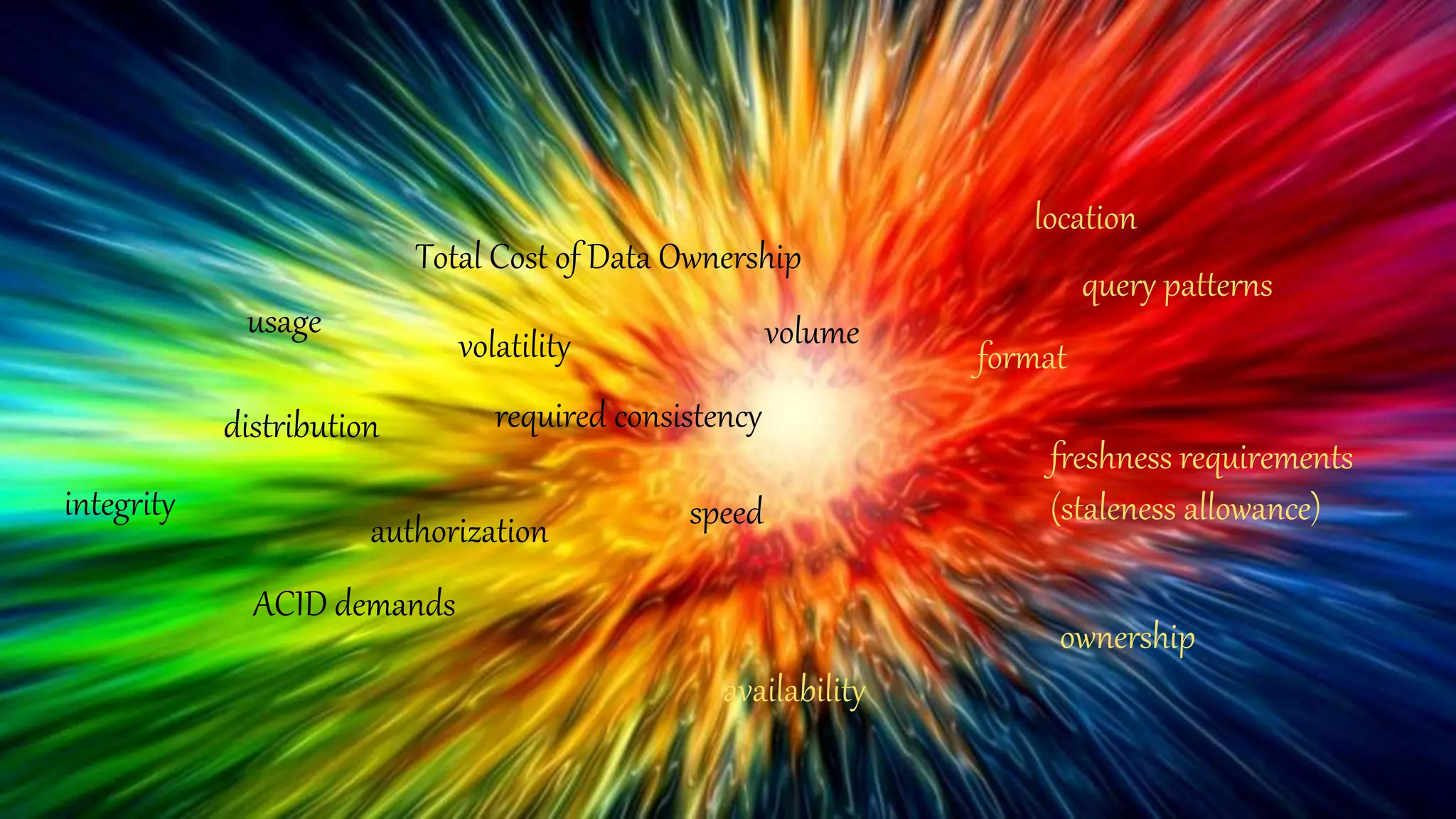
    usage Total Cost ofData Ownership authorization distribution formatvolatility volume ACID demands availability freshness requirements (staleness allowance) location speed ownership required consistency integrity query patterns
  • 86.
    50 Shades ofData 92
  • 87.
    50 Shades ofData 93
  • 88.
    50 Shades ofData 94
  • 89.
  • 90.
    धन्यवाद dhanyavaad Thank you Dank jewel Hoe integreer je applicaties en data 96 • Blog: technology.amis.nl • Email: lucas.jellema@amis.nl • : @lucasjellema • : lucas-jellema • : www.amis.nl, info@amis.nl https://github.com/lucasjellema

Editor's Notes

  • #2 Fast data arrives in real time and potentially high volume. Rapid processing, filtering and aggregation is required to ensure timely reaction and actual information in user interfaces. Doing so is a challenge, make this happen in a scalable and reliable fashion is even more interesting. This session introduces Apache Kafka as the scalable event bus that takes care of the events as they flow in and Kafka Streams and KSQL for the streaming analytics. Both Java and Node applications are demonstrated that interact with Kafka and leverage Server Sent Events and WebSocket channels to update the Web UI in real time. User activity performed by the audience in the Web UI is processed by the Kafka powered back end and results in live updates on all clients. Fast data arrives in real time and potentially high volume. Rapid processing, filtering and aggregation is required to ensure timely reaction and actual information in user interfaces. Doing so is a challenge, make this happen in a scalable and reliable fashion is even more interesting. This session introduces Apache Kafka as the scalable event bus that takes care of the events as they flow in and Kafka Streams for the streaming analytics. Both Java and Node applications are demonstrated that interact with Kafka and leverage Server Sent Events and WebSocket channels to update the Web UI in real time. User activity performed by the audience in the Web UI is processed by the Kafka powered back end and results in live updates on all clients. Introducing the challenge: fast data, scalable and decoupled event handling, streaming analytics Introduction of Kafka demo of Producing to and consuming from Kafka in Java and Nodejs clients Intro Kafka Stream API for streaming analytics Demo streaming analytics from java client Intro of web ui: HTML 5, WebSocket channel and SSE listener Demo of Push from server to Web UI - in general End to end flow: - IFTTT picks up Tweets and pushed them to an API that hands them to Kafka Topic. - The Java application Consumes these events, performs Streaming Analytics (grouped by hashtag and author and time window) and counts them; the aggregation results are produced to Kafka - The NodeJS application consumes these aggregation results and pushes them to Web UI - The WebUI displays the selected Tweets along with the aggregation results - in the Web UI, users can LIKE and RATE the tweets; each like or rating is sent to the server and produced to Kafka; these events are processed too through Stream Analytics and result in updated Like counts and Average Rating results; these are then pushed to all clients; this means that the audience can Tweet, see the tweet appear in the web ui on their own device, rate & like and see the ratings and like count update in real time
  • #29 PII = Personally Identifiable Data
  • #33 https://specify.io/concepts/microservices
  • #34 https://specify.io/concepts/microservices
  • #35 https://specify.io/concepts/microservices
  • #36 https://specify.io/concepts/microservices
  • #43 Data manipulation and retrieval in separate places (physical data proliferation) Query store is optimized for consumers Level of detail, format, filters applied For performance and scalability, independence, productivity lower license fees and lower TCO, security
  • #44 No Event Sourcing No events (?) No green field Packages Applications/SaaS Databases (RDBMS, NoSQL) getting changes from applications directly Challenges – at scale, with enough speed and consistently: do not let query store get into an exposed state that could not exist/be right! Detect relevant changes Extract relevant changes Transport Convert Apply in correct order and reliably (no lost events) Note: after detect and extract, an event can be published
  • #49 https://www.slideshare.net/LorenzoNicora/from-c-to-q-one-event-at-the-time-event-sourcing-illustrated
  • #50 Events are immutable facts Current state (active record) is derived from sum of events Read optimized aggregates are created for specific use case – based on events and rebuildable at any time
  • #51 Events are immutable facts Current state (active record) is derived from sum of events Read optimized aggregates are created for specific use case – based on events and rebuildable at any time
  • #53 https://specify.io/concepts/microservices
  • #54 https://specify.io/concepts/microservices
  • #55 https://specify.io/concepts/microservices
  • #58 https://specify.io/concepts/microservices
  • #59 https://specify.io/concepts/microservices
  • #60 WebScale ‘No ACID BASE Speed, reads Redundancy Read-optimized format Not all use cases require ACID (or can afford it) Read only (product catalog for web shops) Inserts only and no (inter-record) constraints Big Data collected and “dumped” in Data Lake (Hadoop) for subsequent processing High performance demands Not all data needs structured formats or structured querying and JOINs Entire documents are stored and retrieved based on a single key Sometimes – scalable availability and developer productivity is more important than Consistency – and ACID is sacrificed CAP-theorem states: Consistency [across nodes], Availability and Partition tolerance can not all three be satisfied
  • #61 https://specify.io/concepts/microservices
  • #62 https://specify.io/concepts/microservices
  • #82 Reconstruct DML Events Reconstruct History Reverse Engineering of Event Source DEMO Flashback Query & Flasback Versions Query Publish Events from Database using HTTP (or Stored Java) QCRN, Trigger + Job, Log Mining, Scheduled Flashback Job,
  • #86 All data stores are distributed Or at least distributedly available They can be local or on cloud (latency is important) Data in generic data store is still owned by only one microservice – no one can touch it Only in DWH and BigData do we deliberately take copies of data and disown them
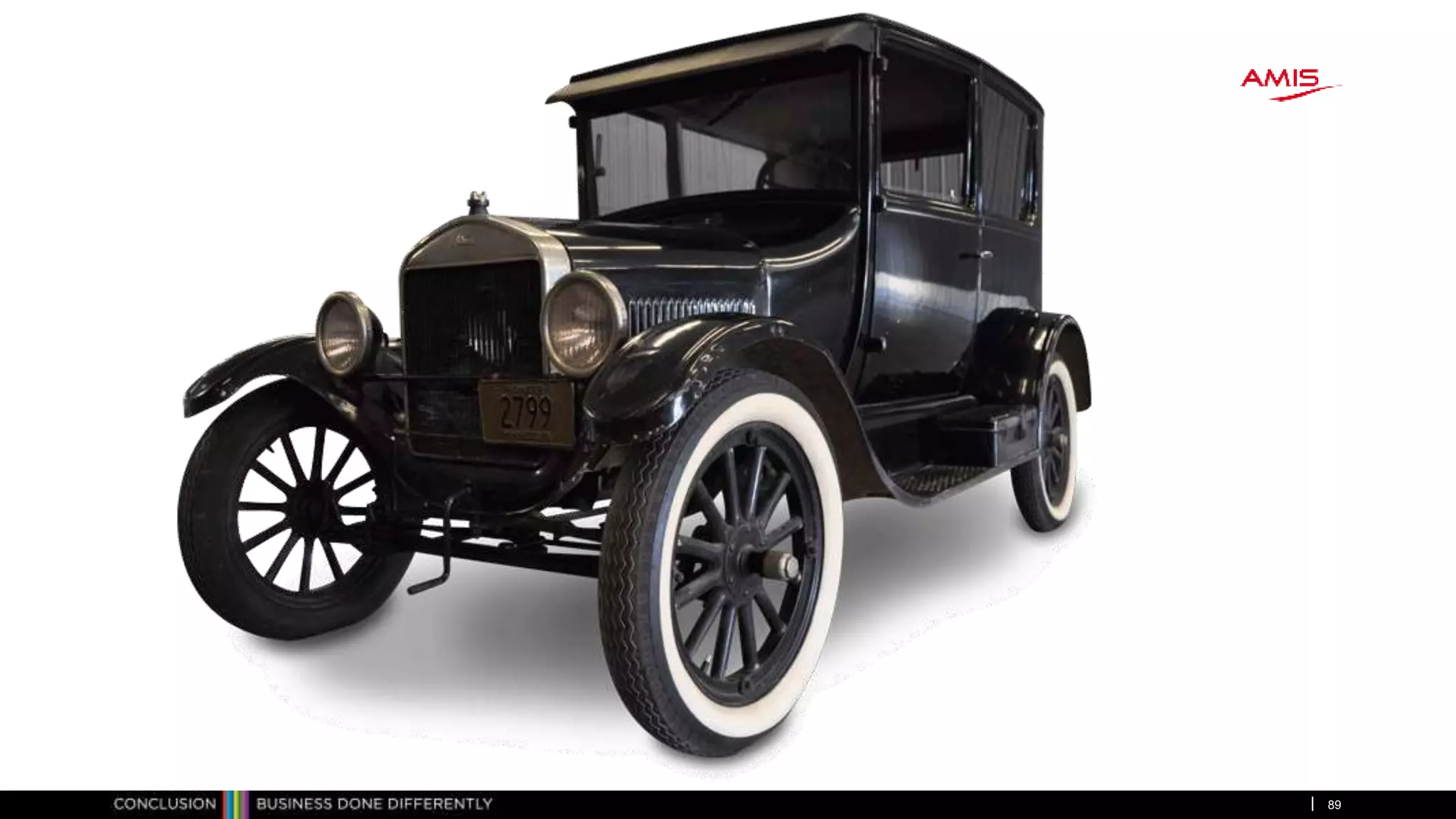
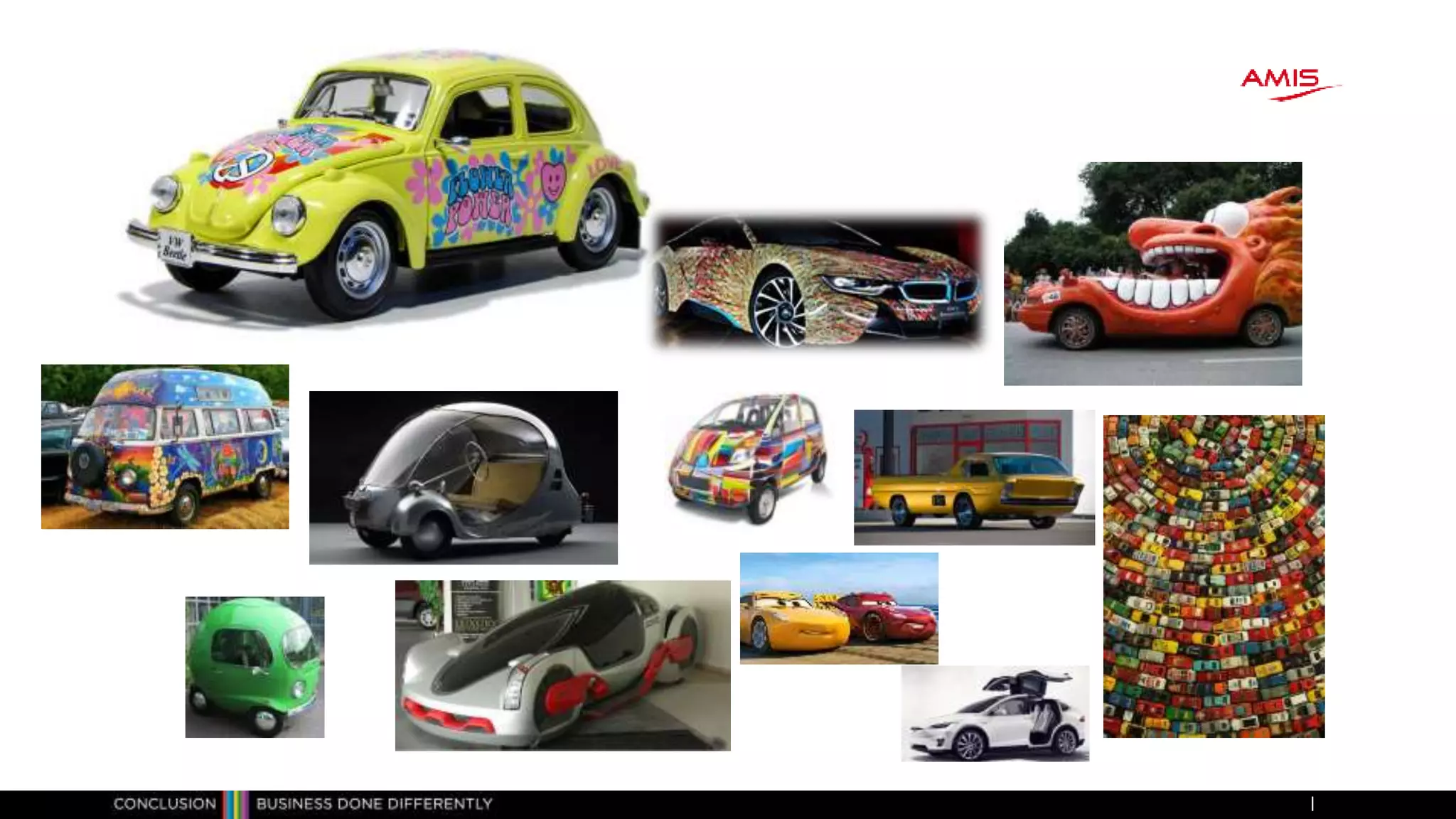
  • #91 Data used to be like T-Ford One model, one color And then:
  • #92 Data comes in many shades (at least 50) – variations along many dimensions
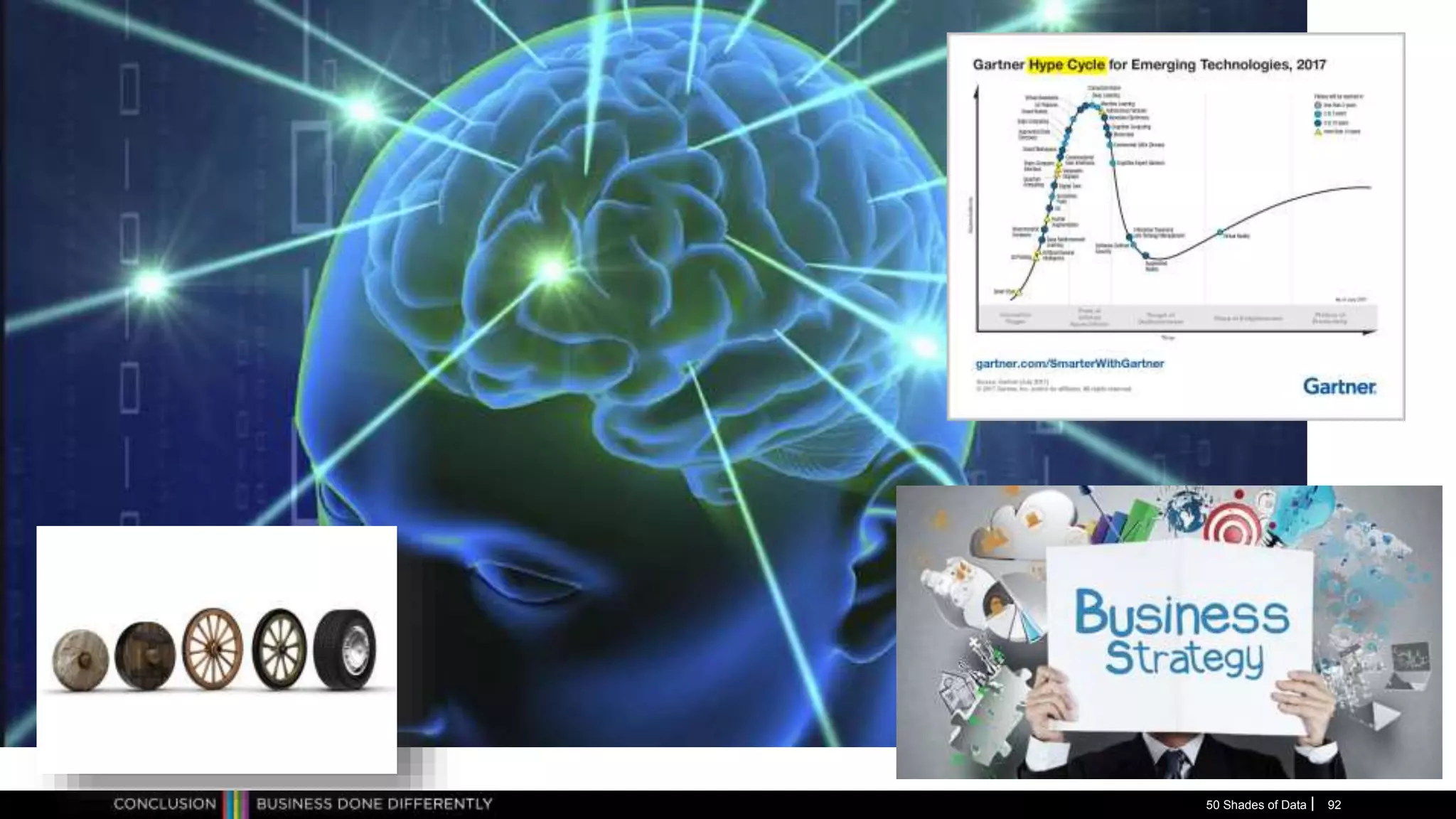
  • #95 technologies
  • #97 Ukranian: Dyakuyu - https://www.google.nl/search?q=thank+you+in+ukrainian&rlz=1C1GGRV_enNL762NL762&oq=thank+y&aqs=chrome.1.69i59l2j69i61j0j69i57j0.1774j0j9&sourceid=chrome&ie=UTF-8 Russian: Spasibo