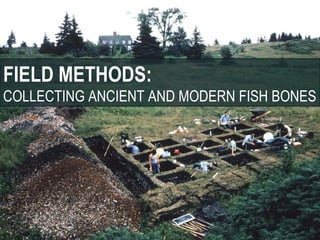
FIELD METHODS:
COLLECTING ANCIENT AND MODERN FISH BONES
FIELD METHODS                      We collect our ancient fish
1. COLLECTING ANCIENT FISH BONES   bone samples from middens
                                   at multiple archaeological sites
                                   in the Penobscot Bay.
                                   Middens are ancient garbage
                                   heaps where people have left
                                   remains from domestic
                                   activities, like cooking. Our
                                   sample middens are full of
                                   discarded mussel shells and
                                   fish bones, representative of
                                   the mainly marine diet of the
                                   local native people.
FIELD METHODS
1. COLLECTING ANCIENT FISH BONES


   Over time, the contents of
   middens form distinct layers,
   or strata, that often represent
   distinct cultural changes. We
   can track changes in the local
   diet by tracking changes in the
   contents of the stratum from
   the deepest depth to the
   surface soil. The lowermost
   stratum reflects the oldest
   deposit, the uppermost the
   youngest.
FIELD METHODS
1. COLLECTING ANCIENT FISH BONES


   Over time, the contents of
   middens form distinct layers,
   or strata, that often represent
   distinct cultural changes. We
   can track changes in the local
   diet by tracking changes in the
   contents of the stratum from
   the deepest depth to the
   surface soil. The lowermost       Stratum 2
   stratum reflects the oldest
                                     Stratum 1
   deposit, the uppermost the
   youngest.
Flounder

FIELD METHODS
1. COLLECTING ANCIENT FISH BONES


   In order to capture information
   about both the nearshore and
   offshore paleoenvironment of          Cod
   the Penobscot Bay regions, we
   specifically searched for the
   remains of two species of
   nearshore fish (flounder and
   sculpin) and one species of
   offshore fish (cod).               Sculpin
FIELD METHODS
1. COLLECTING ANCIENT FISH BONES


   While searching for ancient fish
   bones and other food remains
   in the middens, we also found
   these bone artifacts: hand-
   carved fish hooks. They help
   confirm that fish was a major
   part of the local diet at the time
   they were deposited. The large
   hooks are well suited to catch
   cod, while the smaller ones
   would be useful for catching
   flounder.
Flounder

FIELD METHODS
1. COLLECTING MODERN FISH BONES


                                            Cod


 Within the fish bones, we study
 unique chemical (isotopic)
 signatures that represent the fish’s
                                         Sculpin
 diet. We collect modern fish bones
 and compare their isotopic
 signatures to those preserved in our
 ancient samples so that we can
 track changes through time.
Flounder

FIELD METHODS
1. COLLECTING MODERN FISH BONES


                                            Cod


 To do this, we collect live samples
 of nearshore species (sculpin and
 flounder) and cod (offshore species)    Sculpin
 in close proximity to the Penobscot
 Bay. We also buy samples of
 offshore species from the Harbor
 Fish Market in Portland.

4 field methods

  • 1.
    FIELD METHODS: COLLECTING ANCIENTAND MODERN FISH BONES
  • 2.
    FIELD METHODS We collect our ancient fish 1. COLLECTING ANCIENT FISH BONES bone samples from middens at multiple archaeological sites in the Penobscot Bay. Middens are ancient garbage heaps where people have left remains from domestic activities, like cooking. Our sample middens are full of discarded mussel shells and fish bones, representative of the mainly marine diet of the local native people.
  • 3.
    FIELD METHODS 1. COLLECTINGANCIENT FISH BONES Over time, the contents of middens form distinct layers, or strata, that often represent distinct cultural changes. We can track changes in the local diet by tracking changes in the contents of the stratum from the deepest depth to the surface soil. The lowermost stratum reflects the oldest deposit, the uppermost the youngest.
  • 4.
    FIELD METHODS 1. COLLECTINGANCIENT FISH BONES Over time, the contents of middens form distinct layers, or strata, that often represent distinct cultural changes. We can track changes in the local diet by tracking changes in the contents of the stratum from the deepest depth to the surface soil. The lowermost Stratum 2 stratum reflects the oldest Stratum 1 deposit, the uppermost the youngest.
  • 5.
    Flounder FIELD METHODS 1. COLLECTINGANCIENT FISH BONES In order to capture information about both the nearshore and offshore paleoenvironment of Cod the Penobscot Bay regions, we specifically searched for the remains of two species of nearshore fish (flounder and sculpin) and one species of offshore fish (cod). Sculpin
  • 6.
    FIELD METHODS 1. COLLECTINGANCIENT FISH BONES While searching for ancient fish bones and other food remains in the middens, we also found these bone artifacts: hand- carved fish hooks. They help confirm that fish was a major part of the local diet at the time they were deposited. The large hooks are well suited to catch cod, while the smaller ones would be useful for catching flounder.
  • 7.
    Flounder FIELD METHODS 1. COLLECTINGMODERN FISH BONES Cod Within the fish bones, we study unique chemical (isotopic) signatures that represent the fish’s Sculpin diet. We collect modern fish bones and compare their isotopic signatures to those preserved in our ancient samples so that we can track changes through time.
  • 8.
    Flounder FIELD METHODS 1. COLLECTINGMODERN FISH BONES Cod To do this, we collect live samples of nearshore species (sculpin and flounder) and cod (offshore species) Sculpin in close proximity to the Penobscot Bay. We also buy samples of offshore species from the Harbor Fish Market in Portland.