Recent Developments in
Whistleblower Law
Jason Zuckerman
Zuckerman Law
Washington, DC
jzuckerman@zuckermanlaw.com
(202) 262-8959
https://www.zuckermanlaw.com
Jury Verdicts
Jury Verdicts
• No cap on compensatory damages in SOX and
FCA retaliation cases
• Recent jury verdicts in SOX cases:
– $6M Zulfer v. Playboy Enterprises Inc., JVR No.
1405010041, 2014 WL 1891246 (C.D.Cal. 2014)
– $2.2M in damages and $2.4M in fees Van Asdale
v. Int'l Game Tech., 549 F. App'x 611, 614 (9th Cir.
2013)
– $1.6M in compensatory damages in Perez v.
Progenics Pharmaceuticals (S.D.N.Y. 2015)
Sarbanes-Oxley Protected Conduct
SOX Protected Conduct
• Sylvester v. Parexel Int’l, WL 2165854 (ARB May 25, 2011)
– Disclosure of potential violation protected
– A complaint need not allege shareholder fraud to receive SOX’s
protection
– Reasonable belief standard does not require complainants to
have told management or the authorities why their beliefs are
reasonable
– SOX complainants no longer need to show that their disclosures
“definitively and specifically” relate to the relevant laws
– SOX complainants need not establish criminal fraud
Sarbanes-Oxley Protected Conduct
• Federal courts adopting Sylvester
– Nielsen v. AECOM Tech. Corp., No. 13-235-cv (2d
Cir. 2014)
– Weist v. Lynch, 710 F.3d 121 (3rd Cir. 2013)
– Villanueva v. U.S. Dep’t of Labor, 743 F.3d 103,
109 (5th Cir. 2014)
– Rhinehimer v. U.S. Bancorp Investments, Inc., No.
13-6641 (6th Cir. 2015)
Sarbanes-Oxley Protected Conduct
Wallace v. Tesoro Corp., No. 13-51010 (5th Cir.
7-31-2015)
• “[P]roviding information about potential fraud
or assisting in a nascent fraud investigation” is
protected even though the complainant
“might not know who is making the false
representations or what that person is
obtaining by the fraud”
Dodd-Frank Whistleblower Protection
Dodd-Frank
Whistleblower Protection
• Protected activity if:
• Provided information to the SEC ;
• Initiating, testifying in, or assisting in SEC
investigation; or
• Disclosing information required or protected by
SOX, the 1934 Act, and any other law, rule, or
regulation subject to the jurisdiction of the SEC.
Dodd-Frank
Whistleblower Protection
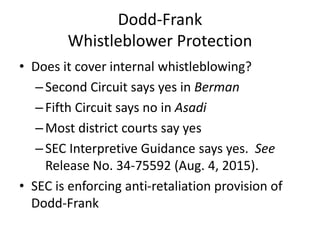
• Does it cover internal whistleblowing?
–Second Circuit says yes in Berman
–Fifth Circuit says no in Asadi
–Most district courts say yes
–SEC Interpretive Guidance says yes. See
Release No. 34-75592 (Aug. 4, 2015).
• SEC is enforcing anti-retaliation provision of
Dodd-Frank
SOX or Dodd-Frank?
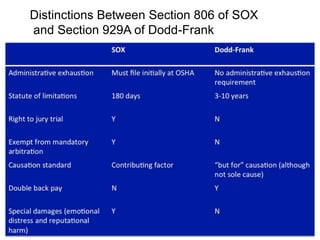
Distinctions Between Section 806 of SOX
and Section 929A of Dodd-Frank
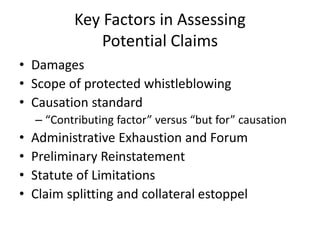
Key Factors in Assessing
Potential Claims
• Damages
• Scope of protected whistleblowing
• Causation standard
– “Contributing factor” versus “but for” causation
• Administrative Exhaustion and Forum
• Preliminary Reinstatement
• Statute of Limitations
• Claim splitting and collateral estoppel
SEC Enforcement of Dodd-Frank
Anti-Gag Provision
SEC Enforcement of Dodd-Frank
Anti-Gag Provision
• Rule 21F-17(a) under the Exchange Act
provides that “[n]o person may take any
action to impede an individual from
communicating directly with the Commission
staff about a possible securities law violation,
including enforcing, or threatening to enforce,
a confidentiality agreement…with respect to
such communications.”
SEC Enforcement of Dodd-Frank
Anti-Gag Provision
• April 2015 administrative action against KBR.
See Exchange Act Release No. 74619 (April 1,
2015).
• No evidence that agreement prevented a KBR
employee from communicating directly with
SEC
• $130,000 penalty
• Companies are amending confidentiality
policies and agreements
SEC Enforcement of Dodd-Frank
Anti-Gag Provision
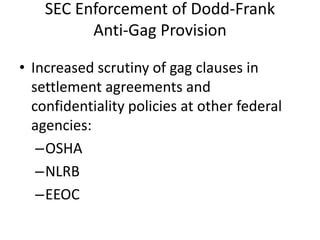
• Increased scrutiny of gag clauses in
settlement agreements and
confidentiality policies at other federal
agencies:
–OSHA
–NLRB
–EEOC
Ask Questions Before
Accepting Documents
• State v. Saavedra, N.J. No. A-68-13
(June 23, 2015)
• Factors to consider
• Are documents being retained to
make a disclosure to a government
agency or instead for a retal claim?
• Are the documents relevant?
• Is any of the material privileged?
• Were the documents acquired
unlawfully?
• Did the employee obtain the
documents in the course of
performing ordinary job duties?
Broad Scope of Adverse Actions
Halliburton v. Admin. Review Bd
• Merely “outing” a whistleblower is an adverse action under
SOX. Halliburton, Inc. v. Admin. Review Bd., 771 F.3d 254, 259
(5th Cir. 2014).
• “[The] targeted creation of an environment in which the
whistleblower is ostracized is . . . in effect, a potential
deprivation of opportunities for future advancement.”
• Whistleblower need not demonstrate the existence of a
retaliatory motive
Protection for Employees of Government
Contractors and Grantees
– False Claims Act, 31 §USC 3730(h)
– NDAA, 41 U.S. Code § 4712 and 10 U.S. Code §
2409
FCA Protected Conduct
• Broader scope of protected conduct post-2009 FCA
amendments
• Protects actions in furtherance of a qui tam action and
“other efforts to stop 1 or more violations of [the FCA]”
• Young v. CHS Middle E., LLC, 2015 WL 3396790 (4th Cir. May
27, 2015)
– protect[s] employees while they are collecting information
about a possible fraud, before they have put all the pieces of the
puzzle together
• Need not prove actual FCA violation
• Higher burden for “duty speech” claims
NDAA Protected Conduct
• Covers employees of nearly all government contractors
• Excludes contractors of Intelligence agencies
• Broad scope of protected conduct
• Violation of law, rule, or regulation relating to federal
contracts, including competition for or negotiation of a
contract;
• Gross mismanagement, gross waste of federal funds,
abuse of authority; or
• Substantial and specific danger to public health or safety
Distinctions Between FCA and NDAA
FCA Anti-Retaliation Provision Sections 827 and 828 of NDAA
Coverage Employee, contractor, or agent Employee of a contractor,
subcontractor, or grantee
Protected
Conduct
Lawful acts done by the
employee, contractor, agent or
associated others 1) in
furtherance of an action under
the FCA or 2) other efforts to
stop 1 or more violations
-Violation of law, rule, or
regulation related to a federal
contract
-Gross mismanagement of a
federal contract or grant
-Gross waste of federal funds
-Abuse of authority relating to a
federal contract or grant
-Substantial and specific danger to
public health or safety
Administrative
Exhaustion
File directly in federal court Must file initially at OSHA; can
remove to federal court after 210
days
Causation
Standard
“But for” causation Contributing Factor
Jury Trial Y Y
Damages Double back pay, reinstatement,
special damages (emotional
distress damages and harm to
reputation), attorney fees
Back pay, reinstatement, special
damages, attorney fees
Statute of
Limitations
3 years 3 years

Developments in Whistleblower Law

  • 1.
    Recent Developments in WhistleblowerLaw Jason Zuckerman Zuckerman Law Washington, DC jzuckerman@zuckermanlaw.com (202) 262-8959 https://www.zuckermanlaw.com
  • 2.
  • 3.
    Jury Verdicts • Nocap on compensatory damages in SOX and FCA retaliation cases • Recent jury verdicts in SOX cases: – $6M Zulfer v. Playboy Enterprises Inc., JVR No. 1405010041, 2014 WL 1891246 (C.D.Cal. 2014) – $2.2M in damages and $2.4M in fees Van Asdale v. Int'l Game Tech., 549 F. App'x 611, 614 (9th Cir. 2013) – $1.6M in compensatory damages in Perez v. Progenics Pharmaceuticals (S.D.N.Y. 2015)
  • 4.
  • 5.
    SOX Protected Conduct •Sylvester v. Parexel Int’l, WL 2165854 (ARB May 25, 2011) – Disclosure of potential violation protected – A complaint need not allege shareholder fraud to receive SOX’s protection – Reasonable belief standard does not require complainants to have told management or the authorities why their beliefs are reasonable – SOX complainants no longer need to show that their disclosures “definitively and specifically” relate to the relevant laws – SOX complainants need not establish criminal fraud
  • 6.
    Sarbanes-Oxley Protected Conduct •Federal courts adopting Sylvester – Nielsen v. AECOM Tech. Corp., No. 13-235-cv (2d Cir. 2014) – Weist v. Lynch, 710 F.3d 121 (3rd Cir. 2013) – Villanueva v. U.S. Dep’t of Labor, 743 F.3d 103, 109 (5th Cir. 2014) – Rhinehimer v. U.S. Bancorp Investments, Inc., No. 13-6641 (6th Cir. 2015)
  • 7.
    Sarbanes-Oxley Protected Conduct Wallacev. Tesoro Corp., No. 13-51010 (5th Cir. 7-31-2015) • “[P]roviding information about potential fraud or assisting in a nascent fraud investigation” is protected even though the complainant “might not know who is making the false representations or what that person is obtaining by the fraud”
  • 8.
  • 9.
    Dodd-Frank Whistleblower Protection • Protectedactivity if: • Provided information to the SEC ; • Initiating, testifying in, or assisting in SEC investigation; or • Disclosing information required or protected by SOX, the 1934 Act, and any other law, rule, or regulation subject to the jurisdiction of the SEC.
  • 10.
    Dodd-Frank Whistleblower Protection • Doesit cover internal whistleblowing? –Second Circuit says yes in Berman –Fifth Circuit says no in Asadi –Most district courts say yes –SEC Interpretive Guidance says yes. See Release No. 34-75592 (Aug. 4, 2015). • SEC is enforcing anti-retaliation provision of Dodd-Frank
  • 11.
  • 12.
    Distinctions Between Section806 of SOX and Section 929A of Dodd-Frank
  • 13.
    Key Factors inAssessing Potential Claims • Damages • Scope of protected whistleblowing • Causation standard – “Contributing factor” versus “but for” causation • Administrative Exhaustion and Forum • Preliminary Reinstatement • Statute of Limitations • Claim splitting and collateral estoppel
  • 14.
    SEC Enforcement ofDodd-Frank Anti-Gag Provision
  • 15.
    SEC Enforcement ofDodd-Frank Anti-Gag Provision • Rule 21F-17(a) under the Exchange Act provides that “[n]o person may take any action to impede an individual from communicating directly with the Commission staff about a possible securities law violation, including enforcing, or threatening to enforce, a confidentiality agreement…with respect to such communications.”
  • 16.
    SEC Enforcement ofDodd-Frank Anti-Gag Provision • April 2015 administrative action against KBR. See Exchange Act Release No. 74619 (April 1, 2015). • No evidence that agreement prevented a KBR employee from communicating directly with SEC • $130,000 penalty • Companies are amending confidentiality policies and agreements
  • 17.
    SEC Enforcement ofDodd-Frank Anti-Gag Provision • Increased scrutiny of gag clauses in settlement agreements and confidentiality policies at other federal agencies: –OSHA –NLRB –EEOC
  • 18.
    Ask Questions Before AcceptingDocuments • State v. Saavedra, N.J. No. A-68-13 (June 23, 2015) • Factors to consider • Are documents being retained to make a disclosure to a government agency or instead for a retal claim? • Are the documents relevant? • Is any of the material privileged? • Were the documents acquired unlawfully? • Did the employee obtain the documents in the course of performing ordinary job duties?
  • 19.
    Broad Scope ofAdverse Actions
  • 20.
    Halliburton v. Admin.Review Bd • Merely “outing” a whistleblower is an adverse action under SOX. Halliburton, Inc. v. Admin. Review Bd., 771 F.3d 254, 259 (5th Cir. 2014). • “[The] targeted creation of an environment in which the whistleblower is ostracized is . . . in effect, a potential deprivation of opportunities for future advancement.” • Whistleblower need not demonstrate the existence of a retaliatory motive
  • 21.
    Protection for Employeesof Government Contractors and Grantees – False Claims Act, 31 §USC 3730(h) – NDAA, 41 U.S. Code § 4712 and 10 U.S. Code § 2409
  • 22.
    FCA Protected Conduct •Broader scope of protected conduct post-2009 FCA amendments • Protects actions in furtherance of a qui tam action and “other efforts to stop 1 or more violations of [the FCA]” • Young v. CHS Middle E., LLC, 2015 WL 3396790 (4th Cir. May 27, 2015) – protect[s] employees while they are collecting information about a possible fraud, before they have put all the pieces of the puzzle together • Need not prove actual FCA violation • Higher burden for “duty speech” claims
  • 23.
    NDAA Protected Conduct •Covers employees of nearly all government contractors • Excludes contractors of Intelligence agencies • Broad scope of protected conduct • Violation of law, rule, or regulation relating to federal contracts, including competition for or negotiation of a contract; • Gross mismanagement, gross waste of federal funds, abuse of authority; or • Substantial and specific danger to public health or safety
  • 24.
    Distinctions Between FCAand NDAA FCA Anti-Retaliation Provision Sections 827 and 828 of NDAA Coverage Employee, contractor, or agent Employee of a contractor, subcontractor, or grantee Protected Conduct Lawful acts done by the employee, contractor, agent or associated others 1) in furtherance of an action under the FCA or 2) other efforts to stop 1 or more violations -Violation of law, rule, or regulation related to a federal contract -Gross mismanagement of a federal contract or grant -Gross waste of federal funds -Abuse of authority relating to a federal contract or grant -Substantial and specific danger to public health or safety Administrative Exhaustion File directly in federal court Must file initially at OSHA; can remove to federal court after 210 days Causation Standard “But for” causation Contributing Factor Jury Trial Y Y Damages Double back pay, reinstatement, special damages (emotional distress damages and harm to reputation), attorney fees Back pay, reinstatement, special damages, attorney fees Statute of Limitations 3 years 3 years

Editor's Notes

  • #6 Note: Please include explanatory notes here
  • #13 12
  • #23 Note: Please include explanatory notes here