www.paulhastings.com ©2015 Paul Hastings LLP Confidential – not for redistribution
Investigations & White Collar Defense Academy 2015:
SEC Whistleblower Rules
Mark D. Pollack
Paul N. Monnin
Mor Wetzler
January 28, 2015
www.paulhastings.com ©2015 Paul Hastings LLP Confidential – not for redistribution
Overview
 Evolution of whistleblower legislation in SEC context
 Notable impact of SOX and Dodd-Frank on SEC
whistleblower activity
 Key statutory provisions relating to SEC whistleblower
enforcement
– Sarbanes-Oxley Act of 2002 (SOX)
– Dodd-Frank Wall Street Reform and Consumer Protection Act of
2010 (Dodd-Frank)
 Significant open issues as to applicability of SEC
whistleblower provisions
 Implications and suggested best practices
2
www.paulhastings.com ©2015 Paul Hastings LLP Confidential – not for redistribution
Evolution of Whistleblower Legislation
www.paulhastings.com ©2015 Paul Hastings LLP Confidential – not for redistribution
Evolution of Whistleblower Legislation:
False Claims Act
 The False Claims Act (the “Lincoln Law”) was passed in 1863 and
was directed at persons or entities who defraud the U.S.
government or misuse federal funds
– Key provisions provided for qui tam suits by private citizens against the
government
– Claim may be based on recklessness
 Surge in FCA litigation following 1986 amendments, which:
– Increased awards to whistleblowers to 15% - 30%
– Increased penalties from double to treble damages
– Provided for reimbursement of attorney's fees by defendant
 Today, FCA is the primary tool used to curtail fraudulent payments to
government contractors (e.g., healthcare, defense, financial) or
underpayments by obligors to government
4
www.paulhastings.com ©2015 Paul Hastings LLP Confidential – not for redistribution
Evolution of Whistleblower Legislation:
SOX
 Enacted on July 30, 2002, in response to the high-profile
Enron and WorldCom accounting scandals
 Grants enforcement authority to the SEC
– Section 3(b) treats violations of SOX also as violations of the
Securities and Exchange Act of 1934
 Key protections for corporate whistleblowers:
– Requires companies to establish internal procedures for filing
complaints
– Civil and criminal penalties (fines and/or prison sentence up to
10 years), for retaliation against whistleblowers who report to
external authorities
– Separate criminal obstruction statute for destruction of corporate
audit records
5
www.paulhastings.com ©2015 Paul Hastings LLP Confidential – not for redistribution
Evolution of Whistleblower Legislation:
Dodd-Frank
 Congressional response to global financial crisis and demand
for changes in the financial regulatory system
 Section 21F amended the Securities Exchange Act of 1934 to add
provision for monetary awards to eligible whistleblowers whose
voluntary reports lead to successful SEC enforcement actions with
sanctions over $1 million
– Rewards up to 10% - 30% of total monetary sanctions
 Bounties now available for all securities law violations, including
violations of the Foreign Corrupt Practices Act (“FCPA”), books and
records, financial reporting
 Grants private right of action to individuals who allege retaliation for
whistleblowing
 In 2011, established The Office of the Whistleblower (“OWB”) within
SEC & CFTC to investigate and monitor tips
6
www.paulhastings.com ©2015 Paul Hastings LLP Confidential – not for redistribution
SEC: The Office of the Whistleblower
Assistance and
information from a
whistleblower who
knows of possible
securities law
violations can be
among the most
powerful weapons in
the law enforcement
arsenal of the
Securities and
Exchange
Commission.
7
www.paulhastings.com ©2015 Paul Hastings LLP Confidential – not for redistribution
Multiple Agencies with Enforcement
Authority
Enforcement
DOJ
OSHA
EEOC
EPAIRS
SEC
DOL
8
www.paulhastings.com ©2015 Paul Hastings LLP Confidential – not for redistribution
Multiple Sources of Whistleblower Protections:
Both Bounties and Anti-Retaliation
Whistleblower
Protections
OSHA
Title VII
Clean Air
and Water
Act
Dodd-
Frank/SOX
FLSA
IRS
FCA
FCPA
9
www.paulhastings.com ©2015 Paul Hastings LLP Confidential – not for redistribution
Impact of Dodd-Frank and SOX on SEC
Whistleblower Enforcement
www.paulhastings.com ©2015 Paul Hastings LLP Confidential – not for redistribution
Overview of Statutory Impact on
Whistleblower Activity
 Plaintiff’s bar actively pursuing whistleblower actions
 Increasing bounties to SEC whistleblowers (e.g., from $14
million, previously the highest SEC award, to highest award
ever of $30 million)
 SEC’s first retaliation case under Dodd-Frank
– Whistleblower demoted
– Paradigm agreed to pay $2.2 million to settle the charges,
without admitting or denying wrongdoing
– Importance of consulting with firm’s Labor & Employment
Department
 SEC focus on retaliation cases with expectation that
enforcement attorneys watch for evidence of retaliation
during investigations
11
www.paulhastings.com ©2015 Paul Hastings LLP Confidential – not for redistribution
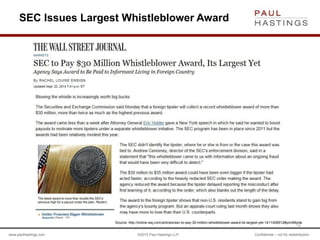
SEC Issues Largest Whistleblower Award
Source: http://online.wsj.com/articles/sec-to-pay-30-million-whistleblower-award-its-largest-yet-1411406612#printMode
12
www.paulhastings.com ©2015 Paul Hastings LLP Confidential – not for redistribution
Dodd-Frank Whistleblower Statistics
 Number of tips, complaints & referrals received by SEC:
 2014: 3,630
 2013: 3,238
 2012: 3,001
 2011: 334
 Common Complaint Categories 2014
– Corporate Disclosures and Financials: 16.9%
– Offering Fraud: 16%
– Manipulation: 15.5%
– FCPA: 4.3%
 Origin
– Every U.S. state
– In 2014, SEC received 448 tips from whistleblowers working in
60 foreign countries
• The highest numbers of international reports came from UK,
India, Canada, China, and Australia.
13
www.paulhastings.com ©2015 Paul Hastings LLP Confidential – not for redistribution
Impact of SOX and Dodd-Frank on
Whistleblower Activity
 $30 million award was pursuant to Section 21F of Dodd-Frank
– Did not identify the whistleblower or the enforcement action (was a foreign resident)
– Did not state the percentage of the total award
 From 2012 to 2014, SEC has issued more than a dozen whistleblowers
payouts
 Awards have been made at highest possible percentage
– In June 2014, two whistleblowers were rewarded with $875,000 for providing
information, representing the highest percentage reward possible (30%)
 Study on “The Impact of Whistleblowers on Financial Misrepresentation
Enforcement Actions”* found:
– Penalty was, on average, 63% higher when a whistleblower was involved
– Individuals’ prison terms were nearly 2.5 times longer when a whistleblower identified
the wrongdoing
– Researchers estimated whistleblowers enabled regulators to successfully obtain
additional judgments of $21.27 billion more than would have been obtained without
their assistance (or 30% of the total $70.13 billion in penalties from 1978 to 2012)
*Source: Call, Andrew C. and Martin, Gerald S. and Sharp, Nathan Y. and Wilde, Jaron H., The Impact of Whistleblowers on Financial
Misrepresentation Enforcement Actions (October 6, 2014).
14
www.paulhastings.com ©2015 Paul Hastings LLP Confidential – not for redistribution
Statutory Provisions Governing
Whistleblowers
15
www.paulhastings.com ©2015 Paul Hastings LLP Confidential – not for redistribution
Who Qualifies as a Whistleblower?
 Sarbanes-Oxley
– Whistleblower is an employee of a publicly traded company (or
its contractors, subcontractors, or agents) who:
• Provides information or assistance to a federal regulatory or law
enforcement agency, a member of Congress or Congressional
Committee, or a person with supervisory authority over the
employee regarding conduct the employee reasonably believes
violates Sections 1341, 1343, 1344, or 1348, or any provision of
federal law relating to fraud against shareholders; OR
• Files, causes to be filed, testifies, participates in, or otherwise
assists in an investigation regarding conduct the employee
reasonably believes constitutes a violation of such laws (18
U.S.C § 1514A(a) (anti-retaliation))
– Extends to employees of private contractors who work for public
companies (Lawson v. FMR LLC)
16
www.paulhastings.com ©2015 Paul Hastings LLP Confidential – not for redistribution
Who Qualifies as a Whistleblower (cont’d)?
 Dodd-Frank
– Whistleblower is “any individual who provides, or 2 or more
individuals acting jointly who provide, information relating to a
violation of the securities laws to the Commission, in a manner
established, by rule or regulation, by the Commission” (15
U.S.C. § 78u–6)
– Includes:
• Providing information to the SEC
• Initiating, testifying in, or assisting SEC investigations or judicial
actions
• Making disclosures that are required or protected under SOX or
any other law, rule, or regulation under the jurisdiction of the
SEC
– Unlike SOX, statute does not expressly include internal
complaints made to supervisors
– No internal reporting requirement
17
www.paulhastings.com ©2015 Paul Hastings LLP Confidential – not for redistribution
Excluded Whistleblowers Under Dodd-Frank
 Excluded Whistleblowers
– Employees who obtain information illegally
– Employees who obtain information through attorney-client
communications
– Certain categories of employees:
• Compliance personnel
• Public accountants
• Senior company personnel who learn information from another
individual or in connection with the company’s processes for
identifying, reporting, and addressing possible violations
– Exceptions for excluded employees:
• Reasonable basis to believe disclosure necessary to prevent
company from engaging in conduct likely to injure company
• Reasonable basis to believe company is impeding investigation
• If internal report, at least 120 days have passed since employee
disclosed information to audit committee, chief legal officer,
compliance officer, or supervisor
18
www.paulhastings.com ©2015 Paul Hastings LLP Confidential – not for redistribution
Bounty Program
 Dodd-Frank contains provisions authorizing bounty
awards for whistleblowers providing information that
leads to successful enforcement efforts
– SEC “shall pay” an award of 10-30% of total monetary
sanction collected in cases resulting in monetary sanctions
exceeding $1 million (15 U.S.C. § 78u–6(b));
– Information must be derived from independent knowledge
of whistleblower and must be previously unknown by the
SEC (15 U.S.C. § 78u–6(a))
19
www.paulhastings.com ©2015 Paul Hastings LLP Confidential – not for redistribution
Bounty Program (cont’d)
 SEC has discretion in determining amount of award (15
U.S.C. § 78u–6(c)(1)(A))
 Criteria include:
– Significance of information provided
– Degree of assistance
– Interest of Commission in deterring future violations
– Additional factors the Commission may establish
20
www.paulhastings.com ©2015 Paul Hastings LLP Confidential – not for redistribution
Key Anti-Retaliation Provisions
 SOX
– Companies may not “discharge, demote, suspend, threaten,
harass, or in any other manner discriminate against”
whistleblower because of any lawful act done by whistleblower
(18 U.S.C § 1514A(a))
– Employee must file complaint with Secretary of Labor within 180
days of violation (18 U.S.C § 1514A(b))
 Dodd-Frank
– Employers may not “discharge, demote, suspend, threaten,
harass, directly or indirectly, or in any other manner discriminate
against, a whistleblower in the terms and conditions of
employment” based on protected whistleblowing activity (15
U.S.C. § 78u-6(h)(1)(a))
– Action must be brought within 6 years of violation or 3 years of
date of discovery (15 U.S.C. § 78u-6(h)(1)(B)(iii))
– May be brought directly in federal district court
21
www.paulhastings.com ©2015 Paul Hastings LLP Confidential – not for redistribution
Consequences of Retaliation
 Remedies for Whistleblower
– Reinstatement
– Back pay
– Special damages, including litigation costs, expert witness
fees, attorneys’ fees
 Criminal penalties: fine or imprisonment of up to 10
years (18 U.S.C. § 1513(e))
22
www.paulhastings.com ©2015 Paul Hastings LLP Confidential – not for redistribution
Incentives for Internal Reporting
 120 day look-back period: if whistleblower reports to
SEC within 120 days of internal report, report to SEC
deemed made as of date of internal report
 SEC has indicated that it will consider whether report
made internally when determining size of bounty award
 If internal report causes internal investigation, bounty
award based on entirety of conduct uncovered, not just
conduct detailed in report
23
www.paulhastings.com ©2015 Paul Hastings LLP Confidential – not for redistribution
Significant Open Issues
www.paulhastings.com ©2015 Paul Hastings LLP Confidential – not for redistribution
Open Questions
 Do whistleblower statutes apply extraterritorially?
– Emerging consensus that whistleblower protections do not apply
outside of U.S.
• Liu v. Siemens AG (2d Cir. 2014)-Dodd-Frank does not apply to
extraterritorial conduct
• Carnero v. Boston Scientific Corp. (1st Cir. 2006)-SOX
whistleblower protections did not extend to overseas plaintiff
– SEC position is that foreign whistleblowers are eligible for bounty
awards even if they are not covered by anti-retaliation provisions
 Does Dodd-Frank protect internal whistleblowing?
– Asadi v. GE Energy (5th Cir. 2013)-Dodd-Frank protections only
apply to employees who report to SEC
– District courts sharply divided on issue
– SOX expressly covers reports to superiors
25
www.paulhastings.com ©2015 Paul Hastings LLP Confidential – not for redistribution
Open Questions (cont’d)
 To what extent do SOX protections cover employees of
private contractors?
– Lawson v. FMR LLC (2014): employees of private mutual
fund advisors protected when reporting fraud at public
mutual funds
– Scope of holding yet to be determined in lower courts
 What steps may companies take to encourage internal
reporting?
26
www.paulhastings.com ©2015 Paul Hastings LLP Confidential – not for redistribution
Open Questions (cont’d)
 What steps can companies take to limit employees’
ability to disclose information?
– SEC regulations prohibit “any action to impede an
individual from communicating directly with” the SEC
“including enforcing, or threatening to enforce, a
confidentiality agreement”
– Director of SEC Whistleblower Office says SEC is “going
to bring a case where somebody has asked an employee
or forced an employee to sign a document that in order of
substance means they can’t report to us”
27
www.paulhastings.com ©2015 Paul Hastings LLP Confidential – not for redistribution
Implications and Best Practices
www.paulhastings.com ©2015 Paul Hastings LLP Confidential – not for redistribution
Implications and Best Practices
 Foster a culture of compliance
 Encourage internal reporting within the bounds permitted
by law
 Promptly and effectively investigate and remediate
problems and reward employees for coming forward
– Protect whistleblowers from retaliation
 Establish, communicate, and practice compliance and
investigative protocols
29
www.paulhastings.com ©2015 Paul Hastings LLP Confidential – not for redistribution
Implications and Best Practices (cont’d)
 Consequences for failing can be severe
– Financial and criminal penalties
– Debarment
– Corporate integrity agreements
– Monitorships
30
www.paulhastings.com ©2015 Paul Hastings LLP Confidential – not for redistribution
Questions
31

SEC Whistleblower Rules

  • 1.
    www.paulhastings.com ©2015 PaulHastings LLP Confidential – not for redistribution Investigations & White Collar Defense Academy 2015: SEC Whistleblower Rules Mark D. Pollack Paul N. Monnin Mor Wetzler January 28, 2015
  • 2.
    www.paulhastings.com ©2015 PaulHastings LLP Confidential – not for redistribution Overview  Evolution of whistleblower legislation in SEC context  Notable impact of SOX and Dodd-Frank on SEC whistleblower activity  Key statutory provisions relating to SEC whistleblower enforcement – Sarbanes-Oxley Act of 2002 (SOX) – Dodd-Frank Wall Street Reform and Consumer Protection Act of 2010 (Dodd-Frank)  Significant open issues as to applicability of SEC whistleblower provisions  Implications and suggested best practices 2
  • 3.
    www.paulhastings.com ©2015 PaulHastings LLP Confidential – not for redistribution Evolution of Whistleblower Legislation
  • 4.
    www.paulhastings.com ©2015 PaulHastings LLP Confidential – not for redistribution Evolution of Whistleblower Legislation: False Claims Act  The False Claims Act (the “Lincoln Law”) was passed in 1863 and was directed at persons or entities who defraud the U.S. government or misuse federal funds – Key provisions provided for qui tam suits by private citizens against the government – Claim may be based on recklessness  Surge in FCA litigation following 1986 amendments, which: – Increased awards to whistleblowers to 15% - 30% – Increased penalties from double to treble damages – Provided for reimbursement of attorney's fees by defendant  Today, FCA is the primary tool used to curtail fraudulent payments to government contractors (e.g., healthcare, defense, financial) or underpayments by obligors to government 4
  • 5.
    www.paulhastings.com ©2015 PaulHastings LLP Confidential – not for redistribution Evolution of Whistleblower Legislation: SOX  Enacted on July 30, 2002, in response to the high-profile Enron and WorldCom accounting scandals  Grants enforcement authority to the SEC – Section 3(b) treats violations of SOX also as violations of the Securities and Exchange Act of 1934  Key protections for corporate whistleblowers: – Requires companies to establish internal procedures for filing complaints – Civil and criminal penalties (fines and/or prison sentence up to 10 years), for retaliation against whistleblowers who report to external authorities – Separate criminal obstruction statute for destruction of corporate audit records 5
  • 6.
    www.paulhastings.com ©2015 PaulHastings LLP Confidential – not for redistribution Evolution of Whistleblower Legislation: Dodd-Frank  Congressional response to global financial crisis and demand for changes in the financial regulatory system  Section 21F amended the Securities Exchange Act of 1934 to add provision for monetary awards to eligible whistleblowers whose voluntary reports lead to successful SEC enforcement actions with sanctions over $1 million – Rewards up to 10% - 30% of total monetary sanctions  Bounties now available for all securities law violations, including violations of the Foreign Corrupt Practices Act (“FCPA”), books and records, financial reporting  Grants private right of action to individuals who allege retaliation for whistleblowing  In 2011, established The Office of the Whistleblower (“OWB”) within SEC & CFTC to investigate and monitor tips 6
  • 7.
    www.paulhastings.com ©2015 PaulHastings LLP Confidential – not for redistribution SEC: The Office of the Whistleblower Assistance and information from a whistleblower who knows of possible securities law violations can be among the most powerful weapons in the law enforcement arsenal of the Securities and Exchange Commission. 7
  • 8.
    www.paulhastings.com ©2015 PaulHastings LLP Confidential – not for redistribution Multiple Agencies with Enforcement Authority Enforcement DOJ OSHA EEOC EPAIRS SEC DOL 8
  • 9.
    www.paulhastings.com ©2015 PaulHastings LLP Confidential – not for redistribution Multiple Sources of Whistleblower Protections: Both Bounties and Anti-Retaliation Whistleblower Protections OSHA Title VII Clean Air and Water Act Dodd- Frank/SOX FLSA IRS FCA FCPA 9
  • 10.
    www.paulhastings.com ©2015 PaulHastings LLP Confidential – not for redistribution Impact of Dodd-Frank and SOX on SEC Whistleblower Enforcement
  • 11.
    www.paulhastings.com ©2015 PaulHastings LLP Confidential – not for redistribution Overview of Statutory Impact on Whistleblower Activity  Plaintiff’s bar actively pursuing whistleblower actions  Increasing bounties to SEC whistleblowers (e.g., from $14 million, previously the highest SEC award, to highest award ever of $30 million)  SEC’s first retaliation case under Dodd-Frank – Whistleblower demoted – Paradigm agreed to pay $2.2 million to settle the charges, without admitting or denying wrongdoing – Importance of consulting with firm’s Labor & Employment Department  SEC focus on retaliation cases with expectation that enforcement attorneys watch for evidence of retaliation during investigations 11
  • 12.
    www.paulhastings.com ©2015 PaulHastings LLP Confidential – not for redistribution SEC Issues Largest Whistleblower Award Source: http://online.wsj.com/articles/sec-to-pay-30-million-whistleblower-award-its-largest-yet-1411406612#printMode 12
  • 13.
    www.paulhastings.com ©2015 PaulHastings LLP Confidential – not for redistribution Dodd-Frank Whistleblower Statistics  Number of tips, complaints & referrals received by SEC:  2014: 3,630  2013: 3,238  2012: 3,001  2011: 334  Common Complaint Categories 2014 – Corporate Disclosures and Financials: 16.9% – Offering Fraud: 16% – Manipulation: 15.5% – FCPA: 4.3%  Origin – Every U.S. state – In 2014, SEC received 448 tips from whistleblowers working in 60 foreign countries • The highest numbers of international reports came from UK, India, Canada, China, and Australia. 13
  • 14.
    www.paulhastings.com ©2015 PaulHastings LLP Confidential – not for redistribution Impact of SOX and Dodd-Frank on Whistleblower Activity  $30 million award was pursuant to Section 21F of Dodd-Frank – Did not identify the whistleblower or the enforcement action (was a foreign resident) – Did not state the percentage of the total award  From 2012 to 2014, SEC has issued more than a dozen whistleblowers payouts  Awards have been made at highest possible percentage – In June 2014, two whistleblowers were rewarded with $875,000 for providing information, representing the highest percentage reward possible (30%)  Study on “The Impact of Whistleblowers on Financial Misrepresentation Enforcement Actions”* found: – Penalty was, on average, 63% higher when a whistleblower was involved – Individuals’ prison terms were nearly 2.5 times longer when a whistleblower identified the wrongdoing – Researchers estimated whistleblowers enabled regulators to successfully obtain additional judgments of $21.27 billion more than would have been obtained without their assistance (or 30% of the total $70.13 billion in penalties from 1978 to 2012) *Source: Call, Andrew C. and Martin, Gerald S. and Sharp, Nathan Y. and Wilde, Jaron H., The Impact of Whistleblowers on Financial Misrepresentation Enforcement Actions (October 6, 2014). 14
  • 15.
    www.paulhastings.com ©2015 PaulHastings LLP Confidential – not for redistribution Statutory Provisions Governing Whistleblowers 15
  • 16.
    www.paulhastings.com ©2015 PaulHastings LLP Confidential – not for redistribution Who Qualifies as a Whistleblower?  Sarbanes-Oxley – Whistleblower is an employee of a publicly traded company (or its contractors, subcontractors, or agents) who: • Provides information or assistance to a federal regulatory or law enforcement agency, a member of Congress or Congressional Committee, or a person with supervisory authority over the employee regarding conduct the employee reasonably believes violates Sections 1341, 1343, 1344, or 1348, or any provision of federal law relating to fraud against shareholders; OR • Files, causes to be filed, testifies, participates in, or otherwise assists in an investigation regarding conduct the employee reasonably believes constitutes a violation of such laws (18 U.S.C § 1514A(a) (anti-retaliation)) – Extends to employees of private contractors who work for public companies (Lawson v. FMR LLC) 16
  • 17.
    www.paulhastings.com ©2015 PaulHastings LLP Confidential – not for redistribution Who Qualifies as a Whistleblower (cont’d)?  Dodd-Frank – Whistleblower is “any individual who provides, or 2 or more individuals acting jointly who provide, information relating to a violation of the securities laws to the Commission, in a manner established, by rule or regulation, by the Commission” (15 U.S.C. § 78u–6) – Includes: • Providing information to the SEC • Initiating, testifying in, or assisting SEC investigations or judicial actions • Making disclosures that are required or protected under SOX or any other law, rule, or regulation under the jurisdiction of the SEC – Unlike SOX, statute does not expressly include internal complaints made to supervisors – No internal reporting requirement 17
  • 18.
    www.paulhastings.com ©2015 PaulHastings LLP Confidential – not for redistribution Excluded Whistleblowers Under Dodd-Frank  Excluded Whistleblowers – Employees who obtain information illegally – Employees who obtain information through attorney-client communications – Certain categories of employees: • Compliance personnel • Public accountants • Senior company personnel who learn information from another individual or in connection with the company’s processes for identifying, reporting, and addressing possible violations – Exceptions for excluded employees: • Reasonable basis to believe disclosure necessary to prevent company from engaging in conduct likely to injure company • Reasonable basis to believe company is impeding investigation • If internal report, at least 120 days have passed since employee disclosed information to audit committee, chief legal officer, compliance officer, or supervisor 18
  • 19.
    www.paulhastings.com ©2015 PaulHastings LLP Confidential – not for redistribution Bounty Program  Dodd-Frank contains provisions authorizing bounty awards for whistleblowers providing information that leads to successful enforcement efforts – SEC “shall pay” an award of 10-30% of total monetary sanction collected in cases resulting in monetary sanctions exceeding $1 million (15 U.S.C. § 78u–6(b)); – Information must be derived from independent knowledge of whistleblower and must be previously unknown by the SEC (15 U.S.C. § 78u–6(a)) 19
  • 20.
    www.paulhastings.com ©2015 PaulHastings LLP Confidential – not for redistribution Bounty Program (cont’d)  SEC has discretion in determining amount of award (15 U.S.C. § 78u–6(c)(1)(A))  Criteria include: – Significance of information provided – Degree of assistance – Interest of Commission in deterring future violations – Additional factors the Commission may establish 20
  • 21.
    www.paulhastings.com ©2015 PaulHastings LLP Confidential – not for redistribution Key Anti-Retaliation Provisions  SOX – Companies may not “discharge, demote, suspend, threaten, harass, or in any other manner discriminate against” whistleblower because of any lawful act done by whistleblower (18 U.S.C § 1514A(a)) – Employee must file complaint with Secretary of Labor within 180 days of violation (18 U.S.C § 1514A(b))  Dodd-Frank – Employers may not “discharge, demote, suspend, threaten, harass, directly or indirectly, or in any other manner discriminate against, a whistleblower in the terms and conditions of employment” based on protected whistleblowing activity (15 U.S.C. § 78u-6(h)(1)(a)) – Action must be brought within 6 years of violation or 3 years of date of discovery (15 U.S.C. § 78u-6(h)(1)(B)(iii)) – May be brought directly in federal district court 21
  • 22.
    www.paulhastings.com ©2015 PaulHastings LLP Confidential – not for redistribution Consequences of Retaliation  Remedies for Whistleblower – Reinstatement – Back pay – Special damages, including litigation costs, expert witness fees, attorneys’ fees  Criminal penalties: fine or imprisonment of up to 10 years (18 U.S.C. § 1513(e)) 22
  • 23.
    www.paulhastings.com ©2015 PaulHastings LLP Confidential – not for redistribution Incentives for Internal Reporting  120 day look-back period: if whistleblower reports to SEC within 120 days of internal report, report to SEC deemed made as of date of internal report  SEC has indicated that it will consider whether report made internally when determining size of bounty award  If internal report causes internal investigation, bounty award based on entirety of conduct uncovered, not just conduct detailed in report 23
  • 24.
    www.paulhastings.com ©2015 PaulHastings LLP Confidential – not for redistribution Significant Open Issues
  • 25.
    www.paulhastings.com ©2015 PaulHastings LLP Confidential – not for redistribution Open Questions  Do whistleblower statutes apply extraterritorially? – Emerging consensus that whistleblower protections do not apply outside of U.S. • Liu v. Siemens AG (2d Cir. 2014)-Dodd-Frank does not apply to extraterritorial conduct • Carnero v. Boston Scientific Corp. (1st Cir. 2006)-SOX whistleblower protections did not extend to overseas plaintiff – SEC position is that foreign whistleblowers are eligible for bounty awards even if they are not covered by anti-retaliation provisions  Does Dodd-Frank protect internal whistleblowing? – Asadi v. GE Energy (5th Cir. 2013)-Dodd-Frank protections only apply to employees who report to SEC – District courts sharply divided on issue – SOX expressly covers reports to superiors 25
  • 26.
    www.paulhastings.com ©2015 PaulHastings LLP Confidential – not for redistribution Open Questions (cont’d)  To what extent do SOX protections cover employees of private contractors? – Lawson v. FMR LLC (2014): employees of private mutual fund advisors protected when reporting fraud at public mutual funds – Scope of holding yet to be determined in lower courts  What steps may companies take to encourage internal reporting? 26
  • 27.
    www.paulhastings.com ©2015 PaulHastings LLP Confidential – not for redistribution Open Questions (cont’d)  What steps can companies take to limit employees’ ability to disclose information? – SEC regulations prohibit “any action to impede an individual from communicating directly with” the SEC “including enforcing, or threatening to enforce, a confidentiality agreement” – Director of SEC Whistleblower Office says SEC is “going to bring a case where somebody has asked an employee or forced an employee to sign a document that in order of substance means they can’t report to us” 27
  • 28.
    www.paulhastings.com ©2015 PaulHastings LLP Confidential – not for redistribution Implications and Best Practices
  • 29.
    www.paulhastings.com ©2015 PaulHastings LLP Confidential – not for redistribution Implications and Best Practices  Foster a culture of compliance  Encourage internal reporting within the bounds permitted by law  Promptly and effectively investigate and remediate problems and reward employees for coming forward – Protect whistleblowers from retaliation  Establish, communicate, and practice compliance and investigative protocols 29
  • 30.
    www.paulhastings.com ©2015 PaulHastings LLP Confidential – not for redistribution Implications and Best Practices (cont’d)  Consequences for failing can be severe – Financial and criminal penalties – Debarment – Corporate integrity agreements – Monitorships 30
  • 31.
    www.paulhastings.com ©2015 PaulHastings LLP Confidential – not for redistribution Questions 31

Editor's Notes

  • #13 SEC August 29, 2014 award of $30 million to overseas employee who reported fraud Previous highest award was $14 million Award amounts are increasing International reach 4th award to whistleblower living in a foreign country Andrew Ceresney, Director of Division of Enforcement: “This whistleblower came to us with information about an ongoing fraud that would have been very difficult to detect.” Sean McKessey, Chief of Office of Whistleblower: “This award … shows the international breadth of our whistleblower program as we effectively utilize valuable tips from anyone, anywhere to bring wrongdoers to justice. Whistleblowers from all over the world should feel similarly incentivized to come forward with credible information about potential violations of U.S. securities law.” “Blowing the whistle is increasingly worth big bucks…. The Securities and Exchange Commission said Monday that a foreign tipster will collect a record whistleblower award of more than $30 million, mor than twice as much as the highest previous award…. The award to the foreign tipster shows that non-US residents stand to gain big from the agency’s bounty program.” - from the article