> Known as the Middle Ages or “Dark Ages” that
started with the fall of the Roman Empire.
> Monophonic plainchant was named after Pope
Gregory I.
 Characteristics of Gregorian Chants:
 Monophonic
 Free meter
 Modal
 Latin liturgy
 Use of neume notation
 Troubadours > group of musicians who
performed secular music.
 Characteristics of Troubadour Music:
 Usually monophonic
 Sometimes with improvised
accompaniment
 Tells of chivalry and courtly love
 Originated in France
 Written in French language
 Adam de la Halle (1237-1288)
 also known as Adam le
Bossu
 oldest secular composer
 Was a French-born trouvere,
poet and musician.
His works:
 Le Jeu de Robin et de
Marion
 La Chanson du roi de Sicile
Renaissance - comes from the word “renaitre” which
means “rebirth”; “revival” and “rediscovery”.
 Renaissance music became popular as entertainment
and activity for amateurs and educated.
 Lute was the prominent instrument of the era.
 This era was also known as the “golden age” of
a capella choral music.
Characteristics of Renaissance Era:
 Mostly polyphonic
 Imitation among the voices is common
 Use of word painting in texts and music
 Melodic lines move in a flowing manner
 Melodies are easier to perform
Vocal Music
1.Mass – is a form of sacred musical
composition that sets texts of the
Eucharistic liturgy into music.
Characteristics of the mass:
 polyphonic
 May be sung in a capella or with orchestral
accompaniment
 Text may be syllabic, neumatic, or
melismatic
1. Kyrie (Lord Have Mercy)
2. Gloria (Glory to God in the Highest)
3. Credo (I believe in One God)
4. Sanctus and Benedictus (Holy, Holy and
Blessed Is He)
5. Agnus Dei (Lamb of God)
2. Madrigal – A secular vocal polyphonic music
composition which originated from Italy. It is
written and expressed in a poetic text and sung
during courtly social gathering. It is the most
important secular form during the Renaissance
Period.
Characteristics:
 polyphonic
 Sung a cappella
 Through – composed
 Frequently in 3 to 6 voices
1. Giovanni Pierluigi da
Palestrina (1525-1594)
 The greatest master of
Roman Catholic church
music.
 Majority of his
compositions are sacred
music.
 Palestrina’s Pope
Marcellus Mass is held up
as the perfect example of
counter-reformation style
 was committed to sacred music and has a
keen interest in satisfying the desires of
church leaders in the 16th
century.
 His career reflects his commitment to the
music of the church.
 Was an organist and choir master at both
the Sistine Chapel and at St. Peter’s.
 His first book MASSES became popular and
was greatly appreciated by Pope Julius III.
2.Thomas Morley(1557-1602)
 was a singer in the local cathedral
and became master of Choristers.
 the famous composer of secular
music
 Received his bachelor’s degree in
Oxford and became an organist at
St. Paul’s in London.
 His musica transalpina, a
collection of Italian madrigals was
published by Nicholas Yonge that
made significant contribution to
the history of music.
 His works:
 Fire, Fire My Heart
 Sing and Chant it
 Fantasie
 April Is In My Mistress’ Face
 It Was a Lover and His Lass
Baroque – is derived from the Portuguese word
“barroco” which means “pearl of irregular
shape”.
Some of the great composers of this time were
George Friedrich Handel, Johann Sebastian Bach,
Claudio Monteverdi, and Antonio Vivaldi
New instrumental technique sand changes in
musical notation were developed.
 Characteristics of Baroque Music
 Melodies sound elaborate and ornamental
 Melodies are not easy to sing or remember
 Dynamic contrast
 Music genres
 Orchestra consists of strings and continuo
 Harpsichord and organ are the keyboard instruments
that are commonly used.
1.Concerto – a form of orchestral music that
employs a solo instrument accompanied by an
orchestra.
2. Concerto Grosso – A form of orchestral music
during the Baroque Period wherein the music is
between a small group of solo instruments called
concertino and the whole orchestra called tutti.
3. Fugue – a contrapuntal piece, developed mainly by
imitative counterpoint usually written in 3 or 4 parts,
with a main theme called “subject”.
4. Oratorio – a large scale musical composition for
orchestra and voices that incorporates narratives on
religious themes.
Examples:
Handel’s Messiah, Samson, Israel and Egypt
Bach’s Christmas Oratorio
Haydn’s The Creation
5. Chorale – musical compositions that resemble a
harmonized version of hymnal tunes of the Protestant
Church during the Baroque era.
Johann Sebastian Bach
(1685-1750)
> came from a family of
musicians.
> was taught to play
violin by his father
>became an orphaned at
age 10.
> His brother, a church
organist provided for him.
> was a religious man.
> was known for his compositions for organ,
orchestra and oratorio.
> his most important and long – term position
was as “cantor” at St. Thomas Church.
His works:
 Brandenburg Concertos (concerto grosso)
 Mass in B minor
 Cantata 208 and 211
 Fugue in G minor
 Works for clavichord and harpsichord
Antonio Lucio Vivaldi
(1678-1741)
>nicknamed the “Red
Priest”
>recognized as Italian
Baroque composer,
catholic priest and a
virtuoso violinist.
>known mainly for
composing instrumental
concertos, esp. for violin,
as well as sacred choral
works and over forty
> entered the priesthood and ordained in 1703.
> well-known for giving the strings a major role
in his compositions.
His work:
 The Four Seasons – this composition is a series
of four violin concerti depicting each of the
seasons Spring, Summer, Autumn and Winter
 George Friedrich Handel
(1685-1759)
 was the second son from
the second marriage of a
pastor.
 At age 7, he gained access
to a church organ and
started to play.
 Remembered for his
operas and oratorios.
 Became England’s favorite
composer
 He lost his eyesight in 1753
 When he conducted his oratorio, Samson, a few
in the audience were unaware that he had lost
his eyesight.
 The Messiah is Handel’s most famous creation
and the very well known Hallelujah chorus is
part of Handel’s Messiah.
His work:
The Messiah – was first performed in Dublin, and
became an instant success.
Prepared:
Ms. Lhey E. Vinoya
Secondary School Teacher III

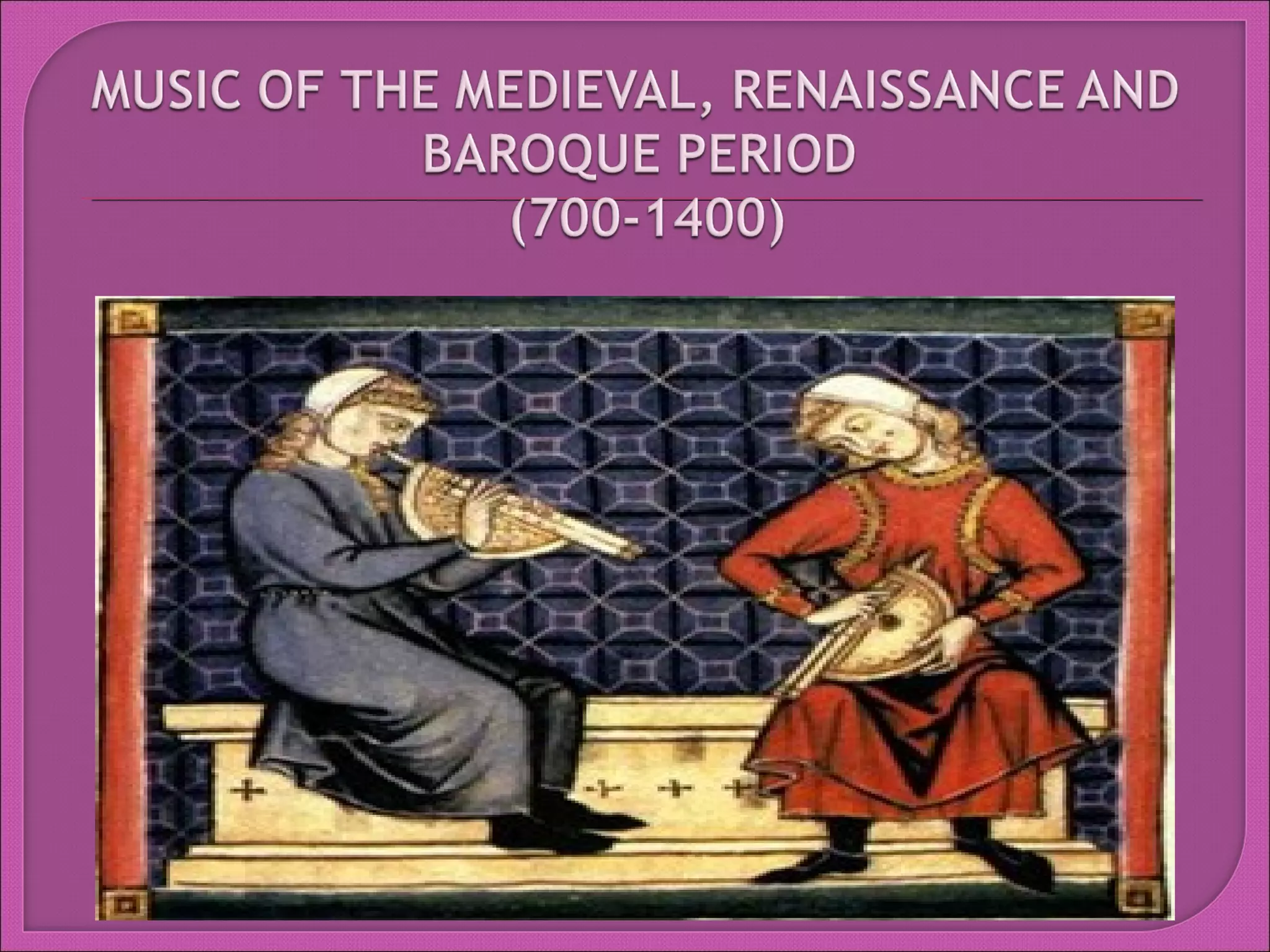
Music of the Medieval, Renaissance, Baroque music

  • 2.
    > Known asthe Middle Ages or “Dark Ages” that started with the fall of the Roman Empire. > Monophonic plainchant was named after Pope Gregory I.  Characteristics of Gregorian Chants:  Monophonic  Free meter  Modal  Latin liturgy  Use of neume notation
  • 3.
     Troubadours >group of musicians who performed secular music.  Characteristics of Troubadour Music:  Usually monophonic  Sometimes with improvised accompaniment  Tells of chivalry and courtly love  Originated in France  Written in French language
  • 4.
     Adam dela Halle (1237-1288)  also known as Adam le Bossu  oldest secular composer  Was a French-born trouvere, poet and musician. His works:  Le Jeu de Robin et de Marion  La Chanson du roi de Sicile
  • 5.
    Renaissance - comesfrom the word “renaitre” which means “rebirth”; “revival” and “rediscovery”.  Renaissance music became popular as entertainment and activity for amateurs and educated.  Lute was the prominent instrument of the era.  This era was also known as the “golden age” of a capella choral music.
  • 6.
    Characteristics of RenaissanceEra:  Mostly polyphonic  Imitation among the voices is common  Use of word painting in texts and music  Melodic lines move in a flowing manner  Melodies are easier to perform
  • 7.
    Vocal Music 1.Mass –is a form of sacred musical composition that sets texts of the Eucharistic liturgy into music. Characteristics of the mass:  polyphonic  May be sung in a capella or with orchestral accompaniment  Text may be syllabic, neumatic, or melismatic
  • 8.
    1. Kyrie (LordHave Mercy) 2. Gloria (Glory to God in the Highest) 3. Credo (I believe in One God) 4. Sanctus and Benedictus (Holy, Holy and Blessed Is He) 5. Agnus Dei (Lamb of God)
  • 9.
    2. Madrigal –A secular vocal polyphonic music composition which originated from Italy. It is written and expressed in a poetic text and sung during courtly social gathering. It is the most important secular form during the Renaissance Period. Characteristics:  polyphonic  Sung a cappella  Through – composed  Frequently in 3 to 6 voices
  • 10.
    1. Giovanni Pierluigida Palestrina (1525-1594)  The greatest master of Roman Catholic church music.  Majority of his compositions are sacred music.  Palestrina’s Pope Marcellus Mass is held up as the perfect example of counter-reformation style
  • 11.
     was committedto sacred music and has a keen interest in satisfying the desires of church leaders in the 16th century.  His career reflects his commitment to the music of the church.  Was an organist and choir master at both the Sistine Chapel and at St. Peter’s.  His first book MASSES became popular and was greatly appreciated by Pope Julius III.
  • 12.
    2.Thomas Morley(1557-1602)  wasa singer in the local cathedral and became master of Choristers.  the famous composer of secular music  Received his bachelor’s degree in Oxford and became an organist at St. Paul’s in London.  His musica transalpina, a collection of Italian madrigals was published by Nicholas Yonge that made significant contribution to the history of music.
  • 13.
     His works: Fire, Fire My Heart  Sing and Chant it  Fantasie  April Is In My Mistress’ Face  It Was a Lover and His Lass
  • 14.
    Baroque – isderived from the Portuguese word “barroco” which means “pearl of irregular shape”. Some of the great composers of this time were George Friedrich Handel, Johann Sebastian Bach, Claudio Monteverdi, and Antonio Vivaldi New instrumental technique sand changes in musical notation were developed.
  • 15.
     Characteristics ofBaroque Music  Melodies sound elaborate and ornamental  Melodies are not easy to sing or remember  Dynamic contrast  Music genres  Orchestra consists of strings and continuo  Harpsichord and organ are the keyboard instruments that are commonly used.
  • 16.
    1.Concerto – aform of orchestral music that employs a solo instrument accompanied by an orchestra. 2. Concerto Grosso – A form of orchestral music during the Baroque Period wherein the music is between a small group of solo instruments called concertino and the whole orchestra called tutti.
  • 17.
    3. Fugue –a contrapuntal piece, developed mainly by imitative counterpoint usually written in 3 or 4 parts, with a main theme called “subject”. 4. Oratorio – a large scale musical composition for orchestra and voices that incorporates narratives on religious themes. Examples: Handel’s Messiah, Samson, Israel and Egypt Bach’s Christmas Oratorio Haydn’s The Creation 5. Chorale – musical compositions that resemble a harmonized version of hymnal tunes of the Protestant Church during the Baroque era.
  • 18.
    Johann Sebastian Bach (1685-1750) >came from a family of musicians. > was taught to play violin by his father >became an orphaned at age 10. > His brother, a church organist provided for him.
  • 19.
    > was areligious man. > was known for his compositions for organ, orchestra and oratorio. > his most important and long – term position was as “cantor” at St. Thomas Church. His works:  Brandenburg Concertos (concerto grosso)  Mass in B minor  Cantata 208 and 211  Fugue in G minor  Works for clavichord and harpsichord
  • 20.
    Antonio Lucio Vivaldi (1678-1741) >nicknamedthe “Red Priest” >recognized as Italian Baroque composer, catholic priest and a virtuoso violinist. >known mainly for composing instrumental concertos, esp. for violin, as well as sacred choral works and over forty
  • 21.
    > entered thepriesthood and ordained in 1703. > well-known for giving the strings a major role in his compositions. His work:  The Four Seasons – this composition is a series of four violin concerti depicting each of the seasons Spring, Summer, Autumn and Winter
  • 22.
     George FriedrichHandel (1685-1759)  was the second son from the second marriage of a pastor.  At age 7, he gained access to a church organ and started to play.  Remembered for his operas and oratorios.  Became England’s favorite composer
  • 23.
     He losthis eyesight in 1753  When he conducted his oratorio, Samson, a few in the audience were unaware that he had lost his eyesight.  The Messiah is Handel’s most famous creation and the very well known Hallelujah chorus is part of Handel’s Messiah. His work: The Messiah – was first performed in Dublin, and became an instant success.
  • 24.
    Prepared: Ms. Lhey E.Vinoya Secondary School Teacher III